WDTPRS: Quinquagesima

An excerpt from the column for this Sunday:

In our traditional Roman calendar this Sunday is Quinquagesima, Latin for the symbolic “Fiftieth” day before Easter.  Today is one of the pre-Lenten Sundays which prepare us for the discipline of Lent. The priest’s vestments are purple. No Alleluia. The prayers and readings for the pre-Lenten Sundays were compiled by St. Gregory the Great (+604).   After the Second Vatican Council the Consilium’s liturgical reformers under Annibale Bugnini and others eliminated these pre-Lent Sundays, much to our detriment.

COLLECT:
Preces nostras, quaesumus, Domine, clementer exaudi:
atque, a peccatorum vinculis absolutos,
ab omni nos adversitate custodi.

This prayer is found in the ancient Liber Sacramentorum Augustodunensis and the L.S. Engolismensis.  I cannot find this prayer in any form in the post-Conciliar editions of the Missale Romanum.  Of course you won’t find Quinquagesima either.

The ponderous Lewis & Short Dictionary reminds us that absolvo means “to loosen from, to make loose, set free, detach, untie” or in juridical language “to absolve from a charge, to acquit, declare innocent”.  The priest uses this word when he absolves you of the bonds of your sins.  Vinculum is “that with which any thing is bound, a band, bond, rope, cord, fetter, tie”.  This bond can be literal, as in physical fetters, or it can be moral or some sort of state.  You can be bound in charity or peace, or bound in damnation or sin.  In the case if sin, in liturgical prayer we find a form of vinculum or its plural with “loosing” verbs such as absolvo or resolvo or dissolvo.  In ancient prayer the state of sin conceived as a place in which we are bound.  The bonds must be loosed so that we can escape and be free.  In the whole of the post-Conciliar Missal I don’t believe the combination peccata absolvere is found, but it is in ancient collections.  One finds the phrase with some additional term such as “bonds” or “ties” of sins.

LITERAL TRANSLATION:

We beseech You, O Lord, graciously attend to our prayers:
and, having been loosed from the fetters of sins,
guard us from every adversity.

What is the first thing an enemy does to you, once you are captured?  He renders you powerless to do your own will.

The Sacrament of Penance is the great gift.  In all good will we must strive to live without mortal sin.  But we fall.  We pray to God to protect us from the dire consequences of sin, including the attacks of the Enemy, which on our own without God’s help we cannot resist.  Among the benefits of the Sacrament of Penance, along with being freed from the chains of sins, is a strengthening to resist sin in the future. 

SECRET:
Haec hostia, Domine, quaesumus, emundet nostra delicta:
et ad sacrificum celebrandum,
subditorum tibi corpora
mentesque sanctificet.

This prayer was in the ancient L.S. Engolismensis.  It didn’t survive the Consilium for the newer missal.

Subdo is “to put, place, set, or lay under; to bring under, subject, subdue”.  After Mary and Joseph found the young Jesus in the Temple, Our Lord went with them and was “subject” them (Luke 2:51).  Subdo is used to describe also the state of a wives to their husbands. This verb, in the participial form acting like an adjective, describes the state of the servants of God.  Very often our prayers describe us as servi or famuli or members of the familia of God.  That fam- root goes back to the household servants on an estate, totally under the law and care of their master.  We call those under someone’s mastery, “subjects”.

LITERAL TRANSLATION:
O Lord, may this sacrificial offering cleanse away our sins,
and may it sanctify the bodies and minds of  those subject to You
unto the Sacrifice now to be celebrated.

Human beings are both body and soul.  The wounds to our human nature from the Fall of our First Parents affected us both spiritually and physically.  The whole human person needs healing. Therefore, the Word took up all of our human nature, perfect human body and soul, so that the whole of man could be redeemed.  At Mass there is also an inward component and an outward physical expression.  Both must be active, each in their own proper manner and moment.  The key in both cases is that we who are active participants nevertheless remain the subjects of the Lord, in the sense that we are entirely dependent on Him.

Paradoxically, we who are subjects in the sense of being beneath and dependent, by willing subjection become our own subjects, in the sense of being aware and willing actors.  In grammar a subject is the thing in an active sentence which acts on an object.  Because humans are God’s images, we are made to be subjects of our own determinations.  We mustn’t be turned into unwilling objects.  When we yield to God, however, in our state of being His “subjects” we are even more our own “subjects”.  As Pope Benedict reminded us in his inaugural sermon in April 2005,

… If we let Christ enter fully into our lives, if we open ourselves totally to him, … do we not then risk ending up diminished and deprived of our freedom? … No! If we let Christ into our lives, we lose nothing, nothing, absolutely nothing of what makes life free, beautiful and great. No! Only in this friendship are the doors of life opened wide. Only in this friendship is the great potential of human existence truly revealed. Only in this friendship do we experience beauty and liberation.

POSTCOMMUNIO:
Quaesumus, omnipotens Deus:
ut qui caelestia alimenta percipimus,
per haec contra omnia adversa muniamur.

This prayer was in the ancient L.S. Engolismensis with a slight insertion mentioning the martyr St. Gordianus as well as the L.S. Gellonensis for the feast of St. Vincent, the martyr. It does not appear in the post-Conciliar Missale Romanum.

Perceptive as you are, don’t precipitously perceive percipio as “perceive”, though that is one of its meanings.  Words have contexts.  Percipio is also “to take wholly, to seize entirely” and then by extension “to perceive, feel” and “to learn, know, conceive, comprehend, understand.”  I think “grasp” is good, but not in the sense of “seize” (as some of the less perceptive do when they “grasp” Holy Communion in the hand). We saw munio last week.  In these pre-Lent prayers, Holy Church is truly readying our defenses for the coming struggle.

Neuter alimentum is nourishment, food itself. In Italian we still call a grocery store an “alimentari”. In biology we speak of the alimentary canal.  Alimentation is the process of giving or receiving nourishment. Alimentum can also mean the recompense given for the rearing of children.  Think “alimony”.  These stem from the verb alo, “to feed, to nourish, support, sustain, maintain”.  L&S adds the interesting note that nutrire usually designates sustenance from meat.

LITERAL VERSION

We entreat You, Almighty God:
that we who grasp the heavenly sustenance,
may be fortified through them against every adversity.

We can work with “grasp”.  St. Paul teaches that we must exercise our perception, our powers of discernment, when approaching the Body and Blood of the Lord lest we eat and drink our own condemnation (1 Cor 11).  We must grasp who we are and grasp the Eucharist.  But we must be ready also to conform our intellect and will to reality and God’s plan rather than grasp it by clinging.  St. Paul also reminds us of the Lord’s own self-emptying, explaining that Christ restricted his glory, set aside His divine dignity, and took instead the form of His servants (Philippians 2).  In His perfect death to self, even to death on the Cross, he grasped salvation for the whole human race.  Remember: this Postcommunion was also in Masses for martyrs.

Bring this paradigm of self-emptying/being filled to your own grasping of yourself, the sacred action of Holy Mass, and reception of the Eucharist.  You lose nothing of who you are when you abandon willfulness.  God gives you greater freedom by your submission.

These prayers of the pre-Lenten Sundays are meant among other things to help us ready with stores our interior fortresses before the spiritual battle of lent.  We must empty out what doesn’t serve and be filled with that which does.  Prepare yourselves for Lent’s discipline.
Posted in SESSIUNCULA, WDTPRS |
9 Comments

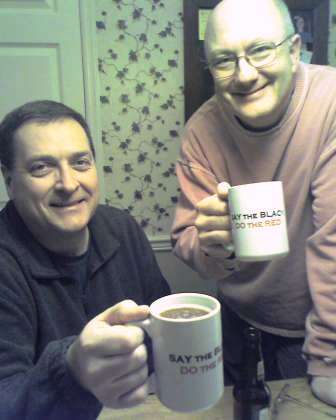
“Ein Proooosit!” the Black/Red way!

A kind reader sent the following:

Fr. Z –

We were impressed with how nicely a 12 oz beer fit in your large mug!

"Ein Proooosit!" the Black/Red way!

Thanks guys, and PROSIT!

"Ein Proooosit!" the Black/Red way!

Posted in SESSIUNCULA |
24 Comments

Help! Getting some Chinese characters back from remaining code

Upon upon a time when some changes were made to the server hosting this blog, I lost the ability to display certain characters, including Chinese characters.

Hundreds of entries had words that were turned into gobbledygook.

I can’t tell you how irritating that was.

Do any of you who possess a Chinese language know how to change the code left behind back into Chinese characters?

Help!

Posted in SESSIUNCULA |
29 Comments

Parsing an article in a diocesan paper: some problems

I don’t want to pick on the writer.  That is not my purpose. 

But more than one person sent me this article with some questions.  In The Message Online, for SW Indiana, which is the internet presence of the Diocese of Evansville, there was an article which left my senders confused.  They thought a couple things were …. not quite right.

I think our Church’s publications should be clear and close to Catholic teaching.

So, let’s have a look with my emphases and comments.

The Christian Journey

Rituals: What we do, why we do it and what it teaches us

Whenever the Church gives us a new ritual for a Sacrament, which is not often, it contains an underlying “blueprint” (“paradigm shift”), that is, an understanding of ourselves as Church in a particular time. [hmmm… at a first reading this doesn’t sound right to me.  The Church’s rites for Sacraments do not intend to convey a different effect or a deepening understanding of those effects.  Perhaps they will stress some elements more than others.  But "paradigm shift" strikes me as not correct.  Also, "blueprint" suggests that the rites are starting points upon which we build thereafter.] Celebrating the Church’s new sacramental rituals has the power to convert the way we think about ourselves as Catholics and how we are to live. [Yes, true.  There is a reciprocal relationship between how we pray and what we believe.  That is why we must always see our rites in continuity with the way those rites have always been celebrated, not in rupture.]  Therein lies our resistance, of which we are usually not aware. “Externals” upset us (e.g. no longer using Latin or Gregorian chant [though the Church says that these ought to be used!] ). However, what is unconsciously disturbing us is the underlying new way of being Church that the sacraments present us. ["new way of being Church"?  When you see people use "Church" without some article like "the", alarms bells should ring.  And "new way"?  You mean we have made a break with an "old way"?  Let’s see where he goes with this.]  A few examples may shed light on this phenomenon.

When the deacon or lector carries a beautifully adorned Gospel Book in the opening procession of Mass, this proclaims that God’s Word is central to our lives.[Huh?  You mean having Scripture for half of Mass and most of the Office wasn’t enough?]  Gone are the pre-Vatican II days when we were told we did not commit a “mortal sin” if we missed the Scripture readings at Sunday Mass as long as we arrived by the Offertory (not the “Preparation of the Gifts”). [I am getting mixed messages. Is he saying that that we do commit a mortal sin if we are not present for the Liturgy of the Word?  I think he is trying to deemphasize "mortal sin", but I am not sure.] Today hearing God’s Word proclaimed is just as vital and relevant for Catholics as for other Christians, who emphasized the Scriptures almost exclusively while we stressed the Sacraments.  [Except, of course, when we celebrated Mass or read the Office.]

Another example of a “paradigm shift” in the Church is the communal celebration of the Sacrament of Reconciliation. Sufficient priests are available during a communal Penance Service to provide time for individual confessions. However, if the proper circumstances are present, general absolution may be given. [Indeed.  But those circumstances are pretty clear: it is NOT to be a scheduled event, but rather an emergency in which it is impossible for auricular confession of those present.] (Both are legitimate sacramental rituals.) [But where is his explanation of the limitations on "general absolution"?!] Our communal Penance Services help us understand how our sins are usually not directly against God, but against people. [Ummm…. "our sins are usually not directed against God…".  I don’t think so.  Our sins are always offenses to God.  I think he is trying to emphasize that we often sin imediately against other people, but this statement is simply wrong.]  Therefore, we gather communally asking forgiveness of God and each other. Our Penance Services catechize us that sin is never a “private” matter, but has public ramifications — our actions affect the Church. [Ok.] They help us realize that instead of judging others for their failings, we — as a forgiven people — are to pray for one another and to be instruments of God’s forgiveness (just as we seek forgiveness).  [This is a little fuzzy… it is right, of course, but fuzzy… even buzzy… with buzz words… but let’s go on.]

Jesus, who is the Primary Sacrament of God’s Presence in the world, attempted to bring about a shift in thinking [there it is again] among the Jewish people; but many leaders could not accept him. How could the awesome, fear-inspiring God, who appeared to Moses in thunder and lightning on Mount Sinai, appear in the compassionate person of Jesus, “the carpenter’s son?” [Who will come again as the terrible Judge and unmake the world in fire… bu I digress…]  After being with his closest friends, Jesus still had to tell Thomas, “Thomas, whoever sees me, sees the Father; the Father and I are one!” Jesus, as God’s eternal Son, in human flesh required a conversion in the way people thought about God. In Jesus, God’s love had drawn close to us. Understanding this by coming into contact with Jesus would lead to a change in attitude and behavior. If God’s eternal Son became a human person, [Actually, this is heresy: Jesus is NOT a "human person".  He is a Divine Person, with two natures, divine and human.] then all humanity receives “immortal value” (Christmas Preface). Therefore, the risen Jesus did not say to Saul, “Saul, why are you persecuting my people?” No, Jesus said, “Saul, why are you persecuting ME?” Jesus’ incarnation gives us a new vision of God’s presence in the human person and our need to respect each person.

It is crucial to grasp how celebrating the Church’s sacraments in faith can lead us to conversion because each sacrament’s foundation is this underlying new blueprint (“paradigm shift). The RCIA as “Christian initiation” truly provides us with Vatican II’s most fundamental new blueprint (“paradigm shift”) that is “prophecy of the highest order or massive institutional suicide” [?] from which we all naturally either retreat out of fear for conversion and change or take a “lower road” making the RCIA into a “program.” [Huh?  Can anyone explain what that last part meant?]


This strikes me as having been written through a hermeneutic of discontinuity and rupture.

Problems, friends, problems.  I think, I hope, the problems spring from lack of clear writing, rather than lack of Catholic belief, but this piece – for me – conveys some confused ideas.

Posted in SESSIUNCULA |
74 Comments

Who paid for Speaker Pelosi’s trip?

I wonder how much Speaker Pelosi’s trip cost the American people?

What was personal?  What was actually on behalf of the American people?

I’m just askin’.

Posted in I'm just askin'... |
30 Comments

QUAERITUR: incomplete vestment sets for TLM

From a priest reader (edited):

With Lent about to begin I have a question regarding Laetare Sunday and what vestments I should wear for the TLM that day.

I will be celebrating a Sung Mass in the EF for Laetare Sunday. I know that Rose vestments are permitted for that day in both forms of the Roman rite.

I have a set of Rose vestments, handmade for me by a parishioner at a previous parish.

However, this set, being made long before I even anticipated offering the EF, has no maniple or chalice veil. It is very unlikely that I would be able to have a matching maniple and veil made between now and March 22.

So the question is: would it be permissible to celebrate the TLM on this occasion "sine manipulo" (since there is none), or should I just bite the bullet and wear violet?

I was always grateful that the Roman shop Gamarelli never stopped making the full set of Roman vestments, with all the necessary pieces.

In any event, I think I would use the rose vestments, what you have available.  You can use a white or purple chalice veil.  I suppose you could go without the maniple or use a purple maniple.

Just provide an explanation for the people.  This could be a good moment for talking about the liturgical colors.  Who knows!  Perhaps a couple folks will pony up for a full set or for the missing pieces.

I think it is a shame when priests think they can’t use beautiful old vestments because a piece might be missing.  For example, some dopey guy years ago threw away maniples or chailce veils for a glorious set, keeping the stole and chasuble.  

Use what you can and build up what is missing.

Brick by brick…. veil by veil.. maniple by maniple…

Posted in ASK FATHER Question Box, Brick by Brick, Mail from priests, SESSIUNCULA |
16 Comments

Closing parishes, preparing for the future… Fr. Z rants

I have had a few e-mails in the last couple days about a very painful topic: parish closings.

People are rightly angry and sad when a parish is closed.

Many factors are involved in a parish closing: shift in demographics, economic downturns, need to expand, etc.

So… I have great sympathy with people who are angry.

It irks me that places should be closed when so many people sacrificed for generations to build what is there.

But… but… ff people are not coming… if people are not giving… what is the alternative to closing a parish? 

Do people think that parishes are free?

We are heading into a massive change in our economy and resources.  But bills at parishes still have to be paid.

I have a sinking feeling that many places wouldn’t necessary have to be closed if some creativity was applied.  I am thinking of the fantastic work done by Fr. Philips at St. John Cantius in Chicago.  He turned a dying disaster into a world famous gem.  How did he do it?  He stuck to the Church’s doctrine in his preaching, the texts and rubrics in worship, and used both the older and the newer forms of Mass.  He stressed the Polish heritage of the parish and made sure there was always something going on.

As I write, I am thinking about a scene in the movie Cinderella Man.  During the Depression people gather at the Catholic parish church.  Their parish is the focal point of their interaction and social activities and support in those troubled times. 

They pool their resources to make a single chocolate cake for the birthdays of several children.

Throughout the history of the West, the Church was the powerful agency of support in times of need.  The Church coordinated groups of laypeople in guilds and confraternities for social support and projects of charity, spiritual and material. 

I have always thought of parishes as, among other things, the nexus points for spiritual and corporal works of mercy.

I wonder if we shouldn’t start planning NOW for how to organize for feeding the elderly and creating opportunities for entertainment for young people at the parish.

We need some creative thinking, thick skin and really sturdy backbones.  We must ready ourselves for what is going to come.

Posted in The future and our choices |
48 Comments

QUAERITUR: How do we make the Novus Ordo better?

From a reader:

Fr. Z: I’m a Junior at ___ in the Television Department. I’ve stumbled upon your blog a few times, and I’ve noticed that you celebrate the Latin Mass. (Tridentine?)

I have a question for you. I’ve witnessed a big debate over how whether or not the Novus Ordo Mass is being followed how it was intended upon it’s release post-Vatican II. If it’s one’s opinion that it is NOT, what could be done to follow it more correctly, and why aren’t parishes with priests who support that viewpoint putting those things into practice, rather than using both the "incorrect" Novus Ordo and the "way better" Tridentine?

Hmmm….

What the Council Fathers wanted for a reform is definitely NOT what we got.  Nevertheless, what we got wasn’t actually followed correctly in most places.

The key to celebration of any of the Church’s liturgies is simply to…

QUAERITUR: How do we make the Novus Ordo better?

We should stick to the books, that is, the texts and the rubrics.  Just do what Holy Church asks. 

It’s that simple.

Don’t make it up.  Don’t change it around.  Just do what the Church asks.

The sacred action of the liturgy is very powerful, because the true Actor is really Jesus Christ the High Priest, … provided we get out of the way.

Two things which will help.

First, the new translation we are waiting for.  The language of the Novus Ordo as it stands now is appalling.

Second, priests should learn how to celebrate the older form of Mass!  Learn the TLM!  That will help a priest’s ars celebrandi and give him deep insights into who he is at the altar and what Holy Mass really is.  Learn the older form will affect the way he celebrates the Novus Ordo.

I suppose at this point some people will want to jump in an say "make the Novus Ordo better by getting rid of it".   Since we know that is not going to happen anytime soon… keep it to yourself.  I will probably delete your comments and kick you off the blog for a while.  The point here is how to make the Novus Ordo better.

Posted in ASK FATHER Question Box |
83 Comments

Some recent posts and other stuff

Some recent entries:


In the meantime, I repeat:

Everyone is insisting that the SSPX accept Vatican II.

Can we insist that everybody accept Trent? 

Don’t forget that the the Z-Cam and Radio Sabina are streaming and we sometimes have online chat.

Follow Fr. Z on:Some recent posts and other stuff
Twitter: @fatherz
Plurk: fatherz
Some recent posts and other stuff
Leave voicemail:
USA 651-314-4554
UK 020-8123-1545

Get Say The Black – Do the Red stuff.

Posted in SESSIUNCULA |
Comments Off on Some recent posts and other stuff

Cold outside – hot inside

A shot from the morning view of the chapel at sunrise.

Cold outside.

Cold outside - hot inside

But it is sure warm inside, as this jar of Chinese hot pepper oil suggests!

Cold outside - hot inside

Posted in My View |
17 Comments