Card. Martini: The “lies” and “damage” of Humanae vitae

This is in from the gentlemanly Sandro Magister.

My emphases and comments.

Cardinal Martini’s Jesus Would Never Have Written "Humanae Vitae"

He is a Jesus who struggles against injustice. So he also opposes the "lies" and "damage" of the encyclical by Paul VI prohibiting artificial contraception. So writes the former archbishop of Milan in his latest book. But in the meantime, in another book, two scholars take a different approach to the spirit of that document [Go to the site for that part.]

by Sandro Magister

ROMA, November 3, 2008 – In his latest book-interview, published first in Germany and now also in Italy, Cardinal Carlo Maria Martini calls himself not an anti-pope, as he is often depicted by the media, but "an ante-pope, a precursor and preparer for the Holy Father." [Interesting.  There is a tendency among some in the Church to think that older is better automatically.  They fall into both camps, conservative and progressivist.  The progressivists tend to think that the "pristine" must be recovered because it is "more authentic".  The problem is that Holy Church has grown and developed.  We know more now than was known and understood in ancient times.  Our reflection has deepened, not strayed far away from the pristine truth.]

But according to the book, there are many points on which Cardinal Martini seems fairly distant from the reigning pope and his most recent predecessors.

If one compares, for example, "Jesus of Nazareth" by Benedict XVI and the Jesus described by Cardinal Martini in this book, the distance is striking. This is expressed well by the German Jesuit interviewer, Fr. Georg Sporschill, who does not hide which side he takes:

"The pontiff’s book is a profession of faith in the good Jesus. Cardinal Martini puts us in front of Jesus from another perspective. Jesus is the friend of the publican and the sinner. He listens to the questions of young people. He stirs things up. He fights with us against injustice."  [And those are contrasting?]

That’s just it. In the words of the cardinal, the Sermon on the Mount is a charter of rights for the oppressed. [Liberation theology?] Justice is "the fundamental attribute of God," and "the criterion of distinction" by which He judges us. Hell "exists, and is already on the earth": in the preaching of Jesus, it was "a warning" not to produce too much hell down here. Purgatory is also "an image" developed by the Church, "one of the human representations that show us how it is possible to be spared from hell." The ultimate hope is "that God will welcome all of us," when justice gives way to mercy.

As always, Martini’s style is subtle and opaque, beginning with the title of his latest book: "Nighttime conversations in Jerusalem. On the risk of faith." About priestly celibacy, for example, he says and doesn’t say. [I hear the soft sound of reptile skin on marble…]  The same about women priests. And about homosexuality. And contraception. And when he criticizes the Church hierarchy, he doesn’t give names, of persons or things. [Right.  Just insinuations?]

But this time, there is an exception. In one chapter of the book, the explicit target is Paul VI’s encyclical "Humanae Vitae," on marriage and procreation. Martini accuses it of causing "serious damage" by prohibiting artificial contraception: "many people have withdrawn from the Church, and the Church from people."

Martini accuses Paul VI of deliberately concealing the truth, [WOW] leaving it to theologians and pastors to fix things by adapting precepts to practice:

"I knew Paul VI well. With the encyclical, he wanted to express consideration for human life. He explained his intention to some of his friends by using a comparison: although one must not lie, sometimes it is not possible to do otherwise; it may be necessary to conceal the truth, or it may be unavoidable to tell a lie. It is up to the moralists to explain where sin begins, [slither] especially in the cases in which there is a higher duty than the transmission of life."  [I wonder which candidate he would vote for tomorrow.]

In effect, the cardinal continues, "after the encyclical Humanae Vitae the Austrian and German bishops, and many other bishops, with their statements of concern followed a path along which we can continue today." It is a stance that expresses "a new culture of tenderness and an approach to sexuality that is more free from prejudice."

But after Paul VI came John Paul II, who "followed the path of rigorous application" of the prohibitions in the encyclical. "He didn’t want there to be any doubts on this point. It seems that he even considered a declaration that would enjoy the privilege of papal infallibility."   [Notice that that implies that Humanae vitae was not infallible.  Card. Martini is a Jesuit, btw.]

And after John Paul II came Benedict XVI. Martini does not name him, and does not seem to have much confidence in him, but he hazards this prediction:

"Probably the pope will not revoke the encyclical, but he might write one that would be its continuation. [slither] I am firmly convinced that the Church can point out a better way than it did with Humanae Vitae. Being able to admit one’s mistakes and the limitations of one’s previous viewpoints is a sign of greatness of soul and of confidence. The Church would regain credibility and competence." [Holy Father, take this man’s hat away.]

That’s Martini’s view. But those who read only his latest book will learn nothing of the letter, much less the spirit, of that highly controversial encyclical.

Much more instructive, from this point of view, is the address that Pope Joseph Ratzinger dedicated to "Humanae Vitae" on May 10 of this year. Illustrating its contents, he affirmed that "forty years after its publication this teaching not only expresses its unchanged truth but also reveals the farsightedness with which the problem is treated."

Even more interesting, for understanding the immediate and historical context in which "Humanae Vitae" took shape, is the reading of a book published in Italy shortly before the one by Cardinal Martini.

The book is entitled: "Due in una carne. Chiesa e sessualità nella storia [Two in one flesh. Church and sexuality in history]." The two authors were both militant feminists during the 1970’s and are both historians, one of them secularist, the other Catholic: Margherita Pelaja and Lucetta Scaraffia.

Scaraffia dedicates a full chapter to "Humanae Vitae," reconstructing its origin, content, and development. Here is the concluding part: [Go to the site for that part.]

Great, huh?
Posted in SESSIUNCULA |
22 Comments

Brisbane: heretic Fr. Dresser and parish told to clean up by 1 Dec

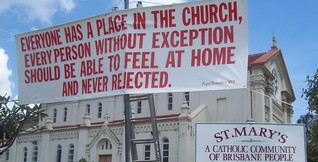
More on St. Mary’s in Brisbane, Australia.   More on the background here.


Brisbane: heretic Fr. Dresser and parish told to clean up by 1 DecBrisbane Archbishop John Bathersby has written to the administrator of St Mary’s in South Brisbane threatening to start "a formal process" to address the situation if changes are not made by December 1.

The Australian reports the parish looks set to be excommunicated after the local priest, Fr Peter Kennedy, said yesterday he would not change his ways despite being warned to do so by Church authorities.[That approach generally doesn’t produce good results.]

The archbishop wrote to the parish in September drawing attention to practices that placed St Mary’s "not in communion with the Catholic Church", and giving them until the end of the year to respond.

But in a second letter last week, Archbishop Bathersby said several undertakings had not been honoured and that "games are still being played, as they were in the past."

"I am prepared to wait until December 1, but no longer. After that I will begin a formal process to address the situation," he said.

But Fr Kennedy indicated yesterday that the local people would not be changing their practices.

He said St Mary’s had been "white-anted" [? I am guessing this is colloquial.] by people who were not regular members of the church.

"There are vigilantes who’ve come into our church and written to Rome, and Rome has put pressure on John Bathersby. Bullies never have enough of bullying, and the Vatican is a bully," he said. [Uh huh.  I think I will make popcorn and watch that that plays out.  But notice that this has nothing, really, to do with the real problem: what this priest and parish are doing is WRONG.]

"Many communities are not sticking precisely to the rules of liturgy. Our problem is that we are a public community. [A "public community"?  Sorry… but this is incomprehensible.] The archbishop has known what we’ve been doing for all these years. [That is a problem, admittedly.  But… that again doesn’t change the situation.  It must stop!] But his model of governance is hierarchical, and that’s his problem, the Church’s governance is hierarchical."

Fr Kennedy, 71, said he was making a stand on behalf of what he called "recovering Catholics".

"They walked away from the Church because they can no longer abide this institution which is so oppressive of women, of gay and lesbian people. [I think the canonical process will not take long.]

"We are one Church community that is prepared to say enough is enough."

According to the ABC, Archbishop Bathersby’s demands include an end to commitment ceremonies at St Mary’s for gay and lesbian couples and the use of non-conventional terms during baptisms.

He insists the priests wear the traditional alb and stole during the Mass and they use a Catholic Church approved eucharistic prayer, not one developed by the community.

He also wants lay people to stop giving the homily.

Power backs St Mary’s

Speaking to the Canberra Times, Canberra auxiliary, Bishop Pat Power said that St Mary’s South Brisbane was a haven to people who had been excluded from their own parishes, Catholic and otherwise. He said canon law required homilies at Mass must be preached by a deacon or priest.

”I have difficulty with that ruling, but that is how it is.” [Another winner.] He did not accept all goodness and knowledge resided in priests. Parishes such as St Mary’s pushed the Church ahead.

”I think the day will come when that sort of thing will happen.”

Bishop Power described Archbishop Bathersby as Australia’s most open and accommodating archbishop, who was committed to dialogue.

”I would have sympathy for a parish which is reaching out to gay people,” Bishop Power said. ”So often they feel no one wants to know them. But a bishop has difficulty with those things. I recognise their desire to be part of the Church.

”I have a lot of sympathy and admiration for a parish like this. I know it is hard to find the middle ground.” [The "middle ground"?  For example, just do half of the baptisms invalidly?] The Queensland bishops were generally open and accommodating and generally progressive in terms of the second Vatican Council.

Dresser aims to "marry" theology and science

Meanwhile, Bathurst diocese priest Fr Peter Dresser who has created a worldwide storm of controversy over his claims Jesus was not God and Mary was not a virgin in his book has said he was simply trying to start a "conversation", Livenews says.  [Well… he did that!]

Fr Dresser, whose book God is Big. Real Big [O God… you are soooo big!] is being sold at Brisbane churches for $20 a copy, says he has not been disciplined since the book’s contents went public in the media.

Dresser said in an interview that his book tries to "marry" theology and science.

SOURCE

I’ll excommunicate you: archbishop (The Australian, 3/11/08)

Brisbane church faces axe over liberal practices (ABC News, 2/11/08)

‘Jesus was not God’ priest speaks to LIVENEWS.com.au (Livenews, 30/10/08)

Bishop backs gay move by parish (Canberra Times, 3/11/08

LINKS

St Mary’s, South Brisbane

Peter Dresser 

Posted in SESSIUNCULA |
39 Comments

16 Nov: Dayton, OH: Solemn TLM

From a reader:

On November 16, Fr. Eric Flood, FSSP, North American District Superior of the Priestly Fraternity of St. Peter, will be visiting the Latin Mass community in Dayton.  He will offer the first Solemn High Mass in almost 40 years in the Cincinnati Diocese  on that day. Those who live in the Dayton area  are encouraged to make a point of attending the Mass on that day . You are also asked to spread the word about this event. This very beautiful liturgy is filled with reverence and many other symbols not present in the typical Sunday High Mass
 
After the Solemn Mass, there will be a brunch reception for Fr. Flood at the Dayton Polish Club at 1470 Valley Street, not far from Our Lady of the Rosary Church.
 
Place:  Our Lady of the Rosary Church
           Corner of Notre Dame Ave and Hart St.
           Dayton, OH
Date:   Sunday, November 16
Time:   8:45 am

Posted in SESSIUNCULA |
7 Comments

Rumor: Pope Benedict considering lifting SSPX excommunications

Our friends at Rorate have an intriguing rumor.

Decree for the removal of excommunications on the Pope’s desk?

From Spanish blog La Cigüeña de la Torre:

    On the Holy Father’s bureau [read=desk] stands a prepared decree which will lift that of [excommunication], of 1988, which applied to the consecrating [Archbishop Marcel Lefebvre and Bishop Antonio de Castro Mayer] and consecrated bishops [Bishops Bernard Fellay, Bernard Tissier de Mallerais, Alfonso de Galarreta, and Richard Williamson]. I mean removing the decree, and not absolving of the excommunication. [If I understand this correctly, that would mean the Holy Father would declare that the excommunication would have been, effectively, confirmed by the Cong. for Bishop in error.]

    The thesis of the subjective element, extenuating or mitigating of fault, and, therefore, of the penalty, according to Canons 1323, 4 and 7, and 1324, 1, 8, and 3, has prevailed.  [The idea is this: in order to incur a penalty you have to have sinned.  You must know what you are doing and will it.  If there are forces working on you from outside, so that you act under compulsion, the guilt for the objective wrong act is mitigated.  If forces are acting on your will from withing, that is, you are emotionally or mentally unstable or impaired by substances, etc., that mitigates the guilt of the act.]

The information sounds highly credible, it matches recent events (including the Rosary Crusade), and Spanish conservative Catholic lawyer Francisco José Fernández de la Cigoña usually only posts on future events (such as the nomination of Bishops) when he is truly certain of the matter. Nonetheless, even if the information is accurate, there is no way of knowing when [if] the Holy Father will sign the document, or when it will be made public.

The referenced canons of the Code of Canon Law (CIC) are the following:

    Can. 1323 The following are not subject to a penalty when they have violated a law or precept:
    …
    4/ a person who acted coerced by grave fear, even if only relatively grave, or due to necessity or grave inconvenience unless the act is intrinsically evil or tends to the harm of souls;
    …
    7/ a person who without negligence thought that one of the circumstances mentioned in nn. 4 or 5 was present.

    Can. 1324 §1. The perpetrator of a violation is not exempt from a penalty, but the penalty established by law or precept must be tempered or a penance employed in its place if the delict was committed:
    …
    8/ by a person who thought in culpable error that one of the circumstances mentioned in can. 1323, nn. 4 or 5 was present;
    …
    §3. In the circumstances mentioned in §1, the accused is not bound by a latae sententiae penalty.

I am reminded of something the Holy Father said last summer during his "vacation" to a gathering of priests in N. Italy.  If my memory serves, a priest asked the Holy Father what to do about people who present their children to be baptized when there is little or no chance they will practice their Catholic faith. 

The Holy Father replied along the lines that when he was a young priest, he was far more strict in these matters.  Now that he is more than 80, however, he would be inclined to baptize.

Tangentially, last night I was watching an episode of the Forsyte Saga.  Old uncle Jolyon toward the end of his life softens about the split in his family, about which he had been quite stern years before.


I am not suggesting that the Holy Father is an old man, "foolish, fond", as the poet says.
 
Perhaps this rumor is too optimistic.  The Holy Father seems to move slowly and reflect for a loooong time about certain things… even dither. 

Still, there was the letter sent back by Bp. Fellay to Card. Castillon about the infamous "conditions". 

There has been a bit of a softening of rhetorics from the SSPX.

The SSPX went to Lourdes and asked or a Crusade of prayer through the Rosary for the lifting of the excommunications.

I fear this new report is overly sanguine… which is better than the opposite tack… but I hope it is true.

Posted in SESSIUNCULA |
50 Comments

The revolution continues in St. Peter’s: hideous Alien altar REPLACED

Our friend John Sonnen of Orbis Catholicus has photographic evidence that the hideous eye-sore altar set up in the apse of St. Peter’s Basilica, to replace the "altar of the Chair", has been removed and replaced.

The revolution continues in St. Peter's: hideous Alien altar REPLACED

Rinascimento Sacro has a great slide show revealing how the old monstrosity was removed.

My favorite shot is of the old altar dragged out and sitting all forlorn next to the organ case back near the altar of St. Leo.

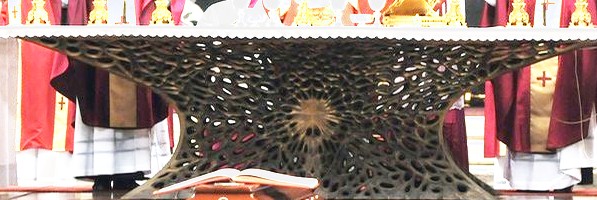
You will recall that the old one, set up at the time of Paul VI looked like something out of Alien.

Here it is at the funeral of the late great Card. Stickler:

Let’s change the contrast on that and crop it so you can get a good look at its alien characteristics.

The revolution continues in St. Peter's: hideous Alien altar REPLACED

Posted in SESSIUNCULA |
61 Comments

Blackfen properly observes All Saints

His Hermeneuticalness, Fr. Finigan, pastor of Blackfen and perhaps the next Archbishop of Westminster has posted about their observance of All Saints.

He also proves that he is a man after my own heart (my emphasis).

Blackfen properly observes All Saints

On the first Saturday of the month in my parish we have Missa Cantata (the other Saturdays it is a Traditional Low Mass). Today for the feast of All Saints we took the opportunity to have a very tasty lasagne, cooked by Patricia, our chef de cuisine, and sing Vespers in the afternoon, followed by Benediction. Above the cantors are pre-intoning the Magnificat antiphon.

Posted in SESSIUNCULA |
13 Comments

WDTPRS: 25th Sunday after Pentecost (4th after Epiphany – 1962MR)

Here is some of my weekly article for this Sunday.


What Does the Prayer Really Say?   25th Sunday after Pentecost (4th after Epiphany) (1962 Missale Romanum)

…

As we approach the end of another liturgical year, a strange thing happens in the Church’s traditional, pre-Conciliar calendar.  After the 22nd Sunday after Pentecost, the Sundays left over after Epiphany, way back after Christmas, are pulled out of the freezer, warmed up and served.  And “left over” is not a flippant description.  In the older Missale Romanum our Sunday is “Dominca quinta quae superfuit post Epiphaniam”.  Superfuit is from super-sum, which the super Lewis & Short Latin Dictionary , indicates is “to be over and above, either as a remainder or as a superfluity”. 

So how can Sundays be ‘left over’?”  Here is what happened.

In structuring our liturgical calendar we Christians depend on the vagaries of the moon.  The date of Easter each year is fixed according to when the spring full moon occurs.  Since the moon isn’t always full on the same date, the date of Easter Sunday shifts.  Lent, however, has a fixed length. Thus the beginning of Lent slides around, earlier or later depending on that spring full moon.  At the other end of the equation, Epiphany (the real Epiphany) is a fixed date: 6 January.  Since the beginning of Lent slides around, the time between Epiphany, which begins on 14 January, and Ash Wednesday and Septuagesima (three weeks before), is longer or shorter depending on when the moon is full in the spring.  There can be many as six Sundays between Epiphany and Septuagesima which can fall from 18 January to 22 February, that is from the 2nd until the 6th Sunday after Epiphany.  Therefore, when Lent begins earlier the texts for as many as four Sundays after Epiphany slated to be celebrated up to Septuagesima must be skipped.  On the other end of the Lent/Easter cycle, Pentecost also shifts its date.   Pentecost is always the same number of days after the movable Easter.  The twenty-four Sundays allotted after Pentecost are not enough to get us all the way to the end of the liturgical year, back around to Advent.  Depending on the date of the spring full moon, there can be a gap of a several Sundays between the 22nd after Pentecost and last Sunday before Advent. Therefore, Holy Church uses those “movable” Sundays left over after Epiphany as fillers until the final Sunday of the year, which liturgically is always the 24th Sunday after Pentecost … even if it isn’t ordinally the 24th. So, at the end of the Church’s year, in the traditional calendar, we usually get left over Sundays.

In the newer, post-Conciliar calendar the shift in the moon also changes how many Sundays of “Ordinary Time” we can squeeze in after the Christmas season ends with the Baptism of the Lord (a mystery yanked away from the Feast of Epiphany).  Again, due to the shifting dates of Pentecost some of the Sundays of Ordinary Time in the middle of the calendar are blotted out by the tail end of the Easter season. At the end of the liturgical year in the newer calendar, the last Sunday is always fixed as the 34th Sunday of Ordinary Time, celebrated as the Solemnity of Christ the King.  In the older calendar Christ the King is observed on the last Sunday of October.

In the older, traditional calendar we have not only the rather more interesting Septuagesima and the pre-Lent Sundays, we also have the Seasons of Epiphany and Pentecost for what is called our tempus per annum… “time through the year”.  In the post-Conciliar calendar we call the tempus per annum “Ordinary Time”.  “Ordinary” refers to “order” rather than “ordinariness”.  The Novus Ordo’s “ordered” time is split into two unequal parts.  An old clerical friend of mine calls them “greater and lesser ‘meatloaf’”.  I think he prefers the traditional reckoning.  Whereas in the ordinary Novus Ordo calendar we just throw the unconsumed “meatloaf” Sundays away, in the Church’s extraordinary calendar we conserve the left over Sundays in the back of the liturgical ice-box and pull them out later if needed.  Either way, as is the case with many things preserved lovingly in the refrigerator for a long time, these Sundays are green… with hope, of course.

Let us now examine the Collect for this 25th Sunday after Pentecost in the traditional, Extraordinary calendar of the Roman Rite, the texts for which are revived from the 4th Sunday remaining after Epiphany. 

COLLECT (1962MR):
Deus, qui nos in tantis periculis constitutos
pro humana scis fragilitate non posse subsistere:
da nobis salutem mentis et corporis;
ut ea, quae pro peccatis nostris patimur,
te adiuvante vincamus.

I found this prayer in the Hadrianum, Augustodunensis, and the Liber sacramentorum Romanae ecclesiae ordine excarpsus.  

WDTPRS: 25th Sunday after Pentecost (4th after Epiphany - 1962MR)WDTPRS: 25th Sunday after Pentecost (4th after Epiphany - 1962MR)Many prayers in the 1962 Missale Romanum survived the snipping and pasting experts brought in by the Consilium under Cardinal Lercaro and Father Bugnini.  Sometimes you can hunt them up pretty easily.  Often prayers conspicuous and repeated on certain Sundays for centuries survived but in an altered form or removed to a remote corner, almost never to be seen again unless you are writing columns on what the prayers really say.  At the time of this writing, I am visiting a well-known seminary in the USA and shooting the breeze with seminarians, one of whose computer I am using because of connectivity problems.  When in an index of words used in the 2002, 3rd edition, of the Missale Romanum I found that this prayer was in fact in the section of votive Masses as some third option or other, one the men quipped, “for deceased pets”?  You see, there are so many options and possibilities in the new books that they are, well, hard to take seriously.  As it turned out, today’s prayers lives in the 2002 Missale Romanum as the optional Collect for the third schema for a votive Mass pro quacumque necessitate… “for whatever necessity”.

WDTPRS: 25th Sunday after Pentecost (4th after Epiphany - 1962MR)Our L&S shows that constituo is quite complex.  What interests us is its meaning of “to cause to stand, put or lay down, to set, put, place, fix, station, deposit a person or thing somewhere (esp. firmly or immovably), etc. (the act. corresponding to consistere”).  It is thus also a military term, “to station or post troops somewhere, to draw up, set in order”.  When the past participle is used as an adjective, it is “constituted, arranged, disposed; fixed, established”.
On the other hand, in Classical usage subsisto means “to take a stand or position, to stand still, remain standing; to stop, halt”.  It comes to mean especially in military contexts, “to stand firm, hold out; to withstand, oppose, resist”.  In later Latin such as in the Vulgate in the Book of Job it is, “to remain alive”.  Also in late Latin, it is “to stand or hold good, to subsist”.

LITERAL TRANSLATION
O God, You who know that we, set in such great dangers,
are not able to hold out because of human fragility:
grant us health of mind and body;
so that, You helping us, we may vanquish
those things which we suffer on account of our sins

The juxtaposition of “such great dangers” and nos constituti, with the final word vincamus, suggests immediately the military image of us as being “drawn up in ranks”.  We are, after all, members of the Church Militant. 

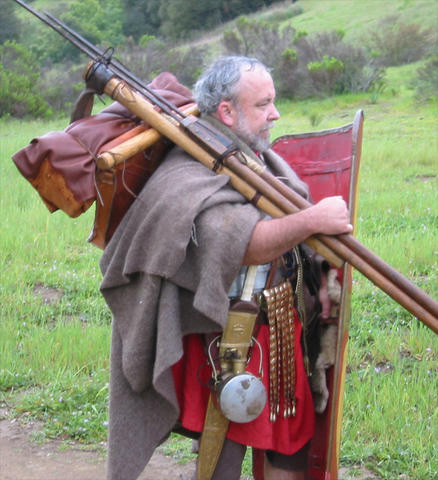
A couple days ago, I visited the American Civil War battlefield at Gettysburg.  In the museum among the displays designed in the modern style so that people, especially children, can have also a “hands on” experience, there was set up a regular Union soldier’s backpack with musket.  Anyone could try to lift it, to get a sense of the burden, over 60 pounds, the soldier carried at all times.  It was interesting to watch the children, who couldn’t budge it, and the faces of their fathers, trying to conceal effort in front of their children.  The backpack of the ancient Roman legionary, the sárcina, with the usual 17 days of rations, weighed between 95-100 pounds.  St. Augustine of Hippo (+430) often referred to the burden of his duties as bishop as his sarcina.

WDTPRS: 25th Sunday after Pentecost (4th after Epiphany - 1962MR)Our Collect gives us the image of the Christian as soldier, weary in mind and body, in danger both from the elements and the enemy.  We are drawn up in ranks (constituti) at the moment the prayer is uttered by the priest, standing in the front of the ranks like an officer.  We are drawn up facing our great Captain, our King.  Christ the Lord is coming from the liturgical East.  His banner is the Cross.
Because of the Fall of the entire human race, which consisted of our First Parents, we all suffer the wounds of Original Sin.  We have a weaken mind, our intellect and will being clouded and unsure.  Our bodies are subject to disease, age and other difficulties.  The world’s environment itself is out of harmony as a result of the fall.  It is our lot to toil, not just work, by the sweat of our brow.  We are in a world dominated by the Enemy, this world’s “prince” set against us and against the King.  The Enemy will attack us relentlessly, both in covert operations through our memories, thoughts and appetites, through other material means, and through more dramatic assaults.  Without God’s help, we would be lost. 

We have our Church and the help of grace.  Christ promised He would be with us to the end of the world and that the Church, to whom He gave His own authority to teach, govern and sanctify us, would in the end vanquish the enemy, who will not prevail.

The Introit invokes the image of captivity (Jeremiah 29, Ps 84).  In the Epistle for this Mass, Paul, writing to the Romans (13:8-10) speaks of our weaknesses through which the Enemy attacks us from within and the remedy of true charity, love of self and neighbor.  In the Gospel (Matthew 8), in the little boat with the terrified apostles Christ calms the storm and waters.  The Gradual has us pray about God freeing us from those who hate and afflict us (Ps 43). The Alleluia and Offertory echo our lot: “From the depths I cry to you, O Lord” (Ps 129 – De profundis).  The Secret again speaks of “fragilitas nostra” and asks God for protection from evil.  The Postcommunio makes reference to the allurements of this world as opposed to heavenly things which are true nourishment.   The texts of the whole Mass present a serious, even stark, image of our situation in this vale of tears.  The Mass goer who is attentive to the texts will more than likely engage in a good examination of conscience, provoked by the texts themselves.  

At the same time, the texts tell us that though our lot is a hard one, and we are staring out into it from the soldiers and battle lines arrayed for conflict, at the end we, not the Enemy, will be victorious. With God, we will vanquish (vincamus) whatever afflicts us.


Posted in SESSIUNCULA, WDTPRS |
15 Comments

Bishops behind “Bring back our BLACK!”

Okay… we have the BIG MO, BABY!

Bring back our BLACK! has a little more support.

A kind reader alerted me to a weekly letter to his flock by His Excellency Most Reverend R. Walter Nickless of Sioux City, Iowa.

Get this!  Here is the relevant section but do go read what else the bishop has to say.  Pretty good stuff.

My emphases and comments.

Bishops behind "Bring back our BLACK!"
There is a clear connection between this Feast and the Feast of All Souls which follows it on Sunday, November 2nd. We know that, although God’s mercy is greater than our sinfulness, still we have the choice to reject His gifts. Most of us live and die struggling to accept fully the gracious gift of faith and mercy. We are not ready for Heaven, for seeing God "as He really is," because we have not seen or loved Him clearly enough in this life. We need more scouring.

Part of how we receive this scouring or "purging" after death is by the prayers of the faithful still sojourning. [That’s where we come in.] We have a duty in this life, born of our unity in Christ, to pray for the dead, for the purifying fire of God’s merciful love to purge them of the heaviness of sin. This duty is one of the spiritual works of mercy. So important is this duty, that the Church uses an entire day to remind us of it each year. Remember, then, that none of us can make become saints without the hard work, not only of ourselves, but of many others also. One of the hardest forms of this sanctifying work is to learn to love and pray for all, especially for our enemies, even after their death. "For if you love those who love you, what reward shall you have? Even the tax-collectors do this. And if you greet your own family only, what more have you done? Even the heathens do this. Therefore, be perfect, as your heavenly Father is perfect." (Mt 5:46-8). All of us would do well to continue to pray for the souls in purgatory.  We hope that many will pray for us as well when we die. [You can say that again.]

[WATCH THIS] Black is a traditional color of the Church’s vestments that may be worn on All Souls Day. It can also be worn at Masses for the dead. As a liturgical color, black symbolizes mourning and penitence, sorrow and solemnity. [Death to the allurements of this world.] This is exactly the spirit we are trying to cultivate on the Feast of All Souls, when we pray for the salvation of the dead. [Oh my HEAVENS!  Did you get that?  This is a modern bishop in the USA, folks.  Kindly note that he connects what should be our proper attitude and BLACK VESTMENTS.  But wait… THERE’S MORE!]  It is appropriate, then, to use the external symbols suitable to help us cultivate the proper internal reality. Black vestments help us to remember to pray for all the dead, [% SOUND.TRUMPETS.HERE %] not just our own beloved dead. Black vestments help remind us of the inestimable worth of the divine gift of life, in this world and in the next. This year, for this feast, I will be wearing black vestments. [YES!] Hopefully, this sign will remind us of our need to face death with all its pain and mourning, but also remind us of the resurrected life to follow.


All I can say is…

THANK YOU!

[I want photos.]

Posted in SESSIUNCULA |
52 Comments

CHANGE YOUR CLOCKS

If you are in a region where your clocks fall back tonight then

CHANGE YOUR CLOCKS.

Mass will start on time whether you are there or not….

…. unless you are the priest, of course. 

But… that has its problems too.

Okay…

Just CHANGE YOUR CLOCKS.

Posted in SESSIUNCULA |
10 Comments

PODCAzT 70: Venerable Bede on All Saints; a collage; don Camillo (Part IV)

PODCAzT 70: Venerable Bede on All Saints; a collage; don Camillo (Part IV)For this Feast of All Saints we tune in to hear what Venerable Bede (+735) has to say.  This is an excerpt from today’s Matins in the traditional Breviarium Romanum and is taken from one of Bede’s sermons.

I comment.

Also, I have a bit of a collage, which just “grew” out of thinking through some e-mail I received while I was working on this, and had Bede’s words about this shortness of this life fresh in my mind.

There are a lot of broken hearts out there, folks.  It takes time to get things in perspective, but the right starting point helps.

Also, we have another installment of stories about the fictional don Camillo Tarocci, (+ A.D. … ?) parish priest of “The Little World” created by Giovanni Guareschi.

PODCAzT 70: Venerable Bede on All Saints; a collage; don Camillo (Part IV)I began a to read stories from The Little World of Don Camillo back in PODCAzT 65.  There is a Don Camillo tag you can use to find the others easily.

These delightful pieces are set in post-war Nothern Italy.

They blend brilliant insight into the human condition with solid applied Catholic Faith.  PODCAzT 70: Venerable Bede on All Saints; a collage; don Camillo (Part IV)

Today we hear two tales:

Rivalry
and
Crime and Punishment

https://wdtprs.com/podcazt/08_11_01.mp3

Not sure if the iTunes feed is working.  It stops and starts again… mysteriously.  Beats me!

Some of the last offerings (check out the PODCAzT PAGE):

069 08-10-30 Augustine on Ps 103; Benedictines can sing!
068 08-08-04 Interview – Fr. Tim Finigan on the Oxford TLM conference; don Camillo (Part III)
067 08-07-29 St. Augustine on Martha, active v. contemplative lives; don Camillo (part II)
066 08-07-25 don Camillo (part I): VM – advice on getting TLMs & “pro multis”
065 08-07-19 St. Ambrose “On mysteries”; Interview: Fr. Robert Pasley
064 08-07-15 Bonaventure on Christ “the door”; Interview – Fr. Timothy Finigan
063 08-07-12 Interview: Fr. Justin Nolan, FSSP; consecrated hands, Holy Communion and the Rite of Baptism
062 08-06-26 Interviews with and by Fr. Z; What has Bp. Fellay really said?
061 08-05-17 Pope Leo I on a post-Pentecost weekday; Fr. Z rambles not quite aimlessly for a while
060 08-05-16 Pentecost customs; St. Ambrose on the dew of the Holy Spirit
059 08-05-15 Leo the Great on Pentecost fasting; Benedict XVI’s sermon for Pentecost Sunday
058 08-05-14 Ember Days; Chrysostom on St. Matthias; Prayer to the Holy Spirit
057 08-05-13 John Paul II on the unforgivable sin; Our Lady of Fatima and the vision of Hell
056 08-05-12 Octaves – Fr. Z rants & Augustine on Pentecost
055 08-05-03 Tertullian, again; Fr. Rutler and Fr. Z on Archbp. Marini’s book
054 08-04-29 Pro-Abortion Politicians and Communion; St. Ambrose and Emperor Theodosius

PODCAzT 70: Venerable Bede on All Saints; a collage; don Camillo (Part IV)

Posted in don Camillo, Patristiblogging, PODCAzT | Tagged ,
3 Comments