Archbp. Gregory of Atlanta speaks about issues and voting

Many bishops have really stood up with clear statements about the importance of weighing the issues before voting, explaining that there is a hierarchy of issues.  Not all issues are of equal importance.  As a matter of fact, one outweighs the others.  It is the sine qua non issue.

Let’s see what His Excellency Most Rev. Wilton Gregory, Archbishop of Atlanta has to say to his flock via the Georgia Bulletin. 

My emphases and comments.

What I Have Seen and Heard

MOST REVEREND WILTON D. GREGORY, Archbishop of Atlanta

Published: October 30, 2008

Thomas Jefferson tailored the famous phrase “Life, liberty, and the pursuit of happiness” in his development of the Declaration of Independence, borrowing it from the writings of the English philosopher John Locke. Jefferson actually used many of Locke’s political principles throughout that document. He employed that particular well-known phrase in detailing some of the inalienable rights that we enjoy as human beings. They are inalienable because they depend not upon the largesse of any human institution or individual but because they flow from the very nature of our humanity — and therefore they belong to a natural law that predates every explicit or written human law. They are not subject to anyone’s choice or opinion because they arise from our very dignity as human beings.  [i don’t know why it was necessary to bring Locke’s name in with this.  It overloads the paragraph.  But let that go….  this isn’t a writing class.]

I suspect that over the past 35 years many people in the United States might well have wished that Thomas Jefferson would have borrowed some other phrase from John Locke or at least reordered this particular phrase so that Life did not appear first or even at all in this listing of inalienable rights. But just as Pilate was quoted after the death of Jesus — what I have written, I have written (John 19:22) — [?] Life itself is the very first principle whenever we decide to consider those rights that that are listed as inalienable in the Declaration of Independence.  [?  Well… YES!  Life is the first.  It must be.  But, again, the paragraph is thick, isn’t it?  And I wonder if it won’t leave some people with the impression "Hmm… too bad life is first, but, oh well,  I guess we have to deal with it somehow."  He gets to a very good conclusion, but it seems muddy to me after the introduction of hemmings and hawings.]

I have been asked by a number of people to comment upon the issues that we now face as a nation during this particular general election, [And… other elections too, right?] and a few people (representing both sides of the political aisle) have even clamored for me to propose a candidate for whom all Catholics ought to vote — or to designate one they certainly must not elect. The Church wisely offers only ethical principles and a moral framework for people to consider and to evaluate when you are about to make your crucially important decisions regarding whom to vote for in this election.

Throughout the centuries, the Church has discovered that it is often perilous to align herself to a particular political party or individual leader. [Bogging down again…] Rather we choose to recommend Gospel-based principles and social teachings to our people and to allow you to make appropriately informed decisions. These principles were carefully and adequately detailed in the most recent edition of the Bishops’ quadrennial statement: Faithful Citizenship. For some people these values were too complex, too nuanced and too oblique. They would much have desired a simple option.

According to the principles of Faithful Citizenship, Catholics must support the just care of the poor, the rights of workers, the dignity of people who immigrate to a new nation, the conservation of the environment; we must assess the very complex economic issues, seek to provide affordable health care for people who do not enjoy that security, and foster the more humane treatment of those who are imprisoned, to list only some of the issues that we now face. However, before and prior to all of those vitally important concerns, Faithful Citizenship places the issue of Life itself. [Good.] All of those other matters are of immense and lasting significance, yet they remain of no consequence for those who are not granted the first right — the right to be born.  [Certainly they are of no consequence to those who are not alive, that is those denied the right to be born.  But I think we have to put this differently.  All those issue above are of less consequence then the issue of the right to be born. Or else, those issues are important because the right to life and dignity is prior.] For this reason, I want to remind all of you, my brothers and sisters, to remember those famous Jeffersonian words borrowed from Locke—and especially remember the order that he gave them.  He gets to absolutely the right conclusion, but it is here, with this last sentence buried behind Locke and Jefferson and even the Constitution when really he is making an appeal to the rights we have because they are written into our being.]

On November 5, the social and ethical doctrines of the Catholic Church will be the same as they were on November 3. The dignity of human life will still be the foundational issue that we face in our society and in our world. Whoever is elected will hear the same policies from the Catholic Church that we have promoted not only during this election year but consistently about the sacredness of human life and the issues of social justice that necessarily flow from that leading concern. We will continue to challenge and urge all of our elected officials to enact laws that respect human life at each stage of its existence. These are not principles that we promote only during the election season but every day in season and out of season.  [Well… this is the "IN SEASON" part, I think.] Our social teaching is not a platform that can be adjusted to fit the mood of the moment or the sentiments of the day. Far longer than the Declaration of Independence, the Catholic Church has placed life first among those rights that are therein described as inalienable — no matter what some people may have recently suggested regarding the Church’s teaching on human life. [C’mon… SAY IT, Your Excellency.  What "some Catholic politicians and others who support abortion suggest".]  We will also speak up for the other concerns that cannot be ignored or dismissed because they flow from the very human dignity that we all enjoy as God’s children.  [Well put.]

Like most of you, I have sometimes felt oppressed by much of the election rhetoric and I am glad that the end is near. This has been a long political season. I deliberately chose to save this column until the final weekend before our election so that I could speak with you about these issues in those closing moments before you cast your ballots. Quite often the last words that we might hear are those that we tend to remember. I am utterly convinced that our people are well prepared to make informed decisions based upon our Catholic faith and its moral framework and the wisdom that you have gained in living our faith each day.

And, from reading this, I think he means that we should vote for candidates who best uphold the sanctity of human life, not because it is in the Declaration of Independence penned by Jefferson (pace Locke), but because all human beings have dignity written into us as images of God. 
Posted in SESSIUNCULA |
23 Comments

Bring Back Our BLACK!

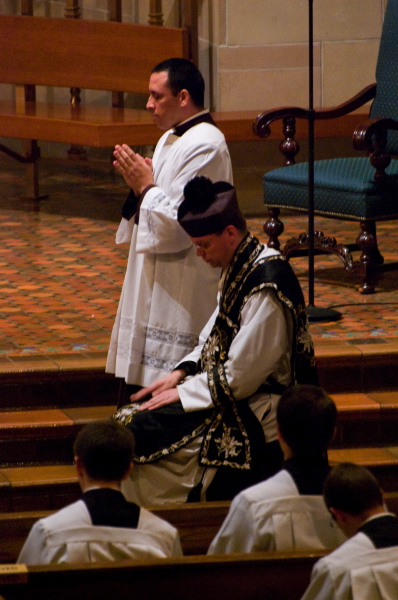
Over at NLM there is a good long post about black vestments, in advance of the observance of All Souls, Sunday 2 November (Novus Ordo), Monday 3 November (1962MR).   I want to ad my voice to theirs in support of the use of black vestments as often as appropriate and possible.

All Souls Day is celebrated tomorrow in the modern Roman calendar and transferred to Monday in the calendar of the usus antiquior. It seemed appropriate then to re-post this which I wrote nearly one month ago:
Bring Back Our BLACK!

Whensoever October rolls around, my mind turns toward All Souls Day and what has become an annual appeal upon the New Liturgical Movement: the call for parish priests to pull out (or find if need be) black vestments for this day.

This year, All Souls Day falls upon a Sunday, which means that in the calendar of the usus antiquior the day will be transferred to the following day, Monday, November 3rd. In the modern Roman calendar however, it falls on the Sunday.

The question will no doubt arise, may black vestments be worn on a Sunday? [YES!] Looking at the GIRM for the modern Roman missal, I see nothing that would prevent it. Given that black is one of the colours for this feast day, and given that this feast day may happen on a Sunday in the modern liturgy, and, further, given that there is no instruction that I can yet find otherwise, it would seem that black is permitted on All Souls Day in the modern liturgy, even if it falls upon a Sunday.


There is more.  You should look at their post.

It is interesting that the Ordo put together for the Vatican Basilica lists only "Viol." for the color for Sunday.  The other, universal Ordo does the same.  However, in par. 16 in the praenotanda in that Ordo, (p. 16) we find:

16. In Missis defunctorum color violaceus colori nigro praeferatur, …" or "In Masses of the dead, the color violet is to be preferred to the color black."

To which I respond: Oh yah?  Really? 

How is this "preference" to be discerned? 

This is one of those nasty weasel rubrics slipped in during the bad times.  The progressivists and Bugniniists couldn’t abolish black outright, so they inserted slithery suggestions like this in order to give the impression that you can’t use black. 

BUT. YOU. CAN. 

Furthermore, Summorum Pontificum, among the many things it accomplishes, gets us back in touch with the continuity we need in a healthy approach to worship.  One of the mutual enrichments foreseen by the Legislator clearly has something to do with the vestments used for Holy Mass: watch what the Holy Father has been doing with papal Masses. 

How long have we Romans used black for Masses for the dead?

And let’s use unbleached beeswax candles too!  I want none of your anemic beeswax for my funeral, I’ll tell ya. Do you?  I’m just askin’.

I think a reclamation of black is in order for funerals and Masses for the dead in the Novus Ordo is entirely appropriate.

Let’s get to it, Fathers!

Laypeople, be prepared to purchase good black vestments and unbleached candles for your parishes.

Request black.

Make it happen.

Bring Back Our BLACK!

Unbleached Beeswax NOW!

Posted in I'm just askin'..., SUMMORUM PONTIFICUM |
45 Comments

Some All Saints fun

Enjoy!   Biretta tip to Fr. I     o{]:¬)

Play video

Posted in SESSIUNCULA |
13 Comments

A lighter note

From Vincenzo, the official photoshopper of WDTPRS:

A lighter note

Posted in SESSIUNCULA | Tagged
3 Comments

Mass Alert – 1500 GMT

I am sure you have many petitions.

Unite yours to mine beginning at 1500h GMT (1500 UK – 1600 Rome – 1100 EST – 0200 Sydney) as I start to say Mass for All Saints (1962MR).

Ask your angel guardians to be present.

Perhaps you might, as I will, ask all the angels and saints to obtain from the Holy Spirit a softening of hearts and illumination of minds of voters in the upcoming USA elections, especially regarding the sanctity of life.

In the meantime:

Veni, Sancte Spiritus, reple tuorum corda fidelium, et tui amoris in eis ignem accende.

V. Emitte Spiritum tuum et creabuntur;
R. Et renovabis faciem terrae.

Oremus. Deus, qui corda fidelium Sancti Spiritus illustratione docuisti: da nobis in eodem Spiritu recta sapere, et de eius semper consolatione gaudere. Per Christum Dominum nostrum. Amen.

Posted in SESSIUNCULA |
2 Comments

Trouble

TroubleThe last few days have seen numerous technical problems. The blog froze up for reasons still unknown. Now my Internet is down. I am working on my phone. So in the absence of anything more lengthy to post and analyze for what it really says, here is pretty photo from my phone. (This is the reason I opted for the iPhone – though I miss my Razr: it is a good emergency backup and I can take the blog on the road.)

Trouble

Trouble

Posted in SESSIUNCULA |
1 Comment

What horrors await us in the penumbras formed by emanations

Forget skeletons.  Here is a truly scary Halloween thought!

What is at stake in the upcoming election?

Here is something to think about from LifeNews.  My emphases and comments.

Washington, DC (LifeNews.com) — In a Thursday interview with NBC News, Barack Obama repeated the pledge he’s made throughout the campaign. Obama indicated he would only appoint judges to the Supreme Court who support unlimited abortions, [That’s the issue, folks.] in what is a clear pro-abortion litmus test for federal justices.

"Well, look, I think that you — what you can ask a judge is about their judicial philosophy," he said when asked how he would make selections if he defeats John McCain on Tuesday.

"I can tell you that how a Justice approaches their job, how they describe the path of interpreting the Constitution, I think can tell you a lot," he added.T

"And so my criteria, for example, would be — [read carefully] if a Justice tells me that they only believe the strict letter of the Constitution — that means that they possibly don’t mean — believe in — a right to privacy ["right to privacy" discovered in the Constitution by the majority in Griswold v Connecticut was the basis for the Court’s eventual Roe v Wade abortion decision.] that may not be perfectly enumerated in the Constitution but, you know, that I think is there," Obama said.   [Uh huh … it’s CLEAR!  It’s right there!  In those penumbras formed by emanations.]

NBC News columnist Mark Impomeni understood the clear meaning of Obama’s words.

"No originalist judges need apply," Impomeni wrote in response. "The right to privacy is a code word for abortion rights. The focus of liberal jurisprudence since Roe v. Wade first conferred the right to an abortion has been the protection of that ‘right.’"

And with Roe guaranteeing virtually unlimited abortions throughout pregnancy for any reasons, based on the so-called privacy right, Obama is confirming his intent to only select pro-abortion judges who want no limits on abortion.  [But not only abortion, folks.  Think of the other things justices appointed by him might find in the penumbras formed by emanations.  Think about it.]

Charmaine Yoest, president of Americans United for Life, a pro-life legal group, understands the enormous impact of the presidential election on the Supreme Court  [And not just because of abortion!] and how an Obama victory could keep unlimited abortions in place for decades.

"This is a historic election," she told USA Today. "With the next president having the opportunity to appoint one, two or even more justice on the life issue."  [And not only the life issue.  Start thinking about, well… eminent domain.  Do you own your own home or land?]

The differences are clear, with McCain saying he wants judges who won’t make up law form the bench but who will respect the rights of the people and their elected officials to make the law on abortion.

In a February letter to the Federalist Society, McCain sounded out the kinds of themes that delight pro-life groups.

In the letter, McCain promised to nominate "judges who understand that their role is to faithfully apply the law as written, not impose their opinions through judicial fiat."

"When I was running for president in 1999 I promised that, in appointing judges, I would not only insist on persons who were faithful to the Constitution, but persons who had a record that demonstrated that fidelity," the letter said.

For Obama, a pro-abortion litmus test is nothing new.

As early as a November 2007 debate with Democratic primary candidates, Obama confirmed he would only back pro-abortion Supreme Court picks.

"I would not appoint somebody who doesn’t believe in the right to privacy," he said.

Penumbras formed by emanations, everyone.  Penumbras formed by emanations.

Think about this. 

Now think about scary things beyond the penumbras and emanations.

Cobwebs on the Constitution.

Election zombies.

Federal judiciary vampires.

The tombstones of the unborn and elderly.

Posted in SESSIUNCULA |
28 Comments

Jaunty

New visitors:

Jaunty

Jaunty!

Plays well with others.

Jaunty

Jaunty

I would like to add more of these to the feed.  I believe this is the female Cardinal.

Posted in My View |
10 Comments

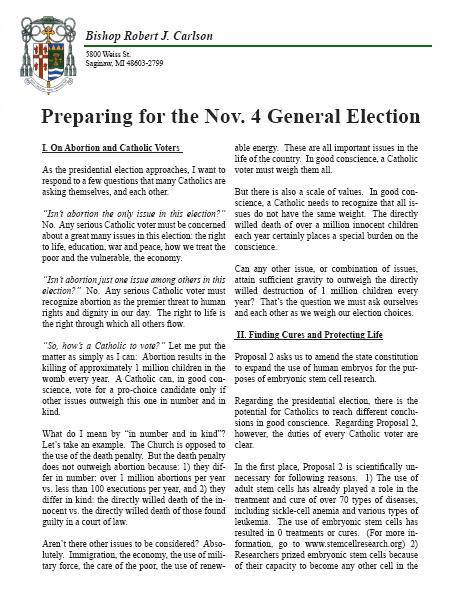
Bp. Carlson of Saginaw speaks out on Prop. 2

Bp. Carlson of Saginaw speaks out on Prop. 2His Excellency Most Reverend Robert Carlson, Bishop of Saginaw, has issued a statement to Catholics in that diocese about the issues to consider at this year’s election.

Read this also against the background of what the dreadful pro-abortion "Catholic" Governor Jennifer Granholm (D-MI) has endorsed: Prop. 2.  Bp. Boyea of Lansing has spoken against this already.

My emphases and comments.

I. On Abortion and Catholic Voters

As the presidential election approaches, I want to respond to a few questions that many Catholics are asking themselves, and each other.

“Isn’t abortion the only issue in this election?” No. Any serious Catholic voter must be concerned about a great many issues in this election: the right to life, education, war and peace, how we treat the poor and the vulnerable, the economy.  [Watch what he does.]

“Isn’t abortion just one issue among others in this election?” No. Any serious Catholic voter must recognize abortion as the premier threat to human rights and dignity in our day. The right to life is the right through which all others flow.  [He is helping people prepare to respond to questions or objections in a conversation.]

“So, how’s a Catholic to vote?” Let me put the matter as simply as I can: Abortion results in the killing of approximately 1 million children in the womb every year. A Catholic can, in good conscience, vote for a pro-choice candidate only if other issues outweigh this one in number and in kind.  [I don’t think we have seen this approach from an American bishop yet.  I am always, btw, delighted to see a bishop speak about anything having to do with "number and kind".  We need to remind people that they must confess their sins in number and kind.  These are very important distinctions.]

What do I mean by “in number and in kind”? Let’s take an example. The Church is opposed to the use of the death penalty. But the death penalty does not outweigh abortion because:

1) they differ in number: over 1 million abortions per year vs. less than 100 executions per year, and

2) they differ in kind: the directly willed death of the innocent vs. the directly willed death of those found guilty in a court of law.

Aren’t there other issues to be considered? Absolutely.

Immigration, the economy, the use of military force, the care of the poor, the use of renewable energy. These are all important issues in the life of the country. In good conscience, a Catholic voter must weigh them all.

But there is also a scale of values. [scale of values] In good conscience, a Catholic needs to recognize that all issues do not have the same weight. [Exactly.] The directly willed death of over a million innocent children each year certainly places a special burden on the conscience.

Can any other issue, or combination of issues, attain sufficient gravity to outweigh the directly willed destruction of 1 million children every year? That’s the question we must ask ourselves and each other as we weigh our election choices.  [Clearly from this the answer is "No. They do not outweigh the willed destruction of the innocent in the millions."]

II. Finding Cures and Protecting Life  [Making it more concrete.]

Proposal 2 asks us to amend the state constitution to expand the use of human embryos for the purposes of embryonic stem cell research.

Regarding the presidential election, there is the potential for Catholics to reach different conclusions in good conscience. Regarding Proposal 2, however, the duties of every Catholic voter are clear.

In the first place, Proposal 2 is scientifically unnecessary for following reasons.

1) The use of adult stem cells has already played a role in the treatment and cure of over 70 types of diseases, including sickle-cell anemia and various types of leukemia. The use of embryonic stem cells has resulted in 0 treatments or cures. (For more information, go to www.stemcellresearch.org)

2) Researchers prized embryonic stem cells because of their capacity to become any other cell in the body. (In scientific language, they are “pluri-potent” stem cells.) Scientific breakthroughs in the last year have made it possible to take ordinary skin cells from any adult and transform them into pluri-potent stem cells. (In scientific language, these are called “induced pluri-potent stem cells” or iPS cells.) The technique has already been used to cure sickle-cell anemia in mice.  [Therefore there is no need to attempt this with embryonic stem-cells.]

In other words, there are other and better avenues for finding cures. In fact Dr. Field, the Director of the Field Neurosciences Institute (FNI), has made a statement that the FNI “will not be using human embryonic stem cells in its clinical or preclinical research projects. We believe that stem cell therapy has tremendous potential for treating brain and spinal cord damage due to trauma or disease, but that either adult-derived stem cells or inducible pluri-potent stem cells have the potential to provide therapeutic efficacy in this regard.”

In the second place, Proposal 2 goes too far as a piece of legislation. Proposal 2 would not only authorize the destruction of human embryos to obtain pluri-potent stem cells, it would take the drastic step of prohibiting any state or local law that would discourage such research. Even a regulation that required researchers to pursue all other options before turning to embryonic stem cells would be unconstitutional. In this respect, Proposal 2 is not only scientifically unnecessary, it simply goes too far.

In the third place, and most importantly, Proposal 2 is based on principles that are morally reprehensible, [morally reprehensible] namely:

1) Things like size, age, and location matter in determining whether a human life is to be accorded legal protection. If those who are very small, very young, and dependent on others for their existence are not to be accorded legal protection, it is hard to see why those who are very old, very infirm, and equally dependent on others for their existence should be accorded legal protection.

2) One group of human beings can be used to advance the well-being of another group of human beings. This is the same principle that justified slavery.  [And Nazi human experimentation.]

3) We can sacrifice the lives of some individuals for the sake of research “because they are going to die anyway.” Those with advanced dementia are also going to die. That hardly justifies using them for research.

The reasoning behind Proposal 2 establishes dangerous moral precedents. In the words of one commentator, “If a principle is established by which some indisputably human lives do not warrant the protections traditionally associated with the dignity of the human person — because of their size, location, dependency, level of development, burdensomeness to others — it would seem that there are numerous other candidates for the application of the principle, beginning with the radically handicapped, both physically and mentally, not to mention millions of the aged and severely debilitated in our nation’s nursing homes.”

Finding cures for diseases is surely a great good. And science and technology are needed to show the way to those cures. But:

1) there are other avenues for research that protect life rather than destroying
it, and have a better scientific track record in finding cures, and

2) there are some things we must never do, like sacrificing our children’s lives to extend our own health and well-being.

Because it is scientifically unnecessary, because it goes too far, and because it is based on reprehensible moral principles, I call on all Catholics in the Diocese of Saginaw to oppose Proposal 2.  [There it is!]

For more information on Stem Cells and Proposal 2, visit the following websites: www.2goes2far.com, www.micause.org, www.stemcellresearch.org, and www.ncbcenter.org/10Myths.pdf

Sincerely yours in Christ,
Most Reverend Robert J. Carlson
Bishop of Saginaw


Another good statement.

Posted in SESSIUNCULA |
16 Comments

BENEDICT XVI’S PRAYER INTENTIONS FOR NOVEMBER

BENEDICT XVI’S PRAYER INTENTIONS FOR NOVEMBER

VATICAN CITY, 31 OCT 2008 (VIS) – Benedict’s general prayer intention for November is: "That the testimony of love offered by the saints may fortify Christians in their devotion to God and their neighbor, imitating Christ who came to serve and not to be served".

  His mission intention is: "That the Christian communities of Asia, contemplating the face of Christ, may know how to find the most suitable ways to announce Him, in full faithfulness to the Gospel, to the people of that vast continent so rich in culture and ancient forms of spirituality".

Posted in SESSIUNCULA |
3 Comments