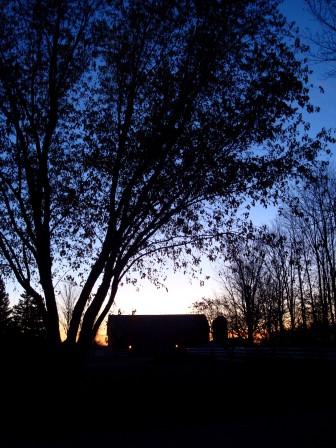
This morning I went out and could smell woodsmoke as the morning birds began their songs.

A tip of the biretta to the Laudator:
Seneca, Phaedra 483-485 (tr. John G. Fitch):
No other life is more free and blameless,
or better cherishes the ancient ways,
than that which abandons city walls and loves the forests.
non alia magis est libera et vitio carens
ritusque melius vita quae priscos colat,
quam quae relictis moenibus silvas amat.
For you who regularly use Italian or are in Italy.
There is a new Messale ordinario tradizionale. Testo latino a fronte.
The descriptive blurb:
Il Messale perpetuo non solo per i fedeli della Santa Messa Tradizionale detta di San Pio V, ma dal 14 settembre 2007 anche per tutte le parrocchie e i sacerdoti in seguito alla liberalizzazione della messa in latino ad opera di Papa Benedetto XVI, rieditato in forma elegantissima per tutte le parrocchie, da mettere sui banchi in chiesa. 64 pagine, copertina in simil tela con impressioni in oro, immagini sacre, facilita’ di consultazione, qualita’ grafica. Uno strumento indispensabile per chi vuole partecipare con profitto al Santo Sacrificio. Un’opera realizzata con elevatissima qualita’ artistica.
Nota Breve : Messalino economico da uso comune, da mettere sui banchi delle parrocchie.
In an interview with Zenit, Giovanni Zenone, editorial director of Fede & Cultura stated that the older rite "brings us closer again to Orthodox Christians".
This is a very good point. Our liturgy and our identity are bound up with each other. Thus, like the liturgy did for the Orthodox in many places, it protected the identity of the people from ungodly attacks of materialist atheists or fundamentalist religious extremists. In the West, we need that sort of bulwark against the encroaching relativism we are experiencing. However, having a rite that is more stable and in continuity with the past also gives us common groud for dialogue with the Orthodox. Perhaps we can win their respect again, on the liturgical front, through a use of our own traditional liturgical expresssions.
The new messale and the "pew version" for churches, has a preface by Card. Castrillon of the PCED.
You all know Mr. Chickadee, with his jaunty little black cap. He is considering his next move as he looks with obvious disapproval at the fare – from just before I went on my eastern journey.

They like the black sunflower seeds better than anything, it seems.
Here is a finch of some sort. I don’t know who.
This finch was rather calm, unlike the flitty Chickadee. He/she just sort of stared into space, zombie-like.
Maybe this is the Zombie Finch.
Anyway, I don’t know this brand, or if this is a winter plumage or if this is a migrating species who just stopped for a snack.
 .
UPDATE 30 Oct 08 13:56:
The fine canonist Ed Peter’s on his canon law blog digs into the issue of the heretic Fr. Dresser.
END UPDATE
_____
A concerned reader sent me this story from The Australian. Read it and weep.
As a preamble, let us review what I have called my quintessential old-style ICEL prayer.
O God,
you are so big.
Help us to be big
like you.
Read on now, gentle reader, with my emphases and comments.
Church row escalates as priest denies Jesus was God
Tess Livingstone | October 29, 2008
THE controversy surrounding one of Australia’s most radical Catholic churches, St Mary’s South Brisbane, has escalated into a wider debate over bedrock Christian beliefs.
On the line for parishioners of St Mary’s and several other parishes in Queensland and NSW are fundamental church doctrines such as who can celebrate Mass, [and even more fundamental] whether Jesus Christ was God, whether Mary had as many as six children, the bodily Resurrection, and the need for sacramental celebrations for same-sex marriages. [The poor reporter maybe isn’t seeing that these are not equivalent issues. Some of them, like the resurrection and above all divinity of Christ are more important than the others.]
In a booklet being sold for $20, [Okay… so there is a written, published proof.] a NSW priest, Peter Dresser of Coonamble in the Diocese of Bathurst, insists Jesus was not God and did not think he was God. The booklet is on sale at two Brisbane parishes: St Mary’s and the Wooloowin/Windsor/Kalinga Parish of outspoken Brisbane priest Richard Pascoe. [Okay… so… where is the bishop and the CDF? WHY. IS. THIS. GUY. STILL. THERE?]
In God is Big. Real Big! [You know… you just can’t make things up fast enough.] Father Dresser — who prefers to be known as Peter — says: "This whole matter regarding Jesus being God … not only does violence to my own intelligence, but must be a sticking point for millions of people trying to make some kind of sense of the Christian religion … No human being can ever be God, and Jesus was a human being. It is as simple as that." [This is heresy. Folks, if you were ever looking for a heretic, this guy’s it. Furthermore, he seems to be a rather thick heretic. If there is anything to be said about the mystery of the two natures of Christ, it is not "simple".]
Father Dresser said he found his own rural flock "very conservative" [i.e., they believed Jesus is God?] and admitted that many of them found his theology difficult to accept. [LOL! That’s not hard to imagine. Picture it: A congregation of rural Aussies… maybe farmers, ranchers, I don’t know, with perhaps some permanent dirt in the callouses of their worn hands and lot’s of sun-deeped laugh lines listening to "Just-Call-Me-Pete" in the pulpit saying that Jesus isn’t God.] He said he had rethought his approach after taking an interest in science. "I’m delighted they’re opening up the debate at St Mary’s," he said. [I would be delighted to know what the date of his removal will be.]
In his book, Father Dresser claims Mary had as many as six children, Joseph was the father of Jesus and the bodily Resurrection is not to be taken literally. ["And if Christ be not risen again, then is our preaching vain: and your faith is also vain." 1 Cor 15:14]
Sydney lecturer in church history, Anthony Robbie, said Father Dresser’s claims defied all scriptural evidence.
"What a breathtaking know-all, [I have other words.] to claim he knows the mind of Christ contrary to scripture and tradition. His words rob Christianity entirely of its meaning and purpose," Father Robbie said.
"The Council of Nicaea settled the question that Christ was God in 325, so he is 1700 years out of date. The rest is a regurgitation of every discredited 19th-century liberal Protestant German cliche in the book." [Worse than a Bultmaniac, perhaps.]
Recently, the priests at St Mary’s — Peter Kennedy and Terry Fitzpatrick — also canvassed the idea of Catholics celebrating the Eucharist in their homes, without a priest.
A discussion paper handed to parishioners [Another written proof.] by Father Kennedy and written by Charles Kelliher said the lack of priests in the 21st century should prompt the faithful to look back to the first 200 years of the church, before the priesthood and the church hierarchy came into existence.
"Like the house church of the first 200 years, it is the community of believers who can concelebrate and bring about the presence of Christ in the eucharistic celebration. [Sounds like Schillebeeckx. Actually… this is all sounding familiar to me personally. More on that later.] Let us embark on the journey as a community of believers in the modern day house church.
"The community of believers would call forth one of its members to preside at this memorial service. This person could be either man or woman, married or single … with no special designation except being chosen or called forth to leadership by the community." [Yep. Schillebeeckx.]
The director of adult education in the Archdiocese of Sydney, Opus Dei priest John Flader, said the earliest celebrants of the Eucharist were called presbyters, a Greek word meaning elders, but they had been appointed by the laying-on of hands by a bishop, and there was no evidence that women took such roles. "Even as early as around 100AD, Pope Clement I wrote to the church in Corinth setting out the authority of Rome over the local church, including the presbyters," Father Flader said. "Suggesting that lay people gather in homes today and pick someone to celebrate the Eucharist is absurd. [even stupid] It would never be valid."
St Mary’s has continued with eucharistic prayers celebrated by the congregation with women leading much of the mass. Recent preachers have included "community jester" and activist Tony Robertson.
While some argue that St Mary’s should be closed, some priests say this would drive the teachers who attend the church towards informal services at home, which could influence the children they teach. "They say they regard themselves as Catholic so it would be better to ensure they conform to the Church’s teachings and practice. These are not optional," said one.
All this from a guy who is stupid enough to put his name on something called God is Big. Real Big! and then actually give it to people.
When I was in the then very sad bastion of wierdness, the seminary I went to in the USA, this was the sort of crap we were manured in day in and day out. Pure Schillebeeckx for anything having to do with Eucharist and Orders. Old Protestant Christology. Completely wacky liturgical creativity which still gives me shudders. All this was poured over us with the tenderest of intentions on the part of the faculty, most of whom probably did their field training at Lubyanka before coming to the seminary. Very few were the moments of sanity. The rest was a nightmare.
I remember clearly one day walking out of a Christology class during our second year. One guy behind me said to another, "That whole thing about Christ having two natures is a pretty interesting idea."
First, note the eloquent reduction of this dogma and mystery of faith to "thing", like the deep thinker "Just-Call-Me-Peter", above. Second, note that the two natures "thing" came as a surprise. In second year major seminary, he hadn’t ever heard of this dogma before. Third, this "interesting things" remained at the level of an idea. In sum, an even slightly informed Christian Christology formed no part of his life, his spirituality. No part of his priestly formation.
You cannot be a priest, alter Christus, if you have screwy ideas about Christ.
What damage would a man like that do?
Just look to Brisbane for the answer.
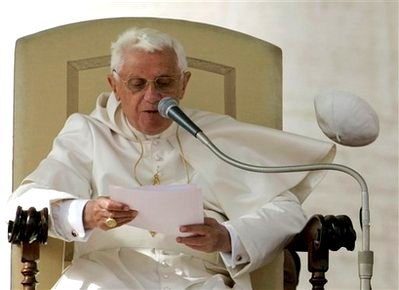
The gentlemanly Sandro Magister has provided us with an English translation of the Holy Father’s Preface to his Opera Omnia which is underway.
The first volume was, unsurprisingly, his liturgical writings. As I have been saying, liturgy is at the heart of what Pope Benedict is doing theologically.
Let’s have a look at the Holy Father’s Preface with my emphases and comments.
Preface to the initial volume of my writings
by Joseph Ratzinger
Vatican Council II began its work with a discussion of the draft document on the sacred liturgy, which was later solemnly approved on December 4, 1963, as the first result of the great Church assembly, with the rank of constitution. At first glance, it might seem to be a coincidence that the topic of the liturgy was put first in the work of the council, and that the constitution on the liturgy was its first result. Pope John had convened the assembly of bishops in a decision that everyone shared in joyfully, in order to reinforce the presence of Christianity in an age of profound change, but without presenting a definite program. An extensive series of projects had been put in place by the preparatory commission. But there was no compass to find the way amid this abundance of proposals. [Which was not really an advantage, in the long run.] Among all of the projects, the text on the sacred liturgy seemed to be the least controversial. [Hah!] So it immediately seemed to be the right choice: like a sort of exercise, so to speak, with which the fathers could learn the methods of conciliar work.
What seems to be a coincidence at first glance turns out to be, after looking at the hierarchy of themes and tasks of the Church, intrinsically the most just thing as well. By beginning with the theme of "liturgy," the primacy of God, the priority of the "God" theme, was unequivocally brought to light. [Get that? Liturgy aims at the priority of God. This makes sense, since it is our direct open worship as individuals and as a Church. Liturgy shapes what we believe, not just expresses what we believe.] The first word of the first chapter in the constitution is "God." When the focus is not on God, everything else loses its orientation. The words of the Benedictine rule "Ergo nihil Operi Dei praeponatur" (43,3; "So let nothing be put before the Work of God") apply specifically to monasticism, but as a statement of priority they are also true for the life of the Church, and of each of its members, each in his own way. It is perhaps useful to recall that in the term "orthodoxy," the second half of the word, "doxa,"does not mean "opinion," but "splendor," "glorification": this is not a matter of a correct "opinion" about God, but of a proper way of glorifying him, of responding to him. Because this is the fundamental question of the man who begins to understand himself in the correct way: how should I encounter God? So learning the right way of adoration – of orthodoxy – is what is given to us above all by the faith. [This is profound. The Holy Father has in the past criticized Gaudium et spes, for example, because it wasn’t adequately centered in Christ, though he concedes that the central section, such as GS 22 helps to save the document by adding the proper hermeneutic: Christ reveals man more fully to himself. In the liturgy, which both expresses and shapes our faith, we are in contact with the true Actor in the liturgy, Christ the High Priest. We learn also who we are when we are being liturgical.]
When I decided, after some hesitation, to accept the project of an edition of all of my works, it was immediately clear to me that the order of priorities at the Council also needed to be applied to it, and that therefore the first volume to be published had to be the one containing my writings on the liturgy. Ever since my childhood, the Church’s liturgy has been the central activity of my life, and it also became, under the theological instruction of masters like Schmaus, Söhngen, Pascher, and Guardini, the center of my theological work. [There it is! The point I have been hammering for years.] I chose fundamental theology as my specific topic, because I wanted above all to go to the heart of the question: why do we believe? But right from the beginning, this question included the other one about the proper response to to God, and therefore also the question about the divine service. It is on this basis that my work on the liturgy must be understood. I was not interested in the specific problems of liturgical study, but in the anchoring of the liturgy in the fundamental act of our faith, and therefore also its place in our entire human existence. [YES! Details are important only insofar as they bring us to the real point of liturgical action. Otherwise they are a distraction.]
This volume now collects all of my short and medium-length work in which over the years, on various occasions and from different perspectives, [therefore showing evolution] I have expressed positions on liturgical questions. After all of the contributions that came into being in this way, I was finally prompted to present a vision of the whole, which appeared in the jubilee year 2000 under the title "The Spirit of the Liturgy." This constitutes the central text of the book. [This is the reference work. This is what he said he hoped would spark a new liturgical movement.]
Unfortunately, almost all of the reviews [I think he is refering to review in scholarly journals] of this have been directed at a single chapter: "The altar and the direction of liturgical prayer." Readers of these reviews must have received the impression that the entire work dealt only with the orientation of the celebration, and that its contents could be reduced to the desire to reintroduce the celebration of the Mass "with [the priest’s] back turned to the people." [The key word there is "reduced". The book is about far more than that.] In consideration of this misrepresentation, I thought for a moment about eliminating the chapter (just nine pages out of two hundred) in order to bring the discussion back to the real issue that interested me, and continues to interest me, in the book. It would have been much easier to do this because in the meantime, two excellent works had been published in which the question of the orientation of prayer in the Church during the first millennium is clarified in a persuasive manner. I think first of all of the important, brief book by Uwe Michael Lang "Turning Towards the Lord: Orientation in Liturgical Prayer" (Ignatius Press, San Francisco, 2004), and in a special way of the tremendous contribution by Stefan Heid, "Atteggiamento ed orientamento della preghiera nella prima epoca cristiana [Attitude and orientation of prayer in the early Christian era]" (in "Rivista d’Archeologia Cristiana" 72, 2006), in which the sources and bibliography on this question have been extensively illustrated and updated. [Kudos to my friend Fr. Lang for the mention by the Pope!]
The result is entirely clear: the idea that the priest and people should look at each other in prayer emerged only in modern Christianity, and is completely foreign to ancient Christianity. [Did you get that? "completely foreign". So… the Holy Father is worried about the way his own treatment of this issue was handled by others. But here he is talking about how important liturgical orientation is.] Priest and people certainly do not pray to each other, but to the same Lord. So in prayer, ["in prayer" is the key here… if they are praying they look to the Lord whichever way they are oriented.] they look in the same direction: either toward the East as the cosmic symbol of the Lord who is to come, or, where this is not possible, toward an image of Christ in the apse, toward a cross, or simply toward the sky, as the Lord did in his priestly prayer the evening before his Passion (John 17:1). Fortunately, the proposal that I made at the end of the chapter in question in my book is making headway: [That is… the "Benedictine arrangment" of the altar with the Cross at the center. The Pope is pleased with how priests are adopting this.] not to proceed with new transformations, but simply to place the cross at the center of the altar, so that both priest and faithful can look at it, in order to allow themselves to be drawn toward the Lord to whom all are praying together.
But [But] with this I may have said too much on this point, [But apparently not… since this man doesn’t write without purpose.] which represents just one particular of my book, and I could have left it out. [But he didn’t.] The fundamental intention of the work is that of placing the liturgy above the often frivolous questions [excellent… "frivolous"] about this or that form, in its important relationship, which I have sought to describe in three areas that are present in all of the individual themes. [THREE THEMES] In the first place, [1] there is the intimate relationship between the Old and New Testament; without the relationship with the Old Testament heritage, the Christian liturgy is absolutely incomprehensible. The second [2] area is the relationship with the world religions. And finally, there is a third area: [3] the cosmic nature of the liturgy, which represents something beyond a simple meeting of a larger or smaller circle of human beings; the liturgy is celebrated within the vastness of the cosmos, it embraces creation and history at the same time. This is what was intended in the orientation of prayer: that the Redeemer to whom we pray is also the Creator, and so there always remains in the liturgy love for creation and responsibility toward it. [Sounds also like a starting point for a theology of ecology or environment.] I would be happy if this new edition of my liturgical writings could contribute to displaying the great perspectives of our liturgy, and putting certain frivolous controversies about external forms in the right place. [Excellent. Move beyond the frivolous. People need to spend more time in Ratzinger’s books actually thinking about what they are reading.]
Finally, and above all, I feel the need to express thanks. My thanks is due in the first place to Bishop Gerhard Ludwig Muller, who has taken charge of the "Opera Omnia" and has created both the personal and institutional conditions for its realization. In a very special way, I would like to thank Prof. Dr. Rudolf Voderholzer, who has invested extraordinary time and energy in gathering and organizing my writings. I also thank Dr. Christian Schaler, who is providing valuable assistance. Finally, my sincere thanks goes to the Herder publishing house, which has taken on the burden of this difficult and laborious work with great love and attentiveness. May all of this contribute to a deeper understanding of the liturgy, and its worthy celebration. "The joy of the Lord is our strength" (Nehemiah 8:10).
Rome, feast of Saints Peter and Paul, June 29, 2008
In the final analysis, the Holy Father is both underscoring the importance of ad orientem worship while simultaneously trying to reconnect it to a larger idea. This is why he both tries to deemphasis the issue and then spend so much ink on it in his preface.
He is trying to reorient our discussion of orientation… get it back on track. This is why he says he thought about removing the pages: It would be better to shelve that discussion than to get it wrong and blabber about it.
This is not to say that he does not think that the orientation question is not important.
Quite the contrary!
It is so important that we must get it right.
It is, perhaps, like one of those journeys which could go very well planned properly, or very badly if it is botched from the beginning and then persued blithly along the wrong path. It is like a cure for a disease which, if undertaken in just the right way, will produce a marvelous healing or, on the other hand, more harm than good if proper care is not taken at the very beginning.
The explanation in the Preface is another contribution to Papa Ratzinger’s already profound reflections. He is helping us with yet another interpretive principle.
Speaking of interpretation, notice his underlying concept of continuity. There must be continuity with ancient and contemporary forms of worship ("looking at each other" is foreign to Christian worship until recently). There must be continuity between Old and New Testament if we are going to understand Christian worship. There must be continuity between the sphere of man’s work in the world and the cosmos, all of creation. At the heart of what Papa Ratzinger is pointing to is the interconnectedness of all our spheres of work and there is a divine component at the heart of every one of those connections.
His use of Nehemiah at the end struck me in this regard.
We seek strong bonds, stronger connections, greater continuity, not lesser. In that verse, the Pope directs our attention to the source of the strength: God. When God is the center, there is strength and joy. Notice that verse says "the joy of the Lord". It is hard to tell if this is objective or subjective, that is, the joy that comes from the Lord as joy’s own source or the joy we have from our perspective when we are coming to know God and His mysteries. Obviously these converge in continuity, become seemless and simultaneous. We make only logical distinctions about them.
Enfolded in the Nehemiah verse itself is an interpretive principle.
At Catholic Culture there is an interesting piece by Jeff Mirus.
My emphases and comments:
“Pitiful Diatribes on Exterior Forms” Posted Oct. 27, 2008 1:28 PM by Dr. Jeff Mirus
If you argue endlessly about this or that form of the liturgy and can be satisfied with nothing less than what you regard as ideal, Pope Benedict wants to yank your chain. The comments in question were made in his preface to the first volume of a German language edition of his complete works, a volume collecting Joseph Ratzinger’s writings on the liturgy from his university days until his election as Pope. [NB: This is all second hand, and we must take as editorializing the "argue endlessly" and "yank your chain". But there is something useful here: arguing for X while being locked into a specific closed position. Most people who do that are not so well grounded in the larger picture.]
In the preface, Benedict wrote: “It would please me very much if the new publication of my writings on the liturgy could contribute to making visible the great perspectives of our liturgy, putting again in their place the small and pitiful diatribes on exterior forms.” [This restates what I mention above. There are reasons why Pope Benedict does what he does. The so-called "Benedictine arragment" of the altar for papal Masses is not merely a reflection of his personal preferences. Or rather, he has aligned his personal preferences to what he come to embrace theologically after reflecting for many years on the function of the Cross and our orientation at the altar. The real problems are raised by people who take stubborn stands on the basis of personal preference without sufficient reasons.]
Ouch.
Apparently Benedict had seriously considered removing nine pages from his book The Spirit of the Liturgy: An Introduction (2000), ["Apparently"?] which is the chief item in the first volume of the collected works. These nine pages covered his ideas on the orientation of the priest when celebrating Mass, and Benedict was concerned at the amount of petty and partisan controversy those pages generated. He did not want to see that happen again. [We must remember the sort of ridiculous blather that erupted from especially the progressivist side when Pope Benedict began to shift the orientation of the Mass, and when he celebrated ad orientem in the Sistine Chapel. The more traditional are also guilty of this to a degree when they claim victory on the basis not of really good arguments and reasons, but on the basis of their preferences.]
He hopes people will take a broader and more balanced view of the same issues when they are revisited in the collected works. His goal is to get beyond “often pedantic questions about one form or another” [It is hard to know what that means, out of context as it is. What is "form" here? Orientation of the altar? Extraordinary/Ordinary?] to a greater understanding of the cosmic significance of the liturgy, which “embraces together creation and history” with Christ at the center as Savior, on Whom we are all to be focused in liturgical prayer. For Benedict, this same cosmic significance ultimately lies behind every liturgical form. [Of course it does. And that is why he wrote what he wrote about ad orientem worship in Spirit of the Liturgy.]
I look forward to getting this text and checking out what the Holy Father wrote in the preface.
Our outward liturgical signs point to deeper realities. At all times during the Church’s liturgies, whether Holy Mass or others, we are, like Moses in Exodus 33, peering through a cleft in the rock at something mysterious beyond our ken. When the elements of liturgy do not foster the glimpse through the cleft, then something is wrong.
Also, the adage that that which is received is received in the manner of the one receiving is also to be applied. When your own approach and attitude (which you can choose to adjust) is to look at the liturgical action as a matter of curiosity, then something is lacking. Even a fascination by why the book is moved from one side to the other, or why a incense is used, can be a distraction, a turning away from the cleft, if that is all the farther you go. Interest must at a certain point move to awe. Until it does, great care should be taken before making monolithic statements about how liturgy should be done.
Over at Standing On My Head Fr. Dwight Longenecker has something to say about saying Mass ad orientem.
Let’s have a look with my emphases.
Here’s a suggestion and question about the liturgy. I was celebrating Mass on Sunday away from St Mary’s and so I did not celebrate ad orientem.
I did, however, go around to the front of the altar, and facing the people, administered the Kiss of Peace. After sharing the Kiss of Peace with the altar servers, I turned East, (facing the altar) for the Agnus Dei, fraction, priest’s prayers before communion, and then turned with the chalice and host back to face the people for the "Behold the Lamb of God."
It seems to me that this is a dignified and sensible way that those who wish to move toward the East might do so in a simple way which begins to introduce people to this posture. It also has the advantage of setting off the Kiss of Peace. I came around the front of the altar marking this part of the liturgy as my address to the people, and by turning my back to them and going to the altar facing East for the Agnus Dei etc. there was a clear indication that the Kiss of Peace was over. (This is a good way to conclude a Kiss of Peace that has turned into a happy time to greet one’s friends)
That’s the suggestion. The question is, "Is there any reason why this should not be done more widely?"
My initial reaction is that this could be a good way to begin shifting people now unused to ad orientem worship back to the proper direction.
At the same time, there is something about using both sides of the altar that leaves me a little unsettled. There is nothing against it in the rubrics, obviously. I think this might be an initial impression that may not have a very good basis.
The dreadful pro-abortion but "Catholic" Governor of Michigan, Jennifer Granholm (D-MI) is now showing her colors.
Apparently, Gov. Granholm is in favor of an embryonic stem-cell research referendum which is on the ballot in Michigan. This is "Proposal 2".
Proposition 2 would give unrestricted license to perform destructive experiments on human embryos
Last Sunday Gov. Granholm said in a speech, "As a Catholic, I can say to be pro-cure is to be pro-life."
For years I have said that pro-death rhetoric would be morphed into a Kafka-esque imitation of a pro-life position. People would argue that if you are not in favor of abortion (for the sake of "research") then you are not truly pro-life because you are against granny getting her cure for [fill in the blank]. This is the flip side of the argument that abortion is merely one among many problems we must consider, and not maybe the most important.
In any event, though it is entirely incredible that Gov. Granholm would not by know the Church’s position on the dignity of human life as it pertains to the unborn, she does The Pelosi in a public address. She has been stumping for pro-abortion presidential candidate Sen. Barak Obama (D-IL) and pro-abortion "Catholic" Sen. Joseph Biden (D-DE) who also did The Pelosi on Meet The Press and throughout his long and undistinguished career in the Senate.
The bottom line is this: If you know what the Church’s teaching is, you cannot be a good Catholic and be in favor of the death of human beings for the sake of medical research. That would make you a Darwinian, not a Catholic.
Gov. Granholm’s statement drew a response from the Bishop of Lansing (the state capital of Michigan), His Excellency Most. Rev. Earl Boyea.
On the website of the Diocese of Lansing:
Bishop Responds to Governor
The Most Reverend Earl Boyea, Bishop of Lansing, issued the following statement on October 27, 2008 in response to recent comments by Michigan Governor Jennifer Granholm:
In a Sunday address in Grand Rapids, Governor Jennifer Granholm incredibly said of Proposal 2 "As a Catholic, I can say to be pro-cure is to be pro-life." Of course, Catholics and all other responsible citizens will continue to seek cures for disease and injury. But to imply that Proposal 2 is a valid expression of Catholic principles is shocking. Nothing could be further from the truth.
Proposal 2, which goes before Michigan voters in a week, would give an unrestricted license to those who perform destructive experiments on human embryos. While the Catholic Church strongly supports legitimate forms of stem cell research and all other proper forms of scientific inquiry, the Church also teaches that is it is always immoral to destroy a human embryo. For that reason, the Catholic Bishops of Michigan have taken a strong position in opposition to this well-funded assault on human life.
Saint Paul reminds us that we must preach the Truth in season and out of season. The Truth will never go unspoken. To be in favor of Proposal 2 is not to be pro-life. A well-formed Catholic conscience would never lead a person to support Proposal 2 "as a Catholic."
Brief, but clear.


Coat of Arms by D Burkart
 ex seaxe on Pope Leo XIV airplane interview: remarks about relaxing Traditional Latin Mass restrictions: “Asked whether he would reconsider his priorities after his surgery and the long trip, Leo replied, “I don’t feel like…”
 on Pope Leo XIV airplane interview: remarks about relaxing Traditional Latin Mass restrictions: ““the Rite of the Vatican Council II, of Paul VI” I’m not very happy with the Novus Ordo being described…”
 on Daily Rome Shot 1119: “I loved the first comment showing on the tweet regarding the Vatican’s decision regarding Bishop Martin of North Carolina’s decree…”
 on Pope Leo XIV airplane interview: remarks about relaxing Traditional Latin Mass restrictions: “@Fr. Jackson, Conversely, if the Pope and those in the Vatican cannot see the difference between Traditionalists who have remained…” on Pope Leo XIV airplane interview: remarks about relaxing Traditional Latin Mass restrictions: “@Rod Intentional or not. With malice or without. I suspect that many within the Vatican, especially among the Curia, consider…”
 on NB: Desktop and Posting – Zuhlsdorf’s Law kicks in – UPDATE: “AI does have its uses. Both good and bad. I’ve been using extensively to help me configure some servers I…”
 on Pope Leo XIV airplane interview: remarks about relaxing Traditional Latin Mass restrictions: “I do wonder to what extent a certain set of Episcopal Consecrations on July 1st created the impression of a…”

A Daily Prayer for Priests








They find you a pro-life agent in your area who commits to giving a portion of the fee to a pro-life group!

PLEASE subscribe via PayPal if it is useful. Zelle and Wise are better, but PayPal is convenient.
A monthly subscription donation means I have steady income I can plan on. I put you my list of benefactors for whom I pray and for whom I often say Holy Mass.
In view of the rapidly changing challenges I now face, I would like to add more $10/month subscribers. Will you please help?
For a one time donation...



Help Monks in Wyoming (coffee – UPDATED LINK) and Norcia (beer) and the wonderful "Soap Sisters" of Summit, NJ!


Please follow me on Twitter!










Visits tracked by Statcounter
since Sat., 25 Nov. 2006:
 Bishop Responds to Governor

