Two greats speak at the Synod: Card. Zen and Archbp. Burke

Here are two interventions from the Synod:

— H.E. Most. Rev. Raymond Leo BURKE, Archbishop Emeritus of Saint Louis, Prefect of the Supreme Tribunal of the Apostolic Signatura (VATICAN CITY)

1. Regarding no. 58 of the Instrumentum laboris, the Holy Scriptures teach that God has written His law upon every human heart. The divine natural law, inscribed upon the human heart, can be discovered by reason but is clearly announced to all through the inspired Word of God (cf. Rom 2:15).

2. In the context of pervasive materialism, relativism and radical individualism, it is especially urgent that the Scriptural teaching on the natural moral law be presented as the common heritage of every man.

3. Also urgently needed is the proclamation of the divinely inspired teaching on the discipline which disposes man to do what is good and to avoid what is evil. Holy Scripture teaches us that the observance of the law is not the height of man’ s self-expression, but it is the irreplaceable foundation of the highest expressions of human goodness.

4. Proclaiming the Scriptural teaching on the place of discipline in the lives of individuals and of society is a challenge in a culture which is either antinomian or has made law a tool in the hands of the most powerful.

5. Regarding the relationship of the Word of God and law, it is important to underline the service of canon law in the Church, by which the life of Christ can grow and develop in the whole Church. In his Apostolic Constitution Sacrae disciplinae leges, Pope John Paul II, describing the service of Canon Law in the Church, referred to "that long heritage of law, which is contained in the books of the Old and New Testament and from which the whole juridical and legislative tradition of the Church takes its origin, as from its first source."

6. In the Church, as in society, the understanding of the law has been obscured and, in some cases, lost, leading to gravely harmful effects, for example, the widespread disregard of liturgical laws and the failure to follow the procedural laws by which the faithful vindicate their rights and ecclesiastical delicts are duly sanctioned.

7. The deeper appreciation of the service of law in the Church, through the study of the Word of God, not only helps the Church to understand and treasure the gift of its canonical discipline for the attainment of its divine mission, but also assists society, in general, to understand and treasure the irreplaceable service of law for the attainment of the common good.

[Original text: English]

— H. Em. Card. Joseph ZEN ZE-KIUN, S.D.B., Bishop of Hong Kong (CHINA)

I would like to focus for a moment on the Word of God as Creator of the beauty of the universe and of human beings, gifted with intelligence and heart and, therefore, capable of dialogue with its Creator.

This aspect of the Word is present in Instrumentum laboris, but coming from a country where the Revealed Word strictly speaking has not reached many and where, on the other hand there is an abundance of semina Verbi in popular cultural wisdom, I would like to come back to the question and to express some personal wishes.

My first wish is that this aspect of the Word be sufficiently developed in the final text and that some pertinent recommendations are made by the Assembly.

In Hong Kong the 6 main religious work together to preserve the precious heritage of Chinese wisdom.

The Catholic Church in China has always found a good ally in the Confucian doctrine.

If, moved by charity, we can manage to instill in the young generation the traditional Chinese virtues, we shall have helped them to take a great leap forward towards sainthood.

We can see, unfortunately, what happens when these virtues are lacking: a frightening decline in the sacred values of life, marriage, the family; brazen corruption, a silencing of the voice of conscience, whereby, with the aim of making easy money, it even becomes possible to taint milk and harm the health of defenseless children or even take their lives.

A second point: it is true that this Word as Creator of the Universe and the human conscience is still a Word whose aim is salvation, which is supernatural.

Accepting this, though, I still think it is possible to recommend that, following the example of the same divine patience, great space be granted to this preparatory Word of God and that we do not fall into the temptation of hurrying. I will provide two examples.

a) I heard Professor Yang, the Nobel prize winner, say, “I am not a believer, but I won’t hide the fact that in two instances I feel touched by the mystery: the first is when I found myself faced with a scientific discovery: it is as though we have been caught looking at something we don’t have the right to. The second is when I become aware of the destructive force of technology: I begin to think that we are using forces we should not.”

I must confess it did not occur to me to ask the professor when he will take the next step. Rather I would have told him he was close to the Kingdom of God.

b) The second episode. A conscientious and patriotic journalist is unjustly condemned for spying. As a young man, when he was a student in a Protestant college, he had refused to read the Bible in public because he was an atheist, but then in the long silence of internment the Gospel had found its way into his heart.

A few days ago we met at a luncheon. Well, I hope you won’t be scandalized if I tell you that on that occasion I complimented him for the time he’d refused to read the Bible.

[Original text: Italian]

And the man who may be the next Prefect of the CDW…

— H. Em. Card. Antonio CAÑIZARES LLOVERA, Archbishop of Toledo (SPAIN)

The intervention refers to catechesis, as one aspect of the ministry of the Word. The essential and fundamental role of catechesis should be underlined in the transmission of the Word of God, whose peculiarity lies in being a period of teaching and maturity, of a living reflection on the ministry of Christ, of integral initiation — enlivening, ordered and systematic — to the Revelation that God Himself made to man in Jesus Christ, neither isolated from life nor artificially juxtaposed to it, and safe-guarded in the profound memory of the living Tradition of the Church. Catechesis introduces, starts listening and welcomes the Word and the teachings of the Apostles in the liturgy, in the evangelical moral life conforming to charity and to prayer.

Without catechesis the majority of Christians would not be able to adapt and express the Gospel in their lives, nor to act in a missionary and apostolic way, nor to successfully face up to the current spiritual and cultural tendencies. Only by starting with a serious, authentic and renewed catechesis, is the Church able to forcefully explain the range of the elements and functions of its evangelical mission.

It is necessary that catechesis as the evangelizing work of the Church, finds its foundation in the nature of Christian revelation and the living Tradition of the Church, as expressed in the Constitution Dei Verbum of Vatican Council II.

When catechesis places itself in this perspective, it inspires the adoration and together with it, the admiration and the wonder in the presence of God. With the strength of its witness, it speaks of God to give glory to Him. This is the source of praise, the action of grace and supplication. Here initiation is rooted in the listening and the obedience to the Word of God, to prayer and liturgy. Also from this arises a life corresponding to God’s will. When catechesis is based on this, the desire for God is born in the heart of man, the search for Him, contemplation of His Face, which is the Word made flesh, Jesus Christ, the joyous experience of being with Him, He who is Love, contemplated in His Incarnated Word and to live in accordance with Him in love and walking in hope.

[Original text: Spanish]
Posted in SESSIUNCULA |
Comments Off on Two greats speak at the Synod: Card. Zen and Archbp. Burke

The Al Smith dinner is on live stream C-Span

Sen. Obama is speaking, right now, live at the Al Smith Dinner:

C-SPAN

Obama is really pretty funny!  Good writers!

Posted in SESSIUNCULA |
26 Comments

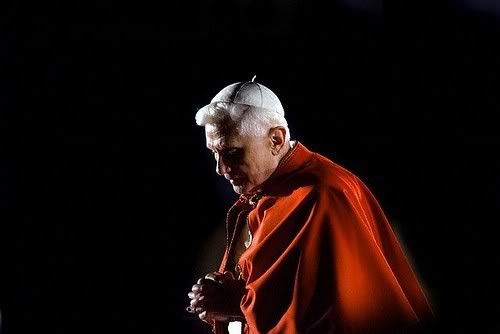
Pope Benedict XVI

Biretta tip to The Crescat:

Pope Benedict XVI

Posted in SESSIUNCULA |
10 Comments

Reading material

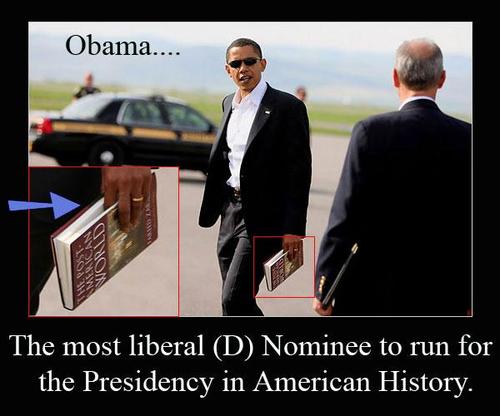
What does Senator Obama’s reading list include?

From Some Wear Hats we have this image:

Reading material

The Post-American World by Fareed Zakaria

Well… I too read books that are written from perspectives very different from mine.

Posted in SESSIUNCULA |
Comments Off on Reading material

How to write to the Holy See about liturgical abuses or anything else

Damian Thompson over at Holy Smoke has a post about how to write to the Holy See.   You can go to Damian’s place to read the many comments.

An anonymous post that orthodox Catholics should read

An anonymous Holy Smoke reader describing himself as "a person of some influence" in the Catholic Church has written a fascinating post offering advice on how the faithful should respond to the liturgical atrocity planned to mark "Youth Sunday" next month. I am fairly sure that the author is a senior cleric with direct experience of the Vatican and that he is indeed writing from a position of authority. So here is his post, which urges caution but also points the way towards victory over the fanatical liberals who have hijacked Church agencies.

[Here is the post Damian received.]

I wish I could tell you who I am, but I am a person of some influence and a regular Holy Smoke reader. It is rare that I post on a site but I feel I should add some comments to urge caution in how we tackle this matter.

"Youth Sunday" resources are seen by very few people. If we whip up a storm they will be seen by thousands more. The agency of the Bishops’ Conference responsible for youth work was disbanded this year, largely in response to an assessment that it was ineffectual, especially in its communications. If we make this issue very visible, we will do their publicity work for them, and that is no good thing. The success of Weaving the Web was as much on the back of the publicity generated by attacks against it, as by the efficacy of its publisher.

Writing to the CDW [Congregation for Divine Worship] is worthwhile. Keep letters simple and to the point. Do not make assumptions and accusations you cannot substantiate. Tell them why you are upset but try to avoid campaigning. And PLEASE DON’T tell them how to do their job. Including evidence can be helpful, but they will check everything anyway once pointed in the right direction so don’t worry too much.  [Does this advice sound familiar?  Go HERE.]
 
Don’t worry if only a few people appear to be complaining. Many more will complain without noting the fact on Holy Smoke. In any case, the Vatican do not care about numbers. An issue is an issue and they will take notice. Petitions and perceived shows of strength just annoy them.

In structuring a letter, my advice would be to stick to the liturgical abuse factor. Don’t quote Church documents at them. They know what the rules are. I would also avoid trying to link the issues we have with this event to every single other cause that is dear to us. So maybe criticising every organisation that has any link to the material in question is a fight to be had another day. The liturgy fight is the big one. If we win that, the others will start to fall like dominos.

Once you have complained, you shouldn’t necessarily expect a reply and you definitely shouldn’t expect the Bishops of England & Wales to be publicly told off. If there is a fight to be had between Rome and Eccleston Square over this issue, it will be played out very privately. Your best measure of success will be this time next year when a very different set of resources is published.

One final word to the wise. I would counsel very very strongly against any kind of direct action. Clearly the pace of change is troublesome to many, but we are making headway in a manner that we could only have dreamed about five years ago and we are building a position far stronger than the Bishops realise. Fr. Z’s saying "brick by brick" is very apt. As each new brick is laid, the pace will only pick up.

Direct action however will set us in direct and open opposition to the hierarchy and we are not strong enough to handle that at present. It will set the work back by years, if not decades. I cannot make this point clearly enough. Indeed it is my reason for posting.

I do not intend on publishing more posts, but I will read replies.


I have written about writing on several occasions.

Here is some of my previously posted advice:

Here are good tips for writing to the Pontifical Commission "Ecclesia Dei" (or any other office of the Vatican) and an address:

  • BE BRIEF. Make your letter no longer than one side of one sheet of paper.
  • Avoid writing long-hand.  Make it easy to read.
  • Include relevant documents: Vatican dicasteries can’t act solely on the basis of Mrs. Joe Bagofdonuts’s description of events.  The best thing you can do is send concrete evidence, printed.  If someone wrote and distributed something, send a copy.
  • If you have relevent past correspondence, such as previous responses from priests or bishops, send copies.
  • Do not tell them their job!  Don’t quote canons, blah blah, as if they didn’t know them already.  Leave the incredibly obvious unsaid.
  • Do not engage in character assassination.  State FACTS with as little editorializing as possible.  Blathering on and on about how "disobedient" priests or bishops are will not strengthen your case.  State facts. They will know if they are disobedient.
  • If you must talk about your feelings, keep it incredibly short, and do not be mean-spirited. If something made you sad or angry, okay, say it, but don’t DWELL on it.  The nastier you are, the weaker your letter will be.
  • At the end thank the one you are writing to for his service, and promise your prayers.  And mean it.

In summary, be brief, send evidence, leave out the obvious, don’t vent.

Remember: if you tell a story, it is hearsay.  It really helps to have proofs.  If something happens to you personally, it would help your cause if other people also wrote letters in which they describe what they saw and heard.  These would then be included with your own letter. 

Vatican offices generally can’t do much more than make a simple inquiry unless they are presented with some sort of evidence.  This also goes for writing to bishops, though in that case bishops can more easily make inquiries.   This is why it is always good to work your way UP the chain of authority: pastor first, then bishop, and finally the Holy See, remember that every Catholic always and at any time has the right to go directly to the Holy See.  But if you work your way up the chain, you have more of a paper trail and, perhaps, more proofs to offer that the Holy See should take interest.  This is common sense.

Therefore, always keep copies of everything.

For matters having to do strictly with the the Extraordinary Form of the Roman Rite, write to:

His Eminence
Dario Card. Castrillon Hoyos
President of the Pontifical Commission "Ecclesia Dei"
Palazzo del Sant’Uffizio
00120 VATICAN CITY

If you want to know why I think these are good tips, I worked at the P.C. "Ecclesia Dei" for some time. 

This is personal experience.

For more general liturgical abuses or matters dealing strictly with the Ordinary Forum of the Roman Rite, write to:

His Eminence
Francis Card. Arinze
Prefect of the Congregation for Divine Worship
       and Discipline of the Sacraments
Palazzo delle Congregazioni
P.zza Pio XII
00120 VATICAN CITY

Posted in SESSIUNCULA |
15 Comments

More of the bison

Yesterday I posted from my phone a photo of some bison, in a small herd.

Here are a few more.

More of the bison

More of the bison

Look at the size of one of the old bulls. 

Get all that meat moving and it could do some serious trampling.

More of the bison

On the hoof…

Posted in My View, SESSIUNCULA |
4 Comments

QUAERITUR: Can a person be stopped from kneeling for Communion?

From a reader:

Father,
The Wanderer told me to write to you and see if you perhaps answer my question. My question is in regards to receiving Communion. Hasn’t the Vatican said that a person cannot be refused Communion if they kneel? The reason for asking is because I am a member of a Catholic Network, and there is a person who also is a member of the same network who has said that her priest has told her to stop kneeling for Communion. Can you give me some help on this?

In short: No.  People may not be prevented from kneeling.

The CDW document on liturgical abuses Redemptionis Sacramentum states:

[90.] “The faithful should receive Communion kneeling or standing, as the Conference of Bishops will have determined”, with its acts having received the recognitio of the Apostolic See. “However, if they receive Communion standing, it is recommended that they give due reverence before the reception of the Sacrament, as set forth in the same norms”.

[91.] In distributing Holy Communion it is to be remembered that “sacred ministers may not deny the sacraments to those who seek them in a reasonable manner, are rightly disposed, and are not prohibited by law from receiving them”. Hence any baptized Catholic who is not prevented by law must be admitted to Holy Communion. Therefore, it is not licit to deny Holy Communion to any of Christ’s faithful solely on the grounds, for example, that the person wishes to receive the Eucharist kneeling or standing.


Not licit.  That is to say, it is against the Church’s law to prohibit someone from kneeling for Communion.

Posted in ASK FATHER Question Box, SESSIUNCULA |
41 Comments

Because we really need more options…

From ZENIT:

VATICAN CITY, OCT. 14, 2008 (Zenit.org).- The Holy See has approved three alternatives to "Ite, missa est," the final words said by the priest at Mass.Cardinal Francis Arinze, prefect of the Congregation for Divine Worship and the Sacraments, today notified the participants in the synod of bishops on the word of God about the new alternatives. The final message is currently rendered in English: "The Mass is ended, go in peace."

Benedict XVI has approved the alternatives, which were requested at the 2005 synod on the Eucharist to express the missionary spirit that should follow from the celebration of Mass.

According to Cardinal Arinze, the Pope had asked for suggestions to be presented. The congregation received 72, from which they prepared nine proposals. The Holy Father has chosen three.

The alternatives are in the revised third "editio typica" of the Roman Missal, which was printed last week, the cardinal said.  [I hope it has better art this time.  I’ve seen better art on refrigerators than what they put in the Missale.]

The alternatives are:

–"Ite ad Evangelium Domini nuntiandum"
–"Ite in pace, glorificando vita vestra Dominum"
–"Ite in pace" with "alleluia, alleluia" added during Easter season.

In English, these could be rendered along the lines of "go to announce the Gospel of the Lord"; "go in peace, glorifying the Lord with your lives"; and simply, "go in peace (alleluia, alleluia)."

The original Latin final message, "Ite, missa est," has not been modified.

Because we really need more options.

Posted in SESSIUNCULA |
63 Comments

Wacky wymynpryst wannabes wend way to Wome

UPDATE: 20:43 GMT

This is from Bridget Mary’s Blog (a Call To Action type… get ready for zany stuff if you visit that blog.  You think it’s all a joke, at first, then you realize she means it.). 

You can click the photos for larger images.  Fun!

Vatican and Italian Police Stop and Seize Passports of Roman Catholic Womenpriests Advocates and Activists

Ree Goes to the Vatican (fifth person in vestments/red stole)

Wacky wymynpryst wannabes wend way to Wome Italian and Vatican Police Confront Women Outside St. Peter’s in Rome Congratulations to the Worldwide Coalition, Speaking Truth to Power for Justice for Women in the Roman Catholic Church!

Wacky wymynpryst wannabes wend way to Wome

Wacky wymynpryst wannabes wend way to Wome
Italian, Vatican police stop and apprehend passports of Catholic representatives delivering petition  [Too bad they weren’t thrown into the Vatican’s hoosgau!]

ROME, Italy – Yesterday, at 6:00 o’clock, the Italian police stopped representatives of Catholic organizations [We deny the premise.  They aren’t Catholic from where I’m sitting.  And the Italian police are supposed to stop ANY protesters who come into St. Peter’s Square.] from around the world as they walked into St. Peter’s Square to deliver a petition calling for the restoration of women’s ordination to the diaconate. The group was holding a banner saying "Ordain Catholic Women" and handing out educational materials. [Yah… that’s not so good either.] A total of thirteen members of the Italian and Vatican police gathered to question the eleven representatives. After taking their materials, the Italian police demanded their passports  [Good!]  and called the Vatican police, who sent their chief. According to a member of the Italian police, this was the first time in 15 years the chief came to question demonstrators. He did not allow them to deliver the petition to the Portone di Bronzo but said he would deliver it to the pope himself. [Uh huh.  Sure.  "Don’t worry little lady.  I’ll make sure the Pope gets this.  Noooo problem!"]  Earlier in the day, the group brought the same banner and materials into the Square without getting stopped by the police. The representatives are in Rome during the Synod of Bishops on the Bible, calling for the full and equal participation of women in the Roman Catholic Church, including ordination as deacons, priests and bishops.
"Our peaceful action did not merit the extreme reaction of the police-sending the chief down to interrogate us while seizing our passports," [Um… yes… it did.  Remember: You are in a different country with its own laws.  Besides… I bet someone called him to say, "Hey Capo!  You won’t believe what’s going on in the piazza!  Wanna go see?  This oughta be good!  C’mon!  Carlo and Giggi have started a pool!"] stated Aisha Taylor, executive director of the Women’s Ordination Conference. "However, I was not surprised. Time and again, when it comes to women’s role in the Church, the Vatican overreacts and demonstrates just how fearful they are about the growing support for women’s ordination. "  [What deluded wretches.  There are all sorts of kooks who try to do things in the Square.  Most of them are benign.]

The Pontifical Biblical Commission determined in 1976 that there is no scriptural reason to prohibit the ordination of women. The Bible describes how women were prominent leaders in Jesus’ ministry and early Christianity. In all four gospels, Mary Magdalene was the primary witness to the central event of Christianity-Christ’s resurrection. The Scriptures also mention women who led small house churches, including Lydia, Phoebe, Priscilla, and Prisca.  [And… none of that makes any difference whatsoever!  o{]:¬)   ]

The representatives are from Britain, Germany, Japan, the Netherlands, Portugal and the United States. They represent the millions of Catholics [LOL!]  from around the world who support women’s ordination.

END UPDATE

ORIGINAL POST:

This just in from AP:

Catholic women march in Rome for female priesthood

By ALESSANDRA RIZZO, Associated Press WriterWed Oct 15, 12:23 PM ET

Catholic women seeking to become priests denounced  the church’s ban on female ordination as sexist and unjust, bringing their campaign close to the Vatican on Wednesday during a worldwide gathering of bishops.  [LOL!  Er.. um… I mean… Gosh! How sad.]

The small group of women representing Catholic organizations from around the world marched across the Tiber River close to St. Peter’s Square, some wearing signs with the names of prominent women in the early days of the Roman Catholic Church.  [I would love photos of that!]

Wacky wymynpryst wannabes wend way to Wome"Ordain Women! Ordain Women!" the woman chanted.  [I bet the Romans looked at them with great patience… as they do most of the unbalanced street people you meet everywhere.] They later tried to deliver a petition to the Swiss Guards at the Vatican, but nobody came to pick it up.  [I can visualize the warm reception they got from the Svizzeri!  LOL!]

Aisha Taylor, the executive director of the Women’s Ordination Conference in the United States, said the women wanted to call attention to [call derision down on]  the issue during the synod, a meeting of 253 bishops under way.

But the Vatican is not likely to drop its long-standing prohibition on women in the priesthood.  [There’s a little understatement!]

In May, the Vatican insisted that it is properly following Christian tradition by excluding women from the priesthood and issued a new warning that women taking part in ordinations will be excommunicated.

The church has always banned the ordination of women by stating that the priesthood is reserved for men. The decree issued in May was explicit in its reference to women.

Pope Benedict XVI led the doctrinal office before becoming pontiff in 2005. Like his predecessor, Pope John Paul II, he has consistently rebuffed calls to change traditional church teachings on divorce, abortion, euthanasia, gay marriage and the requirement that priests be male and celibate.

Taylor conceded that no discussion on women’s ordination was likely to open — and certainly not at the synod, a gathering convened by the pope when he deems necessary, and devoted this time to discussing the relevance of the Bible for contemporary Catholics.  [What kind of stupid is that?  The Synod is not about priesthood.  It is about Scripture?  And why would anyone discuss something that is definitively closed?]

Taylor did take the presence of 25 women, either as observers or experts, at the synod as a mildly encouraging sign. But — with the women representing just 10 percent of the synod and none having a vote — she said it was not enough.

"The exclusion of women from the priesthood is a grave injustice in our church … (and) a blatant example of sexism," [yawn]  she told reporters in Rome. "Even though leaders have come out saying no, and it’s over and over again, I do believe that cannot continue for too many decades."  [oh yah?]

The Vatican’s firmness on the issue has dashed the hopes of women seeking to be priests but also of Catholics who see that as an option for a church struggling to recruit men. It has also raised fears that women might abandon the Roman Catholic Church for other branches of Christianity that allow female priesthood.  [Good!  I say to them "What are you waiting for? Don’t let the door hit you, … etc."]

In March, the archbishop of St. Louis excommunicated three women — two Americans and a South African — for participating in a woman’s [fake] ordination. They were part of the Roman Catholic Womenpriests movement, which began in 2002.

Just so we know what we are dealing with here:

Posted in SESSIUNCULA |
42 Comments

Synod participant suggests Pope start a blog

This is interesting:

A Blogging Benedict XVI?
Chinese Laywoman Makes Proposal at Synod

VATICAN CITY, OCT. 14, 2008 (Zenit.org).- One of the auditors at the world Synod of Bishops has suggested that Benedict XVI opens a blog to explain the word of God in an attractive way.

The proposal was made today by Agnes Lam, president of the Catholic Biblical Association of Hong Kong.

Among her suggestions to promote the word of God so that the faithful can come to know Christ, she included the blog proposal, bringing smiles from many of the bishops. [Many of whom were asking their neighbors "What’s a blog?"]

She invited "the Holy Father to open a multi-language blog to shepherd today’s world: [a] daily scriptural verse with [a] simple reflection, brief text and plentiful images."

Lam also suggested other means for spreading knowledge of the Bible.

Above all, she recommended simple methods of meditation in a complex world. As examples, she suggested reciting verses of the Bible and lectio divina.

"Reading the Bible is like eating," Lam said, "a homemade soup prepared with love and time is delicious, while fast food is tasteless."


Posted in SESSIUNCULA |
13 Comments