Did anyone see the remarkable images of the White House illuminated with pink light to highlight breast cancer awareness?
First Lady Laura Bush, a class act, has made this an issue for this month of October.
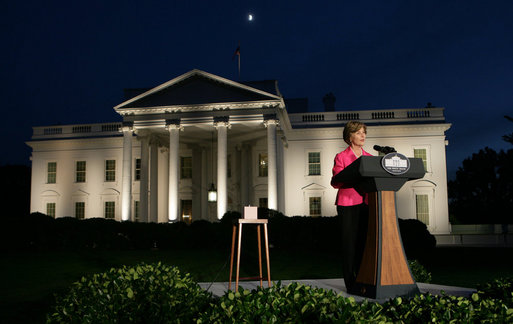
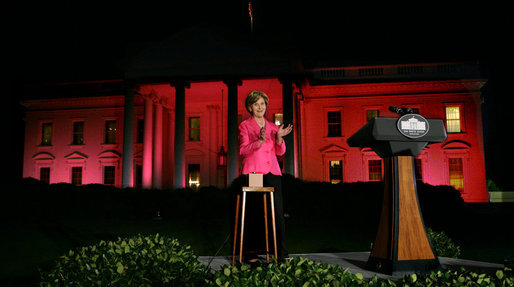
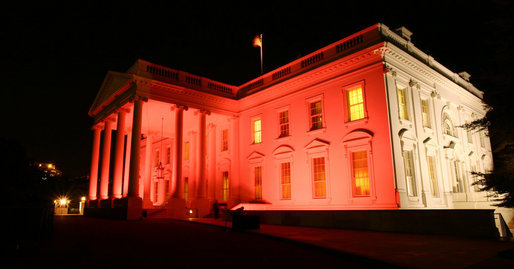
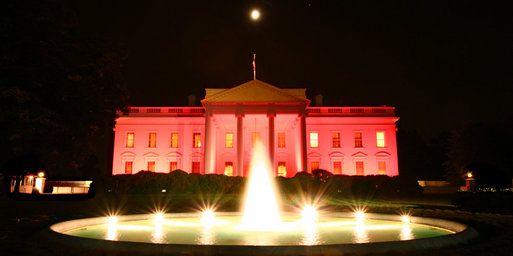


Did anyone see the remarkable images of the White House illuminated with pink light to highlight breast cancer awareness?
First Lady Laura Bush, a class act, has made this an issue for this month of October.
I’ll be saying Mass, with the 1962 Missale, at the top of this hour (thus at 22:00 GMT).
Please unite your prayers to the Holy Sacrifice for whatever your intentions may be.
Ask your guardian angels to be present.
Remember, that a single Holy Mass affects the whole world.
At the memento of the living I will remember all of you who have been so kind as to donate or send things.
I really enjoy reading Camille Paglia. Sure some of her ideas are horrifying. But she is far scarier to modern feminists than she is to me, or probably ought to be to you.
And, boy, can she write. Though I suspect she is paid by the word.
Here is a recent piece from Ms. Paglia on Salon about Gov. Sarah Palin, forwarded to me by a friend. My emphases here to items which either delighted my writer’s ear or got under my skin.
Although nothing will sway my vote for Obama, I continue to enjoy Sarah Palin’s performance on the national stage. During her vice-presidential debate last week with Joe Biden (whose conspiratorial smiles with moderator Gwen Ifill were outrageous and condescending toward his opponent), I laughed heartily at Palin’s digs and slams and marveled at the way she slowly took over the entire event. I was sorry when it ended! But Biden wasn’t — judging by his Gore-like sighs and his slow sinking like a punctured blimp. Of course Biden won on points, but TV (a visual medium) never cares about that.
The mountain of rubbish poured out about Palin over the past month would rival Everest. What a disgrace for our jabbering army of liberal journalists and commentators, too many of whom behaved like snippy jackasses. The bourgeois conventionalism and rank snobbery of these alleged humanitarians stank up the place. As for Palin’s brutally edited interviews with Charlie Gibson and that viper, Katie Couric, don’t we all know that the best bits ended up on the cutting-room floor? Something has gone seriously wrong with Democratic ideology, which seems to have become a candied set of holier-than-thou bromides attached like tutti-frutti to a quivering green Jell-O mold of adolescent sentimentality.
And where is all that lurid sexual fantasy coming from? When I watch Sarah Palin, I don’t think sex — I think Amazon warrior! I admire her competitive spirit and her exuberant vitality, which borders on the supernormal. The question that keeps popping up for me is whether Palin, who was born in Idaho, could possibly be part Native American (as we know her husband is), which sometimes seems suggested by her strong facial contours. I have felt that same extraordinary energy and hyper-alertness billowing out from other women with Native American ancestry — including two overpowering celebrity icons with whom I have worked.
One of the most idiotic allegations batting around out there among urban media insiders is that Palin is "dumb." Are they kidding? What level of stupidity is now par for the course in those musty circles? (The value of Ivy League degrees, like sub-prime mortgages, has certainly been plummeting. As a Yale Ph.D., I have a perfect right to my scorn.) People who can’t see how smart Palin is are trapped in their own narrow parochialism — the tedious, hackneyed forms of their upper-middle-class syntax and vocabulary.
As someone whose first seven years were spent among Italian-American immigrants (I never met an elderly person who spoke English until we moved from Endicott to rural Oxford, New York, when I was in first grade), I am very used to understanding meaning through what might seem to others to be outlandish or fractured variations on standard English. Furthermore, I have spent virtually my entire teaching career (nearly four decades) in arts colleges, where the expressiveness of highly talented students in dance, music and the visual arts takes a hundred different forms. Finally, as a lover of poetry (my last book was about that), I savor every kind of experimentation with standard English — beginning with Shakespeare, who was the greatest improviser of them all at a time when there were no grammar rules.
Many others listening to Sarah Palin at her debate went into conniptions about what they assailed as her incoherence or incompetence. But I was never in doubt about what she intended at any given moment. On the contrary, I was admiring not only her always shapely and syncopated syllables but the innate structures of her discourse — which did seem to fly by in fragments at times but are plainly ready to be filled with deeper policy knowledge, as she gains it (hopefully over the next eight years of the Obama presidencies). This is a tremendously talented politician whose moment has not yet come. That she holds views completely opposed to mine is irrelevant.
Even if she disappears from the scene forever after a McCain defeat, Palin will still have made an enormous and lasting contribution to feminism. As I said in my last column, Palin has made the biggest step forward in reshaping the persona of female authority since Madonna danced her dominatrix way through the shattered puritan barricades of the feminist establishment. In 1990, in a highly controversial New York Times op-ed that attacked old-guard feminist ideology, I declared that "Madonna is the future of feminism" — a prophecy that was ridiculed at the time but that turned out to be quite true. Madonna put pro-sex feminism on the international map.
But it is now 18 years later — the span of an entire generation. The instabilities and diminishments for young women raised in an increasingly shallow media environment have become all too obvious. I had grown up in a vibrant pop culture with glorious women stars of voluptuous sensuality — above all Elizabeth Taylor, sewn into that silky white slip as the vixen Manhattan call girl of "Butterfield 8." In college, I feasted on foreign films starring sexual sophisticates like Jeanne Moreau, Anouk Aimée and Catherine Deneuve. Sex today, however, has become brittle and superficial. Except for the occasional diverting flash of Lindsay Lohan’s borrowed bosom, I see nothing whatever that is worth a second glance. Pro-sex feminism has worked itself out and, like all movements, has degenerated into clichés. And even Madonna, with her skeletal megalomania, looks like a refugee from a horror movie.
The next phase of feminism must circle back and reappropriate the ancient persona of the mother — without losing career ambition or power of assertion. Betty Friedan, who had first attacked the cult of postwar domesticity, had long warned second-wave feminists such as Gloria Steinem about the damaging exclusion of homemakers from their value system. The animus of liberal feminists toward religion must also end (I am speaking as an atheist). Feminism must reexamine all of its assumptions, including its death grip on abortion, if it wishes to survive. [Paglia’s view of abortion is chilling, btw. She readily admits that it is murder of a human being, but.. that’s just the way it goes. The strong treat the weak the way they want. It’s the "the extermination of the powerless by the powerful", and that’s reality.]
The hysterical emotionalism and eruptions of amoral malice at the arrival of Sarah Palin exposed the weaknesses and limitations of current feminism. But I am convinced that Palin’s bracing mix of male and female voices, as well as her grounding in frontier grit and audacity, will prove to be a galvanizing influence on aspiring Democratic women politicians too, from the municipal level on up. Palin has shown a brand-new way of defining female ambition — without losing femininity, spontaneity or humor. She’s no pre-programmed wonk of the backstage Hillary Clinton school; she’s pugnacious and self-created, the product of no educational or political elite — which is why her outsider style has been so hard for media lemmings to comprehend. And by the way, I think Tina Fey’s witty impersonations of Palin have been fabulous. But while Fey has nailed Palin’s cadences and charm, she can’t capture the energy, which is a force of nature.
This woman can write. "That she holds views completely opposed to mine is irrelevant."
I suppose some of you will now leap in with dopey political comments, instead of addressing what Paglia addresses or talking about how she writes. I will tolerate you for a while and then I will, Paglia-like, exterminate both your comments and you from the blog. Too bad.
From a priest:
Fr. Z.
Do you know what the traditional color chasuble is for priests to be buried in (i.e. not necessarily what is done now, but what was most often done in the past)?
I need to write out my will and funeral directions for the chancery files and want to be sure to do things right!
Priests are traditionally buried in purple.
According to the old Rituale Romanum clerics should be dressed if possible in cassock and the apparel appropriate to his rank also with the tonsure and biretta.
13. Sacerdos quidem super talarem vestem, amictu, alba, cingulo, manipulo, stola et casula seu planeta coloris violacei sit indutus. [Titulus VII, Caput I De exequiis]
Priests usually vest the body.
For my part, I have a purple Roman planeta (Italian pianeta) given to me years ago which will be my burial vestment. It is not usable for Mass, in my opinion, because it had been left exposed to the sun for a while, so the back is badly faded in part. But it is otherwise in perfectly good shape.
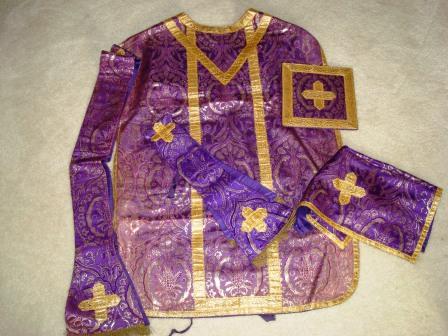
So… priests should do everyone a favor set aside the proper garb against the time.
I was alerted to an interesting article in the Seattle Times.
Seattle’s first parish centered on traditional Latin Mass
By Janet I. Tu
Seattle Times religion reporter
It was a big day Sunday for the couple of hundred devout Catholics gathered at the Josephinum building in downtown Seattle for the traditional Latin Mass.
For the first time in seven years, they were together as a parish, not just as a group that gathers weekly for Mass. And for the first time, they had a priest whose job was to look after them full time.
The parish, called the North American Martyrs, is the first one in the Seattle Archdiocese centered on the Roman Catholic Church’s traditional Latin Mass. And it’s one of the few that’s been established nationwide since Pope Benedict XVI issued a decree last year making possible the wider use of the Latin Mass.
"I’m overjoyed," said Jason King, 59, of Mercer Island, who has hoped for such a parish for decades. "My dreams are realized."
Besides celebrating the Mass in Latin, priests faced the altar, and to receive communion, people knelt at the altar rail.
After the sweeping reforms of the Second Vatican Council, intended to open the church and update its rituals, a new Mass was made standard in 1970. Mass was in local languages, priests faced congregations, and people stood to receive communion.
Until Pope Benedict’s decree, priests could celebrate the Latin Mass only with their bishops’ approval. The decree said parish priests no longer needed that permission.
Traditionalists embraced the decree, hoping it would lead to wider use of a form of Mass that to them seems richer. Others disliked the decree, seeing it as a sign that the church is looking backward, not moving forward with the times.
Since then, the Priestly Fraternity of St. Peter, a priests group, has trained about 150 diocesan priests nationwide on how to celebrate the Latin Mass. It’s opened five parishes and chaplaincies in North America, including the one in Seattle, which will be under the care of one of its priests.
In Seattle, the pope’s decree led to at least one other parish — Holy Family Church in White Center — adding a Latin Mass. And about two dozen more people have come to the weekly Sunday Latin Mass at the Josephinum building sponsored by the group Una Voce of Western Washington, said King, who co-chairs the group.
For Peter Uhl, 44, the local Una Voce’s other co-chair, "the sense of the sacred is most profound for me in the Latin Mass."
Uhl agreed with Sunday morning’s homily by the parish’s newly arrived priest, the Rev. Gerard Saguto, who likened the use of Latin to the black or white lace veils worn by some of the women at Mass. The language, like the veil, conveys a sense of mystery and of the sacred, the priest said.
"As the veil is removed, it becomes more profane, and a sense of sacredness is lost," Uhl agreed.
While the overall numbers of those who prefer the traditional Latin Mass still are relatively small, those who favor it need a priest who can provide pastoral care and perform baptisms, marriages and other sacraments, said archdiocese spokesman Greg Magnoni. That led Seattle Archbishop Alex Brunett last week to approve the formation of the parish.
There’s been a flurry of activity already. The parish is looking for a more permanent home. And starting today, Saguto is celebrating Latin Mass at 7 a.m. almost every day at St. Joseph Chapel in the Josephinum, and Tuesday evenings at Holy Family Church through mid-November.
"My heart is brimming," said Elena Bresee, 35, of Kenmore, who has attended Una Voce’s Latin Mass for seven years. "I hoped it would happen. But there were some long days of waiting."
Bresee has not always loved the Latin Mass, finding it hard at first to remain still during the long quiet moments and feeling left out by the lack of English spoken.
But over the years, because her husband loved it, she continued to go to Latin Mass and study it. Now, it’s something she treasures.
"This rite is greater than all of us," Bresee said. "It was the rite for centuries and centuries. Because it remained substantially unchanged, there is a security I derive from it. … It’s a beautiful thing."
Janet I. Tu: 206-464-2272 or jtu@seattletimes.com
Here is a note from a seminarian, whose identity I am preserving at his request.
It is a tie in with my entry here reacting to Damian Thompson’s post at Holy Smoke.
My emphases and comments.
Dear Father,
First off, I want to exercise a bit of prudence and ask that you not print my name nor location if you choose to use this correspondence. I appreciate the good work you do for the Church, and I always value honesty and openness, but I don’t need to start an electronic "paper trail" just yet.
I read your recent post and commentary on the notion that traditional Catholics are losing hope over matters of liturgy. As a seminarian studying in a well-regarded seminary … , my observation is that the good people of faith should not lose hope. On the contrary, it should be increasing.
Simply observing in my own seminary environments, the priests of the future are excited about tradition. [This is my impression too.] They embrace their faith in all its dimensions, and feel both a historical and spiritual attachment to the Extraordinary Form *and* the Novus Ordo. After all, we are familiar with the Mass of our "childhood," as it were, but we also long for and want the Mass of the ages.
You can see this in things as simple as the cassock: my diocese purchases for each new seminarian a cassock and surplice, and my brothers from other dioceses across the country in a similar fashion embrace that symbol of the Church.
That’s not all. My bishop has celebrated twice a Pontifical Mass at the Throne, and has encouraged his priests to go along with the liturgical reforms of Pope Benedict. ….
My point is that, while things may seem dire in certain locales throughout the world, there is great hope in our young people. I think I speak for my brother seminarians in saying that we realize that one day, we too will be charged with the task of leading the people of God to Christ. And we will be prepared to do that in complete communion, theologically and liturgically, with the Holy Father and the Catholic Church–our formation is already geared to that, the priest-faculty being in complete solidarity with Pope Benedict.
Don’t worry – pray for your bishops, priests, and seminarians, and appreciate how far we’ve come in a few short years.
Thank you, again, Father, for your continued work on behalf of the Church. I do think we are living in challenging, but exciting times – I certainly appreciate the prayers for the continued good formation of myself and my brother seminarians throughout the world.
The use of "that one" by Sen. McCain to indicate Sen. Obama last night during the Presidential debate has created some controversy.
Some idiots are making a big deal of this, even insinuating that there is something "racist" in saying "that one".
When I heard that phrase "that one" last night I was instantly reminded of a very common usage still to be heard in the northeastern part of the US, perhaps under the influence of immigrants who spoke Italian or other languages.
In Italian you will often say "quello" for a person, "that one". I heard this "that one" fairly often in New Jersey and New York.
In any event… it seems to me to be an emphatic way to direct your attention.
It has no racial over tones at all.
It is sheer idiocy to suggest that.

From an old WDTPRS article:
According to the Louis de la Rivière in his Vie de saint François de Sales (1624 – p. 584), the doctor and bishop of Geneva of St. Francis de Sales (+1622) told friend and prodigy Jean Pierre Camus (+1652) Bishop of Belley: “Soyez toujours le plus doux que vous pourrez, et souvenez-vous que l’on prends plus de mouches avec une cuillère de miel qu’avec cent barils de vinaigre… Always be as gentle as you can and remember that one catches more flies with a spoonful of honey than with a hundred barrels of vinegar."
This is the origin of the phrase and just about the only citation I have ever been able to come up with for it.
I was tipped to this from UCAN by a priest reader:
SINGAPORE Traditional Latin Mass Draws Young Working Adults
October 8, 2008SINGAPORE (UCAN) — "Dominus vobiscum" (the Lord be with you), the priest says, and about 40 people answer, "Et cum spiritu tuo" (and with your spirit). The priest then turns his back on them [well…. no… not really…. he just redirects their focus with his to the liturgical East] and continues the opening prayer facing the cross and tabernacle.
A traditional Latin Mass has begun in the bright chapel of St. Joseph’s Institution International School. This Mass, held the fourth Sunday of every month, follows the liturgical books published with the approval of Blessed John XXIII in 1962, before that pope opened the Second Vatican Council (1962-65). It features Gregorian chant, and only the homily is not in Latin.
What immediately strikes a first-time visitor to this Mass, organized by the Traditional Latin Mass (TLM) movement in Singapore, is the congregation. The young working adults, mostly in their 20s, who make up about three-fourths of the people were born after local languages replaced Latin in liturgies following Vatican Council II. [young working adults]
Only Catholics 45 and older, just one-fourth of this group, would have had the chance to attend the traditional Mass in Latin as children. [___] Tay, coordinator for the TLM movement, did not.
Tay also spoke of his role as "master of ceremonies" in another Latin Mass, held the second Sunday of every month at the Church of Our Lady of Perpetual Succour.
That Mass uses the ordinary form of the Roman rite, used around the world today, in which the priest faces the congregation. But everything except the Scripture readings and homily are in Latin rather than a local language. Gregorian chant is used for the hymns.
Tay ensures the smooth conduct of these parish liturgies, which draw around 100 parishioners. The TLM movement does not organize them but sees them as a way to promote Latin as a liturgical language.
About 20 active members make up the movement’s core team, which has three sub-groups: Schola Cantorum, the Gregorian chant choir; altar servers; and logistics.
Several times while speaking with UCA News, Tay stressed that movement members have no association with the Society of St. Pius X, which rejects the liturgical reforms of Vatican Council II and is not in full communion with the Church.
The TLM community has "remained faithful to the local bishop and the Holy Father," and demonstrates this through "patience, obedience and perseverance," Tay insisted. He added that despite hindrances such as being denied use of a church for their Masses and being openly criticized for "rejecting" the Second Vatican Council, community members patiently believe the archdiocese will one day open a Mass center for them. [Patience.]
Educated young TLM members "read Church documents and want to worship in the way the Church wants them to," Tay said. Other members "grew up with the traditional Mass," often called the Tridentine Mass.
Father Paul Staes, ordained in 1961, also grew up with the traditional Mass but sees two main problems with its use in Singapore today.
People can learn to recite the prayers, but "you don’t know what you are saying, because you don’t know Latin," said the priest, who spent six years studying the language. "It’s like having a Mass in sign language where no one is deaf."
Even if everyone understood Latin, he continued, the old form of the Mass raises a more fundamental issue.
"As priest, you are doing your own thing, and the people are doing their own thing. [No.] Is Mass not more a participatory event of the people? [Not if you understand what "participation" means. He set up a false dichotomy and we must reject his premise.] To me, one of the biggest achievements of the Second Vatican Council was the new form of the Mass. The language is not the most important thing; it’s the whole set-up," Father Staes told UCA News. [Not sure what "set up" means.]
Tay, far from a diehard traditionalist, confided to UCA News that he likes contemporary praise and worship songs, only "outside of liturgy." [Right.] He believes the TLM movement can help Catholics regain reverence for the Mass.
Interesting article.


Coat of Arms by D Burkart
 ex seaxe on Pope Leo XIV airplane interview: remarks about relaxing Traditional Latin Mass restrictions: “Asked whether he would reconsider his priorities after his surgery and the long trip, Leo replied, “I don’t feel like…”
 on Pope Leo XIV airplane interview: remarks about relaxing Traditional Latin Mass restrictions: ““the Rite of the Vatican Council II, of Paul VI” I’m not very happy with the Novus Ordo being described…”
 on Daily Rome Shot 1119: “I loved the first comment showing on the tweet regarding the Vatican’s decision regarding Bishop Martin of North Carolina’s decree…”
 on Pope Leo XIV airplane interview: remarks about relaxing Traditional Latin Mass restrictions: “@Fr. Jackson, Conversely, if the Pope and those in the Vatican cannot see the difference between Traditionalists who have remained…” on Pope Leo XIV airplane interview: remarks about relaxing Traditional Latin Mass restrictions: “@Rod Intentional or not. With malice or without. I suspect that many within the Vatican, especially among the Curia, consider…”
 on NB: Desktop and Posting – Zuhlsdorf’s Law kicks in – UPDATE: “AI does have its uses. Both good and bad. I’ve been using extensively to help me configure some servers I…”
 on Pope Leo XIV airplane interview: remarks about relaxing Traditional Latin Mass restrictions: “I do wonder to what extent a certain set of Episcopal Consecrations on July 1st created the impression of a…”

A Daily Prayer for Priests








They find you a pro-life agent in your area who commits to giving a portion of the fee to a pro-life group!

PLEASE subscribe via PayPal if it is useful. Zelle and Wise are better, but PayPal is convenient.
A monthly subscription donation means I have steady income I can plan on. I put you my list of benefactors for whom I pray and for whom I often say Holy Mass.
In view of the rapidly changing challenges I now face, I would like to add more $10/month subscribers. Will you please help?
For a one time donation...



Help Monks in Wyoming (coffee – UPDATED LINK) and Norcia (beer) and the wonderful "Soap Sisters" of Summit, NJ!


Please follow me on Twitter!










Visits tracked by Statcounter
since Sat., 25 Nov. 2006:

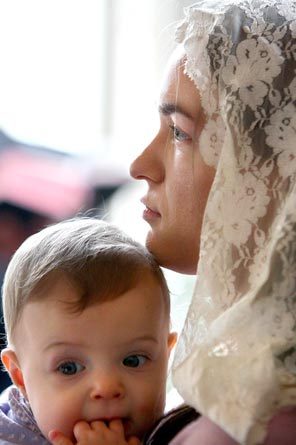 Seattle’s first parish centered on traditional Latin Mass
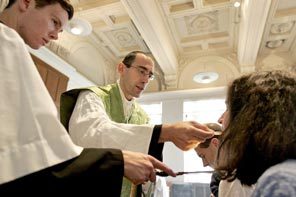 The traditional Latin Mass — or Tridentine Mass — has its roots in the early days of the church. It was codified in the 1500s, and the most recent version was authorized in 1962.

