Catholic League about YouTube’s double-standard

From the Catholic League:

October 7, 2008

EUCHARIST DESECRATED ON YouTube

Under the name fsmdude, a Canadian man, Dominique, has posted over 40 videos on YouTube desecrating the Eucharist. Catholic League president Bill Donohue responds as follows:

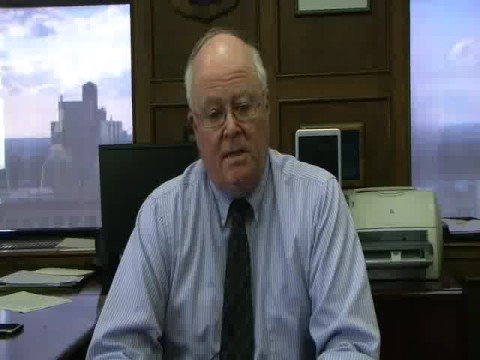
“On September 29, I wrote to YouTube CEO Chad Hurley asking him to take down these offensive videos. I left a phone message for him on October 3, but he refuses to respond. Accordingly, I have posted my own video on YouTube calling attention to this matter.

“It was a professor from the University of Minnesota, Morris campus, Paul Z. Myers, who started the war on the Eucharist this past summer by intentionally desecrating a consecrated Host. Because Myers committed this act off-campus, the University did nothing about it. The latest copycat, however, has violated YouTube’s own ‘Community Guidelines.’ YouTube makes it clear that it does not ‘permit hate speech,’ defined as ‘speech which attacks or demeans a group based on race or ethnic origin, religion….’ It also says it ‘is not a shock site.’ Now if desecrating what Catholics believe to be the Body and Blood of Christ does not constitute hate speech, as well as expression designed to shock, nothing does.

“In August, YouTube took down a video of a teenager who urinated on the Holocaust memorial in Rhodes, Greece. That was not only the right moral choice, it was consistent with its own strictures. Catholics deserve the same sensitivity, and that is why we are asking YouTube to take down these unconscionable videos. It is not only right morally, it is in compliance with its own guidelines.”

Contact editor@YouTube.com

Play video

Posted in SESSIUNCULA |
12 Comments

Institute of Christ the King now of “Pontifical Right”

I just got word that the Holy See has raised the Institute of Christ the King to be of Pontifical Right, rather than merely of Diocesan Right. 

From the ICK website we get this:

On the feast day of Our Lady, Queen of the Holy Rosary, the Vice-President of the Commission Ecclesia Dei, Very Reverend Monsignor Camille Perl, has read in our Seminary chapel the official decree by which, in the name of the Holy Father, the Institute of Christ the King Sovereign Priest was erected to the status of a Society of Apostolic Life of Pontifical Right. Also our Sisters Adorers of the Royal Heart of Jesus received the status of Pontifical Right. The Decree was signed by His Eminence Dario Cardinal Castrillon Hoyos.

Congratulations to the Institute!

Brick by brick, folks.

Posted in SESSIUNCULA |
10 Comments

More (future Cardinal) Burke news

OTHER PONTIFICAL ACTS

VATICAN CITY, 7 OCT 2008 (VIS) – The Holy Father appointed Archbishop Raymond Leo Burke, prefect of the Supreme Tribunal of the Apostolic Signatura, as president of the Commission for Advocates.

NA/…/BURKE

Posted in SESSIUNCULA |
9 Comments

Rabbi at Synod says Pius XII shouldn’t be beatified


[uc]

The Synod still has me scratching my head.  I know everyone is going to say that it is wonderful to talk about, read and use Scripture, but… I think we know that already.

Other curiosities puzzle me as well.

I picked up from the intrepid Andrea Tornielli that the rabbi invited to speak at the Synod, Shear-Yashuv Cohen, Chief Rabbi in Haifa, launched an attack on the President of Iran, Ahmadinejad.  When he was interviewed by Phil Pullela of Reuters he attacked Pius XII, saying that the Church shouldn’t beatify him and that if he had known that the Holy Father was going to celebrate a Mass in honor of Pius XII he wouldn’t have come to the Synod.

Fine with me.

The anniversary of the death of Pius XII isn’t exactly a secret, nor is is a secret that Catholics remember their Popes.

If the Rabbi would like to go home, no one is stopping him.  Otherwise, it might be a good idea to participate in the Synod according to the spirit of the invitation extended to him.

Here is the wire copy of Phil Pullela’s piece:

By Philip Pullella
VATICAN CITY, Oct 6 (Reuters) – The first Jew to address a
Vatican synod on Monday told the gathering that Jews "cannot
forgive and forget" that some major religious leaders during
World War Two did not speak out against the Holocaust.
Rabbi Shear-Yashuv Cohen’s words, spoken in the presence of
Pope Benedict, were a clear reference to wartime Pope Pius XII,
who many Jews say did not do enough to help them.
Cohen, the chief rabbi of Haifa in Israel, had told Reuters
in an interview hours before the address that he would add
indirect comments critical of Pius when he spoke to more than
200 Catholic bishops from around the world.
"We cannot forget the sad and painful fact of how many,
including great religious leaders, didn’t raise their voice in
the effort to save our brethren but chose to keep silent and
helped secretly. We cannot forgive and forget it and we hope
that you understand …" he said in unprepared remarks at the
end of his address.
Last month Pope Benedict forcefully defended Pius, saying he
"spared no effort" on behalf of Jews during World War Two.
Some Jews maintain Pius did not do enough to save Jews. The
Vatican says he worked behind the scenes to help because more
direct intervention would have worsened the situation.
Cohen also appealed to the synod to denounce Iranian
President Mahmoud Ahmadinejad, who made another virulent
anti-Israel speech last month at the United Nations.
"I’m here also to ask you, leaders of religions, to raise
your voice and together with the help of the free world protect,
defend and save Israel … from the hands of our enemies," he
said, referring to a recent U.N. address by "a certain president
of a state in the Middle East".
"This anti-Semitic infamy brought back to us the painful
memories of the tragedy of our people, the victims of the
Holocaust which we hope and pray will never happen again," he
said.
Cohen, 80, anticipated the contents of his address in the
interview with Reuters earlier in the day, saying that Pius, who
reigned from 1939 to 1958, should have done more to help Jews
during the Holocaust.
Cohen also told Reuters he might have stayed away if he had
known the major Church gathering coincided with ceremonies to
honour Pius on the 50th anniversary of his death.
"He (Pius) may have helped in secrecy many of the victims
and many of the refugees but the question is ‘could he have
raised his voice and would it have helped or not?’" Cohen said.
"We, as the victims, feel yes. I am not empowered by the
families of the millions of deceased to say ‘we forget, we
forgive,’" said Cohen.

ANNIVERSARY OF DEATH
Pius is one of the most difficult issues in Catholic-Jewish
relations. On Thursday the Vatican marks the 50th anniversary of
his death, Benedict celebrates a Mass in his memory and there
will be a conference and photo show on his papacy next month.
"I did not know (the anniversary commemorations) happened
during the same meeting. If I had known … I might have
refrained from coming because we feel that the pain is still
here," Cohen said.
"I have to make it very clear that we, the rabbis, the
leadership of the Jewish people, cannot as long as the survivors
still feel painful agree that this leader of the Church in a
time of crisis should be honoured now. It is not our decision.
It pains us. We are sorry it is being done," he said.
Urged by historians to open up all its archives from World
War Two, the Vatican says some are closed for organisational
reasons but that most of the significant documentation regarding
Pius is already open to scholars.
Last year, the Vatican’s saint-making department voted in
favour of a decree recognising Pius’s "heroic virtues", a major
hurdle in a long process toward possible sainthood that began in
1967. But Pope Benedict has so far not approved the decree.
Some Jewish groups say the Vatican should freeze the process
of beatification but others say it is an internal Church matter.
(Editing by Tim Pearce and Mark Trevelyan)

In the meantime, Walter Card. Kasper, President of the Council for Interreligious Dialogue made it clear that Pius XII did what he could to save Jews and that his beatification was a matter internal to the Catholic Church.

Exactly!
 
UPDATE: From Il Giornale:

Milano – Pio XII continua a far discutere. La disputa sulle parole del rabbino capo di Haifa, Shear-Yashuv Cohen, primo rabbino intervenuto a un sinodo è rimbalzata da una parte all’altra del mondo, coinvolgendo anche il blog del vaticanista del Giornale, Andrea Tornielli, autore di quattro libri su Papa Pacelli.

Le dichiarazioni del rabbino Cohen Il rabbino Cohen, intervistato da Phil Pullela, vaticanista della Reuters, ha detto che non è giusta la beatificazione di Pio XII, affermando che se avesse saputo che Benedetto XVI stava per celebrare il cinquantesimo anniversario della morte di Papa Pacelli avrebbe deciso di non partecipare al Sinodo.

Il commento di Tornielli Il vaticanista del Giornale sul suo blog ha commentato così le parole del rabbino: "A parte il fatto che la data di morte di Pio XII non è propriamente un segreto del Mossad, trovandosi in tutte le enciclopedie, a parte il fatto che il cinquantesimo rappresenta una scadenza importante, trovo del tutto fuori luogo che un esponente ebraico invitato a parlare ai vescovi cattolici ne approfitti per mettere in imbarazzo il Papa, per di più sulla base di leggende nere".

Reuters cita il blog del nostro giornalista Commento che non è rimasto inascoltato. Poche ore dopo, Tom Heneghan, curatore di una rubrica religiosa per Reuters, faceva eco alle parole del nostro giornalista : "Tornielli ha saputo focalizzare soprattutto l’attenzione sulla posizione del rabbino Cohen già in un’intervista rilasciata alla Reuters prima del suo discorso effettuato al Sinodo"

UPDATE: 1[]940 GMT

A friend in Rome supplied me with some commentary:

   Rabbi Cohen explained to us that he is here as the representative of the Israeli Rabbinate, and as such came to present the official hermeneutical "line" of that organization. He clearly was at pains to make it abundantly clear that he was not presenting his personal views.  [Interesting.]

  There may be some official reticence to recognize PPXII as a helper and friend to the Jews within the Rabbinate, and perhaps he was embarrassed and caught off guard, or, more likely, found himself placed in a position in which his answer to a question, phrased "just so" by a journalist with whom he had agreed to speak, might have blurred the lines between his personal and official views. In such a case, he might have decided to play it cautiously, and give the "party line" re. PXII.

  I really wonder whether "attacks PXII" is an accurate description of the substance, intention and effect of the Rabbi’s naked statements. I can’t be 100% sure, but I have "la netta impressione" that we are witnessing a sort of "Nixon in China" moment, in which some hard words or declarations ought not be allowed to overshadow the significance of the visit, itself.
 
  Please feel free to publish these speculations, indicating them as such. [Good observations.  I’ll think about the title of the entry.]

UPDATE 15:38 GMT 8 OCT


The rabbi later clarified to Philippa Hitchen of Vatican Radio (transcript):

TRANSCRIPT

I am here, not as an individual, presenting my own approach. I represent the Chief Rabbinate of Israel, the official organization that leads the Jewish religion in Israel, in a way, in the Jewish world, so I would say the majority is with me here. There are those who feel that it’s more than a dialogue, and are suspicious that it’s an attempt, in a way, to blur the differences – just another kind of the same religion – which it’s not. There are some  basic elements in the articles of faith that we believe in, and that Christians believe in, and we cannot ignore it. I think that [dialogue] is not meant to change us. We should try to understand each other and live together, for those principles and for those ideas that join us.

Posted in SESSIUNCULA |
Comments Off on Rabbi at Synod says Pius XII shouldn’t be beatified

QUAERITUR: tips for making altar linens

Here is a good practical question from a reader.

I have a question which you may well be able to answer, but that if you are too busy, I am pretty sure my fellow loyal readers of WDTPRS can.

What are the best practices for making the small linens for the altar? 

I am good on the basics – what’s square and what’s rectangular, white color, and linen’s pride of place, but how much elaboration is good versus when it becomes a hindrance to proper purification.  Where are the rules located?  I haven’t found much at all.  Recalling the wonderful pamphlet on the care of the linens, I am hoping for some guidance beyond common sense.    

Good question.  We do need the help of others for this.  I have never made altar linens.

Here are some observations for my vantage of using them

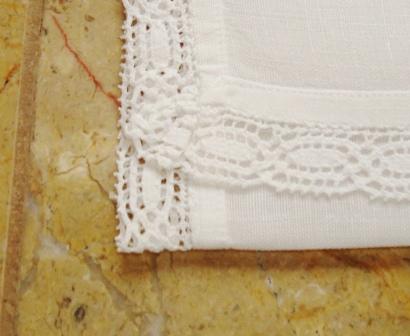
First, keep them simple.  Lots of elaboration, in my opinion, make them more difficult to use.  There can be some embroidery around the edges of the corporal.  Perhaps a very narrow band of lace or trim.  The same for purificators, but only at the very ends.  I would avoid doing (what ever it is called) that thing where you embroider around cut-out shapes.  Pretty, but awkward to use.  With a corporal I am always concerned that some particle will somehow fall through a hole.

Do make sure the fabric is absorbant, especially for the purificators.  I have from time to time had to use nearly liquid resistant purificators.  If a priest is diligent in purifying the chalice well, that’s pretty frustrating.  I do like linen.

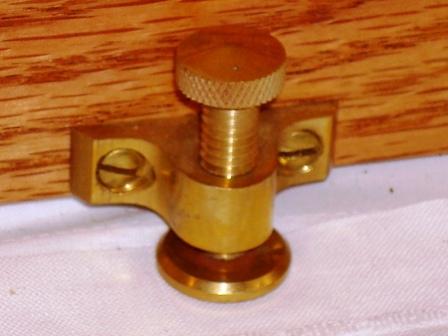
Altar cloths should ideally be long enough to reach close to the ground on either side of the altar.  Remember that an altar really should have three cloths.  The two beneath don’t have to reach the the ground, but they should cover the top.  If you have an altar ad orientem and there are some contraptions designed to hold the altar cloths in place, you might think about reinforcing that side of the altar cloth.  Not necessary, but it could be helpful.

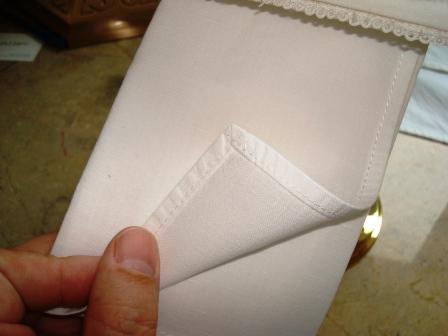
This is a bit picky, but when making purificators you might consider the width of the chalice(s) for which you are making them so that they fit nicely across the top.

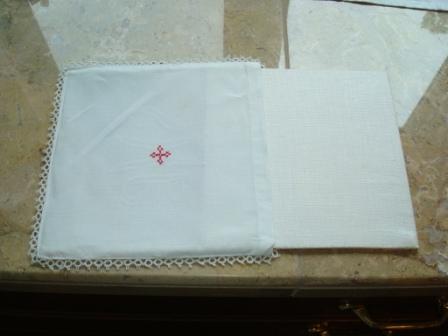
Here is a shot of how a corporal is sown up.  This is one I am using now.  It was made in Italy.

QUAERITUR: tips for making altar linens

Keep purificators simple.  Check the height of the chalice and the width of the cup.

QUAERITUR: tips for making altar linens

Remember that altar cloths are sometimes held down by gizmos.

QUAERITUR: tips for making altar linens

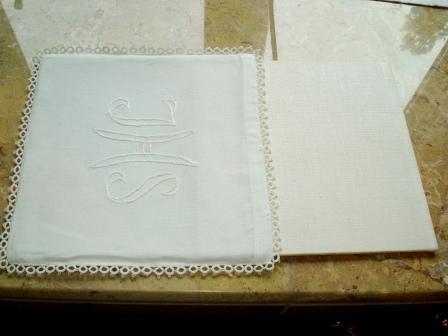
Palls can have some fancy work.  I don’t prefer it, but I do use it from time to time.  They are often made like a little flat bag or envelope in which you insert a stiff card.   I HATE the Italian style pall, which is just a piece of starched cloth.

QUAERITUR: tips for making altar linens

And the back.

QUAERITUR: tips for making altar linens

Maybe the reader with experience can chime in.

Posted in "How To..." - Practical Notes, ASK FATHER Question Box, SESSIUNCULA |
36 Comments

His Hermeneuticalness and Vatican webpages

This is posted over at the site of His Hermeneuticalness:

Via Fr Z, I find that there is now a website for the Pontificia Commissio Ecclesia Dei. Under the "Eventi" menu item, there are two items from the Latin Mass Society: the Merton Training Conference and the Pontifical Mass celebrate by Cardinal Castrillon Hoyos at Westminster Cathedral. On the latter page, there is a photo of the consecration at the Mass. Incidentally, I am kneeling at the bottom step on the Gospel side.

His Hermeneuticalness and Vatican webpages

This is the first time I have been on a Vatican webpage :-)


Many of us are praying that it won’t be the last time!

Posted in SESSIUNCULA |
4 Comments

14 Oct: S. St. Paul, St. Augustine’s – The Argument

I will be engaging in "The Argument" at St. Augustine’s Church in St. St. Paul.

This event is for men only.

I will be speaking to issues surrounding the assertion:

14 Oct: S. St. Paul, St. Augustine's - The Argument

Detail’s may be sought from the parish.

Posted in What Fr. Z is up to |
1 Comment

Fr. Bux responds to the “not enough Scripture” argument against TLM

A bit late, but better than never, which is often the case when I am on the road, I picked up the this interesting piece from our friends at Rorate who do such a splendid job.  The original is in Italian from FIDES.

You often hear critics of the TLM and Summorum Pontificum say that the Novus Ordo is superior because it is far "richer" in use Scripture Scripture.

There are various ways to approach that claim.  First, one might observe that the odler form certain had plenty of Scripture but not so much that people couldn’t remember it.  Second, Mass isn’t a didactic moment.  Etc.

Fr. Bux – remember that name – has more views, along with Fr. Vitiello, as the comment on "Words of Doctrine", timely because of the Synod.  I have added emphases.  Maybe comments later.

As the Synod on Holy Scripture is opened by Pope Benedict XVI in the Basilica of Saint Paul Outside the Walls, a good article on the forms of the Roman Rite and the Scripture readings.


WORDS OF DOCTRINE
Two theories born of Biblicism
Fr. Nicola Bux and Fr. Salvatore Vitiello


Some say that the post-Conciliar Mass is richer in Readings and Eucharistic Prayers, while the Missal said of Pius V would be poorer and less accurate. The theory is anachronistic since it fails to consider four centuries of distance; it is as if we were to say the same about "Sacramentaries" some centuries earlier than that of Pius V. What is more, it is forgotten that the pericopes of the Pius V Missal were formed on the basis of old capitularies with epistles, such as St Jerome’s Liber comitis– dated 471 – or with Gospel pericopes ; a tradition in common with the Church of the East, as the Byzantine liturgy still shows today.

Secondly, the brief readings help memorize the essential and express the sobriety of the Roman Rite. Some even go as far as to say that the Extraordinary Form of the only Latin Rite gives too little emphasis to the presence of Christ in the Word, when the latter is proclaimed in the assembly; in this case the liturgy loses its very essence, the ‘two tables’ – in Dei Verbum, n. 21, there would appear to be only “one” – forming one act of worship!

It is said that the Missal of the Council of Trent moves in a vision far from the tradition of the Church Fathers; that the Missal was planned for the priest only, not for the participation of the assembly because the congregation is merely irrelevant. In fact, it is said that the priest celebrates on his own and so does the congregation; they say the Mass of Paul VI is quite different because it is not the priest who celebrates but the Church, sacramentally present in the assembly, of which the priest, by reason of order, is the natural president.

This position is considerably problematic because it reduces everything to Word and Assembly. However “Jesus is not just the teacher, but also the redeemer of the whole person. The Jesus who teaches is, at the same time, the One who saves ” (J.Ratzinger-Benedict XVI, Gesù di Nazaret, p. 65) and this comes about effectively only through the Eucharistic Sacrament.

Another theory, widespread due to the customary phenomenon of substitution and exchanging one thing with another, is to equal the presence of Jesus Christ in the Blessed Sacrament with the presence of the Word in the Book of the Scriptures: the latter presence takes place only “when the Holy Scriptures are read in the Church” (Sacrosanctum Concilium n. 7). It is necessary to reaffirm that Christ’s presence in the Word exists on two conditions: when it is read out “in the Church assembly ”, not privately, and when Sacred Scripture is ‘read’. Therefore the holy book placed on the lectern or the altar is not sufficient for this presence.

To conclude, it is more than ever urgent for preaching and catechesis to return to making the proper distinction between Revelation, Word of God and Sacred Scripture which, although closely connected, are not equivalent. At times in fact, not without surprise, we see in this regard considerable confusion and not only among the lay faithful. Some even think that the Bible is to be interpreted with the Bible and not, as the Catholic Church has always held, with Tradition and by faithful listening to the Magisterium.


_________________________
FIDES translation, adapted according to the Italian original.

Posted in SESSIUNCULA |
51 Comments

Benedict opens the synod

I am scratching my head a little about the "Word of God" Synod which just opened.  I think we are willing to stipulate that Scripture is good, fundamental, etc.  So… we are in favor of Scripture.

But the Synod connects Scripture with Mission.

As the Synod unfolds, maybe we will find out what they have on their minds.

In the meantime, here is a story about the Holy Father at the opening Mass of the Synod.

Pontiff: Synod to Tell World That God Is Not Dead

Says Church’s 1st Task Is to Be Nourished by Scripture

ROME, OCT. 5, 2008 (Zenit.org).- Benedict XVI opened the world Synod of Bishops on the Word of God expressing the hope that it give birth to a new missionary dynamism in the regions of the world where it seems that “God is dead.”

Today the Pope presided over the inaugural Mass of the synod, which will end Oct. 26, at the Basilica of St. Paul Outside the Walls. The synod’s theme is “The Word of God in the Life and Mission of the Church.”

“Nations that at one time were rich with vocations are now losing their identity, under the deleterious and destructive influence of a certain modern culture,” the Holy Father noted in his homily.   [A sad fact.  It is good to hear a POPE say it.]

“There are those who, having decided that ‘God is dead,’ declare themselves ‘god,’ taking themselves to be the singular artificers of their destiny, the absolute lord of the world," he continued.   "Clearing God away and not awaiting salvation from him, man believes he can do as he pleases and poses himself as the sole measure of himself and his action.  [The Holy Father has been focusing on this during his Pontificate.]

“But when man eliminates God from his horizon, when he declares that God is ‘dead,’ is he truly more happy? Does he truly become free?

“When men proclaim themselves absolute owners of themselves and lords of creation, can they really build a society where freedom, justice and peace reign?” 

Division and confusion

Benedict XVI answered the question in the negative, explaining that “the daily news amply shows” that with this vision “the will to power, egoistic interests, injustice and exploitation, violence in all its forms” spread. “The end of all this is that man finds himself alone and society more divided and confused."

The Pope said that with this synod the Church wants to show the world “that evil and death do not have the last word, but Christ is the victor in the end. Always!”

“The Church never tires of proclaiming these glad tidings, as she does today in this basilica dedicated to the Apostle of the Gentiles, the one who first spread the Gospel in vast regions of Asia Minor and Europe,” he said.

To accomplish this mission, the Pontiff added, the Church’s “primary and fundamental” mission is to nourish herself on the Word of God. “In fact, if the proclamation of the Gospel constitutes her reason for being and her mission, it is indispensable that the Church know and live that which she proclaims so that her preaching is credible, despite the weaknesses and poverty of the human beings who constitute her.”

Citing St. Jerome, he added: “Whoever does not know the Scriptures does not know the power of God nor his wisdom. Ignoring the Scriptures means ignoring Christ.”

The synod’s work will begin on Monday with a meditation offered by Benedict XVI.

Posted in SESSIUNCULA |
14 Comments

A Sunday Mass

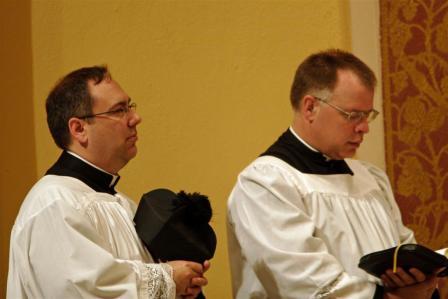
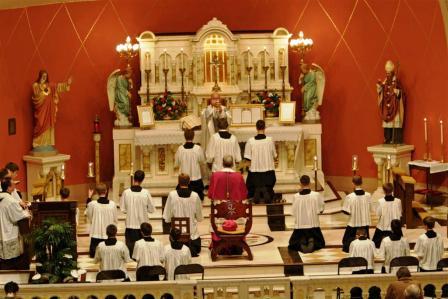
I was at a wonderful feast day celebration at the Church of St. Augustine in South Saint Paul, MN, with Holy Mass celebrated in the Extraordinary Form.  Present was H.E. Most Rev. John Nienstedt, Archbishop of St. Paul and Minneapolis.  Here are a few images.

A Sunday Mass

A Sunday Mass

The church was jammed and the choir sang well.

A Sunday Mass

A Sunday Mass

A Sunday Mass

A Sunday Mass

There was a nice reception for the Archbishop and whole parish afterward.

A Sunday Mass

A good choir of young ladies sand songs for the people and clergy. 

A Sunday Mass

There were lots of kids… as is usual at parishes where the TLM is embraced, and most of them seems happy, well-adjusted, and cute.

A Sunday Mass

Posted in SESSIUNCULA |
15 Comments