Gov. Palin: ex-Catholic? Stop bugging me about it

I am getting strange and even hysterical e-mail from quite a few people about VP candidate Sarah Palin being an "apostate Catholic". 

"BUT FATHER! BUT FATHERFATHERFATHER! WHY aren’t YOU paying ATTENTION to THIS??!?!?!?".

Some e-mail is reasonable and mature.  Some includes lots of SHOUTING and UNDERLINING. 

Tip for the future:  If you write e-mail like that to me, I delete it, mostly unread.

However, about Sarah Palin as "apostate", …

To my knowledge Gov. Palin was baptized in the Catholic Church, but her parents left the Catholic Church for some Protestant sect when she was around 12 years old.

I don’t hold twelve-year-old children accountable for the actions of their parents.

Would that be even slightly rational?

I understand she attends a non-denominational Christian church of some sort.

"Apostasy" is accomplished by a formal act, not by being taken away from the Church as a child and then growing up in a Christian sect. 

I wish she were a Catholic!  I wish everyone were Catholic!  But she’s not, and it seems not to be her fault.

Some who are Catholic really aren’t… and in the case of some politicians that is their fault.

Until it is revealed that Gov. Palin has made some sort of formal act of apostasy from the Catholic Church or done something anti-Catholic, I think you ought to breathe deeply and regularly, trying breathing into a paper bag, and maintain some control.

And stop shouting at me about it. 

Posted in SESSIUNCULA |
2 Comments

Fr. Trigilio works for “orientem worship” in his parish

Following on various entries concerning ad orientem worship, and my request that people post their experiences of Holy Mass celebrated ad orientem…. Fr. John Trigilio now posts this, about implementing ad orientem worship in his parish.

My emphases and comments.

Tonight was the maiden voyage, so to speak, and the comments after Mass were overwhelmingly POSITIVE. In fact, not one complaint and only compliments on the REVERENCE of the Mass, which is accentuated, I believe, by celebrating AD ORIENTEM. I also preached on PROPER FRATERNAL CORRECTION which means people MUST speak to me PRIVATELY IN PERSON if they have any complaints, problems, questions or issues we can discuss them confidentially and charitably. I told them if they choose to whisper behind people’s backs and gossip, then they need to go to confession. Gossip is a sin and the Catechism spells out three bad fruits of gossip: rash judgment, calumny (slander) and detraction. Too many of my colleagues are afraid of celebrating AD ORIENTEM because of gossip and the infamous rumor mill. [I suppose that is true in many cases.]  Best to be out in the open with the people and they with their pastor. I told my people I am more than happy to explain the liturgical and theological reasons for what we do as Roman Catholics, including all legitimate options. BTW, people loved the analogy of the airplane pilot and the bus driver. [Good tip for for priests.] Are they turning their backs on the passengers OR are they facing the same direction as everyone else in the hope of arriving at the same destination?


Thank you Fr. Trigilio for your confident work to deepen the participation of your people at Holy Mass.  You are playing your part in the Benedictine "Marshall Plan".

UPDATE:

This is from Fr. Trigilio’s site The Black Biretta

FROM THE PASTOR:

Another aspect of our human life is the work we do in sacred worship. The Holy Sacrifice of the Mass is also called the Sacred Liturgy. His Holiness Pope Benedict XVI has set the stage for a renewal and renaissance of Catholic worship. This was the intention and objective of the Council Fathers at Vatican II. As mentioned before, we will be learning and using some Latin for common parts of the Mass on one weekend a month. The first Sunday (and evening before) in Marysville and the last Sunday (and evening before) in Duncannon, we will be using the Kyrie (Greek: Lord Have Mercy), Gloria (Latin: Glory to God), Sanctus (Latin: Holy, Holy), Pater Noster (Latin: Our Father), and Agnus Dei (Latin: Lamb of God). They are found in #862-869 of the large Music Issue of Today’s Missal. ‘Catholic’ comes from the Greek word katholikos which means ‘universal’ One obvious and poignant way to demonstrate the universality of our church is to use a universal language as well as our own vernacular.

If you watch the TV Mass on EWTN, you will be familiar with these. Even though only once a month, we will become more comfortable and familiar with our rich patrimony. Eastern Orthodox Americans speak fluent English yet use plenty of Greek in their weekly worship just as Jewish Americans use Hebrew in theirs. Latin is the official and traditional language of the Roman Catholic Church and coexists with the vernacular.

Once a month we will also utilize one of the options afforded the celebrant. Every priest is allowed to celebrate Mass facing the people (versus populum) or facing the Tabernacle (versus apsidem). I will do the latter once a month so you can appreciate and experience one of our beautiful customs going back to antiquity. Originally, all priests had to celebrate the Sacred Liturgy AD ORIENTEM, i.e., facing east. Churches were literally built so that the priest AND congregation both faced EAST during public worship. The reason was that the sun rose each day in the east. The Son of God rose from the dead on Easter morning, when the sun rose in the East. Hence, Christians were keen to respect that by facing east when they worshipped their Lord and Savior. Churches were built from Ancient to Mediaeval times facing east. The priest was not seen as ‘turning his back’ on the congregation, rather, BOTH priest and congregation were facing east TOGETHER. Does the bus driver or airplane pilot have his/her back toward the passengers OR rather is he/she facing the same direction of the destination everyone hopes to arrive at?

One of the dangers of exclusively celebrating Mass versus populum (facing the people) is that the Celebrant may be tempted to see himself as performing for the congregation. He is not on stage as an actor nor is a director or conductor guiding those in the audience. He is a LEADER of prayer and leaders POINT in the right direction. Great Generals led their armies in battle and both faced the same direction to victory. When the priest and the people both face the same direction, they are also doing the same thing, i.e., worshiping God.

The Greek and Russian Orthodox Churches, the Byzantine Catholic Churches, and many Lutheran and Anglican churches have worship services where the celebrant faces east with the congregation. Where it is geographically impossible to face east (ad orientem), the custom arose for the priest and people to face the Tabernacle (versus apsidem) since that is where the Body & Blood, Soul & Divinity of Christ was always present. Facing the Blessed Sacrament was in essence facing east since the east symbolized the Rising SON (and not just the rising SUN). Therefore, once a month, I shall celebrate Mass facing the Tabernacle, just as you do every time you sit in the pews. WE will be facing the same direction TOGETHER and not me turning my back on you as some would erroneously claim. It is only once a month but I think it important to do since it is part of our legacy, it is done all the time in the Extraordinary form of the Roman Rite (Tridentine Mass) and it is a valid and licit option in the Ordinary form (Novus Ordo or Vatican II Mass). The Scripture readings and homily will still be given facing the people since they are directed toward you. The prayers of worship directed toward God, however, will be facing Him as He IS present in the Tabernacle. Just as we have a diversity of music and language, we have a diversity of proper liturgical forms as part of our Catholic heritage. We should embrace the fullness of whom we are and how we worship.

Posted in SESSIUNCULA |
22 Comments

Sioux City’s Bp. Nickless on Speaker Pelosi, culture, and voting

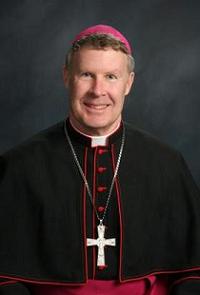
The Bishop of Sioux City, Iowa, Most Rev. R. Walker Nickless in his diocesan paper The Catholic Globe has issued a statement about Speaker Nancy Pelosi and her distortions of Catholic teaching on human life.

This is actually like a short pastoral letter about voting and how to think about your vote.

Let’s have a look with my emphases and comments.

Understanding the issues and what’s at stake
Sioux City's Bp. Nickless on Speaker Pelosi, culture, and votingDear Brothers and Sisters in Christ:

If any of us thought that we could avoid political chatter this fall, the past two weeks of conventions and speeches have been a dose of unpleasant reality. In truth, I hope that all of us are paying at least a little attention. When leading politicians who claim to be Catholic misrepresent so badly the basic teachings of the Church, we Catholic citizens must call them on it. [Not just bishops, he is saying, but the rank and file as well.]

No doubt, no one has missed the Speaker of the House, Nancy Pelosi (D-CA), a self-described “ardent, practicing Catholic,” being interviewed on NBC’s “Meet the Press” two weeks ago (August 24). When asked what advice she would give a president on the issue of when human life begins, and despite the clarity of the Church’s teaching that life begins at conception, Ms. Pelosi attempted to formulate a theological argument that (a) life may not begin at conception (quoting St. Augustine); (b) the teaching of the Church that life does begin at conception is only “about 50 years old;” and therefore (c) this teaching “shouldn’t have an impact on the woman’s right to choose [an abortion].” Clearly, this not-quite-argument is poorly reasoned and false.  [Good summary!]

As saddened as I was to hear Ms. Pelosi make such indefensible, inaccurate statements about the Church’s teachings, I was greatly encouraged by the immediate response of my brother bishops. Archbishops Chaput, Egan, Wuerl, and others have responded strongly and clearly to Ms. Pelosi, and to all who might be swayed by her confusion and evasions, reiterating the constant, unchanging, and unequivocal truth that abortion is always a grave moral evil. On August 25, Archbishop Chaput responded, completely dismantling Ms. Pelosi’s confused argument, in part simply by quoting this from the excellent book “Abortion: The Development of the Roman Catholic Perspective” (Loyola, 1977), by Fr. John Connery, S.J.:

“The Christian tradition from the earliest days reveals a firm antiabortion attitude . . . The condemnation of abortion did not depend on and was not limited in any way by theories regarding the time of fetal animation. Even during the many centuries when Church penal and penitential practice was based on the theory of delayed animation, the condemnation of abortion was never affected by it. Whatever one would want to hold about the time of animation, or when the fetus became a human being in the strict sense of the term, abortion from the time of conception was considered wrong, and the time of animation was never looked on as a moral dividing line between permissible and impermissible abortion.”

Cardinal Egan rebuked Ms. Pelosi even more strongly in his open letter of August 26: “Anyone who dares to defend that they [i.e. the unborn] may be legitimately killed because another human being “chooses” to do so or for any other equally ridiculous reason should not be providing leadership in a civilized democracy worthy of the name.” [Hear hear!]

I agree completely with the rebuke and rebuttal of Cardinal Egan and Archbishop Chaput. As your Bishop, I am responsible to our Lord Jesus Christ for the salvation of all the souls of North-West Iowa. I can’t force anyone to believe the truth, nor would I use such force if I could, but my duty as Bishop requires that I, as my brother bishops have done, teach that truth by word and example as firmly and as clearly as humanly possible.  [Hey!  I am starting to like this fellow!] These true and universal doctrines of the Roman Catholic Church are the teachings of Christ.

1. Abortion is always a grave moral evil (Catechism of the Catholic Church 2270-2272). The deliberate taking of innocent human life can never be justified. The same grave moral evil is likewise practiced in euthanasia (CCC 2276-79), and in the destruction of human embryos for medical research, and in human cloning (CCC 2274). In each of these issues, as well, innocent human life is unjustifiably taken.

2. Cooperation in any evil act is also a grave moral evil (CCC 1868). Directly to assist with, for example, the taking of innocent human life makes one culpable for that action. Indirectly to assist with the taking of innocent human life may or may not be culpable cooperation, depending on circumstances. One of the key circumstances is knowledge of the evil to be perpetrated (CCC 1859-1860); and in our society today, it is scarcely to be believed that anyone above the age of reason could claim “invincible ignorance” regarding the moral status of any of these issues.

3. The proper formation of conscience is an ordinary duty of all the baptized (CCC 1777-1782). The objective sources of moral knowledge, according to which conscience can be formed with certainty, are natural law, Scripture, and the Magisterium of the Church (CCC 1785). Subjective sources of moral knowledge, such as reflection on one’s own experience, private revelation, and infused virtue, never contradict the objective sources, but can deepen and strengthen conviction in the truth of the objective teachings (CCC 1778-1779). This means that the “argument from anecdote” (so-and-so did such-and-such a grave moral evil, and they came to no harm…) and the “argument from personal authority” (I have such-and-such a belief or experience, and I say…) always fail to persuade. It also means that, with very few exceptions, no one has the easy excuse of ignorance of the moral law to justify their malformed conscience (CCC 1791-1793).

4. Participation in the political process is an ordinary duty of all the baptized (CCC 1913-1917). This means not only that the faithful should vote, but also, more importantly, that the faithful must take responsibility for the actions of our elected officials by (a) exercising their vote with care and right discernment in conscience and truth, and (b) insisting that elected officials use their executive or legislative power for the common good (CCC 1916-1917). [He is an organized writer.  I like this!]

5. The end never justifies the means (CCC 1753). This means that the common good can never be achieved by practicing any moral evil as state policy (CCC 1789, 1905).

Sioux City's Bp. Nickless on Speaker Pelosi, culture, and votingNow, it must be admitted that not every moral evil is equally grave (CCC 1852-1854). Some issues have little effect beyond themselves; some touch on a few related issues; some are foundational to the whole structure of politics and society. The issues which have been labeled as “non-negotiable Catholic issues” are the most grave, because they are at the foundation of all our rights and responsibilities. These are, namely, the “life issues” of abortion, euthanasia, embryonic stem cell research, and human cloning; and the fundamental social issue of the family, which in this country today mostly means the definition of marriage. These issues are “non-negotiable” because, if the fundamental right to life is not secure, no rights are ultimately secure. If existence is contingent upon the will of others, so too is every other human right contingent.

Our Holy Father, Pope Benedict XVI, made this explicitly clear, as Cardinal Ratzinger, in the 1987 document called Donum Vitae (“The Gift of Life”):

“The inviolable right to life of every innocent human individual and the rights of the family and of the institution of marriage constitute fundamental moral values, because they concern the natural condition and integral vocation of the human person; at the same time they are constitutive elements of civil society and its order…. The moment a positive law deprives a category of human beings of the protection which civil legislation ought to accord them, the state is denying the equality of all before the law. When the state does not place its power at the service of the rights of each citizen, and in particular of the more vulnerable, the very foundations of a state based on law are undermined…”http://www.usccb.org/catechism/text/pt3sect2chpt2art5.shtml – 80 (Donum Vitae, III; see also Pope John Paul II’s 1995 encyclical, Evangelium Vitae, Chapters 3 and 4).

In this way, the rights of prisoners and criminal suspects, of the ill and elderly, of children and families, of immigrants, all depend directly for their coherence and reasonableness on the right to life. Even opposing the three great “-isms” of modern liberal philosophy (race, gender, and class) depends on the prior recognition of human personhood and its inherent dignity as such. In the same way, the root principles defining all forms of social justice, such as solidarity and subsidiarity, are only ultimately guaranteed by defense of the right to life and of the family as the basic social unit. When families are unstable units, then all voluntary associations, up to and including states and nations, ultimately lack a coherent concept of justice to animate laws and mores. The five “non-negotiables” are fundamental because, when they are abandoned, justice itself is de facto abandoned (CCC 2273).

Our nation is divided today, because we have in fact abandoned these foundations for personal and corporate liberty in our legal system, but not in our culture, our expectations, or our vocabulary. More and more, to be “progressive” means to wish to change the culture to conform to new legal interpretations, while to be “conservative” means to wish to change the laws to conserve traditional culture. More and more, because America is a nation greatly attracted to the innovative, and not much attached to tradition or conservation, the expectation that law be the servant of culture is rejected. In other words, the tools of politics tend to favor a new, illusory ideal of the isolated, autonomous self, rather than (as they ought) to protect and defend a shared and inherited idea of the common good.

When this happens, division results. The “politics of identity” take over; the perceived “rights” of this or that group (defined by race, gender, and class) begin to seem more important than shared identity, shared humanity. In some fundamental sense, as Pope Benedict has said, the denial of a shared humanity requires a denial of some particular group’s humanity: in our day, especially of the unborn, and the terminally ill.

In the early Church, as still today, Christians were ridiculed for coming to the defense of the poorest of the poor: widows, slaves, orphans, infants exposed to die. Christians challenged the assumptions of the world that only the rich and powerful mattered, and died for it. “The blood of the martyrs is the seed of the Church.” The full fruit of the Church’s early centuries of evangelization ultimately included the conviction that politics not only can but must aim for justice – not the worldly justice of due process and evenhanded use of force, which is too easily perverted into an idolatrous worship of order or system; but the divine justice of converted hearts and life completely free from sin. The conversion of the Roman Empire in the 4th century and the democratic revolutions of the 17th and 18th centuries were sparked by the brightness of this luminous ideal. Our nation claims this Christian vision as its foundation and its heritage: to choose to accept one’s personal responsibility for the common good.

We know that for the common good to exist, the strong (such as those who wield the right to vote) are obliged to defend the weak (such as the unborn). We rejoice in the political freedoms of America, especially our freedom of religion. Because freedom in Christ is always freedom from sin, freedom to love, and never license to commit evil, we trust that our freedom of religion strengthens our democracy. When we live faithful to the fundamental truths of our faith and our democracy – that life is an inalienable right, endowed by our Creator, for a clear and specific purpose – then our laws and our culture will be strong and just, defending the weak and the poor.

I hope these words are helpful to you. As we approach the November elections we must clearly understand the issues and what is at stake. May the wisdom of the Church’s teaching help us all and may all faithful Catholics continue to speak the truth in love.

Your brother in Christ,

Most Reverend R. Walker Nickless
Bishop of Sioux City

 Well done!  Solid WDTPRS kudos!

Posted in SESSIUNCULA |
28 Comments

Speaker Pelosi accepts Archbp. Niederauer’s invitation to “converse”

I am getting notices that Speaker of the House Nancy Pelosi (D-CA) has accepted His Excellency Archbp. Niederauer’s invitation to "converse" about a few things.

I solidarity with other blogs, I note that American Papist wrote about this too.

Here is the situation.

SAN FRANCISCO – House Speaker Nancy Pelosi, under fire from U.S. bishops [not just bishops – let us not forget that House Republicans wrote to her… and the blogosphere!] for comments she made about abortion, accepted on Friday an invitation from the Roman Catholic archbishop of San Francisco for a private talk.

Pelosi said in a letter to Archbishop George Niederauer that she’d "welcome the opportunity for our personal conversation and to go beyond our earlier most cordial exchange about immigration and needs of the poor to Church teaching on other significant matters."  [Blah blah… she is trying to couch this in other issues which are of interest to the Church. Keep in mind that there is no moral equivalents in this matter.]

The proposed meeting stems from comments Pelosi made Aug. 24 on NBC’s "Meet the Press." The Democratic congresswoman defended her support for abortion by saying "doctors of the church" have not been able to define when life begins.

She also cited the role of individual conscience. "God has given us, each of us, a free will and a responsibility to answer for our actions," she said.  [She also said that it doesn’t make a difference when human life begins, abortion should still be an option.]

Niederauer, who extended the invitation in the Friday column of the archdiocesan newspaper, and other bishops say that the church from its earliest days has considered abortion evil.

Niederauer said Pelosi’s remarks were in "serious conflict" with church teaching and it was his duty to explain clearly church teachings about faith and morals.

Several U.S. bishops have condemned the remarks made by Pelosi, a Catholic school graduate who repeatedly has expressed pride in and love for her religious heritage.

While Pelosi’s letter said she was interested in speaking about "church teaching on other significant matters," it did not mention abortion specifically. Her spokesman has defended her comments, saying in a previous statement that the congresswoman "fully appreciates the sanctity of family." 

I am very pleased with this.  Archbishop Niederauer’s letter brought her in.

It is necessary now that their conversation actually take place and take place soon.

I suspect that the conversation, which will be private, won’t be transcribed for the public.   But surely there will be reports on both sides.

Our friend Diogenes made these observations.  First, it took Speak Pelosi less than 24 hours to respond, but nearly two week for the Archbishop to issue a statement.  Also…

how many other American Catholic politicians are still waiting for their bishops to summon their courage, clear their throats, and raise the issue for the first time[?]

What must come to the fore is that the issue of human life and abotion had to have been discussed and that Speaker Pelosi acknowledges what the Church teaches.  If she then will not embrace that teaching is a different matter.  Pro-abortion Catholic Senator and candidate Joe Biden (D-DE) accepts what the Church teaches without waffling too much about it, but then he acts against that teaching. 

What we at least need from Speaker Pelosi is that she, as a Catholic, acknowledges what the Church truly teaches.

Posted in SESSIUNCULA |
27 Comments

Plating up the “jump in the mouth”

The other day I posted about the minestrone I prepared for a supper with a guest.

I was going to post the second course the next day, but realized that the next day, yesterday, was a Friday. Some idiot who hates decent food well-prepared and presented was sure to complain that he saw a picture of meat on the blog.

In any event, I made saltimboca alla romana.

My guest brought the veal, and I had some prosciutto obtained from the "big city".

Alas the veal had been frozen, so it needed a bit of care.  I wound up having to work pieces of it together as I pounded it out.  Thus it required some pinning together.  Since I only has big skewers and no toothpicks around, I had to cut off the ends.

For this you use veal, and leaves of sage, beneath the slices of prosciutto.

Plating up the "jump in the mouth"

So, into the pan it goes.  You use butter and olive oil, a bit of salt and pepper.  Deglaze with a little white wine.

Plating up the "jump in the mouth"

Green beans are common with this sort of meal and they are in season and abundant.  I steamed them.

Plating up the "jump in the mouth"

Posted in My View |
24 Comments

QUAERITUR: Your impressions of “ad orientem” worship

In another entry there is discussion of the reintroduction of ad orientem worship in a parish.

A priest made this comment:

it helped VERY much when laypeople actually gave me positive comments about attending Mass ad orientem.


I put to you a couple questions:

First, priests and lay people…. what was your impression of ad orientem worship when you encountered it for the first time?

Positive?  Negative? 

Certainly priests and lay people will have very different comments to make about this. 

Let’s hear both.

Did you have problems with it?  Preferences?

Second, if ad orientem worship has been introduced in your parish, how do you perceive others are adjusting to it?

Was there a fight?  Did it go smoothly?

Down the line somewhere, I will give my impressions of ad orientem versus versus populum.

Posted in SESSIUNCULA |
77 Comments

More ad orientem joy!

One the most damaging “reforms” implemented after the Council, founded on the excuse of poor scholarship, false archeologizing, and the “spirit of the Council”, is the so-called turned around altar for Mass “facing the people”, versus populum.

This certainly was the opinion of the great liturgical scholar Klaus Gamber.  Prominent scholar/figures of the Liturgical Movement Louis Bouyer and Josef Jungmann turned their own ideas about on this issue, as a matter of fact.   That’s something that did get out in the press at the time.

Pope Benedict has been putting into action his plan to reinvigorate the identity of Holy Church, especially through a renewal of the liturgy under a hermeneutic of reform and continuity.  Part of this “Marshall Plan” as I term it, has included the momumental step of Summorum Pontificum, as well as the concrete gestures of distributing Holy Communion on the tongue only to people who are kneeling.

He has also placed the Cross at the center of the altar for celebrations of Holy Mass.  He is surely doing this in order to promote a deeper understanding of the true orientation of our focus during Mass and, consequently, an actual restoration of Mass ad orientem.

Many priests are implementing what the Holy Father has been working for, and they are collaborating.

Thus, am always pleased when I receive news that yet another parish is being restored to ad orientem worship, priest and people facing the Lord, the Cross, on the same side of the altar of Sacrifice, together in unity.

Fr. Rob Johansen has informed me that at his parish of St. Stanislaus he implemented a project of restoring the main altar of the church.

He is going to be introducing celebrations of Holy Mass ad orientem soon.

Here is what he wrote on his site Thrown Back.

The altars have been completed, and they will be officially “unveiled” this weekend.

As part of putting our newly restored altars in their rightfully prominent place, I will celebrate the Masses this weekend and the following weekend (The Feast of the Exaltation of the Holy Cross) Ad Orientem. I have spent some time explaining and catechizing my parish about the use of ad orientem in the past few weeks. The re-introduction of this posture is something of a landmark here, as I’m pretty sure the high altar hasn’t been used for a public celebration of Mass in 30 years or more.

I’ll have photos up of the finished altars, as well as of our historic Ad Orientem liturgies, posted next week!

We look forward to them!

More ad orientem joy!

Posted in SESSIUNCULA |
26 Comments

QUAERITUR: “novus ordo” vestments without orphreys for TLM

A question came by e-mail:

Dear Fr Z,
 
I am hoping you can help me with a question about vestments.  Is it permissible for priests praying the Extraordinary Form of the Mass to wear "novus ordo" vestments, i.e., Gothic style WITHOUT ORPHREYS?  Is this spelled out anywhere?
 
Our pastor has given permission for First Saturday EFM, to be said by retired priests we can line up, not himself.  I am on the committee to prepare for it and to gather what the parish does not presently have available.  We have some not-outrageous gothic novus ordo chasubles & stoles.  If they do NOT need to have an orphrey, we could obtain just the maniple, burse, and chalice veil.


First, I don’t think there is any such thing as a "Novus Ordo" vestment.  No special style of vestments is designated for the Novus Ordo.   I think they ought to be in good taste and, to my mind, in continuity with tradition.

QUAERITUR: "novus ordo" vestments without orphreys for TLM

These are not.

Be sure the the vestments are of good material, tasteful, in good repair.

I did check Trimeloni and, on p. 255, found the comment (#269) that the chasuble should be what the Italians call a pianeta "in forma romana"… that is to say, the Roman chasuble.  This form is sometimes called a "fiddleback", though it isn’t.  The Roman-form has specific proportions and a specific pattern of "orphreys".

And Trimeloni also says that the Roman pianeta shouldn’t have the "forma primitiva", by which I think is mean the "Gothic style".  It permits the more ample style of the pianeta we sometimes call this the taglio filipino:

QUAERITUR: "novus ordo" vestments without orphreys for TLM

Of course outside Rome and Italy fuller "Gothic" vestments were in use everywhere.

The vestment Trimeloni doesn’t like at all is the actual "fiddleback".

I am just digressing:

In a pinch, you can use any decent style of vestment, though the Roman Rite really prefers the Roman vestment.

Posted in ASK FATHER Question Box |
31 Comments

Baker, OR: Bp. Vasa – forceful statement about Pelosi’s persistent errors on life

In The Catholic Sentinel His Excellency Most Reverend Robert Vasa, Bishop of Baker, Oregon, has interesting comments in the wake of the erroneous remarks of Speaker Nancy Pelosi on Meet The Press about the beginning of human life and the Church’s teachings on abortion.

You will recall that Speaker Pelosi (D-CA) asserted that the Catholic Church is somehow uncertain about when human life begins, citing, incredibly, St. Augustine’s 5th century understanding.
 

Modern look at abortion not same as St. Augustine’s

By Bishop Robert Vasa Baker, OR: Bp. Vasa - forceful statement about Pelosi's persistent errors on life

BEND — It is not possible this week to write about things related to the Catholic Church without making special note of the comments of a high-ranking U.S. official regarding abortion. This official, drawing from the rich tradition of the teachings of Saint Augustine, implied that he would have permitted abortion up to three months after conception. [You will want to go here to review what Augustine’s actual thought on abortion was.] As has been well reported by others, Saint Augustine was working from the defective science of his day and he was trying to reconcile what he understood from science with the philosophical views of his day.  [And also was interpreting a LXX passage of Exodus.] It should be noted that Saint Augustine died in 430 AD.

In order to give a fair treatment of Augustine’s view I turn to an entry by John C. Bauerschmidt, Abortion, in Augustine Through The Ages: An Encyclopedia. He writes:  [Hmmm… looks familiar…. yes, I believe I posted that!  Excellent choice, Eccellenza!  See the link I provide above.]

“Abortion: Augustine, in common with most other ecclesiastical writers of his period, vigorously condemned the practice of induced abortion. Procreation was one of the goods of marriage; abortion figured as a means, along with drugs which cause sterility, of frustrating this good. It lay along a continuum which included infanticide as an instance of ‘lustful cruelty’ or ‘cruel lust.’ Augustine called the use of means to avoid the birth of a child an ‘evil work:’ a reference to either abortion or contraception or both.”

According to a spokesperson, [See, again, this page.] the public official’s “views on when life begins were informed by the views of Saint Augustine, who said: ‘the law does not provide that the act (abortion) pertains to homicide, for there cannot yet be said to be a live soul in a body that lacks sensation.’” (Saint Augustine, On Exodus 21.22) Clearly Augustine believed, according to the science of his day, that the “body” of a pre-born child “lacked sensation” and from this he concluded that the child likewise lacked a human soul. Since the creature in the womb of its mother seemed to lack both sensation and soul, at least until the 40th day after conception, he had questions about the full humanity of the child. If Augustine had access to ultrasound images or if he had seen the film, “Silent Scream,” he would have had no doubt about whether the child “lacked sensation.”  [Well said.]

Precisely because of the lack of scientific precision, Augustine distinguished between a vivified and unvivified fetus, (a fetus before or after ensoulment). Since he could not conceive of an ensouled person without sensation, he concluded that the abortion of a “pre-vivifed” fetus, while a grave evil, could not be considered, in the strict moral sense, a murder. [But that is not the end of the story of Augustine’s thought, as that abovemention and cited article on abortion explains.]

I certainly commend the public official for going to Saint Augustine, a great theologian and philosopher, for views on morality but Augustine’s views need to be read and adopted in context. It is highly disingenuous, deceptive and intellectually dishonest to take this ecclesial sound bite from 1,500 years ago and treat it as if it is the last definitive word on the subject. [Note the reference to a 1500 year old sound bite.] This is particularly true since Augustine himself “vigorously condemned the practice of induced abortion” despite the unavailability of accurate scientific information. Furthermore, according to Bauerschmidt, Augustine also called the use of means to avoid the birth of a child “evil work.” It would appear that the public official conveniently missed that part and thus does not allow Saint Augustine to form any part of her understanding of the evil of either abortion or contraception while boasting that this is precisely what she has done.

The spokesperson also attempted to further blur the concerns about the public official’s stand on abortion by indicating that the public official “has a long, proud record of working with the Catholic Church on many issues, including alleviating poverty and promoting social justice and peace.” I, too, could commend the pubic official for “working with the Catholic Church” on these issues but if the views on these issues are formed by the teachings of the Catholic Church, which are quite current, why does the public official seemingly work so hard to reject the teachings of the Catholic Church, as they are currently stated, regarding abortion and contraception? [A good question.  Also, I don’t think there is a true moral equivalence between the sanctity of human life, that is the right to be born, and, say, working to feed and clothe the homeless.  The one is more important and fundamental than the other.]

If I were to think a bit more critically I would be inclined to conclude that the public official accepts the views of the Church which agree with her view and rejects those views which do not. [Given that this has been going on for years, I think we have to conclude the same, until other evidence presents itself.  I don’t think that would be rash judgment.] In other words, she is not formed by either Augustine or the Catholic Church on any of these social or moral issues, but simply happens to agree on some points. This then would have nothing to do with any true conviction about the goodness, beauty or truth of the teachings of the Catholic Church but rather pure political expediency.  [Is this one of the strongest statements we have seen from a bishop to date?]

The spokesperson’s statement also implies that, as has often been posited by politicians of one stripe or another, because they hold and support properly Catholic views on the social issues of race, poverty, justice and peace that they should not be held accountable for their rejection of the Catholic teachings on the more direct life issues such as abortion, assisted suicide and embryonic stem cell research. This is an inappropriate and unjust application of the U.S. Bishops statements concerning a “consistent ethic of life.” This consistent ethic is sometimes interpreted to mean that life issues as divergent as capital punishment and abortion, or assisted suicide and the loss of life in the war in Iraq, are equivalent. [Right!  There is no moral equivalence.] Nothing could be further from the truth. Certainly in each of these instances, regrettably, a human life is at stake but the difference is that only in the case of abortion or assisted suicide do we deal with the direct and intentional taking of the life of a completely innocent person.

A person may work very admirably to alleviate poverty but this does not justify ignoring the greatest poverty which is the one which fails to recognize the value of life. A person may work very admirably to promote social justice but this does not justify turning a blind eye to the greatest injustice openly operative in our society which is the unjust deprivation of the pre-born of their most basic constitutional right, the right to life.

WDTPRS kudos to Bp. Vasa for this strong statement.

Posted in SESSIUNCULA |
25 Comments

The Times: a force to be reckoned with … and more

Here is an interesting opinion piece from The Times.

This is a fascinating bit of writing with provocative insights.  Not the usual blather I have been scanning.

My emphases and comments.

September 5, 2008

Sarah Palin: it’s go west, towards the future of conservatism

Her thrilling convention speech showed that the Governor of Alaska is a force to reckoned with. But she might be more than that

Now we know, thanks to her triumphant debut at the Republican convention on Wednesday, that Mrs Palin not only slaughters her prey. She impales its head on a stick and parades it around for her followers to jeer at. For half an hour she eviscerated Mr Obama in that hall and did it all without dropping her sweet schoolmarm smile, as if she were handing out chocolates at the end of a history lesson.  [Nicely done.  He moves from images of Lord of the Flies to Little House On The Prairie.]

There’s a powerful danger in the sheer thrill that has followed her astonishing performance that we could get carried away with John McCain’s running-mate. Some of the coverage has a hyperbolic tone to it. Not since Paris handed that apple to Aphrodite has a man’s selection of a woman had such implications for the future of our civilisation.  [The seemingly endless Trojan War stared with that little gesture.  But what we must remember is that both sides were hosed by the gods in that tale.  It made no difference to whom he would have given the golden apple: either way someone was going to exact vengeance.]

So let’s stipulate one obvious and important piece of wisdom about US elections. The choice of a vice-presidential candidate rarely makes much of a difference. The pundit class waxes historical in the excitement of the moment but usually the vice-presidential choices go back to playing second banana. However mawkishly we dwell on the mortality of the presidential contenders, it is they who determine the voters’ decision.

This one, to be fair, could be different. For at least the next few weeks the press will follow Mrs Palin’s present and dig deeper into her past, still hoping for some morsel of stupidity or evidence of cupidity to doom her. But in the end, barring such a discovery, this is still an Obama-McCain contest.

But let me try to explain why Mrs Palin, whatever impact she might have in November, may be a figure of real consequence in our lives.

It’s partly about what she represents and partly about what she has already done, but mostly about where she and her ilk [Not flattering.] might take the Republicans – and possibly America.

It never ceases to amaze me how the Left falls again and again into the old trap of underestimating politicians whom they don’t understand. From Ronald Reagan and Margaret Thatcher to George Bush and Mrs Palin, they do it every time. [Puts her in amazing company, including two of the greatest figures of the 20th century.] Because these characters talk a bit funny and have ridiculously antiquated views about faith, family and nation, because they haven’t spent time bending the knee to the intellectual metropolitan elites, they can’t be taken seriously.  [Launched like a jovian bolt from on high.  You can hear the writer’s attitude swell with his own depth of insight even as he glances down from the clouds.]

So the general expectation was that Mrs Palin would stumble on to the stage in high heels, clutching her sprawling, slightly odd family (five children! how weird), mispronounce the name of the Russian Prime Minister, mutter a few platitudes about God, and disappear for ever to a deafening chorus of sniggers.  [A well-written description of the attitude of the lefty East coast elite.]

No one paid much attention to the fact that she had been elected governor of a state. Or that she got to that office not because, unlike some politicians I could mention, her husband had been there before her, [meaning Mrs. Clinton, of course] or because she bleated continuously about glass ceilings, [well said] but by challenging the entrenched interests in her own party and beating them. In almost two years as Governor she has cleaned out the Augean stables of Alaskan Government. You don’t win a statewide election and enjoy approval ratings of more than 80 per cent without real political talent. [Indeed.  This is obvious.  So why aren’t more people on the left and in the media getting this point?]

Never mind all that. She didn’t have a passport! [How un-cosmopolitan!] She was a former beauty queen!  [She must be vapid!] It was so axiomatic that she was a disaster that I was told by lots of savvy men – with deliciously unconscious sexism – that the real problem was what the choice said about Mr McCain and his judgment: cynical, irresponsible, clueless. It was as if Mrs Palin wasn’t really a human being at all, but an article of Mr McCain’s clothing that showed his poor taste, like wearing brown shoes with a charcoal suit.  [This guy can write!]

So here’s why she matters.  [Let’s get down to business.]

First of all she offers an opportunity for an ailing Republican party to reconnect with ordinary Americans. She’s conservative, but her conservatism is not that of the intolerant, uncomprehending white male sort that has so hurt the party in recent years. She is much closer to a model of the lives of ordinary Americans – working mother, plainspoken everywoman juggling home and office – than any Republican leader in memory.  [I think he is spot on.]

The contrast with Mr Obama is especially powerful. The very fact that Mrs Palin didn’t go to elite schools but succeeded nonetheless – the very ordinariness with which she so piquantly jabbed Mr Obama on Wednesday – is what will make her so appealing to Americans. And as a pro-life conservative she debunks in one swoop the enduring myth that all women subscribe to the obligatory nostrums of radical feminism.  [Yes.]

But there’s more to it than that.

The Republicans have decided that they are not going to make the mistake Hillary Clinton made and run against the effervescent Mr Obama on the premise of experience.  [Right!  The experience argument didn’t work for past incumbents Ford, Carter, Bush 41.]

Experience hasn’t got Americans into a very comfortable place. They want change. Before he signed up to some of the less attractive Republican attitudes this year, Mr McCain’s career had embodied that change – the anti-establishment candidate running against his own party. Now he is joined by a woman who, in her short career, has done the same thing. [He seems to be siding with the sort of change that McCain, rather than Obama or the morphed McCain, represents.]

Democrats think that Mr McCain, with the social conservative Mrs Palin, will launch an old-fashioned culture war at them, [I think that is probably the case.  The culture war just became hotter again.] using her appealing manner to drive a populist assault on the familiar Republican issues of God, guns and gays. [That is a reduction of the real issues of the unavoidable, and now necessary, culture war, to a punchline.]

Perhaps this Manichean interpretation [In other words, dichotomous conflict of an force of good and a force of evil.  But to whom is he referring?  The two sides of the culture war?  The Dems v the GOP?  Are those effectively the same sides?] will prove true. But I suspect that it misses the real appeal of the Republican team. The opportunity for McCain-Palin is not reaction, but reform – a reform rooted in a distant conservatism that could be due for a comeback [Refer back to the old McCain who has now made a comeback versus the weaker, less-effective updated McCain who lost his appeal by caving in… as the writer points out above.]

Hailing from Arizona and Alaska, the Republican ticket has a chance to rekindle a western conservatism different from the old Yankee paternalist sort or the Bible Belt version. [Interesting: He seems to have a sort of respect for Western version, and disdain for the East and the South.  But didn’t he also use words above like "ilk" and "danger"?] They like their guns out there (some still kill their own food) and they are pro-life and deeply pro-America, of course. [And those are bad things?] But at a time of grave challenges, the themes of economic freedom and opportunity, the resistance to the idea that government holds all the answers, could resonate with voters. [Again, I get the sense that the writer is trying to remain on his olympian perch while regarding those little people below who have so short-sightedly divided into various deeply flawed camps.  But has he taken a side?  I think so.  He just doesn’t want us to see that he walks the earth with us.]

This is an election, as the Democrats have realised all along, about an America on the cusp of change. With the moose-hunting, establishment-taunting Mrs Palin at his side, Mr McCain might represent a bigger change than the one that his opponents are offering. [What is his message: "And a bigger danger?"]

You have to hand it to him. This was a subtle and interesting bit of writing. 

Posted in SESSIUNCULA |
39 Comments