Msgr. Guido Marini: Communion kneeling and on the tongue will be the standard for papal Masses

From the interview with Msgr. Guido Marini, Master of Pontifical Ceremonies with L’Osservatore Romano.  My translation, emphases and comments:

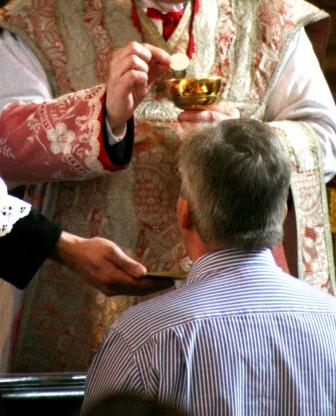
L’ OssRom: In the recent visit to Santa Maria di Leuca and Brindisi the Pope distributed Communion to the faithful on the tongue and kneeling.  It his a practice destined to become habitual in papal ceremonies?

Msgr. Marini: I really think so.  In this regard it is necessary not to forget that the distribution of Communion in the hand remains, even now, from the juridical standpoint, an indult from the universal law, [the exception to the rule, not the norm!] conceded by the Holy See to those bishops conferences which requested it.  The method adopted by Benedict XVI tends to underscore the force of the norm valid for the whole Church. In addition, one could perhaps also note a preference for using this method of distribution [He means the Pope’s own preference.] which, without taking anything from the other, [Uh huh.  Right.]  better sheds light on the truth of the Real Presence in the Eucharist, it helps the the devotion of the faithful, introduces them more easily to a sense of mystery. [It’s all about MYSTERY folks!]  Aspects which, in our time, speaking pastorally, it is urgent to highlight and recover.

Pretty clear what Pope Benedict is trying to do.  (See here and here for what His Holiness did at Corpus Christi and in S. Italy.)

Remember!  He understands that liturgy is the tip of the spear!

In his Marshall Plan for the Church, the liturgy plays an essential role, without which nothing else can be accomplished.

The Pope is trying to bring us back to ad orientem worship and reception of Communion kneeling and on the tongue.  This is all about the Church liturgy being a locus of encounter with MYSTERY, with a sense of awe at transcendence. 

I think the Pope wants everyone to move in this direction.

Therefore, he will keep the focus on the liturgy and what he is doing, slowly but steadily walking us back from some of the things that have happened in last decades.  He is changing the conversation.

To get at my thought about this, perhaps it would be useful to check this out.

Msgr. Guido Marini: Communion kneeling and on the tongue will be the standard for papal MassesOn the very day that mighty gift Summorum Pontificum went into effect, 14 September 2007, I was at the parish of His Hermeneuticalness, the inimitable Fr. Tim Finigan in Blackfen, England.  I gave the sermon for the Solemn Mass to mark that wonderful day.  I wanted to emphasis that what we do in the Church is not about nostalgia, or curiosity, or intellectual stimulation.  Instead, it has to do with the deepest needs of the human person.  The Cross, and even its proper placement during Mass, brings us to an encounter with Mystery. 

My recording of the actual sermon didn’t work, so I had to read record the sermon separately.  I then incorporated it into a PODCAzT (which also deals with Augustine and also women’s chapel veils).  Still, this could be you a glimpse at my theological understand of these liturgical moves the Pope is making and why I think they are so important.
Msgr. Guido Marini: Communion kneeling and on the tongue will be the standard for papal Masses 

Posted in Classic Posts, PODCAzT, SESSIUNCULA |
27 Comments

HURRAY! A return to an older style papal pallium!

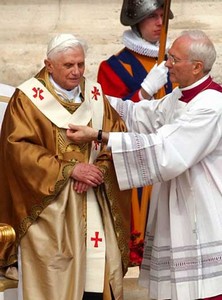
HURRAY! A return to an older style papal pallium!I remember my reaction when I attended the press conference before Pope Benedict’s inaugural Mass and then saw the pallium Archbishop Piero Marini put on the Pope.
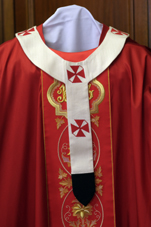
Now, thank God, the Pope is changing the style of the pallium back.  No, really…back back.

Again, what he is doing is picking the transitional form of pallium.  Folks, these moves really do mean something.

I must go over to Mass right now, but our friends at NLM have a first look at this from an article in the new issue of L’Osservatore Romano.

There will be more on this.  L’Osservatore has a couple articles.  YAY!

A new form of the papal pallium, seen to the right, will be introduced on the Solemnity of Saints Peter and Paul. I had seen rumours about this as early as the middle of May, but now it is confirmed in tomorrow’s edition of the Osservatore Romano. Msgr. Guido Marini, the papal MC, explains the change in an interview with Gianluca Biccini. Here is the relevant part in an NLM translation:

"This is the development of the Latin form of the pallium used up to John Paul II," explains the Master of Papal Liturgical Celebrations, Monsignor GuidHURRAY! A return to an older style papal pallium!o Marini, explaining historical and liturgical reasons for the new insignia in this interview to "L’Osservatore Romano."
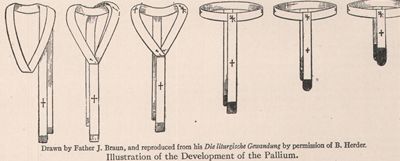
What are the elements of continuity and innovation compared to the past?

In light of careful studies, regarding the development of the pallium over the centuries, it seems that we can say that the long pallium crossed over the left shoulder was not worn in the West as from the 9th century onwards. Indeed, the painting in the Sacred Cave of Subiaco, dating back to ca. 1219 and representing Pope Innocent III with this type of pallium, seems to be a deliberate archaism. In this sense the use of the new pallium intends to meet two requirements: first of all to emphasize more strongly the continuous [organic] development which in an arch of more than twelve centuries this liturgical vestment has continued to have; in second place the practical [requirement], because the pallium used by Benedict XVI since the beginning of his pontificate and has led to several annoying problems from this point of view.

There remain differences between the papal pallium and the one which the Pontiff imposes on the archbishops?

The difference remains even in the current pallium. What will be worn by Benedict XVI from the solemnity of Saints Peter and Paul onwards takes the form of the pallium used up to John Paul II, albeit in a larger and longer cut, and with the color red for the crosses. The different form of the papal pallium vis-à-vis the one of the metropolitans highlights the diversity of jurisdiction which is signified by the pallium.

The other older, pre-Piero pallium was a bit smaller and had black crosses:

HURRAY! A return to an older style papal pallium!

Posted in SESSIUNCULA |
22 Comments

PRAY! PRAY NOW!

The Enemy will try savagely to ruin what has been set in motion.  He and the minions of hell hate the Church, hate unity, hate harmony, hate us, hate hate hate us!  They have angelic powers and are mighty enemies.

But we have God, and who is like Him?  We have the saints and angels to help us.  We have the Mother of God to defend us.

At 2100 GMT, 2300 Rome time, 1700 EDT, I will say Mass using the Votive Mass for the Unity of the Church in the 1962 Missale Romanum for the intention of Bp. Bernard Fellay, that though the merits of this Mass he will be defended from the attacks of hell.

I don’t have the Z-cam in the Sabine chapel going now, but pray please, in a special way, if you read this from the top of the hour onward for about 40 minutes or so.  I don’t have the Z-cam in the Sabine chapel going now.

O God, Who settest straight what has gone astray,
and gatherest together what is scattered,
and keepest what Thou hast gathered together:
we beseech Thee in Thy mercy to pour down on Christian people,
the grace of union with Thee,
that, putting disunion aside and joing themselves to the true shepherd of Thy Church,
they be able to render Thee worthy service
.

(Translation from the Roman Catholic Daily Missal – Angelus Press)

UPDATE: 22:24 GMT

Mass was duly celebrated.  Thanks for the unity in prayer.

Keep it going!

Posted in SESSIUNCULA |
39 Comments

Caption call

Caption call

"Happy Birthday, Holy Pardner!

With my warmest regards, George W. Bush"

Posted in SESSIUNCULA |
47 Comments

Tornielli: the 5 points were for Bp. Fellay

Andrea Tornielli has written (in my translation, emphases and comments):

Bp. Fellay’s moment of truth   [Italian:  "Il bivio di monsignor Fellay" is literally the "fork in the road".  Which path to choose?]

I am in Rome and I have gathered some additional information which helps to frame better the five conditions presented in the letter of Cardinal Castrillon Hoyos to Bp. Fellay.  Above all these conditions were not posed to the Lefevbrites in general, but precisely to their Superior, that is, the Bp. Fellay himself.  In conversations he manifests the will to dialogue, but then he writes and agrees with very harsh attacks on the Pope.  The five conditions re therefore a preliminary step to begin the journey that will lead to the revocation of the excommunication.  Central to this is the point dedicated to the fact that the SSPX, and its superiors, give the impression to feel themselves superior to the Pontiff himself, to judge him from above, as if the SSPX were the "true" Church and the "true" Rome, and the Catholic Church lead by Benedict XVI was a separated group that has to reenter in full communion with Econe and Menzingen.  The truth, unfortunately, is that there are by now stratified attitudes and positions (some comments on the preceding post demonstrate this is true  [I think we can well believe that to be true!]) which make make recognizing this given dimension difficult: the Lefebvrites are not the true Church, the true Catholic Church is that which is in communion with Benedict XVI.  Never before as in this moment is the Pontiff’s generous pastoral heart, through the mediation of Card. Castrillon, open to reconciliation.  But it is the SSPX that must return to the sheepfold about the schismatic act of illicit consecrations by Lefebvre, and not the Holy See that must ask pardon of the Lefebvrites.

Responding to questions from French journalists on this issue the director of the Vatican Press Office, Fr. Lombardi, gave the following declaration:

The recognition of the Second Vatican Council as a true Ecumenical Council of the Church and the recognition of the validity of the Mass celebrated according to the liturgy renewed after the Council are not absolutely put in question.  The five points cited by Tornielli – as even is clear from their tone – concern the minimum conditions why there can be a relationship characterized by respect and openness toward the Holy Father and by a constructive ecclesial spirit.  They are, then, of another nature and it is for this that they make no reference to the Council or the liturgy, not because these topics do not remain fundamental.  It is evident that the Pope desires to extend the hand so to make possible a return to communion, but so that there can can be the necessary steps, it is needed that this offer – this "outstretched hand" – be received with an attitude and spirit of charity and communion.  Clearly the finve points invite this.


My comments:

I think that Bp. Fellay’s sermon in Paris at the beginning of June, may have been the catalyst for this.  On Sunday 1 June Bp. Fellay made harsh statements about Pope Benedict in a public sermon.  On 4 June Bp. Fellay met with Card. Castrillon in Rome.  The five points came from that meeting.  Remember at the time I posted about that sermon, many hard supporters of the SSPX basically cried out here on this blog "But Father!  But Father!  You mustn’t ever point out anything negative that anyone in the SSPX has done!  That’s bad for dialogue!"  No, friends.  It is not.  Bp. Fellay’s words shaped the dialogue and so did reporting them here.

The big point here is that the five conditions were presented to Bp. Fellay not the SSPX.  Formally, at least.  I don’t anyone is under the impression that they don’t also pertain to everyone else in the SSPX.  I am not talking about laypeople here, who really can’t be members of the Priestly Fraternity of St. Pius X, as the SSPX is truly called.   These conditions ultimately apply to the four bishops and to the priest members.   They must.  There cannot be a double standard.  

But Bp. Fellay, who must be under tremendous pressure  – poor man – set the tone.  He is the public face and leader of the SSPX now.  When he speaks in public, people hear the official position of the SSPX.  Ironic, no?  The bishops originally by Archbp. Lefebvre’s design were not supposed to take on that role.  But that is what happened.  Perhaps now for the best.  If Bp. Fellay can set another example -then God will reward him abundantly.  Think of the good he can do.

The Holy See is say that these points are addressed to Bp. Fellay.  Fine.  We accept that.  But they must also be accepted, eventually, by anyone who desires communion with Rome.

So, it is still game on for the entire SSPX. 

What pressure will some of them be putting on Bp. Fellay?  I shudder to think.

If he accepts the conditions, there could be a split, just as if the conditions had been put to every member.

Almighty God, before whom the shining ranks of holy martyrs
cast down their crowns and palms of victory,
strengthen by the Holy Spirit’s sealing Confirmation,
the heart, mind and will of Bernard Fellay
and increase the serenity and patience of all who are around him.

St. Michael the Archangel, defend us in battle…

Saint Pius X, pray for us.
Sts. Peter and Paul, pray for us.
Holy Mary, Mother of the Church, pray for us.

Our Father…

Glory be to the Father...

Posted in Classic Posts, SESSIUNCULA |
21 Comments

SSPX prospects and my ruminations

Our friends over at Rorate have picked up on Paolo Rodari’s note on Palazzo Apostolico about the Five Conditions posed by the Holy See to the SSPX.  The Holy See is requiring a response by the end of the month.

Here is my translation of Rodari’s item:

First consideration: I don’t know if the Lefebvrites will accept the conditions of the Holy See.  I know that another, similar occasion probably will not happen ever again.  And I know that, if they don’t accept, they would probably lose quite a few of their followers, principally because they want to participate in Masses with the old rite.  But this Mass, today, can be found also elsewhere, thanks to the Motu Proprio Summorum Pontificum.

[Right.  Pope Benedict, understanding all the angles here, knew when it was time to pose the unavoidable question.  Will you accept union with Peter and his role or will you be like the others, way over on the other side of the road.  Remember: Ceteris paribus, people would rather be with the Church than against her!  With the local bishop than against him!]

Second consideration: A very small indication concerning the fact that, probably, the Lefebvrites will accept the conditions posed by the Holy See (or that at least they are seriously thinking them over) came to me from a telephone call I made yesterday to Ecône, headquarters of the SSPX.  As at other times in the past, I asked to speak with Bishop Fellay, Superior of the SSPX. Usually, especially when he wanted to reassert that there was nothing new concerning their reentry into the Church, he answered me quickly. Instead, yesterday he made it known that he had nothing to say.  Perhaps this is because he is seriously thinking about accepting the Vatican’s conditions  – but doesn’t want to say it?


I think Rodari has hit the nail on the head both times.

Even if we consider that the conditions were probably put directly to Bp. Fellay, maybe, rather than the whole SSPX.  Still, he is their Superior.

First, if there is a viable option, I think that people in their goodness and their native Catholic instincts, unless they have been somehow terribly hurt or perhaps twisted in their thinking or their hearts, would by far rather be in union with the local Church and with Rome.  That is why I wrote ceteris paribus… all things being equal.  Also, most people want a reverent Mass and sound preaching.  They care little for the loftier theological arguments.  They need the spiritual nourishment neccessary to get through their days and weeks according to their vocations.

Second, were Bp. Fellay to say that he was considering accepting these conditions, the pressure on him would ratchet up beyond what it must be now.  Frankly, I think this is probably a mirror of what happened to the late Archbp. Lefebvre that night after he signed the concordat in 1988 in Card. Ratzinger’s office at the CDF.  I imagine the pressure on the old man was tremendous.  It could be that these young men, perhaps Bernard Fellay, desired that it go the other way and the old man finally caved it.  Speculation on my part, perhaps.  But it seems just about right.  So, what goes around comes around.  Now it is Fellay’s turn, though he is not in the same role that Archbp. Lefebvre had in the SSPX as its founder.

I really don’t envy this poor chap.  He must be under tremendous stress, hounded by a hundred shrill voices.

He needs our prayers, friends. 

I will say Mass for Bp. Fellay’s intention this afternoon, as a matter of fact.

The identity of the SSPX is at stake now. 

What do they stand for?  Who are they?

I think they could by their reunion send a magnificent message not only to many on the left in the Church, but also many non-Catholics who in their hearts look to the Church with hope. 

Also, within the Church I think they could be an incredibly effective leaven.  I always call to mind what our good friend His Hermeneuticalness says, Fr. Finigan.  He looks foward to the SSPX men joining their deanery meetings!  Their integration into the fuller life of the Church, with all its strains and factions and problems, will be real pastoral work, friends. 

The setting of a broken bone is painful, as is the knitting – tedious, inconvenient and worrisome.   But Holy Church needs the strength his knitted bone will have.  A broken bone can wind up a stronger.

Posted in Classic Posts, SESSIUNCULA |
29 Comments

QUAERITUR: Do SSPXers think new rites of ordination are valid?

This question came up in a comment under another entry.

Some SSPX priests and some of the people in the pew have doubted the validity of the new rite of Ordination. Is this a block? Are the priests who hold these ideas and their congregations deviating from official SSPX statements in this regard?

God bless all of us and I really do hope my brothers and sisters in the SSPX and all of trads will be truly reconciled soon.

As do I, but a great deal of humility will be needed before that will happen.

To your question.

I don’t believe many of the priest members of the SSPX, or even their bishops (though I am not sure about Williamson) would say that the post-Conciliar reformed rites for ordination are invalid.  Some probably would.  I recall years ago a priest of my acquaintance who skipped from his diocese to join the SSPX was conditionally re-ordained, which was a pretty serious problem.  But I believe that to be an aberration.  At least I hope it was.

It strikes me that they would hold to the position laid out by the late Michael Davies in his book Order of Melchisedech: Defense of the Catholic Priesthood, which I think might be out of print. 

Davies points out that the new rites, or rather the rites as they were issued by Paul VI, were in many ways flawed.  There was not adequate explicit expression of the meaning of the rite, exactly what was being conferred (the power the forgive sins, bless, transubstantiate bread and wine).  The idea is that a rite should express clearly what it means to accomplish.  That is to say that the ordaining bishop must have the intention to confer what the Church intends to confer.  That is facilitated and made explicit in the rite itself, by word and gesture. 

QUAERITUR: Do SSPXers think new rites of ordination are valid?John Paul II reworked the rites in 1990, reinserting into the rites some elements that had been removed in order to make clear what the rites were doing.  I was probably the first man in the world ordained with that book as a deacon by Augustin Card. Mayer, now the oldest cardinal in the world, and then later I was ordained a priest with it by the same John Paul II.


However, even though Mr. Davies – now sorely missed – said that Paul VI’s rites were flawed, and I think he was right – they were not so flawed as to be invalid. 

The idea is this.  The bishops who were doing the ordaining were trained in an era in which what they were doing was very clear.  They knew what the rite intended to confer even if that wasn’t manifestly expressed in its entirely in the rite.  The rite was sufficiently clear, if not completely, and the Church and bishops knew what they were doing. 

However, Mr. Davies rang an alarm bell, and rightly so.  I am not saying that he is directly responsible for the reworking of the rites of ordination by John Paul II, but I think he may have contributed to and shaped the discussion. 

The problem – and it was a grave grave grave one – was this: What will happen decades in the future when, after decades of really lousy theological training in seminaries and squishy theology in universities, et al., bishops do not have a clear idea of who a priest is or what he does in the Church?  Can he possibly have the intention to do what the Church wants if those things are not explicitly laid out in the rites?  That would call into serious question the validly of the ordination.  The ordaining bishop would not have the proper intention to ordain as the Church intends.  

Thus, it was of critical importance to make sure the new rites had those elements.

Anyone who has been to ordinations with the new post-Conciliar rites and also the older pre-Conciliar rites will know what I am talking about.  Even if you saw the FSSP ordinations in Lincoln, NE on EWTN and have also seen ordinations with the new rite, you will see instantly that they are different in many respects. 

The new rite ordinations are valid, without question in the Latin form of the 1990 revision by John Paul II.  But I think we have to admit that the older form of the rites more clearly expresses what the Church intends.

So, in short, I think that most of the SSPX priests, at least the smart ones, will understand that the new rites are valid, just as the Novus Ordo is valid.  However, I think they would be very concerned about them. 

Final note.  I mentioned Michael Davies.

I can’t help but think that Michael Davies, a great gentleman who died a couple years ago, would have strongly supported the gesture of the Holy See made to the SSPX.

I met Michael Davies and remember what a tremendous bulldog he was on points he was convinced about.  However, you could have an amicable discussion with him and, if your arguments were good, he would shift his position.  Also, he was careful not to go over the top with his rhetoric and, when something was pointed out to him that was too harsh, he would make changes.

I think Michael Davies – sorely missed today – would have been thrilled by the election of Pope Benedict, Summorum Pontificum and this recent gesture of the Holy Father to resolve the divisions that sadly wound the Church. 

Posted in ASK FATHER Question Box |
73 Comments

QUAERITUR: abbrev. in MartRom.

I had an interesting question by e-mail from a reader:

Fr. Z.,
I was working with the 2004 Roman Martyrology [Martyrologium Romanum – there was a new edition in 2001, which it was rapidly recognized needed a lot of revision.  A new edition was issued in 2004 by Card. Arinze.] yesterday and I came across some abbreviations I couldn’t figure out.  I looked in 3 different Latin dictionaries (including Lewis and Short) [May God shed His light upon it for our easy consultations.] and asked the reference librarian–nothing.  There is no table of abbreviations in the book [That is a lacuna for sure.  I will tell my friends in the CDW about that.] and I looked in two previous editions (2001:Latin and 1946:English), which also have no abbreviation tables.  The library does not have the 1962 version and its online existence is presented without any helpful front material. 

Anyway, here’s the abbreviations:
– s. IV in.
– s. inc.
– s. III ex.

All of them are for death dates of saints.  I think the Roman numeral stands for the century.  [Yes.] I think "inc." might stand for "incisus" [No.] that is, "graven" or "inscribed,"  but I’m not sure what that means.  "Ex" is probably for "extra," but what does that mean? [No.]  Any ideas?  [Yes.]

Also I came across LOTS of abbreviations of city names which indicate the episcopal sees of various bishop-saints.  Any idea where to look up city name abbreviations in Latin?  [Hmmm…]


I think what you are looking at here are abbreviations for initium and exitus…. beginning and end.  Thus, when you look up St. Ipsidipsy (don’t try) and find something like s. IV in. that means St. Ipsidipsy lived or died or flourished, etc., in the first part of the 4th century.   On the other hand, s. inc. would be saeculum incognitum… "unknown", as you find under, say, St. Christopher’s entry in the index.

For city abbreviations I think your best bet is Egger’s Lexicon Nominum Locorum published by the Vatican Press (Libreria Editrice Vaticana).  It has the Latin names of places, ancient and modern.  That won’t have the abbreviations, but you will be able to find your places.  Also, the Annuarium Pontificium could be of service.  Under the entry for each diocese the Latin name will be given, in adjectival form. 

Remember that the abbreviation of place names in the MartRom are in adjectival form.  Thus, the Archdiocese of my home place is called the "Saint Paulitan and Minneapolitan Archdiocese" (Archidioecesis Paulopolitana et Minneapolitana – "dioecesis" is feminine in Latin.), while that of ancient Milan is from the ancient Roman name for the city Mediolanum and thus is Archd. Mediolanensis.  The bishop of the Diocese of, say, Autun, would be Episcopus Augustodunensis, from the ancient Roman name of the city in adjectival form, while the bishop of Wagga Wagga in Australia would be Episcopus Corvopolitanus, from Corvopolis (because Wagga Wagga in whatever aboriginal language it may be means "crows" and they just couldn’t bring themselves to name the diocese "Waggawaggopolis".   I guess they didn’t scruple so much with the ghastly "Dioecesis Vayne Castrensis – Southbendensis". But I digress.

I always look at the Martyrologium Romanum in the morning or at least before Mass.  It is fascinating to see the names of these men and women of every age who lived lives or died with heroic virtues.  It reminds us that we, great or small, can really do it.

Today we find for example, the entry for St. Prosper of Aquitane, a fascinating fellow.  He was a great scholar and student of St. Augustine, had his part in the "Semi-Pelagian" controversy and was one of St. Leo the Great’s collaborators.  Also, we find the martyr Dominic Henares, a bishop of the Dominicans, who was killed in Tonkin, Vietnam in the 1800’s.

Posted in SESSIUNCULA |
18 Comments

UK: Solemn Catholic TLM in Winchester Cathedral (Anglican)!

The other day I posted an eyewitness account of the Solemn TLM in Winchester Cathedral… an Anglican Cathedral, under the aegis of the Catholic Bishop of Portsmouth but at the invitation of the Cathedral Chapter.  I warned you about it here at the time when there was that ghastly dust up in Cardiff at the Catholic Cathedral.

This is what I call true ecumenism.

Alas, I think that post got lost in the server changes last weekend.

Here it is again.

Dear Fr John
 
I hope that you have recovered from the awful weather that followed you around the mid-west ten days ago or so.
 
And so to Winchester, to the Cathedral that you and I visited five months ago, to resting place of the bones of so many of the Saxon Kings of Wessex and England, and of Jane Austen, where this morning I had the joy of assisting "In choro" at a Votive Mass (Sacerdotes tui, Domine) of St Swithun, Bishop of Winchester, celebrated by Rt Rev’d Dom Laurence Beer OSB, with Rev’d Dr Laurence Hemming as Deacon and Rev’d Fr Philip Thomas as Subdeacon.   In choir, in addition to your humble correspondent, were Rev’d Frs Andrew Goodman and William Young.   Profound gratitude is due to Bishop Crispian Hollis, the Bishop of Portsmouth and to the Parish Priest, Canon Paul Townsend, for giving permission for this Mass and, most of all to the Dean of the Cathedral, Very Rev’d James Atwell, who was present in his stall, for the invitation.  
 
The ordinary was Palestrina’s Missa Papae Marcelli, sang beautifully and without fault by the Lay Clerks of the Winchester Cathedral Choir, who also sang the exquisite Offertory Motet "Exaltabo te, Domine" by Palestrina and Victoria’s "O Sacrum Convivium" whilst upwards of two hundred and fifty made their Holy Communion.   I remembered you at the Memorial of living and the late Mgr Schuler RIP (who would have delighted in the music) at that of the dead.
 
Dr Hemming preached on the witness of St Swithun to the need for us to cleave close to Christ, our one true High Priest.   At the end of Mass he gave us a delightful fevorino on Reginald Cardinal Pole before we sang the Prayer for the Queen, beginning with the delightful versicle and response, "Domine salvam fac Reginam nostram Elisabeth: et exaudi nos in die qua invocaverimus te" and the Mass ended with the Salve Regina (in the normal tone) and the Christus Vincit from the Worcester Cathedral Antiphoner.  [Msgr. Schuler would have delighted in the music, certainly, but also in the event.  A little know fact is that he was the Catholic priest who brought the first Anglican priests to meet Card. Seper in Rome to talk about the "pastoral provision".]
 
The most beautiful thing this side of heaven?   Procul dubio.
 
With every good wish and the hope of seeing you again before too long.
 
Deacon Stephen Morgan

I am grateful for the report and sorry it was delayed.

Posted in SESSIUNCULA |
10 Comments

ICEL’s Msgr. Harbert responds to Bp. Galeone’s points on the new translation

A couple readers sent via e-mail a text floating around which was claimed to be a response from ICEL to the points raised about the draft of the new translation of the Missale Romanum by His Excellency Most Reverend Victor Galeone, Bishop of Saint Augustine, Florida, during the recent meeting of the USCCB.

Since I didn’t see anything whereby I could verify this text, I contacted the good folks at ICEL and asked about it.  In turn they sent me a copy of the text with a clarification.  I post those here for your perusal.

In the text you will be my emphases and comments.

Dear Fr. Zuhlsdorf,


Attached you will find some notes that Msgr Harbert prepared concerning the comments made by Bishop Galeone at the USCCB meeting in Orlando last week. These notes were sent to Bishop Galeone, but were not really "issued by ICEL" but shared with some interested parties.

 Now the text itself:


Bishop Galeone has broken new ground in the public discussion of liturgical language, raising the debate to a higher intellectual level. Whereas critics of ICEL’s recent drafts have mostly commented on individual vocabulary items, his contribution points to structural and semantic issues that are systemic throughout the Missale. His remarks merit a careful response.

Commenting on ICEL’s proposed translation of the Post-Communion for the Wednesday in Holy Week, he has pointed out that the final verb is preceded by two lines that modify it, whereas the more normal pattern in English is for modifiers to follow their verb. If this principle were followed in this case, the translation might read:

Fill our minds, almighty God,
with sure confidence
that you have given us perpetual life
through your Son’s Death in time,
to which awesome mysteries bear witness.

However, ICEL’s translators have been impressed by the fact that Latin orations, especially Post-Communions, tend to conclude strongly with a teleological or eschatological point.  [Yes.  Roman prayers, even as the Psalms do, identify a particular characteristic of God and then, as a consequence of that divine characteristic, going on to make a petition.  The concise Roman Latin style adds great force to the petition, perhaps a reflection of the confidence of the prayering Church in God’s promises.  Something of this force can be retained by sticking as closely as English allows to the Latin structure.] Because of this, they have often followed the Latin in placing the modifiers before the verb so that the English prayer also ends on a strong note. In doing so, they have hoped to avoid a defect that many have noticed in the current translations of these prayers, namely that they often end weakly. It has not been possible to follow this procedure in every case, because sometimes too contorted a syntax results, but it has been followed frequently throughout the Missal. The Commission hopes that this pattern, though unfamiliar at first, will soon become familiar, and allow the teleological thrust that marks so many of the Post-Communions to become more apparent to the people.  [Right! Once people get used to a new style of more accurate prayers, many of this problems with style will fall away.]

Bp Galeone also recommended the addition of ‘this’ to the third line, so that it would read:

to which these awesome mysteries bear witness.

The recommendation to insert ‘this’ or ‘these’ where there is no Latin equivalent is made frequently, but the translators have often found themselves disinclined to adopt it, because it narrows the focus of the text. A familiar example is found in the words before Communion currently translated:

This is the Lamb of God . . .

These words draw the people’s attention to the Host that the Priest holds in his hand, and invite them to recognise Christ present in the Sacrament. But the words were originally those of John the Baptist, spoken when he was at some distance from Jesus. The Commission’s more recent translation, ‘Behold the Lamb of God . . . ‘. gives the text a greater polyvalence, inviting the people to remember also the Baptist’s words and the context in which they were first uttered, as well as the eschatological appearance of the Lamb in heaven, which the Priest’s subsequent quotation of Apoc 19:9 recalls.

Returning to the Post-Communion for Wednesday in Holy Week, we can see that Bp Galeone’s proposal would make the prayer refer clearly to the Eucharist whose celebration is drawing to a close. But it should be noticed that since its earliest appearance (in the Hadrianum manuscript of the Gregorian Sacramentary, dated 811 – 812), this prayer has been assigned to the day before the beginning of the Easter Triduum. It retained that position in subsequent Sacramentaries, and in the 1570 Missal. [!] This being so, we can see a richer significance in the words mysteria veneranda: they refer not only to the Mass just celebrated, but also to the mysteries of the Triduum that will be beginning next time the people gather. It would seem a pity to remove such a resonance from this ancient prayer by adding the word ‘these’.

 I am grateful for the clarification from ICEL and the text, which we now can be confident is accurate.

Another thing.

Note that Msgr. Harbert points out, much as the weekly WDTPRS columns do, the provenance of the prayer under discussion.  He says that from earliest times this prayer was used as the last Mass oration uttered before the Sacred Triduum began the next day.  This is a very good thing to underscore. 

Most of the prayers of the 2002 Missale Romanum are very ancient.  Sadly many of them were chopped up or uprooted from their original places during the liturgical year and moved around.  But the fact remains that we can look at their original contexts in order to gain insight into what the prayers really say.

Posted in Classic Posts, SESSIUNCULA |
36 Comments






















