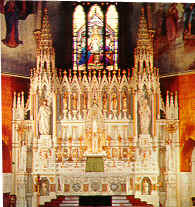
Bp. Seratelli responds to critics of the new liturgical translations – this guy gets it!

WDTPRS has in the past given high kudos to His Excellency Bp. Arthur Seratelli of Paterson, NJ, and chairman of the USCCB’s liturgy committee has published something about liturgical translation on his diocese’s website.

During the USCCB meeting, as you can read here, some bishops – the usually suspects – raised objections to the new draft of the translation of prayers in the Missale Romanum. 

Bp. Seratelli responds.

Let’s have a look with my emphases and comments.

The Language of the Liturgy: The Value of the New Translations

In Act III, Scene II of The Tragedy of Hamlet, the young prince gives this advice: “Suit the action to the word, the word to the action.” [His Excellency must think people are smart enough to know who Shakespeare is!  It is interesting that the norms for liturgical translation mention that liturgical sacral language should make reference to the literary heritage of the language.] Ever since the publication of the third edition of the Missale Romanum in 2000, translators have been grappling with the challenge of suiting the word to the liturgy.  Translators working to provide a fresh translation of the liturgical texts face a number of challenges.

Words, like people’s dress, change from one generation to the next and from one group to another in the same society. What one individual calls a “swamp,” another more ecologically conscious individual calls “wetlands.” A politician waxes eloquently about “public participation.”  His audience understands him to say “self-denial.” The corporate world routinely uses the noun impact as a transitive verb. People follow happily along.

Today, politically correct as well as linguistically conscious individuals carefully circumvent the word “man” not to offend women. Past generations pronounced the word with never the slightest intention of excluding women. But times have changed.  We speak now about humankind.  Certainly, we have gained inclusivity.  Yet, we have sacrificed language that is not so abstract.

English always has been an open language, ready to welcome neologisms. [Oooo… the bishop used a hard word!  HURRAY!] The Internet has enriched our speech with new phrases and words.  Text messaging is altering our spelling and our syntax. Language is a human expression.  As people change, so does the way they speak.

In his popular  rhetorical guide, De duplici copia verborum ac rerum, Erasmus, [My heavens… can I believe what I am seeing?  He even quotes Erasmus, and gives a LATIN title!  O my!] the 16th century Dutch humanist and theologian, showed students 150 different styles they could use when phrasing the Latin sentence, Tuae literae me magnopere delectarunt (Your letter has delighted me very much). Clearly, no single translation of any sentence or work will ever completely satisfy everyone. Even the best of all possible translations of the new Missal will have its critics.

But there is something more at stake than pleasing individual tastes and preferences in the new liturgical translations. The new translations aim at a “language which is easily understandable, yet which at the same time preserves … dignity, beauty, and doctrinal precision” (Liturgiam Authenticam, 25). The new translations now being prepared are a marked improvement over the translations with which we have become familiar. They are densely theological.  They respect the rich vocabulary of the Roman Rite.  They carefully avoid the overuse of certain phrases and words.

The new translations also have a great respect for the style of the Roman Rite. [This is very important.  For example, the very concision of the prayers of the Roman Rite means something!] Certainly, some sentences could be more easily translated to mimic our common speech. But they are not.  And with reason.  Latin orations, especially Post-Communions, tend to conclude strongly with a teleological or eschatological point. [Yes… the structure of a Collect, for example, usually begins with a point about who God is and what God has done, much in the Hebrew way of praying in the psalms and then continues, in the same conceptual current with our petitions.] The new translations in English follow the sequence of these Latin prayers in order to end on a strong note. Many of our current translations of these prayers end weakly. Why should we strip the English translation of the distinctive theological emphases of the Latin text? A slightly non-colloquial word order can lead the listener to a greater attention to the point of the prayer.  [YES!  Like "gibbet" or "consubstantial".]

Our present liturgical texts are framed in simple syntax.  The new translations use more subordinate clauses. This, in and of itself, does not render them unproclaimable. By the very fact that, in some instances, the new translations require thoughtful and careful attention to pauses when speaking helps to foster and create a less rushed and more reverent way of praying. Not a small gain for a proper ars celebrandi. 

The new translation at times may use uncommon words like “ineffable.” The word is not unspeakable! For sure, this word does not come from the street language of the contemporary individual. But, then, why cannot the liturgy use words that elevate the language from the street to the altar?  People may not use certain words in their active vocabulary. This does not mean they will be baffled by their use in the liturgy. “If indeed, in the liturgical texts, words or expressions are sometimes employed which differ somewhat from usual and everyday speech, it is often enough by virtue of this very fact that the texts become truly memorable and capable of expressing heavenly realities” (Liturgiam Authenticam, 27).

Liturgical language should border on the poetic.  Prose bumps along the ground. Poetry soars to the heavens. And our Liturgy is already a sharing of the Liturgy in heaven.

The liturgical texts that we are now using are not perfect, but they are familiar. This familiarity makes celebrants at ease with the present texts. The new texts are better.  When the new texts are implemented, they will require more attention on the part of the celebrant.  But any initial uneasiness will yield to familiarity and to a language that is well suited to the Liturgy.

A language suited for the Liturgy: this is the one of great advantages of the work being done on the new translations.  There is more to the Liturgy than the human language of any age or any one country. In the new translations of the Roman Missal, a conscious effort is being made to suit the human word to the divine action that the Liturgy truly is. As Pope Benedict XVI has said, the “central actio of the Mass is fundamentally neither that of the priest as such nor of the laity as such, but of Christ the High Priest: This action of God, which takes place through human speech, is the real "action" for which all creation is in expectation… This is what is new and distinctive about the Christian liturgy: God himself acts and does what is essential” (The Spirit of the Liturgy p. 173).

In his early work Enchiridion militis christiani, Erasmus states the obvious about human speech and the divine. He argues that words always fall short of their task of miming the Logos. Reaching back to Exodus 16, he argues that the smallness of the manna rained down on the Israelites "signifies the lowliness of speech that conceals immense mysteries in almost crude language.”  Until the end of history, we must be content with imperfect language that will never fully unveil the divine mystery we celebrate.  But the new translations, imperfect as they are — as all human speech will be —are good translations that have passed through the hands of many scholars and bishops. The language of the new texts, while not dummied down to the most common denominator, remains readily accessible to anyone. Most assuredly, these new translations of liturgical texts will help us better approach God with greater reverence and awe. We gladly await their final approval from the Holy See and their use in the Liturgy!
Bp. Seratelli responds to critics of the new liturgical translations - this guy gets it!

Highest WDTPRS kudos to Bp. Seratelli!

He gets this exactly right.

Posted in SESSIUNCULA |
27 Comments

John Allen’s interesting account of the USCCB vote on liturgical translations

My friend the nearly ubiquitous fair-minded former Rome correspondent for the ultra-lefty National Catholic Reporter has an interesting take on what happend in last week’s USCCB meeting when bishops discussed liturgical translation.  I am just catching up on my articles and e-mail so this is a little dated… four whole days!

I have some addition observations at the end.

My emphases and comments.

USCCB: Dramatic debate, cliffhanger result on liturgy
By John L Allen Jr Daily
Created Jun 13 2008 – 06:23

By JOHN L. ALLEN JR.
Orlando, Florida

Perhaps it’s only fitting that a meeting held in Florida, the state that made the hanging chad famous, should feature a dramatic cliffhanger vote, which, as election day ended, remained inconclusive.

Heading into the U.S. bishops’ spring meeting in Orlando, it didn’t seem likely that a proposed new translation of the Proper of Seasons, part of the prayers and other texts for the Catholic Mass, would stir up much dust. [In fact, now that the Ordo of Mass is finished, I suspected there would be much less to fight about.]  Following a decade and a half of impassioned argument over such texts known colloquially as the “liturgy wars,” many bishops privately expressed fatigue and a desire to move on – suggesting to most observers that approval of this text ought to be more or less a given. [Yep.]

In one sign of that mood, only seven bishops out of 250 Latin Rite prelates in the United States even bothered to propose amendments to the text, a clear sign that most felt the handwriting was on the wall. Like it or not, many concluded, Rome has made clear that the new translations must be closer to the Latin, both in structure and word choice, thus producing a more “sacral” language sometimes remote from ordinary English usage.  [These are the norms expressed in Liturgiam authenticam.]

All that changed this morning, however, when Bishop Victor Galeone of Saint Augustine, Florida, [You might remember him and his incredible reaction Summorum Pontificum or how his Diocesan Director of Liturgy, Fr. Thomas Willis, said that people who have ADD can focus better at the Latin Mass with all the silence than at the Novus Ordo where there is more "active participation".] rose to oppose the proposed text — despite, he said, fear that doing so may be "in vain." [Uh huh…. riiiiight…]  A former Latin teacher who still reads Thomas Aquinas in the original language, Galeone made a forceful argument that the new translation is simply too unclear and awkward to be effectively used in American parishes.  [I wonder how forceful it really was.  I didn’t hear it, but citing a few examples of hard vocabulary doesn’t really constitute much of an argument.]

Among other things, Galeone cited the text’s use of the phrase “the gibbet of the Cross.”

“The last time I heard that word was back in 1949, during Stations of the Cross in Lent,” Galeone said.  [Strange… I heard it last Lent in a parish church.]

“I challenge anyone to proclaim what’s given here at Mass,” he said. “It’s very difficult.”  [This is interesting.  We still have not yet heard a single prayer of the new translation "proclaimed" and already it is being challenged.  Amazing.  But this is what the progressivists always do: they take the official text and then screw with it in the interest of improving it in this context or that without it having been actually used.  That is what they did, for example, with the Rite of Ordination.  The Congregation reacted very sharply to that.]

“A good translator has to understand not just the original language, but also one’s own into which these texts are being put,” Galeone said. Despite assurances to the contrary, he said, the new texts are “slavish” with respect to the Latin originals.  [Hmmm… I like that… "slavish".]

“I’m an obedient son of the church, [Nota bene.] and if these texts are passed as they stand, I will pray with them,” Galeone said. “But I feel that the vernacular has been a blessing to our people.” Galeone added that with “all due respect” to the recent ruling from Pope Benedict XVI authorizing wider celebration of the old Latin Mass, he hasn’t celebrated the old rite since 1970. If he were asked to do so today, he said, he would instead celebrate the new rite of the Mass in Latin.  [Okay… I respect a personal preference in this regard.  But, as bishop, couldn’t he have a little more generosity in regard to the legitimate aspirations of Catholic people who were so deeply hurt for so long?]

Galeone’s speech seemed to open the floodgates, as other bishops rose to voice reservations about the new translations.  [This is where things get really interesting.  Watch very carefully who is mentioned and what their positions are.]

Auxiliary Bishop Richard Sklba of Milwaukee, [Consecrated in 1979 by His Excellency Archbp. Rembert Weakland.] for example, said, “If I have trouble understanding the text when I read it, [?!? Really ?!?] I wonder how it’s going to be possible to pray with it in the context of worship.”

Sklba warned that if the proposed text were adopted, “our priests and our people” will press the bishops to come back to it “again and again” to remedy perceived defects. “This is not yet mature,” he said.  [I bet they won’t.  I bet they will praise the new translation and embrace it warmly!]

Bishop Donald Trautman of Erie, [You knew this name would pop up, right?  Remember that His Excellency has said tie and again the people in the pews aren’t smart enough to understand hard English. Check here and here and here and  here, among the many times we have looked at his views.  He active fought against the CDW’s norms. Also, remember how he received H.E. Piero Marini’s book and how he is implementing Summorum Pontificum.  You get the drift.] Pennsylvania, a longtime critic of the new translations, said the texts contain a number of “archaic and obscure” terms, pointing to words such as “wrought,” “ineffable,” and “gibbet.” He also said that the text’s preference for mimicking the sentence structure of Latin, featuring long sentences with a large number of dependent clauses, impedes understanding in English. ["It’s toooo haaard!"]  Trautman cited one prayer in the new Proper of Seasons presented as a single 12-line sentence with three separate clauses.

“John and Mary Catholic have a right to have prayer texts that are clear and understandable,” Trautman said. “The document before us needs further work.”

Bishop Robert Lynch of Saint Petersburg, Florida, [Who has little time for the older form of Mass and who, if memory serves, forbade Exposition of the Blessed Sacrament in his diocese.] thanked Galeone for giving him the “courage for this moment.” Lynch then told the bishops that he had recently taken the new Mass texts back to his presbyteral council, composed of 26 priests. Two were in favor of the translation, he said, and 24 were opposed.

He reported their reaction as, “Bishop, do whatever you can, because we can’t pray these texts.”

“It’s a good thing that we’re supposed to pause before the orations,” Lynch joked, “because we’ll have to gather enough breath to pray the prayers.” [Yuk yuk.]

Other bishops, however, argued that admitted imperfections in the text don’t justify further delays in the process.

“It’s an imperfect sacramentary for an imperfect people, to be prayed by a celebrant who is also imperfect,” said Archbishop George Niederauer of San Francisco. “I respect those who say let’s move forward and get a new sacramentary, before they all fall apart in the sacristy.”  [You know… it is okay for a translation to sound like a translation.]

Archbishop Oscar Lipscomb, the retired archbishop of Mobile who sits on the Vox Clara Commission that advises the Vatican on liturgical translation, said that he doesn’t find the new texts “unacceptable or unproclaimable.” [He must believe that people are smart.]

“Our genius in celebrating,” he said, will make up for any deficiencies.  [Right!  We priests get to explain the texts!] Further, he said, the average Catholic will receive the new texts “with the eyes of faith,” rather than focusing on its problems “like an English teacher or a Latin teacher.”  [Exactly.]

Cardinal Daniel DiNardo of Galveston-Houston said that “with all its difficulties, the translation should go forward,” adding that he believes the new Mass texts “become stronger after Advent, into Lent and Easter.”

Responding to the “let’s move on” argument, Archbishop Daniel Pilarczyk [Who in a rather menacing memo showed that he will restrict priests from using the 1962 Missale Romanum by imposing a double-standard "test" on them.] of Cincinnati warned that it “depends on what you’re moving forward to,” arguing that the new texts would be “a linguistic swamp.”  [Where people should feel right at home in after the last few decades of ghastly liturgy and worse translations.]

Archbishop John Vlazny of Portland made another argument in favor of the text, noting that four other English-speaking bishops’ conferences have already approved it. If the Americans reject it, he said, it could jeopardize the goal of a common text.

“Admittedly, we’re the big ones, but that doesn’t allow us a terribly privileged position,” Vlazny said. “We need a measure of humility in this.”

Echoing a point made by others, Vlazny also argued that today’s texts may seem more “proclaimable” simply because they’re familiar. With time, he said, the new texts will also become familiar, and the issues of syntax and word choice cited by critics “will be a non-problem.”  [Yes.   This goes back to what I mentioned earler.  The opposition is condemning them before there is any experience of them.]

Bishop Arthur Seratelli of Paterson, New Jersey, chair of the U.S. bishops’ Committee for Divine Worship, defended the texts.

“On whole, the translation is a marked improvement,” Seratelli said. “As we use it, as we ourselves and our priests become more familiar with the new language of the liturgy, it will not pose as great a problem as we fear.”

After all that the bishops were unable to reach a decision, largely because of the electoral math.  [So… what a great service the opposition did for the universal Church, right?]

The rules of the conference require that the text be approved by two-thirds of its members, not just those physically present. Since there are 250 Latin Rite bishops in the United States, 166 “yes” votes are required to approve it, while 83 “no” votes are necessary to reject it.

As it turns out, the Orlando meeting was sparsely attended – one headcount yesterday found just 178 voting members. As a result, this morning’s ballot failed to get enough “yes” votes to approve the text, or enough “no” votes to block it.

As a result, Cardinal Francis George of Chicago, president of the conference, announced that bishops who were not present will receive ballots in the mail in order to settle things one way or the other.

The bishops did reach a decision on a couple of other points.

If the text is rejected, they decided, all members of the conference will have the opportunity to submit observations and proposals, not just those who have already expressed concerns.

Further, if the text does have to go back to the drawing board, the bishops decided not to send it to the International Commission on English in the Liturgy, a translation agency which is a joint project of 11 English-speaking bishops’ conferences, for comment. Since ICEL was restructured under Vatican pressure several years ago, some bishops feel the agency has not been receptive to proposed changes to its texts. In a voice vote, the bishops opted this morning to bypass any reaction from ICEL and simply bring a new version of the Proper for Seasons back to the U.S. conference.

That, however, assumes that the text does not pass once all the mail-in ballots are counted. Some veteran conference observers believe that once all the votes are in, the new text stands a good chance of being approved – noting that a number of likely “yes” votes, such as Cardinals Justin Rigali of Philadelphia and Edward Egan of New York, were among those absent in Orlando.

I believe the texts will be passed.

However, what is interesting here is how this was orchestrated. 

Do you remember that before Bp. Seratelli was elected as Chairman for liturgy, they had Bp. Trautman?  Do you remember how he was elected?

If was pretty much a done deal that someone like Card. George was going to be elected.  Then, all of a sudden, there was a nomination made by one of the most liberal bishops in the country, H.E. John Kinney of St. Cloud (the last of the Jadot appointments).  He nominated Bp. Trautman.  Suddenly there was this spontaneous ground swell, out of nowhere, of support for Bp. Trautman, and he was elected.

Sound familiar?  Read Mr. Allen’s account again.

Posted in SESSIUNCULA |
53 Comments

IRELAND: Fota International Liturgy Conference

Someone sent me a copy of the program of the Liturgy Conference that will be held in Ireland in July

Registrations can be made through the following e-mail address

colman.liturgy@yahoo.co.uk

FOTA INTERNATIONAL LITURGY CONFERENCE

Saturday, 12 July 2008

Programme

9.00:   Opening
9.15: His Eminence Jorge M. Cardinal Mejia

The Translation Problem. Some observations not only linguistic.

10.00: Professor James Hitchcock
The ‘Hermeneutic of Continuity’ in the Church

10.45: Concelebrated Holy Mass in St. Colman’s Cathedral, Cobh.

           The Prinicpal Celebrant: His Eminence Jorge M. Cardinal Mejia

           Novus Ordo in Latin, Missa Maria, Ianua Coeli [Collectio Missarum B.V.M.]

           Music: The Lassus Scholars: Missa Papae Marcelli  (Giovanni Pierluigi da Palestrina)

12.00: Luncheon at Fota

13.30:  Dr. Alcuin Reid

The Liturgical Reform of Benedict XVI

14.30:  Professor Manfred Hauke

Klaus Gamber, ‘father’ of the ‘new liturgical movement’

15.30: Coffee

16.00: Mrs. Helen Hull Hitchcock

Benedict XVI and the ‘Reform of the Reform’

17.00: Fr. Uwe Michael Lang

Sacred Art in the Thought of Joseph Ratzinger – Pope Benedict XVI [CHANGED]

18.00: Dr. Neil J. Roy

The Roman Canon: Deesis in Euchology

19.00:  Professor Dennis McMahon

Translation Theory in Liturgiam Authenticam

20.00: Closing of the Conference

20.30: Gala Dinner


Posted in SESSIUNCULA |
16 Comments

QUAERITUR: a presiding but non-celebrating bishop’s Communion

I got a question from a reader:

Dear Father,

I am hoping you can help me with a practical question. 

The question is, when exactly does a Bishop who is presiding but not celebrating approach the altar and take the host?  The Ceremoniale Episcoporum says ‘Episcopus, si communicat, ad altare post celebrantem Corpus et Sanguinem Domini sumit‘ (183).  [A bishop, if he is receving Communion, receives the Body and the Blood of the Lord at the altar after the celebrant.]  The GIRM (our old Canadian edition:  we don’t have the new one yet that you have) [Yes, you do.  It is the 2000 GIRM which is in the 2002 Missale Romanum and it applies to the whole world.] says that after the Commingling and the prayer "Lord Jesus Christ Son of the living God", the principal celebrant steps back and all the concelebrants receive the host. "then the principal celebrant takes the eucharistic bread, holds it slightly raised above the paten, and says ‘this is the Lamb of God who takes away etc".  After the response he receives.  When exactly does the Bishop approach the Altar and take the Host?  only after the principal celebrant (and concelebrants if there are any) have consumed?  or after the principal celebrant "takes the eucharistic bread" but before he speaks?  It seems the text literally says the latter, but I want an expert opinion. 

I would say that the non-[con]celebrating bishop would come up immediately after all the concelebrants have consumed both species, or at least the "main" concelebrants.  Sometimes some concelebrating priests are vested in matching chasubles and are directly at the altar, while in large concelebrations some of the men are a bit farther away, etc.

It seems to me that the bishop, as dignified as he is, is still not in that moment of Holy Mass to usurp the place of a priest who is actually celebrating Mass.  So, the concelebrating priests should go first, and then immediately the non-celebrating bishop.  This is logically what comes from the the language of the Ceremoniale Episcoporum.

Posted in ASK FATHER Question Box, SESSIUNCULA |
8 Comments

BBC: Church ‘comeback’ for Latin mass

I found this BBC story on Card. Castrillon Hoyos’ Mass at Westminster via the new blog Levavi (go give this young man a bump in his stats!).

My emphases and comments.

Church ‘comeback’ for Latin mass Cardinal Dario Hoyos, 1999 Cardinal Dario Hoyos is a senior adviser to the pope

A mass to be held in Latin at Westminster Cathedral has been hailed as a sign that the use of Latin in church services is returning to the UK.


The Latin mass was replaced by modern national languages after the reforming Second Vatican Council of the 1960s.

But Cardinal Dario [Castrillon] Hoyos’s holding of a Latin Mass has been seen by Catholic traditionalists as a signal to the church leadership in England and Wales.

Supporters of the traditional mass say it is popular among young Catholics.  [And they would be right.]

‘Pick-and-choose’ religion

Following the reforming Second Vatican Council of the 1960s – although the Council did not rule Latin out, [Far from "rule out"!  The Council required that Latin be maintained!] many Catholics did not speak it and so Latin gave way to modern national languages.

Many British bishops were reluctant to grant permission to priests to celebrate mass in Latin, and some refused to do so.  [Yep.  But now it is out of their hands.]

But last year Pope Benedict ruled that priests no longer had to secure special permission from their bishop to conduct mass in Latin.

And the presence of Cardinal [Castrillon] Hoyos – a senior adviser to the Pope – celebrating Latin Mass in one of the country’s principal Catholic cathedrals, has been interpreted by some in the Church as a pointed gesture to the relatively liberal leadership in England and Wales.

There is evidence of a demand for the Latin mass from young Catholics in particular, some of whom claim it represents a wider rejection of a modern pick-and-choose attitude to the religion.

Posted in SESSIUNCULA |
11 Comments

Concelebration

I believe concelebration should be safe, legal and rare.

There are times when I think it is fine to concelebrate.  For example, at the Chrism Mass with one’s bishop in the Cathedral.  There are other instances as well. 

However, concelebration has been turned into an enormously inflated sacred cow.  I have strong memories of being strong-armed toward concelebration at shrines and pilgrimage places, Roman basilicas and elsewhere, rather than simply being permitted to say Mass.  Perhaps it was laziness on the part of sacristans in some places. 

Mostly, it was ideological.

I even know some otherwise sensible, though probably deeply insecure, priests place a value on concelebration such that if you don’t chose to concelebrate you are being anti-social or critical. 

In any event, I was alerted to an entry over at our friends of Rorate about concelebration.  I think it is valuable enough to share here, in order to give it some exposure.  Do visit Rorate as well and give them a bump in their stats to show gratitude for their excellent work.  They have a great site.

My emphases and comments.

Abbé Laguérie on Concelebration

Abbé Laguérie of the Good Shepherd Institute (IBP) [These are the guys in Bordeaux.] has an interesting piece on his blog. In response to a question concerning concelebration, Fr. Laguérie lays out a convincing seven point argument explaining why priests can never be coerced into concelebrating contrary to what has been said about priests being obliged to concelebrate the Chrism Mass with the bishops of their dioceses.  [I have never experienced "coercion" about a Chrism Mass, personally.  However, I think after the last simply dreadful liturgical disaster that was the last Chrism Mass I was at, I may not go at all, much less concelebrate.  But I digress….] The following is a somewhat condensed version of Fathers seven points.

1) The major contention made by the motu proprio is that there is but one rite subsisting in two forms. To introduce a distinction between the effects of the ordinary and extraordinary forms would directly contradict not only the mind of the Pope on this matter but Catholic theology as well. [I suspect that the person who framed this may not make the distinction between the juridical and the historical-theological identity of the two uses.  Summorum Pontificum establishes a juridical relationship between the EF and OF, such that any priest with faculties to say Mass at all automatically has the ability to say the EF.  Summorum Pontificum does not make any historial or theological claims.  As a matter of fact, I suspect that His Holiness would himself doubt that the EF and OF are really the same Roman Rite.  This will be an interesting thing to watch in the future.  Perhaps some students of liturgy will apply themselves to the question.]  Since both forms cannot be distinguished in terms of their validity, nor can they be distinguished in terms of the effects of their ecclesiastic communion, attempting to force a priest to show some sort of additional communion would be a gross abuse of authority.  [Yes.  I think this is well put.  Even on a more "social" level, even in a parish: a priest who is in any way censorious about another priest opting not to concelebrate, and then acting on that negative view, would be engaging in an abuse of power.] Those who contest this point of view should consider the proposition that priests and bishops who normally celebrate the ordinary form of the rite should be forced to occasionally celebrate the extraordinary form. Certainly we would never be foolish enough to require such a thing.

2) Canon 902 “fully entitle(s) (priests) to celebrate the Eucharist individually”. The same canon states that concelebration can only be practiced “(u)nless the benefit of Christ’s faithful requires or suggests otherwise”. [It is hard to imagine what circumstances might require concelebration "for the good of the faithful".] How would it be possible for the law to dispense priests from doing that which is necessary to their full communion with the Church?

3) Should all the Eastern Rites on the Catholic Church be required to demonstrate their communion by concelebrating the liturgy promulgated by Pope Paul VI? It certainly hasn’t happened up to this point. Greeks, Melkites, Copts, Syriacs, Slavons, Maronites, etc… Will they all be asked to demonstrate their communion in this fashion? One should shudder to even ask. Their answer may be less then courteous. [And rightly so.]

4) Of course such a proposition flies in the face of the Second Vatican Council which affirms in Sacrosanctum Concilium (I,4) that all lawfully acknowledged rites are accorded equal right and dignity and that this diversity is considered an asset: “Even in the Liturgy, the Church has no wish to impose a rigid uniformity…” (ibid I, II 37). So to reduce all celebrations to a unique form, far from showing communion, will rather likely make things uncertain and problematic.

5) The idea is also contrary to the will of the reigning Pope as he has often expressed it. One example would be the Holy Father’s words as delivered by his Secretary of State on the occasion of the funeral of Dom Gerard wherein he referred to “the beauty of the Latin liturgy, known to be increasingly a source of communion and unity in the Church."

6) As for the IBP, it is protected from any additional requirement by both its statutes and its decree of erection. But the argument can be made by others as well. [I think the writer means the FSSP, since this was once (and may still be) a point of debate in their ranks and with the Holy See.] If Rome grants the use of the extraordinary form as unique in itself it cannot also impose a supplemental theological requirement.

7) [Fr. Laguérie stresses that there are many pastoral arguments that can be developed and he leaves us with this one:]

“I have in mind the many priests of the Fraternity of St. Pius X whom the Holy See, and Cardinal Castrillon Hoyos in particular with his legendary patience and kindness, desire to bring home. Be assured that such a last minute requirement would be entirely out of line and would only serve to reinforce rather than soften them in their positions.”  [Yes.  I would be uncharitable madness to require priests to concelebrate simply to show that they are loyal and in unity with Rome or a diocesan bishop, etc.]

Again, I think that concelebration should be safe, legal and rare.   If priests, even of the SSPX, should of their own free will choose to concelebrate for any occasion, the funeral of a priest, the Chrism Mass, an ordination, just to name a few examples, great!  That is also a good gesture of union and communion. 

But I, for one, will never look down on any priest who ever decides not to concelebrate for any reason at all, even if he simply isn’t in the mood to.


Posted in Classic Posts, SESSIUNCULA |
23 Comments

Boston Globe article on the closing of Southie’s Holy Trinity Church

A reader sent me this article from The Boston Globe, sad city of parish closings.  My emphases and comments.

Boston Globe article on the closing of Southie's Holy Trinity ChurchLosing a Space to Soar

By Yvonne Abraham  |  June 11, 2008

It’s not what you expect to see when you step into a Catholic church these days.

Demurely dressed women in lace mantillas. A priest with his back to the congregation [Well… not really.. but okay.]: In nomini Patris, et Filii, et Spiritus Sancti, Amen.

Bells ringing. Gregorian chant floating down from the choir loft.  [Sounds good to me.]

But here it all is at Holy Trinity German Church, on Shawmut Avenue in the South End, at the start of a sweltering Sunday.

About 100 people from Bourne and West Roxbury and all over come for the 9 a.m. Latin Mass. They are men and women of all ages, Catholics convinced that their church made a big mistake when it did away with the Latin Mass.  [WDTPRSers do not favor the term "the Latin Mass", but let’s move along.]

"I don’t get anything out of the [English] Mass," says Kathleen Stone, 59, of Hull. "There is a lack of reverence. This is my time alone with God."  [I should hope she could at least get the Sacred Body and Blood of Our Lord Jesus Christ out of "English Mass".  Still, the way some Masses are celebrated, we can forgive the momentary lack of perspective.  Also, the issue isn’t language.  We don’t like "the English Mass" any more than "the Latin Mass" as a useful term.]

This grand church is the perfect setting for a Latin Mass. [As so many of them were.  Immigrants scrimped and saved, sacrificed deeply to build these beautiful churches, later treated with so little respect for the people who built them.]
 
Incongruous in one of the few unprettified parts of the South End, its puddingstone and granite exterior is impressive enough.

But walking through Holy Trinity’s doors will take your breath away.  ["But Father! But Father!", someone might be wondering, "Don’t you prefer one of these nice new modern churches?  You know… the one’s that look like a bowling alley or a parking ramp?"]

Light filters through huge, deeply hued, stained, etched, and painted glass windows. Enormous, hand-carved statues of the Twelve Apostles look down from the walls. Immense pillars hold up impossibly high, sky-blue gothic arches.

Boston Globe article on the closing of Southie's Holy Trinity ChurchParishioners say it was mostly working people who scraped together the money to turn the church, which opened in 1877 to serve thousands of German immigrants, into a place resembling the ornate cathedrals they left behind, by cramming it with paintings and statues.
But Stone and the others have just three Sundays left at Holy Trinity.

The Archdiocese of Boston is closing the church June 30, partly because its congregation is too small to sustain it, officials say.

Parishioners at Holy Trinity, like those in many of the churches that have been closed, are mighty angry. They are probably going to appeal the archdiocese’s decision. But the church closing isn’t the end of the Latin Mass in these parts. In fact, the Latin Mass is having a resurgence.

The parish of Mary Immaculate of Lourdes in Newton offers Latin Masses now, and that is where some of Holy Trinity’s worshipers have already gone, reluctantly.

Last year, Pope Benedict XV loosened the rules, allowing any church with enough support to offer Masses in Latin. [Actually, the provisions of Summorum Pontificum go far beyond that.]  Four other local churches now have them, too, so the Latin Mass will survive this closing.

Less certain is the future of that lovely church itself, designed and built to outlast all of the transformations within it.

The Archdiocese has closed about 60 parishes since it began its consolidation four years ago. A few churches have been sold to other denominations. Some have been turned into housing, including condominiums. In the happiest cases, their windows have been pulled out and sent to other parishes, their statues and pulpits and stations of the cross scattered across the country. It’s too soon to know what will happen here.

Susan Long saw her old church, the parish of Saints Peter and Paul on Broadway in South Boston, turned into condos, and she can’t bear the thought of the same thing happening at Holy Trinity, where she says the Latin Mass gave her a spiritual reawakening.

"I was baptized there," she says. "Now there are people sitting at a holy place smoking cigarettes."  [Does this not say it all?]

We have paid a lot of attention to the communities like this one, broken apart by church closings, and rightly so.

But sitting in Holy Trinity for an hour, imagining this beautiful place sectioned off for granite countertops and walk-in closets, you realize there are other casualties in this whole painful process.

Like so many other churches representing the highest aspirations of long-gone Catholics, this grand, transcendent place may ultimately not transcend at all.

Yvonne Abraham is a Globe columnist. She can be reached at abraham@globe.com
 

Posted in SESSIUNCULA |
30 Comments

A nice photo from a beautiful Mass

During my recent trip to Michigan, I not only had a hard time accessing the internet at certain moments, but I was also really busy.  So, I am catching up on the hundreds of e-mails that stacked up in my in box.

It may be that other sites picked this up, but I like the photo and so its my turn.

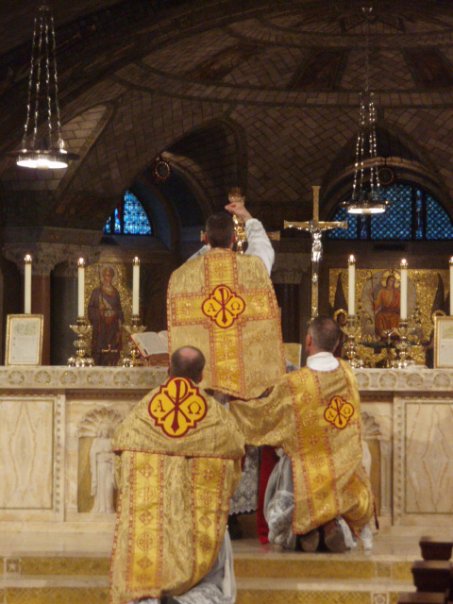
This is from the site Dignare me laudare and it portrays the elevation of the chalice during the Mass of a new FSSP priest, Fr. Romanowski, in the crypt of the National Shrine of the Immaculate Conception:

A nice photo from a beautiful Mass 

Posted in SESSIUNCULA |
6 Comments

Some photos of Card. Castrillon Hoyos’ Mass at Westminster Cathedral

His Hermeneuticalness in action.

Some photos of Card. Castrillon Hoyos' Mass at Westminster Cathedral

Here is one of my favorites.

Some photos of Card. Castrillon Hoyos' Mass at Westminster Cathedral

Cappas…. we need more cappas.

More cappas, less prattle.

See more photos here.

Posted in SESSIUNCULA |
4 Comments

More on what Card. Castrillon Hoyos said to the press in London about the TLM

It is important to keep this in plain sight for a while.

Damian Thompson has a piece on his blog about Card. Castrillon Hoyos’ words in London recently.

My emphases and comments.

Traditional Mass for ‘all the parishes’

Posted by Damian Thompson on 15 Jun 2008  at 18:04 

Yesterday Cardinal Dario Castrillon Hoyos, President of the Pontifical Commission Ecclesia Dei, announced in London that Pope Benedict wishes to introduce the "Gregorian Rite" – meaning the former Tridentine Rite – to every parish in the Western Church.

The Pope wishes to introduce the ‘Gregorian Rite’ to every parish

This was such a huge announcement that many Catholics can hardly believe their ears. I was one of four journalists present. Here are edited extracts from the press conference, in which the Cardinal completely demolishes liberal interpretations of Summorum Pontificum:

Elena Curti (The Tablet): Your Eminence, I’d like to ask what you make of the response of the Bishops of England and Wales to the Pope’s Motu Proprio.

Cardinal Dario Castrillon Hoyos: I think it’s a good one. There are some probems because it’s a new way of celebrating liturgy and they need time to prepare priests and catechists on the content of the Extraordinary Form.

Reuters: In some parts of the world there seems to be resistance on the part of local bishops to allow the faithful their full freedom to celebrate the Extraordinary Form. What do you recommend that the faithful do?

CC: To be informed. Many of the difficulties come out because they don’t know the reality of the Gregorian Rite – this is the just [correct] name for the Extraordinary Form, because this Mass was never prevented, never. Today for many bishops it is difficult because they don’t have priests who don’t know Latin. Many seminaries give very few hours to Latin – not enough to give the necessary preparation to celebrate in a good way the Extraordinary Form. Others think that the Holy Father is going against the Second Vatican Council. That is absolute ignorance. The Fathers of the Council, never celebrated a Mass other than the Gregorian one. It [the Novus Ordo] came after the Council … The Holy Father, who is a theologian and who was in the preparation for the Council, is acting exactly in the way of the Council, offering with freedom the different kinds of celebration. This celebration, the Gregorian one, was the celebration of the Church during more than a thousand years … Others say one cannot celebrate with the back to the people. This is ridiculous. The Son of God has sacrificed himself to the Father, with his face to the Father. It is not against the people. It is for the people …

Damian Thompson (Telegraph): Your Eminence, would the Holy Father like to see ordinary parishes in England with no knowledge of the Gregorian Rite introduced to it?

CC: Yes, of course. We cannot celebrate this without knowledge of the language, of the signs, of the ways of the Rite, and some institutions of the Church are helping in that way.    [So, introduce so as to teach the faithful.  This reminds me of what the Council asked, namely, that pastors teach their flocks to sing and speak in Latin and their mother tongue.  Both.  So, now, it is also both uses!]

DT: So would the Pope like to see many ordinary parishes making provision for the Gregorian Rite?

CC: All the parishes. Not many – all the parishes,  [All.  All.  All.  Say it with me.] because this is a gift of God. He offers these riches, and it is very important for new generations to know the past of the Church. This kind of worship is so noble, so beautiful – the deepest theologians’ way to express our faith. The worship, the music, the architecture, the painting, makes a whole that is a treasure. The Holy Father is willing to offer to all the people this possibility, not only for the few groups who demand it but so that everybody knows this way of celebrating the Eucharist in the Catholic Church.

Anna Arco (The Catholic Herald): On that note, would you like to see all the seminaries in England and Wales teach the seminarians how to celebrate in the Extraordinary Form?

CC: I would like it, and it will be necessary. We are writing to the seminaries, we are in accord that we have to make deep preparation not only for the Rite, but for [teaching] the theology, the philosophy, the Latin language …

DT: What would be the practical steps for ordinary parishes [to prepare for the Gregorian Rite]?

CC: If the parish priest selects an hour, on Sundays, to celebrate the Mass, and prepare with catechesis the community to understand it, to appreciate the power of the silence, the power of the sacred way in front of God, the deep theology, to discover how and why the priests represents the person of Christ and to pray with the priest.  [This also harks to why I say SP is such a gift to priests.  In changing the priest’s own view of Mass and himself as a priest saying Mass, the parish will be affected.]

EC: Your Eminence, I think many Catholics are rather confused by this new emphasis on the Tridentine Rite, mainly because we were taught that the new Rite represented real progress, and many of us who have grown up with it see it as real progress,  [buzzzz] that there are Eucharistic ministers, women on the sanctuary, that we are all priests, prophets and kings. This new emphasis to many of us seems to deny that. 

CC: What is progress? "Progredire", means [offering] the best to God… I am surprised, because many young people are enthusiastic with the celebration of the Gregorian Rite …

EC: In the Motu Proprio, the Pope’s emphasis is on one Rite and two forms, and he describes the Tridentine Rite as "extraordinary". Extraordinary therefore means exceptional, not something that we celebrate every Sunday.

CC: Not "exceptional". Extraordinary means "not ordinary", not "exceptional."  [Slap.  This is, of course, correct.]

EC: Should it therefore supersede the new Rite? Should we go back?  [Note the cliche… "go back".  For these folks this is a zero sum scenario.]

CC: It is not going back: it is taking a treasure which is present, but was not provided. … But it takes time. The application of the reforms of the Second Vatican Council took years. It takes time to understand the deep profundity of the old Rite. The Holy Father is not returning to the past; he is taking a treasure from the past to offer it alongside the rich celebration of the new Rite. The second Eucharistic prayer of the new Rite is actually the oldest one [in the Church’s entire liturgy]. It’s not a matter of confrontation but of fraternal dialogue.

DT: Will there be a clarification of the Motu Proprio?

CC: Not exactly a clarification of the Motu Proprio, but of matters treated in the Motu Proprio, such as the calendario, ordinations to the sub-diaconate, the way of using vestments, the Eucharistic fast.  [WHEN?]

DT: What about the "stable group"?

CC: It’s a matter of common sense … In every bishop’s household there are maybe three or four persons. This is a stable group … It is not possible to give two persons a Mass, but two here, two there, two elsewhere – they can have it. They are a stable group.

DT: From different parishes?

CC: No problem! This is our world. Managers of enterprises don’t live in one place, but they are a stable group.

More on this later. The Cardinal went on to celebrate a traditional Pontifical High Mass at Westminster Cathedral, the first time this has happened since the 1960s. Cardinal Murphy-O’Connor was not present, but had a brief (and rather cool) message of welcome read out on his behalf. No Westminster bishop attended this great event.

Posted in SESSIUNCULA |
48 Comments