
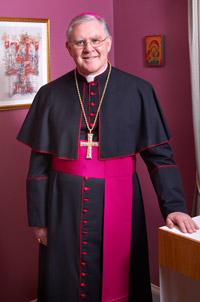
I was alerted by Australia Incognita to an interesting pastoral letter for Pentecost issued by Archbishop Mark Coleridge of the Diocese of Canberra and Goulburn in Australia. The letter concerns liturgical practice.
Find it here.
Let’s have a look at part of it with my emphases and comments.
PREPARING THE FEAST
A Pentecost Letter on the Liturgy
To the People of God
of the Archdiocese of Canberra and GoulburnIn the splendid words of the Catechism, the Holy Spirit is “the artisan of ‘God’s masterpieces’, the sacraments of the New Covenant” (CCC, 1091); and at this time of Pentecost I want to speak to you of the sacred liturgy in which “God’s masterpieces” are celebrated. In doing so, I am conscious of my role in the Archdiocese as the moderator of worship, charged with the duty of sanctifying the People of God, especially in the sacred liturgy.
A NEW PHASE
Pentecost Sunday was the day chosen by the Australian Bishops to implement the new General Instruction of the Roman Missal, albeit in a provisional translation to be replaced by a final version once the new translation of the Roman Missal appears, perhaps late in 2009. For a copy of the new translation, go to www.acbc.catholic.org.au/documents/200707031933.pdf. I would especially ask the clergy to read the Instruction as a whole.
The General Instruction sets out how Mass is to be celebrated in the Roman Rite, [Obviously, this is the Novus Ordo we are reading about.] and the new version has been drawn up in the light of forty years of experience of Mass celebrated according to the Missal of Paul VI. The changes it introduces are not great. For the celebrant there are a number of changes, but for the people there are just two:
The congregation stands immediately after the celebrant has said “Pray, brothers and sisters, that our sacrifice will be pleasing and acceptable to God, the almighty Father” and before praying “May the Lord accept this sacrifice…”.Before receiving Holy Communion, communicants bow to the One they are about to receive. Bowing is the preferred gesture, but those who are accustomed to genuflect before receiving or to kneel to receive will be free to follow their custom. [Excellent. He doesn’t try to squelch freedom.]
At www.acbc.catholic.org.au/documents/200804151396.pdf you can find a brochure outlining and explaining these changes.
The new version of General Instruction is one of a number of indications that the Church is moving into a new phase of the ongoing journey of liturgical renewal, the roots of which reach back to the Second Vatican Council and beyond. In earlier times, it seemed that the process of liturgical renewal begun by the Council was complete. But that is not the case. The journey of liturgical renewal, we can now see, is only in its early phases, and the appearance of the General Instruction is one indication of this. Other still more important indications will be the appearance in the not too distant future of the new translation of the Roman Missal and the new translation of the Lectionary. Now is the time, the Spirit is saying to the Church, to take stock of the liturgical renewal of the last forty years, to discern as clearly as possible what has succeeded and what has failed, and to make adjustments in the light of that discernment.
This means that all of us will have to be open to learn, and that is not always easy. Over recent decades, liturgical habits have taken hold, some of which have been beneficial, others detrimental to the celebration of the liturgy. It is never easy to break the hold of bad habits, especially when we do not see them as bad. Openness to learn always involves humility, a preparedness to recognise that I do not know all the answers. In the case of the liturgy, that humility involves a preparedness to learn from the Church, to whom alone the liturgy belongs; and in the new General Instruction and the new translations of the Missal and Lectionary, it is the voice of the whole Church, the Bride of Christ, that we hear.
THE BIG PICTURE
Against that background, let me make some general observations.
Silence
 The new version of General Instruction is one of a number of indications that the Church is moving into a new phase of the ongoing journey of liturgical renewal, the roots of which reach back to the Second Vatican Council and beyond. In earlier times, it seemed that the process of liturgical renewal begun by the Council was complete. But that is not the case. The journey of liturgical renewal, we can now see, is only in its early phases, and the appearance of the General Instruction is one indication of this. Other still more important indications will be the appearance in the not too distant future of the new translation of the Roman Missal and the new translation of the Lectionary. Now is the time, the Spirit is saying to the Church, to take stock of the liturgical renewal of the last forty years, to discern as clearly as possible what has succeeded and what has failed, and to make adjustments in the light of that discernment.
Our worship generally has become very chatty, [It is a problem, I think, in the Novus Ordo itself, that it lends itself to chattiness.] to the point where one of the challenges now is to allow silence to play its part in the liturgy. This might begin with our places of worship. Where once our churches were places of silence for the sake of prayer in the presence of the Blessed Sacrament, the custom has arisen in more recent years for people to talk freely in the churches, certainly before and after Mass. The same is true of the sacristy: where once silence was the rule (again for the sake of prayer and recollection) often now the sacristy has become a noisy and distracting place. Once was too that the priest was expected to pray the prescribed prayers as he vested for Mass, [YES!!] and this was one factor which contributed to an air of silence in the sacristy. I wonder would it be possible to encourage an air of silence or at least quiet in sacristies before Mass, and to make our churches places where there is a silence which supports prayer. Of course there are times when one has to talk in a sacristy or a church, but it is a question of the prevailing atmosphere. In that sense, I am speaking more about prayer than about silence for its own sake.
Then there is the question of the place of silence within the Mass itself. The Roman Rite presupposes seven silences:
1) before the Act of Penitence
2) before the Collect (after the celebrant’s call to prayer)
3) after the First Reading and before the Psalm,
4) after the Second Reading and before the Gospel Acclamation
5) after the Homily
6) during the Intercessions (after the intention is announced and before “Lord, hear us”)
7) after Holy CommunionSome of these either disappear or are reduced to a bare minimum with the result that the liturgy can have a noisy and unreflective feel to it. This is often what people are referring to when they speak about a loss of the sense of the sacred in the Mass – a weakened sense of the presence of God and the deeper resonances of the liturgical words and actions that comes with silence. In this new phase of the liturgical renewal, I think we need to work hard at creating a greater sense of silence as that from which the words and actions rise and that to which they return.
The style of language used at Mass will change when the new translation of the Roman Missal appears, perhaps late in 2009. [I certainly hope it will be before that!] It will be a more elevated and sacral idiom, which may feel strange at first. But it is important to realise that the language of the liturgy was never everyday language; it was always more elevated and even slightly old-fashioned. [That is exactly right. Even the Latin used when the language shifted from Greek to Latin in Rome was not the Latin of the common people. It was an elevated style. Some make the claim, falsely, that the language of liturgy ought to be in the language of the people as it is spoken. Not so!] That is because it is ritual language. For the celebrant to say at the start of Mass, “Good morning, everyone” and for the people to reply “Good morning, Father” is everyday language which in other contexts would be perfectly appropriate. But in the liturgical context it is out of place because it misunderstands ritual and the language that it requires. It can suggest a casual or informal approach to the liturgy which focuses more on the priest and the people than on their common worship of God. Therefore, in this new phase of renewal, another thing we need to understand better is the kind of idiom appropriate for worship.
When the Fathers of the Second Vatican Council approved the use of the vernacular languages in the liturgy, they had no idea of what was on the way. They imagined that some parts [Right!] of the liturgy would move into English (in our case), but that Latin would remain in general the language of worship. [YES!] It was up to Bishops’ Conferences to ask the Holy See for permission to use the vernacular at certain points of the liturgy. [This is what the likes of Annibale Bugnini (NB: Archbp. Piero Marini worked for him, and some people say still works for him) fought to hard against. For Bugnini the liturgical reforms were also all about shifting the power to regional conferences so that they, not the Holy See, could approve the translations!] What happened then was that Bishops’ Conferences generally and spontaneously asked for the entire liturgy to move into the vernacular and the permission for this was given. That is why it seemed that the Church went from Latin to English overnight. Some in the Church have continued to worship in Latin – as is their right – but most are happy to have moved into English. At the same time, it does not have to be a stark choice of one or the other. In the Cathedral at least I have asked that some elements of the Greek and Latin of earlier times be retained in the Mass, even if English remains by and large the language of worship. This means that the Kyrie is sung at times in Greek, and the Common of the Mass, the Gloria and the Creed are sung at times in Latin. Similarly some of the great hymns of the Gregorian repertoire – especially the Marian anthems – are sung at times. It would be a pity if such a heritage were wholly lost to us. It is perhaps more difficult for parishes than for the Cathedral which has greater resources. But some modest use of the ancient languages of worship can be enriching. [I would say some bold use of ancient languages could be even more helpful in reestablishing the attitudes Bp. Coleridge is wisely promoting.]
Music
Music is another vital element of worship that needs to be revisited as we set out on this new phase of the journey. It is not just a question of having good music, but of having good music which serves prayer and which, in that sense, is not an adornment of the liturgy but integral to it. [Precisely. Music is not an "add on". It is not meerely "functional" or "utilitarian". True sacred music is itself prayer. Listening to it is an active participation in prayer. Thus, good sacred music is an "integrating" part of liturgy, pars integrans.] The music of the liturgy needs to rise from the silence of prayer and create a still deeper sense of that silence. Of course, it has the function of creating a sense of unity as one voice is made of many voices. But it also needs to be music that opens on to the mystery of God, which is what I mean when I speak of serving prayer. Some of the songs used in worship tend to replace or disrupt any sense of silence; they add to the sense that the liturgy is “noisy”.
Some of the texts used are also decidedly feeble and even at times questionable theologically. [Excellent!] Historically, the Roman Rite used only the Psalms in the Eucharistic liturgy: hence the Entrance and Communion Antiphons which were sung with the Psalms and accompanied the Entrance and Communion Processions. It is not a matter of saying now that only the Psalms are acceptable; but they do have a privileged place in the musical repertoire of the Roman Rite. I might add that the Holy See has asked Bishops’ Conferences around the world to draw up a list of music approved for use in worship. This is part of a pruning process of the repertoire that has built up over the last forty years, and it is already taking place in Australia.
The music chosen for worship should be appropriate to the liturgical season and to the part of the Mass when it is sung. This may seem obvious, but it is not uncommon for choices of music to fail on one or both counts. It is worth recalling too that singing or music should not be prolonged unnecessarily. In the Roman Rite, singing or music tends to accompany action rather than stand in its own right. Therefore, the music or singing should stop once the action is complete.
The Body
Another important consideration at this time is the use of the body in worship. Here again it is important to remember that the actions of the liturgy are ritual actions and to see the prescribed gestures of the liturgy as a kind of sacred choreography. This includes a range of gestures: genuflection, the sign of the Cross, bowing (during the Creed and before Holy Communion), kneeling, the use of the hands by the celebrant (to greet the people, to pray, to bless the gifts and the people). It is important that all of these are done simply, carefully and well, with neither over-statement nor under-statement.
Ritual means on the one hand that we worship not just in spirit but in body; it means on the other hand that we avoid theatricality. Theatricality can be a problem with liturgical movement or dance, especially at school liturgies. It can become a kind of concert, which is why at times people applaud at the end. That is clearly not what the liturgy requires. Liturgical movement – whether done before or during the liturgy – needs to serve prayer; it needs to lead people more deeply into the mystery of God. If it does that, it can have a place in the liturgy, but if it does not then it would be better left to a concert.
Beauty
Pope Benedict has stressed the point that beauty has a unique power to speak of the mysteries of the faith, and to speak to those who may not share our faith. That is why the Catholic Church has always been concerned with beauty in worship – not for the sake of a vapid aestheticism but for the sake of the Gospel. Imperfect created beauty makes visible the perfect uncreated beauty of God which is revealed supremely in Christ crucified and risen. Therefore, the buildings in which we worship should be beautiful, which is not to say highly elaborate or impossibly expensive. The great churches of the Franciscan tradition, for instance, have about them a striking simplicity, but they are also strikingly beautiful. Some of the older churches in the Archdiocese are beautiful and need only to be respected for what they are. Many of the newer churches are less evocative, and it is worth asking perhaps how they might be made more beautiful without spending a fortune.
Not only our churches but also the vestments and vessels used in the liturgy need to be of first-class quality. I would ask that parishes have an audit of the vestments and vessels currently in use to see whether they are worthy of the sacred mysteries. I would also offer a reminder that chalices and patens should not be of glass or pottery but of metal. Vestments and vessels of quality are of course an item on a parish budget, but they should be an item close to the top of the list. To claim that a parish could not afford anything better is to raise questions about priorities. [Thus exploding the arguments of the minimalist progressivists.]
Creativity
A final more general consideration concerns creativity in the liturgy. At times, there is the impression that creativity means that we have a freedom to change and adapt the liturgy as we see fit. But this is not the Church’s understanding. Creativity in Catholic worship means that we do as well as possible what the Church sets down in the liturgical books. People coming to Mass have a right to a celebration of the liturgy according to the norms set down by the Church; [Hear! Hear!] anything else can be unsettling and distracting. Without changing anything, we are to bring as much prayer, intelligence, imagination and sensitivity as we can to the act of worship. Creativity concerns the quality of our participation, not an adaptation of the ritual in an attempt to improve it or to make it more relevant.
To speak of participation is to raise the question of what the Council meant when it stressed the need for “full, conscious and active” participation in the liturgy. At times, this is taken to mean that everyone has to do everything all the time. But this is not the Church’s understanding. The Roman Rite presumes that everyone has his or her particular role in the liturgy and that participation means that each performs his or her own role as well as possible. To listen in silence to the Readings is certainly “active” participation, as are all the great silences that are built into the liturgy. To speak of “conscious” participation does not mean that every word, gesture and action needs to be immediately and easily accessible to all, since much of the symbolism of the liturgy moves at a more than conscious level. Creativity in the liturgy respects the different levels at which the language, actions and symbols move and the way in which they gather up the whole human person.
….
 Language
At this point Archbishop Coleridge moves into the norms. You can read that part yourselves.
WDTPRS gives high kudos to Archbp. Coleridge!



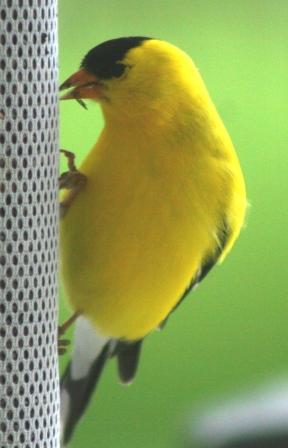


 Today is Tuesday in the Octave of Pentecost, or at least it ought to be in in the Novus Ordo as it is in the older, Traditional Roman Calendar.

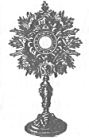 The Real Presence of the Eucharistic Lord remains so long as the "accidents", those outward sensible signs, are able to be distinguished. As a result we must be pay attention to any corruption of the substance of what was once bread, now the Host, which still has its material characteristics. If there is any degradation of the material characteristis, it is best simply to consume what there is and consecrate another Host.
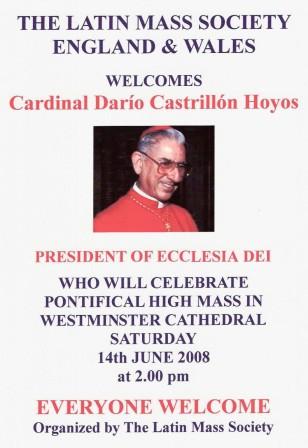 Cardinal Dario Castrillon Hoyos to Celebrate Pontifical High Mass in the Traditional Latin Rite in Westminster Cathedral, Saturday 14 June 2008
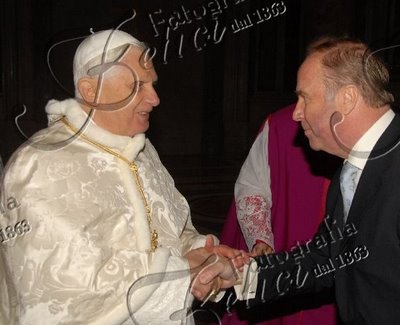


 waalaw on Daily Rome Shot 1119: “In 1st variation, 2. . . . . . Q-g1# also works. As does 4. . . . . .…”




























