The ultimate “anti-Bable”

The ultimate "anti-Bable"

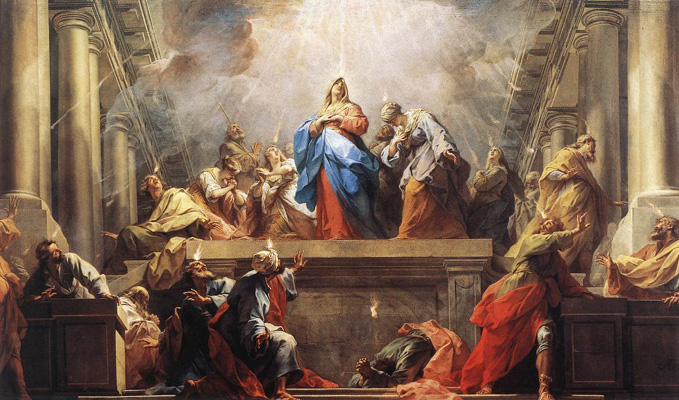
Pentecost (1732)
by Jean Restout

Musée du Louvre, Paris

Since the Ascension, the disciples had been hiding in fear.

Despite the feeling of exhilaration they experienced on their way home from the great event, they were somewhat enervated by the absence of Jesus, who had been with them, teaching, for many days after the Resurrection.

All off a sudden, with a tremendous and terrifying sound of wind that rushed through the room, though the windows and doors were closed, tongues of flame come lancing towards them, as if from nowhere, as if there were no physical barriers shutting out the threatening world.

The Holy Spirit descends upon the Church and gives the Body life.

It is the day of the Church’s birth.

The once timid disciples now rush into the streets, proclaiming the Gospel that Christ had commanded them to preach to all nations.

This is the ultimate "anti-Bable".

Whereas the human pride left man divided by language after the Flood, the event of Pentecost and the comprehension of tongues shows where real human unity is to be found.

By our Confirmation we have the inward strengthening of the Holy Spirit unto the proper living of our God-given vocations.

Learn to call on the Holy Spirit and see His workings in the Church at every level.

Be conscious of yourself as confirmed, sealed, imbued, branded with the "character".

In time of trial, as an indelibly confirmed Catholic, invoke this powerful sacrament.

"Almighty God, Holy Spirit, I call upon the sacrament of my confirmation.  Help me in this moment of need.  Strengthen me.  Give me the actual graces I must have to do Your will.

Posted in SESSIUNCULA |
3 Comments

Benedict XVI’s Pentecost Sunday: again a lesson through vestments

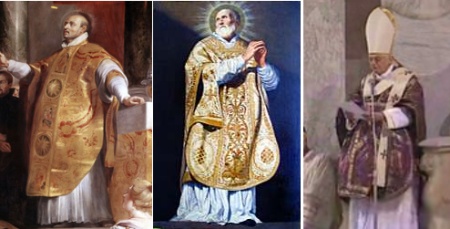
Papa was once again in the taglio filipino vestments for the Holy Mass in the Basilica this morning.

What in Italian is called the "taglio filipino" is so named after St. Philip Neri, who is depicted in paintings in this type of vestments. 

This is the style of vestment in use around the time of the Council of Trent, worn by figures such as St. Ignatius of Loyola. 

Benedict XVI's Pentecost Sunday: again a lesson through vestments

It is emblematic of a age in the Church’s life, a period of Counter-Reformation, when there was an explosion of lay confraternities seeing to spiritual and corporal works of mercy at every level of society, simply and noble.  It is a period of tremendous deepening of our understanding of the Blessed Sacrament and subsequent development of devotions, such as Exposition, Benediction, and increase in observance of 40 Hours, devotion to the Sacred Heart.   This was an era of change in architecture, when the Roman baroque came into its own as an outward, concrete, plastic expression of the Church’s own self-understanding, her ecclesiology. 

It was a time when the humanities were in harmony with theology.

This style of vestment is the first stage of development between the fuller "cloak" style chasuble of the Medieval period and the later Roman vestment, which is smaller and more squared in the back and front.  for example, not only is the "Philip" style longer in front and back, and curved at the bottom, but it also comes farther down the shouders than the modern Roman vestment. 

Thus it is a concrete symbol of continuity between two great Catholic eras.

WDTPRS has asserted again and again that Papa Ratzinger is saying something through his vestments.  He mixes them up a bit, but he keeps coming back to this important taglio filipino.  Some will try to brush this off, or relegate his choice to a matter of mere personal taste.

I say that the very vestment is an icon of what Benedict is proposing: a hermeneutic of reform rather than of rupture.  Benedict is signaling the great value of the period of the style vestment as well as the fact that it is a harmonious bridge between two fantastic periods of Catholicity.  Benedict is healing the rupture that occurred in liturgy in many ways, with Summorum Pontificum, certainly, but also in the accoutrement of celebration, such as the placement of candles and the altar Cross. 

The other day the Pope’s MC, Msgr. Guido Marini, gave an interview to Andrea Tornielli of Il Giornale.  In that interview he said:

"The vestments chosen, as also other particulars of the Rite," the Master of Ceremonies explained, "are intended to underscore the continuity of the present liturgical celebration with that which characterized in the past the life of the Church.  Continuity is the interpretive key, always the exact criteria for reading the Church’s journey through time.  This is valid also for liturgy."  "As one Pope cites in his documents the Pontiffs who preceed him, so as to indicate the continutiy of the Magisterium of the Church," Marini continues, "so in the ambient of liturgy a Pope uses also the vestments and sacred accoutrement of his precedessors to show the same continuity also in his celebratations. …

Posted in SESSIUNCULA |
19 Comments

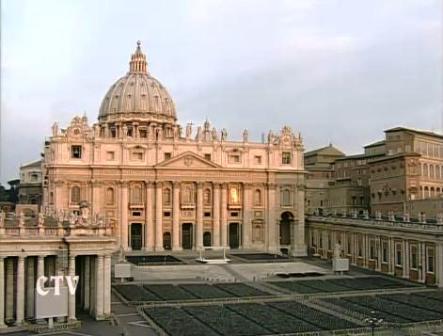
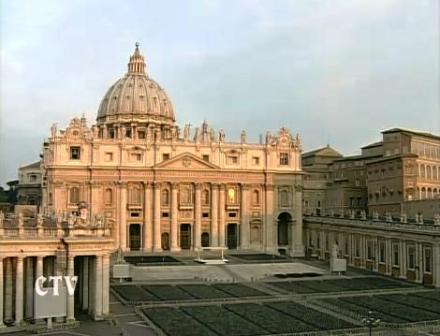
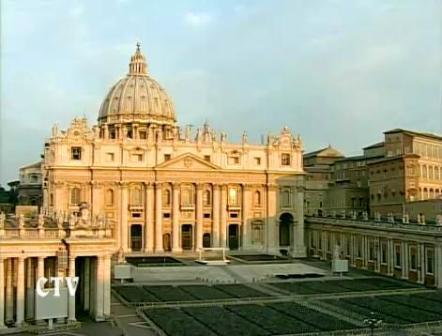
Roman Pentecost Sunday dawn

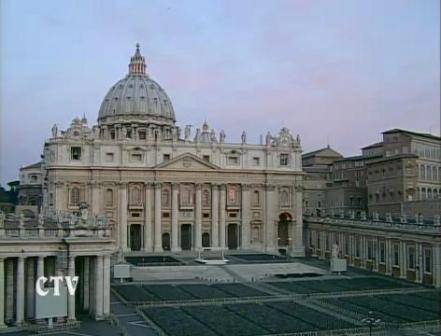
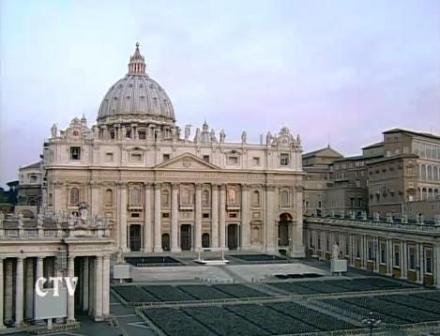
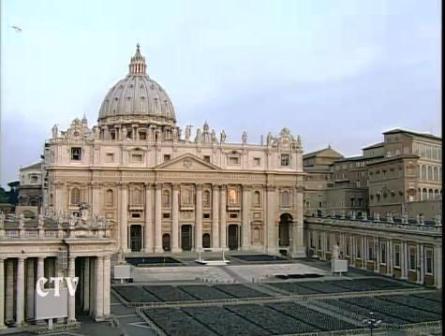
And Pentecost Sunday begins to dawn in Rome:

Roman Pentecost Sunday dawn

Roman Pentecost Sunday dawn 

Roman Pentecost Sunday dawn 

Roman Pentecost Sunday dawn 

Roman Pentecost Sunday dawn 

Roman Pentecost Sunday dawn

Roman Pentecost Sunday dawn 

Roman Pentecost Sunday dawn 


Posted in SESSIUNCULA |
11 Comments

Take PODCAzTs and other mp3s on the go with this

If you were searching for an appropriate way to take the WDTPRS PODCAzTs on the go!

Check this out.

Posted in SESSIUNCULA |
10 Comments

Il Giornale interviews Msgr. Guido Marini, papal MC

Here is the interview with Msgr. Guido Marini in the Italian daily Il Giornale in my translation:

This is how I gave the Pope a retro make-over  ("Così ho rifatto il look stile vintage al Papa") [We can do this in various ways, and what I chose here does not reflect anything of the style of language used by Msgr. Marini in the quotations below.  I was trying to get at the punch of the headline in more popularized jargon.]

by Andrea Tornielli

In Genoa, where he grew up, instead of "Marini" they called him Fr. "Guidino", because he is tall and thin.  In Rome, where he came by the selection of Benedict XVI last October, he has come to be appreciated for his gentility but also his decision to put into practice faithfully Ratzinger’s liturgical ideas.  Msgr. Guido Marini, class of 1965, and for a few months now the new Master of Pontifical Liturgical Celebrations, succeeded the homonymous Piero Marini, for many years the artificer of the liturgies of John Paul II and also for the beginning of the present pontificate.  If from the point of view of the name there couldn’t have been a smoother transition, at the arrival of Fr. Guido – holder of several doctorates, the sometime MC and Chancellor of two Archbishops of Genoa – he hasn’t gone unnoticed, thanks to the recovery of some traditional vestments.  Old mitres have been exhumed, and the Pontiff has even changed his pastoral staff, abandoning the modern one in silver to take up a "ferula" (staff surrmounted by a Cross) of Pius IX.  It has gotten to the point that the press during his visit to the USA spoke of a "vintage" Pope.

Il Giornale met with the MC in his office, from which one has one of most beautiful views of the Piazza of St. Peter.

In the first place, let’s ask the reason for the recovery of the precious headgear of his predecessors: for example, last Christmas, Ratzinger used mitres belonging to Paul VI, John XXIII and Benedict XV.

"The vestments chosen, as also other particulars of the Rite," the Master of Ceremonies explained, "are intended to underscore the continuity of the present liturgical celebration with that which characterized in the past the life of the Church.  Continuity is the interpretive key, always the exact criteria for reading the Church’s journey through time.  This is valid also for liturgy."  "As one Pope cites in his documents the Pontiffs who preceed him, so as to indicate the continutiy of the Magisterium of the Church," Marini continues, "so in the ambient of liturgy a Pope uses also the vestments and sacred accoutrement of his precedessors to show the same continuity also in his celebratations.  I would, however, mention that the Pope does not always use old vestments.  He often wears new ones.  The importance is not so much their antiquity or modernity, as much as their beauty and dignity, important components for every liturgical celebration."

Another huge change, more recently, is the setting aside of the modern silver pastoral Cross of Paul VI.  Ratzinger has adopted a larger one, of Pius IX.

"Obviously," Marini explains, "what I just said about continuity applies here as well.  In this case, however, there is also a practical element: the ferula of Pius IX is lighter and more manageable.  So much so that the Pope decided to use it all the time, as was seen in also in the USA."

On some occasiones, as in the consistory for the creation of new Cardinals, the high papal throne was reinstated.  Nostaligia for temporal power?

"No nostalgia", the MC responds with a smile playing on his lips.  "The so-called throne, used in particular situations, is intended only to highlight the liturgical presidency of the Holy Father."

Finally, it was noted, from the moment Msgr. Marini took up his role, the presence of a Cross in the center of the altar, as in former times.  Also in this case, the MC wanted to make understood the profound meaning of a choice that has nothing to do with nostalgia:

"The position of the Cross in the center of the altar shows the centrality of the Crucified One in the Eucharistic celebration and the precise orientation that the whole assembly is called to have during the Eucharistic liturgy: we don’t look at ourselves, but we look toward Him who was born, died, and rose for us, the Savior.  From the Lord comes salvation. He is the East, the sun which rises, toward which we must all turn our gaze, from which we all must receive the gift of grace."

The telephone rings constantly.  The last details must be finalized for the liturgies that Benedict XVI will celebrate in Savona and Genoa on 17 and 18 May.

We ask of it is difficult to be the papal MC.

"It is a demanding role not only for the amount of work, but above all for the responsibility it carries.  I have really taken stock of the responsibility to live out with complete fidelity to the Holy Father the task which has been entrusted to me, keeping in mind that the liturgy which I have been called to serve and "organize" is the liturgy of the Church, and of the Pope".

Posted in SESSIUNCULA |
6 Comments

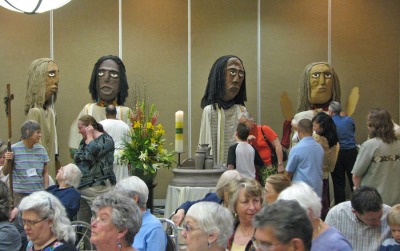
Danger: liturgical potato Solemn TLM?

I think we have all come to the conclusion that just when you think you have seen every liturgical abuse, you haven’t even begun to see what dopey things people can come up with.

Danger: liturgical potato Solemn TLM?For example, the recent "Potato head" puppet Mass at the Call To Action meeting in San Jose, CA.

This sort of thing is scandalous.  I can just imagine that all sorts of liturgical terrorists will want Potato Head Masses too!

But this is not going to happen on His Hermeneuticalness’s watch, I assure you.

Can you imagine….

At St Mary’s, Chislehurst today for lunch, I [His Hermeneuticalness] was concerned to see a suspiciously large bowl of potatoes. Fr Briggs assures me that he obtained these at a good price from Sainsburys and that he intends to eat them rather than use them in the Liturgy. I am happy to take him at his word although I wonder whether I should send over some heavies in case a couple of potatoes attempt to muscle in on his traditional Mass this evening as Deacon and Subdeacon.

Or would that be Spudeacon?

Posted in SESSIUNCULA |
10 Comments

Andrea Tornielli interview Msgr. Guido Marini, papal MC

Andrea Tornielli today reports that in Il Giornale there is an interview with none other than Msgr. Guido Marini, presently the papal MC.  Here is my translation.  I will try to dig up the piece in Il Giornale. 

Msgr. Marini makes comments about Summorum Pontificum and ad orientem worship.

Today Il Giornale published an interview with [Archbp] Guido Marini, the new Mastor of Ceremonies for Papa Ratzinger, who explained the meaning of some of the Pontiff’s choices, starting with the Cross in the center of the altar.  Not all of the conversation I had with Msgr. Marini could be published.  I had to cut two important responses, dedicated to the orientation of the altar and the Motu Proprio.  Here is the text, which I invite you to read.

For baptisms in the Sistine Chapel Benedict XVI celebrated with his back to the faithful, as before the Council.  A fact that created some surprise…

"In circumstances in which the celebration is carried out in the way, we aren’t dealing as much with turning one’s back to the people as, rather, orienting oneself with the faithful toward the Lord.  From this point of view "the door isn’t being closed on the faithful", but, "the door is being opened to the assembly, leading it to the Lord.  There are certain circumstances in which, because of the artistic conditions of the sacred place and of its special beauty and harmony, it becomes advantageous to celebrate at the old altar, where among other things the exact orientation of the liturgical celebration is preserved.  This shouldn’t surprise anyone: it is enough to go into St. Peter’s in the morning and see how many priests are celebrating according to the Ordinary Rite which came out of the post-Conciliar liturgical reform, but on traditional altars and, thus, oriented like that in the Sistine."

Benedict XVI will celebrate a Mass using the old Rite, which he derestricted with the Motu Proprio?

"I don’t know, and I am not in a position to respond.  I believe nevertheless that a serene, ecclesial and non-ideological reading of these decisions by the Pontiff is important.  The liturgy of the Church, just as with Her whole life, is comprised of continuity: I would speak of a development in continuity.  This means that the Church procedes in her journey in history without losing sight of Her own roots and Her own living Tradition: this can require, in some cases, also the recovery of precious and important elements which were lost along the way, forgotten and which the passage of time has made less luminous in their authentic meaning.  It seems to me that the Motu Proprio is aiming precisely in this direction: reaffirming with great clarity that in the liturgical life of the Church there is continuity, without rupture.

Posted in SESSIUNCULA |
8 Comments

Archbp. Naumann of KC to KS pro-abortion Governor: no Holy Communion

The WDTPRS KC Bureau Chief has sent us a fascinating story:

Posted on Fri, May. 09, 2008
Archbishop [Naumann] to [KS Gov. Kathleen] Sebelius: Stop taking Communion

TOPEKA | The Roman Catholic archbishop for northeast Kansas said Friday that Gov. Kathleen Sebelius should refrain from taking Communion until she publicly repudiates her support for abortion rights.

Archbishop Joseph F. Naumann, of the Archdiocese of Kansas City in Kansas, also criticized her recent veto of a bill imposing new restrictions on abortion providers. He called upon the governor, who is Catholic, to take the “necessary steps for amendment of her life.”

Naumann said he wrote to Sebelius in August, asking her to refrain from Communion but learned recently that she’d participated in the sacrament. He said it prompted him to write her again, asking her to respect his request and “not require from me any additional pastoral actions.”  [Folks, what this means is that if she continues, the Archbishop will apply some kind of censure to her, which might include excommunication.]

“The spiritually lethal message, communicated by our governor, as well as many other high-profile Catholics in public life, has been in effect: ’The church’s teaching on abortion is optional!’” Naumann wrote in a column published Friday in The Leaven, the archdiocese’s newspaper.

The issue of Catholic politicians taking Communion arose again recently because of Pope Benedict XVI’s recent visit to the United States. In New York, Cardinal Edward Egan said former mayor and presidential candidate Rudy Guiliani had broken “an understanding” by accepting Communion at a papal Mass.

What is going on here?  I explain it in this PODCAzT.  Essentially, this is not just about the Governor’s position on abortion, though that is key.  What makes this a matter of public statement is that the Governor is a public figure who, by words and actions, gives scandal to the faithful.  Were the Governor doing some other thing very publicly that defied the Church’s teachings or laws, the same remedy would apply.  In this case it is abortion, but it could be, for example, divorce and remarriage, or belonging to the Masons, or actively homosexual lifestyle, etc.  When public figures create public scandal, they must make public reparation before they may return to the sacraments.  The reparation must be proportionate to the scandal.  Were this person a private person no one knew or watched, it might be handled in a different way.

Here is more, from the Archd. of KC, KS site.  This is Archbishop Naumann:

    Governor’s Veto Prompts Pastoral Action  [NB: This is a "pastoral" issue.  A shepherd is trying to heal a sick sheep and also protect the rest of his flock from disease.]

    On the day of my return (Monday, April 21) from the exhilarating experience of participating in Pope Benedict’s pastoral visit to the United States, I learned that Governor Kathleen Sebelius had vetoed the Comprehensive Abortion Reform Act (HS SB 389), which had been passed by significant majorities in both chambers of the Kansas Legislature. Last week, an attempt to override the governor’s veto failed in the Senate by two votes.
    Governor Sebelius in her veto message claimed: “For years, the people of Kansas have asked their elected officials to move beyond legislative debates on issues like abortion.”  From her veto message, I received the impression the governor considered it a waste of the Legislature’s time to pass a statute that attempts to protect some women by making certain they have the opportunity to be well-informed: 1) about the development of their unborn child; and 2) about abortion alternatives available to them. Evidently, the governor does not approve of legislators devoting energy to protecting children and women by making it possible to enforce existing Kansas laws regulating late-term abortions.
    The governor’s veto message demonstrated a lack of respect to the members of the Kansas General Assembly who had carefully crafted and resoundingly passed the Comprehensive Abortion Reform Act, [Yes… but that could be a strictly political or personal issue…] as well as to the many Kansans who find it more than an embarrassment, in no small part due to several previous vetoes by Governor Sebelius of earlier legislative efforts to regulate abortion clinics, that Kansas has become infamous [NB: scandalous] for being the late-term abortion center for the Midwest.  [THIS is a much bigger pastoral problem, much more important than how the governor and legislature get along.]
    What makes the governor’s rhetoric and actions even more troubling has been her acceptance of campaign contributions from Wichita’s Dr. George Tiller, perhaps the most notorious late-term abortionist in the nation. In addition to Dr. Tiller’s direct donations to her campaign, the governor has benefited from the Political Action Committees funded by Dr. Tiller to support pro-abortion candidates in Kansas.
    In her veto message, the governor took credit for lower abortion rates in Kansas, citing her support for “adoption incentives, extended health services for pregnant women, providing sex education and offering a variety of support services for families.” Indeed, the governor and her administration should be commended for supporting adoption incentives and health services for pregnant women.
    However, the governor overreaches by assuming credit for declining abortion rates in Kansas. Actually, lower abortion rates are part of a national trend. Our neighboring state of Missouri has actually had a steeper and longer decline in its abortion rate.
    Governor Sebelius’ inclusion of public school sex education programs as a factor in the abortion rate decline is absurd. Actually, valueless sex education programs in public schools  [A pastoral issue.] have been around for years, coinciding with increased sexual activity among adolescents, as well as increases in teen pregnancy and abortion. On the other hand, the governor does not acknowledge the significant impact of mass media education programs, such as those sponsored by the Vitae Caring Foundation, or the remarkable practical assistance provided by Crisis Pregnancy Centers which are funded through the generosity of pro-life Kansans.
    What makes the governor’s actions and advocacy for legalized abortion, throughout her public career, even more painful for me is that she is Catholic. Sadly, Governor Sebelius is not unique in being a Catholic politician supporting legalized abortion.  [This is the core of why Archbp. Naumann can act in her regard even with the promise of a censure.]
    Since becoming archbishop, I have met with Governor Sebelius several times over many months to discuss with her the grave spiritual and moral consequences of her public actions by which she has cooperated in the procurement of abortions performed in Kansas. My concern has been, as a pastor, both for the spiritual well-being of the governor but also for those who have been misled (scandalized) [there it is!] by her very public support for legalized abortion.
    It has been my hope that through this dialogue the governor would come to understand her obligation: 1) to take the difficult political step, but necessary moral step, of repudiating her past actions in support of legalized abortion; [this is a sine qua non.  Her scandal was public, the reparation must be public.]  and 2) in the future would use her exceptional leadership abilities to develop public policies extending the maximum legal protection possible to the unborn children of Kansas.
    Having made every effort to inform and to persuade Governor Sebelius and after consultation with Bishop Ron Gilmore (Dodge City), Bishop Paul Coakley (Salina) and Bishop Michael Jackels (Wichita), I wrote the governor last August requesting that she refrain from presenting herself for reception of the Eucharist until she had acknowledged the error of her past positions, made a worthy sacramental confession and taken the necessary steps for amendment of her life which would include a public repudiation of her previous efforts and actions in support of laws and policies sanctioning abortion.
    Recently, it came to my attention that the governor had received holy Communion at one of our parishes. I have written to her again, asking her to respect my previous request and not require from me any additional pastoral actions.
    The governor has spoken to me on more than one occasion about her obligation to uphold state and federal laws and court decisions. I have asked her to show a similar sense of obligation to honor divine law and the laws, teaching and legitimate authority within the church.
    I have not made lightly this request of Governor Sebelius, but only after much prayer and reflection. The spiritually lethal message, communicated by our governor, [Great phrase: "spiritually lethal messge"] as well as many other high profile Catholics in public life, has been in effect: “The church’s teaching on abortion is optional!”
    I reissue my request of the faithful of the archdiocese to pray for Governor Sebelius. I hope that my request of the governor, not to present herself for holy Communion, will provoke her to reconsider the serious spiritual and moral consequences of her past and present actions. [Remember: censures are not so much punitive as they are remedial.]  At the same time, I pray this pastoral action on my part will help alert other Catholics to the moral gravity of participating in and/or cooperating with the performance of abortions.

WDTPRS kudos to Archbishop Naumann. 

Posted in SESSIUNCULA |
37 Comments

Things that fly at the Sabine Farm

It has been visually interesting around here.

Last night I caught sight of a balloon, of all things.  This is a first.

Things that fly at the Sabine Farm

Also, take a look at the feeder!

Things that fly at the Sabine Farm
 
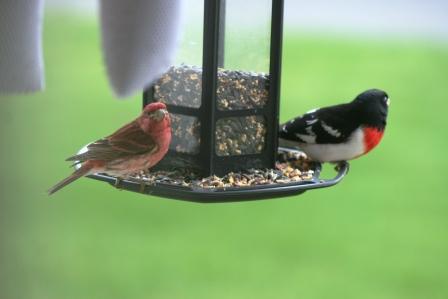
What have we here?  I think it is a Rose-Breasted Grosbeak, Pheucticus ludovicianus.

Things that fly at the Sabine Farm

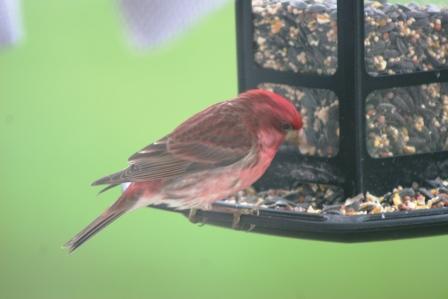
And then…  I think this is a Purple Finch… Carpodacus purpureus.

Things that fly at the Sabine Farm

Posted in SESSIUNCULA |
28 Comments

WDTPRS: Pentecost Sunday

Here is my piece for The Wanderer for Pentecost Sunday:

What Does the Prayer Really Say?   Pentecost Sunday (1962 Missale Romanum)

The more celebrations there are of Holy Mass with the older, extraordinary form of the Roman Rite, using the 1962 Missale Romanum the greater potential there will be for adjustments and corrections in the manner of celebration of the newer form with the Missale of Paul VI reissued by John Paul II.  Summorum Pontificum, Benedict XVI’s Motu Proprio which derestricted the so-called “Tridentine” form of Mass, changed our liturgical landscape.  More and more young priests, and seminarians, are learning the older form now.  Unburdened with the liturgical baggage of their parents’ generation, young people are demonstrating interest in the Traditional Latin Mass (TLM).  At Catholic universities students are asking their school chaplaincies to have celebrations of the TLM.  For example, at Franciscan University at Steubenville, OH, there was at first great resistance on the part of some faculty.  However, the students obtained celebrations of the TLM and things are proceeding calmly and joyfully.  A student sent photos of a Mass celebrated by Fr. Dan Pattee, TOR, which I posted on the WDTPRS internet blog. From Seton Hall University, where recently a TLM was celebrated, one student wrote to tell me:

In attendance were over fifty students, a great many of them seminarians. In his homily Father John Grimm stressed the importance of Catholic traditions, stating that the Extraordinary Form is the same Mass of countless saints including Padre Pio and Elizabeth Ann Seton. After Mass students who never experienced the Extraordinary Form were greatly impressed by the beauty and reverence of the Mass, remarking that they would like to see the Extraordinary Form celebrated on campus more often.

I have even heard that students at the University of St. Thomas, St. Paul, MN, where controversy and conflict abound, have petitioned for celebrations of the TLM.

Celebrations of the TLM will exert a “gravitational pull” on the way the Novus Ordo is celebrated.  Combined with the good example provided by His Holiness Pope Benedict, many parish priests are rethinking celebrating Mass “facing the people”.  They have started to instruct their flocks about the deep advantages to ad orientem or sometimes ad Deum worship, where all face toward God rather priest and people facing each other in a closed circle over a table altar.  In the past I told you how at St. Mary’s Church in Greenville, SC, Fr. J. Scott Newman instructed his flock about ad orientem worship in the parish bulletins during Lent.  Now we read in the bulletin for the Fifth Sunday of Easter, “In the last of those five columns I announced that sometime during Eastertide we would restore the custom of ad Deum celebration here at St. Mary’s to follow Pope Benedict’s lead in recovering our own authentic traditions of liturgical prayer, and we begin this practice today.”

Pope Benedict issued Summorum Pontificum to help heal the rupture in our Church’s liturgical practice since the Council, as well as to reinvigorate Catholic identity and heal the tears in the fabric of the Church’s unity.  His initiative is bearing fruit on all fronts.  I read this week that a separated group called the Transalpine Redemptorists, religious men associated with the Society of St. Pius X (SSPX) founded by the late French Archbishop Marcel Lefebvre, are rethinking their position of formal separation from Rome and the Vicar of Christ. They are not in formal union with Rome or the Redemptorist order.  In a declaration they wrote:

We must ask ourselves if a glimmer of light has not begun to show through the clouds of confusion that for many years have darkened the sky of eternal Rome.  For we now have a Pontiff, a successor of Peter, ready to allow us to adhere fully to this timeless tradition of the Church and its complete expression in Catholic life without apparent compromise. He seems ready to “let us do the experiment of Tradition” as Archbishop Lefebvre asked so many years ago.  This glimmer of light has manifested itself above all in recent months in the courage with which the successor of Peter stood up against opposition from many quarters in promulgating his letter Motu Proprio Summorum Pontificum. …  Can we choose to remain where we are under these circumstances? We have argued for years now of our “state of necessity” and of the resulting supplied jurisdiction that the Church supplies to us.  [Fr. Z adds: A flawed argument in my opinion, but read on…] But can we continue to argue this when ordinary jurisdiction is offered to us without any compromise in the Faith? Can we choose freely to remain in this irregular canonical situation where we are? In other words, can a state of necessity be the object of a choice without moral fault? Clearly not.  And on the other hand: are the authorities ready to accord us regular faculties? If the answer to this second question is affirmative, then we are no longer in the same case of necessity!  All these serious considerations, dear friends, move us to go and see what Rome has to say.

I am deeply impressed with the attitude expressed by these traditionalist men.  Their willingness to start a new conversation with the Holy See is the direct result of Pope Benedict’s liturgical signals and his important document Summorum Pontificum.

Many of problems in Holy Church could be resolved through demonstrations of good will and generosity of spirit.  So many hurts could be healed between laypeople in their families, between laypeople and priests, between priests and their bishops, even between bishops and the Roman Pontiff.  May the Holy Spirit melt our hearts, bend in us what is too rigid to budge.

Let’s move to today’s Collect, which you will recognize as the prayer after saying the Veni, Sancte Spiritus.

COLLECT – (1962MR):
Deus, qui corda fidelium
Sancti Spiritus illustratione docuisti:
da nobis in eodem Spiritu recta sapere,
et de eius semper consolatione gaudere.

I am pretty sure that this ancient prayer, from at least the time of the Liber sacramentorum Gellonensis and probably older, survived the Consilium’s expert scalpels to live in the Novus Ordo only as the Collect for a Votive Mass of the Holy Spirit. ­

I promised to tell you more about the Liber sacramentorum Gellonensis, or Gellone Sacramentary (LSGell hereafter). 

There is a critical edition of the LSGell in the Corpus Christianorum Series Latina edited by A. Dumas, whom WDTPRSers know as the guy who reedited Albert Blaise’s handy dictionary of Liturgical Latin we call Blaise/Dumas.  The manuscript of the LSGell is in the Bibliotèque National in Paris and dates to around 780.  It is part of the super complicated web of manuscripts descending from what we called the Gelasian Sacramentary, the source of so many of our ancient prayers found in the Roman Missal.  There are two types of Gelasians, “old” and “new”, which in turn descend from the far more ancient Roman Libelli.  The some dozen 8th century Gelasians that survive can be used to reconstruct a lost archetype sometimes called the Roman Sacramentary of King Pepin (+768 King of the Franks, son of Charles Martel and father of Charlemagne), thus showing the blending the Roman and Frankish influences in the Church’s prayer life. One of the keys to rebuilding the archetype is a manuscript called the Gellone Sacramentary, our LSGell, written perhaps in Meaux between 790-800.  King Pepin wanted a sacramentary, or missal, for use in his territory to promote liturgical unity. But this was later supplanted by what we call the Gregorian Sacramentary, a more prestigious book, which Pepin’s son Charlemagne obtained directly from Pope Hadrian in Rome between 784-791.  The Gregorian, put together by Pope Honorius (+638), was originally the book used by the Bishop of Rome.  It later developed into different versions, including the Hadrianum type, which Hadrian sent to Charlemagne.  In any event, the 8th century “new” Gelasians were later used to fill in gaps in the Gregorian.  So, Frankish developments from the more ancient Gelasians are exemplified in the LSGell which has 3024 prayers divided in two parts, the first mainly for Mass, and the second for other rituals.  The LSGell seems to have been an attempt at a complete book for liturgical services.  And now you know.  See why I put this off for a while?

In any event, our old Pentecost Collect from the LSGell was shoved to the back of the bus in the Novus Ordo in favor of two Collects from the Gelasian, also existing in the Hadrianum version of the Gregorian.  See how those references make more sense now?  Maybe? 

Again this week there is nothing especially challenging in the Latin vocabulary. The source of Latin consolation and wisdom, Messrs. Lewis & Short’s dictionary, says that sapio (infinitive  sapere) means first of all “to taste, savor; … to have a taste or flavor of a thing”. Logically it is extended to “to know, understand a thing”.  It is often paired in literature with the adverb recte, “rightly”, when wisdom is indicated.  Think of the English word “insipid” (the sap- shifts to sip-) for something without flavor and also a person without taste or wisdom.  A homo sapiens is someone of “good taste”, who knows the savor of life, as it were.  Sapiens is thus connected with Greek sophos, or “wise”, or “sage” (also a savory herb!).  Sapientia, “Wisdom”, is a figure for the Holy Spirit as well as one of His Gifts.  The Holy Spirit, Parácletus, is our Counselor, leading us rightly, and Comforter, bringing us consolation.

LITERAL TRANSLATION:
O God, who taught the hearts of the faithful
by the light of the Holy Spirit,
grant to us, in the same Spirit,
to know the things that are right,
and to rejoice always in His consolation.

What leaps to my mind, steeped in the literature of late antiquity, is the connection of wisdom, inherent in the phrase recta sapere, with consolation.  There was a genre of consolation literature in classical times and late antiquity into the medieval period.  This was part of the province of philosophy (“love of wisdom”).  This literature was used as a moral medication for the soul.  In the famous work of the imprisoned Boethius (+525) before his execution, the Consolation of Philosophy, Lady Wisdom, Philosophy, comes to the author in his cell and diagnoses the true nature of his sickness of sadness.  She does this in a dialogue, so that Boethius can understand things rightly (like our recta sapere), and therefore be consoled. Lady Wisdom descended so as to raise Boethius up to God.  This is our pattern too, both in creation and in our renewal when we have sinned. Two weeks ago in these pages I told you how the Collect show influences of the ancient philosophical concept of that all creation proceeds from God (exitus) in and then turns (conversion) to thus take determinate form and return again to God (reditus). These prayers of late antiquity are echoes of these ancient philosophical concepts.  We can’t read them without knowing these things.  

Think now of our prayer and also the Veni Sancte Spiritus with which it is connected: “Come, Holy Spirit, fill the hearts (corda) of Thy faithful and kindle in them the fire of Thy love. V. Send forth Thy Spirit and they shall be created R. And Thou shalt renew the face of the earth.”

In the Holy Spirit, who breathed life into the Body of Holy Church on Pentecost, may we all be renewed.  May He help us to return to God when we have strayed, and to return to each other in the embrace of our Holy Catholic Church when we have parted from clear unity.

Posted in SESSIUNCULA, WDTPRS |
5 Comments