Rome 22/11 – Day 37: Gold, Alcohol, and You

The Roman sunrise was at 6:46 and the sunset is due at 17:01.  The Ave Maria is still slated for 17:30.  It is the 22nd Sunday after Pentecost and the Feast of St. Felix, of happy memory, about whom St. Augustine wrote in his Expositions of the Psalms.

Thank you for this day, O Lord.  It is my last full day in Rome.

What to post?   People had questions about my chalice.  I had brought it back to Rome to the shop where it was made, over thirty years of wear later.

I brought my chalice with me to Rome to have it restored.  I was going to do this for my 30th anniversary but, you know, Covid and Vaxes and Masks, oh my.  I took the precious thing to the shop where it was made.

Here are a couple of photos of them working on it.

In this, the goldsmith is opening up the settings of the stones on the node do allow more light to bring out their color.

This patently is work on the paten.

A based shot.

Years ago it was determined by the Sacred Congregation for Rites that the re-gilding of a chalice required re-consecration.

I found a bishop whom I highly respect to do the honors.  I will now have the pleasure of thinking also of him when I use the chalice.  We all win!

Things laid out and ready.  I won’t show too much of the lace, because I know that it upsets some less-than-sturdy minds as being restorationizing backwardist nostalgia and therefore “YOU HATE VATICAN II!” stuff.

That’s one pretty chalice, all in all.  Fully restored it is sump’n.

After the consecration, I immediately used it for Mass for the intention of the consecrating bishop, who was so kind.

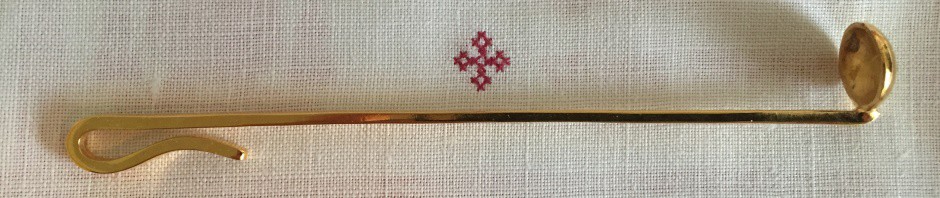
In my conversation with the goldsmith about cleaning the chalice – FATHERS! SACRISTY PEOPLE! LISTEN UP! – I was told to use only very high percentage white alcohol to clean the chalice.  Everything else will damage, “eat”, the gold.   He told me that in the shop.  I wrote a note to him to ask if anything else could be used, some sort of polish or soap and water.

His answer:

“Pulire esclusivamente con alcool puro bianco. Tutto il resto potrebbe danneggiare la doratura…  Clean exclusively with pure, white alcohol.  Anything else could damage the gilding.”

This doesn’t apply to silver, but it WOULD apply to the gilding inside the cup of a silver chalice.  It would apply to a monstrance or paten or pyx or anything else that is gilded.

So, there should be bottles of 90%+ alcohol in sacristies, and not just to make limoncello.

In the USA we have “Everclear” at 95%.  There are other brands, too.  I saw one in an Italian store the other day: 96%.   I bought it and used it to clean the chrism and smudges from the consecration. It worked like a charm.  I’ll leave this bottle with the sacristan at Ss. Trinità.  They’ll either use it for chalice or The Great Roman™ will make limoncello out of it.  Either way is a good way.

Meanwhile, I was supposed to go to see the Van Gogh exhibit in Rome at exactly the time when morons interfered.  HERE  Another one of these climate change idiocies.  They threw vegetable puree at a painting and then glued themselves to the wall while shouting slogans about carbon and climate.   The contempt I have for these nitwits is nearly complete now.   How on earth did they get that stuff in there, given what has been happening?  ANSWER: It was probably an inside job, someone on the inside letting them into the gallery with their stuff.

Here’s another kind of puzzle.

BLACK to move.  You should get this one pretty quickly.

NB: I may hold comments with puzzle solutions a little longer than others so there won’t be “spoilers” for others.

Interested in learning?  Try THIS.

Meanwhile, the mighty Robert Card. Sarah has a new book, Catechism of the Spiritual Life.

US HERE – UK HERE

Chess and Card. Sarah.  It’s a good day.

Posted in SESSIUNCULA |
18 Comments

DIEBUS SALTEM DOMINICIS – 22nd Sunday after Pentecost

A while ago, I ran into a claim that in the near future devotion to the Holy Face of Jesus would be more and more important.

Think about how our ecclesial shepherds have, through neglect and even expressions of contempt, downplayed and eroded the pious devotional practices of the faithful.  Hence, I am inclined to think that any good, traditional Catholic devotion would be better than the wide-spread near-zero we’ve got going now.

That said, we cannot go wrong with contemplation of the Holy Face of the Lord, held up before us sometimes as a portrait, sometimes as a lens, sometimes as a mirror.

In our 1980’s seminary we were inflicted with the deadly musings of Edward Schillebeeckx in his then-recent The Church With a Human Face: A New and Expanded Theology of Ministry.  The heretic priest – he eventually quit – who taught the course which was supposed to be on Holy Orders and Eucharist (but was instead about “ministry and symbol”) used this trash.  While most of us seminarians… well, some… yearned for a formation about a Church resplendent with the face of Christ for her people, we were being told to obscure, nay rather, efface that transcendent face with the merely earthly.

There’s nothing wrong with stressing the real needs of breathing and living human beings in the Church and the care she has for them.  That’s not what this seminary agenda was about.  It was a total, systematic disfigurement of the Church’s teaching on the priesthood and Eucharist.  We could say it was a radical “defacing”.   À la Rahner, sacraments only celebrate pre-existing realities.  There’s no “transubstantiation”.  When an “ordained minister” says the words of “institution” (not consecration) bread and wine become a symbol of the unity of the community gathered in that place at that moment.  À la Schillebeeckx, priests – sorry, scratch that, ministers are called forth from the community. When the community’s “face” changes, they fade back into the community for another to emerge.

My apologies. We were instructed back then not to use the “p-word”, and instead refer to ordained and non-ordained ministers.  We are all ministers, you see.

And now we are all “walking together”.  See how this progresses?

Sadly, as these heretics in the seminary crucified Christ daily in the classroom and in the chapel and in their very quarters, I often had in mind the passage in Isaiah 52:

“His appearance was so marred, beyond human semblance, and his form beyond that of the sons of men”.

This, dear reader, is the pattern we see again and again in the Church.  If Christ suffered His defacing, so must Holy Mother Church and, with Christ, many of her priests.

It isn’t a coincidence that, today, priests of a certain type are being de-faced, cancelled.

We need now to have before our eyes even painful images of the Holy Face of Christ, not only in our both beautiful and battered neighbor, but especially in the Church in the world.

Perhaps the Gospel for this Sunday can help us face up to this need.

Today’s Gospel comes from Matthew 22, which describes the Lord’s final days in Jerusalem.  The previous chapter saw His triumphant Palm Sunday entrance.  Holy Week follows, during which hostility from the high and mighty mounted and mounted against our Lord.

At this point in Matthew, we’ve just heard the parable of the Wedding Banquet, which Holy Church presented during Mass a few weeks ago.  Hard on the heels of that eschatological lesson, a group of Pharisees and Herodians oiled their way up to Jesus with flattering words to lay a trap for Him.  They asked, “Is it lawful to pay taxes to Caesar, or not?” (v. 17).  Keep in mind that at his “trial” a few days later Christ would be falsely accused of forbidding people from paying the tribute (Luke 21:2).

It is helpful to know that, in those times, the Jews had to pay two tributes, or taxes, one to the Romans and another to the Temple.  Taxation, tribute, was a sensitive issue.  Should the Lord have responded affirmatively, the Jews could have seen Him as a Roman collaborator, much as they would the hated Jewish tax collectors.  Had he answered in the negative, they could have accused him of sowing sedition against Rome.  Either way, a “yes” or a “no”, meant trouble.  Christ saw past their unctuous flattery and knew their wicked motive for asking.  He requested to see the “nomisma tou censou”, the tribute coin, a denarius, the famous standard “day wage”, sometimes translated as “a penny” as in the KJV.  There’s been some inflation since the KJV.

The Lord doesn’t deliver a parable here so much as a riddle (vv. 20-22).

Jesus said to them, “Whose likeness and inscription is this?” They said, “Caesar’s.” Then he said to them, “Render therefore to Caesar the things that are Caesar’s, and to God the things that are God’s.”  When they heard it, they marveled; and they left him and went away.

Again, context helps us to break open this nourishing bread of the Word.  The Gospel says Christ underscored not only the image on the coin, but the inscription.  His enemies responded “Caesar’s” and not some other great figure whose coins were in circulation.  It is most likely that the coin in question was a silver denarius of the adoptive son of Augustus, the Emperor Tiberius (+AD 37), which bore the image of Tiberius on the obverse with the inscription “Ti[berivs] Caesar Divi Avg[vsti] F[ilivs] Avgvstvs … “Caesar Augustus Tiberius, son of the Divine Augustus”.  In essence, “Tiberius, son of god”, for Augustus had been declared to be “divine”, like his adoptive father Julius before him.

It was a faceoff between the Son of God and the son of god, the ultimate worldly glorification of a mere mortal and the acknowledgement of the one true and living God.

Christ asked the Pharisees, “Whose likeness… is this?”  In the Greek he asks about the eikon which gives us the English “icon”.  Our Biblically oriented minds direct us back to the ancient Greek of the Old Testament, the Septuagint, and Genesis 1:27 where the same word eikon describes the creation of man in God’s image.

Putting aside controversy over Christian cooperation with or resistance to secular authority, “the state”, which over the centuries has been rooted in part in this encounter of Christ and the Pharisees, we are presented with what Paul later frames in terms of putting off the earthly man and putting on Christ, in whose image we are.  The more we are like Him in word and deed and inner orientation, the more we are good images of Him.

St. Ambrose of Milan (+397) wrote in his Commentary on Luke (9.34):

“Questioned concerning the penny, [Christ] asks about the image, for there is one image of God, another image of the world.  Therefore, the Apostle, also, admonishes us, ‘As we have borne the image of the earthly, let us bear also the image of the heavenly.’  Christ does not have the image of Caesar, because He is the image of God.”

In other words, the coin and its image of the Emperor with the false “son of god” stands for the world and its allurements.  We must detach ourselves from that image to see after the truer image.  In De officiis, the great Bishop of Milan says of the incident of the coin:

“You are laying aside the image of the eternal Emperor and setting up within yourself the image of death. Instead, cast out the image of the devil from the kingdom of your soul, and raise up the image of Christ.  This is the image that should shine in you, that should be resplendent in your kingdom, or your soul, the one which effaces all the images of evil vices.”

The Second Vatican Council’s document Gaudium et spes is not without its puzzles and its legitimate critics.  However, in the Christological section 22, we find, and please have patience with the extended quote:

The truth is that only in the mystery of the incarnate Word does the mystery of man take on light. For Adam, the first man, was a figure of Him Who was to come, namely Christ the Lord. Christ, the final Adam, by the revelation of the mystery of the Father and His love, fully reveals man to man himself and makes his supreme calling clear. …

He Who is “the image of the invisible God” (Col. 1:15), is Himself the perfect man. To the sons of Adam He restores the divine likeness which had been disfigured from the first sin onward. …

As an innocent lamb He merited for us life by the free shedding of His own blood. In Him God reconciled us to Himself and among ourselves; from bondage to the devil and sin He delivered us, so that each one of us can say with the Apostle: The Son of God “loved me and gave Himself up for me” (Gal. 2:20). By suffering for us He not only provided us with an example for our imitation, He blazed a trail, and if we follow it, life and death are made holy and take on a new meaning.

Christ, in whose image we are made, reveals man more fully to himself.  By gazing at Christ, risen and glorious, battered and defaced beyond recognition of man, we find ourselves revealed.

Jesus paid the tax for our sins with the coin of His face.

Shall we, in this time of dreadful and anxious need for our clearly struggling Church, turn away our faces?   We must look our challenges square in the face, remembering that concealed within them are the perennial enemies of our soul: the world, the flesh and the Devil.

Now is the time to pay tribute to the King, whom a week ago we celebrated as such in our traditionally oriented churches and chapels.

If not in churches, if it gets to that point, then on rocks in the forest and in people’s homes.
Posted in Liturgy Science Theatre 3000, Save The Liturgy - Save The World, WDTPRS |
10 Comments

YOUR URGENT PRAYER REQUESTS

PLEASE use the sharing buttons! Thanks!

In your charity would you please take a moment look at the requests and to pray for the people about whom you read?

Continued from THESE.

Let’s remember all who are ill, who will die soon, who have lost their jobs, and who are afraid.

I get many requests by email asking for prayers. Some are heart-achingly grave and urgent.

As long as my blog reaches so many readers in so many places, let’s give each other a hand. We should support each other in works of mercy.

If you have some prayer requests, feel free to post them below.

You have to be registered here to be able to post.

I ask a prayer for myself.  I’m dealing with a particular challenge right now.   I also want to thank all of you who pray for me.

Posted in PRAYER REQUEST |
15 Comments

ASK FATHER: Should priests wear the biretta when preaching? Wherein Fr. Z rants.

From a priestly reader…

QUAERITUR:

I cannot find when to use the Biretta at the Homily, should it be worn, if so, then does one wear at for the Epistle & Gospel readings in the vernacular/English?
Thank you for your precious time.

Use of the biretta! Finally something important, instead of all these questions I get about whether or not X is a mortal sin, or why some in the Church seem determined to commit ecclesial mass-murder and suicide. Refreshing.

A long time I ago, I coined a term “birettaquette” for this critical dimension of clerical comportment.  It has made the rounds, I think. I have some other posts about birettas, and berettas, in the archive.   Gosh, I’m getting nostalgic.  That’s a bad thing, right?

Ad ramos.

Should the biretta be worn when preaching?

This is covered by local and community custom these days. I don’t believe there are specific rubrics or responses from the old Sacred Congregation for Rites that cover this. Pun intended. No, wait. There is one: if memory serves The Pontificale Romanum (that governs ceremonies of bishops) instructs the priest to wear the biretta when preaching. However, that is in a pontifical ceremony. I’m not sure it applies “downward” to the Masses of merely mortal priests.

Fortescue, again if memory serves, opines that it should be worn when preaching, but I think Wapelhorst does not.  It makes no nevermind.  Auctores scinduntur and we can make up our own minds.

I believe that the SSPX priests do not use the biretta when preaching. As a matter of fact their biretta use seems quite limited, perhaps because when they were formed Archbp. Lefevbre, who had been a religious, deemphasized it. The FSSP, influenced in its origins from the SSPX has greater use by far, as does the Institute of Christ the King, whose members I believe may also eat and sleep wearing birettas.  A legit choice, by the way.  Before central heating people used sleeping caps and the biretta is not strictly liturgical.  Priests wore and can still wear the biretta when out and around in the cassock.

It is daily wear, as you might see in the movie Going My Way, when the old Irish priest is strolling outside around the grounds.

And then there are the authoritative don Camillo movies!

We could also get into the removal of the maniple and, in some places, the chasuble for preaching.

The idea is that at that moment the priest steps out of Mass, as the sermon was not perceived as part of the Mass, and then puts them back on when finished and Mass “resumes”, like halting and restarting a clock. In the post-Conciliar view, the sermon is part of the Mass, not a-part.

This usage view reveals something about readings as perceived by the Novus mind or the Vetus mind.

In celebrations of the Novus Ordo you often get the sense that you are in a didactic setting, where things are being described, related, explained, taught. Versus populum orientation of the altar magnifies this as does the vernacular.

In the Vetus Ordo the readings are also sacrificial in nature. This is why in the traditional Roman Rite the readings are always read by the priest celebrant at the altar, which is the place par excellence of sacrifice. In 1962 there was a daft shift in this in regard to the Epistle and Gospel which dopey changes are fit only to be entirely ignored. The main point is that even the uttering of the words of Sacred Scripture in the Mass is the raising of a sacrifice, as incense rises heavenward, and so forth.  Therefore, the readings have to be read by the priest even if they are then sung or read by someone else (subdeacon, deacon, layperson in some places).

It occurs to me as I write that the Novus Ordo practitioner emphasis of the separation of elements underscores how the dimension of sacrifice was obscured in the Novus Ordo regarding readings.

Firstly, in the Novus Ordo there are two books, a Missal and a Lectionary.  Bugnini back in the day wanted to make sure that the priest could never say Mass from one book ever again.  The use of a second book isn’t just because the number of readings was multiplied.  It was a separation of word from sacrifice. In the Vetus Ordo, all the readings are in the same book as all the elements for the Sacrifice.  The use of a separate book for the singing of the readings by subdeacon and deacon is purely a matter of utility and not a theological statement.

Next, in the Novus Ordo design of some churches and sanctuaries there is such an emphasis on the word, that the ambo is given just as much emphasis as the altar, sometimes even being placed in such a way that they have equal positions next to each other.   I’m sure you’ve seen that in places.

I’m digressing, but you see how all of these things are interlaced.

The biretta doesn’t carry nearly the significance as sacred vestments or altars and ambos. However, it did develop from the scholar’s doctoral cap. Therefore, from its origin it seems not unreasonable to wear it while preaching.

That said, some reflection on these matters could provide a priest with a sort of “examination of conscience” about his preaching.  It is not for nothing that the Council of Trent took the matter of quality of preaching (and therefore formation) in hand and called for a book for priests to guide their sermon and instruction, the Roman Catechism.

I do not see an absolute conflict between the idea of “stepping out of Mass” to preach and the sermon being “part of Mass”.  Here is a real point of “mutual enrichment” that Benedict XVI wrote about.  The two views of the sermon seem on the surface to be antitheses.  But are they really?  The priest has choices to make about his preaching.  These two ways of thinking about the sermon could provide some orientating course corrections.

To the point about birettas, there is no hard and fast rule, authors are divided, and local custom and the preference of the priest governs this all important question.

Now back to the lesser stuff, like is it really necessary to go to confession (yes), is is eating alligator permitted on Fridays of Lent (yes), and whether certain acts are mortal sins even in marriage (of course).

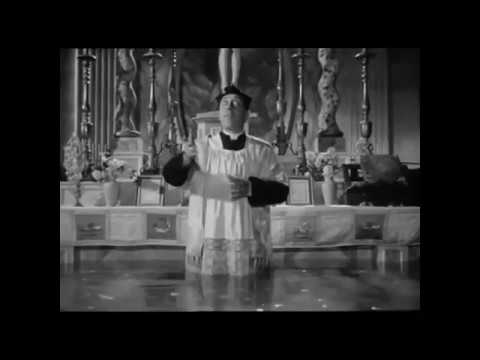
I’ll conclude with this, in Italian, but authoritative and thematically and visually apt for our sad days, when a flood of what can only be called persecution has driven many of the faithful who desire traditional worship out of their “homes”, their churches and chapels.  Don Camillo stays at the altar and, unable to say Mass because of the flood, and reminds people that one day the flood water will subside, the sun will return to shine, sorrow will diminish and divisions will be healed.

Amen.

YouTube thumbnailYouTube icon

A REMINDER of the old BIRETTAS FOR SEMINARIANS PROJECT.

Posted in "How To..." - Practical Notes, ASK FATHER Question Box, Hard-Identity Catholicism, Liturgy Science Theatre 3000, Mail from priests, Save The Liturgy - Save The World, SUMMORUM PONTIFICUM, Wherein Fr. Z Rants | Tagged , ,
17 Comments

Rome 22/11 – Day 36: Stressed and blessed

I had a stress-filled day.  I made it to the end thanks to a prince of the church, for one thing, and a new good friend, for another.

The day was also good in a way that I can only describe as heavenly intervention.  I can’t share the issue involved, but I think I have evidence.

St Thérèse was active in my vocation once before, at its beginning.  I believe I recounted that elsewhere: I had received her classic sign of roses in huge abundance when I asked her intercession at a critical moment.   This is why I have a wreath of roses on the node of the chalice I just had refurbished and, this morning, reconsecrated.

I think she just got involved again.  After I had spoken of her intercession earlier in the day, this was spontaneously given to me in the evening when I was getting groceries for supper at the shops around the Campo de Fiori (apt).

The ambient.  Workers are taking down the stalls and cleaning up after the day.  Massive street sweepers are roaring around.  It was so windy that things were being blow over, garbage is whirling.

What I received out of the blue in this chaos.

What’s really amusing about this is that, just the other day I had a thought about my relics of St Thérèse during the Exposition of Relics at Santissima Trinità dei Pellegrini.  I have two 1st class relics which are impossible to get now.  I considered bringing one to Rome for the parish, to which I am so very much attached.

On what day in the Church’s traditional calendar did I have this tough but good day, and when I received this rose out of the blue?

5 November – The Feast of the Holy Relics.

I would like to post a chess puzzle and some promotions but I am at last a puddle.

I am so grateful for you who have prayed for me.

Mary, Queen of Clergy… St Thérèse….

Thank you, Lord, for this day.

The sun had risen in Rome at 6:45.  It set at 17:02.

The Ave Maria was supposed to be at 17:30.


Posted in SESSIUNCULA |
1 Comment

Wherein Mr. Cricket goes to the Zoo

Forgive typos… I am writing under time constraint and pressures.

Biretta tip to Peter Kwasniewski  – o{]:¬) – for the following from Mr Cricket, Andrea Grillo, whose photo on his blog looks like – and it is exactly what he is doing – giving everyone the finger.

He is a scholar of liturgy and one of the purest of the pure ideologues of “re-interpretation” of Cult, Code and Creed in light of the gnostic reading between the lines of the texts of Vatican II, the empty spaces provided perhaps by active imagination.

He hates you.

Be clear about this.  The people who are relentless in attacking the Vetus Ordo don’t hate and fear only the Vetus Ordo, they hate and fear the people who desire it.  This is what Mr. Cricket posted on his site in the wake of a celebration of Vespers held at the Pantheon (aka St. Mary of the Martyrs) during the recent Summorum Pontificum Pilgrimage.  The celebrant for Vespers was the Cardinal Archbishop of Bologna, Matteo Zuppi who for some time was the Auxiliary Bishop for the center of Rome, where you find the churches with the Vetus Ordo.   Then-Bp. Zuppi had been at the FSSP parish for Masses.  Zuppi is now also President of the Italian Bishops Conference, which is a position of considerable heft.  People must understand that the rest of the Church throughout the world is influenced by what happens at and around the HQ.

Grillo’s venomous piece is, in part, a warning shot towards Zuppi, who is spoken of as papabile (electable as Pope) in the next conclave which some say isn’t all that far away.  I suppose Mr. Cricket’s default position is that everyone is out for himself and, therefore, Zuppi used the Pantheon appointment as part of a campaign. The other part of this is that Zuppi has shown openness towards those who are promoting a homosexual agenda.  Those who are on that side of things might have feelings of dismay that Zuppi cheerfully celebrated Vespers in the Vetus Ordo.   Hence, …

Here’s Grillo.  Not my translation:

“What are you, stupid?” [“Ma che sei scemo?” in the original… it’s quite a strong statement] Matteo Zuppi and the nostalgics of Summorum Pontificum  [“nostalgia” here has far more negative connotation than it would in English]

I very much enjoyed, a few months ago, the interview given by Cardinal Matteo Zuppi, shortly after his appointment as President of the CEI, in which, in his Romanesque style, he said that, to those who resent Pope Francis’ insistence on mercy, saying that this centrality of the theme is a serious mistake, one should say, instinctively, Roman-style, “What are you, stupid?” Well that was my own reaction when a friend said to me yesterday, “Did you see that Zuppi presided over the vespers of the nostalgics of Summorum Pontificum?” And I said, “What are you nuts?”  [“Ma che sei scemo”, again. Off the bat we learn from this that Cricket enjoys it when people call other people “stupid”.]

My amazement stems from some factors, which Card. Zuppi could not have failed to consider in his willingness to preside over the vespers of this de facto “outlawed” association and which claims to nurture a situation that the MP Traditionis Custodes has in fact overcome with the abrogation of the “object” of remembrance. [This is obviously pure fantasy on Mr. Cricket’s part.  Firstly, Traditionis custodes (TC) says that the Vetus Ordo can continue. It’s there in black and white.  Also, the Summorum Pontificum Pilgrimage events included a Solemn Mass in St. Peter’s Basilica by a priest who is in the Secretariat of State office.  So much for “outlawed” and “abrogation”.  When you get to Art. 8 of TC you have to read it with the eye of the technician rather than of the guy who squeegees windshields at the stop light. But, hey, Cricket, don’t let facts interfere with the narrative.] But I try to clarify the matter further:

(a) It seems that Card. Zuppi wanted to dampen the surprise [surprise to him, maybe, it was advertised widely] by saying that he accepted the invitation well before he became CEI president, but I do not know if before the publication of Traditionis Custodes. What is certain is that to stand at the presidency of a liturgical action that TC censures [This is a lie.  TC does not “censure” the celebration of Vespers in the Vetus Ordo.] and makes possible only in limited and circumstantial cases constitutes a fact of singular gravity. [Or singular hope, if you flip the coin.]

b) Secondly, the naming of the “Roman pilgrimage” of the so-called “People of Summorum Pontificum,” [Like those “scare quotes” and the “so-called”?  Remember: he doesn’t like the people who want traditional worship.] under the condition of the abrogation [again the lie] of the document that gives its name to the group itself, should have made one cautious, at least in the second place, with respect to the acceptance immediately given.  [Or maybe Zuppi was a) honorable in not standing the group up or b) trying to show compassion for people who have been violently kicked in the teeth by people like Grillo.]

(c) Third, the “representative” function of the CEI President cannot help but sound jarring with respect to the repeated assertion (in Traditionis Custodes and then also in Desiderio Desideravi) that the only lex orandi, even for the celebration of vespers, is that established by the liturgical books of Paul VI and John Paul II and not by the earlier books.  [Another possibility is that there are some people in the Church who are sort of “doing their own thing” under the shadow of Francis, who may not have as much of a dog in the fight as they would like.  It could be that they are far more invested in this than Francis and the influence they had is now slipping since he is moving on to other issues.]

[Watch this…] At the root of the misunderstanding behavior, [another shot at Zuppi.. poor man, doesn’t understand!] however, lies an original issue that marks the MP Summorum Pontificum: namely, the fact that it is the fruit of a “curial disease,” which has its center in Rome. Nostalgia for preconciliar liturgical forms (but also for the Church and preconciliar relationships and languages and doctrines and disciplines and forms) is a disease not primarily of the periphery, but of the Roman center of the curia[This is a pretty vicious attack on Benedict XVI.  Summorum Pontificum is the fruit of a disease, nostagia, not of the wider world but of the Roman Curia.  This joker hasn’t the slightest clue what he is talking about if he thinks that SP came from urging of the Curia rather than as a response to the many people exactly in the periphery.  The periphery was listened to under Benedict, who saw that there was, in fact, a “disease”, and that was a liturgical disconnect from our Tradition. ]

To the extent that you become a “man of the curia” you begin to hear the sirens of a “strange mercy,” which manages to convince you that you can stand, by mercy, [and here we go with the counciliar hyper-absolutism] with one foot in the council and the other in the pre- and anti-conciliar[NB: Anti- not ante-] And this illusion can infect even the best, to the extent that they allow themselves to be reduced to functionaries of a “mercy” of confusion and reaction. Desiderio Desideravi says it well: it is not the “sense of mystery” that we need, but it is the awe of the paschal mystery that nourishes identity and formation in the celebrated faith.  [Here’s the problem with the “Paschal Mystery” emphases in the post-conciliar absolutists’ minds.  They right look to the eschatological joy that the Resurrection presaged.  However, they have so emphasized it that they obscure the rest of the Paschal Mystery, the part that gives us the means of attaining it: Passion, Sacrifice, Death.  They want the joy without the Cross, like … proponents of the prosperity gospel.]

In perceiving sharply this difference lies the possibility of accepting or rejecting the invitation to preside at a vesper that fields a ritual ordo on which all resistance to Vatican II is symbolically projected, liturgical as well as ecclesial, disciplinary as well as doctrinal. [Straw man… not many people like that exist in reality.  Yes, there are people who reject V2 in its entirety.  Not so many.  Most will say that it was the most important Council in our lifetime and not accept that it was a new Council of Jerusalem ushering in a new age of the Church (which these absolutists do, probably not from conviction but because it is a line that brings them power.] If a man of Matteo Zuppi’s worth falls into this symbolic trap, I am surprised and wonder: [Orrrr… maybe you want to think the worst of people (look at that photo, above… orrrrr…. maybe you don’t know what you don’t know….] but how can one accept the request of a group that names itself and organizes pilgrimages with explicit references to a document abrogated in 2021? [Benedict XVI’s Motu Proprio Summorum Pontificum was more than a mere juridical solution parts of which could be abrogated… but which probably haven’t been.  Mr. Cricket gets that… just barely.  Hence the fear.  I have the image of a slasher movie in which the girl alone in the house knows she shouldn’t open that door.] How did a Cardinal President of an Episcopal Conference fail to take into account this heavy symbolic and ideological entrapment?  [Ockham’s razor?  Maybe Zuppi isn’t a jerk?]

(The Italian original is HERE.)

I had a good long conversation with a real Vatican insider recently, not like Grillo.   He confirms what I learned back in the day when I was in these halls and offices.  There are those who were paid attention to.  Then they get dropped.  Languishing on the outside, waiting by the phone like a jilted cheerleader whom the captain of the football team once took out and got something from, she joins the tribe of mean girls in the bathrooms, to make her presence known and try to keep some of the luster she had for that fleeing moment before he moved on.   This sort of dynamic stems from… various causes.  I’ll stop here.

I applaud Card. Zuppi.  I know he wrote a preface to a really bad book that shall remain nameless.   BTW… one of the things I miss here in Rome at this time of year is Jasmine.  But I digress.

Zuppi gave a lovely sermon at Vespers. He talked about unity, which is the role of Peter.

Meanwhile, be a Custos Traditionis.

Posted in Liberals, Save The Liturgy - Save The World, The Coming Storm, The Drill, Traditionis custodes, What are they REALLY saying? |
10 Comments

ASK FATHER: Can you gain an indulgence by reciting the Rosary with the Luminous Mysteries?

From a reader…

QUAERITUR:

I have never seen a decree or document stating that the Luminous Mysteries of the Rosary have been indulgenced.

I suspect you also have never seen a decree that the Glorious Mysteries have been indulgenced.

The Luminous Mysteries, or Mysteries of Light, are on the Vatican website. HERE  They were derived, in part, by John Paul II’s reflection on the writings of Bl. Bartolo Longo, a converted Satanic priest.  That’s a pretty impressive conversion.

The short answer is: yes.

These beautiful devotions are a bit fluid.  There are different methods of saying the Via Crucis, or Stations of the Cross, even different events of the Via Crucis as points of meditation than those commonly found in our favorite versions, such as that of St. Alphonsus.   There are different methods of saying the Rosary as well, not just one.

BTW… you will notice that on the Vatican website for the Mysteries, the method of reciting the Rosary includes the Litany of Loreto.   Do you do that?  No?  It also starts differently, more like the recitation of the Office (thus the connection with the Psalter).  Also, the Vatican website says that:

The Rosary is made up of twenty “mysteries”….

And …

“This indication is not intended to limit a rightful freedom in personal and community prayer, where account needs to be taken of spiritual and pastoral needs and of the occurrence of particular liturgical celebrations which might call for suitable adaptations”  (Rosarium Virginis Mariae, 38).

Again, there are different ways to pray this devotion.

I have no strong desire to use the Luminous Mysteries.  I’m content with the three sets which I originally learned.  That said, if I were in some group that was going to say the Rosary, such as on a bus in the Holy Land with pilgrims, and someone launched into the Luminous Mysteries, I wouldn’t run up and down the aisle waving them out of the air.  I can’t fathom why it would be a problem do reflect on, say, the Transfiguration of the Lord (I think that’s one of them, no?).

Some will object the recitation of the three chaplets of the Rosary, each with its five decades, amounts to the same number as the Psalms.  50 /3 = 150, right?   Sort of like the Office for those who don’t say the Office.  I recall reading someone’s notion that by adding another chaplet, the Luminous, you have 200 / 3 and that’s 66.6… Ooooo!   We really don’t need that sort of thing.  And wouldn’t it be 200 /4 ?

Others might object that adding another set of Mysteries goofs up the days of the week and which set to use.  I have zero sympathy for that argument.  Use the set you want when you want.   See above.

The important thing is that you recite the Rosary.

With that, I’ll conclude with something I’ve posted before, that an exorcist friend told me.  He told me about the effect that the Rosary has on demons.

In general, the Rosary has a greater effect on demons than any other devotion.  On the “screamometer” from the demons, the Rosary is powerful.

He recounted a particular experience during an exorcism.

Exorcisms can go on for hours and many different prayers and devotions, along with the actual ritual, are deployed.  At one point they were saying the Rosary.  The demon stared to laugh at them.  When queried, the demon responded that their distracted Hail Mary’s were like, “laying wilted dried flowers at her feet”.   When asked what an attentive Rosary filled with love was like, the demon said, “What is a fragrant bouquet for her is our downfall.”

[UPDATE: I’m getting notes along the line of “Even if the flowers are wilted mothers like them if their little children bring them!”  Sentimentalism isn’t wrong because it is sentimental.  Mothers also like the really bad art their children draw… or say they do.  Heck, I like it, too, especially in the Christmas cards you send.  Sincerely.  HOWEVER… wilted flowers are not the best when offered by adults.  Sit down at a restaurant and there are wilted flowers.  Outstanding, right?  Kid art in the Metropolitian Museum… nope.  (Even though some kid art is better than what you see in some of the galleries where I rarely go.) We are adults reading this and not 3 year olds.  Do your best as often as you can.  You can stop with the notes about mothers and children and wilted flowers.  As I conclude this I just thought, “Now some Smarticus Pantsicus is going to write that a term for a “still life” painting is “natura morta”, sometimes with wilting flowers, rotting fruit, or even flies.”  You can’t win.  Smarticus… keep in mind my shifting mood on a stressful day, please. Are hasty Hail Mary’s better than none at all? Maybe.]

Prayers have purposes and effects.  While sacraments work ex opere operato, devotions have effect ex opere operantis.

I think it is better to lay nice flowers at Mary’s feet rather than wilted ones.  And it is difficult to understand how these are not beautiful flowers:

  • Baptism of the Lord
  • Wedding at Cana
  • Proclamation of the Kingdom of God
  • Transfiguration
  • Institution of the Eucharist (which also means Priesthood)


Posted in "How To..." - Practical Notes, ASK FATHER Question Box, Our Catholic Identity, Our Solitary Boast | Tagged , ,
42 Comments

Rome 22/11 – Day 35: Getting to the heart of it

6:44 was sunrise and 17:03 will be sunset in Rome. The Ave Maria should ring at 17:30.

Please remember me when shopping online. Thanks in advance. US HERE – UK HERE

Also, there is now talk of my returning to Rome for Holy Week, or at least the Triduum.  More on that to come.

For this day we thank you, Lord.

It is the Feast of St. Charles Borromeo, a magnificent and important figure of the Counter-Reformation. While his body is in Milan, where he was Archbishop, his heart is in Rome, behind the main altar of the church dedicated to him on the Via del Corso.

The writing is St. Charles motto: HUMILITAS.

A detail from the fresco above the little chapel.

San Carlo al Corso

Meanwhile…

WHITE to move.  Get that King!

Priestly chess players, drop me a line. HERE

Thanksgiving is coming up.  How about some excellent beer for your meal from the traditional Benedictine monks in Norcia?   This is really good, especially with savory foods.

Finally, a note to donors and benefactors.  Some of you have moved over to Zelle for regular donations.  While that works well, there is one little problem.  Whereas the other services for donations included an email for you, Zelle does not … unless you include it, I think.  Therefore it is nigh on impossible for me to send you a thank you note unless I can match you up with previous donations with another service.

Please know that I still note everyone’s names and I pray for you regularly.  Here in Rome I have been offering Masses for my Roman Sojourn donors especially, but also all you benefactors.  It is my pleasure and my duty.  I ask prayers for myself, especially now.

Especially in the next three days.

Posted in SESSIUNCULA |
6 Comments

ROME 22/11 – Day 34: Four Last Things… Vetus v. Novus… Wherein Fr. Z rants

In Rome today the sun rose well after I did, at 6:43 and it will set at 17:04. I, however, unlike the sun, may have a nap: there will be no eclipse today… at least visible from Rome. If there is some other syzygy, I will be unaware of it. The Ave Maria bell ought to ring at 17:30. There are 59 days left in this calendar year and Advent is on the horizon.

For this day, Lord, we thank you.

Given that we are in the month dedicated to prayer for the dead, let us also consider on our own the Four Last Things, Death, Judgement, Heaven and Hell. Two of these are not optional. The other two are contingent. BUT… you will wind up in one of them. You will. It might mean a period of time in Purgatory. In that case, we should be solicitous about those who are NOW in Purgatory, whom we can help along by taking on some of the penance they might in justice still perform due to temporal punishment due to sin. Through the treasury of the merits of Christ’s Sacrifice and of the saints, Holy Church has Christ’s own authority to “unbind” temporal punishment due to sin to one degree or another, partial or whole. The Church has designated certain works to perform, in a prayerful and devout attitude and with a proper intention, which can be applied to souls in Purgatory.

The Golden Rules applies here, doesn’t it. The “poor” souls, rich in the knowledge that one day they will enter Heaven, are still members of the Church. We who are members who are still alive on Earth should be interested in them, as we are interested in the materially poor or sick in front of our eyes.

You can gain plenary indulgences during the eight day period after All Saints/Souls. Make use of this gift.

And GO TO CONFESSION.

BTW… a priest wrote to tell me that I was wrong about the period for the plenary indulgence during the “octave”.  He said he was sure that the period was extended for the entire month of November.  I don’t believe that is correct.  It was extended in a Decree of the Sacra Paenitentiaria Apostolica in 2021 for that year because of COVID-19 (Prot. No. 1253/21/1).  The extension of the indulgence was granted for November 2020 and 2021.

NOW IT IS OVER.  There has returned in force the concession #29 in the Enchiridion Indulgentiarum.   The dates for the concession 1-8 November.

Fathers: Don’t be telling people that they have all of November.

Finally, since I am in Rome this morning I called the offices of the Sacra Penitenzieria and asked them specifically.

I’ll update a previous post with this.

And…

The ordo ( for the Vetus Ordo) for this year has this: NB the 3rd paragraph.

Speaking of raising the souls of Purgatory through the mercy of God….

On the side of the catafalque.  Tempus fugit.  Again, I say…

GO TO CONFESSION!

A cheerfully bound book for the celebration of Requiem Masses.

We are living in a time in the Church when the Last Things which are FOUR in number (mentioned above) are more or less reduced to one alone: Heaven.  The Novus Ordo systematically stripped out of the prayers concepts like sin, guilt, penance, propitiation, etc., in favor of an emphasis on the future joy of Heaven.   The result is a rosy view of our final end, as individuals and a Church that doesn’t correspond to reality.

While it is true that Christ conquered Death and Sin once for all time, it remains true that, in order to partake of that victory, we have responsibilities.   It isn’t automatic.

There are some in the Church today, let’s call them Vatican II absolutists, who argue that we mustn’t stick to the texts the Council produced, we have to discern the new and revolutionary style of the documents in which we discover the Council’s real authority.  Rather than a style of judgment or prescriptions or correction, V2 gave us a new “age of the Church” (yes, people say that) characterized by dialogue, welcoming, accompaniment, etc.  This new style, call it the “spirit of Vatican II” is so radically charged with – they claim (though I am not sure on the basis of any evidence) that virtually everything about the Church before the Council “event” must be reinterpreted, changed, brought up to date, etc.   What was before is not so much “sacred and great” but rather antithetical to the “spirit” discerned (I am not sure how) on the new spirit-inspired “style” of the Council.  It’s all right there, not in the black on which of the documents but rather between the lines, in the inspirations of those who were at the Council, in the imaginations of those who followed.

So, we are now and Easter people and Alleluia is our name.  We don’t worry now about sin, guilt, expiation, propitiation, in sober black that reminds us of our dusty future.  No.  Now we blue sky together as we engage in dialogue with a few to the Heaven that is doubtless ours.  So great is that future, that we also should bring our utopia of dialogue to life here and now in a kind of permanent revolution of “walking together”.

So, the prayers of the Novus Ordo and of the Vetus Ordo seem to some to be in conflict.

They are not.

The problem is that the Novus reduced the content to the eschatological joy of Heaven and obscured what you have to do to get there.

On the other hand, the eschatological joy of Heaven is front and center in many of the prayers of the Vetus Ordo, but the tough message of how to get there remains also.

If the Novus Ordo points optimistically to where we want to go, the Vetus Ordo also points there but is more practical in telling us what we have to do to get there: penance, works of mercy, constant examination of life.

Meanwhile, lovely light.  Too bad about that tarp.

Please remember me when shopping online. Thanks in advance. US HERE – UK HERE  These links take you to a generic “catholic” search in Amazon, but, once in and browsing or searching, Amazon remembers that you used my link and I get the credit.

WHITE TO MOVE. You need a strong forcing move to gain the decisive material advantage.  The first move is not obvious, or it wasn’t at first to me.  But it “cleared” up fast once I found it.

[I’ll hold your solutions in the comment queue for a while to let others work it without spoilers.  It has been great to see your answers!]

Priestly chess players, drop me a line. HERE


Posted in Four Last Things, GO TO CONFESSION, SESSIUNCULA, Wherein Fr. Z Rants |
6 Comments

2 November – All Souls, Octave, Indulgences, and YOU! – **IMPORTANT UPDATE about availability of the indulgences**

UPDATE 3 Nov ’22:

A priest wrote to tell me that I was wrong about the period for the plenary indulgence during the “octave”.  He said he was sure that the period was extended for the entire month of November.  This WAS the case and it is NO LONGER the case.   The concession had been extended for all of November in a Decree of the Sacra Paenitentiaria Apostolica in 2020 and 2021 for because of COVID-19 (Prot. No. 1253/21/1).  The extension of the indulgence was granted for November 2020 and 2021. Only.

NOW IT IS OVER.  There has returned in force the concession #29 in the Enchiridion Indulgentiarum (The Handbook of Indulgences).   Now, again, the dates for the concession 1-8 November.

Fathers: Don’t be telling people that they have all of November.  It’s 1-8 November.

Finally, since I am in Rome this morning I called the offices of the Sacra Penitenzieria and asked them specifically.


Originally Published on: Nov 2, 2022

Let’s have a review of the indulgences available for All Souls and the days that follow, so that you can plan your own action.  Don’t let these days slip by.

From the Handbook of Indulgences:

Visiting a Church or an Oratory on All Souls Day

A plenary (“full”) indulgence, which is applicable only to the souls in Purgatory is granted to the Christian faithful who devoutly visit a church or an oratory on (November 2nd,) All Souls Day.

Requirements for Obtaining a Plenary Indulgence on All Souls Day (2 Nov)

  • Visit a church and pray for souls in Purgatory
  • Say one “Our Father” and the “Apostles Creed” in the visit to the church
  • Say one “Our Father” and one “Hail Mary” for the Holy Father’s intentions (that is, the intentions designated by the Holy Father each month)
  • Worthily receive Holy Communion (ideally on the same day if you can get to Mass)
  • Make a sacramental confession within 20 days of All Souls Day
  • For a plenary indulgence be  free from all attachment to sin, even venial sin (otherwise, the indulgence is partial, not plenary, “full”).

You can acquire one plenary indulgence a day.

A partial indulgence can be obtained by visiting a cemetery and praying for the departed.

Each day between 1 November and 8 November you can gain plenary indulgence visiting a cemetery. These indulgences are applicable only to the Souls in Purgatory.

A plenary indulgence, applicable only the Souls in Purgatory, is also granted when you visit a church or a public oratory on 2 November. While visiting the church or oratory say one Our Father and the Apostles Creed.

A partial indulgence, applicable only to the Souls in Purgatory, can be obtained when saying the “Eternal rest … Requiem aeternam…” prayer.

Do you know this prayer?

Requiem aeternam dona ei [pl.eis], Domine, et lux perpetua luceat ei [eis]. Requiescat [-ant] in pace Amen.

Eternal rest grant to them, O Lord, and let perpetual light shine upon them. May the souls of the faithful departed, through the mercy of God, rest in peace. Amen.

It is customary to add the second half of the “Eternal Rest” prayer after the prayer recited at the conclusion of a meal.

Gratias agimus tibi, omnipotens Deus, pro universis beneficiis tuis, qui vivis et regnas in saecula saeculorum.

Fidelium animae, per misericordiam Dei, requiescant in pace. Amen.

We give Thee thanks, almighty God, for all Thy benefits, Who livest and reignest, world without end.

May the souls of the faithful departed, through the mercy of God, rest in peace. Amen.

My friend Fr. Finigan has a good explanation of being detached from sin and the disposition you need to gain indulgences.  HERE

Keep in mind that having high standards is a good thing.

Shouldn’t we be free from attachment to sin?  To what degree is being attached to sin okay?

In the final analysis, perhaps we have to admit that gaining plenary indulgences is rarer than we would like.

That said, it is not impossible to gain them.

I don’t think we have to be a hermit living on top of a tree beating his head with a rock to be free of attachment to sin so as to gain this plenary or “full” indulgence.

Also, we do not know the degree to which a “partial” indulgence is “partial”.  It could be a lot.  That in itself is something which should spur us on!

Generally, if someone is motivated to obtain an indulgence, he does so from true piety, desire to please God and to help oneself and others.

When it comes to complete detachment from sin, even venial, few of us live in that state all the time.

Nevertheless, there are times when we have been moved to sorrow for sin after examination of conscience, perhaps after an encounter with God as mystery in liturgical worship or in the presence of human suffering, that we come to a present horror and shame of sin that moves us to reject sin entirely.  That doesn’t mean that we, in some Pelagian sense, have chosen to remain perfect from that point on or that by force of will we can chosen never to sin again.  God is helping us with graces at that point, of course.  But we do remain frail and weak.

But God reads our hearts.

Holy Church offers us many opportunities for indulgences.  The presupposition is that Holy Church knows we can actually attain them.

They can be partial (and we don’t know to what extent that is) and full or plenary.  But they can be obtained by the faithful.

Holy Church is a good mother.  She wouldn’t dangle before our eyes something that is impossible for us to attain.

That doesn’t mean that a full indulgence is an easy thing.  It does mean that we can do it.  In fact, beatifications and canonizations have been more common in the last few decades and in previous centuries.  The Church is showing us that it is possible for ordinary people to live a life of heroic virtue.

Therefore, keep your eyes fixed on the prize of indulgences.   Never think that it is useless to try to get any indulgence, partial or full, just because

Perhaps you are not sure you can attain complete detachment from all sin, even venial.  Before you perform the indulgenced work, ask God explicitly to take away any affection for sin you might be treasuring.  Do this often and, over your lifetime, and you may find it easier and easier. Support your good project with good confessions and good communions.  You need those graces.

A person does not become expert in worldly pursuits overnight or without effort.  Why would not the same apply to spiritual pursuits? It takes time and practice to develop skills and virtues.  It takes time to develop habits of the spirit as well.

We can do this.  And when we fall short, we still have the joy of obtaining the partial indulgence and that’s not nothing.

So… take that, Luther!


Posted in "How To..." - Practical Notes, Liturgy Science Theatre 3000, Our Catholic Identity, Save The Liturgy - Save The World | Tagged , ,
10 Comments