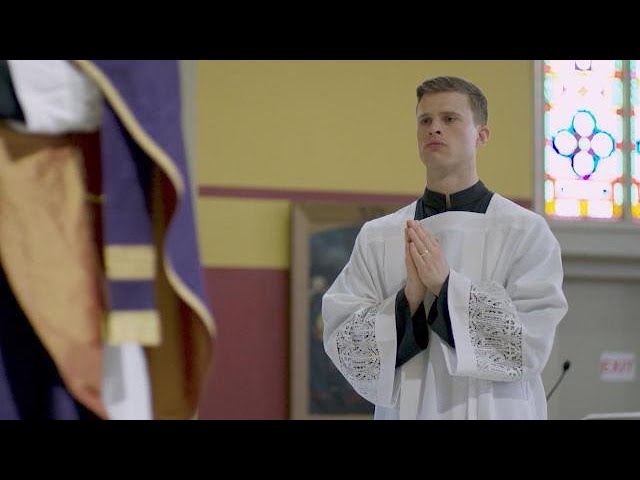
“Don’t bite the priest!”

This is a great tweet. I am reminded of a post on this I wrote in April. HERE. And I even once had a post with the phrase, “Don’t bite the priest!” HERE


Posted in "How To..." - Practical Notes, Liturgy Science Theatre 3000 | Tagged
1 Comment

ASK FATHER: Lutheran service more reverent than the Sunday Mass

From a reader…

QUAERITUR:

I’m on vacation visiting my sister in Orlando. I try a new parish every time I come because they all seem to be lacking in reverence.

(After Mass, I attended a Lutheran service with my sister’s family and it was more reverent without Jesus’s actual presence!)

Lots of abuses at Mass that I question but in particular I’d like to ask about the patens. They were glass, along with the chalices. After the Eucharist was distributed, an EMHC poured all the unused Eucharist into what looked like a large glass fruit bowl and carried it down the hall. I thought that glass was not to be used because of its fragility. Is that a regional thing?

I have no idea what that’s about.  It could be that there is a separate chapel where they reserve the Blessed Sacrament.  That would suggest that the Blessed Sacrament is not reserved in the church… which is dreadful.

What strikes me in this is your observation that the Lutheran service was more reverent than the Mass you went to.

Sweet Jesus, how long?  Frankly, its amazing that anyone goes to church at all in some places.  That’s going to change, of course, with a massive demographic cliff we are about to go over.

Under the last pontificate we made real progress with our liturgical ars celebrandi.  Younger priests, lacking the drunkenness of those halcyon days of the 60s and 70s, are doing their best to bring the ship back to course.  However, there are still a lot of priests on deck who were pickled in the briny “spirit” of those times and they still hold positions of power.   And there are a goodly percentage of really decent younger priests who just don’t know any better.    They, alas, were raised up in an era of horrid education and worse catechesis.  In their seminaries – some seminaries at least – they were taught a combination of very little and very goofy.  They didn’t buy it all, of course, and sensed that something else was out there to be claimed as their patrimony, but they didn’t know how to find it.  Then they were flung into parishes run by the pickled pastors still teetering on the fumes of Vatican II’s “spirit” and Rahner and Notre Dame liturgy workshops.  Many were hammered by whining complaints of lay-libs, even more inebriated on the lib-grog measured out to them in regular doses by their pickled pastors.  Nolens volens, the liturgical and pastoral style of most priests will always bear something of the stamp of the first pastor to whom they were assigned.  The rest is history.

Right now I’m picking up notes of regress.  It’s going to get worse before it gets better.  But it will get better.  Demographics are going to change things dramatically.  I suspect that, before too long, the only ones left will be those who have a strong desire for tradition or at least a great interest and openness that can be fostered by kind, prudent, patient laypeople who are involved in all levels of the parishes life.


Posted in "How To..." - Practical Notes, ASK FATHER Question Box, Liturgy Science Theatre 3000, Priests and Priesthood, Seminarians and Seminaries, The Coming Storm, The Drill, The future and our choices | Tagged
14 Comments

ASK FATHER: Can lay people assist with sprinkling rite and give homily?

From a reader…

QUAERITUR:

I had to use my territorial novus ordo parish for a valid mass instead of the TLM since I work in emergency medicine and sometimes shift work makes it difficult to get to a TLM or even a moderately well celebrated novus ordo mass.

During mass this evening 5/11/19 Archdiocese of __ the pastor had a lay woman assist with the sprinkling rite (i.e. he did half of the congregation she did the other half).

Additionally after the Gospel he gave a short homily (~3-4 sentences) and then another woman gave a “reflection on the scripture readings”.

Before I get too frustrated, are either of these licit in the novus
ordo (I know they are in poor taste). If illicit, are there any hard
references I can send to my territorial pastor (he was presiding at this mass) in the hopes this is all simply out of liturgical
ignorance.

GUEST PRIEST RESPONSE: Fr. T. Ferguson

Fr. McNamara actually has a pretty thorough and (to my mind) reasonable answer to the question of whether a layperson can assist with the sprinkling rite (http://www.ewtn.com/library/liturgy/zlitur573.htm). He concludes that a deacon (or deacons) might be able to assist the priest, but finds no support for the laity assisting with the rite, even in the case of a priest who is too old or infirm to do it. I would add that since it is an optional rite in the Novus Ordo, except on Easter, if the priest is unable to sprinkle the congregation, logic would dictate that he simply refrain from using the rite.

As to the “reflection” that issue has been treated time and time again. There is simply no excuse for this sort of folderol. Redemptionis Sacramentum 64, 65, 66, and 161 outright exclude the possibility of a lay person preaching, or reflecting, or testifying, or memorializing, or ruminating, or remonstrating, or chewing the fat, or lecturing, or sharing bon mots at the time of the homily or even after the homily. Paragraph 74 raises the notion of a layperson giving some kind of appeal or instruction – preferably outside of Mass, but “for serious reasons” after the Prayer after Communion (it’s hard to imagine what these serious reasons might be), but this appeal or instruction should not in any way shape or form be confused with a homily.

Posted in "How To..." - Practical Notes, ACTION ITEM!, Liturgy Science Theatre 3000 | Tagged
15 Comments

“Meno chiacchiere… più processioni! … Less chattering … more processions!”

I received a video which has some good grist for our Catholic identity mills.

First, note that people are happy. Joy is a mark of the working of the Holy Spirit. Even in adversity it is possible to have Christian joy.

Next, an old Italian bishop once growled something I’ve shared here many times. In view of the nonsense that most modern Church endeavors devolve into he said, “Meno chiacchiere… più processioni!… Less chattering … more processions!” He got it right. These popular devotions do us a world of good.

Also, let’s have great respect for the ways of our forebears. They loved loved loved their Faith and they polished it and smoothed it and put it into beautiful settings such as churches built with hope, like a jewel into a broach or a ring. Then they handed the lovely jewel and setting to us, to guard and polish and maybe even make more beautiful by adding to the setting. The ways of our forebears are venerable. And as Ratzinger wrote, What was sacred then is sacred now.

Madonna del Sacro Monte: 2018 Festival from Joe Minnella Studios on Vimeo.

¡Hagan lío!

Posted in ¡Hagan lío!, "How To..." - Practical Notes, Hard-Identity Catholicism, Just Too Cool | Tagged , ,
5 Comments

What priests – and you too – will have to deal with

I spotted this on Twitter. It’s not just the anti-Catholicism that comes from the outside that troubles us. More troubling is the anti-Catholicism from within. It has ever been so, since Judas sold the Lord.

I am struck by the fact that the 1st Reading in the Novus Ordo for this coming 4th Sunday of Easter, from Acts 13, shows what happens when Paul and Barnabas preach the truth.   In that time the Gentiles were eager to hear and accept the Good News but, in this particular community, the Jews were not.  So the Jewish resisters used a long-tested technique to disrupt the truth being preached.   Namely…

The Gentiles were delighted when they heard this
and glorified the word of the Lord.
All who were destined for eternal life came to believe,
and the word of the Lord continued to spread
through the whole region.
The Jews, however, incited the women of prominence who were worshipers
and the leading men of the city,
stirred up a persecution against Paul and Barnabas,
and expelled them from their territory.
So they shook the dust from their feet in protest against them,
and went to Iconium.
The disciples were filled with joy and the Holy Spirit.

Recently I had to deal with a situation in which a few people squawked about something to powers that be and then everyone had to run in circles to placate them, leaving those who had to do the work left holding the bag.

But “clericalism” is the big problem, right?

There are different kinds of clericalism, as Fr. Longenecker and I have recently written about.  Here’s another kind… the clericalism of the spineless cleric, who caves into a small pressure group with fear and then forces the rest to comply.


Posted in Liberals, The Coming Storm, The Drill, The future and our choices | Tagged , , ,
16 Comments

ASK FATHER: My mind goes blank just before confession

From a reader…

QUAERITUR:

I have a frustrating problem that has plagued me for years without fail. Throughout the week, all my faults and sins that a I’ve committed since my last confession ruminate through my mind clearly and distinctly. Like I could confess them there and then if the opportunity presented itself. When it’s time to actually examine my conscience before I go to confession each week, all those sins and faults that ruminated throughout my mind during the week seem to disappear. My mind goes blank and I can’t remember them at all. It takes me an hour just to examine my conscience before confession. It’s so frustrating! I hate it! Do you have any practical suggestions that might help with this? Even prayer doesn’t help the matter. Sooo frustrating!

First, thanks for being diligent about examining your conscience.   The spiritual life needs discipline.   We have to develop good habits.  We members of the Church Militant do well to have well-ingrained behaviors of prayer and reflection which then free us also to be spontaneous.

Everyone should examine his conscience on a daily basis.  It’s good to do so in the evening, after one’s day.   Newbies perhaps could associate this with another activity which – I trust – they never omit: brushing teeth before bed.   Linking the two can help form the foundation of the good habit.

If you are regularly examining your conscience but still having a hard time just before confession, there are a couple things you can do.

First, remember that, even though it might take a hour to pull everything back up to the surface… it’s worth it.   Think of the benefits of absolution!   Mortal … let’s repeat that… MORTAL sins forgiven!  The soul strengthened against sin!   Reconciliation within the Body of Christ, the Church!  Not bad for an hour of work.   Picture yourself in Garden with the Lord, watching and pondering.

It could be that the Enemy of your soul is trying to fog you up.   Pray to your Guardian Angel as you get ready for confession.  Invoke your special helper sent by God.   Angels rejoice at the reconciliation of sinners.  They will help.

Click!

Next, you might write things down.  There is a risk in this that someone might find what you wrote.   Perhaps you care and perhaps you don’t.  Use a safe place or create one.   Off the top of my head, for example, some people who conceal and carry a firearm, have lock boxes in their dwellings, especially of there is some traffic of other people or children around.   Why not use something like that?  It’s a small biometric safe and some of them open with the touch of your fingers and no one else’s.   These small safes or vaults can be used for anything, not just your pistol: jewelry, documents, diary, cash, etc.  Some are are expensive, but there are some reasonably priced ones too.  And, if you get one that uses a key or just buttons, it’s a great deal less expensive.  The one pictured is around $17.

Also, you could have one in your car.   Moreover, perhaps you could create a kind of code for yourself if you don’t want to be explicit.  It may be that just a slight mark or brief phrase will be enough to bring something back.

Don’t allow yourself to be so frustrated that you stop or hesitate going to confession.

Also, remember this important point: If you have sincerely done your best in the confessional to confess your sins, then all your sins will be forgiven, even those which you forgot.  Even if you remember them 10 seconds after you get out of the confessional, all your sins were forgiven.   It is good to mention them the next time you regularly go, but they were forgiven, provided that you did your sincere best.

I hope this helps.  I know that others might have this difficulty, so it is good that you brought it up.

Posted in "How To..." - Practical Notes, ASK FATHER Question Box, GO TO CONFESSION | Tagged , , ,
11 Comments

“Tactical Rabbi”. Why not “Tactical Priests”? “Tactical Bishops”?

Let us begin our reflection on this post with a favorite passage of Scripture from Nehemiah 4:16-18 about the rebuilding of the walls of Jerusalem, a pivotal moment in salvation history:

And it came to pass from that day forward, that half of their young men did the work, and half were ready for to fight, with spears, and shields, and bows, and coats of mail, and the rulers were behind them in all the house of Juda. Of them that built on the wall and that carried burdens, and that laded: with one of his hands he did the work, and with the other he held a sword. For every one of the builders was girded with a sword about his reins. And they built, and sounded with a trumpet by me.

Another great moment in salvation history is the Lord’s passage with the Apostles, singing the Hallel psalm, from the Last Supper to the Garden of Gethsemene. We are in Luke 22:35-39:

When I sent you without purse and scrip and shoes, did you want anything? But they said: Nothing. Then said he unto them: But now he that hath a purse, let him take it, and likewise a scrip: and he that hath not, let him sell his coat and buy a sword. For I say to you that this that is written must yet be fulfilled in me. And with the wicked was he reckoned. For the things concerning me have an end. But they said: Lord, behold, here are two swords. And he said to them: It is enough. And going out, he went, according to his custom, to the Mount of Olives. And his disciples also followed him.

“Tactical Apostles”?  It’s hard to know what this passage means, frankly.  But the fact remains that the Lord wanted a couple swords around for whatever reason.

Shifting gears to present day and secular reporting…

From the LA Times:

The ‘Tactical Rabbi’ helps synagogues defend against anti-Semitic violence

It was 45 minutes into his lecture when the rabbi pulled out an AR-15.

“Who thinks, by show of hands, that we should be carrying more guns in shul?” Rabbi Raziel Cohen asked the crowd at a Westside Chabad synagogue Wednesday night, during an active-shooter seminar organized in the wake of the deadly attack at Chabad of Poway.

Half the room raised their hands.

In the days since the shooting, Chabad leaders in California have scrambled to secure public safety grants and to calm frightened congregants, mobilizing hundreds more through active-shooter drills and community defense training. In Southern California, religious security experts such as Cohen, who calls himself the “Tactical Rabbi,” are quickly becoming their own cottage industry.

Chabad is a movement of Hasidic Judaism. Unlike other Hasidic communities, which tend to be insular, Chabad views outreach to unaffiliated and less observant Jews as the heart of its theology — a position that sometimes puts it at odds with other Jewish groups.

Los Angeles has more Chabad congregations than anywhere outside Brooklyn. A deadly attack on one of their own just six months after the massacre in Pittsburgh has raised painful questions of identity for a group long animated by outreach. The sect’s embrace of ahavat yisrael — the commandment to love one’s fellow as oneself — is these synagogues’ reason for being.

“Our arms are open, but security always comes first — if some of the openness has to be sacrificed, so be it,” said Rabbi Simcha Backman, who heads Chabad of Glendale and is part of the sect’s California leadership. “In Jewish law, going back to the Torah, first and foremost is protecting lives. Everything else is secondary. And in the world we live in today, we need to focus on saving lives and keeping people safe.”

[…]

One rabbi outright opposed men coming to pray armed.

“The solution is never the gun,” said Rabbi Avraham Zajac, who leads a Chabad congregation in Los Angeles. “The solution is [surveillance] training.”

[…]

The synagogue recently hired an armed guard, but the rabbi sees this mainly as a deterrent. His true faith lies with fellow members of the community, dozens of whom have trained with Community Security Service.

“We have 36 volunteers — both men and women — who come every week,” the rabbi said. “They’re very vigilant, they’re very aware. They have a very sophisticated communication with each other and the LAPD.”

A typical Shabbat at this synagogue will see a mother in a skirt suit and bobbed wig standing guard with an earpiece and a walkie-talkie at her hip. Such electronics are forbidden to touch, much less use, on the Sabbath. But the commandment to protect lives in danger supersedes virtually every other rule of Jewish law.

[…]

“It’s like a neighborhood watch versus joining the Marines,” the rabbi said of the new program. “It demands almost a thousand hours of training.”

[…]

Read the whole thing there.

Interesting points for discussion.

Has your parish had any sort of meeting about or presentation on active shooter scenarios?

BTW… the emphasis at that synagogue on training is key.

Situational awareness and training.

Posted in Semper Paratus, Si vis pacem para bellum!, The Coming Storm, The future and our choices, The Religion of Peace | Tagged , , ,
7 Comments

VIDEO: Conversion of an NFL player and the Traditional Latin Mass

Several kind souls have sent this video and I have heard about this young man from friends in Kansas City for some time now. You can see also my friends Fr. Matthew Bartulica and Fr. Shawn Tunink (who has a blog).

YouTube thumbnailYouTube icon

I hope the interviewer learned something in this process.

A lesson to be learned from this is that we must always be prepared to give reasons for the hope that is in us!

Another is, never never never underestimate the power of an invitation.

And… GO TO CONFESSION!

Posted in GO TO CONFESSION, Just Too Cool | Tagged ,
7 Comments

Maybe “Pray Brethren that my sacrifice and yours …” doesn’t mean what people assume.

From Fr. Hunwicke, something provocative… with my emphases and comments:

ORATE FRATRES

“Pray Brethren that my sacrifice and yours …”

We find the roots of this formula, which precedes the Prayer Over The Offerings, in Carolingian Gaul, in a rubric which goes: “Then indeed the Priest to [or with?] right hand and left asks of the other priests that they pray for him”.  [In case someone from Columbia Heights missed that… “the other priests” and not the congregation!]

I am suggesting that originally the Orate Fratres was a formula addressed to concelebrants; although, of course, through being used by celebrants who had no concelebrants around them, it soon came to be thought of as addressed to the assistant clergy in the sanctuary and to the congregation.

The strength of my suggestion is that it makes sense of the concept of “my sacrifice and yours”. I have long been puzzled by the assumption we have all made that a formula which entered the Mass as late as the Carolingian period should seem to want so explicitly to refer to the People as offerers of the Sacrifice. Yes, I know that in a sense they most certainly are, [By baptism they have a priestly character at Mass, but not in the same way the priest is priestly.] but that was a period in which emphasis was laid more and more strongly on the idea that the Priest sacrifices for the people (so that the phrase “for whom we offer unto thee” entered the Memento).

Interesting.

Surely the eventually diminishing of concelebrants and priests in choir for most Masses permitted a shift in meaning.   However, in recent years there have also been relentless efforts to pull the priest down and to diminish him.

Posted in ¡Hagan lío!, Hard-Identity Catholicism, Liturgy Science Theatre 3000, Mail from priests, Priests and Priesthood | Tagged
5 Comments

Francis and the Deaconess Study Commission

At Crux Charles Collins (quondam Vatican Radio speaker) has some cleared-eye comments on recent remarks made on an airplane trip by Francis about the possibility of the ordination of women to the diaconate.

In his view, and I agree, Francis established the commission to study the problem in order to give him cover for not doing anything about women’s ordination.

Francis will address a big group of women religious soon, and the topic could come up, as it did the last time he addressed them.  He can now point to that commission – which, predictably, failed to come to any solid conclusions – and exclaim, “The experts just don’t know!”   It must be observed that the commission was comprised of people with diametrically opposed positions.  Of course they weren’t going to come to any firm agreement.

But the fact of the commission remains and Francis isn’t going to do anything.

Let’s see the last part of Collins’ piece:

[…]

Despite the pontiff’s claim that the work of his commission “can be an impetus to go ahead and study and give a definitive answer, yes or no,” his response on the papal flight can’t do anything but deflate the hopes of those wanting to see women ordained to the diaconate[Right.  It isn’t going to happen.  Ever.]

Of course, this raises the question: Why establish the commission in the first place?

Francis actually answered the question himself three years ago, even joking about it: “There was a President of Argentina who said – and advised other presidents of other countries – When you don’t want something to be resolved, create a commission!

The pontiff had been asked on the papal flight from Armenia in July 2016 about the promise to create the commission he made while meeting members of the International Union of Superiors General a few weeks earlier.

Francis told the reporters he was “surprised” the promise had been publicized in the manner it was, and “a little bit angry” with how the media had reported the issue.

But a commission was made, and much was made of how voices in favor of women’s diaconal ordination were given a seat. [Because the lefty catholic media missed the punchline.] Less attention was given to the fact that several scholars opposed to the idea were also placed on the commission.

Anyone who had reported on this issue in the past would know that such a commission would never reach a consensus – in fact, if that were the aim, scholars who had not been vocal advocates for either side would have been better picks.

But now, to paraphrase the unnamed Argentine president, nothing is resolved, and the pope can only shrug and speak about how the commission could go no further.

This will be good to keep in mind this October, when the Vatican hosts a Synod on the Amazon region, where participants have already said they will discuss the possibility of married priests.

It’s just the sort of idea a pope might want a panel of experts to explore.

Now I wonder if those people who, in other matters, channel their inner Mottram and claim that every word that flows from Francis’ lips is part of his magisterium will now obediently accept that women are not going to be admitted to the diaconate.

Posted in Francis, Liberals, The Drill, What are they REALLY saying? | Tagged , ,
2 Comments