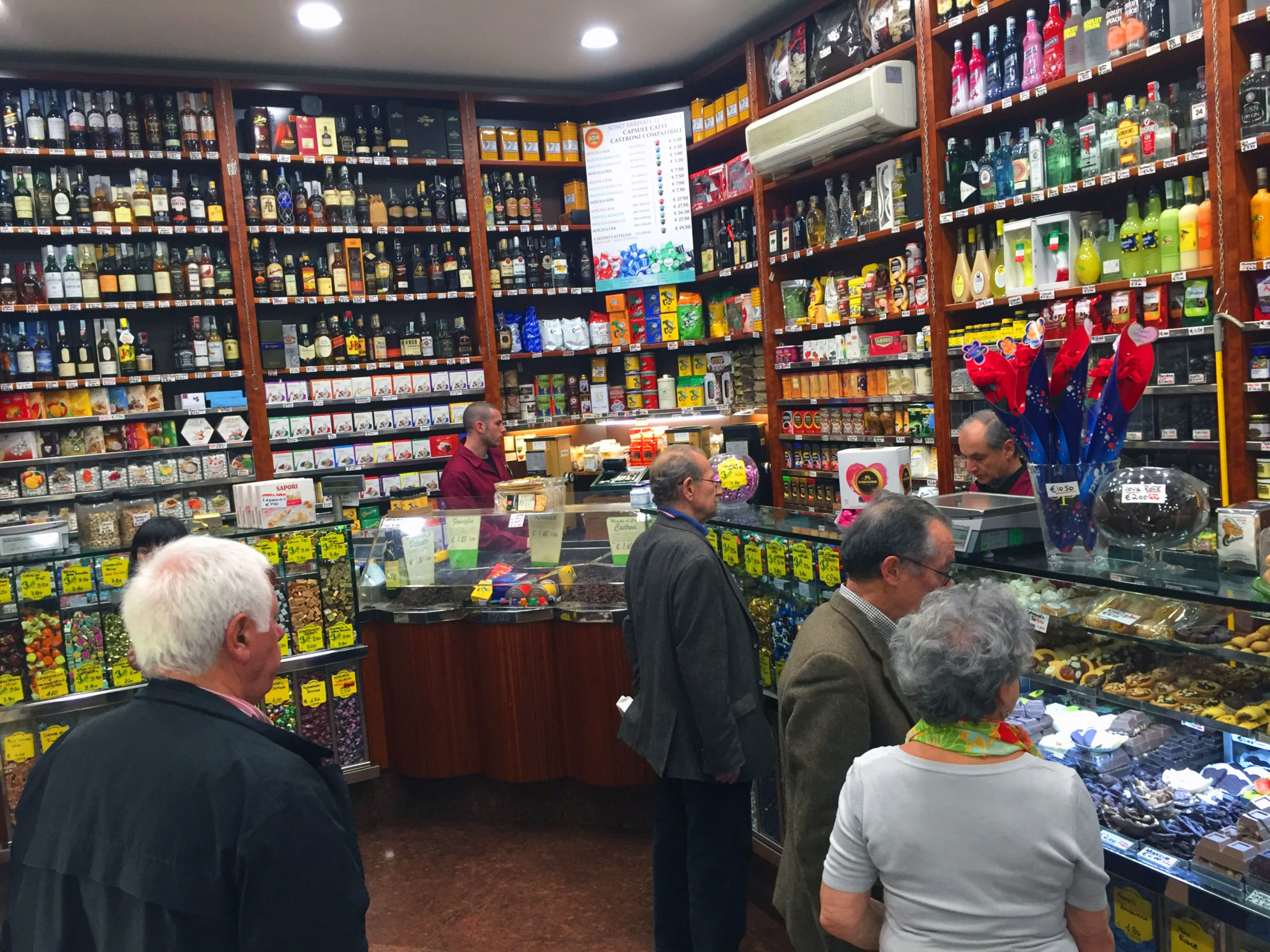
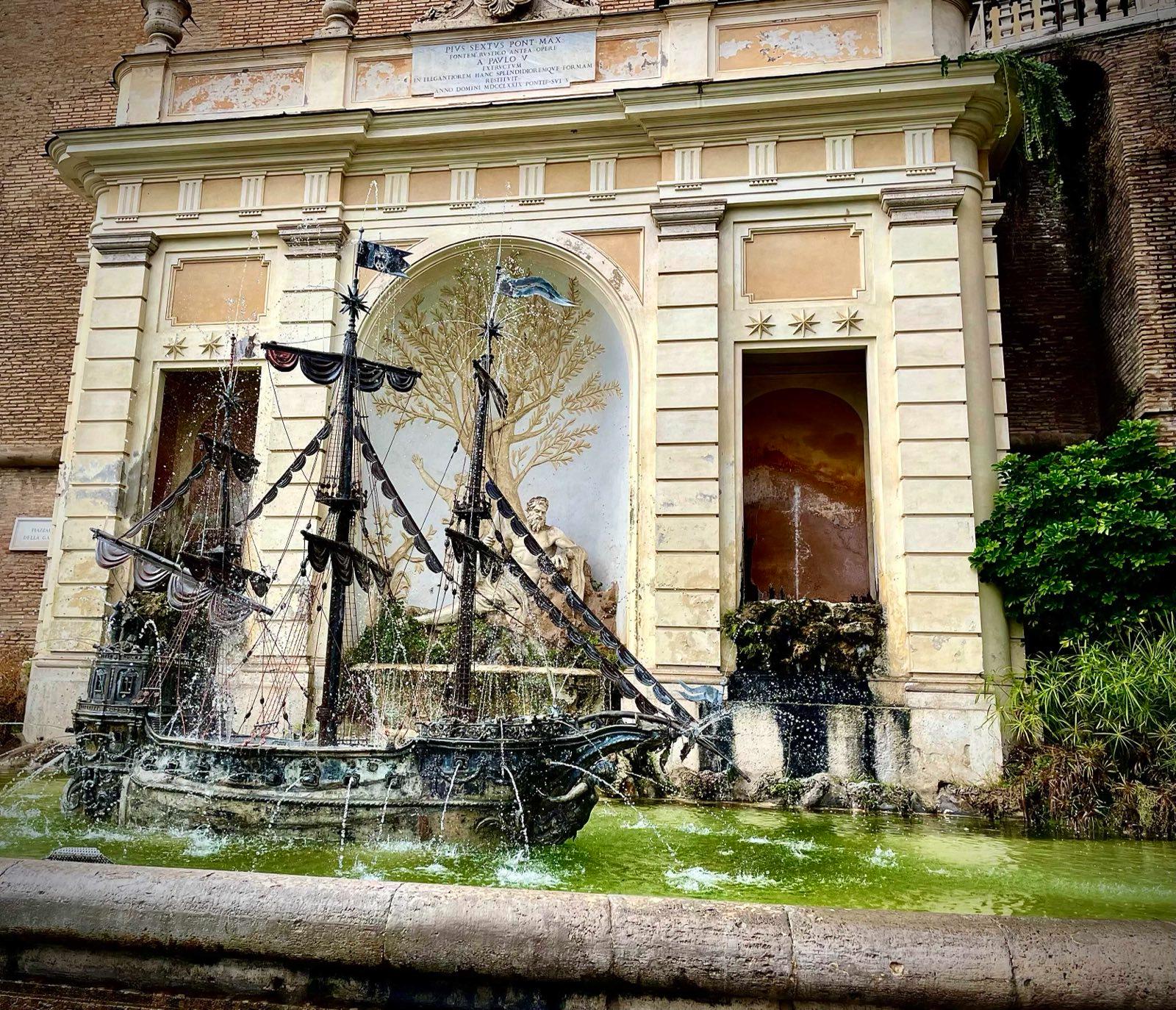
Photo by The Great Roman™
By FSSP seminarians

From a reader…
QUAERITUR:
Pope Francis has said that he is going to name St. Irenaeus of Lyon a “Doctor of the Church”. Is it possible that too many doctors, like too many pope saints, waters down the whole thing?
I am reminded of the line in the movie The Incredibles.
Too many “pope saints”…. Right. Yes, I think that the causes of recent pope saints should have been shelved until more time had passed. Just because the Congregations procedure for a cause is followed diligently doesn’t mean that it is the prudent thing to pass along with great speed. I was at the press conference for the Beatification of the founder of Opus Dei. It was one of the first causes that went through very swiftly after the death of the servant of God. The question was asked about that speed. The answer was, “Opus Dei is very well organized.” They had people and resources to throw at the cause like no one had before. They followed the procedure and got all the work done. The cause moved quickly and the Pope wanted it. Bada bing. That is not to say that quick causes (Mother Teresa, Padre Pio) are undeserving. I just think it is a good idea to slow down.
John XIII? Paul VI? John Paul II? Now, they say, John Paul I? Really?
It starts looking like a canonization of something else.
Back to Doctors of the Church.
Who are Doctors?
Doctors are saints (therefore holiness of life) whose lives and writings (greatness of learning) manifest something special about Holy Church as Magistra, Teacher. They make a profound contribution to her theology or spiritual life, beyond that of normal theologians and divines. The Church has, over time, designated three conditions for being declared a “Doctor”. The candidate must be, eminens doctrina, insignis vitae sanctitas, Ecclesiae declaratio … or eminent in learning, with a eminent degree of sanctity, and through declaration by the Church.
The Vatican News story points out Irenaeus will be called “Doctor Unitatis… Doctor of Unity”. Doctors get nicknames. For example, St. Thomas Aquinas is Doctor Angelicus, Angelic Doctor, John of the Cross is Doctor Mysticus, Mystical Doctor. Doctor Who is still just Doctor Who. If Karl Rahner were made a Doctor… and these days I wouldn’t rule it out… as one commentator here quipped he would be Doctor Equivocus, Equivocal Doctor.
Apparently it is thought that Irenaeus, through his striving against heresy of Gnosticism, helped to preserve the unity of the Church. That’s surely correct. Benedict XVI waxed eloquent about Irenaeus, and rightly so, in his Wednesday audience series on Fathers of the Church, a title Irenaeus truly merits.
Should Irenaeus be declared Doctor of the Church?
Look at it this way. At the request of Benedict XVI the question of whether Irenaeus should be named Doctor was given the Patristic Institute “Augustinianum” (my school – across the way from the Palazzo del Sant’Uffizio where the CDF is housed). The CDF entrusted very important tasks to the “Augustinianum”, such as the verification and proofing of all the references in the Catechism of the Catholic Church. As a matter of fact, I was asked to deliver the final copy to Ratzinger’s office. I digress.
At the request of Card. Ratzinger, the “Augustinianum” studied the question of Irenaeus as Doctor and concluded, “No.” Why? Because no Father before Nicea can really be a Doctor of the Church because they all lack a developed orthodox understanding of the Trinity.
That might have disappointed Card. Ratzinger a little, I don’t know. But, when he could have, Papa Ratzinger didn’t make Irenaeus a Doctor. He must have found it a) convincing because of the ante-Nicean angle or b) it wasn’t timely.
As far as “watering down the whole thing” goes, I am not sure that having more Doctors waters down their prestige… after all, the pool to draw on is pretty small. Some people were a little surprised, and not in a good way, about St. Therese. I think they have gotten over that. I am still asking, in the regard to St. Gregory of Narek… Who? Maybe that’s our Doctor… Who?
There is no question that Irenaeus is a great Father of the Church who made important contributions that echo to our own day. No question.
I guess we who celebrate the Vetus Ordo will have to figure out how to work with his Feast Day. Irenaeus feast was celebrated in Lyon on 28 June, which in the Church’s universal calendar is the Vigil of Sts. Peter and Paul. Benedict XV confirmed Irenaeus feast as 28 June. However, in 1960 Irenaeus was moved to 3 July, thus bumping poor St. Leo II – quite the saint – into the liturgical shadows. But because there were lots of vigils – “bad” in the eyes of the reformers – for the Novus Ordo the Vigil of Peter and Paul was suppressed and Irenaeus was transferred back to 28 June! That way St. Thomas the Apostle could be transfered from 21 December to 3 July which is the anniversary of the translation of his relics. One gets the impression of a calendrical pinball machine. Ping… boing… snak… ding ding… snak… boing.
I say, let’s slow down.
There weren’t a lot of liturgical changes between 1570 and the 20th century. Then the 20th hit and BAMMO! Things started to change really fast, both in the world outside and inside the Church.
Both in the outside world and within the Church.
Hmmm.
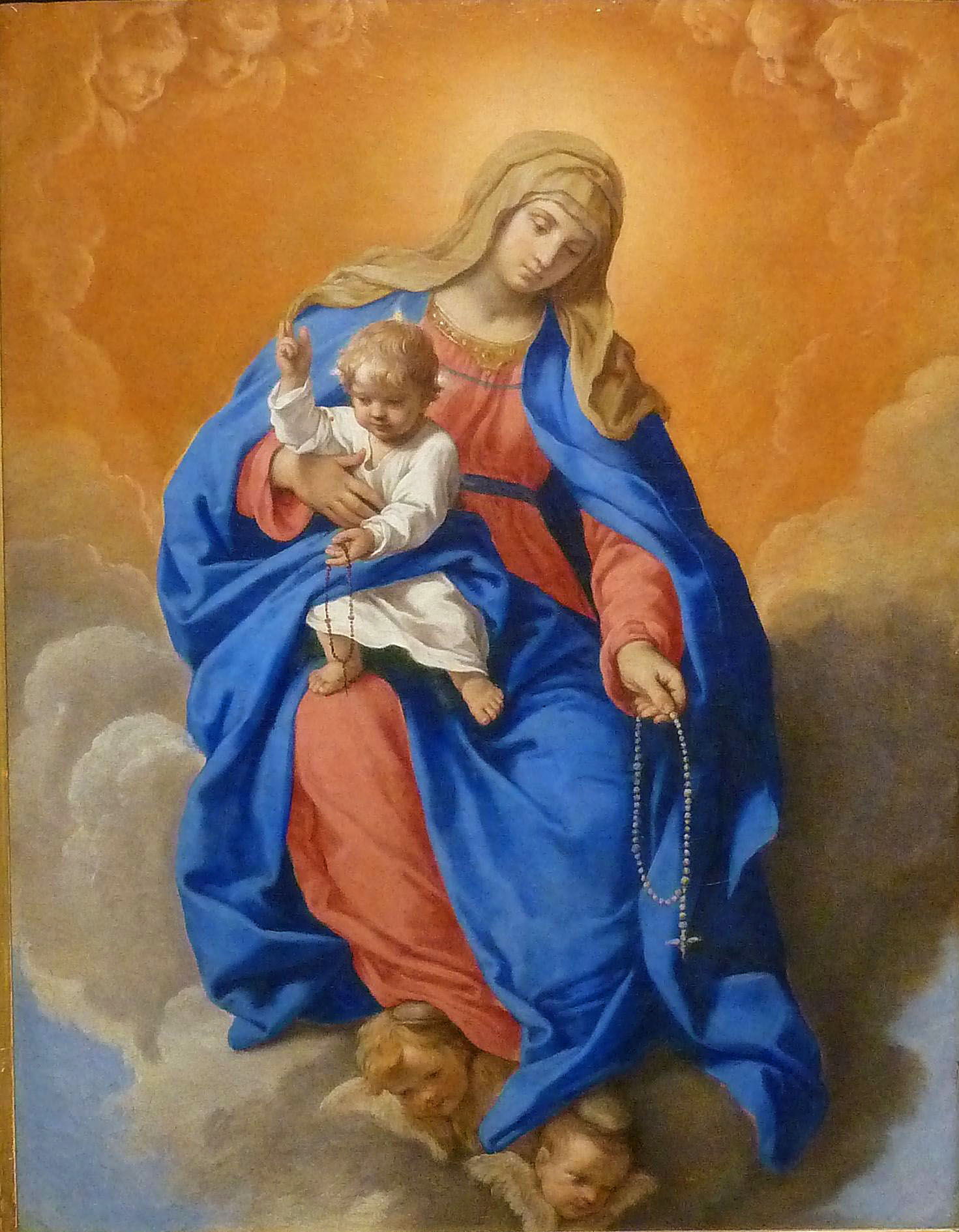
I very much appreciate the former name of this Feast: Our Lady of Victory.
There are many famous battles, but most of them come no where near the significance of Lepanto for the history of Western Civilization.
The Battle of Lepanto on 7 October 1571 was the largest naval engagement until Jutland in 1916. 40,000 dead in 4 hours.
One might muse on what would have been different had Islam triumphed at Lepanto.
Western Civilization would have been been scuttled and burned.
But the Christendom triumped. Our Lady brought the victory. She did so through the praying of the Holy Rosary by the sailors and warriors throughout the Christian fleet. On the flagship there was a statue of Our Lady, which has recently been identified. HERE
A few years ago, when I was in Madrid, I went to the Royal Naval Museum. It happened that, for a short time, they were displaying the pennant that flew at the main mast of the flag ship of Juan Andrea Doria y Alvaro de Bazan, Juan of Austria. The blue color represents the center of the line.
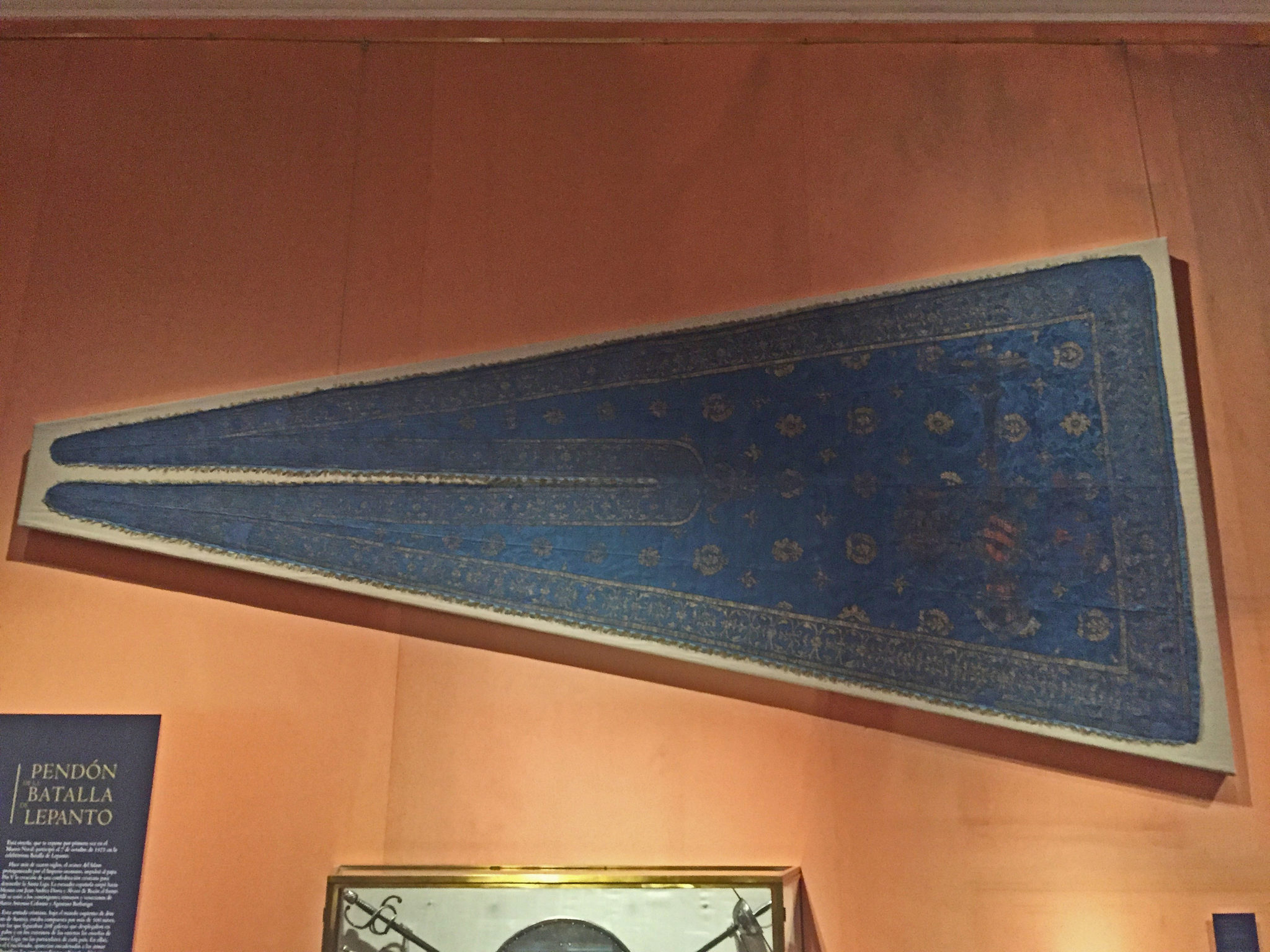
Another miracle occurred that day. As the Battle raged, St. Pius V in Rome had a vision of the victory while he was visiting the headquarters of the Domincans on the Aventine Hill at Santa Sabina. The messenger bringing news of the victory would arrive a couple weeks later. You can visit the room where Pius received the message.
All sorts of people will post about Lepanto today, so I won’t over burden you.
Read GK Chesterton’s Lepanto.
Here is the Collect from the traditional Mass, which is the prayer we say at the end of the Rosary.
Deus, cuius Unigénitus per vitam, mortem et resurrectiónem suam nobis salútis ætérnæ præmia comparávit: concéde, qu?sumus; ut, hæc mystéria sacratíssimo beátæ Maríæ Vírginis Rosário recoléntes, et imitémur, quod cóntinent, et quod promíttunt, assequámur.
Let us pray.
O God, Whose only-begotten Son, by His life, death and resurrection, has merited for us the grace of eternal salvation, grant, we beseech You, that, meditating on those mysteries in the most holy rosary of the Blessed Virgin Mary, we may imitate what they contain and obtain what they promise. Through the same Jesus Christ, thy Son, Our Lord, Who liveth and reigneth with thee in the unity of the Holy Ghost, God, world without end.
Please pray the Rosary today. Please add a prayer for me.
But remember: the problem is the Latin Mass! pic.twitter.com/OpOAWbZAjm
— Alberto? (@FlatCath) October 7, 2021
 The Society of St. Hugh of Cluny is located in the Diocese of Bridgeport. Bishop Frank Caggiano of Bridgeport has issued his decree concerning the implementation of Franci’s Plessy v. Ferguson legacy document, Traditionis custodes.
Become a Custos Traditionis – HERE
Bp. Caggiano’s document is HERE. The necessity of such a decree in the first place is a little foggy for me. However, given the present environment, this isn’t horrible. Remember that a while ago, Bp. Caggiano did a radio interview or a podcast of some sort in which he said he was going to think about this, and he made some decent observations. It seems he followed through.
In summary, in Bridgeport, Caggiano has wisely made use of can. 87 to dispense from certain restrictive articles in the cruel TC, allowing parishes which already have their activities going to keep going under his “direct supervision”.
He provides for the case that the pastor no longer wishes to continue such Masses…. quod Deus avertat.
Priests who want to celebrate the Vetus Ordo muest seek the faculty from him and the priest must be idoneus. This was a big deal at the time of Summorum Pontificum when some bishops claimed that priests had to be as fluent in Latin as little Cicero’s tutor. Idoneus – roughtly “qualified, suited to” – means that the priest must
All in all reasonable, and in keeping with what his predecessor, the late canonist and Cardinal Egan, said about idoneus and Latin.
Caggiano describes the faculty to use the 1962 books, which includes the Breviary, the forms for the Sacrament of Penance, public Masses at approved times, and – this is the flaw, I think – private Mass.
Good canonists maintain that TC did not deal with private Masses and I agree. Hence, this should have been left out.
The newly ordained have to ask the bishop for faculties and then he will consult Rome. Keep in mind that TC says “consult”, not “ask permission from Rome to give the faculty”. The bishop can send a postcard from his vacation in Atlantic City with the note that this is a consultation and then go ahead and give the faculty.
It seems to me that the point of that “consultation” business is a sneaky tactic to keep track of the growth of the TLM among younger clergy. I think young priests should go ahead and learn the TLM anyway. There is nothing against that and no one can stop them. Nor should they try. It would be foolish.
He imposes the idoneus qualification also on the newly ordained deacons. I hope there are some.
A quibble I have with the document is that the bishop, throughout, speaks of himself in the first person rather than saying “the diocesan bishop”. After all, diocesan bishops come and go.
AS. WE. ALL. KNOW. TOO. WELL.
There are some other odds and ends in the decree. All in all, compared to what we have seen in many other places, the decisions were pretty broad and fairly kind and reasonable in an environment of spiritual stinginess evinced by diocesan bishops.
 I bring to your attention today two books, which I have mentioned before, quite a while ago and recently. Book club opportunities for sure.
Firstly, I stayed up a good share of the night last night reading deep into an immensely deep book, the newest from Michael O’Brien.
The Sabbatical. US HERE – UK HERE
Thanks to the reader who sent it!
There are so many layers in this that I am rather gobsmacked. I long to stop to make notes – I’m reading a hardback, not Kindle – but I am restraining myself. I just decided I would at least use some little post-it arrows.
Here is a passage that particularly struck me. There is a confluence of Catholic intellectuals, gathered in a remote place, delivering papers and discussing them, the world and everything. In one address:
“Modern humanism, divorced from the Catholic sense of the imago Dei, has not given us progress in any deep abiding sense. It has given us the development of technique. It has given us the triumph of subjectivism. It has given us despiritualization, and despiritualization has in consequence given us dehumanization. Dehumanization, in turn, is now showing every sign of working out its terrible logic: In the end, unless there is a return to our true identity, the world will degenerate into the overtly diabolic, which means the absolute negation of man.”
I put down the book at few minutes ago when I found this:
“Yet salvation history is moving toward the end, the eschaton, which scriptural prophecy and the words of Christ warn will be a dire and horrible climax.”
“Yes, the ultimate conflict will come. It will come regardless of the forms of government mankind produces. Even so, a virtuous monarchy might delay the end and enable people to thrive for a time, perhaps even an extended period of time. But that is a matter for God’s will alone.”
“I’m not sure I understand your meaning, Clement. Are you saying that God might prefer mankind to fall deeper into darkness, as a way of wrapping things up, getting the business of history over and done with?”
“No, such a position would veer very close to determinism. It would also indicate ignorance about God’s nature, which is love, and his desire for the salvation of souls. Even so, he respects our freedom.”
“So you’re saying that certain souls may yet arise in the course of this dark age, using their freedom rightly and reversing the tide?”
“Reversing the tide? No, it cannot be reversed absolutely. I mean, rather, that until the final climax saints may arise and, using their freedom rightly, steer their generations toward the true light, for the good of many souls.”
“And by implication, those who govern wisely might also arise.”
“It is possible, if there is conversion of heart. Yet the heart alone is not enough. There must be radiant truth in the mind, and for this, I believe, an illumination of conscience is necessary.”
I decided to walk around for a while, and then share this.
Anyway, I am catching tendrils back into a couple of his other books, such as “Cry of Stone” and “Voyage”.
I sense I am at a turning point. O’Brien has been setting up for some crisis even that must be a kind of eucatastrophe. He has woven Tolkien’s – Inklings’ – world view in, about reality and myth and history. At moments it feels like an intersection of Mr. Chips and John Galt, with some Narnia and … not sure what next… Agatha Christe, thrown in. I know myself, as the Greeks put it. I will finish this book before sundown. I may start reading again for the sake of marking passages. The “Easter Eggs” jump out, but I’m reading without stopping so as to get the whole flow, which I sense is equally important. They will still be there, probably multiplied, after I’ve finished for the first time.
Next, today is the Feast of St. Placid, a disciple of St. Benedict. If you do not know the superb little book, now reprinted in English thanks to a long-time reader here, you are in for a treat.
Thank you St. Augustine Academy Press. Also a monthly donor here. (Are you?)
I discovered this little book during a retreat I made at a pretty much dying convent’s library.
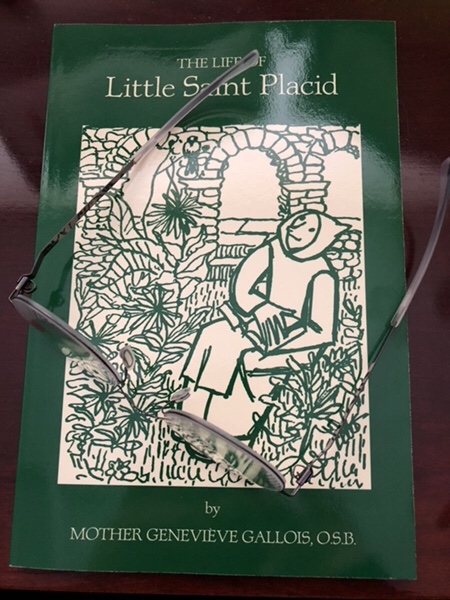
The book is called La vie de petit st Placid… The Life of Little St. Placid by Mother Geneviève Gallois. I have it in the French original and in both the older and new English editions.
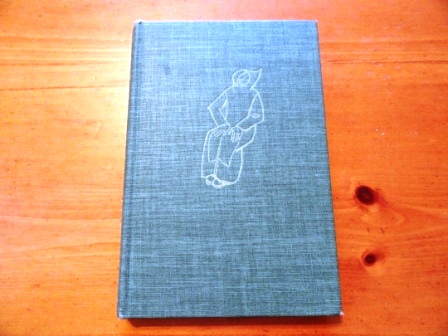
A sister name Placida came to Mother Geneviève and asked her to draw her a picture. Mother drew 104 and thus the book was born. It is a work of deep spiritual value and nearly painful charm.
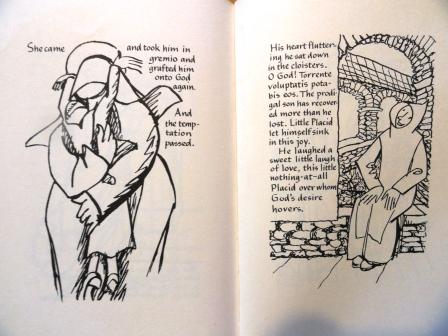
Mother Genevieve, who had come from an extremely anti-clerical background, was a talented painter. She had bad health and a hard time when at 23 she entered the convent of the Les Bénédictines de la rue Monsieur (20 rue Monsieur in the 7e arrondissement). She wound up being a novice for 22 year, in fact.
A couple more images from the book.
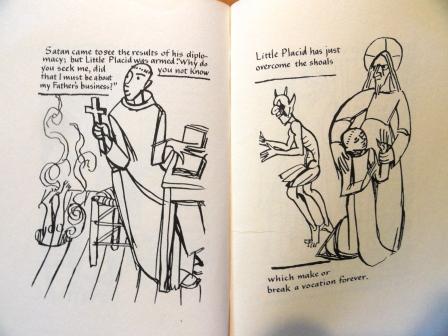
About Mass. Click to enlarge.

Every once in a while I receive something so annoying, that it needs wider attention out of justice.
If you are not easily provoked to the sort of anger that is sin, as Paul warned us about Sunday in the Epistle (Eph 4:26), have a look at an entry on the blog of a priest of the Diocese of Kansas City-St. Joseph, pastor of St. Charles Borromeo.
The reason I bring in “bully” imagery, is because the priest writer targeted concrete priests, not theoretical cases. He hides his animus behind a smoke-screen of concern.
Fr. Don Farnan wrote a slick bit entitled “Aberrant Subculture”, about young priests in cassocks, who want Latin and to – here comes the idiot-parroting – “turn their backs on congregations” or who are “obsessing over orthodoxy”. Smarmy, he suggests that they are “spooked by their own sexuality”, which is why they stick to the Church’s teaching on homosexual acts (he calls it “lambast the LGBT community”). This is also a common tactic of angry “gays”, of course: accuse anyone who objects to acting on that affliction of being secretly “gay” too… how I have come to hate that twisted word now.
Get this:
Most of us, including the pope, have grown tired of this kind of clericalism that is tolerated by some bishops and encouraged by some Catholics.
He thinks he is on the safe side and can hide behind them. He’s on the virtue-signaling band-wagon.
The thing is, there are many fine young priests in the Diocese of Kansas City-St. Joseph who are doing wonderful pastoral work. I know some of them. They are good men and good priests. They don’t have 60’s-and 70’s baggage about cassocks, or Latin, or being faithful to the Church’s teachings on moral issues. They have the courage to speak up rather than conform themselves to the wisdom of this world.
These young priests don’t have the 70s stuck on a loop in their brains.
If Farnan, as an older priest, who once held important roles in the diocese, has concerns about some younger priests, why did he go after them in this indirect way, with veiled references that locals will recognize – even people who are not from there will recognize? He attacked them through innuendo, publicly hinting at their identity, rather than call up a young priest privately and invite him to lunch in order to ask him, “What are you doing? What are you trying to accomplish?”
That’s what a brother would do.
That’s not how he operated.
That’s what makes us angry.
Fr. Farnan closed comments under that particular post. I get that. Sometimes I do that too, when I don’t have a lot of energy or I am short on time or can’t scan all the comments. However, people can and do reach out to me with varied, respectful, charity-informed feedback. I imagine he would welcome that too in his email. HERE
More from him about these good young priests in his diocese. Notice the clues he drops which – if you are at all acquainted with the scene there – make it possible to identitfy individuals, thus making them targets.
A high percentage of priests ordained in this young century were home-schooled and/or come from households that hold to rigid ideologies; a significant percentage also come from unstable households in which parents were married multiple times. Many of these priests crave structure and they administer unbending order. Yet many of them are quickly disappointed and leave active ministry within their first ten years of priesthood; they join a religious community for a while, take a sabbatical, fall in love for the first time and marry, or do uncharacteristic or shocking acts that destroy them and devastate others. Some are not equipped to deal with the chaos of life—theirs or those they serve, and some, after realizing that they are imperfect according to standards set by church or parents, hate themselves. Still others build psychological walls to shelter and self-protect, much as the corporate church has habitually protected itself.
See what I mean? From this even I – who don’t live in KCMO – am able to pick out a couple of priests whom I know personally. I find it appalling that, for the sake of his own virtue signaling, Farnan would exploit not only a priest’s vocational questions but also personal, human crises and mortal peril.
And he dares to ride above it? Look at his bio. His bio says he was director of vocations for some years. I wonder how that went. Maybe someone in KCMO can look that up.
I want to send a word of support to my priest friends in Kansas City, MO, who are clearly the target of this man’s condescending, clichè-laden diatribe, delivered probably because – as he is firmly clutching the bumper of the band-wagon – he thinks there can’t be any blowback.
It’s also potentially a passive-aggressive attack on the bishop who supports these young priests (aka The Future). The bishop has the unenviable task of building up a body of priests for the future. Farnan cut the knees out from under him.
Fr. Farnan is emblematic of a whole swath of priests of his time of formation and ordination. They don’t have a clue what it is like to be a young priest in the sort of Church that men like them crafted over decades, with their feckless acquiescence to secular norms and popularity, their undermining of the Faith through appeals to “compassion” in order to excuse people in their contracepting, living together out of wedlock, never going to Confession. By their empty catechism and liturgical slop – over decades – they contributed to the demographic sink-hole into which Catholics are now falling away.
Farnan’s generation created the parishes that are dying, created the terrain in which these young men are standing up and being men and priests under the hammer blows of the Enemy whom they welcomed in through those opened windows.
Talk about “aberrant subculture”!
The fact that these young priests breathe is taken by many of their older 70’s-locked-in brethren as an indictment of their entire lives as priests.
Rather than engage, they seek to “cancel”. Bullies.


Coat of Arms by D Burkart
 WVC on ASK FATHER: “Are the faithful who go to the SSPX being sacramentally forgiven in confession, or not?”: “@fac – I don’t believe you’re doing a fair comparison with Henry VIII and the current situation with the SSPX.…”
 on ASK FATHER: “Are the faithful who go to the SSPX being sacramentally forgiven in confession, or not?”: “Highly appreciate this, Father. Here’s a question: what if someone did not believe that Francis was the pope, and instead…”
 on ASK FATHER: “Are the faithful who go to the SSPX being sacramentally forgiven in confession, or not?”: “The last comment grew too long so I am placing this in a new comment: Lastly, the question of this…” on ASK FATHER: “Are the faithful who go to the SSPX being sacramentally forgiven in confession, or not?”: “This is a delicate topic that requires a measure of precision, precisely because it bears directly on the salvation of…”
 on ROME 26/10– Day 15: munch: “acardnal says: Dachshunds Oh yes, still there! I was just there with them both yesterday and, for a while, today.…”
 on ASK FATHER: “Are the faithful who go to the SSPX being sacramentally forgiven in confession, or not?”: “@WVC Yes, thank you, that does help a little. I still am not clear, then, on why all Anglicans were…”
 on ROME 26/10– Day 15: munch: “Truffle mortadella sounds like heaven. A little crema of pistachio pesto and some stracciatella di bufala and all fear of…”
A Daily Prayer for Priests








They find you a pro-life agent in your area who commits to giving a portion of the fee to a pro-life group!

PLEASE subscribe via PayPal if it is useful. Zelle and Wise are better, but PayPal is convenient.
A monthly subscription donation means I have steady income I can plan on. I put you my list of benefactors for whom I pray and for whom I often say Holy Mass.
In view of the rapidly changing challenges I now face, I would like to add more $10/month subscribers. Will you please help?
For a one time donation...



Help Monks in Wyoming (coffee – UPDATED LINK) and Norcia (beer) and the wonderful "Soap Sisters" of Summit, NJ!


Please follow me on Twitter!










Visits tracked by Statcounter
since Sat., 25 Nov. 2006: