Today I saw with disgust that the US Embassy to the Holy See in Rome has displayed a homosexuality flag.
At Crisis today there is a good piece entitled “The Catholic Response to ‘Pride Month'” by John A. Monaco.
After recounting the increasingly rapid incrementalism by which the homosexalist agenda is being shoved down everyone’s throats, the writer make positive suggestions for how we, as faithful Catholics, should comport ourselves in the face of incessant LGBTQ+ aggression.
[…]
What is the Catholic response to “Pride Month,” then? Certainly, it is not found in Ontario’s Catholic schools, nor is it found in Fr. Martin’s celebration and promotion of how “Pride Month” is congenial to Catholicism. Nor can a Catholic in good conscience march in “Pride Month’s” scantily-clad parades and tolerate the LGBT community’s attempts to redefine the family, love, and compassion.
Aggressive protest measures, such as burning the rainbow flag, will only result in fifteen years of imprisonment. But as the oft-quoted motto goes, “silence is violence”; and to remain silent in the wake of a growing LGBT movement is to show one’s apathy and complicity in it. An appropriate and prudent response is required, one that will be consistent with traditional Catholic moral teaching and living. Three responses come to mind: prayer, penance, and proselytization.
It goes without saying that prayer is essential to the life of any Catholic. Prayer, in itself, may take many forms—our prayer may be mental, vocal, imaginative, devotional, liturgical, communal. Each of us have our own preferred methods and established habits.
What I suggest for June, then, is not merely to pray (I take that as a given), but to focus and add to our spiritual lives by praying for those who experience same-sex attractions and those involved in the homosexual lifestyle. This should not be interpreted in a condescending way (“I’ll pray for you, sinner!”), but rather in a truly loving way. Whether in our recitation of the rosary, Eucharistic adoration, or morning and nighttime prayers, let us make a conscious effort to bring same-sex attracted men and women—perhaps our friends, maybe our enemies—to the Lord by our intercession.
If June is a month of “pride” for the LGBT community, Catholics should counter the celebrated vice of pride with the oft-scorned virtue of humility. There is no better way to grow in this virtue than to remember in our minds and hearts those involved in certain lifestyles and carrying particular crosses.
[…]
Penance is often understood as a “making up” for one’s own wrongdoings. However, a true definition of penance avoids individualism. While we are solely to confess our own sins in the Sacrament of Penance, we are encouraged by the tradition to not only do penance for ourselves but for the whole world. Even if we ourselves are not involved in homosexual activity, we still are connected to those who are by virtue of our common humanity and, in many cases, our shared baptism.
We need not to be guilty of a specific wrongdoing to perform penance in satisfaction for the sins of others, especially for those sins which cry out to heaven for vengeance. After all, if Christ—who is sinless—suffered out of love for all humanity—how much more is it appropriate for we—who are sinners—to perform acts of voluntary penance on behalf of our fellow sinners? Admittedly, this is not a popular concept today. But it nonetheless remains true.
[…]
The final suggestion I have is that of proselytization. This is often considered a dirty word, especially in the post-conciliar epoch. Pope Francis has repeatedly warned against proselytization, preferring the more neutral term “evangelization” and “witness.” However, by proselytization, I am referring to its literal, etymological definition—coming from the Greek word prosêlutos meaning “to come over/towards.” In ancient times, it was understood to refer to someone who leaves one community for another, such as a Gentile convert to Judaism. Despite numerous attempts to suggest the contrary, one cannot simultaneously celebrate homosexual activity and remain committed to the teachings of Christ’s Church.
Whatever the fruits of the “New Evangelization,” it cannot include in them the conversion of society—if not all bishops and clergy in the Church—to the truth of human sexuality as illuminated by Christian identity. In fact, I would go as far to suggest that attempts by some Catholics to weaken Church teaching on homosexuality in the name of “accompaniment” and “dialogue” are more worthy of damnation than anything one might witness at any given “Pride” parade.
[…]
Interwoven in these snippets from his piece are good suggestions about concrete things to do and how to tie them to, for example, certain feast days. Also, check his original piece at Crisis for the links he embedded.
It is important for all of us to engage this pervasive and growing problem in the positive ways the writer proposes. Remember: the stakes are high and their homosexualist agenda won’t end at creating “welcoming communities”. No. There is a great deal more to the homosexualist agenda, ultimately, including demonic gender ideology and the lowering of the age of consent as well as the totalitarian principle that “everything not forbidden is compulsory”.
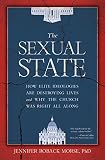
Homosexualists and abortion defenders are, at heart, totalitarians. My friend Jennifer Roback Morse make this argument, demonstrating how their thought and agenda is, in essence, totalitarian in scope and tactic. You can start with her book:
The Sexual State: How Elite Ideologies Are Destroying Lives and Why The Church Was Right All Along

US HERE – UK HERE
“Why The Church Was Right All Along…”. Well… iuxta modum. There is plenty of silence from our lots of our leaders on this and downright complicity from many.
I’ll add something to the writer’s suggestions.
GO TO CONFESSION!
Good initiatives ought always to start with a good examination of conscience and a good confession and good Holy Communion.

 At Catholic Culture Phil Lawler has some thoughts about the rumored document that would enervate Benedict XVI’s “emancipation proclamation” Summorum Pontificum. Such a document, as rumor has it, could be a kind of ecclesiastical “slave act of 2021”* which would return diocesan priests to forced servitude to their ring-wearing masters in the big house.

 Please note that I exclude from the following list of links my daily


 I’ll lead off with a mind exercise. It is possible that the rumored document that would undo Benedict XVI’s “emancipation proclamation” Summorum Pontificum is actually founded on a well-constructed campaign of disinformation. It could be a psy-op designed to get “trads” to over-react, rear up in defiance before anything is promulgated. Like a “false flag” operation, it would give the powers-that-be cover to enact what they want because, after all, “look how they are behaving”. Göring bragged that the Nazis actually started the Reichstag Fire in order to be able to blame the Communists, whom they then had an excuse to repress. A recent alleged “insurrection” was probably a “false flag” operation. These folks are good as this sort of thing.