Honduras: homosexual seminarians sent away from seminary except for those from…

A while ago, the best English language Vaticanista these days, Edward Pentin wrote about the rampant homosexual network in the seminary in the Archdiocese of Tegucigalpa, Honduras, the See of one of Francis’ key players, Oscar Card. Rodriguez Maradiaga. HERE

Moreover, forty-eight seminarians wrote a letter exposing what is going on. The full Spanish text HERE.  It is truly horrible.

Now I read this,

All the homosexual seminarians have been set away except those from Tegucigalpa.

And then there was the situation of the abuser auxiliary bishop of Tegucigalpa who resigned.  HERE


Posted in Sin That Cries To Heaven | Tagged , ,
6 Comments

“Whatsoever new and unheard-of doctrine you shall find to have been furtively introduced” is “permitted as a trial”.

When confusing things happen that leave people upset, legitimately, I have often written that that we should stay calm.   This is for several reasons.

  1. Each horrid thing that clerics do or strange thing they say is further proof that this is God’s Church.  Only He keeps it going.  If it depended on us, we’d be finished in no time.  God is trustworthy and the Church is indefectible.  Good to know!
  2. Every Pope’s pontificate, or bishop’s or priest’s mandate are the merest blips in the long history of salvation which is directed, not by us, but, again, by God.  We are offered every grace we need to get though any blip, whatsoever.
  3. Some Councils and Popes were not nearly as important as others.  In the long term, we will see how things shake out.  Perspective!
  4. When something weird or confusing comes our way, we have an opportunity to crack open our trustworthy books and study.  Thus, we wind up being better educated and better prepared to give reasons for the faith that is in us.  That’s a good thing.

Hence, calm down.

That said, on that last note, putting on my old patristiblogger cap, I’ve been reviewing the great adage of Vincent of Lérins (+c.445) about authenticity of doctrine: quod ubique, quod semper, quod ab omnibus creditum est … what has been believed everywhere, always, and by all’ (Commonitorium 2.3).  This doesn’t preclude development of doctrine.   However, authentic development of doctrine has been assessed by another adage, which has been absorbed by the Church’s Magisterium as its own, namely, a change in the expression of doctrine or its development must be eodem sensu eademque sententiawith the same sense and with the same meaning.  Vatican I claims this principle, also from Vincent’s Commonitorium, 23, 3, in Dei Filius.  It is pretty much unavoidable.   If something changes in such a way that is it not like what it was before, it is not authentic doctrine.  Further, it has become something that, in the Church at least, is not believed everywhere, always and by all the faithful.  “The faithful” is a key, by the way.  To have the sense of the faithful, you have to be faithful.

This adage, eodem sensu eademque sententia, has become a central, structural support in the Church’s Magisterium. That’s why, for example, Pius IX rested on it when infallibly teaching in Ineffabilis Deus in 1854 the dogma of the Immaculate Conception.  St Pius X uses the concept in his anti-modernist Pascendi dominici gregis. This phrase was in the oath that all clergy had to take until 1967. John XXIII used the phrase in his opening speech Gaudet Mater Ecclesia at the opening of Vatican II. John Paul II in his great encyclical Veritatis splendor 53 cites it. Benedict XVI cited it, when quoting John XXIII, in his monumentally important address to the Roman Curia in 2005.

Moreover, this passage from Vincent of Lerin is not unknown to clergy today because it must be read each year in the modern Liturgy of the Hours on Friday of the 27th Week of Ordinary Time.  No excuse is possible.

Bl John Henry Newman wrote a treatise on the development of doctrine which explains the conditions and the parameters of authentic development. Newman identified seven “notes” or characteristics of authentic development, as opposed to doctrinal corruptions. The first, and the most important, is unity of type or the external expression of an idea. Does the main idea change or remain unchanged if the manner of expression changes? If the content remains, then the expression is a genuine development of doctrine rather than a corruption. For example, a bird doesn’t have much resemblance to an egg, but the bird is the proper development of the egg, not its corruption. An acorn rightly and legitimate changes into a oak tree, not a palm tree.

As you can guess, legitimate development of doctrine does not include direct contradiction of what has always been taught by the Church.  It develops.  It doesn’t evolve into something it wasn’t.

Tracking back to Vincent of Lérins I found a sobering and consoling passage.

Allow me a slight editing choice from “he” to “you”… which doesn’t change the sense at all!

“….he is the true and genuine Catholic who loves the truth of God, who loves the Church, who loves the Body of Christ, who esteems divine religion and the Catholic Faith above every thing, above the authority, above the regard, above the genius, above the eloquence, above the philosophy, of every man whatsoever; who set light by all of these, and continuing steadfast and established in the faith, resolves that he will believe that, and that only, which he is sure the Catholic Church has held universally and from ancient time; [Here start reading aloud…] but that whatsoever new and unheard-of doctrine you shall find to have been furtively introduced by some one or another, besides that of all or contrary to that of all the saints, this, you will understand, does not pertain to religion, but is permitted as a trial, being instructed especially by the words of the blessed Apostle Paul, who writes thus in his first Epistle to the Corinthians, ‘There must needs be heresies, that they who are approved may be made manifest among you:’ as though he should say, This is the reason why the authors of Heresies are not forthwith rooted up by God, namely, that they who are approved may be made manifest; that is, that it may be apparent of each individual, how tenacious and faithful and steadfast he is in his love of the Catholic faith.” Commonitorium 20.48

Opportunity, dear readers.  Opportunity!

If you hear something strange, then that strange thing becomes the cause of the clearer revelation of the truth.  God even tolerates heresies for the sake of pointing more clearly to the good teachers and teachings.

Posted in "How To..." - Practical Notes, Hard-Identity Catholicism, Our Catholic Identity, Patristiblogging, The Drill | Tagged ,
6 Comments

Pius XII: coercive power, death penalty NOT “conditioned by historical circumstances” for they have “a general and abiding validity”

I was recently reminded of a 2013 article at Crisis by Fr. George Rutler about capital punishment” “Hanging Concentrates The Mind”.

Among other things in his piece, Rutler writes of the guy I wrote about yesterday, Mastro Titta, the official Papal Executioner in the 19th c. Rutler has more details. He provides, in addition, quite a few papal anecdotes about the death penalty. He also mentions the great little Roman church dedicated for my favorite onomastico, San Giovanni Decollato. However, it was a quote of Venerable Pius XII that really caught my attention.  Mind you, Rutler has, by this point, mentioned Pius’ distinctions of medicinal and vindictive aims for punishment:

“All other considerations of the machinery of death aside, this paramount regard for the human soul is quaint only if belief in eternal life is vague. Pope Pius XII was so eager for vindictive penalties that he lent the help of a Jesuit archivist to assist the prosecutors at the Nuremberg trials. He personally told the chief United States prosecutor, Robert Jackson: “Not only do we approve of the trial, but we desire that the guilty be punished as quickly as possible.” This was not in spite of, but issuing from, his understanding of the dual role of healing and vindication. All this should not be remaindered as historical curiosities, for, as Pope Pius XII said, “the coercive power of legitimate human authority” has its roots in “the sources of revelation and traditional doctrine” and so it must not be said “that these sources only contain ideas which are conditioned by historical circumstances” for they have “a general and abiding validity.” (Acta Apostolica Sedis, 1955, pp.81-82).

I looked it up in AAS 47 (1955) and there it is.  … “Facevamo anche notare che la Chiesa in teoria e in pratica ha mantenuto la doppia specie di pene coercitivo della legitima autorità umana.  Non si dà a questa asserzione una risposta sufficiente, osservando che le fonti anzidette contengono soltanto pensieri corrispondenti alle circostanze storiche e alla coltura del tempo, e che quindi non si può attibuire loro un valore generale e sempre durevolve.  Poiché le parole delle fonti e del magistero vivente non si riferiscono al contentuo concreto di singole prescrizioni giuridiche o regole di azione, ma al fondamento stesso essenziale della potestà penale e della sua immanente finalità.  Questa poi e tanto poco determinata alle condizioni del tempo e della coltura, come la natura dell’uomo e la società umana voluta dalla natura medesima. – Ma qualunque atteggiamento del diritto positivo umano su questo problema, per il Nostro presente scopo basta di mettere in chiaro che in una totale o parziale remissione delle pena anche le pene vindicative (non meno medicinali) possono od anche debbono essere prese in considerazione.”

There’s a great deal to be mined in this second part of Pius’ considerations about crime and punishment.

I cannot fathom that anyone who worked on the CCC change looked at this important contribution by a Roman Pontiff.  The second part of the address is HERE.   The online PDF of AAS has some OCR typos, but it is readable.  There is a lot to consider in there.

Posted in The Drill | Tagged , ,
27 Comments

A Gatherum Omnium: Fr. Z comments on lots of today’s stories

There is so much going on today, allow me to signal to you some things that I found interesting, but have not the time to comment upon comprehensively individual posts.

Here is a Gatherium Omnium with my pointed comments.  I want to have a little of the day off today without posting these separately, so here goes.  This is an experiment.  The combox moderation is, as I write, OFF (though some of you are on permanent moderation for one reason or another).

At Italian Sismografo, we read that the Vatican City State only abolished the death penalty in 2001, only 17 years ago, and the the Papal States applied capital punishment on 527 people in a period of 74 years between 1796 and 1870.   There was an official executioner Giovanni Battista Bugatti (aka “Mastro Titta” and “er boia di Roma”).   He started work at 17 and continued for the next 68 years.  He was succeeded by Vincenzo Balducci, to whom Pius IX gave a pension of 30 scudi. The concordat with Italy in 1926 read: “Considering that the person of the Supreme Pontiff is sacred and inviolable, Italy declares that whatsoever attempt on his person or whatsoever incitement to commit such an attempt shall be punished with the same penalty forseen for all similar attempts or incitements conducted against the person of the King.”

At WaPo we read the claim from AP and Nichole that Catholic orders of religious in these USA favor the ordination of women as deaconettes.   Well… of course they do!  Water is still wet and the sun still rises in the East.  CARA did a survey of men and women: 72% think it should be done.  Of course we know the state of religious orders these days, don’t we.  And we know why groups such as the FFIs and the Canons of St. John Cantius, et. al. are given special treatment.

A priest friend sent an excerpt from a piece by the late and lamented Justice Antonin Scalia about capital punishment penned in First Things in 2002:

It is a matter of great consequence to me, therefore, whether the death penalty is morally acceptable. As a Roman Catholic—and being unable to jump out of my skin—I cannot discuss that issue without reference to Christian tradition and the Church’s Magisterium.
The death penalty is undoubtedly wrong unless one accords to the state a scope of moral action that goes beyond what is permitted to the individual. In my view, the major impetus behind modern aversion to the death penalty is the equation of private morality with governmental morality. This is a predictable (though I believe erroneous and regrettable) reaction to modern, democratic self-government.
Few doubted the morality of the death penalty in the age that believed in the divine right of kings. Or even in earlier times. St. Paul had this to say (I am quoting, as you might expect, the King James version):
Let every soul be subject unto the higher powers. For there is no power but of God: the powers that be are ordained of God. Whosoever therefore resisteth the power, resisteth the ordinance of God: and they that resist shall receive to themselves damnation. For rulers are not a terror to good works, but to the evil. Wilt thou then not be afraid of the power? Do that which is good, and thou shalt have praise of the same: for he is the minister of God to thee for good. But if thou do that which is evil, be afraid; for he beareth not the sword in vain: for he is the minister of God, a revenger to execute wrath upon him that doeth evil. Wherefore ye must needs be subject, not only for wrath, but also for conscience sake. (Romans 13:1-5)
This is not the Old Testament, I emphasize, but St. Paul. One can understand his words as referring only to lawfully constituted authority, or even only to lawfully constituted authority that rules justly. But the core of his message is that government—however you want to limit that concept—derives its moral authority from God. It is the “minister of God” with powers to “revenge,” to “execute wrath,” including even wrath by the sword (which is unmistakably a reference to the death penalty). Paul of course did not believe that the individual possessed any such powers. Only a few lines before this passage, he wrote, “Dearly beloved, avenge not yourselves, but rather give place unto wrath: for it is written, Vengeance is mine; I will repay, saith the Lord.” And in this world the Lord repaid—did justice—through His minister, the state.
These passages from Romans represent the consensus of Western thought until very recent times. Not just of Christian or religious thought, but of secular thought regarding the powers of the state. That consensus has been upset, I think, by the emergence of democracy. It is easy to see the hand of the Almighty behind rulers whose forebears, in the dim mists of history, were supposedly anointed by God, or who at least obtained their thrones in awful and unpredictable battles whose outcome was determined by the Lord of Hosts, that is, the Lord of Armies. It is much more difficult to see the hand of God—or any higher moral authority—behind the fools and rogues (as the losers would have it) whom we ourselves elect to do our own will. How can their power to avenge—to vindicate the “public order”—be any greater than our own?
So it is no accident, I think, that the modern view that the death penalty is immoral is centered in the West. That has little to do with the fact that the West has a Christian tradition, and everything to do with the fact that the West is the home of democracy. Indeed, it seems to me that the more Christian a country is the less likely it is to regard the death penalty as immoral. Abolition has taken its firmest hold in post-Christian Europe, and has least support in the church-going United States. I attribute that to the fact that, for the believing Christian, death is no big deal. Intentionally killing an innocent person is a big deal: it is a grave sin, which causes one to lose his soul. But losing this life, in exchange for the next? The Christian attitude is reflected in the words Robert Bolt’s play has Thomas More saying to the headsman: “Friend, be not afraid of your office. You send me to God.” And when Cranmer asks whether he is sure of that, More replies, “He will not refuse one who is so blithe to go to Him.” For the nonbeliever, on the other hand, to deprive a man of his life is to end his existence. What a horrible act!
Besides being less likely to regard death as an utterly cataclysmic punishment, the Christian is also more likely to regard punishment in general as deserved. The doctrine of free will—the ability of man to resist temptations to evil, which God will not permit beyond man’s capacity to resist—is central to the Christian doctrine of salvation and damnation, heaven and hell. The post-Freudian secularist, on the other hand, is more inclined to think that people are what their history and circumstances have made them, and there is little sense in assigning blame.

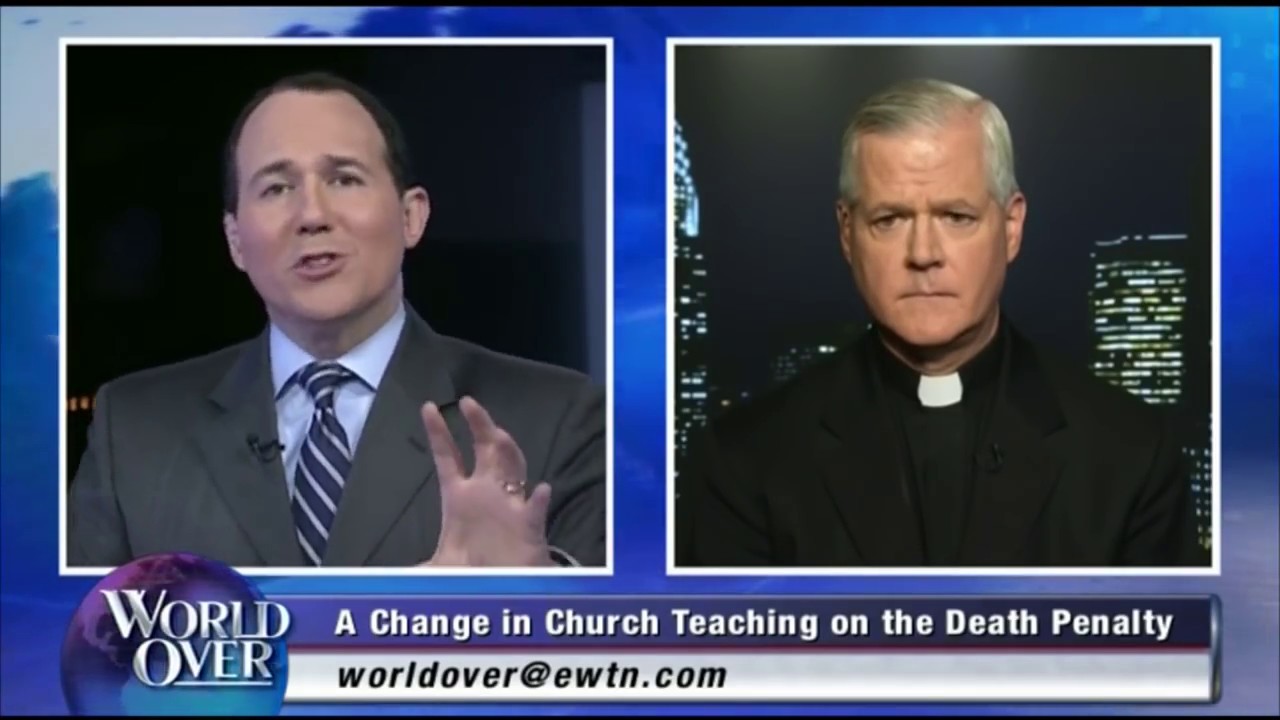
Speaking of capital punishment, my friends Fr. Gerry Murray and Dr. Robert Royal were on Raymond Arroyo’s EWTN show last night. They commented on L’Affarie McCarrick and about Francis’ change to the CCC. This is “must watch TV”.

YouTube thumbnailYouTube icon

They think that what Pope Francis did is, frankly, ultra vires.

Meanwhile, back in Rome, the Pope meet with a bunch of Jesuits.  He spoke to them, of course.  Here is how he greeted them in my translation:

Good day!  I am happy to welcome you.  Thanks a lot for this visit, which does me well.  When I was a student, when you had to go to the General and when with the General we had to go to the Pope, you wore the cassock and cape.  I see that this fashion is gone, thank God.

I would respond to the Holy Father – who was wearing a cassock with a little cape – that sometimes clothes do make the man.  There is a relationship between outward habit and inward habit.  Formality is a good thing.  It promotes respect and maintains roles.  Without such, with informality, comes priests saying, for example, “Call me ‘uncle’!”

On that same note, Austin Ruse, of the esteemed C-FAM (Center for Family & Human Rights),  wrote something that will be controversial at the ever more valuable Crisis:

The Fetid Sea in Which They Swim

The gaying of the Church is perhaps the most diabolical attack the Devil has ever launched against the Catholic Faith.

[…]

The rest is pretty rough, so I’ll leave it there. But he is *expletive” right.

Also at Crisis from Michael P. Foley:

The Jim Foley Option to End Clergy Sexual Abuse

In the wake of the “Uncle Ted” McCarrick scandal have come a series of recommendations about where the Church should go from here and what the laity can do to help. Answers range from Anthony Esolen’s urging the resignation of every bishop who knew of the Cardinal’s vile actions to Christopher Tollefsen’s invitation to suspend all donations to diocesan coffers until the American bishops clean up their act. I also recall that when the clerical abuse scandal first broke twenty years ago, Alice von Hildebrand called for priests to follow the example of Pope St. John Paul II and use “the discipline” (self-flagellation) to mortify the flesh. Not a bad idea, that.

To this promising list I would like to add one more: the Jim Foley Option. Jim Foley was my dad (1930-2009), a relatively short but solidly-built Korean War vet who grew up on the streets of eastern Los Angeles. Jim was a devout Catholic and fiercely proud of his Irish heritage, but he differed from his fellow Irishmen in one crucial respect. As Wilfrid Sheed, son of the great Catholic apologist Frank Sheed, once explained, while the English respected the priestly office and took the man as they found him and while the Australians were cynical about their ordained ministers, the Irish were prone to an undue reverence of the clergy. [A gift that keeps on giving, it seems.]

Jim did not have this tendency. He was enormously respectful of and helpful to the priests in our life even when, which was often the case in California’s San Bernadino diocese in the 1970s and ’80s, those priests were broken men (usually because of alcoholism) or dishonest (especially where our parochial school’s finances were concerned).

But Jim knew where to draw the line. When I was about twelve or thirteen, our parish received a new associate pastor.

[…]

He goes on to describe how the priest wanted to “fraternize” with the boys. Continuing….

[…]

My father had no proof, but the rumor made sense. Jim did not make a federal case out of it by writing to the pastor or the bishop; instead he went straight to the potential troublemaker and told him not to spend time with me. And if the priest “had any problem with this,” Jim added as he thrust a finger at the priest and then a thumb over his shoulder, “I’m going ask you to take off your collar and we are going to step outside.”

[…]

I anticipate all kinds of backlash from the Jim Foley Option. I don’t care. Our culture has moved away from fist fights (which do note, is all that I am suggesting) to ridiculous lawsuits and hysterical shaming on social media, and I don’t think it is the better for it. We have forgotten the quick and easy art of conflict resolution through threat of bloody nose.

I do not recommend the Jim Foley Option as the only solution because it clearly is not. But while reforming clerical culture and eliminating the hierarchy’s Lavender Mafia will take time, the Jim Foley Option can be instituted without a moment’s delay. Just think for a moment how much different the last few decades would have been if every homosexual or pedophile clergyman had lived in fear of getting the stuffing kicked out of him for preying on the innocent. Just think how different the lives of so many victims would be if they had had a Jim Foley like I did. If fear of the Lord is the beginning of wisdom, perhaps a fear of pugilistic dads could become the beginning of clerical chastity.

[…]

A couple things about this.  First, “do it yourself gallows” or “the guillotine” this is not.  Not by a long shot.  Next, I have long been of the mind that when priests hear about other other priests doing stupid or wicked things they should get a group of the guys together and find their confrere, perhaps in the parking lot, and “explain the situation”. I’ve never had any takers. We live in troubled times.  For my part, a long time ago in a galaxy far far away I once told a guy from another continent with a different view of women than we tend to have in these USA that, if he ever grabbed Mrs. X and shook her again or even looked at her cross-eyed, I’d introduce fractures to his ulnae and radii.  My language may have been a little more pointed and I may have said it with one hand on his office chair and the other on his desk.  He seemed to get my point despite our cultural differences and he was quite considerate toward women parishioners thereafter.  Yes, I also told the pastor.  The situation was handled.

To be honest, I really do get the urge of some for “DIY gallows”, I really do.   But it’s one thing to talk about fraternal correction and another thing to talk about lynching and guillotining.

But I do get it.  What normal man, seeing kids threatened or harmed, won’t be enraged? For example, when I am with a family who have little kids or grandchildren around – mind you, give the present circumstances I as a rule avoid children as if they were plague bearing ship rats – something wells up in me.  I think I would probably do grievous harm to anyone who tried to hurt them: and I am not even their natural father.  Protective instincts are just plain human.  Urges to harm are of Hell. I can indeed imagine the protective instincts of a father for his sons.  Hence, what Austin wrote, above, makes a lot of sense.  He writes, of course, about the fall out to this approach:

Sure, the Jim Foley who carries out his threats could get arrested, but how many predator priests and bishops or their colluding chanceries would wish to press charges and have their own foul deeds brought into the light of day? Besides, my father would have gladly gone to jail to save me from being molested.

*sigh*  We have been put into a seriously EVIL situation.

His note about self-mortification is apposite. I think I must make a plan along these lines.

An article at Catholic World Report reminds us that Pope St. John Paul II’s important encyclical Veritatis splendor will be 25 years old on 6 August, Feast of the Transfiguration of the Lord.  You will recall that certain elements of VS were key to the Five Dubia of the Four Dubia Cardinals about Amoris laetitia, which to all appearances contradicts VS. My friend Sam Gregg of ACTON Institute wrote:

Veritatis Splendor was certainly that rarity: a post-1960s text which forcibly challenged the moral subjectivism and sentimentalism which had permeated most Western culture-shaping institutions. But the encyclical wasn’t just about reaffirming basic Catholic moral teaching. It sought to present to a church and world increasingly settling for moral mediocrity a compelling narrative about what freedom and the good life are really about.

Isn’t that a key?  Note the “sentimentalism” point.  If you go back and watch that video I posted, above, you will hear Robert Royal say that he thinks that a certain sentimentalism could lie behind the change to the CCC.

Gregg’s whole article is really good.  Spend the time to read it.  Perhaps I should PODCAzT it?

BTW… I was at the presser for the presentation of Veritatis splendor (yes, I am getting old).  I remember reading the Latin, which was customarily distributed to journalists before these pressers.  Then I saw it in Latin in L’Osservatore Romano the next day, back when L’OR was mostly useless and harmless instead of positively ridiculous and weird.  Then, months later, I remember sitting in the office of the PCED and checking the Latin of VS in the newly delivered copy of the AAS.  I pulled out the original release in Latin and started to compare it with the official, final version in the AAS.  I found change after change after change.

When They Who Are High Atop The Thing stopped writing their documents in Latin, they got longer and murkier.  With the introduction of word processors the length and murkiness increased.  Now, documents have to be reverted into Latin, which to this days remains the official version.

This to students and scholars: When a document is released these days, it comes out in various languages, none of which are Latin.  However, the Latin that will appear in the AAS is the official version.  However, the Latin version is hardly ever looked and and it can have changes.  So, most of the time, when people cite modern papal documents, they are not referring to the true, official version.  Nor are they double checking the vernacular they are working from against the finalized text in the AAS.  Is this a problem?

At The Catholic Thing, David Warren writes about the change about capital punishment. He opines:

At a time when the Catholic Church endures spiritual catastrophe, he has decisively re-focused from the interior and sacred, to the exterior and profane – in effect from religion to politics, of an unmistakably left-liberal stamp, changing the demeanor of his office by his dress and gestures, his appointments, and so forth.

My impression – that he is systematically undermining the integrity of Catholic teaching, and politicizing what was once apolitical – may be discounted. It is only my opinion. In the realm of fact, I simply notice that the Church is at war within herself, with rival factions, “traditionalist” and “modernist.” One would have to be obtuse not to notice.

Hard to argue with that.  If anything has advanced in the last few years in the Church it is disunity.

Church Militant, a few days ago posted a story about how the Diocese of Orlando barred a parish from ad orientem worship.  It seems that the priest started this quite a while ago, but now the diocese has crushed it out… with raw power, not with law or reason.  There is a local petition to the diocese.  However, there is also a separate petition for the reversal of this oppression intended for people who are not in the diocese.  I have no idea if any of you are interested in such things, but that petition can be found HERE.

The faithful have a right to be heard.   Let’s put it this way: In the present environment, I would not want to be a bishop known as blowing off the legitimate aspirations of the faithful.

That’s it for now.  I may add later.

For now I will NOT turn on moderation.  However, some of you are assigned to permanent moderation because some of you do not think before posting or engage your reason filters, or whatever.

I don’t really need the fruits of your chattering Id in my combox.  Also, I know some of you reeeeeally want to vent you frustrations, but let’s have more decorum than the libs provide.

If you have any charity towards me, please don’t act like a dope in my combox.  Your unfiltered, unconsidered comments can hurt me.  Get it?

UPDATE:

US HERE – UK HERE

Edward Feser, who write The Book about this topic has penned a piece for First Things

I wonder if anyone in Rome asked Feser for his thoughts before this change to the CCC was announced.

Feser writes:

It was clearly and consistently taught by the popes up to and including Pope Benedict XVI. That Christians can in principle legitimately resort to the death penalty is taught by the Roman Catechism promulgated by Pope St. Pius V, the Catechism of Christian Doctrine promulgated by Pope St. Pius X, and the 1992 and 1997 versions of the most recent Catechism promulgated by Pope St. John Paul II — this last despite the fact that John Paul was famously opposed to applying capital punishment in practice. Pope St. Innocent I and Pope Innocent III taught that acceptance of the legitimacy in principle of capital punishment is a requirement of Catholic orthodoxy. Pope Pius XII explicitly endorsed the death penalty on several occasions. This is why Cardinal Joseph Ratzinger, as John Paul’s chief doctrinal officer, explicitly affirmed in a 2004 memorandum:

If a Catholic were to be at odds with the Holy Father on the application of capital punishment … he would not for that reason be considered unworthy to present himself to receive Holy Communion. While the Church exhorts civil authorities … to exercise discretion and mercy in imposing punishment on criminals, it may still be permissible … to have recourse to capital punishment.

Interesting, no?  About Catechisms?

Feser has a razor sharp mind.  He says that what Pope Francis has done contradicts past teaching.

Nor does the letter from the CDF explain how the new teaching can be made consistent with the teaching of scripture, the Fathers and Doctors of the Church, and previous popes. Merely asserting that the new language “develops” rather than “contradicts” past teaching does not make it so. The CDF is not Orwell’s Ministry of Truth, and a pope is not Humpty Dumpty, able by fiat to make words mean whatever he wants them to. Slapping the label “development” onto a contradiction doesn’t transform it into a non-contradiction.

He goes on to make the point I made yesterday.  If this new idea of how development is applied to other questions, what results is a circus clown car of results for moral questions.  That’s my image, not Feser’s.  Feser, as I did, mentions implications for contraception, marriage, divorce, Holy Communion, etc.

More… if this doesn’t sober people up, I don’t know what will:

If capital punishment is wrong in principle, then the Church has for two millennia consistently taught grave moral error and badly misinterpreted scripture. And if the Church has been so wrong for so long about something so serious, then there is no teaching that might not be reversed, with the reversal justified by the stipulation that it be called a “development” rather than a contradiction. A reversal on capital punishment is the thin end of a wedge that, if pushed through, could sunder Catholic doctrine from its past—and thus give the lie to the claim that the Church has preserved the Deposit of Faith whole and undefiled.

Not only does this reversal undermine the credibility of every previous pope, it undermines the credibility of Pope Francis himself. For if Pope St. Innocent I, Pope Innocent III, Pope St. Pius V, Pope St. Pius X, Pope Pius XII, Pope St. John Paul II, and many other popes could all get things so badly wrong, why should we believe that Pope Francis has somehow finally gotten things right?

That, my friends, is a question to be asked.

Posted in ¡Hagan lío!, The Drill |
34 Comments

“Cancel the Dublin gathering and instead lead a two-day procession of public penitence”

In Dublin, there is scheduled a World Meeting of Families, later this month.

Is this a good idea right now?

Given what is going on, is an autumn Synod on Young People (where homosexual stuff is sure to be soft-peddled according to a pre-conceived plan) a good idea?

At The Catholic Thing, Robert Royal wrote:

[…]

The Dublin meeting is taking place at a time when the Church is heading into yet another dark time. The scandal reaches to the highest levels of the Vatican. Chilean Cardinal Francisco Javier Errazuriz Ossa, a member of the pope’s own council of nine cardinals, may – like McCarrick – have to resign as secular authorities pursue him for cover-up of abuse. A Chilean commission is threatening to rescind the citizenship of his successor, Cardinal Ricardo Ezzati Andrello, an Italian who received Chilean citizenship a decade ago. [Farrell is scheduled to speak at the Dublin meeting!]

And all this is just the barest beginning of what inevitably will be a wave of charges and investigations in many places, including the Vatican, now that the process has really started.

[…]

It won’t happen, but the Church would do well to cancel the Dublin gathering and instead lead a two-day procession of public penitence for what has happened, in Ireland as well. And make it an annual thing. And while we’re at it, instead of discussing LGBTs and varied “forms of families” in Dublin and at the upcoming Synod on Youth in October, the Church should put such matters on hold, and clean up it’s own house first.

[…]

Posted in "How To..." - Practical Notes, Clerical Sexual Abuse, The Coming Storm, The Drill, The future and our choices | Tagged , ,
8 Comments

QUAERITUR: If something is in the Catechism, do I have to give in, believe it even though it is different from what the Catechism taught before?

I am getting questions from lots people about Pope Francis’ move to change the Church’s doctrine concerning capital punishment.
QUAERITUR:

If this is in the Catechism, do I have to give in and believe it even though this is different from what the Catechism taught before?

QUAERITUR:

What is required of Catholics regarding the change to the teachings on capital punishment? I don’t agree with the change, and what’s worse, I don’t believe what the Holy Father has written is Church teaching.

These changes disturb my peace and cause me to question if I can recieve communion.

At the very least Francis seems to have cut the legs out from under the authority of the Catechism, if not the Catholic Faith, by introducing something into that Catechism which seems to contradict the Church’s perennial teaching.

What is the authority of the Catechism?  

I often tell people that, when they hear something confusing, go to the CCC.   That is a bit more difficult now, but I stand on it.  Why?

Teachings found in the Catechism are not true, reliable and sure because they are in the Catechism. 

Teachings are true because they’re true.

Teachings have authority in themselves, because they are rooted in natural law, revelation, the Church’s entire body of teaching and the Rule of Faith, going back to Apostolic Times.

The Catechism is a sure reference and authoritative because it has sure teachings in it.

Teachings don’t become sure because they are included.

In Introduction to the Catechism of the Catholic Church (US HERE – UK HERE) Joseph Ratzinger wrote:

The individual doctrines which the Catechism presents receive no other weight than that which they already possess. The weight of the Catechism itself lies in the whole. Since it transmits what the Church teaches, whoever rejects it as a whole separates himself beyond question from the faith and teaching of the Church.

In the same section, Ratzinger said that the CCC is not a “super-dogma”, which can repress theologians in their free explorations.

Let’s stress: “as a whole”.

It is possible that some point in the Catechism will have greater authority on the mind and conscience of a Catholic than another.  For example, what the Catechism contains concerning the Holy Trinity is far more binding on the minds and hearts of Catholics than what it says about religious liberty or the death penalty or other matters of contingent moral decision making.

Even within matters that concern moral decision making, some issues have more weight than others.  For example, the right to life of the innocent is found within the Church’s teaching on abortion and euthanasia, which is unquestionable.  However, capital punishment concerns NOT the taking of the life of an innocent person, but rather of a guilty person who has in some way demonstrated a lack of respect for the right to life of others.   This point about innocence or guilt has always been at the heart of debates about the legitimacy of capital punishment.

So, if you say “I reject the content of the CCC” you reject the Catholic Faith in its entirely: it is comprehensive.  If you say that you reject a doctrine in the CCC which is at the very core of the Catholic Faith, such as the Trinity or the Incarnation or the Resurrection, you reject the Catholic Faith: you cannot believe as a Catholic if you reject the Trinity.  If you reject some highly controverted teaching that involves moral contingencies, such as the just war teaching of the Church or such as capital punishment, you do not reject the whole of the Catholic Faith, for the Faith doesn’t depend on those murky issues.

Let’s pretend for a moment – and it doesn’t take much – that baseball’s designated hitter rule is a matter for the Church’s Magisterium.   If I, Pope Clement XIV The Second, were to drop into the Catechism a paragraph stating that the designated hitter is wrong and inadmissible, that opinion’s presence in the Catechism wouldn’t make that statement true and necessary for belief.

Things in the Catechism don’t become true when they are put into the book.  They are put into the book because they are true.  The fact is, you can argue about the designated hitter forever.

So what happens if something blatantly false is put into the Catechism, such as, “abortion is not intrinsically evil”.  That would be a serious violation of the purpose of the Catechism and it would reveal the insertor as a heretic.  But what about the insertion of something ambiguous?   For example, stick into the CCC that, because of the human dignity of the person, the capital punishment is “inadmissible”.  I suppose we can argue about what “inadmissible” means.  It doesn’t manifestly state that capital punishment is intrinsically evil, as abortion and euthanasia is intrinsically evil.

The Church in CCC 2271 teaches what she has always taught from the earliest times: abortion is a grave moral evil.  That teaching is in the CCC because the Church has always taught that.

The Church in the CCC 2277 teaches that direct euthanasia is, in English, “morally unacceptable”.  Not too different from “inadmissible”, right?  But it goes on to call it “murder gravely contrary to the dignity of the human person… a murderous act”.

What Pope Francis wrote about capital punishment doesn’t call it intrinsically evil or a murderous act.

But he does say that it is “inadmissible”… “not allowable”.

Is that a hedge?   It is hard to take it as a hedge.

There is going to be a lot of ink spilled about this.

Finally, it seems to me that Pope Francis has emphasized the Church’s outward, pastoral policy which she desires to argue before the state: don’t put people to death.

Having thought about it, I am not entirely convinced that Pope Francis didn’t attempt to change the Church’s teaching about capital punishment.  At the very least, he made it far murkier than before.

It seems to me that someone could place the new paragraph side by side with the rest of the body of the Church’s teachings on capital punishment and then make a well-informed choice to stick with the traditional teaching, while embracing the pastoral policy of diminishing the application of the death penalty.

The admissibility of the death penalty WAS, in fact, in the Catechism.  And it was there for a reason: it is the traditional teaching of the Church and, therefore, TRUE.

Meanwhile, we seem to be pushing outrage about McCarrick out of the news cycle.

Posted in ¡Hagan lío!, ASK FATHER Question Box, Emanations from Penumbras, Our Catholic Identity, The Drill | Tagged , ,
42 Comments

2 August until midnight: “Portiuncula” Plenary (or Partial) Indulgence

From midnight tonight to midnight 2 August, you can gain the “Portinuncula” Indulgence.  This indulgence seems to have been granted directly by Christ Himself in an appearance to St. Francis.  The Lord them told Francis to go to Pope Honorius III, who, as Vicar of Christ, who wielded the keys, would decree it.

Catholic Encyclopedia

St. Francis, as you know, repaired three chapels. The third was popularly called the Portiuncula or the Little Portion, dedicated to St. Mary of the Angels. It is now enclosed in a sanctuary at Assisi.

The friars came to live at the Little Portion in early 1211. It became the “motherhouse” of the Franciscans. This is where St. Clare came to the friars to make her vows during the night following Palm Sunday in 1212 and where Sister Death came to Francis on 3 October 1226.

Because of the favors from God obtained at the Portiuncula, St. Francis requested the Pope to grant remission of sins to all who came there. The privilege extends beyond the Portiuncula to others churches, especially held by Franciscans, throughout the world.

A plenary indulgence is a mighty tool for works of mercy and weapon in our ongoing spiritual warfare. A plenary indulgence is the remission, through the merits of Christ and the saints, through the Church, of all temporal punishment due to sin already forgiven.

To obtain the Portiuncula plenary indulgence, a person must visit the Chapel of Our Lady of the Angels at Assisi, or a Franciscan sanctuary, or one’s parish church, with the intention of honoring Our Lady of the Angels. Then perform the work of reciting the Creed and Our Father and pray for the Pope’s designated intentions. You should be free, at least intentionally, of attachment to venial and mortal sin, and truly repentant. Make your sacramental confession 8 days before or after. Participate at assist at Mass and receive Holy Communion 8 days before or after.

BTW… the faithful can gain a plenary indulgence on a day of the year he designates (cf. Ench. Indul. 33 1.2.d). You might choose the anniversary of your baptism or of another sacrament or name day.

My friend Fr. Finigan, His Hermeueticalness, has some excellent points and suggestions in his post about the Porticuncula indulgence.  HERE

Also, HERE, Fr. Finigan wrote about the requirement that we not have any attachment to sin, even venial.  He offers quite a hopeful view of what sounds like a difficult prospect.  I warmly recommend it.


Posted in Just Too Cool | Tagged
4 Comments

Pope Francis changed the Catechism about the death penalty. What next? Wherein Fr. Z opines.

US HERE – UK HERE

I wonder if the recent move of the Holy Father to change the text – the teaching of the Church – of the paragraph in the Catechism of the Catholic Church about the death penalty will generate enough buzz to knock anger at McCarrick and Rodriguez Maradiaga’s seminary out of the news cycle.

With a Rescript, the Pope changed the Church’s teaching on capital punishment. 

Being concerned about this move does not mean that a person is for the death penalty, even in only extremely restricted conditions.  Concern about this stems from other considerations.  You can be entirely against the death penalty and still be deeply concerned about what this change means.  I’ll spin that out, below.

Letter from the Prefect of the CDF. Card. Ladaria, states that this is an authentic development of doctrine.   The Rescript provides the changes in major modern languages but has, inexplicably, excluded Latin.

This is tedious, but let’s look at the texts, before we think more about them and this change with my emphases:

2267 Traditionalis doctrina Ecclesiae, supposita plena determinatione identitatis et responsabilitatis illius qui culpabilis est, recursum ad poenam mortis non excludit, si haec una sit possibilis via ad vitas humanas ab iniusto aggressore efficaciter defendendas.

Si autem instrumenta incruenta sufficiunt ad personarum securitatem ab aggressore defendendam atque protegendam, auctoritas his solummodo utatur instrumentis, utpote quae melius respondeant concretis boni communis condicionibus et sint dignitati personae humanae magis consentanea.

Revera nostris diebus, consequenter ad possibilitates quae Statui praesto sunt ut crimen efficaciter reprimatur, illum qui hoc commisit, innoxium efficiendo, quin illi definitive possibilitas substrahatur ut sese redimat, casus in quibus absolute necessarium sit ut reus supprimatur, « admodum raro […] intercidunt […], si qui omnino iam reapse accidunt ». 177

(177) Ioannes Paulus II, Litt. enc. Evangelium vitae, 56: AAS 87 (1995) 464.

2267 The traditional teaching of the Church does not exclude, presupposing full ascertainment of the identity and responsibility of the offender, recourse to the death penalty, when this is the only practicable way to defend the lives of human beings effectively against the aggressor.
“If, instead, bloodless means are sufficient to defend against the aggressor and to protect the safety of persons, public authority should limit itself to such means, because they better correspond to the concrete conditions of the common good and are more in conformity to the dignity of the human person.
“Today, in fact, given the means at the State’s disposal to effectively repress crime by rendering inoffensive the one who has committed it, without depriving him definitively of the possibility of redeeming himself, cases of absolute necessity for suppression of the offender ‘today … are very rare, if not practically non-existent.'[John Paul II, Evangelium vitae 56.]

THE NEW TEXT of 2267 removes language about “traditional teaching” and “not exclude”:

2267. Recourse to the death penalty on the part of legitimate authority, following a fair trial, was long considered an appropriate response to the gravity of certain crimes and an acceptable, albeit extreme, means of safeguarding the common good.

Today, however, there is an increasing awareness that the dignity of the person is not lost even after the commission of very serious crimes. In addition, a new understanding has emerged of the significance of penal sanctions imposed by the state. Lastly, more effective systems of detention have been developed, which ensure the due protection of citizens but, at the same time, do not definitively deprive the guilty of the possibility of redemption. [the death penalty did not deprive the guilty of redemption either]

Consequently, the Church teaches, in the light of the Gospel, that “the death penalty is inadmissible because it is an attack on the inviolability and dignity of the person”,[1] and she works with determination for its abolition worldwide.

_______________________

[1] Francis, Address to Participants in the Meeting organized by the Pontifical Council for the Promotion of the New Evangelization, 11 October 2017: L’Osservatore Romano, 13 October 2017, 5.

Note well that word: “inadmissible”.  The Italian says: “inammissibile”.  The French says: “une mesure inhumaine”.  The German says: “unzulässig”.  The rest of the languages are along this line.  French is not.  We don’t know what the official text is.  However, we can be pretty sure that it won’t go farther than “inadmissible”.

It does not and will not say in Latin that the death penalty is “intrinsically evil”.

Back in October 2017, Francis talked about changing the Catechism.  At that time he said that the death penalty is “per se contrary to the Gospel” and it was “dictated by a mentality more legalistic than Christian.” Hence, the death penalty is “inadmissible.”

How do we square that with innumerable sources which affirm that the Church has always taught, from Apostles times through the Pontificate of John Paul II in Evangelium vitae, that the death penalty – though highly cautiously – admissible?

Christ Himself upholds Pilate’s authority to kill Him (John 19:11).  St. Augustine, writing to the prefect of Africa Macedonius, begged for clemency for a man condemned to death, but he upheld the rights of the state (epp. 152-155).   St. Thomas Aquinas, though his teaching is not coterminous with the Church’s, taught in the Summa Theologiae and in the Summa Contra Gentiles in support of the death penalty.  Thomas’s arguments are subtle and in no way “dictated by a mentality more legalistic than Christian.”  Neither did John Paul’s.  Numerous examples are found between Christ and modern pontificates.

The student of theology and Joe Bagofdonuts in the pew will want to know how this change to the Church’s teaching is an “authentic development of doctrine” when it seems to fly in the face of the pretty much universally accepted explanation of development of doctrine described by Bl. John Henry Newman: Essay on the Development of Christian Doctrine. 

In essence, Newman points out that when a development changes the doctrine so that it no longer is what it was, then that is not authentic development of the doctrine.  He would call that a “corruption” of doctrine.

Granted that Newman’s view is not coterminous with the teaching of the Church, Francis does not seem to understand “authentic development” in the same way that Newman does.

Remember, too, that Francis seems to think, given his teaching in Amoris laetitia that the teachings of the Lord and of the Church concerning marriage and adultery are some sort of idea to which people – at least all people – cannot be expected to adhere.  Some can’t.  Hence, they can legitimately receive the Eucharist even though, objectively, they are committing what the Church has always identified as mortal sins.

All this is tied into the notion of theology based on “lived experience” and, as Francis puts it – indeed, one of the four principles inscribed in Evangelii gaudium which he gleaned from the 19th c. Argentinian caudillo Juan Manuel de Rosas:

Realities are more important than ideas.

So, if there is an idea (the Church has always permitted the death penalty though in highly restricted cases) the reality is that, as the CDF Letter to Bishops states, there is “a growing public opposition to the death penalty” and “growing number of countries”.   This is lived experience, you see.

While the Letter does in fact mention public order and legitimate defense of society, it emphasized the increasing recognition of dignity of the human person.  Hence, it also cites the fact that there are better prisons and an emphasis on reform of criminals.

I suppose we should assume that less developed nations should have these also, even though I don’t think we should assume that, right now, they want them.  In other words, those countries have been judged to be backwards: they should be like us.  I guess that we are someone who can judge.

I have to ask myself: is there really a growing public opposition to the death penalty?  I’m not expert on this matter, but I wonder about that.  Maybe, since John Paul II, more countries have abolished the death penalty.  I don’t know.  However, what sheer numbers of people think and how many countries have this or that law has never and must never be the basis for a doctrine of the Church.  Also, this “growing” might be among those who do not practice their Catholic Faith, or any other faith.

But this seems to be part of the grounding of the “lived experience” approach that turns doctrines into ever shifting, morphing, vanishing, reappearing targets.

So, setting aside the thorny problem of whether or not there really is a “growing” opposition to the death penalty and growing move to reform, etc., what are we left with?

I ask, if we are now setting aside Newman’s view of development of doctrine, as this move to change the Catechism suggests, then will we see this new notion of development of doctrine applied to other issues, hitherto thought to have been long-settled?

How much do you want to bet?

As a mind exercise, I tried to substitute some terms into the basic argument of the Letter to Bishops.  Without being closely systematic, how does this strike you?

Marriage is a building block of society.

Society must be defended from undermining by same-sex marriage.

But, today, there is growing approval of same-sex marriage.

Many countries have abolished laws about homosexuality and have legalized same-sex marriage.

The Church teaches that we must in all ways respect the dignity of homosexuals.

While the Church today affirms that society must be defended from forces that undermine it, realities are greater than ideas.   There are ideals and there is reality lived day to day.

Hence, because it doesn’t seem that same-sex marriage is really harming anyone, we recognize by our lived experience as a authentic development of doctrine the right of same-sex couples to marry.

How does that strike you?

Wile E. Defarge, thwarted in one aspiration might be happy in the long-run.

Now two major camps will be at odds: One camp will struggle to show that this change is coherent with what the Church has always held and that it is an authentic development of doctrine.  The other large camp will adhere to the traditional teaching and will work to show that this change is not authentic development.

In fact, we might see several camps, even within camps: One camp will work to show how this change to the Catechism is an “authentic development of doctrine”.  another camp will swiftly apply the reasoning in this argument to approve of sodomy and various other strange things, like Communion for, basically, anyone.  Another other camp will work to show that Pope Francis has now taught heresy.  Some will focus on the fact that the change says “inadmissible”, which is pretty weak, hence people can still believe the “traditional teaching” without being a heretic.  Yet another, simply assuming that he has, without further proofs, will argue that Francis has lost his office or that, after a trial for heresy, will lose his office.

Whatever we see will not be unity in doctrine.

Some reading is in order.

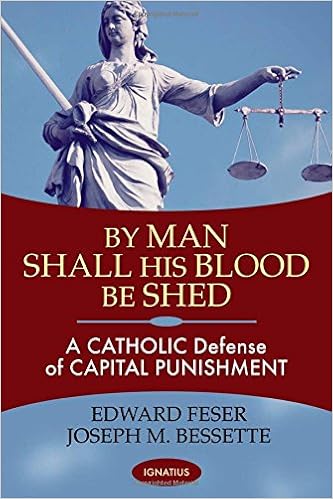
Start with Edward Fesser and Joseph M. Bessette

By Man Shall His Blood Be Shed: A Catholic Defense of Capital Punishment (May 29, 2017)

US HERE – UK HERE

More… check out the late Avery Card. Dulles 2001 article on capital punishment in First Things.   Dulles puts his finger already on the argument that Francis would use about human dignity.

His article pretty much puts apart the argument that seem to inhere in the CDF Letter to Bishops.

Posted in The Coming Storm, The Drill, Wherein Fr. Z Rants | Tagged , , , , , , , , ,
75 Comments

Concerning beautiful liturgical vestments

The other day a friend and patron of this blog set a suggestion for a new set of vestments.

Nice, huh?  Take a closer look!

I am in the process of having fabrics, custom damasks, woven for upcoming sets of vestments.  It is an interesting process, though it is dragging out.  I am running out of time!

We will have a black/black woven.  We will have a gold/gold woven, to match as closely as we can the color of the gold silk set I had made some time ago.  There wasn’t enough fabric for, for example, an antependium.  I want to complete that set, even though the patterns of the weave won’t match.   I have the options also of gold/metallic gold, which would be amazing and, blue/gold… remember, I want to make a Pontifical set in blue, but if the blue and the gold are balanced in quantity, it can work both ways.

Anyway, here are some shots of the “dips” of the fibers for the gold.

Yes, that’s Chinese.

It is an interesting process.

This time I have in mind more of an English “gothic” style, with wider panels/bars for the distinguishing marks.  I’ll use the dusty gold not only for the pieces we are missing from the gold set, but also for these panels in the black set.

Anyway, this is what the TMSM are working on!  We can use all the tax deductible help that YOU can give us!  Please donate!  Use the link, just above.

Also, another goal that I have is for the Society to have its own crosier and variations on the miter, with matching albs for the sacred ministers, so that clerics could effectively come in off the street, or we could move the whole thing on the road, and then just do it.  I would like eventually to get matching albs and maybe surplices for the MCs.

To that end, at Liturgical Arts Journal – a new project of the original founder of NLM – I saw a post about some folks who are making vestments and altar cloths with high quality linen and good lace.   I like the idea of supporting initiatives like these.  HERE  Perhaps you good lay people might ask Father what he would like to have and then have them made.   When you contact them, tell them “Fr. Z sent me!”

Our revitalization of our liturgical worship will be aided by the rise of these new efforts to make good vestments and statues and glass, etc.  All these liturgical arts have to be revived.  There are great opportunities for those of you who have skills already or who would like to learn to, say, bind books, make stained glass, embroider images, carve wood, make chalices and other vessels.

Working together is also a great possibility.  For example, back in the day I tried to link up St. Joseph’s Apprentice, who makes the great portable altars, with SPORCH, who makes the great travel altar cards.  After that, I suggested someone who could make tailor linens for the altars.  It all works together.

Posted in ¡Hagan lío!, "How To..." - Practical Notes, Hard-Identity Catholicism, Liturgy Science Theatre 3000 | Tagged ,
15 Comments

A priests suggestions to correct our Catholic identity

At Catholic World Report, Fr. Peter Stravinskas reacts to ongoing scandal. He has some suggestions about how to address the identity problem we have in the Church – that’s what it is, isn’t it! – along the lines of Catholic Education, Clerical Leadership, and Faith and Conviction.

His section on Liturgy was of greatest interest to me, because I contend that everything… everything… all our problems and all our achievements… flow from and are brought back to how we collectively worship God in our sacred liturgical worship. What does Fr. S prescribe?

Eliminate altar girls, Communion-in-the-hand and extraordinary ministers of Holy Communion. [Do I hear an “Amen!”?] All of these practices entered the mainstream in direct violation of liturgical law, were winked at by bishops, and then codified as normative, thus rewarding disobedience. In keeping with the recommendations of Cardinal Joseph Ratzinger/Pope Benedict and Cardinal Robert Sarah, re-introduce celebrations of Holy Mass ad orientem, which would have a major effect on the atmosphere of worship and the mentality of the priest. Needless to say, a healthy dose of Latin and Gregorian chant is likewise in order.  [We need the TLM far and wide and often.]

The vast majority of priests under the age of forty would move in this direction tomorrow. [Yes!  They would.  But there is a big “however”…] However, they are inhibited from doing so by pastors still living in the 1960s and by chancery bureaucrats who are similarly enmired. Fidelity to the rubrics, truly sacred liturgical music, and a deep sense of the sacred are essential if we are to bring back those who have been scandalized by abuses over the long haul, abuses which have been deeply ingrained, institutionalized and normalized. That’s the “zero tolerance” that is needed. Not a few good bishops are supportive of these liturgical changes but are cowed by their own bureaucracy and/or by their fellow bishops.

We need positively to support our bishops and our priests who are putting themselves in the cross-hairs by trying to revitalize our sacred liturgical worship.  We must must must encourage and support them.

There are small things you can do to help your priests and bishops move in the right direction.  For example, THANK THEM for what they do.  Assure them of your prayers.  TELL THEM what your legitimate aspirations are.  Get organized to provide material support and dedicated time.   Send them Spiritual Bouquets!   The TMSM I am involved with recently organized a Spiritual Bouquet for the Extraordinary Ordinary.  We took out a color ad in the newspaper for the occasion of his 15th Anniversary as bishop here.

We need to get onside and stay onside.liturgical

Posted in "How To..." - Practical Notes, Liturgy Science Theatre 3000, Mail from priests, Our Catholic Identity | Tagged ,
10 Comments