UPDATE:
Anti-Catholicism is the last acceptable prejudice.
Check out the WSJ piece about the group to which Judge Amy Coney Barrett belongs.
___
Originally Published on: Jun 29, 2018
I’ve been looking at the list of the SCOTUS candidates from which the POTUS will choose a nominee. There are some great people on that list. You can see why the Left is having a spittle-flecked nutty.
Today I heard on the news that the POTUS is consider a couple of women from that list, which seems about right.
One which got my attention is Amy Coney Barrett, appointed by the POTUS to the 7th Circuit Court of Appeals.
During Barrett’s hearing before the Senate, she was attacked on religious grounds by Sen. Feinstein (D-CA) and Sen. Durbin (D-IL and decidedly PRO-ABORTION catholic who has been barred from Holy Communion by Bp. Paprocki.) The US Constitution has in Article VI a No Religious Test Clause (c. 3).
Coincidentally, in this video another name on the SCOTUS list, and someone people are talking about right now, Sen. Mike Lee (R-UT) is asked about what Dicky and Di did to Barrett:
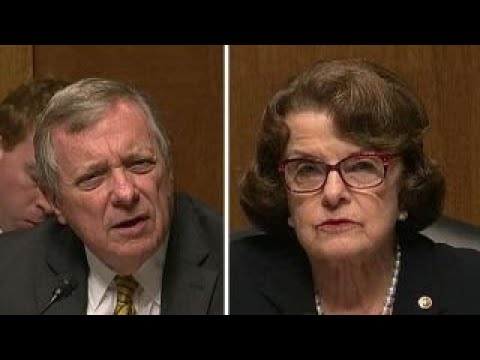

I wonder if they will reprise their previous bigoted performance.
Meanwhile, Judge Andrew Napolitano said something really interesting the other day about the POTUS’s vision for a SCOTUS Justice: they have to have “judicial humility“.
On FNC he said:
NAPOLITANO: I think, he’s going to narrow the list of 25 down to three. I think he will interview those three personally, and I think he will choose which one of the three he wants, and go with that person.
MACCALLUM: Who do you think those three are?
NAPOLITANO: He — I don’t know honestly, who they are. But I know their characteristics. They are all pro-life, they all believe in something called judicial humility, which is the recognition that the judiciary is the third branch of government. That the presidency and the Congress are more important. That they set public policy that it’s not the job of judges to set public policy, but just to interpret the law and to apply the Constitution to the laws that the Congress has written. A sort of deference if you will to the primacy of the other two branches.
As it turns out, judicial humility is a real thing, a term. It also includes the issue of stare decisis. My searches on the interwebs produced some interesting reading, for example, something from Yale Law Journal, which includes:
The judicial humility10 this Essay seeks to reveal in Justice Thomas’s work has five core features: first, an insistence on reaching and pronouncing the correct interpretation of the law even when one disagrees with the result;11 second, persistence in the correct interpretation despite potential or actual backlash; third, a recognition of one’s own limitations and a resulting commitment to doctrines and practices that subordinate self to law; fourth, a willingness to admit mistakes; and finally, a foundation in faith.
Footnote 10 reads:
It may be helpful to distinguish this kind of judicial humility from judicial restraint. Judicial restraint might lead a judge to proceed incrementally toward correcting a law, lest the judge exercise too much power or appear “activist.” Judicial humility requires something a bit different: most basically, it requires a subordination of self to some higher authority. In Justice Thomas’s case, the subordination of self is to law, specifically to the original meaning of the Constitution. The judicial humility reflected in his opinions therefore is not a form of minimalism; nor does it reflect or require self-doubt or timidity. Indeed, Justice Thomas has stated that “too many show timidity today precisely when courage is demanded.” Clarence Thomas, Francis Boyer Lecture at the AEI Annual Dinner: Be Not Afraid (Feb. 13, 2001), http://www.aei.org/publication/be-not-afraid[http://perma.cc/N5VX-8W3K].
Justice Thomas’s humility contrasts with the kind of judicial “humility” that Chief Justice Roberts praised as a justification for stare decisis during his confirmation hearings. See Confirmation Hearing on the Nomination of John G. Roberts, Jr. To Be Chief Justice of the United States Before the S. Comm. on the Judiciary, 109th Cong. 55 (2005) (statement of John G. Roberts). Justice Thomas rejects constitutional stare decisis. He has described the Court’s leading formulation of the doctrine as “a product of its authors’ own philosophical views . . . , and it should go without saying that it has no origins in or relationship to the Constitution and is, consequently, . . . illegitimate.” Stenberg v. Carhart, 530 U.S. 914, 982 (2000) (Thomas, J., dissenting) (referring to the stare decisis doctrine articulated in Casey v. Planned Parenthood, 505 U.S. 833 (1992)). For Justice Thomas, subordination of his “own philosophical views” to the law means returning to the original Constitution, not to the views of earlier Supreme Court peers. Thus, his judicial humility differs from judicial restraint or minimalism, and is compatible with the claim that he behaves as an “activist” judge regarding precedent. It is not compatible, however, with the claim that he is deliberately cruel.
The idea is this: It is by humility that Justice Thomas seeks to read the original intention of the Constitution. Humility lead Thomas to be an originalist.
Ave Maria Law Review also has an interesting piece about judicial humility. Be sure to read the conclusion.
Do a search on Amy Coney Barrett and stare decisis and you get some really interesting reading material. For example, “Originalism and stare decisis” in Notre Dame Law Review. See a page of selected works: HERE
There is going to be a huge fight over this appointment. I suspect that she could be on the short list of candidates.



 Look at this piece from