Two figures in music died today.
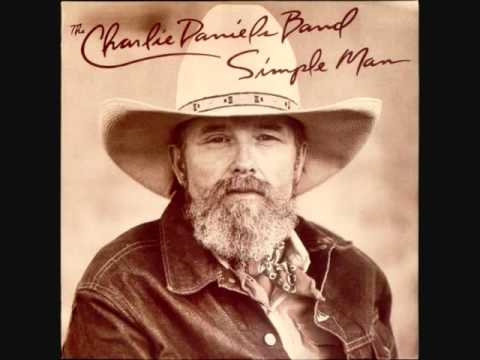
Charlie Daniels. Here’s a favorite of mine:
Ennio Morricone.


This is a very cool video.
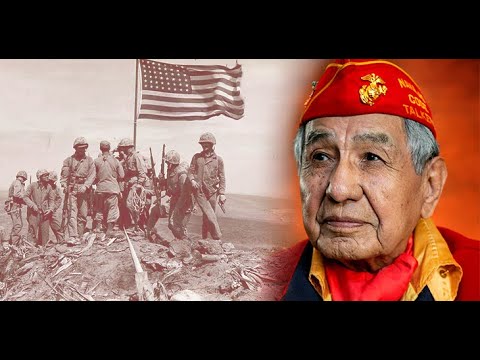
Apparently, there was code translating machines but they weren’t that fast. The “telegraphic” code words in the unwritten Navajo language, with their memorized meanings, meant that coms were very fast.
During WWI the Choctaw language was used for tactical messages. Meanwhile, Japan and Germany had sent people to these USA to study native languages! However, there was Navajo, which is really complicated.
400 Navajo were in the Code Talker program, in all 6 Marine Divisions. The Japanese had cracked the codes for the Army and Army Air Corps, but not the Marines. There was even a Navajo captured by the Japanese, but he couldn’t make it out.
Code Talkers were at Guadalcanal, Tarawa, Pelilieu and Iwo Jima. Major Howard Connor, signal officer of the Navajos at Iwo Jima, said, “Were it not for the Navajos, the Marines would never have taken Iwo Jima.”
More at the Naval History and Heritage Command. HERE
Was there a good point made in the sermon you heard at the Mass for your Sunday, either live or on the internet?
Let us know what it was.
Also, are you churches opening up? What was attendance like?
For my part…

I have been sitting on this and sitting on this and sitting on this….
Finally…
From Archbishop Broglio of the Archdiocese for the Military Services:
|
|
|
|||||
|
|||||
UPDATE 4 July 2020:
It is 2:30 in the afternoon and I have finished reading the avalanche of emails you sent. Some of them were straight-forward descriptions of what changed at the parish. Some were that with also what you thought and felt about them. Some had deep introspection and some had predictions for the future. Some were quite sad. Others had strong notes of hope.
The whole thing has been instructive.
What have I learned from your feedback?
In large part, it has been a confirmation of what I have heard and suspected.
I am very grateful for these notes.
Drop me a note with and put in the SUBJECT line (copy and paste works well):
MASS IN THE TIME OF COVID
Write to me HERE
___ ORIGINALLY POSTED 2 July 2020
 FATHERS! I would like some feedback.
How has COVID-1984 and the lockdown changed how you have been saying Mass. In particular I am interested in those of you who have been affected by, perhaps, switching to TLM only or often and to ad orientem worship.
LAY PEOPLE! I welcome feedback from you as well.
Many of you have not had access to church. What have you learned or discerned from this? Have you been watching Masses streamed online? Have those streamed Masses been mostly what you followed in your average parish or have you started to view Traditional Latin Masses online?
Drop me a note with and put in the SUBJECT line
MASS IN THE TIME OF COVID
Write to me HERE
UPDATE:
Imagine for a moment that you want feedback on a question.
And imagine that you don’t want to miss anything someone might send.
You get a lot of email and you don’t want things going into spam or going unnoticed. So, you ask that people put a specific phrase in the subject line of the email so that those emails will go into a handy folder.
Just for the sake of imagination, mind you.

Adventures in email!
o{]:¬)
Our nation is being torn by organized factions. The followers of those factions are mostly blind and dim dupes, the ultimate products of a long-targeted education system precisely for these days. We run the risk of losing all that our forebears won.
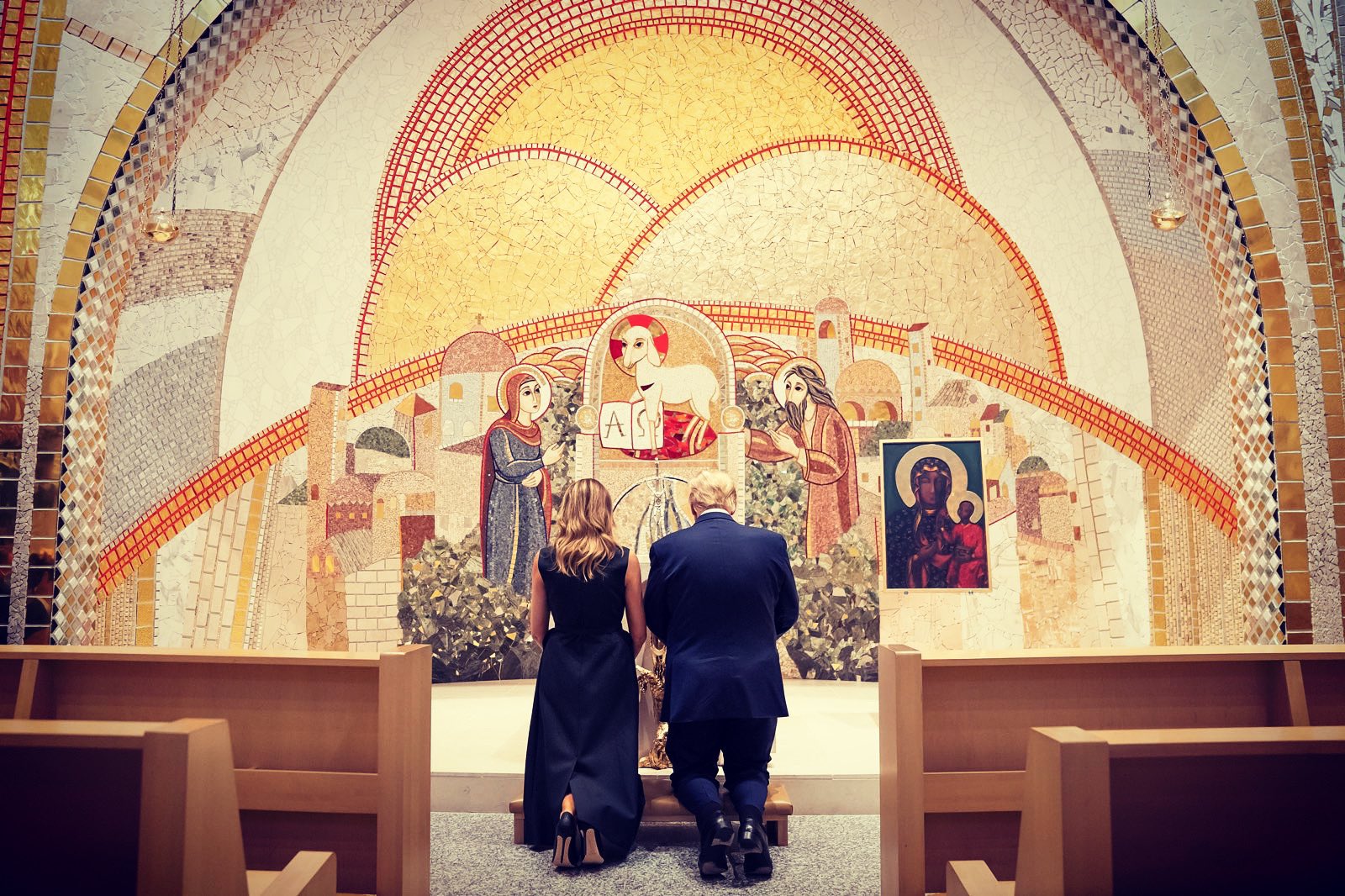
Pray in a special way today, Independence Day, and also make acts of reparation to the Immaculate Heart of Mary, who is the Patroness of these United States.
ORIGINALLY POSTED 2 June:
Everyone, in this time of chaos and mob brutality, please PRAY for government officials.
Fathers, you might want to have everyone pray this after Masses. This, and other prayers, are deeply needed.
The following prayer was composed by John Carroll, Archbishop of Baltimore, in 1791. He was the first bishop appointed for the United States in 1789 by Pope Pius VI. He was made the first archbishop when his see of Baltimore was elevated to the status of an archdiocese. John was a cousin of Charles Carroll of Maryland, a signer of the Declaration of Independence.
For Catholics who love their country!
PRAYER FOR GOVERNMENT
We pray, Thee O Almighty and Eternal God! Who through Jesus Christ hast revealed Thy glory to all nations, to preserve the works of Thy mercy, that Thy Church, being spread through the whole world, may continue with unchanging faith in the confession of Thy Name.
We pray Thee, who alone art good and holy, to endow with heavenly knowledge, sincere zeal, and sanctity of life, our chief bishop, Pope N.,the Vicar of Our Lord Jesus Christ, in the government of his Church; our own bishop, N., all other bishops, prelates, and pastors of the Church; and especially those who are appointed to exercise amongst us the functions of the holy ministry, and conduct Thy people into the ways of salvation.
We pray Thee O God of might, wisdom, and justice! Through whom authority is rightly administered, laws are enacted, and judgment decreed, assist with Thy Holy Spirit of counsel and fortitude DONALD J. TRUMP, the President of these United States, that his administration may be conducted in righteousness, and be eminently useful to Thy people over whom he presides; by encouraging due respect for virtue and religion; by a faithful execution of the laws in justice and mercy; and by restraining vice and immorality. Let the light of Thy divine wisdom direct the deliberations of Congress, and shine forth in all the proceedings and laws framed for our rule and government, so that they may tend to the preservation of peace, the promotion of national happiness, the increase of industry, sobriety, and useful knowledge; and may perpetuate to us the blessing of equal liberty.
We pray for his excellency, the governor of this state , for the members of the assembly, for all judges, magistrates, and other officers who are appointed to guard our political welfare, that they may be enabled, by Thy powerful protection, to discharge the duties of their respective stations with honesty and ability.
We recommend likewise, to Thy unbounded mercy, all our brethren and fellow citizens throughout the United States, that they may be blessed in the knowledge and sanctified in the observance of Thy most holy law; that they may be preserved in union, and in that peace which the world cannot give; and after enjoying the blessings of this life, be admitted to those which are eternal.
Finally, we pray to Thee, O Lord of mercy, to remember the souls of Thy servants departed who are gone before us with the sign of faith and repose in the sleep of peace; the souls of our parents, relatives, and friends; of those who, when living, were members of this congregation, and particularly of such as are lately deceased; of all benefactors who, by their donations or legacies to this Church, witnessed their zeal for the decency of divine worship and proved their claim to our grateful and charitable remembrance. To these, O Lord, and to all that rest in Christ, grant, we beseech Thee, a place of refreshment, light, and everlasting peace, through the same Jesus Christ, Our Lord and Savior. Amen.
I became familiar with this moving prayer at my home parish of St. Agnes in St. Paul (MN) where it was recited after all Masses on civic holidays of the USA, such as 4 July and Thanksgiving.
Americans among the readership might print it and bring it to your parish priests and ask them to use it after Mass on national holidays.
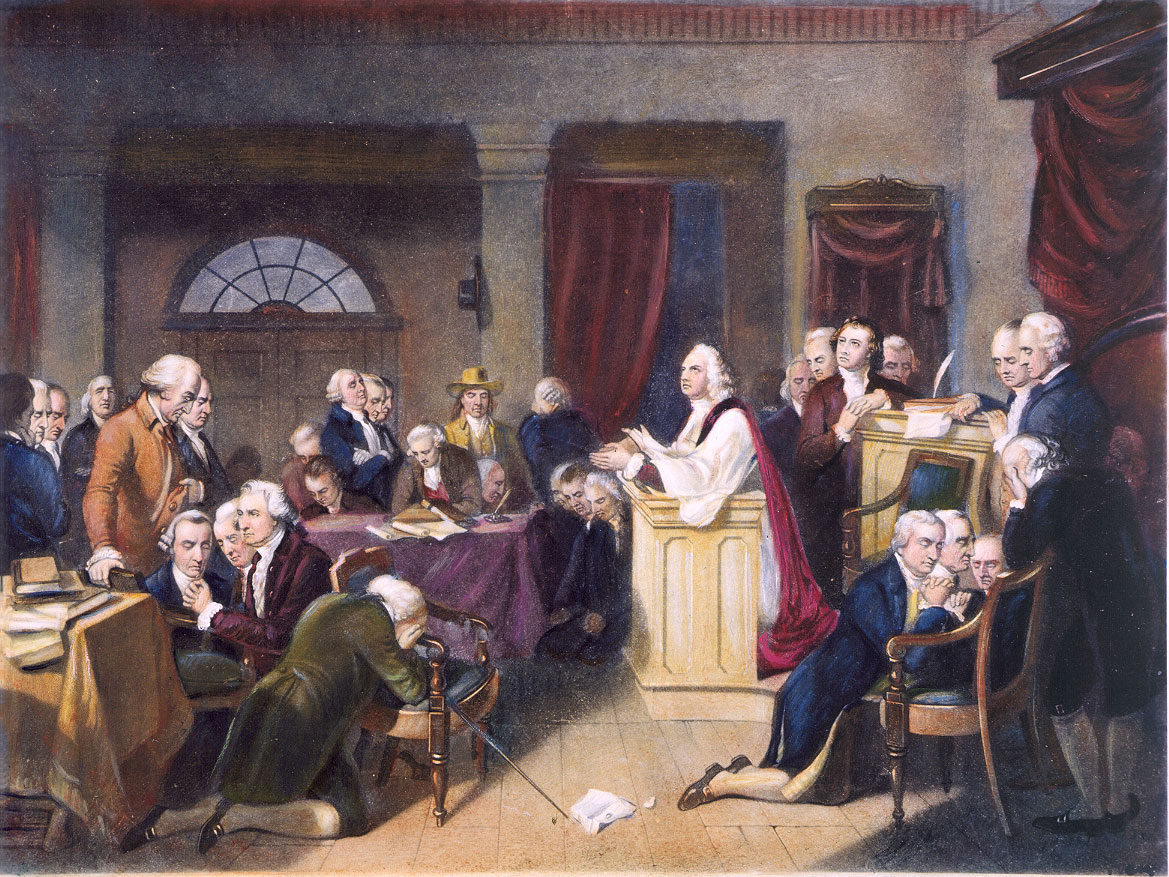
Continental Congress at Prayer
The opening prayer session of the 1st Continental Congress was about 3 hours long.
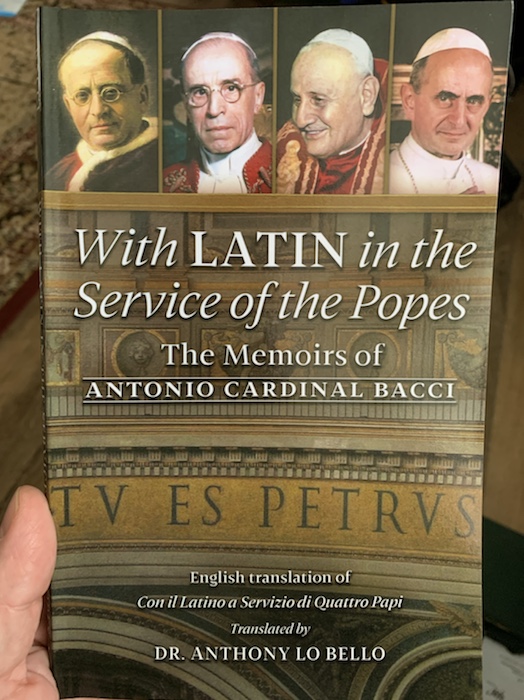 I am reading a charming little book, which is also helpful for explaining the ongoing importance of Latin for the Church.
With Latin in the Service of the Popes: The Memoirs of Antonio Cardinal Bacci (1885-1971) translated by Anthony Lo Bello.
Card. Bacci was a great Latinist who worked for the Holy See, for four Popes, for several decades. His mark is all over Vatican City in the form of inscriptions, including for an elevator in the Apostolic Palace.
I used some of Card. Bacci’s splendid reflections in my last series of LENTCAzTs. He is terrific. Meditations For Each Day. US HERE – UK HERE
I will assume permission to read you a small section, so you can have a taste. I will not read all Latin inscriptions, which I find terribly interesting but which are not perhaps best for this tidbit (they are translated in the book). Also, note that, at the end, the Second Vatican Council was underway as he was writing. Bacci and Ottaviani would join forces to fight the worst of outcomes of the Council.
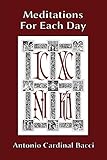 This little volume is only about 115 pages long, including its index. Each section has some of the Latin that Bacci wrote, including the Latin oration given by Pius XII at his coronation, which Morton Henry Robinson quoted in his novel The Cardinal (US HERE – UK HERE).
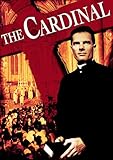 The Cardinal was made into a movie directed by Otto Preminger. It is rumored that young Joseph Ratzinger was a consultant for the movie. And the liturgical scenes in it, including an ordination to the priest and an episcopal consecration in Santa Maria sopra Minerva, are spectacular. US HERE – UK HERE Too bad the movies doesn’t include the game played with Merry del Val, quoting Horace and tossing oranges. It does, however, have the Card. Initzer strudel crack.
I think you will enjoy the Bacci memoir, even if you don’t know much Latin. It is also a good press to support, Arouca Press. They are doing good work.
 From a reader…
QUAERITUR:
In a not-so-hypothetical situation wherein the faithful are able to attend mass on Sunday inside a church, under nearly normal circumstances (face masks, 6 foot distancing), would it be permissible, or even advisable, to opt instead for a drive-in parking lot mass?
My diocese has resumed the public celebration of mass, albeit with social distancing enforced. However there is still a parking lot mass being offered out of town wherein people are obliged to remain in their cars and listen to the mass via radio livestream. People close to me have opted to continue attending that mass.
Would attending mass in such a way be prudent, or even permissible, when there are more “normal” options available?
I’m getting tired of all the melodrama, aren’ t you? Do you have a sense that we are all being lied to?
In any event, this is one of those situations in which we must not pit the perfect against the good. It is better to be able to be in church for Mass. However, even in the case of the parent who has to take little Stupor Mundi out of the church and into the narthex or even outside, because little SM is having a core meltdown, it is still good to be there. You are still morally present to Mass in the church proper. Is it better to be inside a calm and peaceful church for Mass? Of course. But exigencies cause some people to be out and some to be in and that’s just life.
It it a good thing to have parking lot Masses. Is it better to be in church? Yes. It would have been better for the sailor off the coast of Iwo Jima to have been in a church when their chaplain said Mass.

Should the servers have been in cassock and surplice? Sure. But there they were making the best of it.
Frankly, that priest looks a lot like Bp. Cozzens of St. Paul and Minneapolis.
We work with what we have, friends, and we should strive to do the best whatsoever the circumstances. Need an outdoor altar and have lots of time and help? Make it elaborate and wonderful? Don’t have a lot of time or help? Do your best. Need a sound solution for outside, parking lot Masses and have a budget and a guy with know how? Great! Give them great audio. Don’t have those? Raise your voice!
Do let the perfect be the enemy of the good.
Now the question comes in: if there is a better option should one still go to parking lot Masses.
I say, if all other things are equal – ceteris paribus – No! But not all things are equal. You might be a young person with a robust immune system and your neighbor might be in her 70’s with various risks. In her case, parking lot could be better, for the sake of prudence.
I apply this also to the appallingly abused practice of Saturday vigil Masses. There are people who are perfectly healthy and will no other conflicts on Sunday who haven’t darkened the door of a church on Sunday for years. They take the minimalist route to fulfill their obligations (though now in most places there is no obligation) not because they are compelled by circumstances, but because they want to have their Sunday entirely free to do… whatever. Do they fulfill their obligation? Yes. But they do it in a stingy way, insofar as their time and lives are concerned. That is a terrible abuse of the Church’s provision for the fulfillment of the Sunday obligation.
If a person goes to a parking lot Mass because they want perhaps to look at their phones as they tune out now and again, or they perhaps want to be able to drive away quickly – even better than leaving church immediately after Communion – then … well… that’s bad.
We should avoid minimalism when it comes to worship of God.
At the same time, we have to be flexible enough to know when to apply the accelerator, when to shift gears, and when to apply the brakes.


Coat of Arms by D Burkart
 Benedict Joseph on Are things as bad as the seem? Auctores scinduntur.: “When will we banish from the Catholic lexicon “reform” and “renewal”? They serve only the cause of mendacity. Let’s call…”
 on Not a huge fan, but the question is dead on right…: “This is not an “apologia pro Iacobo Martino,” but it’s unfair to say, as above, that Tim Busch’s apparent friendship…”
 on ROME 26/10– Day 21: fountain: “That’s funny I can’t recall any of the woman saints I have read ever mentioning that they aspired to be…”
 on ROME 26/10– Day 19-20:: “I agree acardnal. The dachshunds at Pippo’s always make me smile too. Thank You Father Z.”
 on Not a huge fan, but the question is dead on right…: “It’s easy to discipline the obedient child. Reprimanding the one who will oppose you openly and pitch a fit in…” on ROME 26/10– Day 21: fountain: “When will *women* understand that: No means no. Every. Single. Time.”
 on ROME 26/10– Day 21: fountain: “How do we facilitate that discernment? If such ladies truly seek to discern, ask them to enter a contemplative monastery,…”
 on ROME 26/10– Day 21: fountain: ““Hear the call” Sometimes I hear neighborhood cats fighting in my yard. This hasn’t prompted me to dress up like…”
A Daily Prayer for Priests








They find you a pro-life agent in your area who commits to giving a portion of the fee to a pro-life group!

PLEASE subscribe via PayPal if it is useful. Zelle and Wise are better, but PayPal is convenient.
A monthly subscription donation means I have steady income I can plan on. I put you my list of benefactors for whom I pray and for whom I often say Holy Mass.
In view of the rapidly changing challenges I now face, I would like to add more $10/month subscribers. Will you please help?
For a one time donation...



Help Monks in Wyoming (coffee – UPDATED LINK) and Norcia (beer) and the wonderful "Soap Sisters" of Summit, NJ!


Please follow me on Twitter!










Visits tracked by Statcounter
since Sat., 25 Nov. 2006: