UPDATE:
From a friend:
My German friend who attended today told me that De Mattei wanted it kept quiet as he was afraid Marx would step in and shut it down. Apparently the state and Marx work closely together.
It seems to me that that in itself would have been newsworthy.
____ Originally Published on: Jan 18, 2020

This morning my phone starts ringing from a German number.
An old friend had heard that there was going to be a protest in Munich with recitation of the Rosary against the German bishops and their nutty synodal process. Rather like what was done in Rome before the rigged October Pachamama Synod (“walking together”). That was Acies Ordinata.
My friend would have gladly gone to Munich to participate but he had no advance warning that it was going to take place. He heard also that there would be a presser afterwards. He was willing and eager to go to it, even if he missed the protest.
I reached out to get some information for him, BUT, I as learned, it was sort of a secret demonstration.
A secret demonstration?
A press conference afterwards? By whom and for whom?
I’m afraid it was merely for each other, for the people who were on the inside, in the know.
Just as I write, I see that Ed Pentin is posting on Twitter about the protest at presser. Archbp. Viganò showed up in his FIRST PUBLIC APPEARANCE in a long time.
Pentin also wrote at the National Catholic Register after the fact.
Gee whiz. I would have liked to be there for that, to lend support.
What I am afraid that we have here, my friends, on the traditional side of things, is a self-licking ice cream cone.
And not even a well packed ice cream cone.
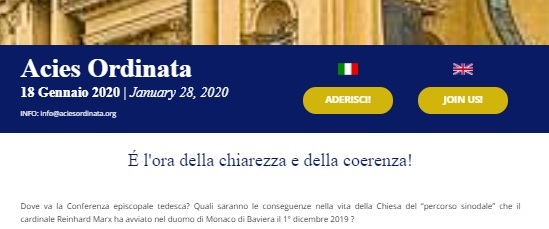
While looking for information on the protest in Munich by Acies Ordinata I found this.
I love that… 18 Gennaio and January 28… and it’s “It’s time for clarity and coherence!”
Problem: not only is the date screwed up, but nowhere on that single page site do you find the PLACE and the TIME of the protest.
What were they worried about? Thugs from the German Bishops Conference?
Was it secret because Archbp. Viganò was going to be there and they were worried that someone from the Holy See might try to stick him with a radioactive needle.
Actually, that’s not outside the realm of possibility.
I now see, just now, as I refresh that screen, that the banner has been changed to a photo from that protest in front of the Theatinerkirche.
I see John Henry Weston of LifeSite. No advance news of this on LifeSite.
I see Robert de Mattei. Nothing on the Lepanto site.
I see the young Austrian idol thrower, Alexander Tschugguel. Nothing at his Boniface Institute page.
I see Michael Matt. There is a post, posted today, the day of the protest, at The Remnant. It says…
Representatives of the many different Catholic action groups around the world will unite in Munich, Germany today in a peaceful demonstration of silent but prayerful protest against the German Bishops’ Conference “synodal way”.
Oh really? Many different action groups? Who would they be? Do they have some sort of secret handshake or decoder ring so that only they know what’s going to happen, lest anyone who doesn’t share the code might participate? Is there a “black list”? Are they using encrypted comms so that word doesn’t get out? Is there some sort of purity pedigree you have to pass?
It seems to me that if you want real action, you don’t do things on the sly.
Look, I think all these people are terrific. They are dedicated Catholics. They see that things aren’t going well. They want to do something.
I don’t think that the self-licking ice cream cone approach is the most effective.
Things are obviously not going well in the Church. Because our Lord underwent His Passion, the Church also must undergo her own time of torment and upheaval. I maintain that God, who disposes all things, gave us a magnificent honor to live in these troubled times.
Because of that great gift from Our Lord, to be called into existence at this time in the history of salvation, we have to roll up our sleeves and do our part even as God showers graces on us. The harder the times, the greater the graces. What an honor.
Think of the honor God gave to the Jews who, with a sword in one hand and a trowel in the other, worked together under Nehemiah to rebuild the walls of Jerusalem. And their enemies were not as spiritually dangerous as our are today.
May I return to a theme I’ve punched at for years?
What is it about traditional and conservative Catholics that makes them atomize themselves into small groups that won’t cooperate with each other? We obviously see some cooperation among this little group of groups in Munich.
A few months ago, the same Michael Matt of The Remnant put out a call to UNITE THE CLANS. A great idea then. A better ideal now. However, it’s ironic that his post at The Remnant was called also Mission Impossible.
When Michael Matt called to Unite The Clans I was right there. HERE
In that post, Michael wrote:
What we’ve got here are two old war horses who’ve not always seen eye-to-eye on everything over the past 25 years, but who nevertheless know Devils when we see them. Unite the clans with Father Z? You bet! I’m proud to stand together with him against the demons attempting to destroy our beloved Church.
So when not even I have a clue something is going on, I wonder how committed they really are.
The last time that the hashtag #UniteTheClans was used on Twitter was 24 November of last year.
Meanwhile, catholic libs set aside small differences, create fronts, and roll over everyone in their path.
Why don’t Catholics work together?
It seems to me that many on our side of the spectrum are so dedicated to protecting their little wrinkle of turf that they are afraid of the success of others.
Someone is going to have to emerge as a good leader with a good vision and leadership skill to do some uniting. It’ll have to be a layperson, I think. As Fulton Sheen said:
“Who is going to save our Church? Not our bishops, not our priests and religious. It is up to you, the people. You have the minds, the eyes, and the ears to save the Church. Your mission is to see that your priests act like priests, your bishops act like bishops.”
Let’s think of this in terms of strategy.
- What are the threats to the Church? Concretely?
- What the enemies’ centers of gravity?
- What are the measures we have to take to overcome?
- How do we destroy, neutralize or coopt their centers of gravity?
None of that is going to happen without united action and concrete work.
Realistically… ask yourself…
- What are we going to do if they actually start ordaining married men or women as deacons?
- How far is too far to be pushed? How much nonsense is enough?
Hence…
- Who are the people who will lead in the future?
- What do I, personally, have to give up in order to make the mission work?
- What do certain organizations have to give up in order to cooperate with others?
- How can I help?
- Am I complacent in what I now have?
- Is my ego in the way of our collective success?
It tears at my heart daily to see what is going on in the Church.
Once again, I ask that people on the more conservative and traditional side of things do an examination of conscience, set aside smaller differences, and start repairing the walls together.

 From a reader…
 Was there a good point made in the sermon you heard at the Mass that fulfilled your Sunday Obligation? What was it?







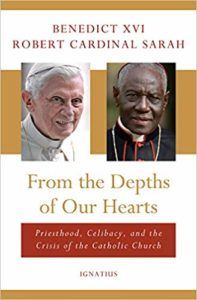 The new book, From The Depths Of Our Hearts, has really freaked out some people on the left, including the papalotrous.

 Discerning Altar Boy on Your Sunday Sermon Notes – Feast of Christ the King (N.O.: 30th Ordinary): “NO. Pastor preached on setting a good example, riffing on Saint Josemaria and the Epistle to the Thessalonians. Challenge people…”




























