A quick look at some ‘c’atholic media

It is necessary from time to time to put on the forensic pathologist cap.

I always feel like I need to wash with bleach after I read this stuff, rather like the investigation of a crime scene where the deceased isn’t… new.

What’s going on these days on the catholic Left?

First, in view of the upcoming Synod (“walking together”) on the Amazon,  we glance at the Jesuit-run “semi-official” journal, La Civiltà Cattolica, allegedly vetted by the Secretariat of State.   This is behind a paywall… so only the cash-flush and/or ideologically committed have easy access.

Amazonian Indigenous Spirituality and Care for the ‘Common Home’
Adelson Araújo dos Santos, SJ
13 August 2019

The blurb in the email alert communicates what they want us to know.

How spirituality in Amazon contributed to Christianity

The indigenous people living in Brazil and Pan-Amazonia therefore have a mythological legacy that remains alive.

Indigenous spirituality is based on the experience of the forest peoples: their myths, rituals and their way of relating to nature.

As in Christian spirituality, it is also from the religious experience of the indigenous people that we can derive the basic elements and paradigms of the elaboration of their understanding of God and of themselves.

What could possibly go wrong with Jesuits writing about the intersection (syncretism?) of the spiritual myths of pagans (certainly demonic) and Christian (generic?) spirituality?

Perhaps one of you have access to the whole piece. I don’t.

Another organ of the ultra-Left, La Croix International has behind its own paywall – hence it is not for the disposable-income challenged and is mostly for the ideologically pure – this nutty offering.

‘How America wanted to change the pope’ An archbishop’s claim that Francis was complicit in covering up sexual abuse within the Church amounted to an attempted coup d’état Nicolas Senèze
Vatican City

An ultra-conservative fringe of the American Catholic right has fomented a coup against Pope Francis.

Introduction: From Santiago to Dublin – or how the pope’s trip to Dublin in Aug. 2018 marked the beginning of an attack against himRead exclusively the first chapters of the book by Nicolas Senèze, permanent special envoy of “La Croix” in Rome, to be published by Bayard Publishing on Sept. 4. Pre-order from your bookseller.

On Sunday morning, Aug. 26, 2018, there was great excitement at The Alex, the small hotel in central Dublin where the Vatican housed journalists following the pope on his trip to Ireland.After rising at 4:30 a.m. to board the flight that would take Francis to the Marian shrine in Knock, in the west of the country, people at the Vatican were stunned by a bombshell dropped by a former Apostolic Nuncio in the United States, Archbishop Carlo Maria Viganò, and published during the night by several…

That’s as far as you can get without coughing up money better spent elsewhere.

You can see where this is going.

Then over to Fishwrap (aka National Schismatic Reporter). There is so much that’s dreadful there… just pick a link, any link. These stand out, however.

Tackle clericalism first when attempting priesthood reform
by Fr. Peter Daly

Essentially, priests are bad. They need to be re-educated so that they no longer understand themselves as being different in any way from any other person. He works from a definition of clericalism provided by the Ass. of Catholic Priests.  Telling.

The last in a list of symptoms of clericalism: “When thriving parishes are closed because there is a shortage of priests when there are deacons and lay people readily available to keep the community going.” In cauda veneno.

And…

Churches’ struggles could be a staging ground for the new vessel
by Ken Briggs

It’s scrambled, to be sure, but this stuck out…

The churches’ struggles at this time could become a staging ground for that new vessel. I’m guessing that the deck would be cleaned for the emergence of a global, essentially single church with various branches that attract seekers who find an appeal in a church that doesn’t crave approval from the culture or that damns but respects it and offers its own breadth and depth of life and faith. A different kind of hope not dependent on societal success. [Gee… a single global Church that doesn’t conform to the world… hmmm… sounds familiar.]

Not long ago, churches were chided for having an “edifice complex,” an outsized attachment to sanctuaries that begged for architectural and cultural awards. Bigness and ostentation told the world that the churches belonged in the realm of makers and shakers. The American way was anchored to a model of “growth,” the gross national product being the measure of national pride and health, “winning” in everything from Olympics to Oscars the ends sought.

A Christianity aborning could be imagined as a modest partner in a larger, global community of religions, surrendering privilege and assumed primacy to humbling sharing of a commonly recognized mysticism.

And there’s this…

Faith is something best ‘lived on one’s feet’
[María Teresa (M.T.) Dávila is Associate Professor of the Practice, Religious and Theological Studies, Merrimack College.]

On one’s feet… not on one’s knees.  Immediately one wonders if there will be a mention of prayer in this piece. Nope.  The beginning, so you can get the flavor…

La fé se vive de pié. Faith is lived on your feet. On whatever motors your body. Faith calls the body to become incarnate in the realities in which Christ too becomes incarnate. These past few weeks have seen tremendous movimiento – movement. People of faith, of all ages, abilities, sexual orientations, religious traditions, genders and ethnicities have mobilized! They moved into spaces and advocated for dignity — their own and others. They clamored in the streets and in the halls of political power for human rights for those who are held captive. They bore on their bodies and in their witness some of the injustices being heaped upon the most vulnerable.

There’s a lot more of this. I’m sure you now want to put on your Che beret and make large character posters. Yes, I mixed those together.

Meanwhile, Fishwrap’s tricoteuse MSW (aka Madame Defarge) is still bashing Pres. Trump while he croons in the direction of Elizabeth Warren. Also, a few days ago he typed up a paen of Francis’ recent letter to priests so cloying that you feel like you’re drowning in Lyle’s Golden Syrup. It’s “remarkable… most exemplary… quintessential Papa Bergoglio”. Oh his “brutal frankness”, the “deeply spiritual insight… the deeply [again] traditional understanding…”! It’s not all like the “the programmatic, managerial understanding of the life of the church we encounter so often in this country, so focused on who has power.” No no. Instead, “Francis’ spirituality is also very traditional and very vibrant [verily]: No flashy new lights for him.” Don’t forget the “practical pastoral wisdom” which is “so simple and yet… profound”. Then again, he is “deeply [again] rooted in the teachings of the Second Vatican Council”.

We are informed by Madame Defarge… and maybe you can figure out what the heck this means, “Pope Francis’ way is not the way of the “heroic priesthood.” You will find no Jungian archetypes here.” Apparently Francis also has an “anti-Pelagian approach to discipleship”.

And, right on schedule, there is the programmatic diminishing of the priest and priesthood which so characterizes everything Fishwrap is about:

And so far from encouraging any vision of the priesthood that emphasizes the distinction between the lay faith and the ordained ministry, he reminds the priests to be encouraged by the fact that “our people have a ‘nose’ for things. They sniff out, discover, new paths to take; they have the sensus fidei (cf. Lumen Gentium, 12)… What could be more beautiful than this?” Again, it is not just his fidelity to Vatican II, it is how he makes the teachings of that council fresh.

Very deeply!

The thing that Fishwarp doesn’t get is that is that for someone to have the sensus fidei they have to have fides in the first place. To have the sensus fidei fidelium, you have to be faithful.

Anyway, Defarge’s panegyric soars to this high C:

This short text will go down as one of the paradigmatic documents of this pontificate. It breathes faith, hope and charity. It displays a wisdom of years and a still youthful heart. Deeply [again] rooted in the tradition, it does not treat the tradition as a source of proof texts and footnotes but as a springboard from which to vault into the challenges of our day. It is one of Francis’ finest, simplest, most profound texts, and I hope the priests of our time can and will receive it as such.

It doesn’t treat tradition as a source of proof texts! What he is really saying is that the clock started in 1963 and, after bad period of about 35 years, it was restarted in 2013.  Outside of that very deep time scheme, we don’t have to pay a lot of attention to, you know, documents and other Councils and outdated stuff like that.

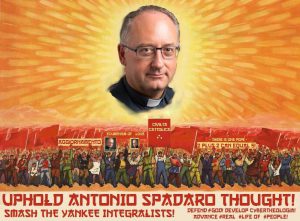
I am reminded of another of the New catholic Red Guards, now a venerated comrade who fell in his marching through the streets, little book held high, as he sloganed his way along against the Four Olds.  What was it he wrote? Pope Francis…

“breaks Catholic traditions whenever he wants because he is ‘free from disordered attachments.’ Our Church has indeed entered a new phase: with the advent of this first Jesuit pope, it is openly ruled by an individual rather than by the authority of Scripture alone or even its own dictates of tradition plus Scripture.”

Apart from it being highly weird, that was one of best/worst examples of sycophantic crawling you will find from that end of the spectrum.  Truly exemplary.

And… it was plagiarized.

MSW also got a bit oily.  However, I admit that found Francis’ letter at least engaging. Frankly, I expected it to be yet another round of his beating up on priests, but it was – mostly – benign and encouraging.  I am not convinced that it was entirely written by Francis. That’s okay, of course. Popes have ghost writers and what they sign belongs to them.  Was Spadaro’s hand in it?

I agree with Fr. Jeff Kirby writing at Crux (!) that there is a lacuna: a call for personal repentance. Of course such a letter, which needs to be short, can’t mention everything. That element, however, ought to have been included.

And I am still struggling with Francis’ description in the letter of the Church… the CHURCH, mind you, and not just her members… as being like a Bride (so we know he is talking about the Church) “sorpresa in flagrante adulterio… caught in flagrant adultery… Esposa sorprendida en flagrante adulterio”.

Francis offers this puzzling image in conjunction with a reference to Ezekiel 16 which contains 63 of the roughest verses in the whole body of Scripture.  Ezekiel describes the relationship of God with faithless “Jerusalem”, likened to an orphaned girl whom the Lord adopts and lavishes good things upon, eventually wedding her. But she is unfaithful and becomes an adulterous whore. She will be punished and humiliated, but the Lord nevertheless is faithful to his covenant and is forgiving. This is a head scratcher. If it were clearer that Francis is talking about the Church considered in the individual members who comprise her rather than the Church, spotless Bride of Christ, so in unity with Christ that they are like one Body, the Body of Christ.  Members… okay.  I wouldn’t bat an eye. As a matter of fact, I’d be inclined to applaud. But it is not clear to me that he is thinking of us, her members. Am I wrong?  Seriously.  Read it for yourselves.  HERE

In any event, that’s enough of this.  No energy or will to look at Amerika.

I’ll go use some eyewash now and get on with my day.

Posted in Biased Media Coverage, Jesuits, Liberals, The Drill | Tagged , , , ,
4 Comments

BOOK : A guide for forming Catholic gentlemen and future priests – and a mini rant.

A prelude.

I treasure a copy of a French book of etiquette from long lost decades, Le Livre D’Or Du Savoir-Vivre. Dictionnaire Illustre De La Politesse.  It’s an informative hoot, since much of what it contains is seemingly outdated and, well, continental.  But in some cases it has been helpful.

Also, I remember stories and hints from our old pastor at St. Agnes in St. Paul, Msgr. Schuler, who constantly had young priests, seminarians, men interested in priesthood at the supper table. The evening meal was always formal, served from the kitchen.  We had our places and our proper napkin rings and you were expected to dress for supper.   When you have a lot of men living together, it is important that there be decorum and some feminine presence about the place, in the form of a housekeeper or cook.  Also, once upon a time, as a new priest assigned to the minor seminary, beginning with high school through college, he had been put in charge of teaching etiquette.  They took in young men often straight off the farm, who didn’t have a clue about social graces.   Heck, in Rome in the early 90s we had to help a few guys learn how to eat without causing shock and general revulsion.

That must have been a challenge, in the last years of the 40’s and into the 50’s, and the 90’s, but not as much of a challenge as it would today.

Now to my present point.

At the recent annual Canon Law conference organized by Card. Burke and held at the marvelous Shrine of Our Lady of Guadalupe, some volunteers set up tables with books for purchase. I found a little treasure, in a reprinted book from the ’60s,

Social Manual For Seminarians.

US HERE – UK HERE

UPDATE: NB that when I posted this, the price was $14.95.  However, I suspect that readers here got the copies that were in stock and they switched to some other, more expensive supplier.  There are other venues.

The contents include headings such as

POSTURE AND CARRIAGE
ANNOYING HABITS
THE CONVENTIONALITY OF EATING
WHEN THE LADIES ARE PRESENT
TELEPHONE USAGE
YOUR FIRST SOLEMN MASS

There are, of course, others.

The book is a practical guide to help the 1960s seminarian be a “Catholic Gentleman”.   This was a necessary part of formation… and remember that seminary back in the day began with HIGH SCHOOL seminaries!

This stuff is important.   Of course, the publisher adds a note:

An intro to the Intro…

A few sample pages…

In the section about… WHEN THE LADIES ARE PRESENT

And also…

Sigh.  As the years are torn off the calendar like flying leaves in the fall, will there be any “ladies”?   The coarseness of young women now is alarming.  It is hardly surprising, really.  Look at entertainment these days.  Who are the most vicious and prolific killers? Women.  Think about it.

But I digress.

I am so glad I don’t have any annoying habits.

And, as ordination approaches, there is some really good advice in this section.  There are an awful lot of things to think about, and this book helps to identify them.

This book is simultaneously a nostalgic hoot and neuralgic poke.  It provokes smiles about lost days and it stimulates desire to recover what has been lost…

DECORUM.

Decorum is the key to a great deal of the life of the Church.   Categories from rhetoric are applicable across the board.  Think about how for many centuries rhetoric tied together the whole formation of a young man.  They were to be trained in identifying the bonum, the aptum, the pulchrum.

Decor, that which is seemly.

The right word or gesture at the right time for the right reason.

Choices of gestures and words for the sake of eliciting the chosen effect.

How often I contemplate how liturgical abuses and bad choices and deficient ars celebrandi is not just a violation of law, or the rights of the faithful, or good taste.  They are also a violation of the priest’s own dignity.  They are infra dignitatem.   They manifest a lack of understanding of …

who the Church is,

who the priest is,

Who Christ is.

In any event, this book could be a great starting point for reflection not only among seminarians, but also among young priests.

And let’s not underestimate how parents of young children could take some cues from the helpful observations about “Catholic Gentlemen”.

Posted in "How To..." - Practical Notes, Decorum, Hard-Identity Catholicism, Just Too Cool, Mail from priests, Pò sì jiù, Priests and Priesthood, REVIEWS, Seminarians and Seminaries, The future and our choices | Tagged , , ,
31 Comments

ASK FATHER: Am I obliged to tell an old priest about his liturgical ad libs?

From a seminarian…

QUAERITUR:

Thank you very much for everything you do on this blog. I am a seminarian and an avid reader of this blog. My seminary is orthodox, but these are difficult times in the Church and it is a great blessing to have you as a consistent voice of reason and orthodoxy. It is also great to have someone I can trust to answer my question without beating about the bush.

I recently attended Mass at a parish outside my diocese. It was a difficult experience. The music (surprise!) was terrible, but the thing that irked me the most was the fact that the elderly priest kept ad libbing. Most unfortunately, he also made up a part of the prayers of consecration of the Precious Blood. Overall, he basically got across the same meaning (except his blatant substitution of “all” for “many”). That is until the Ecce Agnus Dei which he rendered “This is Jesus…ad lib…ad lib…ad lib…” and the closing prayer which he completely made up.

My question is twofold.

First, at what point is the Mass invalid and what does one do in such a circumstance? I always worry that I should go to Mass a second time elsewhere.

Second, I really wanted to say something to the priest after Mass, but I chose not to. However, am I morally obligated to say something. I’ll be honest. I chickened out. Should I have said something? Again this was not my home parish, and as far as I could tell, this was a visiting priest.

Thank you very much and God bless!

Thanks.

There are several factors at work here.

Second question first.  Should you have said something?

Firstly, you were outside of your diocese.   There is little you can do to follow up.  So, in this situation, it is best to keep your mouth shut.

Second, as a seminarian, you are about at the level in our priestly corps as the recruit getting off the bus in the middle of the night for your tender welcome at Parris Island.  Your job right now is to find your particular painted set of yellow footprints and stand in them until you are told what to do next.  So, in this situation, it is best to keep your mouth shut.

Third, the priest is old, “elderly”… which from your perspective could be directed also at me.  Old men tend to be set in their ways.  And here comes Sonny with his helpful observations.  In terms of “fraternal correction” you had no obligation, in your present status.  In fact, since seminarians are not an easily renewable resource, don’t needlessly put yourself in the line of fire.  So, in this situation, it is best to keep your mouth shut.

This is like the old chestnut, “‘Shut up!’, he explained.”

Your job, along with finding your yellow footprints, is to get ordained.  Smile, watch your back, work hard, get ordained.

Fourth, at what point is Mass invalid?  If the priest has a negative intention against what the Church teaches, that invalidates.  If the matter and form are defective to the point that they don’t conform to what the Church specifies, that invalidates.  If the priest does not consume both of the sacred species, then he may have confected the Eucharist but it wasn’t Holy Mass. Fail.   Other than that, ad libbing doesn’t do it, unless he ad libs the consecration into incoherent idiocy.

Friend, be good and be prudent.  File these experiences away and let them warm your cold times.  Examine your conscience often and use the sacrament of Penance regularly.  Continue to verify your vocation with brutal honesty.

YouTube thumbnailYouTube icon

There are a lot of people praying for you.

Posted in "How To..." - Practical Notes, ASK FATHER Question Box, Liturgy Science Theatre 3000, Seminarians and Seminaries | Tagged ,
14 Comments

Your Sunday Sermon Notes – What Catholics DO BELIEVE about the Eucharist!

Was there a good point made in the sermon during your Mass of Sunday obligation? Let us know.

For my part, I started with the image of Jesus weeping over Jerusalem and then went into the problem of a vast percentage of Catholics who don’t belief what the Church teaches about the Eucharist because they haven’t been taught or they haven’t accepted it.

Posted in SESSIUNCULA |
12 Comments

ASK FATHER: Was I automatically excommunicated?

Excommunication ceremony (British Library Royal, 6 E VI f216v)

From a reader…

QUAERITUR:

Since latae sententiae excommunication is not incurred without committing a mortal sin, and acting against one’s conscience regarding something one thinks might be mortally sinful is itself a mortal sin, is excommunication incurred if one thinks one committed an excommunicable offense? For example: *possibly* having a particle of the Eucharist on one’s fingers, but washing it in a cup of water so the accidents change and *certainly* pouring it on the ground.

I guess another way to put it would be: does one have to certainly and actually complete the excommunicable act or is just thinking one completed the act grounds for excommunication? I can’t seem to find anything in canon law.

In order to incur an excommunication, you have to have committed a sin.  You have to have known what you were doing was a sin and then willed to do it anyway.  If you really don’t know, or you are truly in doubt, you don’t commit the sin or incur the censure.  However, as it says in the Act of Faith, God can neither deceive nor be deceived.  Mind games are dangerous.

That said, …

GUEST PRIEST RESPONSE: Fr. T. Ferguson

Canon 18: Laws which prescribe a penalty, or restrict the free exercise of rights, or contain an exception to the law are to be interpreted strictly.

The Church in her mercy and wisdom imposes the strictest of interpretations on penal law. For a person to incur a latae sententiae excommunication is, honestly, not an easy thing to do. One cannot incur such an excommunication casually or without knowledge. For an excommunication to apply, one must be cognizant that it is an excommunicatable offence and commit that offense willfully.

The law says, “A person who deliberately violated a law or precept is bound by the penalty prescribed in that law or precept. If however, the violation was due to the omission of due diligence, the person is not punished unless the law or precept provides otherwise.” (c. 1321, 2) and further, “No one is liable to a penalty who, when violating a law or precept was, without fault, ignorant of violating the law or precept; inadvertence and error are equivalent to ignorance.” (c. 1323, 2).

The Lord is Lord of our consciences and He cannot be mocked, so it’s good not to play the games we often play in our heads of trying to get as close to a violation of a moral law without going “past the boundaries,” but at the same time, He and His Bride, the Church, are wise and merciful. If you have doubt about a sin, it’s best to bring it to the confessional, but once absolved and forgiven, leave it there and move on.

Satan wants to keep us tied up fretting over past sins, God wants us to live freely and striving always towards Him.

Posted in "How To..." - Practical Notes, ASK FATHER Question Box, Canon Law | Tagged , , ,
4 Comments

Fr. Murray makes a point – VIDEO

Raymond Arroyo had Prof. Royal and Fr. Murray on his EWTN show.

At this point, Fr. Murray makes a good point.  Believe me, good points are made through the whole video!  But start here.

YouTube thumbnailYouTube icon

Fr. Murray is simply the best MSM priest commentator. That has been the case for a while.

Meanwhile, former Fr. Jonathan Morris (Mister), is still showing up on FNC. Why?

Posted in Synod, The Drill | Tagged
8 Comments

Great. Just… great! Another thing to worry about.

As if planet killing asteroids and civilization killing CMEs weren’t bad enough, now we get to think about…

“killer electrons”.

At SpaceWeather:

A NEW SOURCE OF SPACE RADIATION: Astronauts are surrounded by danger: hard vacuum, solar flares, cosmic rays. Researchers from UCLA have just added a new item to the list. Earth itself.

“A natural particle accelerator only 40,000 miles above Earth’s surface is producing ‘killer electrons’ [not to be confused with the Oh-My-God! Particle.] moving close to the speed of light,” says Terry Liu, a newly-minted PhD who studied the phenomenon as part of his thesis with UCLA Prof. Vassilis Angelopoulos.

This means that astronauts leaving Earth for Mars could be peppered by radiation coming at them from behind–from the direction of their own home planet.

NASA’s THEMIS spacecraft ran across the particles in 2008 not far from the place where the solar wind slams into Earth’s magnetic field. Researchers have long known that shock waves at that location could accelerate particles to high energies–but not this high. The particles coming out of the Earth-solar wind interface have energies up to 100,000 electron volts, ten times greater than previously expected.  [An electronvolt (eV) is the amount of kinetic energy gained or lost by a single electron accelerating from rest through an electric potential difference of one volt in vacuum, and a unit of energy equal to exactly 1.602176634×10?19 joules (J) in SI units. I hope that helps. What can these killer electrons do? 1.1 eV is the the energy EG required to break a covalent bond in silicon. ]

How is this possible? Liu found the answer by combining THEMIS data with computer simulations of the sun-Earth interface. When the solar wind meets Earth, it forms a shock wave around Earth’s magnetic field, shaped like the bow waves that form ahead of a boat moving through water. Within this “bow shock” immense stores of energy can be abruptly released akin to the sonic boom of an airplane.

Liu found that some electrons are shocked not just once, but twice or more, undergoing mirror-like reflections within the bow shock that build energy to unexpected levels. Most of the boosted particles shoot back into space away from Earth.

“Similar particles have been detected near Saturn, suggesting that the process is at work there as well,” says Liu. “Indeed,” adds Angelopoulos, “this type of particle acceleration could be happening throughout the cosmos–from supernovas to solar storms–wherever a supersonic wind hits a barrier.”

Meanwhile, back home, Earth-orbiting satellites and departing astronauts have a new source of radiation to contend with. It’s right over their shoulder.

Read the original research at Science Advances.

And there’s a graphic, which explains it all.

As I scan this and see “killer electrons” and “relativistic electrons”, I strain to make a connection to the catholic Left and make some pithy comments.  But, I’m just not up to it today.

Since we are dealing with killers, perhaps we should get Tracer Bullet on the case.

Meanwhile, enjoy the “Tears of St. Lawrence”, underway. As well as a nice conjunction of the waxing gibbous Moon with Jupiter near the red giant star Antares of Scorpius: closest approach on Friday 9 August, with Jupiter and the Moon just a few degrees apart. Catch them at twilight.

And for you hams… the sun is blank.  Zero sun spots.  147 days of 0 this year so far.

“Antares of Scorpius”?  Where’s Tracer when you need him?

Posted in Global Killer Asteroid Questions, Look! Up in the sky! | Tagged
12 Comments

CNA: “This is not the first low-quality document the Synod secretariate has produced”

Firstly, there is a MUST LISTEN to podcast from Damian Thompson about Card. Pell’s railroading into jail.  HERE  Take the time.

Next, at CNA there is a piece in which Card. Pell comments on the Instrumentum Laboris for the upcoming Pan-Amazonian Synod (“walking together”).

The drop-the-mic line:

“This is not the first low-quality document the Synod secretariate has produced,” Pell writes. 

More:

“The knowledge that my small suffering can be used for good purposes through being joined to Jesus’ suffering gives me purpose and direction,” Pell writes in the letter. “Challenges and problems in Church life should be confronted in a similar spirit of faith.”

Pell goes on to say that “we have reason to be disturbed by the Instrumentum Laboris of the Amazonian Synod,” which was published in June ahead of the October meeting.

UPDATE:

You might check a post by Fr. Hunwicke.  HERE

There is some seriously unserious insider baseball within, but it all serves to culminate in a fulminating dig at a certain cardinal in charge of “walking together”.

Posted in SESSIUNCULA | Tagged , ,
1 Comment

UPDATE! Navy Chaplain’s replacement vestments – DELIVERED!

Do you remember the project to replace the travel vestments of the Navy Chaplain whose plane crashed into the river on landing?  He lost everything.  HERE and HERE

I started a campaign to have new vestments made and YOU AMAZING readers made it happen.

I received word from Commander Father Johnson that he received the new travel vestments and alb!

Thank you and your extremely generous readers from the bottom of my heart! These are truly beautiful and yet very practical. I will remember you and all your benefactors at the altar frequently.

Here are a couple photos he sent of the vestments.  These are reversible.  So, you have, below, views of the different sides in two pics.

Green/Purple – Red/White – Rose/Black

They have all the pieces need for the Extraordinary Form, which Father celebrates regularly.  When I subbed for him at GITMO I, too, used the EF.  Then I asked Angelus Press to send him some hand missals and other materials.  They are squared away.

When I was in Rome last May I purchased the fabric and took everything to Gammarelli, who had made my travel set.  The photos don’t quite capture the depth of color and the texture.  They are silk.

I am very pleased at the results.  As a matter of fact, Fr Johnson chose better combinations than I did with my own travel sets (which several of you donated).

What a great project and good cause. HOOYAH! You people are the best.

And when my buddy Charlie says he’ll remember you at Mass, he means it.  He’ll remember you at Mass.


Posted in ¡Hagan lío!, "How To..." - Practical Notes, ACTION ITEM!, Just Too Cool, Mail from priests | Tagged ,
5 Comments

@CCPecknold writes on belief in the Eucharist and Fr. Z rants at length

I need seminarians and young (especially) priests to pay attention to this.

Chad Pecknold, contributing editor at the Catholic Herald (where I have a weekly column), is articulate, bring and right. He manifests these attributes much to the dismay of New ‘c‘atholic Guard wannabees like Comrade Defarge, the Fishwrap‘s Tricoteuse, who wants Pecknold fired from his teaching position because he doesn’t like Pecknold’s positions.

Which is sure to endear Chad to the readership.  You can tell a lot about someone from their antagonists.

With that in mind, check out Pecknold’s piece at the aforementioned CH on confusion and ignorance about the Eucharist. He locates the problem, in the sense of locus, a word that will be used a lot in the near future.

Why do so few US Catholics believe in the Real Presence? Look at the liturgy

The latest Pew study shockingly states that only 31 per cent of Catholics in the United States believe that “during Catholic Mass, the bread and wine actually become the body and blood of Jesus.” Out of the 69 per cent of Catholics surveyed who believe that the bread and wine are mere “symbols,” only 22 per cent of those understand that they are dissenting from the Church’s actual teaching. The rest are accidental Zwinglians. [Who held that the Eucharist is a sign of grace already given. Hmm… sounds like Rahner.]

It sometimes surprises students how little dispute over the Eucharist there was in the early Church. Certainly one could see how Donatism or Pelagianism or Nestorianism might touch upon Eucharistic understanding, but there were no serious disputes until the ninth century — when the aptly named Ratramnus taught Charles the Bald that the elements of bread and wine should not be regarded as “verily” Christ’s body and blood, but as “figures” which spiritually communicated the reality to us. Yet this never rose to the level of a grand ecclesial dispute.

[… Hereafter follows a compact theological history about Eucharistic doctrine…]

Yet even in the sixteenth century, as historians such as Eamon Duffy have shown, it took time for the people’s understanding of the Eucharist to catch up with the theological and liturgical reforms of the theologians. But [… wait for it…] eventually, the people began to learn through the liturgical changes. They learned by hearing how the theologians and pastors spoke about the Eucharist, and they learned from the kind of reverence, or lack of it, given to sacrament of sacraments[Change the way we pray and we will per force change what people believe.  And vice versa. Prayer reflects and shapes belief and belief shapes how we pray.  50 years of, for example, hearing “for all” and seeing white vestments and panegyrics at funerals – rather than prayer for the deceased, certainly has lead to a severely diminished understanding of the fact that, one day, we will have to render a personal account to God, as Judge, that will have eternal consequences.]

What the Pew study shows is something like an echo of this protestant history, yet very much downstream from another set of reforms: a series of unnecessary and para-conciliar liturgical reforms that were implemented by Catholic priests in the United States to better accord with their view of what it meant to be “open to the modern world.”  [The Council Fathers required that Latin remain. They did not mandate that churches be stripped and altars destroyed and rendered into ironing-boards.  There is nothing about versus populum worship in the documents.  The mandated that nothing be done that was a) not truly consistent with previous practice and b) that it was truly for the good of the people.  That’s NOT what we got. We have been reaping the weeds ever since.]

Many have said that the Pew study reflects a catechetical failure. I fear the opposite: it reflects a certain kind of catechetical success. [!!! Yes!  As a matter of fact, I think what we see today was the intended objective of those who had their hands on the controls of information about the Council, etc., such as the infamous IDOC.  It has been as effective as Gramsci’s patient advice about the Italian DC.] It is the result of an unwritten catechesis that American Catholics have been slowly learning. Through a deracinated, spiritualistic, and emotivistic treatment of the Eucharist, many Catholics have learned their faith from a generation of pastors who stripped the altars, razed the bastions of reverence around the Lord in the sacrament, and who generally treated the Most Holy Eucharist itself as something to be passed out like a leaflet rather than received in awe, as people prostrate before the fire of divinity. Far too many have received this kind of unwritten catechesis.  [Unwritten.. BUT… more eloquent than words.  If, from the beginning, they had frequently articulated bad or inadequate or misleading teaching about the Eucharist, they would have, at first, been howled down.  But, slowly but surely, through their ars celebrandi, they warped their flocks into what could be argued to be a different religion.  It is no wonder that the clear-sighted Ratzinger/Benedict wrote in Sacramentum caritatis about the importance of the priest’s ars celebrandi.  This ars celebrandi… “art” of celebranting… with all that is packed into the super-charged technical word “ars” is as important a factor in the Church as gravity is in the cosmos.  The “knock on effect” of a priest’s liturgical choices and manner must never be under estimated.]

It’s past time that our pastors preach what St. Cyril of Alexandria taught. Namely that the Eucharist is divine fire. Mistreat it, and it will burn you. The whole “razing of the bastions” theme has played itself out to disastrous effect in the Church. The bastions turned out to be things like altar rails, and liturgical actions which conform us to the reality of the Eucharist. The Pew study proves that it’s time to put the bastions back.

Put the bastions back!

Hereunder I shall rant.

A dear nonagenarian priest friend describes the older, traditional form of the Roman Rite as “a suit of armor”.  “It stands”, says he, “on its own.”  We need bastions.  We need armor.  We always will, for this world has its “prince”.

There was a gruesome and gory vivisection of the Faith during the 60s and 70s when an artificial form of liturgical worship was imposed on the Church with nary a cogent explanation.  The “knock on effect” was devastation for our Catholic identity.  Lex orandi – lex credendi.

Ratzinger/Benedict understood that only slow and organic development of liturgical worship will effect holistic and positive effects.  Hence, it was his vision that the Novus Ordo and the Traditional Roman Rite ought to be side-by-side, so as to “jump start”, as it were, the organic process which that artificial imposition snuffed out.  As Pope, Benedict released the hitherto enslaved traditional forms through his “emancipation proclamation”, Summorum Pontificum.   What he calls a process of “mutual enrichment” I call a “gravitational pull”.  Each form will exert a pull on the other.  This is happening, this is inexorable, and this is positive.

In my early conversations with Card. Ratzinger, late 80s and early 90s, I had the sense that he thought that the Novus Ordo would have logical priority and that the older forms would serve as a corrective to abuses such that, later, a tertium quid would emerge which favored the Novus Ordo.  Later, I think he came to see that the older form must retain its priority.

Using my gravity analogy, two bodies in space will “pull” at each other.  However, your planet Earth’s pull on the Moon is greater than the pull of the Moon on the Earth.  Perhaps a better analogy would be that the Sun’s pull on all the planets is greater than their pull on the Sun.  The traditional form is that much more dense and vast in scope and importance in the Church’s history and lived life.  The traditional form has a far greater impact.  After a renewed organic process, it could be that a tertium quid will emerge, but it is bound greatly to favor the traditional forms and not the modernistic forms artificially imposed. If nothing else, demographics and the Biological Solution will see to that.

In the meantime, we need patience, without tinkering with the Traditional Roman Rite, as some well-meaning but impatient people have suggested.

Let’s take Pecknold’s image of “putting back the bastion” another way.

First, “putting back” then “bastion”

Putting back.  In geometry, when two lines diverge from the same point, the farther they extend, the farther apart they get.  In a journey, if you take a road leading the opposite direction of your destination, the farther you go from it. You have to turn around and find the correct road.  If you are smart.  Or … if you are not perverse.  I think that a false road was purposely created for our naive feet by the City of Man’s diabolical civil engineers and we were lead astray.  But we’ve now had time to study the map.

Now for Pecknold’s “bastion”.

When Summorum Pontificum was issued, I often described it as part of Benedict’s vision in terms of what I called his “Marshall Plan” for the Church.

After the devastation of WWII these USA helped to rebuild Europe in order to foster trade and to create a bulwark (or bastion) against Communism.

In the wake of the devastation caused by a hermeneutic of discontinuity after the VaticanII, Benedict tried to revitalize our Catholic identity as a bulwark (or bastion) against the dictatorship of relativism.  Summorum Pontificum is a key to his vision.

The renewal of our Catholic identity absolutely requires a realigning of the Roman Rite.

We must renew our liturgical worship in order to be who we are within Holy Church, so that we can have an impact, as Catholic disciples of the Lord, on the world around us.

This realigning requires the Extraordinary Form.  There is no way around it.

If we don’t worship rightly, we can’t know who we are.  Heck, we don’t even know what the Eucharist is anymore, in large part.  If we don’t know that… then who are we?  If we don’t know who we are, no one will pay attention to us or what we might have to offer.

Why should the world listen to us if we don’t have a clue about our own identity.  But the Lord said, “Go forth and teach all nations!”  How, pray tell, do we do that when we haven’t the foggiest idea of who we are?  If we have no clear identity as Catholics?

That identity includes our patrimony whole and entire, especially our worship.

Think of the implications of not knowing who we are for, say, inculturation.  This is an ongoing process of gravitational pulls and mutual enrichments between the Church and the world.  It does and will happen, period.  However, we can guide this unavoidable exchange by giving logical priority to what the Church has to give to the world, rather than giving priority to the world’s contribution.  That reversal, giving priority to the world, results in the disasters we see around us today.

The key to everything is our sacred liturgical worship.  Worship is doctrine and identityIt must be rightly ordered. 

If justice is the virtue by which we give to men what is due to them, then religion is the virtue by which we give to God what is due to God.  They are similar, but God is wholly other than man, so a different virtue describes what we owe Him: religion.

The principle way in which we fulfill giving what is due to God is through worship.  We worship as individuals, as small groups and as larger bodies, like the Church.  The hierarchy of our loves and things that require our attention is unquestionably topped off by God, who alone has the rightful place on the throne of our hearts and minds.  If we have a disordered relationship with God, then all of our other relations and goals and activities and accomplishments are going to be skewed, out of sync, off.

We have to get sacred liturgical worship of God right before everything else can be right.  This goes for individuals, small groups, the whole Church.

God has always indicated what pleasing worship is.  He did this under the old covenant through His revelation.  He does this in His new covenant through the authority of the Church He established as the means for our salvation.  We fulfill the worship due to God as individuals, groups and a Church by properly carrying out our sacred liturgical actions with full, conscious and actual participation, with fidelity, care and reverence.  Our baptism enables all of us to participate in the priest/victim action of Christ, the true actor in the actions, the true speaker in the prayers.   The ordained priest, through Holy Orders, alter Christus in worship, in Christi persona in moving and singing, therefore, must cultivate (and there is a relationship of that word with cultus, worship) and order the Church’s sacred liturgical action properly, especially by their ars celebrandi.

PROPONITUR: Think of what a widespread renewal of worship through the conscious efforts of priests, fully integrated with Tradition and mindful of the lessons learned in the last half century, would do to enkindle the vocations of the faithful in the world.

Pecknold cited Cyril who said that the Eucharist is divine fire. Mistreat it, and it will burn you.  If that is true, then guarding, protecting and worshiping rightly the Eucharist will transform us from within like the burning bush inflamed with God’s presence.

Think about how, when the cloud of God’s presence was upon the tent of meeting, and Moses came forth, his face shone so brightly that people couldn’t look at him.  He had to wear a veil after his meetings with God.   So much more do we have in Holy Communion.

Yes, we have to put the bulwarks and the bastions back.  We have to do this now.

Thus endeth the rant.

Posted in "How To..." - Practical Notes, Hard-Identity Catholicism, Liturgy Science Theatre 3000, SUMMORUM PONTIFICUM, The Coming Storm, The future and our choices, Turn Towards The Lord, Wherein Fr. Z Rants | Tagged , , , , , ,
10 Comments