Mark Shea is sad because seminarians are Catholic

UPDATE 19 July:

Another voice chimes in about Mark Shea.  HERE

___

I was amused by this, which provoked some interesting twitter comments.

Mark Shea strikes me as… bumfuzzled.  Too bad.  He had promise.

The left has had its time. Sure, there’s a way to go yet and they can still perpetrate a lot of nasty. But, they are done. They just don’t get it.

Let me try to put this in terms that they will understand using a scene from Kill Bill, or if you prefer, Clan of the White Lotus (1980) or Executioners of Shaolin (1977). Kill Bill involves elements of old Japanese samurai, old Chinese Wu Xia, and old Spaghetti Westerns. It’s an homage pastiche with his weird post-modern scrambling of time frames. Any way, our anti-hero finally get’s her revenge on her former master using the Five Point Palm Exploding Heart Technique taught her by Pai Mei. After receiving this blow, the recipient’s, Bill’s, heart explodes but only after taking five steps.

So, just stand or sit there, no problem. Take five steps, blammo. It is, “Kill Bill”, after all.  In other words, he sits and chats for a bit after the Five Point Palm Exploding Heart Technique , but… he’s already dead.

How many steps are left now?

UPDATE 16 July:

I guess this is a “No” vote from poor Shea. It must be difficult.

As I read this unfortunate post of his, I am taken back to last Sunday’s Epistle from 1 Peter 3.  We are admonished not to return abuse for abuse but rather to bless.  We are urged:

“So have no fear of their fear and do not be troubled. But hallow the Lord Christ in your hearts.”

Hence, through the intercession of Our Lady of Mount Carmel, I ask the Holy Spirit to bring calm and peace to Mark’s heart and mind, to restore the Fruits and Gifts if they are absent and to inspire in him good things.  I also ask our Guardian Angels to work on their own level for the same.  May Almighty God bless him and his.

UPDATE 17 July:

It seems that Shea has, again, posted on Fakebook about me.  God bless him.    Comments stirred by his actions remind me of what the combox was like at the Fishwrap.  Remember that?  It was a real fever swamp breeding rash judgment and calumny.

Blessed be the name of the Lord.

In any event, I’d ask you readers to say a prayer for Mr. Shea, whom I suspect is a pretty unhappy fellow, as well as for the readers.   Stick with the advice of 1 Peter 3, the Epistle last Sunday:Lesson from the first letter of St. Peter the Apostle

1 Pet 3:8-15.
Beloved: Be all like-minded in prayer, compassionate, lovers of the brethren, merciful, reserved, humble; not rendering evil for evil, or abuse for abuse, but contrariwise, blessing; for unto this were you called that you might inherit a blessing. For, He who would love life, and see good days, let him refrain his tongue from evil, and his lips that they speak no deceit. Let him turn away from evil and do good, let him seek after peace and pursue it. For the eyes of the Lord are upon the just, and His ears unto their prayers; but the face of the lord is against those who do evil. And who is there to harm you, if you are zealous for what is good? But even if you suffer anything for justice’ sake, blessed are you. So have no fear of their fear and do not be troubled. But hallow the Lord Christ in your hearts.
R. Thanks be to God.


Posted in Lighter fare | Tagged
49 Comments

Amazon Prime Day Discounts

A public service announcement for those of you who shop online. At Amazon there are “Prime Day” deals today and tomorrow. You would think that they would call this “Prime Days”. But no.

PRIME DAY DEALS


For example…

And, when reading about what’s going on in the Church, you can keep track of your blood pressure…

And check out Sam Gregg‘s new book.

Remember to use my links to enter Amazon for your shopping. I’ll get a small percent of your spending at no additional cost to you.  It’s important income.

US HERE – UK HERE

These are always at the top of the blog’s side bar.


Posted in SESSIUNCULA |
Comments Off on Amazon Prime Day Discounts

My View For Awhile: To the East and to priests

I’m heading to a conference for priests held by the St. Paul Center.

We shall see.

More to come.

Posted in On the road, What Fr. Z is up to |
8 Comments

Good VIDEO for people who aren’t familiar with the TLM or with our traditions

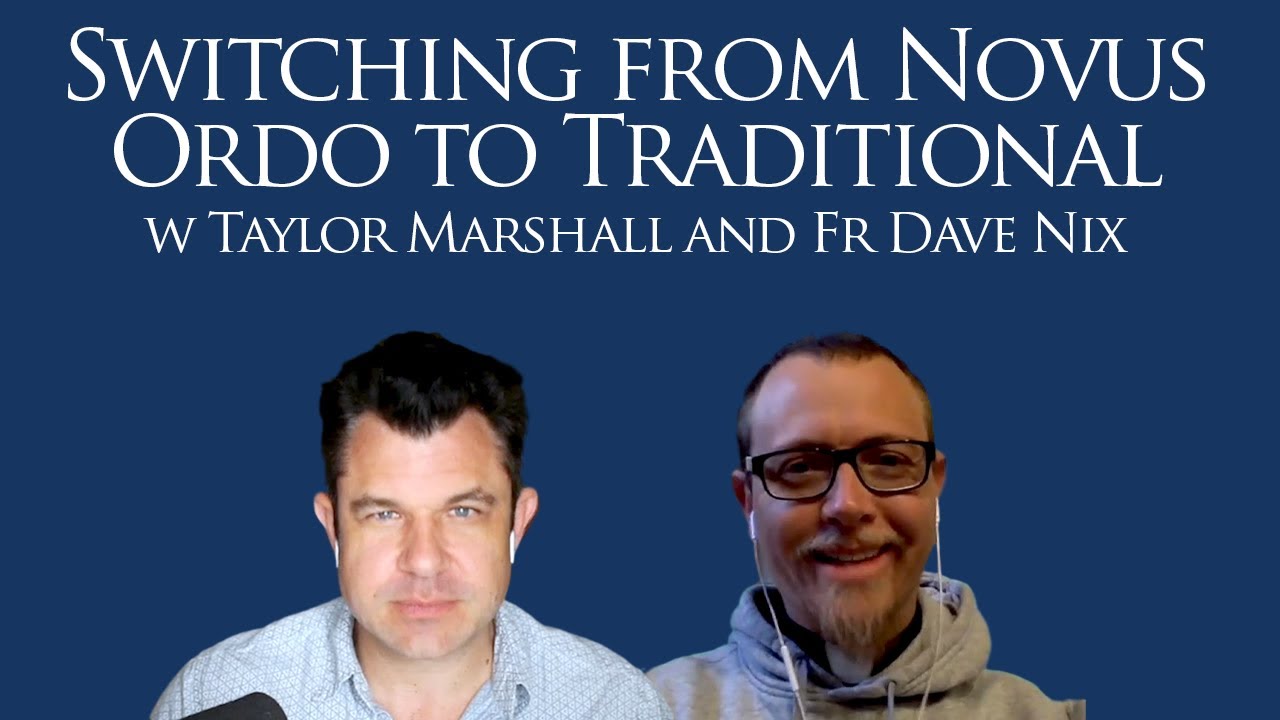
I occasionally catch video interviews that Taylor Marshall has with folks who interest me. Today I saw most of a video he did with Fr. David Nix, a good young priest in Denver whom I’ve met.  They both are both smart and sincere.

In this video, they discuss issues people encounter if, after having experienced nothing other than the Novus Ordo, start attending a traditional parish and the Traditional Latin Mass. There are things which have to be explained, because they’ve dropped by the wayside since Council and its disastrous implementation.

Taylor himself is a convert and Fr. Nix is a revert. They had to make a lot of discoveries as they “came into the Church” on a new level. They cover quite a bit of territory, from their discovery that in sacristies there is something called a “sacrarium” and how altar linens are to be rinsed by a priest before they are laundered, to certain customs of the confessional.

Being a convert myself, and having been a priest now for quite a while, and having been writing and answering questions for many years on this blog and elsewhere, it was fun to listen to their conversation. They had some good insights. In a couple cases, as in why a priest might start the form of absolution before the penitent is finished saying an Act of Contrition, I might add a thing or two. That’s okay.  It’s hard to get to everything in an off the cuff discussion.

There was a great point made by Marshall about how one might add prayers to one’s assigned penance for the priest in gratitude. That’s wonderful. Some priests whom I know keep track of the penances they assign and then do them themselves.

Another good point is a discussion of roles of men and women in marriage and the family.  Men have headship.  But that means that men have to step up and lead as a “cruciform servant”.  They, too, have had the experience of hearing men say, “I’d like to go to the TLM, but my wife won’t let us.”  Oh my.  Spiritual headship means men make the call.  BUT!  BUT!  Who is teaching the kids their catechism?  He or she?  Who is leading the family rosary?  He or she?  If men abdicate their leadership, there’s a problem.   If he is going to say, “We’re going to the TLM”, then he had better be stepping up as  “cruciform servant”.  On the other hand, say a guy’s wife wants to go to the TLM but he doesn’t.  Then we can get into the sacrificial love aspect and work it out.

Other good points. How to deal with the “chapel veil police” or unpleasant things at coffee and donuts after Mass.   I like that: Veil Police™.  Fun.  And TRUE in some places.

I loved the point about sung Vespers in the parish on Sunday evening!   That’s what we had in my parish in St. Paul.   It was extremely formative for me. That’s why there are prayers for Vespers in hand missals, by the way.

They talk about the differences in the rites of baptism and supplying the elements of the ritual missing in the newer form, or the way that the traditional sacrament of anointing is administered.   They consider how the Eucharist was moved to the place where the sick are to receive.

In any event, here’s the video. It could be helpful for people interested in getting into our Tradition.

YouTube thumbnailYouTube icon

Posted in "How To..." - Practical Notes, Just Too Cool, Our Catholic Identity | Tagged , ,
10 Comments

ASK FATHER: Sex before Communion

UPDATE 15 July 2019:

Rev. Mr. Kandra remarked at his blog about this post.   He disappoints.

The non-canonist deacon disagrees with the canonical arguments of the esteemed canonist Ed Peters.  Fine.  Kandra can state a position and attempt to defend it. So can Peters.   That’s not the disappointment.

What disappoints is the flippancy with which Kandra treated the issue of continence for deacons.  He concludes…

Meantime, the Church has moved on to more pressing matters.

Regarding his last point: I suspect many would greet that admonition the same way they greeted Humanae Vitae.

“More pressing matters”?  Like… what?  Climate change?

This is a big fail because a major component in long-building Present Crisis has to do with the eroded identity of Holy Church’s clergy.   It is hard to think of a “more pressing matter” than clerical identity.   Who is the cleric and how should the cleric live is at the core of many problems we face today.  Are married deacons clerics or not?   Remember, there are married priests out there, too.

In the post above, I cited how seriously GOD takes priestly continence in the episode at the mountain before the Law was imposed (because of disobedience).  The Church has taken clerical continence seriously for a long time and for good reason.   If married permanent deacons want to be taken seriously as clergy, they need to take issues that concern clergy seriously and not just blow them off.

And moving to that second part, and the reference to Humanae vitae… how to read that?

If I understand Kandra correctly, I think he is referring to the fact that many lay people ignored or willfully and knowingly violated the Church’s teaching concerning contraception.  Many of them did this because their clergy told them they could and should.  I may be wrong, but it seems that Kandra is, with that Humanae vitae reference, suggesting to his married diaconal confreres ignore or disobey the admonition in the Roman Catechism.

There may be a newer catechism since the Roman Catechism, but that doesn’t make the Roman Catechism into a nothing.  This is a serious issue addressed by serious and saintly theologians (including St. Charles Borromeo).  They didn’t include that admonition for the heck of it.   Clearly they thought there was a spiritual good in it and, therefore, a good for the whole people of God.

One of the traps of modernists is the erroneous notion that we of this, our 21st century, are more mature, more sophisticated, better now than our benighted forebears.   We’ve outgrown all that old stuff and can put it aside without any qualms.  Who cares what the letter says?  Who cares what our predecessors thought or admonished?   We know better.

I’m not saying that I think Rev. Mr. Kandra is a modernist.  I’m saying that this is a modernist trap into which many people can and have fallen.

In any event, canonical issues aside, I think that this is a serious issue precisely because it concerns a key and divinely instituted component in our collective Catholic identity.


___ Originally Published on: Jul 14, 2019

From a reader…

QUAERITUR:

The Roman Catechism (Trent) says that a couple should abstain from the marital act at least three days before receiving Holy Communion. I have read that this, though still advisable, is not required under current law. Please advise? Thanks and Jesus and Mary be with you.

In a section concerning the ends of marriage, the Roman Catechism – intended to improve the preaching of priests in parishes – temporary abstinence from the marital act is recommended for the sake of greater prayer.

It was recommended.  It is not required by law.

This is still an issue in the case of married permanent deacons.  Canonists such as Ed Peters argues – convincingly – that, as clerics, they are obliged to abstinence by can. 277 and tradition upon which it rests.

Unlike angels, we humans have both body and soul.  It therefore makes sense that people should prepare in both soul and also body for reception of Holy Communion.

In our souls we prepare by making an examination of conscience, confession of sins, prayer and meditation on the profound implications of such a daring act.

In our bodies we prepare through self-denial of bodily appetites which, obviously, includes sexual desires.

Food is good.  Sex is good (natural sex, of course, not the same-sex filth that makes even the demons turn away their gaze).  We practice denying ourselves good things.  These mortifications and sacrifices are good for us.

Abstinence, especially for clergy, is attested to in Scripture.  It was the will of God that, before His descent upon them after the Exodus, men (they were all priestly then) should abstain from sexual intercourse.  They weren’t even to set their feet on the mountain.   They violated God’s will and, as a result, since they weren’t to be trusted on their own God imposed more laws on them.  The Roman Catechism also cites the example of David, who abstained from sexual relations for three days before receiving the show-bread from the priest.   Of course David is a priestly-king. But by baptism, the baptized participate in Christ’s three-fold office.

Remember too that while the Roman Catechism advocates frequent Communion, it comes from an era when Communion was received relatively rarely, even as seldom as once a year. The Church did have to demand, as a matter of a “commandment of the Church” to receive Communion at least once a year.

It is a matter of conjecture to consider the relationship between the infrequency of Communion and the strong admonishment to refrain from sex for three days before Communion.

It is perhaps a sign of the times that, now, bodily preparation for Communion is so attenuated. It is as if the post-Conciliar Church succumbed to the “ghost in the machine” view of man.  Abstinence from food before Communion devolved.  It was, once, from midnight onward.  Then it was for three hours.  Now it is a laughable one hour before Communion under normal circumstances.   But at least there is a law about the Eucharistic fast.  There is nothing whatsoever about sexual abstinence, not even a recommendation.

And it isn’t as if practicing Catholics are going to Communion once a year only.   They go all the time.  It has gotten to be that people think they haven’t been to Mass if they haven’t received Communion. FAIL!  People think that they have to go to Communion.  FAIL!  The result is that there is now a kind of psychological pressure to receive which overrides sound judgement about being in the state of mortal sin.

Heck, Amoris laetitia has even given license to adulterers who are not living in continence to go to Communion.   Ideologues are on the ascendancy right now, and therefore totalitarianism, with its tenet, “Everything that is not forbidden is compulsory”.  Both Communion and sex are now obligatory, even for adulterers.

I wonder what would happen if the Church started to admonish married people to abstain from sexual relations for three days before Communion.

Or, let’s be post-Conciliar, and say one day.

Or, let’s be post-Conciliar and into Amoris laetitia, and say maybe only one hour?  Including adulterers?

No, that’ll be shouted down too.

Posted in "How To..." - Practical Notes, ASK FATHER Question Box, Canon Law | Tagged , ,
25 Comments

Your Sunday Sermon Notes – GO TO CONFESSION! – VIDEO

Was there a good point made in the sermon during your Mass of Sunday obligation? Let us know.

For my part, I had a note early this morning from the scheduled celebrant, our VG, who succumbed to some ailment (get well soon!) and, subsequently, could I take the Mass.  Hence, I saluted, combed my hair, and headed off to an early morning Missa Cantata on this 5th Sunday after Pentecost.   Full disclosure: I was going to be there anyway, so that I could take the diaconal slot and we could have a Missa Solemnis.  But I had not planned on preaching.   What follows is off the cuff.

GO TO CONFESSION!

Posted in GO TO CONFESSION, Liturgy Science Theatre 3000 |
7 Comments

SSPX video of their amazing new US church project.

There is an amazing video available of an amazing project mounted by the SSPX in these USA.  They are building a huge and beautiful new church.

One of the things I find interesting about this video is the intelligent commentary on what it takes to plan and to build the sort of church they are projecting in the place where they want to build it. I’ve thought quite a bit about these same issues.

Building a Home Worthy of The Immaculata from Society of St Pius X on Vimeo.

Each group in every age of the Church’s life has built churches which reflect their faith, which communicate an answer to the question: “Who is the Church?”

Yes, today it is still possible to build amazing churches worthy of the name. They don’t all have to look like municipal airport terminals.

I would also like to recommend a book by Fr. James W. Jackson, FSSP, which begins with a view of church architecture based on the tenets of St. Charles Borromeo.

Nothing Superfluous: An Explanation of the Symbolism of the Rite of St. Gregory the Great 

US HERE UK HERE

Posted in SSPX, The future and our choices | Tagged , ,
19 Comments

BOOK: In Praise of the Tridentine Mass and of Latin, Language of the Church

What a great title!

The nice folks at Angelico Press sent a copy of

In Praise of the Tridentine Mass and of Latin, Language of the Church

by Fr. Roberto Spataro, Secretary of the Pontifical Academy for Latin.

US HERE – UK HERE

Table of contents.  This is a collection of talks given around Italy.   Note that the introduction by Patrick Owens is significant.  Inter alia he provides a history of Latin in the Church.

In the section “Desperate Times Call For Desperate Measures”, the author argues that spreading to use of the Vetus Ordo is a “work of mercy”.

Fathers, these essays could help you to prepare the way for the implementation of Summorum Pontificum in your parishes.  They could help lay people bring their priests around to what must be done.

He’s right.

Posted in "How To..." - Practical Notes, REVIEWS | Tagged , , ,
18 Comments

WDTPRS – 15th Ordinary Sunday: Too far right or too far left, we wind up in the ditch in the dark

This week, the 15th Ordinary Sunday in the Novus Ordo calendar, we have a good example of the dramatic difference between the old, Obsolete ICEL version we suffered with for decades, and the Latin with the Current ICEL version.

The Collect or Opening Prayer for this 15th Sunday of Ordinary Time in the Ordinary Form of the Roman Rite is also used in the Extraordinary Form on the 3rd Sunday after Easter.   In the Ordinary Form it is also the Collect for Monday of the 3rd week of Easter season.

Today’s prayer goes back at least to the ancient Gelasian Sacramentary.  My trusty edition of St. Pius V’s 1570 Missale Romanum, and the subsequent 1962MR, shows the insertion of a word – “in viam possint redire iustitiae” – not present in the more ancient Collect in the Gelasian (though it was present in some other ancient sacramentaries).

The Ordinary Form editions of the Missal drop iustitiae.

Stylistically, this is a snappy prayer, with nice alliteration and a powerful rhythm in the last line.

Deus, qui errantibus, ut in viam possint redire,
veritatis tuae lumen ostendis,
da cunctis qui christiana professione censentur,
et illa respuere, quae huic inimica sunt nomini,
et ea quae sunt apta sectari.

It is hard to know what might be the sources influencing this prayer.  There is John 14, which we shall see below. Can we find a trace of the Roman statesman Cassiodorus (+c. 585 – consul in 514 and then Boethius’ successor as magister officiorum under the Ostrogothic King Theodoric)?  Cassiodorus wrote, “Sed potest aliquis et in via peccatorum esse et ad viam iterum redire iustitiae? But can someone be both in the way of sins and also return again to the way of justice?” (cf. Exp. Ps. 13).  Note especially the presence of “iustitiae” in Cassiodorus’ phrase.  Might we infer a touch of Milan’s mighty Bishop Ambrose (+397) or even more probably Augustine of Hippo (+430) who use similar patterns of words?

The thorough Lewis & Short Dictionary informs us that the verb censeo, though quite complicated, is primarily “to estimate, weigh, value, appreciate”.  It is used for, “to be of an opinion” and “to think, consider” something.  There is a special construction with censeo, censeri aliqua re meaning “to be appreciated, distinguished, celebrated for some quality”, “to be known by something.”   This explains the passive form in our Collect with the ablative christiana professione.   Getting this into English requires some fancy footwork.   Censeo here retains a meaning of “be counted among” (think of English “census”).  We can get the right concept in “distinguished” since it can mean both “be counted as” as well as “be celebrated for some quality.”

Christianus, a, um is an adjective with the noun professio. When moving from Latin to English sometimes we need to pull adjectives apart and rephrase them.  We could say “Christian profession”, but what this adjectival construction means here is “profession of Christ.”  We find the same problem in phrases such as oratio dominica, which is literally “the Lordly Prayer”. In English it comes out more smoothly as “the Lord’s Prayer”.

Respuo literally means “to spit out” and thus “reject, repel, refuse”.  The fundamental meaning gives a strong enough image for me to say “strongly reject, repudiate”.  The deponent verb sector indicates “to follow continually or eagerly” in either a good or bad sense.  Sector is used, for example, to describe a group of followers who accompanied ancient philosophers, which is where we get the word “sect”.

The word via needs our attention.  It means, “a way, method, mode, manner, fashion, etc., of doing any thing, course”.   There is a moral content to via as well, “the right way, the true method, mode, or manner”.

That’s a lot of vocabulary.  On the other hand, that’s what the prayer contains and words have meanings.

VERY LITERAL TRANSLATION:

O God, who show the light of Your truth to the erring so that they might be able to return unto the way, grant to all who are distinguished by their profession of Christ that they may both strongly reject those things which are inimical to this name of Christian and follow eagerly the things which are suited to it.

Now look at this!

OBSOLETE ICEL (1973):

God our Father,
your light of truth
guides us to the way of Christ.
May all who follow him
reject what is contrary to the gospel.

I’m inspired!  Aren’t you?

What were they thinking?!?   No wonder so many Catholics today are so screwed up, after decades of that rubbish.

CURRENT ICEL (2011):

O God, who show the light of your truth
to those who go astray,
so that they may return to the right path,
give all who for the faith they profess
are accounted Christians
the grace to reject whatever is contrary to the name of Christ
and to strive after all that does it honor
.

Some initial associations to my mind.

Ancient philosophers (the word comes from Greek for “lover of wisdom”) would walk about in public in their sandals and draped toga-like robes.  Thinker theologian/philosophers such as Aristotle were called “Peripatetics” from their practice of walking about (Greek peripatein) under covered walkways of the Lyceum in Athens (Greek peripatos) while teaching.  Their disciples would swarm around them, hanging on their words, debating with them, learning how to think and to reason.  They would discuss the deeper questions the human mind and heart inevitably faces and in this they were theologians.

We must be careful not to impose the modern divorce of philosophy and theology on the ancients.  In ancient Christian mosaics Christ is sometimes depicted wearing philosopher’s robes, his hand raised in the ancient teaching gesture.  He is Wisdom incarnate and the perfect Teacher.   He is the one from whom we should learn about God and about ourselves.  After Christ Himself, we also have His Church, who is Mater et Magistra – Mother and Teacher.  Sometimes a small Christ is seated upon His Mother as if she were His teaching chair, or cathedral.  When so depicted, Mary is called Seat of Wisdom.

I am also reminded of the very first lines of the Divine Comedy by the exiled Florentine poet Dante Alighieri (+1321) who was heavily influenced by Aristotle’s Ethics and the Christianized Platonic philosophy mediated through Boethius (+525) and St. Thomas Aquinas (+1274).

The Inferno begins:

Midway in the journey of our life
I came to myself in a dark wood,
for the straight way was lost.
Ah, how hard it is to tell
the nature of that wood, savage, dense, and harsh –
the very thought of it renews my fear!
It is so bitter death is hardly more so.

Dante, the protagonist of his own poem, describes his fictional self.  His poetic persona, in the middle of his life (35 years old), is mired in sin and irrational behavior.  He has strayed from the straight path of the life of reason and is in the “dark wood”.

If you haven’t read the Divine Comedy, Esolen translated it into English and did a great job. You could start with Part 1, Inferno – US HERE – UK HERE – or perhaps with Dorothy Sayer’s fine version – Part 1, Inferno, US HERE – UK HERE

The life of persistent sin is a life without true reason, for human reason when left to itself without the light of grace is crippled.

Dante likens his confused state to death.  He must journey through hell and back.  He then experiences the purification of purgatory in order to come back to the life of virtue and reason.  In the course of the three-part Comedy he finds the proper road back to light and Truth and reason through the intercession of Christ-like figures such as Beatrice and Lucy and then through Christ Himself.

In the Comedy, Dante recovers the use of reason.  His whole person is reintegrated through the light of Truth.

Don’t we often describe people who are ignorant, confused or obtuse as “wandering around in the dark”?  This applies also to persistent sinners.

By their choices and resistance to God’s grace they have lost the light of Truth.  God’s grace makes it possible for us to find our way back into the right path, no matter how far off of it we have strayed in the past.

When we sin, we break our relationship with Christ.

If in laziness we should refuse to know Him better (every day), we lose sight of ourselves and our neighbor.

The Second Vatican Council teaches that Christ came into the world to reveal man more fully to himself (GS 22).

Christ, the incarnate Word, tells us in the person of the Apostle St. Thomas:

“‘Let not your hearts be troubled; believe in God, believe also in me. In my Father’s house are many rooms; if it were not so, would I have told you that I go to prepare a place for you?  And when I go and prepare a place for you, I will come again and will take you to myself, that where I am you may be also. And you know the way (via) where I am going.’  Thomas said to him, ‘Lord, we do not know where you are going; how can we know the way (via)?’ Jesus said to him, ‘I am the way (via), and the truth (veritas), and the life; no one comes to the Father, but by me.  If you had known me, you would have known my Father also; henceforth you know him and have seen him…. He who has seen me has seen the Father’” (cf. John 14:1-6 RSV).

We have not only the words and deeds of Christ in Scripture, but God has given us in the Catholic Church herself a secure marked path to follow towards happiness.

We can stray off this sure path either to the right or to the left.  Either way, too far right or too far left, we wind up in the ditch in the dark.

When we have gone off the proper path and have left Christ, the Way, we can return to our senses again and be reconciled with God and neighbor through the sacraments entrusted to the Catholic Church, especially in the Sacrament of Penance and then good reception of Christ in Holy Communion.

We Catholics, who dare publicly to take Christ’s name to ourselves, need to stand up and be counted (censentur) in public and on public issues and even sharply refuse (respuere) whatever is contrary to Christ’s Name.

In what we say and do other people ought to be able to see Christ’s light reflected and focused in the details of our individual vocations.

To be good lenses and reflectors of Christ’s light, we must be clean.  When we know ourselves not to be so, we are obliged as soon as possible to seek cleansing so that we can be saved and be of benefit for the salvation of others.

GO TO CONFESSION!

We must also practice spiritual works of mercy, bringing the light of truth to the ignorant or those who persist in darkness either through their own fault or no fault of their own.

QUAERITUR: When people look at us and listen to us, do they see a black, light-extinguishing hole where a beautiful image of God should be?


Posted in GO TO CONFESSION, WDTPRS | Tagged
4 Comments

“Damn!”, quoth I.  “That’s the spirit.” Coasties getting the job done.

Last night I saw on the news a video of a Coastie jump onto a moving surfaced submarine hauling narcotics to these USA and pound the hatch till it opened.

“Damn!”, quoth I.  “That’s the spirit.  That’s an object lesson.”

This is fantastic.  The admiration meter is now broken.

Fr. Z Kudos to the US “Semper Paratus” Coast Guard.

YouTube thumbnailYouTube icon

A somewhat “raw” account, HERE.

The analogies for our attitude in The Present Crisis are multiplying rapidly in my mind.

With what kind of courage must parents raise their children today, given the not-even-submerged poisons being hauled to their souls?

With what sort of determination must priests have in preaching and teaching the truths of the Catholic faith and in their celebration of the sacred mysteries?

THAT KIND.

You, dear reader, have a vocation.  How are you living it?


Posted in Be The Maquis, Fr. Z KUDOS, Hard-Identity Catholicism, Semper Paratus, Si vis pacem para bellum!, The Coming Storm, The future and our choices | Tagged ,
8 Comments