Fr Rosica, amazing papal claims, and resignations

Let’s be clear. There is an element among Francis’ most dedicated promoters, channel their inner Rex Mottram and declare nearly every syllable that he utters to be oracular and under the inspiration of the Spirit.   Some of them form an inner core, like a New catholic Red Guards, a la the Cultural Revolution, ready to pounce on any deviation from their received message and according to their orders from their cadres.

One of best/worst examples of this came almost a year ago from NcRG member Fr Thomas Rosica of Salt and Light.  Recently, Rosica has been embroiled in a plagiarism scandal, which has revealed quite a few examples.

Anyway, Rosica, in July 2018, wrote… and meant it… that Pope Francis

“breaks Catholic traditions whenever he wants because he is ‘free from disordered attachments.’ Our Church has indeed entered a new phase: with the advent of this first Jesuit pope, it is openly ruled by an individual rather than by the authority of Scripture alone or even its own dictates of tradition plus Scripture.”

Apart from it being highly weird, that was one of best/worst examples of sycophantic crawling you will find from that end of the spectrum.  Truly exemplary.

And… it was plagiarized.

As a story at CNA notes, …

In April, it was discovered that one of Rosica’s most controversial publications, a July 2018 blog post, had been plagiarized from a 2014 blog post by by Richard Bennett, a former member of Dominican Order and an apparently laicized priest, who is now active in a fundamentalist Protestant organization which says it “places particular emphasis on the evangelization and conversion of Roman Catholics.”

What a source.

That same CNA story says that Rosica has resigned from Salt and Light.

I’ll turn on the comment moderation queue for this one.

Posted in The Drill | Tagged ,
9 Comments

Priest apologizes to traditional Catholics: “The future of the Church is in her past.”

From a priest… (my emphases)

Dear Fr Z:

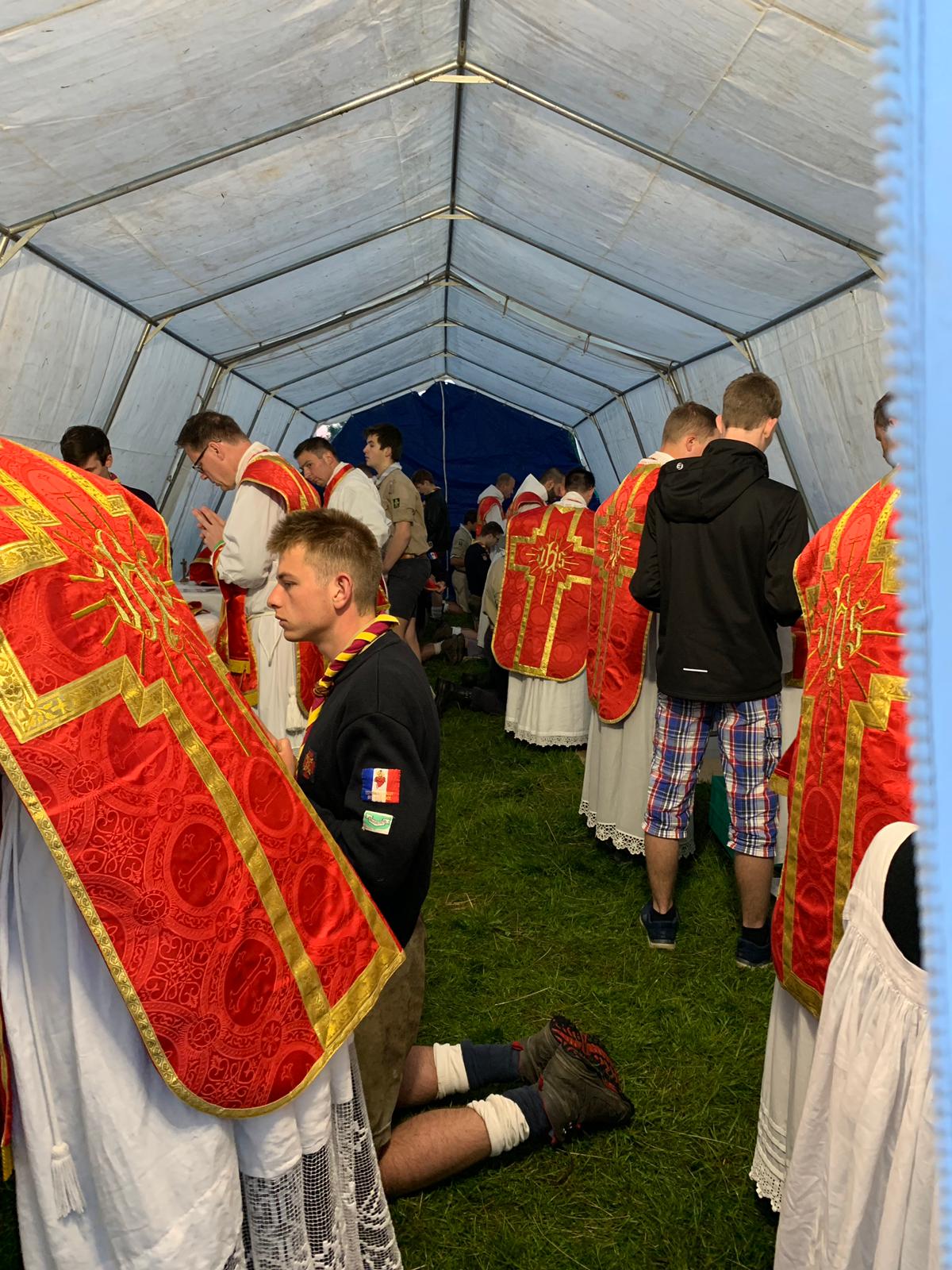
I’ve just returned from France where, among other things, I took part in the Chartres Pilgrimage.

After registering for the Pilgrimage, I discovered that the usus antiquor would be required of all participating priests, I decided it was high time to learn how to celebrate the Extraordinary Form, thanks to a very kind and patient FSSP priest in the neighborhood.

At first, I was taken back by the demand to stick to the Extraordinary Form, then I realized that a far worse injustice was inflicted when it was ripped away from the faithful shortly after the Council.

Several months beforehand, however, I took it upon myself to celebrate the older Breviary–I bought the Baronius edition– […].  I was therefore exposed to a greater number of the Psalms and, since I was using an edition based upon the Septuagint, I found these Psalms to be more Christologically obvious.  Not only that, but the prayers, I discovered, were more even more “manly.”

The great boon in celebrating the Extraordinary Form, for me, was mainly twofold.  First, there is something very liberating about incessantly asking the Lord for forgiveness as we do, in not only the Confiteor but also the many private prayers of the priest.  The Scripture became very true for me:  “Humiliamini in conspectu Domini, et exaltabit vos.”  Second–and I understand that some of your readership may differ from me here–as a Charismatic Catholic, I deeply, deeply appreciated the celebration of the Pentecost Octave, with the sevenfold Veni, Sancte Spiritus and the focus on the outpouring of the Holy Spirit in the Epistle.  I’ll come right out and say it:  The “mutual enrichment” envisioned by Pope Benedict has come true in my own priesthood by the exchange between Traditionalism and the Catholic Charismatic Renewal.

Without abandoning the Ordinary Form, I confess that the older Missal and Breviary has enriched my priesthood in ways I had never imagined.  In fact, I found myself becoming more robustly priestly and fatherly.

[ NB] I also want to take a moment for public repentance.  Long ago, at a certain liberal seminary far, far away, I was indoctrinated with a disdain for, and even a mockery of, Traditional Catholics.  I jumped on the bandwagon for their supposed liturgical naivete and sanctimony.  I was convinced that they were backwards, habitually uncharitable, and elitist.  After being around 14,000 other Traditional Catholics and priests of more traditional religious congregations, I found them to be astonishingly affable, joyous, and genuine.  I was especially surprised to not have heard a single murmur against Pope Francis during the Chartres Pilgrimage.  So, to all of those Traditional Catholics I mocked in the past:  I am truly sorry.  I was wrong.  You are doing tremendous good for Christ and His Church.

And you, Traditional Catholics, you are so young!  Attached is a picture I snapped as I was walking, of a young boy and a tonsured monk in long, deep conversation–as I took it, a word came to me:  “The future of the Church is in her past.”

I have also become convinced that Summorum Pontificum was in fact a prophetic  document, as it made possible a place of refuge and safe harbor in the face of the Church’s current crisis.

If you decide to reproduce this, kindly withhold my name.

Do keep up the good work.

Fraternally in Christ….


Posted in ¡Hagan lío!, Mail from priests, Priests and Priesthood | Tagged
35 Comments

ASK FATHER: Is a concelebrated Mass just one Mass or several Masses?

From a reader…

QUAERITUR:

Your recent post and “rant” regarding concelebration made me realize…I don’t actually know what happens at a concelebrated Mass. Is it technically two Masses (if there are two concelebrating priests)? How does that actually work?

At first glance, yes, this can be confusing.  It seems as if there are as many Masses as their are priests concelebrating.  This is especially so because priests are able to accept a stipend even when they concelebrate.  Hence, it seems that there are more than one Mass.

However, it’s a philosophical principle that there can be various instrumental causes united under an agent cause.  That is, there can be a main celebrant and various concelebrants with their own intentions to apply the merits of the Mass (which are infinite) to this or to that purpose (thus the stipend) but, in fact, at the time of the consecration they all have (we hope) the same intention to consecrate the Eucharist.

Sometimes an analogy of baptism is used.  If several priests were to pour water and say the formula of baptism simultaneously over the head of a child, there would be one baptism occurring in the child, not many baptisms.

At a concelebration there is ONE Mass with more than one celebrant,

That said, I think that, as far as the Novus Ordo is concerned, concelebration ought to be safe, legal and rare.

I will concelebrate for, say, an ordination to the priesthood, but not to the diaconate.  I won’t concelebrate at weddings and funerals.  I am happy to attend in choir.   Having clerics in choir also adds to the decorum of the moment.

Concelebration has its place.  In the traditional Roman Rite, newly ordained priests each have their own missal and they consecrate with the ordaining bishop.   That seems fitting.  The rest of the priests present don’t, however.  They manifest their unity of priesthood by imposing hands during the rites.

At gatherings of priests, say that a bunch of guys get away at someone’s lake place “up north”, it is tempting to have one concelebrated Mass.    It’s “brotherly”, quick, and over.  It seems to me better that priests should serve Mass for each other, even if multiple altars must be set up so that it doesn’t take all day (thus, cutting into golf time).   It’s good for a priest to serve Mass occasionally.

Frankly… more, reverently offered,  Masses are better.   How could it not be so?

See my remarks on Save The Liturgy – Save The World.

Posted in "How To..." - Practical Notes, ASK FATHER Question Box, Liturgy Science Theatre 3000, Our Catholic Identity, Priests and Priesthood | Tagged ,
15 Comments

NOVENA FOR SEMINARIANS – from Corpus Christi to Sacred Heart, with a Marian Consecration

From a priest:

Dear Father, we have met several times, most recently last year at the Canon Law conference in La Crosse. I wrote a novena for seminarians to be prayed from Corpus Christi to the Sacred Heart, with a Marian Consecration on the Immaculate Heart (OF Calendar). If you wish to distribute it, here is the text. If you do so, please do so anonymously.

On another note, have you ever thought of trying to collect (no pun intended) and publish the various What Does the Prayer Really Say articles as a commentary on the liturgical year?  [I have indeed.]

Here’s the novena.  I had to guess a little at the format, but you can work it out.

Novena to the Sacred Heart and Consecration 
to the Immaculate Heart for Seminarians 

Said from the Solemnity of Corpus et Sanguinis Christi to the
Solemnity of the Sacred Heart of Jesus

Eucharistic and Sacred Heart of Jesus, you were not satisfied to enjoy
and glorify the Father alone with your Mother, but wanted many
brothers and sisters to join you in glory. Coming among fallen
humanity, you proclaimed the friendship of God and we, yet enemies,
crucified you. You submitted to our blows and insults: satisfying for
our disobedience with your obedience, our sensuality with your
suffering, our hubris with your humiliation, our acedia with your
ardor, and our rejection of God by submitting, obedient to the Father,
to our rejection of You and your Mother. We pierced those hearts which
so loved unlovable man and from your opened side was brought forth
Holy Church, fully Immaculate in your Mother. To make us faithful like
the Beloved Disciple, you entrusted us to Her and Her to us. Having
finished the work of redemption but wishing to remain with us still,
you called men to yourself and sent them to proclaim your teaching and
through them flow forth the stream of water and blood in Baptism and
Eucharist.

Therefore, I lift up in prayer all the seminarians throughout the
world. Form them in solid doctrine and virtue, fill them with the
Spirit and His Holy Works, and fix them in the Immaculate and Virginal
Heart of Mary. Thus configured to you, the One High Priest, they may
proclaim the Word of God boldly and bring forth souls for the Kingdom
through prayer and the Sacraments.

Immaculate Ever-Virgin Mother of God, from your place at the side of
your son, send down upon them the grace and illumination of the Holy
Spirit, so that they, from infidelity, may be made faithful to God and
true sons of the Church.

May your love, fiery and sweet as honey, wean their hearts from the
things of this world:
So that they may die for love of your love, as you died for love of
our love.

Give them a right faith, a sure hope, a perfect charity, a profound
humility:
The gifts of will and intelligence to know and fulfill your Holy
Will.

Holy Father Saint Francis, Holy Mother Saint Clare, Saint Maximilian,
and Saint Pio:
Pray for us!

Consecration on the Feast of the Immaculate Heart

O Immaculate, Queen of heaven and earth, Refuge of sinners and our
most loving Mother, God has willed to entrust the entire order of
mercy to You, take these unworthy men who cast themselves at Your feet
with all they have and are, wholly to Yourself as Your possession and
property. Please make of them, of all their powers of soul and body,
of their whole lives, deaths, and eternity, whatever pleases You. If
it pleases You, use all they have and are without reserve, wholly to
accomplish what has been said of You: “She will crush your head”,
and “You alone have destroyed all heresies in the whole world.”
Let them be fit instruments in Your immaculate and most merciful hands
for introducing and increasing Your glory to the maximum in all the
many strayed and indifferent souls, and thus help extend as far as
possible the blessed Kingdom of the Most Sacred Heart of Jesus. For,
wherever You enter, You obtain the grace of conversion and
sanctification, since it is through Your hands that all graces come to
us from the Most Sacred Heart of Jesus.

Allow us to praise You, O most holy Virgin:
Give them strength against Your enemies.

Posted in "How To..." - Practical Notes, HONORED GUESTS, Mail from priests, Our Solitary Boast, PRAYER REQUEST, Seminarians and Seminaries | Tagged , ,
1 Comment

A Solemn Mass in Albany in the presence of the bishop. Wherein Fr. Z rants.

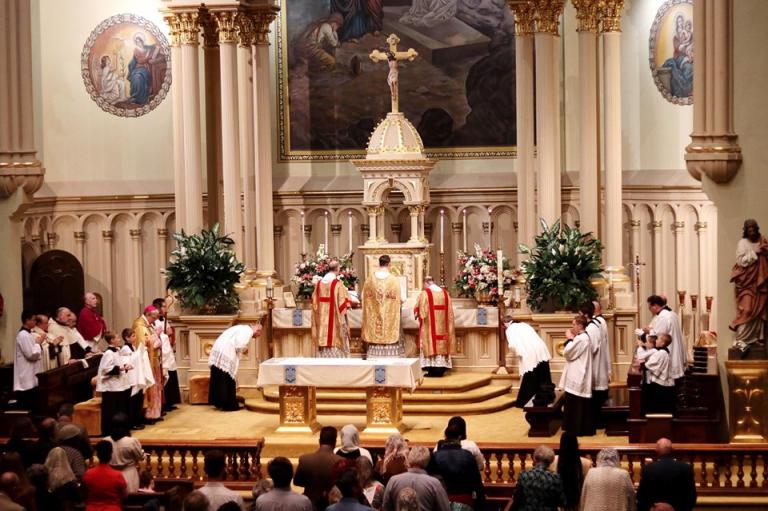
The esteemed Deacon Kandra posted – picking up on some Facebook page or other (I don’t like Facebook) – that a Solemn Mass was celebrated on Trinity Sunday in the Roman Church’s traditional form at the St. Mary’s in Albany, NY. From Rev. Mr. K (my emphases and comment):

This popped up on the Facebook page for the Diocese of Albany, and it’s worth noting:

Solemn High Mass in the Presence of the Ordinary to commemorate the 20th Anniversary of The Extraordinary Form in the Albany Diocese. Both Bishop Edward B. Scharfenberger and Bishop Emeritus Howard Hubbard concelebrated[Ummm… no.  They didn’t.]

The Mass took place at St. Mary’s Church in Albany.

A few people have noted that there is no “concelebration” in the Extraordinary Form. It appears, however, that Bishop Scharfenberger and Bishop Emeritus Hubbard both took part.

[…]

Yes, they “took part”, but they did not concelebrate.

Let me rant about this for a little bit.  And, believe me, I am not slinging arrows at Deacon Kandra.  Moreover, I renew an invitation to him anytime he is in WI to come to learn to act as deacon in the Roman Rite.  I’m sure he would like to learn to do that.

However, allow me to riff a little on the “concelebration” thing for a moment.

What Deacon Kandra get a little wrong here is that, there was NOT concelebration in the modern, common usage of the word. What happened was Solemn Mass in the presence of the Diocesan Bishop.  A priest said the Mass and bishops were present.  In this case the variant was that the bishop, the diocesan ordinary, participated in cope and miter. There are also provisions for the bishop to be in cappa magna.

Here’s a shot of the late Extraordinary Ordinary at the First Mass of a priest.  The bishop is in cappa.

As for the presence of the bishop emeritus (Hubbard…not exactly a friend of tradition, he), he was simply in choir dress and in choro. In a generic sense of “concelebrating” they were “concelebrating”, but there was only one celebrant, the priest saying the Mass.  Bp. Scharfenberger “presided” so to speak, but not as celebrant.  Bp. Hubbard was in choir and he helped with Communion.  There’s another term that get’s mixed up.  In NovusOrdoese “preside” often is applied to the priest celebrating the Mass, “Good morning everyone!  Today’s presider is Fr. Jasmine of the Society of Jesus… open your worship aids to page….”

Here’s where you can see the Great Divide made manifest.

Again, I’m not trying to beat up Rev. Mr. Kandra.  Nemo dat quod non habet.  If you have not learned all this technical stuff from the older rite, then you pull out terms from the Novus Ordo and your own experience to fill in the blank.  But the older, traditional form has levels of celebration that the extremely flattened Novus Ordo eliminated.

Here’s where I want to rant a little.

In just a few decades, even clerics aren’t really sure about what is going on in our Church’s Roman Rite.

Remember: I maintain that a Roman Catholic cleric who doesn’t know also the Extraordinary Form, doesn’t really know his own Rite.  It’s one thing when men ordained before the Emancipation Proclamation was issued (aka Summorum Pontificum), but it is entirely another afterwards.  This is because at ordination someone has to stand up and attest that the ordinands are well trained.  But if they don’t know their Rite, they are not well-trained.   However, now that Summorum is out, and at least juridically there are two forms of the one Roman Rite, then ever cleric who does not know the traditional form is obliged to learn it and learn it NOW.

This is for the sake of their own professional integrity and identity, if nothing else.

Consider, for example, the graduation of a medical doctor who perhaps studied pathology, pharmacology, and maybe specialized in endocrinology, but didn’t get into all that anatomy and biochemisty stuff. Image a lawyer being passed to the bar without having studied civil procedure, constitutional law, or contracts. How about a doctorate in French literature without knowing French?

I suggest that a physician, lawyer, or professor worth their salt would, upon discovering a big gap in their tool box, move heaven and earth to get those tools!

Professionals are expected to know the tools of their trade, basic and advanced. Priests are to know the Rites of their Church. The Roman Rite is more than the Novus Ordo, in English, “facing the people” with a four-(Protestant) hymn sandwich to the accompaniment of a piano.   It’s a great deal more than that.   Just because “that’s what we do every weekend done at St. Idealia” in the Diocese of Libville under Fr Bruce Hugalot , and the actual Roman Rite doesn’t seem to be very useful there, that doesn’t exonerate clerics from learning their Rite!   There is also the issue of identity and integrity.

WE ARE OUR RITES.

That goes for Catholics in the pews and clerics at the altar.  We are our rites.  And if you don’t know and never experience half your Rite – nay, rather far more than a mere half – the… who the heck are you?

C’mon, men!  Learn your Roman Rite!

If I wanted to by B-Ritual, say, Ukrainian, I’d have to work hard to learn the liturgy!  I’d have to learn Ukrainian, too, though some of their worship is in the vernacular.  It would be hard.  But if I respect it and the people… I’d do the work.

The late Bishop Morlino, above, told his seminarians that he wanted them to know, before ordination, the traditional Roman Rite.   He didn’t impose it (“Learn it or else!”).  He wasn’t expecting that they had to use it all the time.  But he wanted them to know it.  And, I can say for sure, that has had a real impact on the ars celebrandi of the men who were thereafter ordained.

Let me approach this another way, from the affective side rather than the intellectual side.

When you love someone, you want to know all about that person, all their little foibles.  And, learning those little foibles, even some of the annoying ones, you love them more deeply.  You engage your will and you reach out with your mind and heart to embrace the person as he or she is.  You delight in making your loved one more comfortable or more beautiful or better educated or… whatever is the true good for that person.  You’ll take care of the house and keep it clean and beneficial.  Food preparation will reflect your esteem.  Etc.

If a priest loves his Church and the Rite he belongs to, then he wants to know all about the Church and her Rite.   He want’s the whole scoop, all the reality of her history, all the ins and outs.  And because the most important thing that his Church does is worship God with sacred liturgical rites, then he should want to know all the ins and outs of those rites.  No?  If you love, you want to know and you want to do the very best you can, and not some slip-shod job, or something half way.   You want it all.  You’ll make God’s house lovely.  Worship will be greatly adorned with the best you can manage.  Etc.

Does that sound right?

I am very encouraged by the growing number of occasions for the use the traditional Roman Rite and the questions that arise and the issues that pop up as a result.  This is a time of mutual enrichment, as Benedict XVI wanted.   This occasion in Albany was an opportunity for mutual enrichment: it raised questions and issues for those who aren’t that familiar with it.  Armed with more knowledge, they will probably – from love of the Church – desire to flesh out than knowledge and learn more and then apply it where they serve!

Part of the problem is that subtlty has been lost.  The Novus Ordo shoves everything straight at you.  Talk talk talk… sound sound sound.  And there is a tendency to flatten it all out, so that it is “generic” and without variation.  There”s little difference from day to day even for big occasions.

On the other hand, the traditional Roman Rite had many layers of celebration from extreme simplicity up to supreme complexity.  If memory serves there are four ways for a Solemn Mass to be said in the presence of a bishop, depending also on that bishop’s office.  It was worked out.  And it worked.   And those workings-out provided great freedom…. and subtlety.

Again, when you love, you allow for complexity.  Subtlety is delightful.  You enjoy texture and contour rather than flatness and sameness.  The genius of the Roman Thing, Romanitas, in liturgy is that there can be multiple things going on at the same time.  There are concise, even terse prayers, and then elaborate gestures.  There are layers and subtlety.

Having layers and subtlety in WORSHIP means layers and subtlety in the mind of the cleric and and the hearts of the faithful.

We are our rite.


Posted in "How To..." - Practical Notes, Liturgy Science Theatre 3000, Mail from priests, My View, Wherein Fr. Z Rants | Tagged , ,
6 Comments

Thoughts about the change to CCC 2267 on the death penalty

When the change was made to the Latin text of CCC 2267 – concerning the death penalty (claiming that it is now always “inadmissible”) – I both said in sermons and wrote here that the change was troubling and for more than one reason.

First, when changes are made to doctrinal statements, they should make the teaching of the Church clearer, not less clear.  The change to CCC 2267 created confusion.

Second, it struck me that perhaps this was a trial-balloon, floated before attempting to change CCC 2358 on objectively disordered homosexual inclinations.

Also, I explained that something doesn’t become true by the fact of it being put into the CCC. It is put into the CCC because it can be demonstrated to be true. Look at pages in your CCC and you will find lots of footnotes with pertinent references to Scripture and the Fathers and Councils, etc. Look at CCC 2267 and you find one note, referring to a statement that Francis’ himself made in a speech a short while before.   That’s it.   It’s a bit self-referential. Of course it would be challenging to find references in Scripture or the Fathers or Councils etc. to uphold the position asserted in 2267, for, using all those, the Church has always upheld that capital punishment is admissible in some cases.

Hence, I refer you back to my first point.

Look.  You can be, personally, sincerely against any application of the death penalty in any circumstance, but you should still be really concerned about this change.   It’s puzzling… and that’s not what catechisms are for.  Catechisms might make you stop and think and scratch your head as you work it out, but they are not supposed to leave you puzzled.

People are confused by CCC 2267. It appears to be a radical change to the Church’s teaching. You have to read a lot of things into the vague word “inadmissible” to get to a place where 2267 doesn’t look like a reversal.

The other day, the US Bishops voted with only 8 NO votes – who are those guys, I wonder – to approve a change to the US edition of the Catechism to bring it into line with the Latin of CCC 2267.

Also, I see that Peter Kwasniewski gave a talk in Chicago about the change t0 CCC 2267. HERE

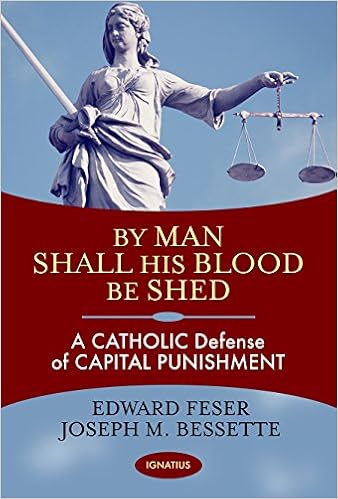
Ed Feser and Joseph Bessette co-authored a useful book about capital punishment.

US HERE – UK HERE

Finally, does this mean that the CCC is not, any longer, a sure reference work, as John Paul II, called it, for the Faith?   No.  It is still useful, to the extent that it was intended to be used.   The CCC – any catechism – is not and must not be thought of as the final word on every issue of faith and morals.   It’s a catechism.   As such, it is intended to be a summary for the introduction of teachings to the young and converts, catechumens, and to refresh the knowledge of those who haven’t been maintaining what they had once learned.   We could include reverts and the lapsed.   Catechisms are imperfect… but useful.

I’ll turn on the moderation queue for this one.

Posted in My View, Our Catholic Identity, Pò sì jiù, SESSIUNCULA, The Drill | Tagged ,
30 Comments

Chilean priest’s episcopal consecration axed because of some comments

I suspect there’s more to this story than this story suggests.  Nevertheless, it is a sign of the dopiness of the times we are enduring, that a priest, soon-to-be bishop can be dismissed for something as insignificant as this.

From The Guardian:  (my emphases and comments)

Chile bishop resigns after suggesting there is a reason the Last Supper had no women

Carlos Eugenio Irarrazaval stands down, weeks after appointment by pope to clean up church’s public image

A Chilean auxiliary bishop appointed by Pope Francis less than a month ago has resigned, just weeks after he made controversial comments about the lack of women in attendance at the Last Supper.  [Hang on.  What’s the timing of this?  He was named to be  bishop, but, before he was consecrated he made comments about women.  But, were the comments made before or after his public nomination to be a bishop?]

Carlos Eugenio Irarrazaval was appointed by the pope in an effort to rebuild the church’s credibility following a pervasive sex abuse scandal that exposed hundreds of allegations now being investigated by Chilean criminal prosecutors.

The archdiocese of Santiago did not specify the reasons for Irarrazaval’s departure in its statement, but said the pope had accepted the bishop’s resignation “in favour of unity and for the good of the church”.

The bishop’s [NOT!] short tenure began with a television interview in May, in which he said there were no women seated at the table at the Last Supper and that “we have to respect that”.

“Jesus Christ made decisions and they were not ideological … and we want to be faithful to Jesus Christ,” he said in reference to the lack of women in attendance. [So far so good.]

He also said that perhaps women “like to be in the back room”.  [Is that really that terrible?  In Italy, I was often at gatherings where the men were over here and the women were over there.]

According to the Bible, the Last Supper was Jesus’ last meal with his disciples before his crucifixion, depicted in many famous works of art. [The Last Supper!  It’s FAMOUS!]

The comments sparked a backlash among women’s groups and critics of the church in Chile at a time when confidence in church leadership in the once staunchly Catholic nation has plummeted.

Pope Francis earlier this year accepted the resignation of Cardinal Ricardo Ezzati as archbishop of Santiago, the highest-ranking member of the Catholic church in Chile, after he was caught up in the country’s sex abuse scandal.

The church’s credibility has been harmed in much of the world by abuse scandals in countries including Ireland, Chile, Australia, France, the United States and Poland.

In Chile, prosecutors say they are investigating more than 150 cases of sexual abuse or cover-up involving more than 200 victims.

Irarrazaval will continue to serve the church as a pastor in Santiago, according to the Archdiocese of Santiago.

Irarrazaval could not be immediately reached for comment.

CNA has other information:

[…]

The decision for Irarrázaval to resign “was the fruit of dialogue and joint discernment, in which Pope Francis valued the spirit of faith and humility of the priest, in favor of the unity and good of the Church that is a pilgrim in Chile,” according to the statement.

Irarrázaval apologized to the Jewish community at the end of May after he made some controversial statements in an interview with CNN Chile May 23.

In the interview, the priest was asked about the role of women in the Church, to which he said: “we all have to ensure that they can do what they may want to do. Obviously, Jesus Christ marked out for us certain guidelines, and if we want to be the Church of Jesus Christ, we have to be faithful to Jesus Christ.”

“Jewish culture is a male dominated culture to this day,” he continued. “If you see a Jew walking down the street, the woman goes ten steps behind. But Jesus Christ breaks with that pattern. Jesus Christ converses with women, converses with the adulteress, with the Samaritan woman. Jesus Christ let women care for him.”

“It is true that at the Last Supper there was no woman seated at the table, and we also have to respect that. Jesus Christ made choices and he didn’t do it ideologically,” he said.

May 28 Irarrázaval expressed his apologies to the Jewish community during a meeting held at the archdiocesan offices with Jewish representatives.

[…]

So, women and Jews went after him, both.

Crux has more HERE.

So, I guess the moral of the story is that, n the present situation, Church leaders must say nothing that might be in the slightest way interesting enough to draw attention of special interest groups who are represented by the professionally offended.

Otherwise…. hey!  There’s another angle.   For you priests out there who might be tapped to be a bishop… and you want to say “No!” … but they won’t let you.    Accept with smiles and then say something you really mean in public!   They’ll be tearing your resignation letter out of your fingers so fast it’ll make smoking trail marks.

Posted in "How To..." - Practical Notes | Tagged
6 Comments

Canonist Ed Peters eviscerates bishops – one in particular – who won’t apply law

Right away go over to canonist Ed Peters’ place and read his vivisection of Card. Cupich.

It’s not just Cupich whom he has eviscerated.  It’s all the bishops who refuse to implement the Church’s Canon Law.   I believe bishops take oaths when they are consecrated and when they take an office.   Am I wrong?

Since he doesn’t have a combox, and he doesn’t mind reposting of text with attribution…

Cupich’s rationales for not taking canonical action against prominent pro-abortion Catholic politicos are as unconvincing as ever

No one thought that Chicago’s Blase Cdl. Cupich would follow Springfield’s Bp. Thomas Paprocki’s example in calling upon Catholic state legislators, who had supported Illinois’ express attack on the basic rights of pre-born babies, to refrain from holy Communion until they repented of their evil deed (Canon 916), further directing that his ministers withhold holy Communion from two specific legislators based on their protracted and public support of such measures (Canon 915), so no one was surprised when Cupich didn’t. But, if only ‘for the record’, some replies to Cupich’s rationales for not following Paprocki’s example are in order.

1. Cupich claims that “it would be counterproductive to impose sanctions”. This misrepresents a crucial point: withholding holy Communion under Canon 915 is not the application of canonicalsanction but rather the observance of a sacramental disciplinarynorm. Casting the operation of Canon 915 as a sanction (implying thereby proof of canonical crimes upon the observance of special penal procedures) is a straw-man frequently posed by prelates skirting the plain provisions of Eucharistic discipline.

2. Cupich claims that “sanctions [sic] … don’t change anybody’s minds”. This misrepresents the two-fold purpose of withholding holy Communion, namely to prevent the scandal to the faith community that arises from the administration of holy Communion to Catholics who obstinately persist in manifest grave sin (say, by their formally depriving innocent human beings of any protection under civil law) and to prevent sacrilege from being committed against the august Sacrament. ‘Changing people’s minds’ has nothing to do with either goal.

3. Cupich claims that, when confronted with prominent Catholics who formally and actively cooperate in depriving innocent human beings of their right to life, his “primary responsibility is to teach”. This misrepresents the fact that bishops have not one but three primary responsibilities, namely, to teach, to sanctify, and to govern the People of God (Canon 375, emphasis added). Preserving sacramental discipline in the Church entrusted to him is a crucial part of a bishop’s governing duty (Canon 392). A bishop cannot therefore point to his admittedly sound teaching in regard to the right to life as if that satisfies his duty of governing his Church in support of that teaching, any more than a father can excuse sitting by while members of his household act against the common good, by saying, “Well, I told them what was right and wrong.”

4. Cupich might (it is not clear from the CNA article) claim that Paprocki’s action was taken in response to legislators “who championed the law”, referring only to the awful bill passed in Illinois a couple weeks ago. But if this is Cupich’s claim it would be factually wrong, for Paprocki, in invoking Canon 915 against two named politicos, expressly underscored their repeated and prominent role in advancing pro-abortion state legislation over a period of time and in multiple ways. Paprocki did not act upon news of a single bad act (although he might have been justified in doing so on these facts).

5. Finally Cupich claims that “an elected official has to deal with the judgment seat of God” adding that God’s judgment will be “much more powerful” than any here on earth. In that regard Cupich is certainly correct. Elected officials will be answerable to God for their acts and omissions. As will bishops. And cardinals.

Posted in 1983 CIC can. 915, Canon Law, Emanations from Penumbras, Liberals, The Drill | Tagged , , ,
15 Comments

Please

Prayers, please.

Posted in SESSIUNCULA |
38 Comments

USCCB meets. They talk about the “nones”. Wherein Fr. Z rants.

How many times have I written it here?

Nothing we undertake as a Church, this plan or that project or this resolution to form a committee or action item, will succeed unless it flows from and returns to our sacred liturgical worship.

I watched the USCCB stream when they were talking about what to do to keep young people in the Church.

Guess what they didn’t talk about.

There’s a story at LifeSite which has reaction of young people about what has kept them in the Church: the TLM.

If we get our liturgical worship of God wrong, then everything else we do will fail.   We build on sand.  Put another way, familiar to long-time readers here, everything we undertake in the Church must begin with liturgical worship and must be brought back to liturgical worship.

If the virtue of justice governs what is due to human persons, since God is a qualitatively different Person a different virtue governs what we owe to God: religion.  The primary way in which we individually and collectively fulfill the virtue of religion is through our sacred liturgical worship.  If we screw up on the virtue of religion and our sacred worship, then all our other relationships will be out of harmony.  We have to get our worship right.  This is so intimate to who we are as Catholics that I constantly say: We Are Our Rites.

And because we have an individual and collective vocation not just within the Church (ad intra) but to the world around us (ad extra), we might say even “Save The Liturgy – Save The World”.

If we don’t know who we are, what we believe, how to act on it and have thin to no strong supports and sources in our sacred worship of God, then we will be ineffective across the board.

Why should the world pay any attention to us if we don’t know who we are?

Why should young people stay?

Not many reasons I can think of, given the state of worship and of preaching in the average suburban parish under the aging aegis of the 80’s formed clergy.  80’s and others.

We must MUST revitalize our worship of God and the way to do that is through the gift – the foresighted and farsighted gift that Benedict XVI gave us in when he implemented Summorum Pontificum.  And this is why that gift is so feared by those who think that we can do it on our own, who reduce the supernatural to the natural.

This is a huge issue, friends.  We need the TLM more and more and more in our parishes.

Again, we are our rites.  Change them and you change our identity and, hence, our impact in the world around us (as in “Save The Liturgy, Save The World“)… not to mention our path to salvation.

We Are Our Rites.

Posted in "How To..." - Practical Notes, Liturgy Science Theatre 3000, SUMMORUM PONTIFICUM, Wherein Fr. Z Rants | Tagged , , ,
25 Comments