Pope Francis heard confessions in St. Peter’s Square

Pope Francis does things that annoy me, that puzzle me, that surprise me and that please me.

Today was one of the later.  He could stick to this sort of thing, in my book!

Everyone…

GO TO CONFESSION!

From The Daily Mail:

The Catholic act of penance is normally conducted in the privacy of a confessional box.
But 16 teenagers carried out the traditional rite in front of thousands of young Catholic faithfuls as they confessed their sins to Pope Francis on chairs in the middle of St Peter’s Square.
The youths were given the unexpected opportunity as the Pontiff made a surprise appearance for a special Holy Year youth day at the Vatican in Italy late on Saturday morning.

Francis and each of the 16 teenagers sat face-to-face in simple chairs set up in pairs for him and many others hearing confessions near the famed Colonnade of Bernini.
The teenagers seemed at ease, with Francis shaking hands warmly with the youths. In all, the pope spent over an hour in the square.

[…]

16_04_23_Francis_confession_01

It is great that Francis wants to hear confessions (what he was ordained to do).  And it is great that he underscores the importance of confessions (what he is obliged to do now).

Fathers, please hear confessions.

Posted in Francis, GO TO CONFESSION | Tagged ,
14 Comments

A canonist looks at Amoris laetitia

If you are not yet weary of Chapter 8 of Amoris laetitia – or indeed the mere mention of the Post-Synodal Apostolic Exhortation by incipit or innuendo, my friend Fr. Gerald Murray has some observations at The Catholic Thing.

Fr. Murray begins by quoting the pivotal Familiaris consortio 84:

“[T]he Church reaffirms her practice, which is based upon Sacred Scripture, of not admitting to Eucharistic Communion divorced persons who have remarried. They are unable to be admitted thereto from the fact that their state and condition of life objectively contradict that union of love between Christ and the Church which is signified and effected by the Eucharist. Besides this, there is another special pastoral reason: if these people were admitted to the Eucharist, the faithful would be led into error and confusion regarding the Church’s teaching about the indissolubility of marriage.”

He goes on to look at how Amoris laetitia concerns itself with “scare quote” couples, that is, “irregular” couples.

For example:

The publication of Amoris Laetitia brought an end to this discipline. Now, the Church’s help and accompaniment of people publicly known to be living in “an objective state of sin” [305] has changed, as set forth in footnote 351 (and somewhat obscurely in footnote 336): “In certain cases, this can include the help of the sacraments.” The footnote refers to two statements Pope Francis made previously encouraging pastors to act with mildness and wide latitude when administering the sacraments of penance and the Holy Eucharist.

It’s strange that such a momentous change is effected in two footnotes, but much stranger is the change itself, which is manifestly a contradiction of the previous discipline. It makes no real difference that Holy Communion will now be given in “only certain cases” of adulterous second unions. Once some people living in adultery are allowed to receive the Holy Eucharist, while continuing to commit acts of adultery, the principles that upheld the previous discipline have been undermined. We are about to see creative ways in which the gravity of adultery and the obligation of Christians to conform their lives to the demands of the Gospel [102] will be minimized, if not largely denied, in matters related to the 6th Commandment.

And also…

Here we arrive at a signal difficulty in AL Chapter 8: “Naturally, every effort should be made to encourage the development of an enlightened conscience, formed and guided by the responsible and serious discernment of one’s pastor, and to encourage an ever greater trust in God’s grace. Yet conscience can do more than recognize that a given situation does not correspond objectively to the overall demands of the Gospel. It can also recognize with sincerity and honesty what for now is the most generous response which can be given to God, and come to see with a certain moral security that it is what God himself is asking amid the concrete complexity of one’s limits, while yet not fully the objective ideal.”[308 emphasis added]

The primary duty of Christian conscience is to come to know what God asks of us, and then conform our thoughts and behavior to that. A “given situation” is not in question when analyzing one’s moral responsibility, but one’s freely chosen acts in that given situation.

It’s impossible that someone even minimally instructed in the “overall demands of the Gospel” by his pastor – and thus understands that the commandment “Thou shalt not commit adultery” applies to everyone without exception – could then decide that to continue committing acts of adultery “is the most generous response” to God that he can make “for now” as a Christian.

And…

Some have suggested that it is a mistake to say that Pope Francis has changed the discipline of the Church, and that the discipline in effect on April 7th was still in force on April 8th. But the Synod Father invited by the Holy See to officially present the document, Cardinal Christoph Schönborn, said on that occasion: “the pope affirms in a note [351] that the help of the sacraments may also be given ‘in certain cases.’” Did he misunderstand the pope? Did the Synod office fail to vet his remarks? Hardly. It published the remarks in written form. The media essentially reported this story in the exact same sense.

These mere snips should send you over there to read the whole thing.

Posted in Francis, Mail from priests, The Drill | Tagged ,
37 Comments

NYC EXILE – DAY 2: Of Octopus and Opera

Day two allowed me to lunch outside.  Winter has lingered a bit back at The Cupboard Under The Stairs (where there is no electricity at the moment… I remotely shut down the network of the Mother Ship in the morning).

A couple friends joined me for lunch and great conversation.

Just a few sights of the city.

Some might not quite get the connection between “Astoria” and a relief of a beaver in the subway stop.

Ummm… I doubt it.

Some propaganda on the side of a Village Voice paper dispenser.


Who remembers what famous event took place in the Cooper Union building?

Here’s a great establishment.


In the not to distant past I have seen this place depicted in paintings by George Bellows, one in Detroit and one at the Huntington in Pasadena.

Across the street, however, is a fine church, St. George Ukrainian Catholic Church.  It was locked, but we went to the rectory and asked if we could see it.

As it turned out, they are Basilians.  I lived with them on the Aventine Hill in Rome for a couple summers and a deacon at the parish, too, had stayed there for his studies.

Our calendars are off for about as long as they can be this year because of the vagaries of your planet’s Moon.   They are getting ready for Palm Sunday.   They use pussy willows rather than palms.


In the evening, off to the Metropolitan Opera with a bunch of seminarians.   Something had to be eaten, of course.

Which drink is mine?

A day without octopus is a day without octopus.

The great James Levine conducted!   It was Mozart’s “Abduction from the Seminary”.

Today I ran into Fr. Paul Check, head of the great organization Courage.   Also, I am heading to Newark.  At the Cathedral (one of the great churches in these USA) there will be the first Solemn Mass in decades, as I understand it.


Posted in On the road, What Fr. Z is up to |
25 Comments

WDTPRS – 4th Sunday after Easter (1962MR): The smoke of Satan

This is the 4th Sunday after Easter according to the older, traditional Roman calendar.

Today’s Collect survived the slash and hack editors of the Novus Ordo.  You can find it in the Novus Ordo for the 21st Sunday of Ordinary Time as well as Monday of the Fifth Week of Easter.  That is… of Easter.  In the post-Conciliar calendar Sundays are reckoned “of Easter”. In the pre-Conciliar calendar they are “after Easter”.  In the newer calendar Easter Sunday itself is included in the reckoning of Sundays of the Easter season.  In the older calendar Sundays are counted from the first Sunday after Easter.  So, in the new calendar today is the Fifth Sunday of Easter and in the older it is the Fourth Sunday after Easter.

However, today’s Collect is in the ancient Gelasian Sacramentary for the Third Sunday after the close of Easter!  Our more distant ancestors counted Easter Sunday, the days of the Octave, and “Low” Sunday in albis as being one single liturgical idea, one day, as if the clock stopped for that whole Octave.  Thus, what is the Fifth Sunday of  Easter (2002MR) and the Fourth Sunday after Easter (1962MR) is also the Third Sunday after the close of Easter (GelSacr).

Is it clear now?

COLLECT
– (1962MR):
Deus, qui fidelium mentes unius efficis voluntatis:
da populis tuis id amare quod praecipis,
id desiderare quod promittis;
ut inter mundanas varietates
ibi nostra fixa sint corda, ubi vera sunt gaudia.

The Novus Ordo version adds commas “ …ut, inter mundanas varietates,…”  All those long eeee sounds produced by the Latin letter “i” are marvelous to hear and to sing. Note the nice parallels in the construction: id amare quod praecipis, id desiderare quod promittis as well as ibi…sint corda with ubi…sunt gaudia.  In the first line the genitives unius…voluntatis are elegantly split by the verb efficis.  A genius wrote this prayer.  Let’s find out what it really says.

The densely packed leaves of your own copy of the thick Lewis & Short Dictionary show that varietas means “difference, diversity, variety.”  It is commonly used to indicate “changeableness, fickleness, inconstancy”; “vicissitude” hits it square and sounds wonderful to boot.  The adjective mundanus, a, um, “of or belonging to the world”, must be teased out in a paraphrase.  Efficio (formed from facio) means, “to make out, work out; hence, to bring to pass, to effect, execute, complete, accomplish, make, form”.   Voluntas means basically “will” but it can also mean things like “freewill, wish, choice, desire, inclination” and even “disposition towards a thing or person”.

LITERAL TRANSLATION:
O God, You who make the minds of the faithful to be of one will,
grant unto Your people to love that thing which You command,
to desire that which You promise,
so that, amidst the vicissitudes of this world,
our hearts may there be fixed where true joys are.

Let us revisit that id…quod construction. We could simply say “love that which you command,” or “love what you command”, but to me that seems vague and generic.  Of course, we must love everything God commands, but the feeling I get from that id…quod is very concrete.  We love and desire God’s will in the concrete situation, this concrete task.  A challenge of living as a good Christian in “the world” is to love God in the details of life, especially when those details are little to our liking.  We must love him in this beggar, this annoying creep, not in beggars or creeps in general.  We must love him in this act of fasting, not in fasting in general.  This basket of laundry, this paperwork, this obsolete ICEL translation…. Didn’t I say it was a challenge?  God’s will must not be reduced to something abstract, as if it is merely a “heavenly” or “ideal” reality. “Thy will (voluntas) be done on earth as it is in heaven.”

What did the Anglican Church do with this back in the day?

1662 Book of Common Prayer (Fifth Sunday in Lent):
O almighty God, who alone canst order the unruly wills and affections of sinful men:
Grant unto thy people, that they may love the thing which thou commandest,
and desire that which thou dost promise,
that so, among the sundry and manifold changes of the world,
our hearts may surely there be fixed, where true joys are to be found.

You have to love that!  I often wonder why the original incarnation of ICEL didn’t use the Book of Common Prayer as a model.  But… right… first the redactors of the Novus Ordo cut certain unpleasantries, such as guilt and sin, out of the Latin original and then the people working for ICEL cut out all the rest of the meaningful concepts.

When you slaughter a critter, first you bang it on the head, then you tear its guts out, and afterwards hang upside down to drain out all its blood.

So what did the pre-reformed ICEL do to this prayer?

OBSOLETE ICEL (1973):
Father,
help us to seek the values
that will bring us lasting joy
   in this changing world.
In our desire for what you promise
make us one in mind and heart.

This version makes me want to scream.

Note the theological catch-all word “help”, a technical term in obsolete ICELese and rather Pelagian.  Does “help us” underscore our total reliance on God?  He does a bit more than “help”.  What did ICEL did to God’s “commands”?

Presto-chango they are now “values”.

And did no one in ICEL or in Rome, where blame for this translation disaster must also be ascribed, see a theological problem with “lasting joy in this changing world”?  The Latin says the world is “fickle” (mundanas varietates).  We cannot have “lasting” joy in this world.  It can be attained only in the life to come.

More about the slippery word “values”.  We should make a distinction between values and virtues.  To my mind, values have an ever shifting subjective starting point while virtues are rooted in something objective.  In 1995 Gertude Himmelfarb wrote in The De-Moralization of Society: From Victorian Virtues to Modern Values: “it was not until the present century that morality became so thoroughly relativized that virtues ceased to be ‘virtues’ and became ‘values.’

Rem acu tetigit!   In this post-Christian, post-modern world the term “values” seems to indicate little more than our own self-projection.  I suspect this is at work in the obsolete ICEL prayer with its “help us” and the excision of God’s commands and promises.

We should be on guard about that word “values”, in this time of growing conflict between what the Church embraces and worldly relativism.  Can “values” be rescued, used properly? Perhaps. John Paul II used it in Evangelium vitae, but in a concrete way.

Benedict XVI constantly presented us with the threats we face from both religious and secular relativism, the reduction of the supernatural to the natural, caving in to “the world”, that which shifts constantly, is subjective.

Holy Scripture also warns us about “the world” which has its Prince.

The Enemy still dominates this world until Christ the King will come again.   St. Paul wrote to the Romans: “Do not be conformed to this world but be transformed by the renewal of your mind, that you may prove what is the will of God, what is good and acceptable and perfect” (12:2 – RSV).  Christ put His Apostles on guard about “the world”: “The world cannot hate you, but it hates me because I testify of it that its works are evil” (John 7:7).

When what “the world” has to give is given preeminence over what God has to give through His Church, we wind up in the crisis Pope Paul VI described on the ninth anniversary of his coronation (29 June 1972):

“…da qualche fessura sia entrato il fumo di Satana nel tempio di Dio… through some crack the smoke of Satan has entered into the temple of God”.

Today’s Collect, in both the Ordinary and the Extraordinary form of the Roman Rite, is a spiritual safeguard in the vicissitudes of this world.
Posted in EASTER, Hard-Identity Catholicism, Liturgy Science Theatre 3000, Our Catholic Identity, WDTPRS | Tagged
6 Comments

NYC EXILE – DAY 1: Of Pyrrhic Victories and Choirs from Nebraska

Yesterday was as beautiful a day as I would have hoped for. Sunny, not to hot, and with a breeze. Delightful.

Though the roof as I Ubered in.

Having settled it, the first item on the list, on the way to the Met, was lunch, soup and sandwich.  Barley mushroom…

Pastrami on rye.

Flowers and flowering trees are in blossom.  A view on Park.   The fragrance is wonderful.

The Met was lively with student, most of whom (happily) weren’t heading to the exhibit I wanted to see.

My favorite hot dog carts in the city.  They are run to support two Marine vets.  I always get a dog, either going in or coming out of the museum.


These guys got game.

The exhibit I wanted to see.

We know a lot about ancient Pergamon (now in Turkey).  There were extensive digs there.

The exhibit was just a little underwhelming.  A museum in Berlin is closed for renovation.  They lent out a large portion of their stuff to the Met.   The Met, in turn, fleshed the exhibit out with some other objects from their own collection and various museums.  I think that, because Pergamon by itself isn’t so alluring, they decided to give an overview of the Hellenic world including Roman influence.  Many of the pieces they front loaded were Roman copies of things from the Hellenic era after Alexander the Great.

Here, for example, is a late-Republican (not GOP) 50-35 BC, bust of Pyrrhus of Epeiros, copy of a work from c. 390 BC found in Herculaneum.   This was the general who defeated a Roman army but with such huge losses to his own, that his victory was a paradoxically a defeat, thus giving us the phrase “Pyrrhic victory”… much as the what might turn out to be the case in the wake of a certain document I won’t name.   Note the oak leaves on the helm, associating him with Zeus, and the cheek plates. His features are highly stylized.

The exhibit uses the following as one of their adverts.  It is a fragment of a over life size bust of a youth, or perhaps Alexander, that was meant to be in a rondel.  It is a very early example of this arrangement, that would have been some four feet wide, intended for a large space, such as a gymnasium.   Even as a fragment, or even because it is, it is ethereally beautiful.

This, friends, is the earliest written record of a work of Homer, from Odyssey XX.  It is papyrus, c. 285-250 found in Egypt.

Greeks like symposia, which were drinking and discussion parties. They would often wear wreaths of woven leaves and so forth.  After Alexander took the wealth of conquered lands as spoils, there was a lot of gold to work.  Here is a symposium wreath.   It also has blue enamels, much faded.

A close up so you can see the detail.  These artisans were amazing.

For you clerics, here is a seminarian in a saturno.

Actually, this 3rd c. bronze dude, found in the sea of the coast of Kalumnos in 1997, is wearing a kausia.  His eyes, which are cut glass, are preserved, which you don’t see much of from the ancient world.  He’s probably Macedonian, which is suggested by the hat, which is… ehem… Macedonian.  Alexander’s successors are depicted on coins with such a hat in addition to a diadem.  This head perhaps belonged to an equestrian statue.

To the park!


Which of these does not belong?

At Holy Innocents (37th between Broadway and 7th) I took a gander at the bulletin.  The mighty pastor, Fr. Villa, included Card. Brandmüller’s comments about… a certain document I will not name.  Kudos to him.

At Holy Mass, which was a Solemn Mass, mind you, there were over 100 choristers from a fantastic choir from St. Pius X High School in Lincoln, NE.   The sang a little during Mass itself, including some of the Gregorian chant that they knew.  After Mass they stayed and sang a few pieces for everyone.  They were amazing.

I was especially edified by the reverence with which they received Holy Communion.  With no problem at all they all knelt and received on the tongue (as is proper in the older form of the Roman Rite).  Some of them did not choose to receive and made it clear through a discreet sign.  They were reserved and reverent.

I thought to myself, what must the many people who wander into and out of this church in the course of a hour or so think as they heard that sound, the choir singing, during the celebration of a Solemn Mass, with deacon and subdeacon, with the incense going and light playing?

So… the visit is off to a good start.

Meanwhile, I am now cut off from the Mother Ship (my network back at the Cupboard Under The Stairs).  The Powers That Be have severed the power that was.  The power that will be won’t be for several days.  So, I am on my own, wandering… in exile.   Dante, also an exile, uses various images for exile in his Divine Comedy.  He mentions how the bread is salty, which means that he is not in his native Florence where bread is unsalted… an vile, in my opinion.  I detest the bread in Florence.  He also mentions that the steps are hard to climb.   Once you have trod familiar steps a thousand times, you do so without thinking, even when they are uneven.   Here, however, its just lots of stairs in an out of subway stations.   Exile… I struggle along.  Don’t worry about me.  I’ll be okay.

Now, it’s off to meet a friend for lunch.  The bread will have salt.

Posted in On the road, What Fr. Z is up to | Tagged , ,
6 Comments

WDTPRS – 5th Sunday of Easter (2002MR): Eternity and Sempiternity – not the same

Sunday’s Collect for the Ordinary Form was not in a previous edition of the Roman Missal. A precedent is found in the Sacramentarium Bergomense.

COLLECT:
Omnipotens sempiterne Deus,
semper in nobis paschale perfice sacramentum
ut, quos sacro baptismate dignatus es renovare,
sub tuae protectionis auxilio multos fructus afferant,
et ad aeternae vitae gaudia pervenire concedas.

LITERAL VERSION:
Almighty eternal God,
perfect in us always the paschal mystery,
so that those whom You deigned to renew by means of sacred baptism,
may under the aid of Your protection bear many fruits,
and that You will grant them to attain unto the joys of eternal life.

OBSOLETE ICEL (1973):
Father,
may we whom you renew in baptism
bear witness to our faith by the way we live.
By the suffering, death, and resurrection of your Son
may we come to eternal joy
.

CURRENT ICEL (2011):
Almighty ever-living God,
constantly accomplish the Paschal Mystery within us,
that those you were pleased to make new in Holy Baptism
may, under your protective care, bear much fruit
and come to the joys of life eternal
.

BoethiusPerfice as the imperative “perfect” has the force of “bring to completion”. It could be perceived as “perfect” in an instant of time, by a sudden and all embracing act, or it could be construed as being an ongoing process of perfection, of bringing to completion. In a way the Paschale Mystery itself (remember that mysterium and sacramentum are pretty much interchangeable in these contexts) reflects this same problem of our perception of time and God’s work in time, or outside of time, or beyond time. The Paschal Mystery is both completed and not completed. Our redemption is “already” completed, but “not yet” completed. As Christians we live in this pilgrim life, this earthly continuum, in a constant state of “already but not yet”.

We have some time to look at the word sempiterne.

This is a vocative form of sempiternus, a, um. In philosophy and theology (mostly indistinguishable in ancient times through late antiquity) there has been constant effort to figure out time and God’s relationship to time. In this prayer sempiternus is simply the equivalent of aeternus, “eternal”. Scripture has innumerable references to God being aeternus and it is associated with God’s unchanging nature. There are some 50 or so prayers in the Ordinary Form missal which begin with today’s formula and many that start with aeterne Deus.

Even though the words are pretty much interchangeable in our prayers, eternity and sempiternity are really different concepts.

Eternity can be thought of different ways.

First, eternity can be completely independent of time. Something eternal in this sense is entirely outside of time. St. Augustine, who was a Neoplatonist in this sense, thought of God this way.

Another eternity is everlastingness. It has no beginning or end. This is what we call sempiternity. That is to say, it exists at “all points in time”.

This is a great simplification of a millennial discussion, but it can give you a quick glimpse into this language of prayer.

The Greeks, from Parmeides to Plato to Plotinus all wrote about eternity. Christian ideas of eternity were explored by authors like St. Augustine (+430), Boethius (+c.526), Eriugena (+c.877), St. Anselm (+1109), St. Thomas Aquinas (+1274).

When we say in these prayers that God is sempiternus we do not thereby believe as Catholics that God is “everlasting” in the sense of being in time, that is all points of time, but without beginning or end. God is eternal in the sense of being beyond time, entirely transcending time.

Finally, there is in this prayer a reference to John 15:16:

Non vos me elegistis sed ego elegi vos et posui vos ut eatis et fructum adferatis et fructus vester maneat ut quodcumque petieritis Patrem in nomine meo det vobis… You have not chosen me: but I have chosen you; and have appointed you, that you should go and should bring forth fruit; and your fruit should remain: that whatsoever you shall ask of the Father in my name, he may give it you.”

By the way, in the 1970 editio typica of the Missale Romanum the Collect is:

Deus, per quem nobis et redemptio venit et praestatur adoptio,
filios dilectionis tuae benignus intende,
ut in Christo credentibus
et vera tribuatur libertas et hereditas aeterna.

In other words, the Collect was changed for the 2002 edition.

Posted in EASTER, Liturgy Science Theatre 3000, WDTPRS | Tagged ,
Comments Off on WDTPRS – 5th Sunday of Easter (2002MR): Eternity and Sempiternity – not the same

“Bless our families, bless our children. Choose from our homes those who are needed for Thy work.”

I have lately mused about vocations.  Last Sunday was the Day of Prayer for Vocations.  What I mean by vocations, by the way, is vocations to the priesthood.  Yes, yes… I think about religious life as well.  When I think of vocations, it isn’t generic, including ever sort of possible vocation.  For me: it means priesthood.

Every knows that the plural of anecdote is “data”.   Thus, I am gathering “data” that applications to seminaries are down.   I would appreciate notes from Vocation Directors which I would keep entirely under wraps!

They will up, a few years ago.  They seem to be going down now.

I saw a thought provoking post at the blog of my friend Fr. Ray Blake, the great PP of Brighton.

Secular clergy are unattractive to the young

I am told by a priest of the diocese that in Westminster diocese there are no ordinations to the diocesan priesthood this year but apparently -according to the com-box there are seven however in Buenos Aires, this year has only three, my own diocese has only two seminarians spread over the whole six year course, some diocese have no seminarians, some diocese have far more bishops (active and retired) than seminarians..
But my own rather odd little parish, ‘least of the cities of Judah’, prays regularly for three men who came here to Mass and were very much part of our parish. One is at one of our English Oratories, another has joined one of the Traditional priestly societies and yet another has joined the most ascetic monasteries in Britain.

One of the things that attracted these young men here is Old Mass, all three came to it, all three had a great love for it. It does seem to be a source of vocations. As one teen age lad said, “I don’t understand a word of it but at least it gives you a chance to pray”. Prayer, communion with Christ is the source of vocation.

Personally I found it easier to speak to young men about priesthood when Pope Benedict so often spoke about the great value and the significance of the priesthood and the Sacred Liturgy. Now, there seems to so many warnings to young priests, so much criticism of young priests, even suggestion they might be mentally ill, it makes it far less attractive, perhaps there is sense that maybe young men considering the priesthood might be better off being tender hearted social workers, rather than servants of the altar.

One of the things that is at the back of mind is that young men are certainly not choosing the secular or diocesan priesthood though some religious orders aren’t doing too badly, especially those with something of traditional about them.

[…]

In France, for most people it will be easier in ten years time to get to the Traditional Mass than the Novus Ordo.

[…]

For all the rather sad holding on to the 1970s of some of the most senior clergy this is not where the Church will be in ten years time.

Read the whole thing over there.

Good observations from Fr. Blake, to whom I send kudos.

It’s not rocket science.  Again and again we see that traditional and reverent sacred worship, hard-identity priesthood, an open door, joy and a sense of humor, and lots of prayer draw men to the priesthood.

In my home parish we prayed for vocations to the priesthood and religious life at every Sunday Mass using this…

On this note… the Extraordinary Ordinary, Bp. Morlino of Madison, has been able to foster a large number of vocations for a mostly rural diocese.  How does he do it?  First, he asks men to think about the priesthood.    Duh, right?  He is supportive of his priests and seminarians.  And he says Mass, including the Extraordinary Form, happily and often.  Consider this:

Your Excellencies… THIS is how you do it.

Posted in Fr. Z KUDOS, Liturgy Science Theatre 3000, Mail from priests, Priests and Priesthood, Seminarians and Seminaries | Tagged , , ,
23 Comments

“For he that eateth and drinketh unworthily, eateth and drinketh judgment to himself, not discerning the body of the Lord.”

12_09_11_Joos_CommunionLet’s review 1 Cor 11:27-30:

Therefore whosoever shall eat this bread, or drink the chalice of the Lord unworthily, shall be guilty of the body and of the blood of the Lord. But let a man prove himself: and so let him eat of that bread, and drink of the chalice. For he that eateth and drinketh unworthily, eateth and drinketh judgment to himself, not discerning the body of the Lord.  Therefore are there many infirm and weak among you, and many sleep.

Tough, right?

Does “discern body of the Lord” mean, “notice and attend to the needs of the poor around you?”  This is what libs suggest.  It’s also what writers in the ancient Church, such as St. John Chrysostom would suggest, and vigorously so!   Also, there is a section in Amoris laetitia that has this interpretation.  There is nothing in the least new about this.  It’s been around for centuries.

Does “discern the body of the Lord” mean merely attend to the needs of the poor?  No.

It can and does mean that, but that is not the only thing it means.

It also means being properly disposed to receive the Eucharist, that is, not receiving Communion in the state of mortal sin.

1 Cor 11 refers to our entire moral selves.  Hence, 1 Cor 11 involves both concern for mortal sin and concern for the poor. These are, as a matter of fact, flip sides of the same coin: if you are not (according to your ability and circumstances) taking care of the poor, you sin.

Right?

But there are other ways of sinning other than guilty negligence of the poor.

Right?

At this point, review what St. John Paul II wrote about 1 Cor 11 in his Encyclical Ecclesia de Eucharistia 36:

“Along these same lines, the Catechism of the Catholic Church rightly stipulates that “anyone conscious of a grave sin must receive the sacrament of Reconciliation before coming to communion”.74 I therefore desire to reaffirm that in the Church there remains in force, now and in the future, the rule by which the Council of Trent gave concrete expression to the Apostle Paul’s stern warning when it affirmed that, in order to receive the Eucharist in a worthy manner, “one must first confess one’s sins, when one is aware of mortal sin”.75

74 No. 1385; cf. Code of Canon Law, Canon 916; Code of Canons of the Eastern Churches, Canon 711.
75 Address to the Members of the Sacred Apostolic Penitentiary and the Penitentiaries of the Patriarchal Basilicas of Rome (30 January 1981): AAS 73 (1981), 203. Cf. Ecumenical Council of Trent, Sess. XIII, Decretum de ss. Eucharistia, Chapter 7 and Canon 11: DS 1647, 1661.

That was refreshingly clear.

Amoris laetitia didn’t change what John Paul wrote (and which millennial tradition of commentaries and teachings have maintained).

The Church’s doctrine is the same today as it was before 8 April 2016.

The Church’s law is the same today as it was before 8 April 2016.

It remains that a priest cannot be required not to follow the Church’s law and he cannot be prevented from preaching Catholic doctrine, nor can he be compelled to preach something against the Church’s doctrine.

Really useful!

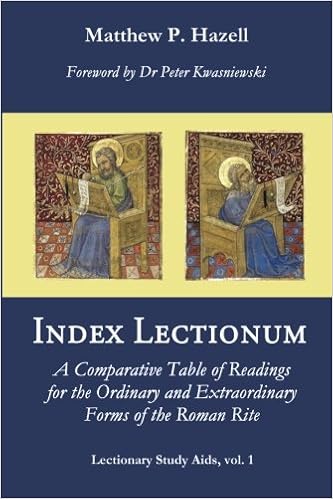
On another note, since I firmly hold that no real renewal of the Church is possible without a renewal of our sacred worship, Peter Kwasniewski pointed out that 1 Cor 11:27-29 was purposely excluded from the Novus Ordo Lectionary.  It is, however, in the older, traditional form of Holy Mass, for Corpus Christi and for Votive Masses of the Most Holy Eucharist.  A quick consultation of the new book Index Lectionum: A Comparative Table of Readings for the Ordinary and Extraordinary Forms of the Roman Rite shows you that it is missing from the Novus Ordo and is present in the TLM.  My post on the book HERE.  US HERE – UK HERE – ITALY HERE

Thus, Summorum Pontificum, that great gift of Benedict XVI to the Church, that profound aid in his “Marshall Plan” to rebuild after the devastation against the encroaching dictatorship of relativism, provides a necessary corrective for a serious gap in our worship and, therefore, identity.  Once again we hear in our churches, in the context of Mass, “For he that eateth and drinketh unworthily, eateth and drinketh judgment to himself, not discerning the body of the Lord”, knowing full well that it means that we mustn’t approach the Eucharistic Lord for Communion in the state of mortal sin.

Posted in Hard-Identity Catholicism, The Drill | Tagged , , ,
6 Comments

ASK FATHER: Dying man hasn’t asked for sacraments. Can he be anointed?

Extreme UnctionFrom a reader…

QUAERITUR:

We have a question and prayer need for a man dying of cancer. He is a remarried Catholic without an annulment who doesn’t receive Communion.

Not sure if he attends Mass. His daughter-in-law’s pastor said he could receive the Anointing of the Sick and Communion because there was an exception in the case of the dying. The patient has not requested the sacraments or has agreed to a visit from the priest.

However Father said that Canon Law allowed for an exception in these cases. So assuming that this ill man would not be living in sinful actions on his death bed, if he desired to go to confession would that be sufficient to receive Communion? Second question, could he receive Communion if he did not express a desire to confess?

The pastor offering the sacraments to this man is a canon lawyer as well.

A Mass has been offered for this man.

Thank you for having Mass said for this man.  Why wait until a person dies to have Masses said?

While it is true that in case of danger of death there is a great deal of flexibility given in the administration of sacraments, the sacraments – and the persons own will – are to be respected.

The Sacrament of Anointing, is one the sacraments “of the living”, that is, they are to be received by one who is in the state of grace.  If a person is compos sui and make his own decision and understand what is going on, he must be given a chance to make his confession before being anointed.   Otherwise, if his communication is impeded, he should indicate by signs and respond to the priest’s questions.  If a person is not sui compos, cannot respond, and isn’t aware of what is going on, such a person can be anointed and, in that case, the sacrament can also act for the forgiveness of sins.

He he says he doesn’t want to be anointed, doesn’t want the priest, etc., … well… there it is.

The same is said, of course, for Communion, as Viaticum or not.  If this person is not in the state of grace, if he is able he should make his confession before receiving any sacrament.

Of course danger of death can accelerate things greatly, but, if a person is able by signs or speech to indicate at least sorrow for sins and love of God, that should first be ascertained.

Everyone: GO TO CONFESSION!  You don’t know when it will be your turn.  Today?  Tomorrow?  It will happen.

Posted in "How To..." - Practical Notes, ASK FATHER Question Box, Four Last Things, GO TO CONFESSION | Tagged ,
5 Comments

ASK FATHER: Date for 2nd marriage set at parish before Tribunal decision

From a reader…

QUAERITUR:

My in laws divorced one year ago. My father in law is remarrying one month from now. He filed the annulment paperwork late last year and was told by the deacon handling it that it would “come through” last month. Nothing yet. My husband and I are disturbed by the fact that his parish (not in our diocese) allowed him to set the wedding date and complete marriage preparation courses even though he is already married in the eyes of the church. Now we’re concerned about what may occur if the annulment is not granted in time. We are considering writing to the bishop of that diocese to express our concern about this situation. It really doesn’t make sense in light of the church’s teaching on marriage and annulment. Do you agree that a letter to the bishop is warranted? Or are we being too nitpicky since no sacraments have been given falsely?

First, allow me to nitpick.  Some people, even informed people working in the Church who ought to know better,  use phrases like “granting an annulment” (or not “granting one”, as the case may be).  This is imprecise terminology which leads to confusion. The Church does not “grant” an annulment as though an annulment were some sort of a prize, or honor, or distinction… or a divorce.  Rather, the Church, through Her tribunal system of educated professionals, examines the facts presented in an orderly way and then makes a declaration based on those facts. It’s similar to a doctor making a diagnosis. We don’t say, “Doctor Bombay granted me a diagnosis of rickets.”

If we stop using unhelpful terminology, we might stem the tide of looking at a declaration of nullity as some sort of reward that the Church either kindly bestows or stingily withholds, or indulgently squanders or righteously refuses to grant. Rather, if we use more precise terminology, such as “The Tribunal determined the marriage was null,” or even better “The Tribunal was able to find sufficient proof of nullity,” or “The Tribunal was not convinced the marriage was null”, then we demonstrate a better grasp of reality.

Anyway, it is a Really Bad Idea™ for a parish (priest or staff) to set a date for a marriage until it is certain that both parties are free to marry.

In this case, no date should have been set until and unless the Tribunal issued a declaration of freedom to marry, stating not only that the previous marriage had been declared null, but also that no restrictions were placed on the party.  In some cases, even if the marriage is proven null, the Tribunal has the ability to place a restriction on one or both parties, stating certain conditions which need to be met (e.g., psychological counseling) before a subsequent marriage can take place.

Ideally, Catholics should not consider moving towards a prospective marriage until their freedom to marry has been established. That said, we do not live in an ideal world.  “Kind” pastors who ignore these norms in order to give people what they think they want end up creating more problems than they solve.

The question you ask is whether a letter to the bishop is warranted in this case.

Perhaps, but there are a lot of variables that come into play.

On the one hand, the bishop should know what is going on in his parishes.  Was this, for example, a one time stupid mistake? Or is this part of a larger pattern of imprudence or disobedience?  Some bishops might act swiftly and mete out the appropriate discipline. Some bishops, themselves of the mistakenly “pastoral” school of thought, might react by putting a fire under the tribunal to grind out a decision more quickly, thinking that will eliminate the scandal. Yet other bishops might just shrug and ignore the matter.

I think a more helpful course of action would, first, to have a conversation with your father-in-law. Ask what his plans are should the declaration of nullity either not be issued, or be issued after the date of the proposed wedding, or be issued with a restriction.  Perhaps a phone call to the pastor asking why a date was set without the freedom of both parties to marry being established is warranted. The response you receive from your father-in-law and from the pastor in question might help answer your question of whether a letter to the bishop is appropriate.

Whatever course of action you take, do it prayerfully, with patience, and without acrimony or an accusatory tone.

Posted in "How To..." - Practical Notes, ASK FATHER Question Box, Canon Law, One Man & One Woman | Tagged , ,
8 Comments