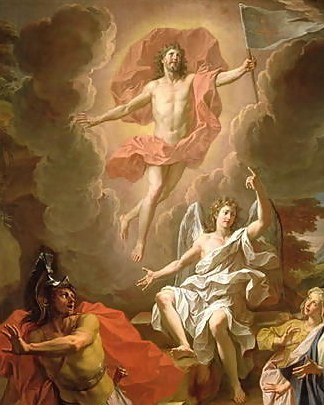
ASK FATHER: Does the Risen Christ still suffer?

From a reader…

QUAERITUR:

We hear often in prayers and reflections before confession that we crucify Christ whenever we commit mortal sins. My question is: does Christ, being resurrected and in heaven, still suffer?

Big question.

Without a doubt, tambourines at Mass make Christ suffer immensely.  Our Lord certainly sheds tears when a priest wears a beige alb. Surely the Savior again suffers horrible agony when faith formation coordinators instruct First Communicants to receive… I can hardly bring myself to write … in the hand!

What is in play here is the dogma of divine impassibility. God does not suffer. Christ, in His divinity, did not, and does not suffer. But Christ, in His human nature, did suffer.

Does Christ, now in heaven, suffer? Will we, in heaven, suffer?

St. Thomas Aquinas says not (STh Supplement, q. 94, a. 2).  One seldom goes wrong in siding with The Angelic Doctor (provided that he not simply cherry-picking quotes, say, at the end of documents).

Holy Church teaches, and cannot be wrong, that Christ’s risen Body has four characteristics, namely, impassibility (no suffering or death), subtlety (spiritualization of the body’s matter), agility (no limitation by space or time – though somewhere I have heard that “time is greater than space, whatever that means), and clarity (another word for beauty).  We, images of God, members of Christ’s Mystical Body, indeed his Mystical Person, will be like him.  Complete impassibility will be a quality of the just who, when risen, enjoy the happiness of heaven.

As far as our physical or spiritual suffering is concerned, remember that Scripture says that in heaven, there will be no tears.  And that means something different than what Eric Clapton meant.  In heaven “God shall wipe away all tears from their eyes: and death shall be no more, nor mourning, nor crying, nor sorrow shall be any more, for the former things are passed away.” (Rev. 21:4) In heaven, we will be so aligned with God’s will that we will be at peace, no matter what.  As Picarda says in the Paradiso, “In His will is our peace.”

Don’t put that at risk by staying away from Confession or by receiving Holy Communion in the state of mortal sin!

The constant and consistent teaching of the Church that our sins cause Christ to suffer means that our sins and transgressions caused Christ to have suffered during His earthly life and passion.  When we speaks of time and eternity, things become difficult. We are so bound up in time it is very hard to think of our actions today having effect in the past. Yet, that is precisely what the Church teaches.  Christ suffered in that one historical point in time in His Passion for every sin ever committed in the past, as He was suffering, and every sin that ever would be committed.  His suffering and death was the perfect expiatory satisfaction for all sins, past, present and future.

If someone reads and agrees with the Fishwrap – quod Deus averruncet! – Christ has already suffered for that.

So, yes, Christ suffered when we sin now, but He doesn’t suffer when we sin.  That doesn’t mean that His suffering wasn’t/isn’t real.

For more reading on this, try Fr. Thomas Weinandy, OFM in a helpful article in First Things.  HERE

That said, it cannot be doubted that God suffers and the holy angels weep with the saints in heaven when music by Marty Haugen is played during Mass, when anyone takes out a subscription to America Magazine, and when, as today, Michael Sean Winters puts pen to foolscap to attack, hah!, Dr. Peters as being “poisonous” (like venom) or ACTON INSTITUTE.

For these and all our foolish errors, have mercy on us, O Lord.

UPDATE:

We might ask next if heaven rejoices when you buy Mystic Monk Coffee (or Tea), thus helping both the Wyoming Carmelites to build their monastery and Fr. Z at the same time.  Aquinas is silent on the topic.

Posted in "How To..." - Practical Notes, ASK FATHER Question Box, GO TO CONFESSION | Tagged ,
8 Comments

ASK FATHER: My unconscious aunt died after being anointed: was she forgiven? (Wherein Fr. Z also rants.)

last rites extreme unction anointing viaticum 02From a reader…

QUAERITUR:

My aunt recently passed away two major strokes. After her second, my uncle, an openly declared agnostic, asked me if she should have a priest. I replied in the affirmative, and the hospital had a priest come. Since my aunt was heavily sedated and likely very impaired due to the stroke, she was unable to confess. I’ve read several blogs, but its unclear if forgiveness of sin occurred or if it is even possible in such as case. Can a person impaired in such a way that they are unable to confess receive absolution? Or is this one of those mysteries that we hold out hope for God’s mercy?

It is good that the priest came.  I am sure that he anointed your aunt before her death.  This can be a consolation to you as it was a great spiritual benefit for her.

The Sacrament of Anointing, also called Extreme Unction when administered close to death, has several effects. The effects are 1) to comfort us in the pains of sickness and to strengthen us against temptations, 2) to remit venial sins and to cleanse our soul from the remains of sin, and 3) to restore us to health, when God sees fit.  These are the effects when a person is still conscience and in the state of grace.  When you are compos sui this sacrament should be received only in the state of grace, which means that, when possible, it should be administered after sacramental confession and absolution.

However, not all people near death are conscious and able to make a confession of their sins.  In cases of necessity, the Sacrament of Anointing, Extreme Unction, will also take away mortal sin (not just venial) if the dying person is no longer able to confess, provided she has the sorrow for his sins that would be necessary for the worthy reception of the Sacrament of Penance.

And so, we can say that the Sacrament of Anointing straddles two categories in one instance: when the person cannot express sorrow for sins and receive absolution from the priest.  If a priest anoints a person who is incapable of response and in danger of death, the sacrament can not only possibly heal (according to God’s will), and strengthen the soul in the last moments of life, but also forgive mortal (not just venial) sins.

Dear readers, do you see how important it is to make a regular confession of your sins?  We do not know the day or hour when we will be called before God’s Judgement Seat.

That woman was given a great grace: the priest came before she died.

And, yes, there is such a thing as mortal sin and, yes, there is a particular judgment which each of us will undergo at death.

Some people might want to give the impression these days that the mercy of God is so great that mortal sin doesn’t mean anything.

Some people might want to give the impression today that it is nearly impossible to commit mortal sins and that we shouldn’t even talk about these outdated categories anymore.

Mercy mercy mercy, they cry, while ignoring truth and justice and, frankly, common sense.

Well… THIS PRIEST is here to tell you that you CAN sin mortally and that you will be JUDGED.  THIS PRIEST is here to tell you that we all are going to get God’s JUSTICE whether we want it or not even though we can always BEG for His mercy.

We should daily reflect on the Four Last Things: Death, Judgment, Heaven and Hell.

We should daily, even several times a day, beg God to spare us from a sudden and unprovided death.  An “unprovided death” is a death when someone has not had the last sacraments.

My job is to keep as many of you out of Hell as I can.

Hence, I am not going to blow happy gas and sunshine up your pants legs.  It IS possible to sin in such a way that you kill the life of grace in your soul, you lose the friendship of God, and you cut yourself from the eternal happiness of heaven which Christ opened up again from us sinners through His expiatory Sacrifice on the Cross.

Some will tell you that it is really really haaard to commit a mortal sin.  I’m not so sure about that.  Don’t bet your immortal souls on the devil-may-care pabulum spooned out by modernists and the foolish.

Don’t be distracted from what is important for salvation by those who are rattling that shiny thing over there in the wrong direction, on the road to perdition.

Examine your consciences, be brutally honest with yourselves, and GO TO CONFESSION!

Do you know fallen away Catholics?  Help them to GO TO CONFESSION!

two roads

Posted in "How To..." - Practical Notes, ASK FATHER Question Box, Four Last Things, GO TO CONFESSION, Liturgy Science Theatre 3000, Wherein Fr. Z Rants | Tagged , , ,
10 Comments

Card. Burke’s reaction to #AmorisLaetitia !

The National Catholic Register has His Eminence Raymond Card. Burke’s reaction to the Post-Synodal Apostolic Exhortation Amoris laetitia.

Here is a key bit with my emphases:

[T]he Holy Father is proposing what he personally believes is the will of Christ for His Church, but he does not intend to impose his point of view, nor to condemn those who insist on what he calls “a more rigorous pastoral care.” The personal, that is, non-magisterial, nature of the document is also evident in the fact that the references cited are principally the final report of the 2015 session of the Synod of Bishops, and the addresses and homilies of Pope Francis himself. There is no consistent effort to relate the text, in general, or these citations to the magisterium, the Fathers of the Church and other proven authors.

More on this later.

IT’S LATER:

The Cardinal makes a point that everybody should pay attention to.  I scratched around this in the post in which I raised the issue of the types of and weight of types of papal documents.

Card. Burke says in his piece wiht my emphases and comments:

The only key to the correct interpretation of Amoris Laetitia is the constant teaching of the Church and her discipline that safeguards and fosters this teaching. Pope Francis makes clear, from the beginning, that the post-synodal apostolic exhortation [NOTA BENE] is not an act of the magisterium (No. 3). [!] The very form of the document confirms the same. [It is a Post-Synodal Exhortation, and therefore it seems to be more closely aligned with the Synod than the Pope’s Ordinary Magisterium.] It is written as a reflection of the Holy Father on the work of the last two sessions of the Synod of Bishops.

Okay… let’s go see Amoris laetitia 3 with my usual:

3. Since “time is greater than space”, [I think that that means that there isn’t room in one document to solve problems.  Otherwise… I have no idea what that means.] I would [1] make it clear that not all discussions of doctrinal, moral or pastoral issues need to be settled by [2] interventions of the magisterium. Unity of teaching and practice is certainly necessary in the Church, but this does not preclude various ways of interpreting some aspects of that teaching or drawing certain consequences from it. This will always be the case as the Spirit guides us towards the entire truth (cf. Jn 16:13), until he leads us fully into the mystery of Christ and enables us to see all things as he does. Each country or region, moreover, can seek solutions better suited to its culture and sensitive to its traditions and local needs. For “cultures are in fact quite diverse and every general principle… needs to be inculturated, if it is to be respected and applied”.

So… “I would make it clear that not all discussions of doctrinal, moral or pastoral issues need to be settled by interventions of the magisterium”.

Otherwise… “Pay attention.  There are problems that need to be dealt with, but I’ll deal with these problems in a non-magisterial way, namely, in this Post-Synodal Exhortation, which isn’t part of my Ordinary Magisterium.”

Another important bit containing the $64 Question:

How then is the document to be received? First of all, it should be received with the profound respect owed to the Roman Pontiff as the Vicar of Christ, in the words of the Second Vatican Ecumenical Council: “the perpetual and visible source and foundation of the unity of both the Bishops and of the whole company of the faithful” (Lumen Gentium, 23). [NB]Certain commentators confuse such respect with a supposed obligation to “believe with divine and Catholic faith” (Canon 750, § 1) everything contained in the document. [Remember: The Cardinal’s position is, and I think we have to take him as an expert on these matters, that the Post-Synodal Exhortation is not an act of Francis’ Ordinary Magisterium.] But the Catholic Church, while insisting on the respect owed to the Petrine Office as instituted by Our Lord Himself, has never held that every utterance of the Successor of St. Peter should be received as part of her infallible magisterium.  [So, we can take it or leave it.  Also, the document has only the strength that its arguments have and its consistency with the Church’s doctrine (and discipline which safeguards it) as officially promulgated.  If what the Pope writes for the Synod (because this document is aligned to the Synod as part of its Acta) as a private person (rather than in his role as the Church’s highest and official teacher on faith and morals), doesn’t harmonize with what is officially taught and the law that is officially promulgated, we can nod respectfully at it and set it aside without additional comment.]

The Church has historically been sensitive to the erroneous tendency to interpret every word of the pope as binding in conscience, which, of course, is absurd. [Right!] According to a traditional understanding, the pope has two bodies, [interesting!] the body which is his as an individual member of the faithful and is subject to mortality, and the body which is his as Vicar of Christ on earth which, according to Our Lord’s promise, endures until His return in glory. The first body is his mortal body; the second body is the divine institution of the office of St. Peter and his successors.  [This is why the Pope’s trappings of office ARE IMPORTANT.  And the Cardinal makes this point.]  The liturgical rites and the vesture surrounding the papacy underline the distinction, so that a personal reflection of the Pope, while received with the respect owed to his person, is not confused with the binding faith owed to the exercise of the magisterium.

Another key to interpreting Amoris laetitia and then, especially in the case of priests and bishops, speaking about it in public:

With the publication of Amoris Laetitia, the task of pastors and other teachers of the faith is to present it within the context of the Church’s teaching and discipline, so that it serves to build up the Body of Christ in its first cell of life, which is marriage and the family. In other words, the post-synodal apostolic exhortation can only be correctly interpreted, as a non-magisterial document, using the key of the Magisterium as it is described in the Catechism of the Catholic Church (85-87). [Again… it’s not a document of the Pope’s Magisterium and it is only as strong as its harmony with the Magisterium.]

The Church’s official doctrine, in fact, provides the irreplaceable interpretative key to the post-synodal apostolic exhortation, so that it may truly serve the good of all the faithful, uniting them ever more closely to Christ Who alone is our salvation.

Be sure to read the whole of the Cardinal’s piece, but I wanted to underscore a few important points.

Posted in Synod, The Drill | Tagged , ,
52 Comments

Another reaction to #Amorislaetitia – “The cowardice and hubris of Pope Francis” (Hang on tight!)

participation trophyReactions to Amoris laetitia, the Post-Synodal Apostolic Exhortation (I’m getting tired of typing that out), are mixed between cloying gushes and frustrated contempt.

The following is surely more along the lines of the later.

I present it here because he has a perspective I haven’t seen elsewhere… yet.

As I started to read, I wondered if the writer was along the lines of Han Küng who thought that Vatican II didn’t go nearly far enough, or a Fishwrapper who is disappointed that Francis doesn’t condone the ordination of women or same-sex “marriage”.  Liberals: “Why doesn’t Francis just come out and say that everyone can go to Communion!”

Then, as I read, I realized that the writer’s name was familiar and I looked him up in past correspondence.  The writer also a participant in the Traditional Roman Rite.

From The Week:

The cowardice and hubris of Pope Francis [Whew!]
by Michael Brendan Doughtery

To universal fanfare from the mainstream and Catholic media, Pope Francis has issued a long-awaited document, Amoris Laetitia, “the Joy of Love,” as his conclusion to the Catholic Church’s two-year Synod on the Family. But to this Catholic, the pope’s supposedly reformist document is a botch job.

For two years, bishops presented their respective cases for two contradicting views of marriage, re-marriage, and the Church’s own sacraments. Pope Francis didn’t choose between these two options. He chose them both. The pope did not effect some grand synthesis. He merely gave his imprimatur to the Church’s own confused practice on these matters and, more frighteningly, to its self-doubt.  [Problem: The Church doesn’t have self-doubt.  Also, the Church’s doctrine and law are clear when it comes to the issues that were addressed: homosexual acts – NO! Communion for those living in mortal sin without amendment of life – NO!]

As a result, the Joy of Love reads as an admission that God, as Catholics understand him, really isn’t merciful or gracious to poor sinners. So priests should try to do better from now on.

All of this requires some explanation. While the document spends hundreds of pages, some of them quite good, and others quite banal, on the meaning of Christian marriage and family life, the headlines and anxiety all revolve around one topic. The “Great Matter” [a reference to Henry VIII – get it?] of the two-year Synod on the Family came down to one question: Can the divorced and re-married receive holy communion without obtaining an annulment or otherwise amending their life?

The Church’s traditional reasoning is straightforward. If a valid, sacramental marriage is indissoluble, and someone contracts and lives within a second civil marriage, they are committing the sin of adultery, and doing so publicly. [claro!] Like anyone in a state of moral sin — for instance, someone who knowingly missed Sunday Mass through their own fault — they are to exclude themselves from communion, lest they commit a further sin of sacrilege. [genau!] If they repent of the sin and want to amend their life, they can make a sacramental confession and return. [right!]

The German Cardinal Walter Kasper [boooo!] has proposed a way around this — a kind of penitential path in which the remarried person admits some responsibility for their failed first marriage, but persists in the second. [The Kasperite Proposal – “tolerated but not accepted”…] For two years, cardinals and bishops lined up on opposing sides of this proposal. Some argued for retaining the Church’s traditional understanding and practice. Others pressed for some kind of “pastoral” accommodation to better integrate those who persist in their second marriage into the life of the Church.

Pope Francis sided with all of the above. And he did it not by effecting some greater synthesis, but by cowardly obfuscation.

Pope Francis tries to reframe what Catholics have long understood as the truth about marriage and chastity as merely an ideal, possibly an impossible or oppressive one, if taken too seriously by mere Christians. He pits his concept of mercy against marriage, as if a true understanding of the latter were a threat to the former. Pope Francis reveals himself to be a pope of his times, and embodies the defects of the Church he leads; [ummm…. no.  The Church doesn’t have defects.  She has members with faults.  Maybe that is what he meant, but… there it is.] Amoris Laetitia is characterized by loquacity and evasiveness in trying to dignify and disguise moral cowardice borne from a lack of faith.  [WHOA!]

Chapter 8 of this heralded document begins by describing the kind of person in an “irregular union” who might be considered for pastoral counseling back toward communion. It describes that person as someone possessed of “humility, discretion, and love for the Church.” The [key] question of whether this person has sincere sorrow for sin and a firm purpose to amend their life is side-stepped. Repentance and conversion? How old fashioned. Even the term “irregular union” is evidence of the way the Church is abandoning its understanding of adultery, draining away the moral force of its own teaching, as if marriage were merely a matter of paperwork yet to be amended.

Francis cites well-known Catholic teaching about whether a person is truly and fully culpable for their sins as if it were a new revelation, and then draws reckless conclusions from it, such as in paragraph 301 of chapter 8, where Francis simply announces, “Hence it can no longer simply be said that all those in any ‘irregular’ situations are living in a state of mortal sin and are deprived of sanctifying grace.” One can see how this substitution of “ideals” for commandments works when, in paragraph 303, Pope Francis posits, absurdly, that in some instances the most generous response a person can offer to God’s grace is still itself “not fully the objective ideal.”

The message is clear: God’s grace is insufficient to assist you to do what he asks of you. Jesuits can do better. [I suspect the writer is not a fan of Jesuits.]

Finally, although the pope rejects a formal institution of the Kasper proposal as a general rule, he strongly encourages the readmission of people in “objectively” adulterous unions to holy communion. He doesn’t trumpet this, of course. He buries it in the 351st footnote. [The Infamous Footnote 351!] For a man showing such great audacity before God, Francis certainly isn’t bold before men. [So, the writer is saying that Francis should have just gone ahead and said clearly, boldly, openly what he really wanted.]

Many conservatives are revealing themselves as cowards, too. [!] They hope that because the pope’s document seems so confused and self-contradictory, because it hides its innovations under a ton of verbiage, [μέγα βιβλίον μέγα κακόν!] and buried within footnotes, and because it is merely an exhortation and not a more lofty encyclical, that they can embrace what is good in the document, and pass over the rest. “It could have been worse,” they are telling themselves. “It cites the Church’s teaching against contraception, at least.” I would remind them that their forebears said the same thing about the Vatican II’s document on the liturgy. “Oh, it says Latin shall be retained, it promotes Gregorian chant,” they comforted themselves. As now, the betrayal of the institution was too unthinkable, and they willfully overlooked the footnotes that contained within them a mandate to destroy high altars, tabernacles, altar rails, and institute folk music in a synthetic vernacular liturgy. So too, many conservatives will try to find the good parts, an easy feat in a document so prolix.

But progressives are not so timid.  In the talking points handed out to bishops and other spokesmen ahead of the document, the intention was made clear, but plausibly deniable. “Pastors need to do everything possible to help people in these situations to be included in the life of the community.” Words like “possible” and “inclusion” are left to be interpreted broadly, from the footnotes. Cardinal Kasper described the document glowingly as a “definite opening.” Cardinal Schonborn boldly papered over differences between Pope Francis and Pope John Paul II by describing the work of Francis in Amoris Laetitia as the development of doctrine. [It isn’t.]

Traditionalist critics of the modern Church have a kind of slogan: Lex Orandi, Lex Credendi, the law of prayer is the law of belief. [Indeed we do.] It’s hard not to see how the already incoherent prayer of the Church is leading to incoherent doctrine and practice. [I agree!  This is why the TLM and Summorum Pontificum are so important.] The Church officially teaches that confession is necessary to be restored to holy communion after committing a mortal sin, and that receiving communion in a state of sin is itself sacrilege. Yet rare is the pastor who seems troubled by the long lines for communion and the near disappearance of the sacrament of confession among the people in his parish. Everyone just sort of knows the Church doesn’t really mean what it says.  [Again, NO!  Not “the Church”, but her feckless shepherds, yes.  And “Amen” to the point about incoherent prayer leading to incoherent doctrine and practice.  We saw the corrosive effects of that over decades of horrid English translations, to name one identity dissolving acid.]

The Church’s [again…] blasé attitude here has a pedagogical effect, teaching people that there is no need to have a holy respect or fear when approaching the altar. [I do agree.  The effect has been destructive.] Naturally, this attitude has worked its way up the chain to a papal pronouncement. Pope Francis’ document justifies people receiving communion in a public state of sin by saying that the Eucharist is “not a prize” for good behavior. That is true. But instead the Church has turned it into a participation trophy, something so perfunctory and ultimately meaningless that it seems just too cruel to deny it to anyone.  [Ouch.]

Perhaps worse than Pope Francis’ official invitation to sacrilege is the document’s cowardice, cynicism, and pessimism. The Church can no longer even bring itself to condemn respectable sins such as civilly approved adultery. It can barely bring itself to address a man or woman as if they had a moral conscience that could be roused by words like “sin.” Instead, it merely proposes ideals; ideals cannot be wounded by your failure to realize them. And it promises to help you out of your “irregular” situation.

This supposed paean to love is something much sadder. A Church [Again, the Church is not to be reduced to THE POPE and some lax shepherds.] so anxious to include and accept you that it must deny the faith that transforms and renews you. It admits that God’s commands are not just beyond our reach, but possibly destructive to follow.

Pope Francis is trying to be more merciful than God himself. He ends up being more miserly and condescending instead.

Wow.

I feel a little beaten up by that, come to think of it.

No, but wait.  There are a couple problems here.

First, as I mentioned the Holy Catholic Church is NOT reducible to its members, not even key players such as the Pope.   The Church doesn’t have self-doubt (she has feckless members).  The Church is not cowardly (there are craven Catholics).  The Church is not blasé (though some people in it are, in fact, so).

Second, can we make a distinction between being timid and being decorous?   If liberals are not timid in their dissent, neither are they brave, properly understood.  They are, I insist, rude and pusillanimous in their dissent no matter how vociferous.  Yes, there are times when Catholics who are faithful should speak out more when they encounter heterodoxy and heteropraxis.  But I think they usually err in decorum rather than cowardice.  Furthermore, it is not everyone’s job to correct everyone else all the time.

That said, in the main, the writer, this parrhesiastes, has gouged his finger into a sore spot.  Sometimes that is what doctors do to find where the problems are.

This goes into my Cri de coeur category.

So… a huge question is raised.  In view of the coming confusion and division, …

… what are we going to do about it?

As I mentioned before, we have to be ready – and get ready – to explain clearly and accurately, with charity, what the Church really teaches.

I spoke with one priest friend today who said that if people in what Francis is calling “irregular” situations come to him and want the sacraments, he will explain the situation to them and not simply cave in under the bludgeoning and accusations he might receive.   And if his bishop calls him in, he’ll be glad to explain himself.

And the moderation queue is definitely ON.


Posted in Cri de Coeur, Hard-Identity Catholicism, The Drill, The future and our choices | Tagged , , , ,
30 Comments

ASK FATHER: #ConsecratedWidows – ACTION ITEM!

St. Margaret the Barefooted, widow (1325–1395)

From a reader…

QUAERITUR:

Easter blessings Father! God has given me the gift of widowhood and I feel He is calling me to offer it back to Him as a dedicated or consecrated widow. Is there and current progress in the US towards that end? My spiritual director suggested I try to find some rules of life for those forging ahead in this area to try to present something to my Archbishop. Any help is appreciated. God bless you.

First, your attitude is exemplary.

For those who don’t know, in the ancient Church there were orders of lay people such as virgins (this has been revived), widows and even gravediggers.  They were especially concerned with works of mercy.

I know that the Holy See was studying the revival of consecrated widows.  I don’t know where they are at with it.  I recall also that a diocese in Italy was once experimenting with this.

At this time I don’t know of any efforts in these USA to foster an order of widows.

I can’t for the life of me think of why there hasn’t been more movement on this.  There are a heck of a lot of widows out there, living good lives, faithfully participating in their parishes.

Why should virgins get all the love?  (If you get my drift.)

I suppose with the help of a pastor or a bishop one could start a Consorority of St. Monica (or some other great widow saint… Frances of Rome, Elizabeth Ann Seton, Ksenia Blazhennaya Peterburzhskaya*, Margaret the Barefoot…).

Here’s a thought.

Pope Francis seems to react well when approached personally.

ACTION ITEM!

How about all you widows out there put pen to paper and write to Pope Francis and ask him to revive the ancient order of widows?

I suspect that it he got hundreds of letters from around the world, he’d sit up and take notice.  This seems like the sort of thing that he might take personal interest in.

“¡Hagan lío!”, after all. Right?

Back in 2013 Pope Francis said:

Jesus has, “the capacity to suffer with us, to be close to our sufferings and make them His own,” said Pope Francis, who began his reflections with the encounter between Jesus and the widow of Naim, of which Tuesday’s Gospel reading tells. He pointed out that Jesus, “had great compassion” for this widow who had now lost her son. Jesus, he went on to say, “knew what it meant to be a widow at that time,” and noted that the Lord has a special love for widows, He cares for them.” Reading this passage of the Gospel, he then said, that the widow is, “an icon of the Church , because the Church is in a sense widow”:

“The Bridegroom is gone and she walks in history, hoping to find him, to meet with Him – and she will be His true bride. In the meantime she – the Church – is alone! The Lord is nowhere to be seen. She has a certain dimension of widowhood … and that makes me makes me think of the widowhood of the Church. This courageous Church, which defends her children, like the widow who went to the corrupt judge to [press her rights] and eventually won. Our Mother Church is courageous! She has the courage of a woman who knows that her children are her own, and must defend them and bring them to the meeting with her Spouse.”

Pope Francis might say and write some weird stuff but that was pretty good!

Such a letter might include, along with a very brief description of the circumstances of one’s life…

  • There was in the ancient Church an order of widows.
  • Since Vatican II the ancient order of virgins has been revived.
  • There are many widows living good and faithful lives who would benefit from such a consecration.
  • Local churches could benefit from their prayers and works of mercy.

End with a promise of prayers for the Pope.

Keep it BRIEF… on one side of one sheet of paper.

His Holiness
Pope Francis
Casa Santa Marta
00120 Vatican City

*Russian Orthodox but, hey!, a great name!  A little hard to fit on a procession banner, though.

Posted in ¡Hagan lío!, "How To..." - Practical Notes, ACTION ITEM!, ASK FATHER Question Box, Hard-Identity Catholicism | Tagged , ,
19 Comments

The Infamous #Footnote351 read through the lens of the Prodigal Son and his prostitutes

In the Post-Synodal Apostolic Exhortation Amoris laetitia, there is a footnote, an infamous footnote in par. 305 .

Context:

Because of forms of conditioning and mitigating factors, it is possible that in an objective situation of sin – which may not be subjectively culpable, or fully such – a person can be living in God’s grace, can love and can also grow in the life of grace and charity, while receiving the Church’s help to this end.

Then the footnote … for sake of Tweets #Footnote351 :

16_04_10_AL_FN351

I am getting good comments on this troubling footnote.  I am not sure which sacraments unrepentent public sinners should or may receive.  Dr. Peters comments about 351 in the light on can. 915, which prohibit from Communion those who are manifestly grave sinners (such as public adulterers, which is what one is if one remarries civilly without a declaration of nullity).  HERE.  

This evening I was talking with a priest friend, Fr. Richard Heilman (whom I’ve mentioned in these electronic pages, most recently yesterday because he lead me to that great text by Fulton Sheen).  He wrote…

“The Eucharist is not a prize for the perfect, but a powerful medicine and nourishment for the weak…

… for the weak who have chosen to come home, as did the prodigal son, to live in God’s presence, under God’s “house rules.” Might they make mistakes while home? Yes! And they will be offered forgiveness when they do. What they are not allowed to do is to “come home” and dictate their own “house rules.” Which is akin to the prodigal son coming home, and bringing the prostitutes with him.

Rem acu.

What Fr. Heilman understands, and what the Church has always understood, and what Christ Himself taught when he forgave the woman caught in adultery, is that we have to amend our lives after sinning.

Fr. Z kudos.

Posted in 1983 CIC can. 915, Fr. Z KUDOS, Hard-Identity Catholicism, The Coming Storm, The Drill, The future and our choices | Tagged , , , , ,
28 Comments

DOUTHAT: “a distinctive late-Marxist odor”

At the NYT (aka Hell’s Bible) Ross Douthat has a reaction to Pope Francis at the new Post-Synodal Apostolic Exhortation Amoris laetitia.

In the first part, Douthat sets up that while in most world religions there has been a split between orthodox and progressive, in the Catholic Church the factions have remained officially together in a kind of truce: conservatives have their orthodoxy but liberals have a soft heterodoxy.

Then comes Francis.

Douthat thinks that what Francis has done is come down in favor of the truce, rather than tolerate the heterodoxy and heteropraxis.  My emphases:

[…]

But there is also now a new papal teaching: A teaching in favor of the truce itself. That is, the post-1960s separation between doctrine and pastoral practice now has a papal imprimatur, rather than being a state of affairs that popes were merely tolerating for the sake of unity. Indeed, for Pope Francis that separation is clearly a hoped-for source of renewal, [!] revival and revitalization, rather than something that renewal or revival might enable the church to gradually transcend.

Again, this is not the clear change of doctrine, the proof of concept for other changes, that many liberal bishops and cardinals sought. But it is an encouragement for innovation on the ground, for the de facto changes that more sophisticated liberal Catholics believe will eventually render certain uncomfortable doctrines as dead letters without the need for a formal repudiation from the top. [It is hard to deny.]

This means that the new truce may be even shakier than the old one. [Surely it will be.  There will be far more division among priests and among priests and bishops.] In effectively licensing innovation rather than merely tolerating it, and in transforming the papacy’s keenest defenders into wary critics, it promises to heighten the church’s contradictions rather than contain them.  [Divison.]

And while it does not undercut the pope’s authority as directly as a starker change might have, it still carries a distinctive late-Marxist odor — a sense that the church’s leadership is a little like the Soviet nomenklatura, bound to ideological precepts that they’re no longer confident can really, truly work. [Ouch.]

A slippage that follows from this lack of confidence is one of the most striking aspects of the pope’s letter. What the church considers serious sin becomes mere “irregularity.” What the church considers a commandment becomes a mere “ideal.” What the church once stated authoritatively it now proffers tentatively, in tones laced with self-effacement, self-critique. [Indeed.  When I first got the text of the Letter (before its release), one of my corespondent (who also had it) wrote: “It reeks of ‘effeminacy’.”  I suspect that this move might have a strongly negative, dampening effect on priestly vocations.  Not that that will bother liberals, of course: they have been trying to destroy the priesthood for decades.]

Francis doubtless intends this language as a bridge between the church’s factions, [doubtless!] just dogmatic enough for conservatives but perpetually open to more liberal interpretations. And such deliberate ambiguity does offer a center, of sorts, for a deeply divided church.

But not one, I fear, that’s likely to permanently hold.  [Ditto.]

This will make the libs (especially Jesuits) have a spittle-flecked nutty.   The last time Douthat commented on issues of the Synod, a passel of libs signed a letter asking Hell’s Bible to fire him… in that spirit of “liberty” for which liberals are so famous.

Posted in The Drill | Tagged
27 Comments

Canonist Ed Peters notes on some juridical issues in #AmorisLaetitia

The great canonist Ed Peters has some first thoughts about the Post-Synodal Apostolic Exhortation Amoris laetitia.  HERE

He doesn’t have a combox, so let’s him borrow this one.

First thoughts on the English version of Pope Francis’ Amoris laetitia.

There are as one might expect in a document of this length and written with access to the kinds of resources a pope commands, [I assume he means ghost writers]many good things said about marriage in Amoris. Whether those things speak with any special profundity or clarity is better left, I think, for each reader to decide individually. [A kind way to express that.]

That said, however, one must recall that Francis is not a systematic thinker. [By way of contrast, I just review Pope Benedict’s 2005 Christmas Address to the Roman Curia.] While that fact neither explains nor excuses the various writing flaws in Amoris, it does help to contextualize them. Readers who are put off by more-than-occasional resort to platitudes, caricatures of competing points of view, and self-quotation simply have to accept that this is how Francis communicates.  [That’s fair.]

[And since Peters is a canonist…] Some juridic issues that were widely anticipated include:

Holy Communion for divorced-and-remarried Catholics. Francis does not approve this central assault tactic against the permanence of marriage, [the Kasperite “tolerated but not accepted” Proposal] but [but] neither does he clearly reiterate constant Church teaching and practice against administering the Eucharist to Catholics in irregular marriage situations. And, speaking of ‘irregular marriage’, [marriage!  Some couplings are not any kind of marriage, but there are times in the Letter when that isn’t entirely clear.] nearly every time Francis uses that traditional phrase to describe what could more correctly be termed pseudo-marriage, he puts the word “irregular” in scare quotes, as if to imply that the designation is inappropriate and that he is using it only reluctantly.

Internal forum. Francis makes almost no commentary on the so-called “internal forum” solution. What little comment he does make on the internal forum in AL 300 is not controversial.  [For example: “Conversation with the priest, in the internal forum, contributes to the formation of a correct judgment on what hinders the possibility of a fuller participation in the life of the Church and on what steps can foster it and make it grow. Given that gradualness is not in the law itself (cf. Familiaris Consortio, 34), this discernment can never prescind from the Gospel demands of truth and charity, as proposed by the Church.”]

Canon law in general. Francis makes almost no use of canon law in Amoris. What few canonical comments he does make are not controversial.

‘Same-sex marriage’. Francis leaves no opening whatsoever that ‘same-sex marriage’ can ever be regarded as marriage. AL 251.  [Clear as a bell.]

Some problematic points (in no special order) include:

1. Speaking of divorced-and-civilly-remarried Catholics, Francis writes: “In such situations, many people, knowing and accepting the possibility of living ‘as brothers and sisters’ which the Church offers them, point out that if certain expressions of intimacy [i.e., sexual intercourse] are lacking ‘it often happens that faithfulness is endangered and the good of the children suffers’ (Gaudium et spes, 51).” AL fn. 329. I fear this is a serious misuse of a conciliar teaching. Gaudium et spes 51 was speaking about married couples observing periodic abstinence. Francis seems to compare that chaste sacrifice with the angst public adulterers experience when they cease engaging in illicit sexual intercourse.  [An example of what I have mentioned before… the Letter glides from one group of people to another without distinctions.  Also, it is useful to review Gaudium et spes 51, which liberals normally ignore because of it’s reference to abortion as an “unspeakable crime”.  For liberals, V2 documents only contain non-condemnatory lollipops, hugs and fuzzy bunnies.  GS 51:  This council realizes that certain modern conditions often keep couples from arranging their married [married] lives harmoniously, and that they find themselves in circumstances where at least temporarily the size of their families should not be increased. As a result, the faithful exercise of love and the full intimacy of their lives is hard to maintain. But where the intimacy of married [married] life is broken off, its faithfulness can sometimes be imperiled and its quality of fruitfulness ruined, for then the upbringing of the children and the courage to accept new ones are both endangered. To these problems there are those who presume to offer dishonorable solutions indeed; they do not recoil even from the taking of life. [read=abortion] But the Church issues the reminder that a true contradiction cannot exist between the divine laws pertaining to the transmission of life and those pertaining to authentic conjugal love. For God, the Lord of life, has conferred on men the surpassing ministry of safeguarding life in a manner which is worthy of man. Therefore from the moment of its conception life must be guarded with the greatest care while abortion and infanticide are unspeakable crimes. The sexual characteristics of man and the human faculty of reproduction wonderfully exceed the dispositions of lower forms of life. Hence the acts themselves which are proper to conjugal love and which are exercised in accord with genuine human dignity must be honored with great reverence. Hence when there is question of harmonizing conjugal [married] love with the responsible transmission of life, the moral aspects of any procedure does not depend solely on sincere intentions or on an evaluation of motives, but must be determined by objective standards. These, based on the nature of the human person and his acts, preserve the full sense of mutual self-giving and human procreation in the context of true love. Such a goal cannot be achieved unless the virtue of conjugal [married] chastity is sincerely practiced. Relying on these principles, sons of the Church may not undertake methods of birth control which are found blameworthy by the teaching authority of the Church in its unfolding of the divine law. [artificial contraception].  Peters nailed it.]

2. Speaking of “Christian marriage, as a reflection of the union between Christ and his Church”, Francis writes “Some forms of union radically contradict this ideal, while others realize it in at least a partial and analogous way.” AL 292. This simple phrasing requires significant elaboration: forms of union that most radically contradict the union of Christ and his Church are [1]objectively adulterous post-divorce pseudo-marriages; forms of union that reflect this union in a partial, but good, way are [2] all natural marriages. These two forms of union are not variations on a theme; they differ in kind, not just in degree.

3. Speaking of what the Catechism of the Catholic Church 2384 describes as “public and permanent adultery”, Francis writes that some post-divorce marriages can exhibit “proven fidelity, generous self-giving, [and] Christian commitment”. AL 298. Many will wonder [I’m one of them…] how terms such as “proven fidelity” can apply to chronically adulterous relationships or how “Christian commitment” is shown by the public and permanent abandonment of a previous spouse.

4. In AL 297, Francis writes: “No one can be condemned for ever, because that is not the logic of the Gospel!” To the contrary, it is precisely the logic of the Gospel that one can be condemned forever. CCC 1034-1035. [1034 Jesus often speaks of “Gehenna” of “the unquenchable fire” reserved for those who to the end of their lives refuse to believe and be converted, where both soul and body can be lost. Jesus solemnly proclaims that he “will send his angels, and they will gather . . . all evil doers, and throw them into the furnace of fire,” and that he will pronounce the condemnation: “Depart from me, you cursed, into the eternal fire!” 1035 The teaching of the Church affirms the existence of hell and its eternity. Immediately after death the souls of those who die in a state of mortal sin descend into hell, where they suffer the punishments of hell, “eternal fire.” The chief punishment of hell is eternal separation from God, in whom alone man can possess the life and happiness for which he was created and for which he longs.] If one meant, say, that no one can be ‘condemned for ever’ by earthlyauthority, one should have said so. [NOTA BENE] But, of course, withholding holy Communion from those in “public and permanent adultery” is not a “condemnation”[NOT] at all, so the point being made is not clear.

5. In AL 280-286, directly discussing sex education for youth, I did not see any acknowledgement, indeed not even a mention, that parents have rights in this important area. Perhaps that is to be gleaned from comments about parents made elsewhere in AL.

UPDATE:

Okay… that was one Peters Post.  And there is another, as long as we are at it.

The law before ‘Amoris’ is the law after

Holy Communion is to be withheld from divorced-and-remarried Catholics in virtue of Canon 915 which, as has been explained countless times, [NB] does not require Catholic ministers to read the souls of would-be communicants, but rather, directs ministers to withhold holy Communion from those who, as an external and observable matter, “obstinately persevere in manifest grave sin”. [VP Biden… Rep. Pelosi…] The Catechism of the Catholic Church 2384 describes civil remarriage after divorce as “public and permanent adultery” (something obviously gravely sinful), so, if Francis had wanted to authorize the administration of holy Communion to divorced-and-remarried Catholics (and he did not want to repudiate CCC 2384, 1650, etc.) he would have had to have wrought a change in the law contained in Canon 915. [BUT… Francis didn’t change can. 915, did he?  And so the P-SAE Amoris laetitia is also a challenge to those who have ignored can. 915 to be more faithful to the Church’s discipline.]

[This is interesting…] To legislate for the Church popes usually employ certain types of documents (e.g., apostolic constitutions, motu proprios, ‘authentic interpretations’ …[Bulls] ) or they use certain kinds of language (e.g., ‘I direct’ or ‘I approve in forma specifica’). Amorislaetitiae, an “apostolic exhortation”, is not a legislative document, it contains no legislative or authentic interpretative language, and it does not discuss Canon 915. The conclusion follows: whatever Canon 915 directed before Amoris, it directs after, including that holy Communion may not generally be administered to Catholics living in irregular marriages.  [Get that? Amoris laetitia DIDN’T CHANGE LAW or DOCTRINE. Of course that’s not what will be claimed by those who haven’t been inclined to obedience or sound teaching.]

To this conclusion, however—and recalling that the burden of proving that the law changed is on those who claimed that it changed, not on others to prove that it hasn’t—I can anticipate at least three rejoinders.  [This guy’s posts are worth their weight in gold.  More, actually since posts don’t weigh anything… but you get my drift.]

The first is easily dismissed.

1. Pope Francis wrote that “Each country or region, moreover, can seek solutions better suited to its culture and sensitive to its traditions and local needs.” AL 3, and 199, 207. But of course developing local approaches to proclaiming universal truths is a hallmark of “pastoral theology” (when that concept is properly understood and not offered as cover for avoiding the demands of Christian doctrine). [This, friends, was one of the things I feared the most in anticipation of this Letter – and, frankly, in everything else this Pope does – namely, devolution of the role of, for example, the mandate of the CDF to local conferences.  That would be disaster of the highest order.  Also, I once fell afoul of a prof of “pastoral theology” from a Roman university just exactly what “pastoral theology” is: he couldn’t tell me. He got mad at me, of course.] Church documents often encourage local initiatives, but they never authorize dilution, let alone betrayal, of the universal teachings of Christ and his Church. Amoris might well have left itself open to regional manipulation (as Robert Royal has explained) but Catholics committed to thinking with the Church will not develop particular approaches to ministry among the divorced that betray the common truth about the permanence of marriage.  [As I wrote yesterday.  The orthodox and faithful can find in this Letter a challenge to even greater compassion and zeal in pastoral ministry.  Those who have abandoned fidelity and obedience, and who have violated the promises and oaths they made a ordination, will continue on their course of deceiving souls, but with greater energy, hiding behind this new Letter.]

A second rejoinder is, however, more complex.

2. In AL 301 Francis writes: “Hence it is can [sic] [yep… sic… but remember that an English version will (eventually) have no real authority once (if) the Latin comes out… yes, I am an optimist.  I am also an unreconstructed ossified manualist.] no longer simply be said that all those in any ‘irregular’ situation are living in a state of mortal sin and are deprived of sanctifying grace.” [I’ve received questions about that already.  I suppose that there are some people who are so poorly formed they haven’t the slightest clue about what they are into.  Also, there are others who really have undertaken the “brother sister” solution.  Remember: living together is in itself not the sin of adultery or fornication.  One might be putting oneself in an occasion of temptation and sin, which could be sinfully irresponsible, but it’s the sexual contact that is gravely sinful. This applies to two men or two women who live together.  Sexual contact makes that sinful.] This presents a more substantial objection to my conclusion above for, at first glance, Francis seems to attack the very idea that the irregular situation usually produced by a post-divorce civil remarriage is gravely sinful. [Yes, that is what that statement seems to be.  It is at least poorly written.] We need to consider this possibility carefully.

Setting aside whether any Church document ever ‘simply said’ what Francis implies above, one can agree that it would be wrong to assert that “all” people living in “any” irregular situation are necessarily “living in a state of mortal sin”. If even one person living in an irregular marriage situation does so with no suggestion of sin—and I can think of many*Francis’ point, narrowly and literally read, stands.

But Francis’ assertion here could mean something more contentious, namely: that we can no longer assert that any individual living in an irregular union could be “living in a state of mortal sin”—an assertion that would, I suggest, place Francis in opposition to Church tradition. [This is what libs are going to say. But they will be happy about it!] Let’s consider this possibility more closely:

A) The phrase “living in a state of mortal sin” could be understood as a short-hand way to describe many morally wrong living situations, one that summarizes Church teaching that all Catholics must, on pain of committing grave sin, abide by certain laws and teachings regarding marriage and sexual activity. That is how all of the canonists, moral theologians, and clergy whom I know, and most of the lay Catholics in my circle, use the term. I think it consistent with the Catechism of the Catholic Church. But,

B) The phrase “living in a state of mortal sin” could also be taken as judging the state of another’s soul based on their living arrangement. Whether speaking from ill-will or from inaccurate catechesis, Catholics who describe others (let alone all others) living in irregular marriage situations as “living in a state of mortal sin”—meaning by that phrase that such persons have necessarily incurred the guilt of grave sin—should indeed cease thinking and speaking that way. [See what I wrote, above.]

So, if the pope was thinking about those who use the phrase “living in a state of mortal sin” to imply an ability to read souls, then his admonition that one must not speak this way is quite sound, it does nothing to detract from the Church’s view that post-divorce civil marriage is an aggravated form of adultery, and it impacts not one jot or tittle of Canon 915. But to construe the pope’s words here as denying that freely living in an irregular marriage situation can be, as the Catechism holds, gravely sinful, and that therefore Canon 915 is not applicable to such cases, would be to attribute to the pope a conclusion at odds with Church moral and sacramental teaching. That accusation should not be casually made.  [And yet we see that there are some – at some web sites – who are making that claim.]

Finally, however, let’s assume that, however he expressed himself, [admittedly ineptly] the pope somehow really believes that few Catholics, perhaps none, living in irregular marriages are subjectively culpable for their state. Even that conclusion on his part would [NB] have no bearing whatsoever on the operation of Canon 915 [!] because, as noted above, Canon 915 does not (and cannot!) operate at the level of interior, subjective responsibility, but rather, it responds to externally cognizable facts concerning observable conduct.

Yet a third possible rejoinder relies another eisegetical reading of Francis’ words.  [“eisegesis” means to “read into” a text when interpreting it one’s own presuppositions and agendas, etc.]

3. Some think that AL fn. 351[the Infamous Footnote reads, about priests helping people to discern the truth of their “irregular” situations: “351 In certain cases, this can include the help of the sacraments. Hence, “I want to remind priests that the confessional must not be a torture chamber, but rather an encounter with the Lord’s mercy” (Apostolic Exhortation Evangelii Gaudium [24 November 2013], 44: AAS 105 [2013], 1038). I would also point out that the Eucharist “is not a prize for the perfect, but a powerful medicine and nourishment for the weak” (ibid., 47: 1039).”] and its accompanying text authorize holy Communion for Catholics in irregular marriages. I would ask, recalling that a matter of law is at issue, where does Francis do this? The pope says that Catholics in irregular unions need the help of the sacraments (which of course they do), but he does not say ALL of the sacraments, and especially, not sacraments for which they are ineligible. [Which probably means Holy Communion.  But also remember that, without purpose of amendment, they cannot be absolved in the Sacrament of Penance.  Also, if they are compos sui and in danger of death they don’t manifest sorrow for manifest sins they cannot be confirmed or anointed.] He says that the confessional is not a ‘torture chamber’ (a trite remark but not an erroneous one). And he observes that the Eucharist is not a prize for the perfect (thank God), but a powerful spiritual medicine, which it is—unless it is taken unworthily or in violation of law, a caveat one may assume all Catholics, and certainly popes, know without having to say it.  [Dear Dr. Peters… I think that, today, we have to remind people of this, even prelates.]

Bottom line: sacramental rules are made of words, not surmises. Those who think Amoris has cleared a path to the Communion rail for Catholics in irregular marriages are hearing words that the pope (whatever might be his personal inclinations) simply did not say.

* Example: One who was baptized Catholic but raised without knowledge of that fact, is (incredibly) bound by canonical form and thus, if married outside of form, he or she would be, by definition, living in an irregular union. It would be ludicrous to refer to such a person as “living in sin”. I can offer a dozen more fact patterns that would duplicate this point.

I love the smell of clarity in the morning.

Be sure to visit In The Light Of The Law for more large doses of refreshing clarity.

Posted in 1983 CIC can. 915, Emanations from Penumbras, The Drill | Tagged , , , , , , , , ,
22 Comments

True Humility

Sent by a priest friend…

True Humility

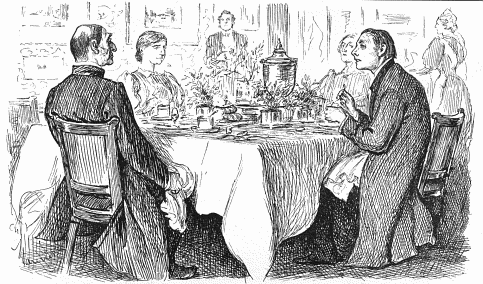
Bishop: “I’m afraid you’ve got a bad egg, Mr Jones”.

Curate: “Oh, no, my Lord, I assure you that parts of it are excellent!”

Thus, the origin of the phrase “The Curate’s Egg“, describing something mostly or partly bad, but also partly good.

This is from Punch of 9 November 1895 by George du Maurier.

Posted in Lighter fare | Tagged ,
7 Comments

PODCAzT 143: Fulton J. Sheen – “In the face of this false broadmindedness, what the world needs is intolerance.”

Click

With a biretta tip to my friend Fr. Heilman at Roman Catholic Man, this PODCAzT welcomes today’s guest Ven. Fulton J. Sheen.  We will hear his

Plea for Intolerance

… yes, you read that right.

It seems appropriate to read this in the wake of Amoris laetitia.

Sheen’s text is in a book given its imprimatur in 1931!  They had a lot of the same problems we have, because the Devil is always at work, but that was a different time, I’ll tell ya’.  Pius XI was gloriously reigning….

You can immediately tell that what Sheen is addressing was already a problem in 1931, at least 85 years ago.  I would submit that, though Sheen concerns himself with “America”, his comments reach far beyond America now.

In the PODCAzT I have bits and pieces of popular hits from 1931 as well as a clip from Stravinsky’s Violin Concerto which came to us in … guess which year.  Also, to get you into the mood and the era, salted through are clips of voices and moments from 1931 (except for the brief intro to Sheen’s radio show The Catholic Hour which is actually from 1943).

(There is a super bit – among many – starting about 15:00!)

Below is a taste of a deeply edited version of Sheen’s original piece with my emphases and comments.  I, on the other hand, read the whole thing in the PODCAzT unedited, so it has some references that folks in 1931 would have found current but which some of you might not grasp.  Here’s the edited version…

America, it is said, is suffering from intolerance. It is not. It is suffering from tolerance: tolerance of right and wrong, truth and error, virtue and evil, Christ and chaos. Our country is not nearly so much overrun with the bigoted as it is overrun with the broad-minded. The man who can make up his mind in an orderly way, as a man might make up his bed, is called a bigot; [Sound familiar?  Watch the nightly news!] but a man who cannot make up his mind, any more than he can make up for lost time, is called tolerant and broad-minded. [Indeed… “nuanced… thoughtful…”.]

A bigoted man is one who refuses to accept a reason for anything; a broad-minded man is one who will accept anything for a reason—providing it is not a good reason. It is true that there is a demand for precision, exactness, and definiteness, but it is only for precision in scientific measurement, not in logic. The breakdown that has produced this natural broad-mindedness is mental, not moral.  [That’s 1931.  Today, I think it’s both mental and moral.  We are in serious trouble now, after decades of the dumbed-down education at least two generations have received. On top of that habitual sin, especially of the carnal variety, makes you stupid.  Add dumb to stupid and we wind up with a real problem.] The evidence for this statement is threefold: the tendency to settle issues not by arguments but by words, the unqualified willingness to accept the authority of anyone on the subject of religion, and lastly the love of novelty. [Fulton J. Sheen… prophet.]

The science of religion has a right to be heard scientifically through its qualified spokesmen, [God, save us.] just as the science of physics or astronomy has a right to be heard through its qualified spokesmen. Religion is a science despite the fact the some would make it only a sentiment. Religion has its principles, natural and revealed, which are more exacting in their logic than mathematics. [!] But the false notion of tolerance has obscured this fact from the eyes of many who are as intolerant about the smallest details of life as they are tolerant about their relations to God.  [Sound familiar?]

Another evidence of the breakdown of reason that has produced this weird fungus of broad-mindedness is the passion of novelty, as opposed to the love of truth. Truth is sacrificed for an epigram, the Divinity of Christ for a headline in the Monday morning newspaper. Many a modern preacher is far less concerned with preaching Christ and Him crucified than he is with his popularity with his congregation. A want of intellectual backbone makes him straddle the ox of truth and the ass of nonsense, paying compliments to Catholics because of “their great organization” and to sexologists because of “their honest challenge to the youth of this generation.” Bending the knee to the mob rather than God would probably make them scruple at ever playing the role of John the Baptist before a modern Herod. [Get this…] No accusing finger would be leveled at a divorce or one living in adultery; no voice would be thundered in the ears of the rich, saying with something of the intolerance of Divinity: “It is not lawful for thee to live with thy brother’s wife.” Rather would we hear: “Friends, times are changing!” The acids of modernity are eating away the fossils of orthodoxy.

Belief in the existence of God, in the Divinity of Christ, in the moral law, is considered passing fashions. [In a way, this is the Kasperite approach: truth and how we interpret even Christ’s words in Scripture depends on the needs of the time, changing needs.  Philosophy is displaced by politics.] The latest thing in this new tolerance is considered the true thing, as if truth were a fashion, like a hat, instead of an institution like a head.

The final argument for modern broad-mindedness is that truth is novelty and hence “truth” changes with the passing fancies of the moment. [As I was saying…] Like the chameleon that changes his colors to suit the vesture on which he is placed, so truth is supposed to change to fit the foibles and obliquities of the age. The nature of certain things is fixed, and none more so than the nature of truth. Truth may be contradicted a thousand times, but that only proves that it is strong enough to survive a thousand assaults. But for any one to say, “Some say this, some say that, therefore, there is no truth,” is about as logical as it would have been for Columbus who heard some say, “The earth is round”, and others say “The earth is flat” to conclude: “Therefore, there is no earth.” Like a carpenter who might throw away his rule and use each beam as a measuring rod, so, too, those who have thrown away the standard of objective truth have nothing left with which to measure but the mental fashion of the moment.

The giggling giddiness of novelty, the sentimental restlessness of a mind unhinged, and the unnatural fear of a good dose of hard thinking, all conjoin to produce a group of sophomoric latitudinarians[Wow!] who think there is no difference between God as Cause and God as a “mental projection”; who equate Christ and Buddha, and then enlarge their broad-mindedness into a sweeping synthesis that says not only that one Christian sect is as good as another, but even that one world-religion is just as good as another. The great god “Progress” is then enthroned on the altars of fashion, and as the hectic worshippers are asked, “Progress toward what?” the tolerant comes back with “More progress.” All the while sane men are wondering how there can be progress without direction and how there can be direction without a fixed point. And because they speak of a “fixed point”, they are said to be behind the times, when really they are beyond the times mentally and spiritually.

In the face of this false broadmindedness, what the world needs is intolerance. The world seems to have lost entirely the faculty of distinguishing between good and bad, the right and the wrong. There are some minds that believe that intolerance is always wrong, because they make “intolerance” mean hate, narrow-mindedness, and bigotry. These same minds believe that tolerance is always right because, for them, it means charity, broadmindedness, and American good nature. [Remember, that was 1931 and this applies beyond America.]

[NB] What is tolerance? [What is “real” tolerance.] Tolerance is an attitude of reasoned patience toward evil and a forbearance that restrains us from showing anger or inflicting punishment. But what is more important than the definition is the field of its application. The important point here is this: Tolerance applies only to persons, but never to truth. Intolerance applies only to truth, but never to persons. Tolerance applies to the erring; intolerance to the error.  [Get that?  Do you hear an “Amen!”?]

America is suffering not so much from intolerance, which is bigotry, as it is from tolerance, which is indifference to truth and error, and a philosophical nonchalance that has been interpreted as broad-mindedness. Greater tolerance, of course, is desirable, for there can never be too much charity shown to persons who differ with us. [Or to persons who have gotten themselves in to serious problems in life, with the marriages and moral lives and rapport with the Church and sacraments.] Our Blessed Lord Himself asked that we “love those who calumniate us, for they are always persons,” but He never told us to love the calumny.

In keeping with the Spirit of Christ, the Church encourages prayers for all those who are outside the pale of the Church and asks that the greatest charity be shown towards them. Charity, then, must be shown to persons and particularly those outside the fold, who by charity must be led back, that there may be one fold and one Shepherd. Shall God, Who refuses to look with an equally tolerant eye on all religions, be denied the name of “Wisdom” and be called an “Intolerant” God?  [Let’s talk about fallen away Catholics and people in “irregular” situations.]

The Church is identified with Christ in both time and principle; She began thinking on His first principles and the harder She thought, the more dogmas She developed. [Beautifully put.] She never forgot those dogmas; [… sigh…] She remembered them and Her memory is Tradition. The dogmas of the Church are like bricks, solid things with which a man can build, not like straw, which is “religious experience” [That, friends, is the Kasperite approach.] fit only for burning. The Church has been and will always be intolerant so far as the rights of God are concerned, for heresy, error, and untruth affect not personal matters on which She may yield, but a Divine Right in which there is no yielding. The truth is divine; the heretic is human. [NOTA BENE…]Due reparation made, the Church will admit the heretic back into the treasury of Her souls, but never the heresy into the treasure of Her Wisdom. Right is right even if nobody is right; and wrong is wrong if everybody is wrong.

The attitude of the Church in relation to the modern world on this important question may be brought home by the story of the two women in the courtroom of Solomon. Both of them claimed a child. The lawful mother insisted on having the whole child or nothing, for a child is like truth—it cannot be divided without ruin. The unlawful mother, on the contrary, agreed to compromise. She was willing to divide the babe, and the babe would have died of broad-mindedness.  [So, too, immortal souls?]

There’s a lot more, folks.  Enjoy the PODCAzT.


Posted in Classic Posts, Hard-Identity Catholicism, Our Catholic Identity, PODCAzT, The Drill | Tagged , , , ,
10 Comments