More Musings on #AmorisLaetitiae and a ‘Statement” from great #confccb priests

Now that the Post-Synodal Apostolic Exhortation (P-SAE) Amoris Laetitia is settling in, I have few more observations.

First, “left” and “right” have reacted predictably.   We are challenged by the P-SAE in different ways.   The P-SAE doesn’t change Catholic doctrine, though some will claim that it does.  If the RIGHT, conservatives and traditionalists are now challenged to an even more compassionate approach to all who need pastoral care (I’m not saying thereby that they aren’t already compassionate – that’s just a canard), the LEFT, liberals, are now challenged by Pope Francis actually to embrace Catholic teaching and conform their pastoral approaches to it (and I am saying that they often don’t – and that’s just a fact).  Among other things, Amoris Laetitia is at least a call to liberals to fidelity to the Church’s teachings and to abandon dissent!  On this point Amoris Laetitia could cause some division in the catholic Left.  Some are more honest than others, after all. Those pastors of souls who aren’t, who dissent from clear Catholic doctrine both in the pulpit and in pastoral practice after this Exhortation will probably wind up in the deep cinders of Hell.  There.  I said it.

Second, the P-SAE Amoris Laetitia doesn’t change doctrine.  I don’t think, pace Jesuits, it develops doctrine either.  However, despite the fact that it doesn’t change Catholic teaching, most people – including the divorced and civilly remarried – reading garbage MSM will see headlines like “Pope Francis, Urging Less Judgment, Signals Path for Divorced on Communion” and “Pope to church: Be more accepting of divorced Catholics, gays and lesbians” and then perhaps hear loopy rubbish on Sunday (if they still go to Mass more than four times a year).  They will be left with the conclusion that the Church has changed its teaching on homosexuality and will think that it is okay to go to Communion.  There isn’t much that we can do about that.  What to do? We have to be clear in our own little spheres of influence about what Amoris Laetitia says and doesn’t say.

Third, I am contemplating the nature of the P-SAE itself.  I wrestled with this after Evangelii gaudium.  It is not an Encyclical Letter, which is a pretty weighty type of papal teaching instrument about faith and morals.   It is not an Apostolic Letter, which, either Motu Proprio or not, can either be doctrinal in nature or juridical.  It is not just an Apostolic Exhortation out of the blue, but rather it is a Post-Synodal Apostolic Exhortation.  As such, it is closely attached to the acta of the Synods that took place on the announced topic, the family.  An exhortatio is “an encouragement”.  If it is true to its nature as a P-SAE, then Amoris Laetitia “exhorts” more than anything.  I now consider myself duly “exhorted”… “encouraged”.  Pope Francis is pushing, exhorting, encouraging me to go in a particular direction.  When Popes exhort, we listen.  We Catholics must give assent to the Ordinary Magisterium. There are, however, levels of teaching and levels of teaching instruments.  There levels of documents but any level of document can be the instrument of a definitive or even infallible teaching, so long as the language is clear.  That said, a P-SAE isn’t all that weighty in itself.  It’s a fairly low level document intended to “exhort” and it is closely aligned to the Synod it remarks on.  The quality of the arguments and teachings are another matter and they must be given due consideration.

Meanwhile, the Confraternity of Catholic Clergy in the UK issued a good statement about Amoris Laetitia.  I know some of the organizers of the CCC/UK  They are fine men, good priests, and friends.  My emphaes.

Statement of the Confraternity of Catholic Clergy in response to the Apostolic Exhortation Amoris Laetitia

The priests and deacons of the Confraternity of Catholic Clergy in England and Wales affirm with the Holy Father, in his Apostolic Exhortation Amoris Laetitia, the unchanging teaching of Christ and His Church regarding marriage, the family, and human sexuality.  They renew their pledge to continue to follow the teaching and example of Jesus Christ, the Good Shepherd, who acts with great clemency towards sinners, but also with pastoral clarity: ‘Go and sin no more’. (John 8:11)

Our members are heartened that the Exhortation calls for a return to the wisdom of Humanae Vitae (82), defence of the ‘inalienable rights’ of the unborn child (83), re-affirmation of the role of parents as the primary educators of their children (84), and warning of an encroaching ‘gender ideology’ (56).  In response to the Holy Father’s call, the Confraternity’s members particularly pledge themselves to work for better and more profound marriage preparation and accompaniment, and clearer, unashamed and more positive articulation of the good news of the joy of human love.

At a time when moral relativism has caused such confusion, the Confraternity recognises the need to work with pastoral sensitivity, guided by the consistent principles of Scripture and Tradition, and will help its members to discern wisely how to help individuals hurt by the crisis in marriage and family life of which the Holy Father speaks.  Those in irregular unions are a particular focus of pastoral concern, and need to be brought closer to Christ and his Church.  Confraternity clergy will continue to encourage those in problematic marital circumstances to move forward, by personal discernment in the light of the Gospel, and to deepen their involvement in the life of the Church, without losing sight of the fact that certain situations constitute objective and public states of sin.  The Church’s pastors must never neglect the call to repentance, and the need to avoid scandal which would cause the weak to fall, while accompanying their people with kindness and understanding.

 Combox moderation is ON.

Posted in Mail from priests, Priests and Priesthood, The Drill | Tagged , , ,
24 Comments

Gathering the MSM’s headlines about #AmorisLaetitia

So… there is the Letter itself and there is the MSM (“main stream media” for those of you in Columbia Heights) spin, especially through headlines.

Headlines are often composed not by the writers of the articles, but by backroom editors who often a) don’t have clue about the subject matter and b) have an axe to grind.

So, let’s gather headlines… just headlines and links… of the first articles about Amoris laetitia.

Some samples:

CNN:

Pope to church: Be more accepting of divorced Catholics, gays and lesbians

Right. That really gets to the heart of it.

WaPo:

Pope Francis offers hope to divorced Catholics, says no to gay marriage

NYT:

Pope Francis, Urging Less Judgment, Signals Path for Divorced on Communion

Reuters:

Pope calls for compassionate Church open to ‘imperfect’ Catholics

AP:

Pope insists conscience, not rules, must lead faithful

THAT was predictable.

PennLive:

‘No one must feel condemned,’ says pope while affirming church doctrine

National Catholic Register:

Pope’s Family Document ‘Amoris Laetitia’ Tackles Complex Pastoral Challenges

Fishwrap (aka National Schismatic Reporter):

Francis’ exhortation a radical shift to see grace in imperfection, without fearing moral confusion

‘Amoris Laetitia’: Francis challenges the church

Jesuit-run Amerika:

Pope Francis’ Exhortation on the Family an ‘Organic Development of Doctrine’

In their dreams!

Catholic Herald (UK):

Papal exhortation avoids clear statement on Communion

The Bitter Pill (aka The Tablet, aka RU-486):

AMORIS LAETITIA OPENS THE WAY TO HOLY COMMUNION FOR DIVORCED AND REMARRIEDS

Again, predictable.

Posted in Biased Media Coverage | Tagged ,
26 Comments

More analysis: “There will be those who will try and contort #AmorisLaetitia into the Kaspser proposal”

The newly released Post-Synodal Apostolic Exhortation Amoris laetitia in English is HERE.

From the UK’s best Catholic weekly, The Catholic Herald, some analysis of Amoris laetitia. My emphases and comments.

Francis has left Church teaching on Communion for the divorced and remarried absolutely intact [Yes… but is that enough?]

Amoris Laetitia offers a compressive and eloquent, to the point of being lyrical at times, defence of the Catholic vision of marriage, Humanae Vitae and all.

While doctrinally packed, the pastoral concern of the document is no less intense. [“intense”…] At times, the tone is so personal as to read like a letter from one individual to another, [vintage Francis] and the concern of the Pope for married couples and families is palpable and most especially for young people being denied a formation in the true Christian understanding of marriage.  [There’s a key point.  Are people being formed in the Faith?  If people are to exercise their consciences, are they doing so according to the mind of the Church (and not by prevailing worldly mores or a fantasy, deluded “mind” of the Church?]

But, as good as it is, the real expectation surrounding this exhortation was not[not] about what it would say about married couples but rather divorced and remarried couples, discussion of whom dominated the media coverage of both sessions of the Synod on the Family.  [And other “irregular” couples, mind you.]

What we all wanted to know, really, was where the Pope would come down on the so-called Kasper proposal of allowing those in second, sacramentally invalid, marriages [adulterers] to receive Communion, even though their second unions are technically adulterous. [technically and in fact adulterous]

It was suggested that a “penitential path” could be found, whereby couples in this situation would, through personal reflection and internal forum conversations with their priest, progress towards the reception of Communion. [The Tolerate But Not Accepted Kasperian Approach.]

In fact, Amoris Laetitia shamelessly adopts the Kasper methodology of intimate and intense pastoral guidance but[BUT] the goal is no longer their eventual reception of Communion, but instead a deeper and more mature understanding by the couple of their situation in the light of the Church’s teaching.  [Yes… this is sort of fair.  However, then human nature kicks in and liberals toss out the teaching part in favor of a mercy emptied of content.]

In the eighth chapter, [sigh] entitled Accompanying, Discerning, and Integrating Weakness, Pope Francis revisits the important distinction between the “law of gradualness” and “gradualness of the law” and, like St John Paul II before him, makes clear that while individual circumstances, understanding, and intentions can mitigate the culpability of a person, it cannot detract from the objective seriousness of a situation of sin, still less render it good.

The key to Amoris Laetitia’s treatment of the divorced and civilly remarried is the recognition that every marriage, and certainly every broken marriage, is unique. In line with his own image of the Church as a hospital, the intimate process of pastoral discernment outlined by the document represents a profound period of diagnosis, where the individual’s reality, and pastoral needs, can become clear.  [Diagnosis is a first step.  And we all acknowledge that the one seeking the proper diagnosis not be a cold-hearted, clinical machine.]

The first goal of this period of pastoral discernment is, according to Pope Francis, to provide a solid mechanism for welcoming those in irregular situations into the Church; a welcome that needs to be as individual as the person and their situation and which reflects that, whatever their circumstances, the parish is the proper home of every Christian.  [So far so good!  Who will object to that?  And I’ll be most parishes are that way.  Can they perhaps improve?  Probably.  But I don’t know of places where parishes and priests are as insensitive as this Letter perhaps (or some people behind the Letter) assume.]

Pope Francis repeats, again and again, that couples in irregular unions are not excommunicated, they are not, in the language of the old code of canon law, the vitandi – those to be shunned. On the contrary, their presence and participation in the life of the parish is essential, how else are they to be helped?

The second purpose of the period of pastoral discernment is to allow for the person to be met exactly where they are and genuinely accompanied along a period of discernment, formation of conscience, and growth in the faith.  [I am reminded of a priest friends references to young people and “psycho-geography”.  “I just want you to know that I’m there for you!”, they assure.  “I know where you’re coming from!”, they reassure.  “Are you in a bad place today?”, they sympathize.  That said… okay… we’ll meet them where they are and then go with them where they are going!]

Where Amoris Laetitia parts company with the Kasper proposal is the stated goal of this process. Kasper and his supporters were clear that the goal is always full sacramental participation in the life of the Church, most especially through Communion.  [The disaster scenario if there isn’t not true conversion and amendment of life.  Alas, I think that the soon-to-be infamous Footnote 351 is going to be taken by some as carte blanche to pass over that amendment step into an affirmation of “where they are” and “being there for them” before they go all the way to “the end” of the penitential process of discernment.]

Pope Francis is clear that the goal of this pastoral accompaniment is as individual as the person’s situation – and he does state that, in some cases, this can include access to the sacraments. [The infamous Footnote 351.  But NB!…] This will be held out by many as Kasper’s vindication, but, in fact, it couldn’t be further from the case.

When Francis refers to the sacraments his is referring, and this is explicit in the text, first of all to Confession, [CONFESSION!] which is our primary means of encountering the mercy of God. It is within this context that he insists that pastors consider the full complexity of a person’s situation and never think that “it is enough simply to apply moral laws to those living in “irregular” situations, as if they were stones to throw at people’s lives.”

The period of pastoral accompaniment and discernment described in Amoris Laetitia is, effectively, an extended guided examination of conscience leading to Confession.  [The writer is right.  And the Letter is great on this point.  So… what could go wrong?  Right?   We all remember what quite a few bishops and lots of priests did after Humanae vitae.  They basically told people that they could – in good conscience – do whatever they wanted to do about contraception.  “But Father! But Father!”, some of you wide-eyed progressives are bleating, “That can’t happen now!  This is Pope Francis we’re talking about!  He’s the first Pope who ever kissed a baby or smiled! He’s … ummm… leading us out of the darkness of rigid doctrine into the ineffable light of freedom and joy!  Priests won’t tell homosexual couples or the divorced and remarried or the cohabitating they can do anything they want because they are going to be faithful to the the Church’s… ummm… you see, they’ll be… like, it’ll be Communion and… but… they won’t… ahhhh…. YOU HATE VATICAN II!”]

It is in the light of this period of discernment that the person or couple can find their place in the life of the parish of which Francis says “necessarily requires discerning which of the various forms of exclusion currently practised in the liturgical, pastoral, educational and institutional framework, can be surmounted.”  [At some point during the period of the two Synods that led to this, I recall mentioning that the Germans were determined that they couldn’t come home empty-handed.  They have their Church Tax to think about, after all, and keeping people in the rolls!  So, it seemed to me at the time that if they couldn’t get admission to Communion outright for the divorced and remarried and other “irregulars”, then perhaps they could get law changed to open up things such as being lectors at Mass, or Ministers of Communion (though they couldn’t receive – and how long would that last until people thought it was absurd and just did it anyway) or membership on the boards and committees of Church entities.  Is that what that is all about?  QUAERITUR.]

And for some this will mean being able to take Communion. But, crucially, when discussing these situations and the huge scope for different circumstances, the Pope refers to two documents in particular, St. John Paul II’s Familiaris Consortio, and the Pontifical Council for Legislative Texts’ Declaration Concerning the Admission to Holy Communion of Faithful Who are Divorced and Remarried.

These documents both articulate the significance which individual circumstances can have, but also make it clear that only couples in irregular marriages who live a life of marital abstinence can receive Communion, and this is left absolutely intact by Francis.  [As I keep saying, theologically this is okay.  I am wondering about the application down the line.]

Without question, there will be those who will try and contort Amoris Laetitia into the Kaspser proposal, [into the full monty Kasper Proposal, mind you] but they will do so against the obvious and clear intentions of Pope Francis. [The people who would do such a thing have not been overly obedient to Popes and Canon Law and the Magisterium in the past.  What make you think that they will be now?] In fact, what the Pope has produced is something much more personal, pastoral, coherent, and enduring. If it can be successfully brought, in its fullness, into parish life, its potential is enormous.  [As I said in a previous post.]

Good analysis and food for thought.

But I repeat…

The people who would twist Francis’ Letter in such as way as to bring their own practices into a full-monty Kasperite scenario, are not the sort of people who in the past have been firmly obedient to Popes, Canon Law and the Magisterium.  What make you think that they will be now suddenly be obedient to the full-picture in Francis’ Letter rather than pick and choose the bits they like?

More later.

And, yes, the moderation queue is ON.  

NB: If I have the sense that you are simply reacting without have read and thought a bit, I won’t let your comment through.  Also, I won’t let through mere Francis bashing.  Take it elsewhere.  I’m sure there are places where you can do that.

I may release comments slowly so this doesn’t produce more heat than light.

Posted in "But Father! But Father!", Francis, GO TO CONFESSION, Hard-Identity Catholicism, Liberals, One Man & One Woman, Our Catholic Identity, The Coming Storm, The Drill, The future and our choices | Tagged , , , , ,
30 Comments

Robert Royal on ‘Amoris Laetitia’: Beautiful, Moving, and Divisive… Chaos and conflict, not Catholicity

I begin with a call for prayer.  Please pray, then read.

Hail, Holy Queen, Mother of Mercy, our life, our sweetness and our hope! To thee do we cry, poor banished children of Eve. To thee do we send up our sighs, mourning and weeping in this valley of tears! Turn, then, O most gracious Advocate, thine eyes of mercy toward us, and after this, our exile, show unto us the blessed fruit of thy womb, Jesus. O clement, O loving, O sweet Virgin Mary.

V. Pray for us, O holy Mother of God.
R. That we may be made worthy of the promises of Christ.

The newly released Post-Synodal Apostolic Exhortation Amoris laetitia in English is HERE.

There are texts now in Italian, French and Spanish.  There is no Latin text (so the title Amoris laetitia just sort of trails off into the void for now).  This reveals something about the preparation of the text, but I digress.

At The Catholic Thing we find a helpful commentary on the new Apostolic Exhortation from Pope Francis Amoris Laetitia.  For a dense summary and presentation of the positives and negatives it is hard to improve on this on by Robert Royal.  He touches most of the points that I made notes on yesterday for myself and which I discussed with others in my circle with the text.  Be sure to pay attention to the fact that I cut out part of Royal’s look at the positives.

I didn’t cut that part to diminish the positives, but rather to help to drive you over there to The Catholic Thing to find those paragraphs.

To be clear: Amoris laetitia has positive elements!  Don’t let examination of the negatives – and they are some serious negatives in my view – take you away from the fact of the positives.

That said, Robert Royal, with my emphases and comments

Beautiful, Moving, and Divisive
Robert Royal

First, the positives. As there were in the Final Report of the 2015 Synod, there are many beautiful passages in the pope’s new Apostolic Exhortation on the Family, Amoris Laetitia (“The Joy of Love”) testifying to: God’s original plan for man and woman; love and marriage; children, siblings, parents, grandparents; the bond between the generations; and the crucial importance of all this to the future – and the sheer survival – of the Church and society. Oh, and not least, the “tenderness” of God, which should be reproduced in our homes.

There are also quite a few unambiguous affirmations of Catholic principles related to the subject:

openness to life (i.e., no contraception) in every marital act;

the right to life, and the right – and duty – of healthcare workers not to participate in abortion, euthanasia, and other anti-life medical procedures;

denial that “homosexual unions [are] in any way similar or even remotely analogous to God’s plan for marriage and family” (though persons with same-sex attraction should be ministered to);

the need of children for both a mother and a father, and to be born of their own parents (even if sometimes with special needs), not via reproductive technologies that dominate human life or make children mere players in their parent’s life plans;

the right of parents to control the education of their children and to receive assistance from the community in doing so.

And much more, even extensive quotations from St. John Paul (notably absent from the Synod text) and Benedict XVI. [One of the goals of the organizers of the Synods was, I think, to shove the Magisterium of John Paul II into the locked cabinet of ancient history.  Familiaris consortio was, after all, as the Synod capo Card. Baldisseri intimated, really really old… 33 years old!  This prompted some to stir themselves to defend JP2’s teaching.  Thus, my call on the banner during last year.  Eventually the Polish Bishops, I understand, took up the call for “Doctor of the Church.”]

[… You’ll have to go there to read some paragraphs that I cut.  Positives. …]

[…]

CLICK

However, in a first, necessarily quick reading (we’ll have to return to it when time permits calmer reflection), problems begin to crop up amidst all these efforts at understanding and reconciliation. [Do they ever.] To begin with, what used to be the quite ordinary process of getting married and raising a family, often – very often – is presented in the text as an “ideal,” or some “perfect” arrangement that people will, inevitably, fall short of.  [And here is a problem in the document.  Toward the end, where most of the … not so great part is… the Letter brings up married couples and then suddenly pivots into talking about “irregular” situations without clarifying who they may be.]

The falling short, it’s true, is very common now. You get the impression that it’s because it’s so common that Pope Francis has been seeking Communion for divorced/remarrieds in some circumstances (ever since he invited Cardinal Kasper to present the case). [The “tolerated but not accepted” solution, that would create a kinds of “white only – blacks only drinking fountain” segregation situation in parishes. Not to mention that it goes against Christ’s teaching and the teaching and millennial practice of the Church. You should all get your paws on The Five Cardinals Book™, Remaining in the Truth of Christ: Marriage and Communion in the Catholic Church. UK HERE]

This is not driven primarily by Scriptural and theological reasons. Indeed, the pope seems almost to think that mercy short circuits what have been regarded as the grounds for Catholic teaching on marriage: “a pastor cannot feel that it is enough simply to apply moral laws to those living in ‘irregular’ situations, as if they were stones to throw at people’s lives.” [Yesterday I referred to passages that are “vintage Francis”.  That was one of them.] The image here is clearly intended to suggest that dutifully following traditional teaching is akin to stoning the woman taken in adultery. As if our Lord’s own words on indissolubility – and his warnings that divorce/remarriage is adultery (not mere “imperfection” or “irregularity”), were somehow nullified by mercy. (Lk. 16:18; Mt. 19:9; Mk 10:11, 1 Cor. 7:10, etc.)   [That’s the core of it.  Again, GET THAT BOOK!]

Amoris Laetitia hopes to resolve the situations of many in the modern world, but is far more likely only to add further fuel to the holocaust. It doesn’t take a crystal ball to predict that once Communion can be taken by the divorced/remarried in some circumstances, it will soon be assumed licit by all. And – why not? – by people in gay relationships, who probably have an equally good claim to mitigating circumstances. [Remember how I said that it suddenly veers into “irregular” situations.]

The pope spends many pages explaining how culpability and circumstances may qualify absolute moral principles without compromising the fullness of truth. (No thoughtful person has ever denied this, of course.) He even quotes [cherry picks] Aquinas in this context – who is not exactly a poster boy for the kind of “pastoral” change the pope is suggesting. Expect protests from the Thomists.  [I am so glad Royal wrote that. In my discussion yesterday with a theologian who also had the text, he said that the Thomists are going to have a lot to do in the future to deal with the Letter’s use of the Angelic Doctor.  Furthermore, can we for a moment imagine that St. Thomas Aquinas would condone the reception of Holy Communion by couples objectively living in an adulterous state?  Fornicators?  Homosexuals?]

But despite much candid talk on many matters, he seems hesitant to put the “pastoral” change too clearly. [Yesterday I mentioned that the Letter was vague, though I couldn’t give textual examples.] The only place where sacramental change is mentioned as such is in a footnote. [And this is the footnote that two friends wrote to me about and I, in turn,… well…] And even then the formulation is odd:

351. In certain cases, this can include the help of the sacraments. Hence, “I want to remind priests that the confessional must not be a torture chamber, but rather an encounter with the Lord’s mercy” (Apostolic Exhortation Evangelii Gaudium [24 November 2013], 44: AAS 105 [2013], 1038). I would also point out that the Eucharist “is not a prize for the perfect, but a powerful medicine and nourishment for the weak.”  [I’m starting a new tag for Footnote 351.  It will soon be infamous.  Just watch… every liberal will cite it.]

Which makes you want to ask: where, exactly, is the confessional currently being used as a torture chamber? [Again, vintage Francis.  This and many of his dramatic statements, such as priests who never talk about anything other than abortion… where are they?] And where is it taught that the Eucharist is only for the perfect? When you set up straw men like this, it’s usually because it’s easier than making a real argument.

It’s impossible to know for sure, but many priests in the developed world have probably been using the “internal forum” in the Confessional for a long time, precisely in the way Francis is suggesting, to allow people in “irregular” circumstances to receive Communion. It doesn’t seem to have done much for marriage and family, or the Church. And making it a public practice now would surely bring something besides mercy and tenderness.  [And who thinks that it won’t, rapidly, be “public” (cf scandal).]

Please donate to our Pontifical Mass vestments project. There’s nothing like a Pontifical Mass in the Traditional Roman Rite for regaining our bearings in view of our forebears!

Here’s a hypothetical that may soon be a test case: suppose that, taking cues from the overall tendency of Amoris Laetitia, the German bishops follow their avowed inclinations and allow Communion for the divorced and remarried. The Polish bishops, adamantly orthodox and finding nothing in the text that explicitly requires changing millennia-old teaching, [See above.] choose instead to read it as only encouraging greater pastoral counseling with the ultimate goal of leading people to change their lives and follow Christ’s words on marriage.

Both readings may be possible, but the consequences, in this instance and others, are impossible. On one side of a border between two countries [perhaps of dioceses], Communion for the divorced and remarried would now become a sign of a new outpouring of God’s mercy and forgiveness. On the other side, giving Communion to someone in “irregular” circumstances remains infidelity to Christ’s words and, potentially, a sacrilege. In concrete terms, around the globe, what looms ahead is chaos and conflict, not Catholicity. A new Iron Curtain may descend between Western Catholicism and the Church in the rest of the world – to say nothing of civil wars within “developed” countries.

When he was embroiled in controversies that eventually led him to the Catholic Church, the great Cardinal Newman warned his Anglican brothers and sisters about mere verbal solutions to concrete differences in faith and morals: “There are no two opinions so contrary to each other, but some form of words may be found vague enough to comprehend them both.” And added: “If the Church is to be vigorous and influential, it must be decided and plain-spoken in its doctrine. . . .To attempt comprehensions of opinion. . .is to mistake arrangements of words, which have no existence except on paper for. . .realities.” We know where that led for Anglicans.

For all his claims to the contrary in these many pages, Francis seems more interested in bringing people comfort than full conversion to what Christ clearly taught on marriage. Newman had seen that too: “Those who make comfort the great subject of their preaching seem to mistake the end of their ministry. Holiness is the great end. There must be a struggle and a trial here. Comfort is a cordial, but no one drinks cordials from morning to night.”

That’s one voice.  But it is Robert Royal’s, who knows more than his prayers.

Yesterday I said that, with Amoris laetitia we dodged a bullet, at least a bullet to center Mass.  That is to say, this isn’t theological disaster.  There is no attempt change to Catholic doctrine.  That doesn’t mean that, given human nature, given our constant struggle against the world, the flesh, and the wiles of the Enemy of the Soul, that many bishops and priests will not make this an occasion for pastoral disaster and the misleading of souls under the cloak of a “mercy” that does not properly balance truth and holiness.

It is a powerful temptation for pastors of souls, across all forms of ministry, to want to relieve sorrow and be helpful and to see smiles rather than tears… even at the expense of the truth, at the expense of Christ’s Truth.   We don’t like to be hated.  We want to see happiness.  And the Enemy Lion prowls, waiting for moments of weakness… cui resistite fortes in fide.
It seems to me that if pastors of souls, remembering that they are going to be judged by God for their ministry and their influence on souls, take Pope Francis’ call for mercy to heart and seek ways to meet people “where they are” while remaining firmly in the truth of Christ and His Holy Church come rack, come rope, then this Letter will be a great accomplishment.

I’ve read enough Augustine, however, and history, and I now have enough years on my back to suspect that we will see something quite different than my rosy hope.

Pray, dear friends, for priests, that they remain in the Truth of Christ while exercising their ministry of mercy.

The New Evangelization just became a little harder.  For a couple years now confessors have been hearing things like, “Pope Francis says that X is okay!”, or “You have to give me absolution now, Pope Francis says so!”  If we remember the immense responsibility of the priest in the Sacrament of Penance, who is alter Christus, exercising mercy in justice and truth, I don’t think the situation for confessors was made easier today.  The Spin War™ begins, my readers.

Meanwhile, just so that you don’t despair, part of the good news is the Letter

251. In discussing the dignity and mission of the family, the Synod Fathers observed that, “as for proposals to place unions between homosexual persons on the same level as marriage, there are absolutely no grounds for considering homosexual unions to be in any way similar or even remotely analogous to God’s plan for marriage and family”. It is unacceptable “that local Churches should be subjected to pressure in this matter and that international bodies should make financial aid to poor countries dependent on the introduction of laws to establish ‘marriage’ between persons of the same sex”.

More later.

And, yes, the moderation queue is ON.  

NB: If I have the sense that you are simply reacting without have read and thought a bit, I won’t let your comment through.  Also, I won’t let through mere Francis bashing.  Take it elsewhere.  I’m sure there are places where you can do that.

I may release comments slowly so this doesn’t produce more heat than light.

Posted in Francis, Hard-Identity Catholicism, Liberals, One Man & One Woman, Our Catholic Identity, Synod, The Coming Storm, The Drill, The future and our choices | Tagged , , , ,
41 Comments

St Thomas Aquinas House: A traditional Catholic religious community of men in the Archd. of Detroit

From a priest friend who passed this along to me:

Would you please ask Fr. Z if he might be willing to feature our new experimental, extraordinary form community on his web blog?  We have Archbishop Vigneron’s endorsement for now, but need to grow.  I think something like this happening in Detroit will be big news for a lot of people.

Our website is as follows:

www.traditionalcanons.org

Brick by brick, friends.

Posted in Brick by Brick, Priests and Priesthood, Seminarians and Seminaries, The Campus Telephone Pole | Tagged
19 Comments

HELP from readers! (Sound) liturgical catechesis bulletin inserts needed!

From a priest:

In the [d]iocese of ___ we are expected to do more Catechesis on the Mass. I want to do this using bulletin inserts. …  Any group or website or publishing company that you might recommend for this? My people need to hear the truth, but presented in a way they can handle after many years of bad catechesis.

Thanks so much for your time in advance.

Readers!

Can you help Father?


Posted in "How To..." - Practical Notes, ACTION ITEM!, Liturgy Science Theatre 3000 |
16 Comments

In advance of The Big Letter™ – Amoris laetitia

The day before The Big Letter™ comes out (aka the Post-Synodal Apostolic Exhortation Amoris laetita), I received this meme from a reader:

16_04_07_HenryVIII_discerned

A couple notes in advance of its release.

First and foremost, tens of people will ever read the whole thing.  I don’t think the people who wrote it read the whole thing.

I will not violate the embargo by quoting specific texts, but I can say that the document is not a theological disaster, as some have predicted.  We have dodged a bullet, at least dodged a round to center mass.

Taken as a whole, The Big Letter™ doesn’t have to be a pastoral disaster either.

However, some will not want to take the whole of The Big Letter™ into consideration.  They will focus only on the last parts.  Just watch.

You are going to need a great deal of this coffee to get through the whole Letter!

As most papal and curial documents these days, it goes on and on.  It’s repetitive.  Some parts are vintage Francis.  Others are obviously not.  This Letter also has paragraphs wherein you can’t ferret out about whom he is talking (which might be purposeful).  It shifts from one group to another, which will produce some confusion.  It is, alas, really vague toward the end.  This vagueness, so characteristic of our era, could allow some pastors (especially of a certain age, leaning, or membership in the Society of Jesus) to channel their inner Jeremiah 23:1 and seriously misguide their sheep (see the meme, above).

But they would do that anyway, regardless of what Amoris laetitia says, wouldn’t they.

Tomorrow I will watch with interest how certain unnamed liberal writers (go look at the National Schismatic Reporter) who have built up the importance of Amoris laetitia as if it were the new iteration of the … I don’t even know what, because they don’t adhere to truly important magisterial documents … will do when they actually read the thing.

No wait… they won’t read the whole thing. They will ignore 90.3077% of it (I picked that percentage for a reason).

They are not going to like some bits at all.  Thus, they will ignore those bits.

Also, some on the other end of the spectrum, the more traditional and conservative side, will not be able to indulge fully in their descent into grand mal Schadenfreude.   There are some good bits in it.

No… wait … what am I saying?!?  Yes, they will.

Yes yes… I know… if it also has vague stuff in it then the world has truly come to an end. Human sacrifice! Dogs and cats living together! Mass hysteria!

YouTube thumbnailYouTube icon

When you get your own copy, perhaps you might wind up being one of the tens of people who make through the whole thing, but you are going to have to have serious quantities of Mystic Monk Coffee (or TEA!).

Try not to freak out when you reach the end.

Finally, I am trying to obtain the Latin of the first sentence of The Big Letter™ (which gives the document its title). Judging from the English of the first sentence and paragraph, as well as the general content, the admittedly ill-sounding, ill-advised title Amoris laetitia probably shouldn’t be – pace some of my friends – translated into English as “The Joy of Sex”.

Until you get to the end… maybe.

The combox is CLOSED.

Posted in The Drill | Tagged ,
1 Comment

ASK FATHER: Sex and Latin typos in papal document

While some wags have been saying that the Latin title of the upcoming (tomorrow, as I write) Apostolic Exhortation – Amoris laetitia – means “The Joy of Sex” or perhaps “The Pleasure of Lust” (and it can, if you don’t have the whole sentence)*, more “sex” appears in Laudato si‘… in a manner of speaking.

From a reader…

In paragraph 21 of the Latin version of Laudato Si’, the Holy Father

says: “sescentae tonnae eiectamentorum” but in the English and Italian, it’s “hundreds of millions of tons.” What gives? Thanks.

Just so you know, sescentae is sex-centae which is “six-hundred”. It literally says, “six hundred tons of garbage”, which can describe even a lot of documents of … I digress.

First, it is not easy to find the Latin of Laudato si’, given that it isn’t linked at the Vatican site from the ENGLISH page (which is where you will default to if you are coming from an IP in an English-speaking country, I guess).

16_04_07_screenshot_04

However, if you go to the Latin language index… yes, there is such a thing… for the encyclicals of Francis… yes… I know… you will find it.

16_04_07_screenshot_03

CLICK

That said…

In ancient times, our forebears had a hard time getting their heads around really large numbers…. unlike the Obama Administration and dem candidates which think that trillions of dollars of debt is mere chump change.

In classical Latin “600” – sex-centum or sescentum – was a huge number.  And thus, something like “there was 600 of them” would be like us saying “there were zillions of them”.

That’s what’s going on in the Latin you cited.   600 tons, in Latin, can indeed mean “hundreds of millions”.

Thus endeth your Latin lesson for the day.

*The first sentence of the Apostolic Exhortation in English reads: “The Joy of Love experienced by families is also the joy of the Church.”  I’ve seen the English.  I haven’t see the Latin.


Posted in "How To..." - Practical Notes, ASK FATHER Question Box | Tagged , , ,
5 Comments

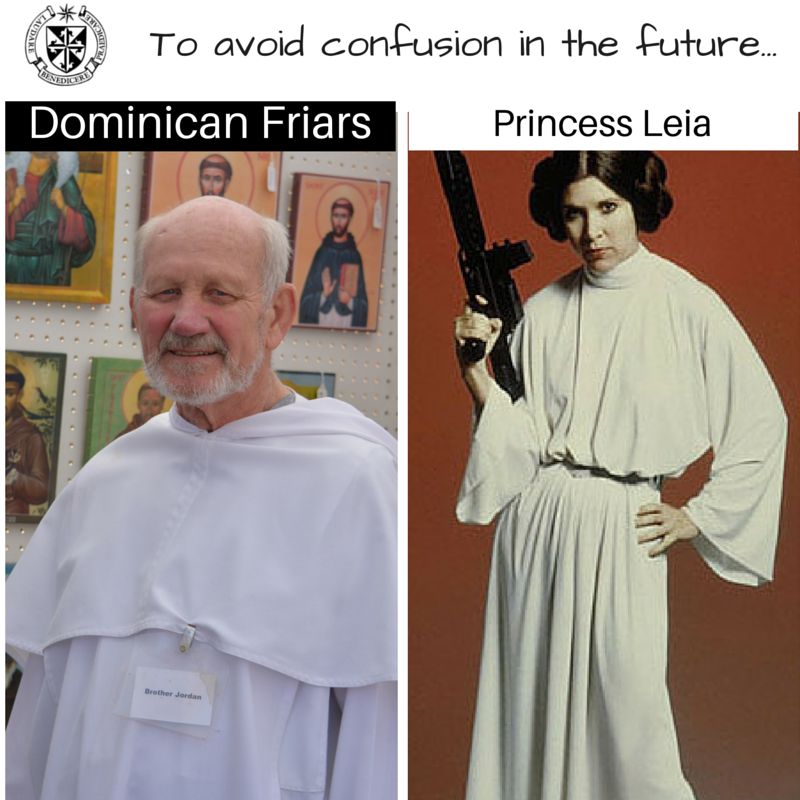
Univ. Indiana student mistakes Dominican priest for Klansman. Hijinx ensues.

My in box is replete with notes about what would be an amusing story, but which really isn’t that amusing after all.

One of my correspondents writes:

Proof That Colleges Are Making People Stupid

At U Indiana in Bloomington, a co-ed thought she spotted a KKK Klansman with a… wait for it… whip!  She did what all alert university scholars do today… she tweeted about the KKK guy to the whole world!

It got worse… HERE

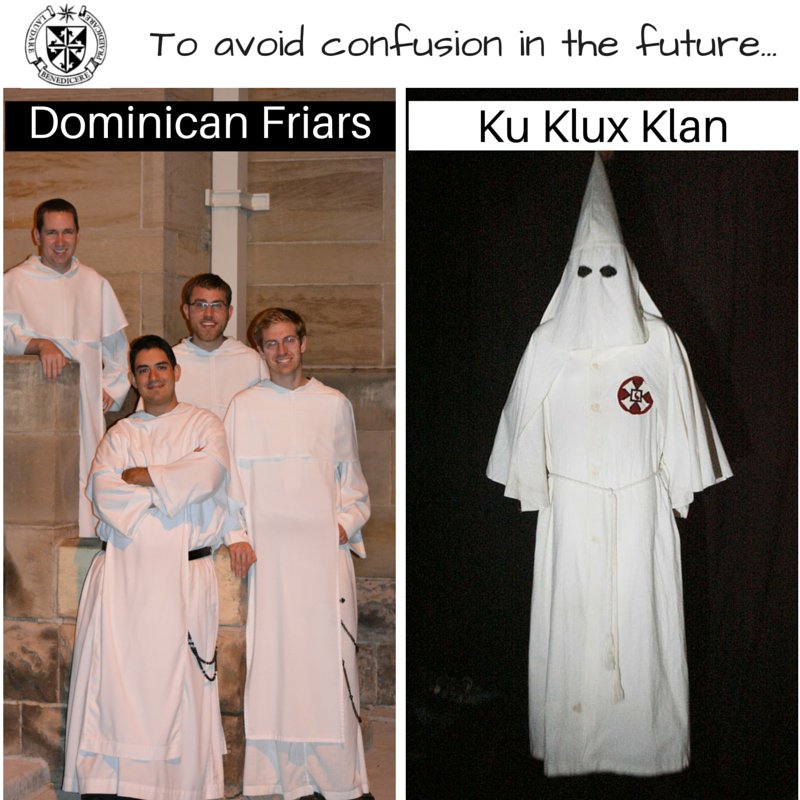
The deadly Klansman was Dominican priest, in his white habit, which has… wait for it… a Rosary.

Breitbart HERE

BUT WAIT!   There’s more.

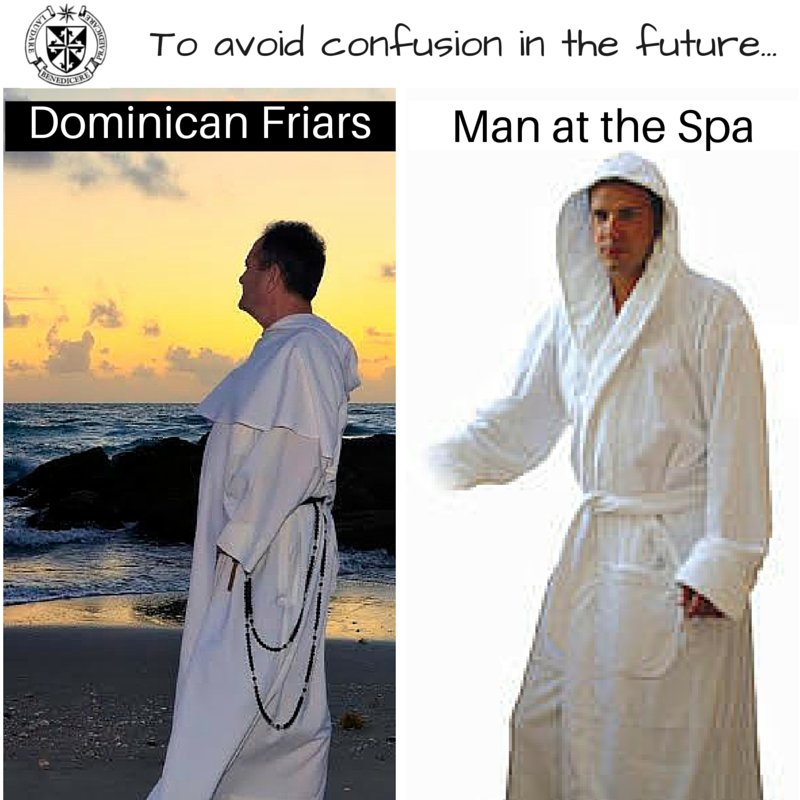
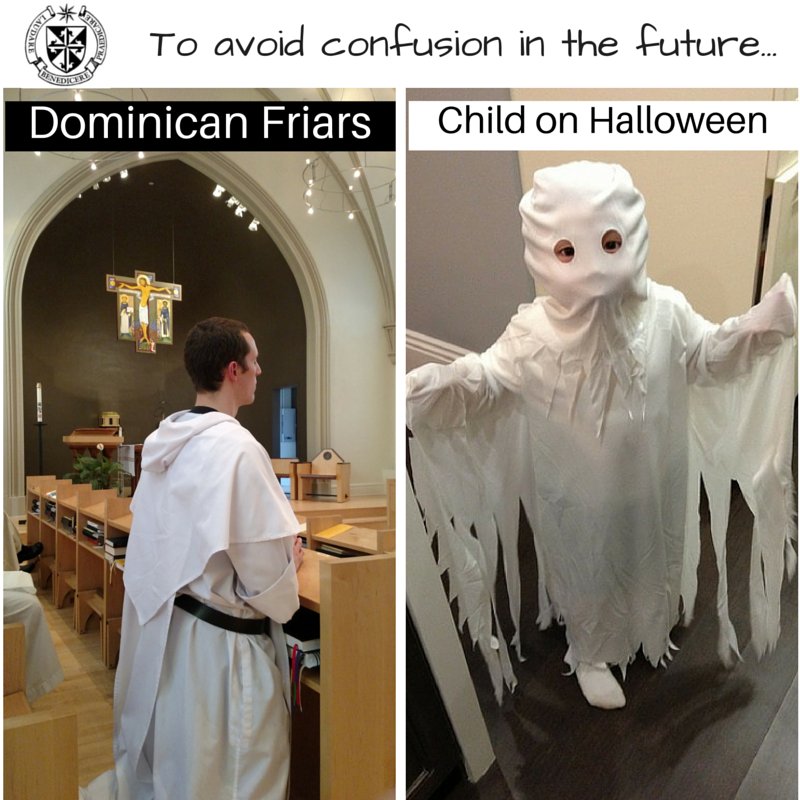
Since Dominicans are teachers, one Friar (another word for what Dominicans are) posted (on Twitter… where else do students get their information) a helpful field guide to white people dressed in white to help that girl in Indiana.  HERE

I am sure that the students of UofI are really on edge after that scary scare.   Surely there are some official university counselors available to help them.

On a more serious note, … we are in trouble.

MEANWHILE….

Over at discarding images I spotted this

From … Le livre de Lancelot du Lac and other Arthurian Romances, Northern France ca. 1275-1300 (Beinecke Rare Book & Manuscript Library, MS 229, fol. 100v)

For those of you at U of I, a woman jousting with a friar.

UPDATE:

One email sender made a connection between KKK and the three-fold Kyrie.

For those of you who go to U of I or perhaps still haven’t gone to what I call with increasing frequency the “Adult” Form of the Roman Rite, might not know that the Kyrie Eleison of the Mass has a three-fold, not two-fold, repetition.  Three-fold means you sing or say it thrice.  Thrice means three times.  That’s like having your tweet retweeted by two other people… two people… because 1+2=3.  1+2 equals 3 only at your local Starbucks when you want accurate change back.  It doesn’t have to come out to 3 in your college classes… if you don’t want it to.

Posted in Lighter fare, The Coming Storm, The future and our choices |
59 Comments

Land of Cotton – Day 3-5: Cooking and stuff

It seems that Natchitoches is famous for meat pies.   So, I had to have one.

And what would a trip to these parts be without an enormous bowl of gumbo.

I am still not sure what gumbo is, but it was pretty tasty.

This town was established in 1715.  Apparently missionaries came down the river from my native place and worked first in the northern part of Louisiana.

The river front.   It isn’t actually a river.  It is a lake that is formed from the extremely long “ox bow” cut off from a nearby river.

During the stay, I turned some mushrooms and onions and spinach and cheese and a few other things not shown,…


We made due with a not perfect cut of meat that had to be … adapted by force.  No skewers or string, so I split some chopsticks.

… into these.

The Basilica of the Immaculate Conception, once the Cathedral of this now-titular diocese.

And, just for fun.

And….

No, I don’t think I will.

It’s off to the north for me today.

Posted in Fr. Z's Kitchen, On the road, What Fr. Z is up to |
6 Comments