A 4 year-old and the rubrics

From a reader…

Good evening Father,

A funny story that you might appreciate. My 4 year old son was sitting with me while putting my 2 year old to sleep, and he was watching my phone. I was praying Vespers (via DivinumOfficium.org) and he asked me:

“Daddy, are you saying the black parts and doing the red ones?”

“Yes, kiddo, that’s right.”

Kids absorb a lot more than we think they do! Tradition is for the young.

That’s wonderful.

Children have a strong liturgical sense.  I’ll bet lots of you parents out there can bear witness to that.

Posted in Lighter fare, Liturgy Science Theatre 3000, Our Catholic Identity | Tagged
17 Comments

@DanHoranOFM -The Horan of Babylon – calls #MarchForLife “repulsive and futile”

Breitbart has a piece which shows the fruits of decades of slack theological training and compromised religious formation.  An LBGT promoting Franciscan, who teaches heaven knows what in the theological Babylon called Chicago Theological Union, has called the March For Life “repulsive and futile”.

The Franciscan, Daniel P. Horan, from now on to be known as the Horan of Babylon.

However, as per Breitbart:

Horan has praised the pro-abortion Women’s March as consistent with Catholic social teaching. The fact that pro-life women and organizations are not welcomed at the event seems not to bother his conscience in the slightest.

Think about this.

He is anti-March for Life.  That means that he has little interest in the aims for which the March was born: defense of human life.  He sidesteps the life issue by super-imposing his own irrelevant, left-wing political views on the March.

He is pro-sodomy.   That means he promotes fruitless, sterile sex which also leads to any number of other problems.

He praises a pro-abortion rally.  That means he supports something that kills the fruit of naturally ordered sexual relations.

A while back at Fishwrap, he denigrated traditional liturgical worship of God together along with John Paul II’s “theology of the body”.

Are you seeing a pattern?

The Horan of Babylon, ladies and gentlemen.

He seems to be failing around for attention.

The moderation queue is ON.

Posted in Emanations from Penumbras, Liberals | Tagged , ,
30 Comments

D. Albany Bp. Scharfenberger calls out hypocrite Gov. Cuomo

It seems that Albany’s bishop, Most Rev. Edward B. Scharfenberger, is not remaining silent about Gov. Cuomo and his hypocrisy.

From Fox:

NY Bishop Calls Out Cuomo Over State’s New Abortion Law: ‘It Goes Way Beyond Roe vs. Wade’

A bishop in Albany, New York, called out Gov. Andrew Cuomo for citing his Catholic faith and supporting recent legislation that legalizes abortion up until birth.

Cuomo (D) signed the Reproductive Health Act on Tuesday, which he called “a historic victory for New Yorkers and for our progressive values.”

Days earlier, though, the governor touted his Catholic faith during his ninth State of the State address.

In an open letter to Cuomo, Albany Bishop Rev. Edward B. Scharfenberger said it was “very difficult to understand” how the governor can cite his faith, yet advocate for such a “profoundly destructive legislation.

Scharfenberger said Saturday on Fox & Friends that although Cuomo’s bill advertised bringing more equality to women, it excludes the class of women who are unborn.

“It goes way beyond Roe vs. Wade in so many ways, so certainly I don’t see it’s something to celebrate,” he said.

He added the governor’s excommunication from the Catholic Church may occur if he continues to distance himself.

“I can certainly understand the outrage and the anger,” he said. “My hope is that since his faith is important to him, he will reconsider the importance of maintaining that communion and not continue to distance himself.”

Posted in ¡Hagan lío!, Emanations from Penumbras | Tagged , , ,
27 Comments

ASK FATHER: What happens to Guardian Angels after we die?

From a reader…

QUAERITUR:

What happens to your guardian angel after you die? Did he necessarily exist before you were conceived? If so, was he possibly somebody else’s guardian before? Indeed are angels the guardians of more than one soul?

Thanks for the question about angels.   Angels are fantastic and fascinating.

Yes, all the angels who exist, existed before material creation.  When we profess that God created all that invisible, “unseen”, that means the angelic realm.

There are two kinds of persons, created and uncreated.  The uncreated Persons are obviously the three Persons of God, the Holy Trinity.  The created persons are in two categories, those who are individuated in matter and those who are not.   Because we human beings are individuated in matter, we all belong to one species, the human race.  Because angels are not individuated in matter, each angel is his own species, as different from each other as alligators are from giraffes.

There is no telling how many angels there are.  Scripture indicates at certain points that there are so many angels that they are hardly to be counted.  God knows, but we couldn’t count them if we tried.  As a matter of fact, some think that there may be an angel for everything that moves, guiding it according to God’s great plan.   In any event, there are far more angels than there are of us.

We know from Scripture that we have angel guardians.  Christ even refers to the angels of little ones who see the face of God.  Angels, not having bodies, are not limited to one place as we all.  They are where they need to be acting. In seeing the face of God at the same time as they guard us, they watch over us according to God’s will.

What happens to our guardian angels after we die?  They remain angels, of course.  They can never be anything other than what they are.  They do not lose their angelness.  Could God assign them to some other person?  Sure.  Does He?  Who knows.   There are so many angels that every human every born could have a new one, from any of the choirs of heaven, high or low.

And even the least of the angels, at the very bottom of the angelic heap, by far transcends this material realm.  Angels are mighty beings, indeed.

Aside: Remember that St. Francis said that were he to meet a priest and an angel on the road, he would reverence the priest first.  An angel can’t do what a priest can, such as forgive sins and confect the Eucharist.

Nevertheless, angels perpetually behold the face of God and worship Him in the heavenly hosts, wreathed and thronging around the celestial altar of the Lamb, singing praises… KADOSH… KADOSH… KADOSH… DOXA DOXA DOXA… SANCTUS SANCTUS SANCTUS… HOLY HOLY HOLY.  Holy angels are never not worshipping God, even when they have a job to do that refers to our lives.  A “job”, a mission from God that makes these incredible pure spirit persons “messengers… heralds…”.  “Angel is from Greek, “messenger”, Hebrew malakh.  Once the mission is done, they are not then “messengers” but their nature doesn’t change.

Speaking of choirs of angels, the mightiest of the Angels whom we think about, Michael, is from what we identify as one of the lower choirs.   At the top are the magnificent seraphim and cherubim described in Scripture.

There is a lot more to be said about angels, but that will suffice.   There is, however, a story told in a letter St. Jerome to a friend, Eustochium, about a nightmare. Jerome was questioned by an angel. The angel asked him who he was.  Jerome said that he was a Christian.  The angel said, “No, you are a Ciceronian!”, because Jerome was a great admirer of Cicero.  Then the angel beat him.

They can do that.


Posted in "How To..." - Practical Notes, ASK FATHER Question Box | Tagged , ,
17 Comments

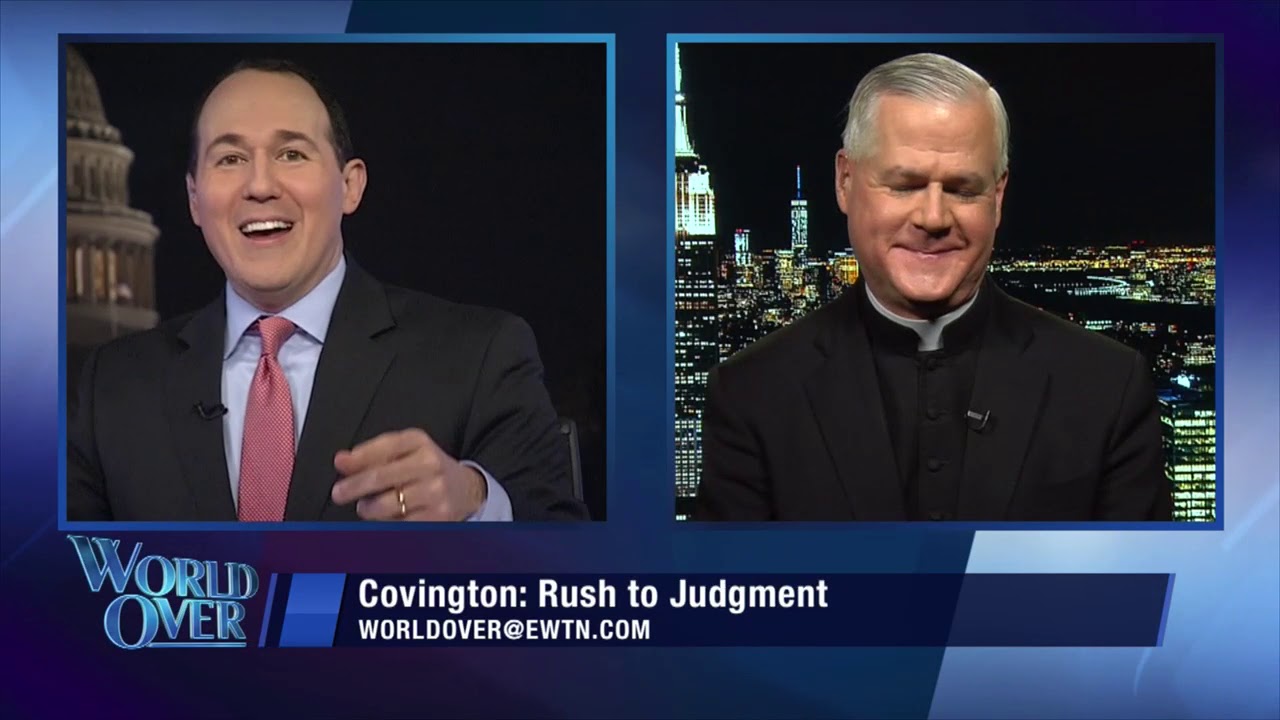
Fr. Murray on the Covington Matter and NY State abortion debacle

My good friend Fr. Gerald Murray was on EWTN commenting on the Covington Matter and on the abortion debacle in NY.

You won’t find a better commentator.

YouTube thumbnailYouTube icon

Posted in The Drill |
2 Comments

Msgr. Pope and canonist Ed Peters on NY Gov. Cuomo: “It is time to end the charade”

Canonist Ed Peters responded to Msgr. Charles Pope’s implicit request for canonical clarifications in the matter of NY Gov. Cuomo and his complicity… nay, rather, full-throated promotion of infanticide.  If there were ever a case of application of the law to a highly visible public figure who identifies as Catholic, committing scandal, it is Cuomo and his promotion of abortion.

Let’s see Peters:

From Msgr Pope’s lips to the bishops’ ears

Msgr. Charles Pope, on no one’s Top Ten List of Catholic Hot-Heads, [I’d like to see that list!] captures the sense of faithful Catholics everywhere when he writes, regarding the major role that New York Gov. Andrew Cuomo played in pushing, signing, and celebrating [he didn’t just stand by, he played a highly active role] that state’s new, gruesome abortion law, that Cuomo-qua-Catholic must now face ecclesiastical consequences [gosh!  What are those?  Ecclesiastical what? Ohhhh yeaaaaah… I remember something about them.] for his egregious actions. Pope acknowledges, though, that he is not a canon lawyer and seems implicitly to ask for input from those who are regarding possible consequences. My thoughts follow.

1. Cuomo is already barred from the reception of holy Communion per Canon 915 (a sacramental disciplinary norm, not a penalty) in light of his openly living with a woman to whom he is not married. This matter was widely discussed back in 2011. My understanding is that Cuomo, to his credit, has not approached for holy Communion since that matter was aired.

2. Regardless of Cuomo’s ineligibility for holy Communion on other grounds, his conduct in regard to New York’s new abortion law also suffices, in my view, to bar him from holy Communion per Canon 915. If information should reach ecclesiastical authority that Cuomo is, despite the foregoing, being given holy Communion by ministers under their authority, Church leaders should act immediately to prevent such administration. Canons 375, 381, and especially 392, among others.  [And they must publicly state that he must not receive.  They should issue directives to their dioceses.]

3. Cuomo is not liable for excommunication for abortion under penal Canon 1398. I have made this argument many, many times and won’t repeat it here. Neither is he, in my view, liable for prosecution as an accomplice to abortion per Canon 1329.  [His participation in the successful of an abortion is not proximate enough.]

4. Cuomo has, however, committed acts that, in my view, suffice to invoke penal Canon 1369 against him. That possibility occasions some observations for Catholics forming their expectations about exactly who in the Church could be doing exactly what in a case like this.

[NB] 4 A) Penal jurisdiction in this matter rests with the bishop of Albany (as the place where some or all of the canonically criminal conduct was committed, per Canon 1412) and/or with the archbishop of New York (as the place where Cuomo apparently has canonical domicile, per Canon 1408). They are authorized to initiate canonical penal procedures under Canons 1341 and 1717, among other norms. Neither the state nor national episcopal conference has jurisdiction here.

4 B) The 1983 Code prefers that penal matters be tried judicially but an administrative penal process is not precluded. Canon 1342. Either way various rights of canonical defense are owed to Cuomo and would doubtless be honored. Canon 221, among others.

4 C) Canon 1369, as a penal law, must be strictly (i.e., narrowly) interpreted and applied. Canon 18. This means, among other things, prosecuting Cuomo only for acts that fall within the terms of the canon and not using a Canon 1369 prosecution as a pretext for punishing Cuomo for other acts, that, while offensive to the faith and to the faith community, are simply not embraced by its terms.

4 D) Canon 1369 authorizes a “just penalty” against those who violate its terms. That broad (but not unlimited) phrase “just penalty” allows for tailoring the canonical consequences in specific cases to the wide variety of fact patterns that could be addressed in its light, here, everything from Cuomo’s speeches and comments in support of this abortion law to his ordering a ghoulish light show in celebration of its enactment.  [Lighting the Empire State Building!  If a penalty is to be tailored, a lot of fabric is going to be needed.  This is a big deal.] That said, while the notion of a “just penalty” is broad, there is some question as to whether it extends, at least immediately, to excommunication. Here is not the place to air that technical issue, but neither should its presence derail consideration of using Canon 1369 against Cuomo. Some justice is better than no justice and even if (I say, if) excommunication could not be imposed immediately on Cuomo, the Church could still impose some canonical sanctions for his conduct. If, moreover, such sanctions as could be imposed per Canon 1369 were ignored by Cuomo, Canon 1393 would allow for their augmentation, making the possibility of a “just penalty” reaching to excommunication stronger.

5) Canon 1399, known as the general penal norm, is also available for canonical use against seriously bad acts but only, in my view, if those acts are not otherwise addressed in penal law. Thus, for example, using Canon 1399 as a backdoor way to prosecute Cuomo for abortion (notwithstanding that Canon 1398 does not reach him) would not be correct. Identifying adequately what divine or canon law was supposed to have been violated by Cuomo in acting as he did, and identifying that law in such a way that nearly every other sinner would not be liable to criminal prosecution for violating it, is a difficult task. Not an impossible one, perhaps, but difficult. I say this, by the way, as a canonist who thinks Canon 1399 to be applicable against Uncle Ted.

6) Canon 1339 authorizes “rebuke” against one “whose behavior causes scandal”. That Cuomo’s conduct here causes classical scandal (CCC 2284) seems to me beyond question. Whether canonical rebuke adequately serves, however, the needs of the faith community for good order or Cuomo’s need for personal correction I leave to others to consider.  [A “rebuke”.  “Whereas you, Gov. Cuomo, actively promoted infanticide and committed horrendous scandal, we rebuke you.”   Yeah… that’s going to do it.]

7) Much of the above analysis would apply to Catholic legislators supporting abortion laws, but the canonical case against Cuomo is, in my view, so much the stronger that, if ecclesiastical action were not feasible, or taken, against him, it would be harder to see it being taken or succeeding against lesser figures.  [Hence….]

8) Two final notes for other prelates concerned about similar actions and actors in their territories.

8 A) Canon 915 is a sacramental disciplinary norm, not a penal canon, and its application requires no penal process. It is, and has long been, applicable to many prominent pro-abortion/euthanasia Catholic politicos and it has been correctly invoked by a few clear-thinking bishops. It at least cauterizes the wound inflicted on the Body of Christ by prominent Catholics acting in open disregard of fundamental Church teaching. It is not a cure-all, but it is a serious step toward healing.  [NB – These moves by Church authorities are medicinal.  They are not meant for revenge or simply for punishment, but to bring about conversion and a change of behavior.]

8 B) In terms of penal canon law the best time to move against a Cuomo-type crisis is, of course, before it happens, i.e., pro-actively instead of re-actively. [I am not well-informed on this.  Did the bishops of NY do anything while Cuomo was on his infanticidal jihad?] Because this post deals with what can still be done now, and not what should have been done before, I will simply observe that a penal precept could have, in my view, been issued against Cuomo on these facts (specifically against, say, his promoting or signing this death-dealing legislation) and in turn that precept could have been enforceable by canonical penalties up to and including excommunication. Canon 1319. The canonical prerequisites to such a penal precept could have been satisfied in this case, facilitating the Church in acting justly and in being seen to act justly. Cuomo’s conscience would have been confronted and the values of the Catholic community would have been protected. Again, this observation does not detract from assessing what can be done canonically, even now, in regard to Cuomo, but it does suggest that other bishops looking at similar problems arising in their Churches would do well to consider acting sooner than later.

Msgr. Pope ends his essay thus: It is time to end the charade, even the lie, that Andrew Cuomo and others like him are Catholics in good standing. [Do I hear an “Amen!”?] They are not, and this must be made plain to them and to others. Join me in praying that Bishop Scharfenberger and other bishops in New York with jurisdiction will do what is right and necessary.”

I join him in so praying.

Posted in Canon Law, Emanations from Penumbras, Our Catholic Identity, The Coming Storm, The Drill, The future and our choices | Tagged , , , , , ,
12 Comments

US bishops asked about women deacons

A CNA piece at the Catholic Herald looks into women deacons, deaconettes, whatever.   

Yesterday, I posted about a brilliant piece at Touchstone which shows, incontrovertibly, that the reasoning behind support for ordination of women (to any grade of order) is the same as promotion of sodomy and the homosexualist agenda.  HERE

What does CNA say?

Two-thirds of US bishops do not believe women should be ordained deacons

Most want women to have a greater role, but do not believe a diaconate is the answer

A survey of bishops in the US released this week found that among respondents, 41 percent believe it theoretically possible to ordain women as deacons, and only 33 percent believe this should be allowed.  [Good grief.  41%? What have they been reading?  To whom have they been listening?]

The survey released by the Center for Applied Research in the Apostolate at Georgetown University (CARA) was sent in September 2018 to 192 bishops, of whom 108 responded, [So 56% responded.] resulting in a margin of sampling error of plus or minus 6.25 percentage points.

The responses regarding the possibility of female diaconal ordination and whether it ought to occur suggest that eight percent of bishops in the US might believe it possible, yet not believe it should be authorized.

Diocesan deacon directors were also surveyed by CARA. Of the 186 deacon directors invited to participate, 133 responded, leading of a margin of error of 4.55 percentage points.

Asked if they believe the USCCB would implement the sacramental ordination of women as deacons were it authorized by the Holy See, [not going to happen] 79 percent of bishops and 72 percent of deacon directors responded in the affirmative. Of bishops, 54 percent said they would consider implementation in their own local Church, and 62 percent of deacon directors believed their ordinary would do so.

Twenty-seven percent of bishop and deacon director respondents believe the Church will authorize the sacramental ordination of women as deacons. [nope]

Among the bishops, 97 percent agreed strongly or somewhat that their diocese is committed to increasing women’s involvement in ecclesial leadership; 86 percent of deacon directors affirmed this.

Asked if it would be helpful to have women deacons in liturgy, word, and charity ministries, most of the bishops responded in the affirmative for each category. [That’s the trap.  Functionalism.] Most deacon directors responded affirmatively as well, and all of the deacon directors said women deacons serving in charity ministries would be somewhat or very helpful.

It is to be held definitively that priestly ordination is reserved only to men.  [I wonder how many bishops believe that.  Moreover, remember that Lumen gentium definitively ties diaconate into Holy Orders – if women can’t receive the two other grades of Holy Orders, they can’t receive the other one.]

The question of female deacons has recently resurfaced after Pope Francis appointed in August 2016 a commission to look into the historical role of deaconesses in the early Church.

Non-sacramentally ordained deaconesses were part of the early Church, although it is not entirely clear what their role was.  [NB…. “Non-sacramentally ordained”… so, they were, rather, “installed… commissioned…” something other than ordained in the way we understand it now, which is what counts.]

In June 2018, Cardinal Luis Ladaria, prefect of the Congregation for the Doctrine of the Faith and head of the commission, clarified that “the Holy Father did not ask us to study whether or not women can be deaconesses…but rather, [he asked us] to try to say in a clear way what the problems are and what the situation was in the ancient Church on this point of the women’s diaconate.”

Francis has acknowledged that the subject of deaconesses has already been studied by the Church, including a 2002 document on the diaconate from the International Theological Commission, an advisory body to the Congregation for the Doctrine of the Faith.

The document, which gave a thorough historical context of the role of deaconesses in the ancient Church, overwhelmingly concluded that female deacons in the early Church had not been equivalent to male deacons, and had neither a liturgical nor a sacramental function.

The ITC wrote: “a ministry of deaconesses did indeed exist, and that this developed unevenly in the different parts of the Church. It seems clear that this ministry was not perceived as simply the feminine equivalent of the masculine diaconate. At the very least it was an ecclesial function, exercised by women, sometimes mentioned together with that of sub-deacon in the lists of Church ministries.”

In his seminal 1982 work Deaconesses: An Historical Study, referenced several times by the ITC, Aime Martimort [US HERE – UK HERE] wrote that “the Christians of antiquity did not have a single, fixed idea of what deaconesses were supposed to be,” and that “the Greek and Eastern canonists of the Middle Ages were even less able than those of antiquity to know who and what deaconesses were.”  [That hasn’t changed since Martimort wrote it.]

He added that “the continuity of a true ecclesiastical tradition was lacking in the case of deaconesses,” and that their institution “lasted only as long as adult baptisms were the norm” and that “it rapidly became obsolete.”

According to Martimort “the resemblance between the ordination rituals of the deacon and deaconess … should not deceive us,” and that “the various euchologies had already given fair warning that there were significant differences as well as resemblances.”

“During all the time when the institution of deaconesses was a living institution, both the discipline and the liturgy of the churches insisted upon a very clear distinction between deacons and deaconesses.”

Martimort concluded that “the real importance and efficaciousness of the role of women in the Church has always been vividly perceived in the consciousness of the hierarchy and of the faithful as much more broad than the historical role that deaconesses in fact played. And perhaps a proposal based on an ‘archeological’ institution might even obscure the fact that the call to serve the Church is urgently addressed today to all women, especially in the area of the transmission of Faith and works of charity.”  [Like, for example, women religious? Nuns?]

Posted in Deaconettes | Tagged , , , , ,
6 Comments

Bishop of Covington does a 180, apologizes.

Say you set out on an errand by foot to the post office.  Trudge trudge trudge.   Suddenly you realize that you made a bad turn and you are going in the wrong direction.  Someone might say, “Hey, buddy!  If you are going to the post office, it’s that way.”  Time after time, the neighbors helpfully offer, “Yo!  It’s that way!  You’re going the wrong direction!” What do you do?  Do you keep going on the same, errant, direction?  Or do you stop, turn around, go back to where you made the mistake and correct your way?

Scratch that. Better analogy.

Say you are in a burning building.   Smoke is filling the halls, making it hard to see.  You want to get out, so you start running down the hall.  But people are running in the other direction.  They say, “Hey! You’re going the wrong way!”  Do you listen to them, turn, and go in the right direction?   Do you keep going?  Do you stop and stand there doing nothing?

Most of us would retrace our steps and correct our course.

Today at the site of WCPO of Cincinnati, we read that Bp. Foys of Covington has at last done a 180 to retrace his step and get back on the right course.

Bishop: Diocese of Covington felt ‘bullied and pressured’ into condemning students too quickly  [Not a great headline, but keep reading.]

COVINGTON, Ky. — Diocese of Covington Bishop Roger Foys apologized Friday afternoon for issuing a premature statement about a group of Covington Catholic High School students’ interactions with Native American activists Saturday in Washington, D.C.

In a letter to Covington Catholic parents, Foys wrote the diocese felt harangued into reacting as quickly as possible to a viral clip of the incident — and then, when additional clips filmed from other perspectives began to circulate, to issuing a just-as-quick retraction of its earlier condemnation. [The diocese felt bullied?]

“We should not have allowed ourselves to be bullied and pressured into making a statement prematurely, and we take full responsibility for it,” he wrote. “I especially apologize to Nicholas Sandmann and his family as well as to all CovCath families who have felt abandoned during this ordeal. Nicholas unfortunately has become the face of these allegations based on video clips.

“This is not fair. It is not just.”

Sandmann, 16, was among a group of Covington Catholic students who had traveled to the capital for the anti-abortion March for Life. While waiting for buses outside the Lincoln Memorial, they became involved in a back-and-forth shouting match with members of a fringe religious group known as the Black Hebrew Israelites. The BHI, who believe they are the “true” Jewish people and are known for anti-gay, anti-Semitic invective, vociferously insulted the students as well as uninvolved passersby.

Among those passersby were Native American activists participating in their own demonstration, the Indigenous Peoples March. They attempted to intercede in what they perceived as an escalating conflict.

A short video clip of one activist, Omaha tribe elder Nathan Phillips, playing a traditional drum while face-to-face with a smiling Sandmann, who wore a “Make America Great Again” cap, became the lit fuse on a controversy Bishop Foys said led to an online explosion that damaged the entire diocese.

Shortly after the clip began to circulate Saturday, earning Sandmann the condemnation of figures ranging from “Captain America” actor Chris Evans [As if we care what actors think.] to sitting politicians, the diocese and school released a joint statement.

It read:

We condemn the actions of the Covington Catholic High School students towards Nathan Phillips specifically, and Native Americans in general, Jan. 18, after the March for Life, in Washington, D.C. We extend our deepest apologies to Mr. Phillips. This behavior is opposed to the Church’s teachings on the dignity and respect of the human person. [What is really a violation of dignity is rash judgment and harming their reputation on this scale.] The matter is being investigated and we will take appropriate action, up to and including expulsion. We know this incident also has tainted the entire witness of the March for Life and express our most sincere apologies to all those who attended the March and all those who support the pro-life movement.
In Friday’s new statement, Foys wrote he hoped an independent third-party investigation would definitively exonerate the students of the racism and harassment of which they had been accused.

He added he supported the school and its principal, Robert Rowe, moving forward.

“This has been a trying time for all of us,” he wrote. “I pray that with the grace of God and the goodwill of all involved peace will once again reign in the hearts and minds of our faithful. As for CovCath, we have a spirit that will not die!” [Except maybe when you beat it to death with rash judgment.]

Foys had earlier in the week spoken with Covington Catholic students in person, according to an article published in diocese newsletter the Messenger.

It quoted him as having told the students: “This is a no-win situation. We are not going to win.  [Yeah… that’s the spirit!] No matter what we say one way or another there are going to be people who are going to argue about it … The best we can do is, first of all, to find out the truth. To find out what really went on.”

Read Bishop Foys’ entire letter to Covington Catholic families: …

The letter follows on Scribd. You can read it there.

The mess continues.

BTW… that burning building analogy at the top could describe what we have been doing as a Church for the last 50+ years.

Posted in Si vis pacem para bellum!, The Coming Storm, The Drill, The future and our choices, The Last Acceptable Prejudice | Tagged
25 Comments

25 January 1959 – 60th anniversary of the calling of Vatican II

On 25 January 1959, just under 3 months after his election to the See of Peter, John XXIII, at St. Paul’s outside-the-walls, stunned his listeners and the rest of the world.

60 years ago he announced the summoning of an Ecumenical Council to be held, for the second time, at the Vatican.

At the same time, John announced that the Code of Canon Law should be reformed (which happened in 1983) and that there should be a Synod for Rome.

My old boss in the curia, the late and great Card. Mayer was present at St. Paul’s.  He told me his story about hearing the announcement and the buzz it created.  It caught nearly everyone by surprise… as it still does today, in a lot of ways.

60 years ago, today, 25 January, at least where I am, in Tokyo as I write.

I suspect that, in far enough retrospect, the Second Vatican Council will be counted as having created lots of tumult, but it won’t be counted as an important council, not at least in comparison with monumentally important council’s such as Nicea, Chalcedon, Constantinople(s), Trent.   Some councils were super game changers, some adjusted the game, some didn’t do much at all.   We are, in light of history, just getting to the point when we can see more objectively the fruits – good or bad – of Vatican II.   We are “sobering up” after those halcyon days.  Reason is returning to many sectors of the Church.  Of course some are so stuck in the present, that they forget the importance of continuity with the past.  Others haven’t forgotten the past, they just don’t like it.  Hence, they think Vatican II was tantamount to the Council of Jerusalem.

Anyway, 60 years, friends.

Posted in The future and our choices, Vatican II | Tagged , ,
10 Comments

The “logical union of women’s ordination and sodomy”

I have noticed lately an uptick in chatter about women deacons, deaconettes, deaconesses, whatever.  There was a conference at Fordham recently at which speakers (read: promoters) blew past the obvious problems of our lack of certainty about what ordination may have meant for women in the ancient Church, etc., and the fact that Lumen gentium definitively identifies diaconate, with priesthood and episcopacy, as a grade of Holy Orders (reserved to men), and also made assertions about how deaconettes would be accepted in parishes, etc.

Essentially, promoters of women’s ordination, even to the diaconate, comes down to this:

Maybe we don’t know some essential points about ancient deaconettes, but we want them now because they could be useful for ministry today.

This is a deadly trap.

However, there is a brilliant response to the trap available at this month’s number (Jan/Feb 2019 – Vol. 32, No. 1) of Touchstone James A. Altena.   This superb article is a must read for anyone even slightly interested in the issue of women’s ordination to any of the three grades of Holy Orders.

Sex, Women’s Ordination and the Rejection of Hierarchy and Equality.

The article is, alas, behind a paywall.  You can subscribe monthly online with Kindle – US HERE – UK HERE.

The author lays down the “irreducible theological connection between women’s ordination and ethical normalization of homosexuality.

The article slays women’s ordination.  The fact that Altena writes from an Anglican perspective makes no difference whatsoever for the inescapable logic of his conclusions.

The writer, James A. Altena, carefully sets forth his argument, to which in a single blog post I can hardly do justice.

He begins by showing how the Trinity is a hierarchy of equal persons.  Equality and hierarchy do not conflict.  Man (human beings), as God’s images, reflect in his relationships both equality and hierarchy.  The ease of harmony of human equality and hierarchy was marred in the Fall.  Maleness and femaleness reflect equality and hierarchy.

The relationship of man to woman, who signify in living forms the divinely created principles of male and female that in turn manifest the divine triune relations of hierarchy and equality, is one such unalterable symbolic relation, because it signifies the relation of Christ to his Church.  It is in the Church that the principles of the Incarnation – God made man – and of man and woman – complimentary persons made in the image and likeness of God – are brought together.

As Paul states,

the relation of Christ to his Church, and hence of male to female within it, is that headship and submission, in short, one of hierarchy…. And yet St. Paul also states that in the Church the salvific relation between its members, conferred by baptism, is neither male nor female… in short, is one of equality.    Both principles… are fully present and operative in the Church, and when rightly understood and applied, they cannot contradict each other.

Thus, the hierarchic relation of male headship to female submission cannot be one of dominance to subjugation that violates the principle of salvific equality, and the relation of equality cannot be one of undifferentiated egalitarianism that denies the principle of hierarchic relation.  Instead, as reflective of the ordered relations within the Trinity, the relation of headship to subjection, of male to female, is one of service and response – of self-sacrificial service by the head in union with the consenting and enabling cooperation and support of the subject, each selflessly seeking the greatest good of the other.

From here, Altena moves into examining ordained ministry as a sign of the Church.  As you might guess, ordained ministry, too, “embodies and manifests the principles of hierarchy and equality, and of headship and submission within hierarchy”.  Note the use of “sign”, which is a theological principle.

[T]he ordained minister does not just do things…. Rather, and far more importantly, he is something – a living sign, an ‘icon’ or ‘image’ of Christ to the Church, just as Christ as the Incarnate Son is the divinely given image of God to man (Heb 1:3), and the husband is the image of God to his wife and children in marriage and the family.

Then Altena moves into an important distinction between what he calls essentialism and functionalism.  Everything has an essential principle which makes it what it is, which orders its relations, goals and ends.  However, there is a modern, secular concept of functionalism,

“which denies the existence of any such inherent and irreducible essence, and hence of any intrinsic ontological or teleological character to things.  Instead, it asserts that a thing is nothing more than the sum of its parts and capacities for action or uses at a given moment, a particular collection of accidents which man chooses to conceptualize as a unity and to assign a name to.

Dear readers, I am harshly compressing Altena’s carefully argued article into a quick outline.  Do not assume that there are not well-argued connections and foundations for all of these moves.   However, you can see where he is going, even with my rough sketch.

Stepping away from Altena for a moment, the promoters of women’s ordination deny this hierarchal dimension when in comes to male and female.  They don’t like the “iconic” argument, that males reflect the male Christ in ordained ministry and maleness is necessary.  They say that women are also icons of Christ. Sure they are!  In the salvific dimension of equality.  But the way God has it set up, as revealed in the Trinity, equality can’t be considered alone.  There is also hierarchy, an ordering of headship and submission, in the Trinity, in nature, in the Church, in ministry.

Proponents of women deacons refer to how “useful” they would be.  This is a functionalist argument that does not account for what Altena calls essentialism.   The idea is this.  If ministry is a function, a job, in the Church, then anyone qualified should able to fulfill it because all in the Church, men and women, are equal.   Some men who are ordained can barely put three coherent sentences together in the pulpit and some women are brilliant orators and scholars.  Why shouldn’t they be ordained?  That reduces ministry to a function.  That’s a trap.

Going back to Altena, you can see where he is going with the connection between those who promote women’s ordination (to any grade of order) and those who promote sodomy. If sex is just a detail, then why shouldn’t men have sex with men?

When it comes to promotion of women’s ordination and of homosexuality

both positions deny or reject essentialism in favor of functionalism.  Apologists for sodomy deny that there his any underlying significance or purpose to sexual relations as essentially procreative and unitive, which naturally constitutes them and orders their use to those specific ends.  Rather, since they they can be conceived of and use (physical and emotional pleasure), these become [pace James Martin!] ends in themselves, and the means to them is asserted to be ‘natural’ in a reductionist sense.

Likewise, apologists for women’s ordination deny that there is any underlying significance of purpose to the ordained ministry as essentially hierarchical and authoritative, which naturally constitutes it and orders its use to that specific end.  Rather, since it can be conceived of and used functionally to obtain other desired results (e.g., pastoral care, Bible study, church administration, etc.), these become [pace Phyllis Zagano, Fr. Pottier, etc.] ends in themselves, and the means to them is asserted to be ‘natural’ in a reductionist sense.

Second, both sets of apologists deny or reject the Christian belief in divine signs, symbols, and signification.  For both, there is no belief that created things – whether sexual relations or the ordained ministry – are divinely constituted with any essential power or meaning to signify and point beyond themselves to revealed, eternal divine verities.  Instead, all symbols are purely human concepts which may be created, altered, and discarded at will, since their signifying power and meaning are determined by man (not God) to satisfy human desires and needs.

Altena keeps arguing through eight different points with two more quickly mentioned.   One of them, point eight, mentions a long-time reader of this blog…

Eighth and last, the final fruit of support for both women’s ordination and “sanctified sodomy” (to borrow William Tighe’s term) is the fundamental inversion of divine human relations.  Both the ability and the asserted right to take as a sexual partner a member of one’s own sex, or to ordain as a minister a woman rather than a man, presume that it is man and not God who sets the terms. As with inclusive language – the assertion of the right to name God as man desires rather than as God reveals – these are (as with all acts of disobedience) ultimately acts of idolatrous self-worship that seek to conform God to the image of and likeness of fallen man.

Do you hear the cosmic echo of the Fall of man?  Remember the lie of the serpent?   “Did God really tell you that?  You shall be as gods!”

Altena goes on to shoot down the counter-arguments, which I won’t summarize here.  You should get that article.  But if you have followed this, you can hear anticipate them: there is a priesthood of all believers… ministry is a job, a function… ministry shouldn’t reflect any sort of hierarchy…etc.

Altena shows in his superbly argued article – 9 densely argued pages – that the same line of thought and desire underlying the defense of and promotion of sodomy undergirds the promotion of women’s ordination.  And that applies to ordination all grades of Holy Orders.  The fact that Altena writes from an Anglican perspective makes no difference whatsoever for the inescapable logic of his conclusions.

Posted in Deaconettes, Our Catholic Identity, Sin That Cries To Heaven, The Drill | Tagged , , , , , , , ,
17 Comments