ASK FATHER: Do I fulfill Mass obligation if I take screaming child out for a long time?

From a reader…

Father, my youngest son, who is less than a year old, is frequently unruly at Mass and throws very loud and lengthy tantrums, often over small things. I (or my wife) sometimes have to stay outside for very long periods of time until he calms down. Nevertheless, we continue to pray silently as best as we can and offer our prayers and trials in union with the Mass. My question is: is there a certain point where being outside too long, or being away from the church, causes us to fail to fulfill our Sunday obligation?

I always tread carefully when any question comes up about noisy kids at Mass.  It is like the proverbial “third rail”.

That said, speaking for myself, thank you from the bottom of my beady-black heart for taking Junior out.   I believe that many people are honest when they say that they don’t mind some crying infants or fussing kids or even melt-down tantrums.  I believe also that many people do mind these thing when they are extended no matter what they say.

So… you take Junior out.  Good move.

In my opinion you are still morally present in the rites on the other side of the door.  You are in heart and mind certainly still united with the action inside. You are most likely trying to guess at which point it is in the Mass.  You desire to be within but for the sake of charity and practicality, you had to go out.

There are various reasons why someone might suddenly have to leave a Mass.  You can, I am sure, think of a few.

Also, yes, our obligation to participate at Mass is a serious obligation.  However, God does not require the impossible from us and neither does Holy Church.

If you are impeded in some way, for a good reason, from participating on a day of obligation, you are, so to speak, “dispensed” from the obligation.   If there is a blizzard and it is too dangerous to go, you don’t have to fulfill the obligation.  If you are sick… if there is a forest fire to fight… if you have no idea where to go to Mass when you are traveling… your obligation is relaxed.  We are reasonable.  If you are taking care of your child who is melting down, you are doing what you need to do.

I also remind everyone here that going to Communion at any Mass is not obligatory, even if you are in the state of grace.  You are not forced to go.  You are not obliged to go.  If you aren’t sure about going because you only managed to be in the church for 5 minutes of the 45 minute Mass while Junior was out of control, you don’t have to go.  It seems to me that if you are checking in with what is going on in church and you are doing your best to participate, you can probably go to Communion.  But you don’t have to.

Also, if your child is having these melt-downs only in church, you might speak to the parish priest.  Use some sacramentals judiciously.

Good luck with that child.  And to all who have young children… I admire you.   Parents of small children often have to deal with things that would make most priests curl up in a ball in the dark and bar the door.

Posted in "How To..." - Practical Notes, ASK FATHER Question Box, Liturgy Science Theatre 3000 | Tagged , ,
29 Comments

ASK FATHER: Why no confessions on Good Friday or Holy Saturday?

From a reader…

I would like to know why many parishes do not offer the Sacrament of Penance on Holy Saturday? There’s only 1 parish in my area that hears confessions on Holy Saturday and I often wonder is there a law forbidding the Sacrament of Penance on Holy Saturday?

In answer to “why”, I have no idea.  It’ll depend on the parish priest.

In answer to “is there a law against hearing confessions”.  NO!

Each year one sees confusion about the Sacrament of Penance during the Triduum.  Confusion is rarer now than before because there have been official explanations and also changes to the wording in the Roman Missal.  But, the less than informed and some liberals who don’t care to keep up to date, cling to their past errors.

Some priests, liturgical experts, and even diocesan liturgy offices wrongly claim – or claimed – that the rubrics of the Missal (or in the old, obsolete editions in English, “Sacramentary”) forbade the sacrament of Penance.

However, this claim was and is incorrect.

Here is what the texts really say.

The previous, obsolete 1970 and 1975 editions of the Missale Romanum (the Novus Ordo) said of Good Friday and Holy Saturday (BTW… the language of this rubric goes back to Pope Innocent III +1216):

Hac et sequenti die, Ecclesia, ex antiquissima traditione, sacramenta penitus non celebrat… On this and the following day, the Church, from a most ancient tradition, does not at all celebrate the sacraments.

However, since this is in the Missal (the book for MASS), sacramenta refers only to the Eucharist, Holy Mass, and not to the other sacraments.

The Congregation for Divine Worship and Discipline of the Sacraments (CDWDS) clarified this in its official publication Notitiae (1977 – no. 137 (Dec) p. 602).

In the 2002 edition of the Missale Romanum at paragraph 1 for Good Friday all doubt is removed.

The above cited text has been amended to say (the change with my emphasis):

Hac et sequenti die, Ecclesia, ex antiquissima traditione, sacramenta, praeter Paenitentiae et Infirmorum Unctionis, penitus non celebrat…
On this and the following day, the Church, from a most ancient tradition, does not at all celebrate the sacraments, except for (the sacraments of) Penance and Anointing of the Sick.

Priests can indeed, and probably should, hear confessions on Good Friday and on Holy Saturday.

john paul confessions good fridayWho can forget the image of the late Pope – Saint – hearing confessions in St. Peter’s Basilica on Good Friday?   Who can forget Pope Benedict?  Pope Francis?  Francis even made his own confession on Good Friday!

So, it is absolutely FALSE that it is forbidden to hear confessions during the Triduum.

That said, there may be other reasons why the priest has decided not to hear confessions.  It may be, for example, that he has been hearing confessions every day during Lent before Masses.

PEOPLE: Go to confession.  Don’t wait until the last minute.  In my 20 Tips I recommend that people go to confession at the time confessions are scheduled to begin, not a few minutes before they are to end.  Why?  So you don’t lose your chance to go.  Similarly, go to confession now, before the Triduum.

Here is a bonus tip, speaking of confessions.

As I have posted before, it is both permitted and appropriate in many instances for confessions to be heard during Holy Mass on other days of the year!

Want proof?  Try the CDWDS document Redemptionis Sacramentum 76 and also the Congregation’s Response to a Dubium in Notitiae 37 (2001) pp. 259-260.

Having a priest in a confessional before and even during Mass on Sundays and feasts could be a way to revive the use of this ailing but essential sacrament.

GO TO CONFESSION!

Posted in "How To..." - Practical Notes, ASK FATHER Question Box, GO TO CONFESSION, Liturgy Science Theatre 3000 | Tagged , , , , , ,
28 Comments

PRAYERCAzT: The Lorica of St. Patrick

The Latin word loríca (note the accent… lo-REE-ka) means “a leather cuirass; a defense of any kind; a breastwork, parapet”.  In effect, it means “armor”.  It has come to be associated with a prayer attributed to St. Patrick (+ 5th c.) .

“Loríca” is also association with an rhythmic invocation or prayer especially for protection as when going into battle.

The Loríca of St. Patrick is rooted in an unconfused belief in the supernatural dimension of our lives, that there is a spiritual battle being waged for our souls, and in our absolute dependence on the One Three-Personed God.

One could pray this prayer each and every morning.

In one source, we read that Patrick composed it on Easter Saturday in 433 while traveling with some clerics to Tara, to shield them from the plots of druids (equivalent to ancient Democrats and Fishwrap readers and most liberals in general) and assassins.  Perpend: “Tunc vir sanctus composuit illum Hymnum patrio idiomate conscriptum, qui vulgo Feth-fiadha, et ab aliis lorica Patricii appellatur, et in summo abinde inter Hibernos habetur praetio; quia creditur, et multa experientia probatur, pie recitantes ab imminentibus animae, et corpore preservare periculis.

In the recording, below, I read the prayer as adapted in a common English format.

And now a more ancient version in Latin, that will not correspond perfectly to English versions you have heard.

For you students of Latin, the preposition ad can mean many things, including “next to” or “in the presence of”.  Temoria is the seat of the high kings where Patrick preached.  The hill of Temoria is, if I am not mistaken, Tara.

Sancti Patricii Hymnus ad Temoriam.

Ad Temoriam hodie potentiam praepollentem invoco Trinitatis,
Credo in Trinitatem sub unitate numinis elementorum.

Apud Temoriam hodie virtutem nativitatis Christi cum ea ejus baptismi,
Virtutem crucifixionis cum ea ejus sepulturae,
Virtutem resurrectionis cum ea ascensionis,
Virtutem adventus ad judicium aeternum.

Apud Temoriam hodie virtutem amoris Seraphim in obsequio angelorum,
In spe resurrectionis ad adipiscendum praemium.
In orationibus nobilium Patrum,
In praedictionibus prophetarum,
In praedicationibus apostolorum,
In fide confessorum,
In castitate sanctarum virginum,
In actis justorum virorum.

Apud Temoriam hodie potentiam coeli,
Lucem solis,
Candorem nivis,
Vim ignis,
Rapiditatem fulguris,
Velocitatem venti,
Profunditatem maris,
Stabilitatem terrae,
Duritiam petrarum.

Ad Temoriam hodie potentia Dei me dirigat,
Potestas Dei me conservet,
Sapientia Dei me edoceat,
Oculus Dei mihi provideat,
Auris Dei me exaudiat,
Verbum Dei me disertum faciat,
Manus Dei me protegat,
Via Dei mihi patefiat,
Scutum Dei me protegat,
Exercitus Dei me defendat,
Contra insidias daemonum,
Contra illecebras vitiorum,
Contra inclinationes animi,
Contra omnem hominem qui meditetur injuriam mihi,
Procul et prope,
Cum paucis et cum multis.

Posui circa me sane omnes potentias has
Contra omnem potentiam hostilem saevam
Excogitatam meo corpori et meae animae;
Contra incantamenta pseudo-vatum,
Contra nigras leges gentilitatis,
Contra pseudo-leges haereseos,
Contra dolum idololatriae,
Contra incantamenta mulierum,
Et fabrorum ferrariorum et druidum,
Contra omnem scientiam quae occaecat animum hominis.

Christus me protegat hodie
Contra venenum,
Contra combustionem,
Contra demersionem,
Contra vulnera,
Donec meritus essem multum praemii.

Christus mecum,
Christus ante me,
Christus me pone,
Christus in me,
Christus infra me,
Christus supra me,
Christus ad dextram meam,
Christus ad laevam meam,
Christus hine,
Christus illine,
Christus a tergo.

Christus in corde omnis hominis quem alloquar,
Christus in ore cujusvis qui me alloquatur,
Christus in omni oculo qui me videat,
Christus in omni aure quae me audiat.

Ad Temoriam hodie potentiam praepollentem invoco Trinitatis.

Credo in Trinitatem sub Unitate numinis elementorum.
Domini est salus,
Domini est salus,
Christi est salus,
Salus tua, Domine, sit semper nobiscum.

Want some Gaelic with facing English? Try HERE

Posted in PODCAzT, PRAYERCAzT: What Does The (Latin) Prayer Really Sound L, Saints: Stories & Symbols | Tagged , ,
5 Comments

BREAKING: Remnant and Fishwrap to MERGE!

In the wake of the collapse of Crux comes this recent report from the often amusing Eye Of The Tiber about the Fishwrap (aka National Schismatic Reporter) and The Remnant (aka The Remnant).

Breaking: The Remnant Newspaper, National Catholic Reporter To Merge

The Remnant Newspaper and The National Catholic Reporter announced yesterday that they have entered into a merger agreement to create a new entity called The National Remnant Reporter.

The organization will become the third-largest Catholic reporting organization in North America and the sixth-largest in the world.

As part of the agreement, former Reporter employees will no longer be permitted to write articles that contain more than 95 percent garbage, while Remnant employees will be asked to sign a form acknowledging that Pope Francis is not the Beast as foretold in the Book of Revelation. The USCCB will add an additional $1,000,000 into the new company to make sure the merger goes through.

“We really don’t have the money to spare, but this is a priority and an opportunity we cannot miss,” said USCCB representative Alex Puente. “I mean, how awesome would it be to witness the chaos if this thing actually goes through. That would be the best money we’ve spent in decades.”

Puentes later said in a press release, “By bringing together these two newspapers through this transaction, we are hoping to create a strong platform for Catholic humor for years to come. The combined brands will increase the level of madness in the Church. We have the utmost respect for both companies, and greatly look forward to taking, what has up till now been freaking hilarious combox feuds, to a more face-to-face and personal level, with everything recorded and posted on youtube for everyone’s viewing pleasure.”

I, for one, shall have a weekly column.

Posted in Lighter fare | Tagged
12 Comments

Card. Dolan: “Where’s the Catholic Sandy Koufax?”

Because it is Spring (or close enough) and because in Spring all right-thinking souls turn their thoughts and hopes once again to that summa of sports, baseball, and because the Old English origin of the word “Lent”, lencten, means “Spring”, and because we are in Passiontide and rapidly approaching the end of Lent, a weekly column of His Eminence Timothy Card. Dolan caught my eye.  My emphases.

Have We Lost It?

One of my favorite memories of baseball is about the pitching legend Sandy Koufax. This cherished recollection about one of the game’s greatest pitchers did not occur on the mound, however, it came in 1965, when Sandy informed the manager of the Dodgers that he would not be able to pitch on the Jewish high holyday, Yom Kippur. For Sandy, his faith was more important than even baseball.

Last week I was taking a walk in Central Park and stopped at a cart for a bottle of water. But, the attendant was not to be seen. I walked around the cart hoping to find him, and there he was, a faithful Moslem, on his knees for his duty of prayer.

If you haven’t seen it…

How about the movie Chariots of Fire, the true story about the committed Christian Olympic runner, Eric Liddell, who would not compete on Sunday, the Sabbath? Remember?And now I understand the Jewish members of the senior class at Baruch University have asked that their late Friday afternoon graduation ceremony be rescheduled earlier so as not to interfere with Sabbath. God bless them!

What about us Catholics?

From what I can detect, instead of fidelity to communal acts of penance, we write in for “dispensations” for the measly eight days of fasting left – – Ash Wednesday and the Fridays of Lent.

We continue to schedule celebrations, parties, and fundraisers during what should be forty somber days of penance.

As for observing the Sabbath, only 25% of us attend Mass, instead of loyalty to Sunday, when we seem to prefer Starbucks and sporting events – – even sponsored by the CYO!

Our Catholic colleges will compete in “March Madness” even on Good Friday, and coaches in our parishes will complain that CYO games cannot be scheduled on Holy Thursday and Good Friday.

The Bible tells us we need fasting, penance, holy days and the Sabbath.

Sociologists tell us that a religion needs what they call “markers” to flourish, external signs (like Sabbath observances and fasting) to flow from internal conviction. [Like reverent sacred worship.]

Am I exaggerating when I ask if we Catholics have lost it?

Where’s the Catholic Sandy Koufax?

The Cardinal asks a good question.

Have we lost it?  It, I think, being our Catholic identity?  An identity strong enough to help us take the narrow and hard path rather than comform?

To start the discussion, I remind the readers of my long-running POLLS, which are implicit requests to the US Bishops…

Should the US Bishops have us return to obligatory "meatless Fridays" during the whole year and not just during Lent?

View Results

And what about …

Under normal circumstances, should the Latin Church Eucharistic fast (for people who are obliged) before Communion be lengthened?

View Results

I agree entirely with Card. Dolan in what he asks.  I respond, “Yes, we have lost it.  Our identity has been shattered through reckless liturgy and the dumbing-down or our markers.”

Please, may we have them back?

We might see a change, slowly, in the attitude of Catholics to Mass attendance, Lent, Good Friday, etc., etc., etc. We might also find that we are more respected in the public square.

The moderation queue is ON.  Think before posting.

UPDATE:

That admonishment to “think before posting” isn’t being followed by some of you, who think that this is simply an opportunity to vent or to trash the Cardinal.  Look, I didn’t like what he did at the St. Patrick’s Day Parade last year either.

However, if you want to give him a piece of your mind, don’t give it to me.  Go over to his blog, which has a combox of its own, and blast away to his face.  Don’t sneak around.

If he doesn’t personally handle his own blog, but lets handlers do it for him, that’s his choice.  As they say: “Not my circus, not my monkeys.”

Posted in Cri de Coeur, Our Catholic Identity, POLLS | Tagged , , , ,
56 Comments

ASK FATHER: A Host was dropped, the minister did nothing, and neither did I!

12_08_08_San_Leocadio_Christ_with_the_HostFrom a reader…

I recently started reading your inspiring blog and would like to pose a question regarding what is the appropriate response to a liturgical abuse during Holy Communion. I have been plagued with guilt since the incident.

Last December, I attended a 0700 Sunday Mass at my parish. Communion was being distributed by two female Eucharistic ministers. I was in the left line about 8-9 people back from the minister when I saw the Euchariatic minister in the right line drop a sacred Host to the ground. She did not immediately stop and pick up the Host to consume it. She saw it drop to the ground and repositioned herself over the Sacred Body. One by one people processed forward walking over The Lord. I was appalled and wanted to break through my line and pick up the Host. But I did not — mostly out of fear it would disrupt the flow of Communion and bring confusion to the people and anger to the Eucharistic ministers.

While I stood in judgment of the Eucharistic ministers, who clearly violated their roles, or who were outright ignorant of what to do in a situation like this, my question is: do I need to go to Confession for timidity? Did I sin by not honoring The Lord in breaking through my line to consume the Host and ensure all broken pieces were removed from the ground and consumed? Did I perpetuate the sacrilege committed that Sunday morning?

Please advise. My heart is very much consumed with guilt even four months after the incident.

Ah… these ministers…. So many of them are, in addition to being unnecessary, unprepared and clueless though not through their own fault.  Sadly, too few pastors spend adequate time with their legions of Extraordinary Ministers of Holy Communion to explain to them how to handle situations like this (perhaps because few pastors were ever themselves taught in seminary what to do).

We all must be vigilant about abuses and sacrileges against the Blessed Sacrament. It is… or rather He is Our Lord and Savior, worthy of all praise and worship. One can hardly think of a situation wherein one could show too much deference or too much respect towards the Blessed Sacrament. Paul Comtois, the Lieutenant Governor of Quebec, died in 1966, when a fire engulfed his residence. He had been privileged by the Archbishop of Quebec to have the Blessed Sacrament reserved in his residence. After being reassured that his family and all guests had been evacuated, Comtois re-entered the inferno to rescue the Blessed Sacrament from the chapel. As he was descending the stairs, they collapsed under him and he was burned alive. HERE  He wouldn’t be a martyr, in this case, by the way.  This is where the Orthodox category of Passion-Bearer would come in handy.

Polish President HostAnd do you remember the story, and video, of President of Poland, Andrej Duda who pounced protectively on a Host that had fallen and was being blown by the wind, lest it be lost or desecrated?  HERE (video)

Should he have waited for a priest to catch the Host?

In the traditional, pre-Conciliar Roman Missal there is a section dedicated to problems, things which goes awry during Mass: De defectibus.  It is useful today for the Novus Ordo, even though the Novus Ordo editions of the Missal lack such a clear section.  O tempora! O mores!   In De defectibus  – though addressed particularly to clerics, of course – we learn how to handle the situation of a dropped host. It happens, and not always because of irreverence or laziness.  Accidents can happen.

On an amusing side note, in better seminaries with good classes for the men to be ordained, there was usually discussion of how to handle situations of spiders winding up in chalices (Consume it or fish it out with your maniple pin? – Another reason to wear a maniple!), mice grabbing Hosts (What to do if you can catch the mouse? Burn it and put the ashes in the sacrarium?), Hosts accidentally dropped into an ample décolletage (Go in after It, to the amusement of all – perhaps except her husband? Let her, a layperson, fish It out, thereby touching it with unconsecrated hands? Quod Deus avertat!  Ladies, for pity’s sake, cover up.)

16_03_14_red_01

CLICK ME!

To your situation.  The logistics of what you described are a bit unclear. The EMHC positioned herself OVER the Host? Then how did others approaching step on, walk over the Host?

Hard to say without having been there.

To the more pressing problem.

You’ve stewed about this situation for four months?

Folks, the sacrament of penance is, even in this day and age, pretty widely available in the civilized world.

I don’t know you so I can’t say if you sinned or not.  You need to discuss this with a confessor.  However, remember that for a sin to be mortal it must concern grave matter (this did, because it concerned the Blessed Sacrament), it must be done with full knowledge (you don’t seem to have known what to do), and it must be done with full free will (you seem to have been afraid for various reasons).  I suspect you did not commit a mortal sin.  Furthermore, while we all have responsibilities to the Lord in the Eucharist you didn’t have a specific role in that moment as the priest or the EMHC did.  But … go talk to a confessor about this where you might give more details.  (That’s not a request for more from me, by the way.)

Folks, do not let your hearts be troubled by situations, or worries, or concerns for long periods of time.  GO TO CONFESSION!  Go this weekend! Let a good confessor help you untangle these situations and your particular roles in them.  Without going into long rambling detail, say what happened and express your concern.  If you think it’ll take a while, make an appointment.  Take the confessor’s advice, do the penance he assigns, pray for him, and move on.

Posted in "How To..." - Practical Notes, ASK FATHER Question Box, GO TO CONFESSION, Liturgy Science Theatre 3000 | Tagged , , ,
18 Comments

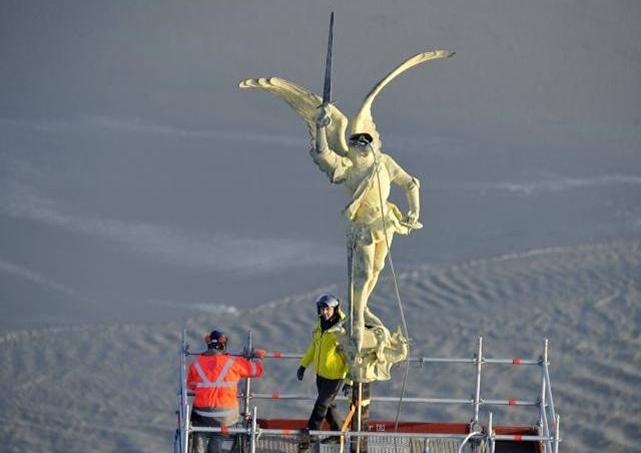
VERY COOL: St. Michael the Archangel flies again!

St. Michael leaves Mont-Saint-Michel… for now.

For years the famous Mont-Saint-Michel off the coast of France has been undergoing a lot of work.  Le Figaro has a story about the dismounting of the gilded statue of St. Michael from the pinnacle of the island town, from it’s monastic church’s steeple.  It will be restored.

There is some very cool video – alas preceded by annoying obligatory ads – followed by some other items.

From the article (you can translate it yourselves):

C’est la première fois, depuis sa dernière restauration en 1987, que l’archange de 520 kg qui culmine à 156 m au-dessus de la mer, est décroché. La restauration, prévue elle pendant deux mois, doit coûter 450.000 euros. «L’or a disparu, a expliqué François Jeanneau, architecte en chef des Monuments historiques. Sur l’archange, on voit l’usure due au vent chargé de sable. Le cuivre devient apparent. Il faut donc rénover l’œuvre pour la conserver», a-t-il ajouté.

L’archange en cuivre doré, arrivé en 1897 au sommet de l’abbaye, n’a été restauré que deux fois dans son histoire. Outre l’opération de 1987, la statue a aussi fait l’objet de réparations en 1935, mais sans décrochage. Seuls quelques éléments avaient été démontés pour être réparés, précise le Centre des monuments nationaux (CMN) qui gère l’abbaye.


Posted in Just Too Cool | Tagged ,
2 Comments

New interview with Benedict XVI in Avvenire

I just noticed the news at LifeSite that Pope (Emeritus) Benedict XVI gave an interview to Avvenire, which is the daily of the Italian Bishops Conference. Yes, they have their own newspaper.

The interview is refreshing.

At this point I haven’t seen a full English translation. Here is the Lifesite piece about it. My emphases and comments.

Pope Emeritus Benedict says Church is now facing a two-sided deep crisis

March 16, 2016 (LifeSiteNews.com) — On March 16, speaking publicly on a rare occasion, Pope Benedict XVI gave an interview to Avvenire, the daily newspaper of the Italian Bishops’ Conference, in which he spoke of a “two-sided deep crisis” the Church is facing in the wake of the Second Vatican Council. [Indeed.] The report has already hit Germany courtesy of Vaticanist Guiseppe Nardi, of the German Catholic news website Katholisches.info.

Pope Benedict reminds us of the formerly indispensable Catholic conviction of the possibility of the loss of eternal salvation, or that people go to hell:

The missionaries of the 16th century were convinced that the unbaptized person is lost forever. After the [Second Vatican] Council, this conviction was definitely abandoned. The result was a two-sided, deep crisis. Without this attentiveness to the salvation, the Faith loses its foundation.

He also speaks of a “profound evolution of Dogma” with respect to the Dogma that there is no salvation outside the Church. This purported change of dogma has led, in the pope’s eyes, to a loss of the missionary zeal in the Church – “any motivation for a future missionary commitment was removed.” Pope Benedict asks the piercing question that arose after this palpable change of attitude of the Church: “Why you should try to convince the people to accept the Christian faith when they can be saved even without it?[Indifferentism is pernicious and corrosive!  I will add that our identity is undermined through liturgical worship which is not sufficiently focused on the transcendent, not aimed at an encounter with Mystery, not helpful in our dealing with our fear of death.] As to the other consequences of this new attitude in the Church, the Catholics themselves, in Benedict’s eyes, were less attached to their Faith: If there are those who can save their souls with other means, “why should the the Christian be bound to the necessity of the Christian Faith and its morality?” asked the pope. And he concludes: “But if Faith and Salvation are not any more interdependent, even Faith becomes less motivating.”

Pope Benedict also refutes both the idea of the “anonymous Christian” as developed by Karl Rahner, [BOOO!] as well as the indifferentist idea that all religions are equally valuable and helpful to attain eternal life. He says: “Even less acceptable is the solution proposed by the pluralistic theories of religion, for which all religions, each in its own way, would be ways of salvation and, in this sense, must be considered equivalent in their effects.” In this context, he also touches upon the exploratory ideas of the now-deceased Jesuit Cardinal, Henri de Lubac, about Christ’s putatively “vicarious substitutions” which have to be now again “further reflected upon.” That is to say, Christ’s own acts in the place of others in order to save them eternally.

With regard to man’s relation to technology and to love, Pope Benedict reminds us of the importance of human affection, saying that man still yearns in his heart “that the Good Samaritan come to his aid.” He continues: “In the harshness of the world of technology – in which feelings to not count anymore – the hope for a saving love grows, a love which would be given freely and generously.” Benedict also reminds his audience that: “The Church is not self-made, it was created by God and is continuously formed by Him. This finds expression in the Sacraments, above all in that of Baptism: I enter into the Church not by a bureaucratic act, [Amen!  By a liturgical act!] but with the help of this Sacrament.” Benedict also insists that, always, “we need Grace and forgiveness.”

It is so refreshing again to hear Benedict think, to follow his line of thought.

Here is a portion I found intriguing (my on-the-fly translation):

“Above all I have to underscore once again what I wrote in Communio 2000 about the problem of justification.  For today’s man, in respect to the time of Luther and to the classical perspective of Christian faith, things are in a certain sense upside-down, or indeed there is no longer man who believes that he needs justification in the sight of God, but rather he is of the opinion that God has to justify himself because of all the horrible things present in the world and in the face of the misery of the human being, all things which in the final analysis would depend on him.

In this matter, I find significant the fact that a Catholic theologian assumes this overturning in a way that is indeed direct and formal: Christ wouldn’t have suffered for men’s sins, but rather would have, so to speak, cancelled the faults of God.  Even for now the majority of Christians do not share such a drastic reversal of our faith, we can say that all of this reveals an underlying trend of our time.”

I direct the readership back to my perpetual remarks about our identity and our liturgical worship.  They are inseparable.

We are our rites.

If we emphasize the horizontal and immanent, turning inward on ourselves (through, for example versus populum celebration of Mass, Communion in the hand, etc.) and do not leave time for the apophatic experience of Mystery in worship, what Benedict describes is inevitable.  Over time we are, as a Church, beginning to reap these fruits of “reversal – revolution – overturning – capsizing” of “capovolgimento” of the relationship of God and man.


Posted in Benedict XVI, Hard-Identity Catholicism, Our Catholic Identity | Tagged , ,
26 Comments

ASK FATHER: Priest asks for name during confession

12_10_04_confessionalFrom a reader…

What should I say when a priest, while in the confessional, wants to know my name? Or a priest that holds the belief that by knowing me personally he, by hearing my confession, will help me be more holy?

My first thought is to say, “Mind your own business, Father.”  Then again, since I’m a priest, and getting a little older, I might say, “Mind your own business, sonny.”, since most older, experienced priests would not do this… unless they are really slow learners.

Fathers, if you are young and you do this… STOP IT.

Penitents need to have the opportunity for anonymity if they choose it.  Anonymity is really important.

This is one reason why I abominate face-to-face confession rooms.  The one’s without windows I call “Law Suit Rooms”.  The tradition of the Church, and the law, from about the time of St. Charles Borromeo onward, was that all confessionals were to have a fixed grate, which would serve the functions a) of protecting the reputation of the priest and b) of at least partially obscuring the penitent from view and recognition.

I don’t hear confessions if there isn’t a fixed grate anymore.  And, according to the law, no priest can be compelled to hear confessions when there is not a fixed barrier. It is up to the individual priest, and not the bishop or the pastor, etc.

Many confessionals in Europe have, in addition to the side confessional spots, which have obscuring grates, a divided door in the center, to the box where the priest sits.  The lower part can be closed, leaving the upper part open for those who wish to talk to the priest face-to-face.

According to Canon Law, can. 964 §2. “The conference of bishops is to establish norms regarding the confessional; it is to take care, however, that there are always confessionals with a fixed grate between the penitent and the confessor in an open place so that the faithful who wish to can use them freely.”

Again, this is to protect the priest, but it is also to preserve the anonymity of the penitents.

What to say, then, about those parishes which have stingy confession schedules and list on the bulletin or website “By appointment”?  It seems to me that that risks the violation of anonymity, particularly if you have to give your name or if Father comes late to church and sees you before getting into the confessional.

So… in the case of the the nosy Fr. Ryan Ficcanaso, who is oozing concern and trying to connect in a priestly fervent bid for an especially compassionate warm and fuzzy experience of mercy, you might either stay silent until he gets the point or you can say, “I believe it is my right to be anonymous.”  You might also try, “…

… no, don’t say that.

In any event, if you don’t want to give your name, don’t.  And the priest presses you, tell him that you will let the bishop know what he is doing.

Finally…

GO TO CONFESSION!

Posted in "How To..." - Practical Notes, ASK FATHER Question Box, GO TO CONFESSION, Liturgy Science Theatre 3000 | Tagged , , ,
34 Comments

Jersey City, NJ – Tenebrae… No, the liturgical Tenebrae!

I received a good note from a reader…

HOLY WEEK TENEBRAE SERVICE AT ST. ANTHONY OF PADUA CHURCH

JERSEY CITY – The Office of Tenebrae of Holy Thursday will be anticipated on Wednesday, March 23 at 7:30PM as part of this year’s schedule of Holy Week services at the historic downtown church of St. Anthony of Padua, located at Monmouth St. between 6th and 7th.

This ancient service generally referred to as the Holy Week Office of Shadows or Darkness consists of the Office of Matins and Lauds for Holy Thursday, Good Friday and Holy Saturday. The name derives from the Latin meaning of Tenebrae which means “shadows.” It is also referred to as “Christ’s Funeral.”

As the name suggests, the service is conducted in a darkened church while the choir chants Psalms, Lamentations, Responsories and Lessons. After the completion of each Psalm one candle is extinguished from the “hearse” holding fifteen candles gradually reducing the lighting throughout the service. The six altar candles are put out during the Benedictus, and then any remaining lights in the church. The last candle is hidden, and the service ends with the strepitus (Latin for “great noise”) symbolizing the earthquake that followed Christ’s death. This beautiful and moving service is very rarely experienced in parish churches.

The resident choir, Cantantes in Cordibus will lead the Gregorian chant and other musical settings by Allegri. Its director, Maestro Simone Ferraresi, studied at the Conservatory of Music in Ferrara, Italy where he earned his degree with highest honors; at the Academy of Music and Performing Arts in Vienna he studied with world renowned pianist and musicologist Paul Badura-Skoda. Maestro Ferraresi specialized in interpretation of classical composers; at the Royal Academy of Music in London, where he was awarded the Diploma of the Royal Academy of Music – the highest examinable award given by the Royal Academy. He was also awarded three special prizes for best performance in the final recital. He is the founder and artistic director of the Ferrara International Piano Festival.

St. Anthony’s Church is listed on the State and National Registers of Historic Sites. The church built in the Victorian Gothic Style is a pristine example of a church untouched by modern elements and remains a true example of Roman Catholic aesthetic rarely seen today. The church parking lot is located on 6th St. between Coles and Monmouth Street and is easily accessible from the Grove Street PATH, the Newport PATH and Light Rail stop.

Through the generous support of Very Rev. Canon Joseph Urban, Pastor of St. Anthony’s, this is the first time Tenebrae will be available at St. Anthony’s. We invite everyone to attend this moving service during the most important and significant week of the Liturgical Year. Please visit the parish website at stanthonyjc.com for more information about the other traditional services during Holy Week.

Posted in Liturgy Science Theatre 3000, The Campus Telephone Pole | Tagged
8 Comments