Fr. Scalia’s Sermon at Justice Scalia’s Mass, Death, and Your Funeral Plans

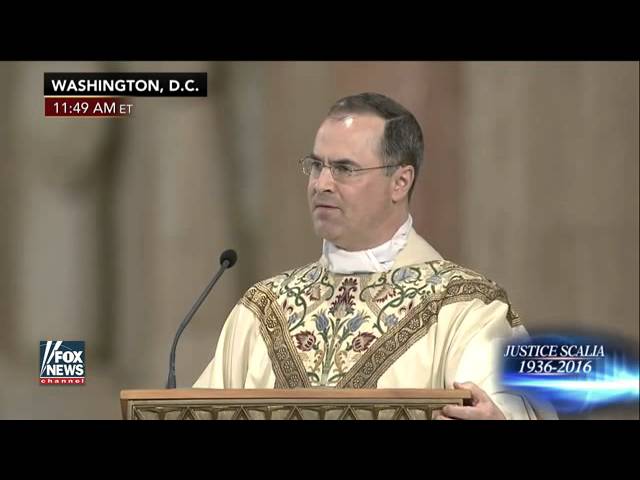
frscalia-jesusofnazarethToday I watched the broadcast of the funeral Mass for the late Supreme Court Justice Antonin Scalia.  It was held at the National Shrine in Washington DC.

A couple points.

First, Justice Scalia’s son, Fr. Paul Scalia of the Diocese of Arlington, was celebrant for the Mass and he preached.   His sermon was masterful.  It was a model of decorum, admirably shaped for that congregation and for broadcast to a wide and diverse audience.   It was replete with excellent teaching about the reason for the Mass (prayer for the deceased).  He called on all of us to consider our own death.  He continually brought the focus back to Christ and our need for His saving merits.  Well done.

The video of the sermon.

YouTube thumbnailYouTube icon

The video of the funeral is HERE.  For the sermon go to about 1:05:00

Second, how important it is that all of you think about your own death and that you write down your wishes for your funeral. Make sure that someone knows about where that paper is and that it is to be sought before plans are made. Make sure that what you plan is in keeping with the Church’s rubrics and with good taste and common sense. Please do this.

Posted in "How To..." - Practical Notes, Four Last Things | Tagged , , ,
43 Comments

ASK FATHER: Returning to the Church from schism

penance_confession_stepsFrom a reader…

I’ve heard a lot recently about ordinary priests being given the power to lift excommunications for abortion, what with the Year of Mercy.

What about other sins that carry an automatic excommunication, like schism?

I left the Catholic Church years ago for another denomination, and want to come back, but I don’t know how to have my excommunication lifted.

Your first step should be into a confessional.

Pretty much everyone – yes, you too – your first step should be into a confessional.

There are some sins which carry with them an automatic penalty (and here’s where Dr. Ed Peters chimes in with his Catonian comment about latae sententiae penalties). Among those sins that incur automatic penalties are, during most years, a few that are reserved to the Holy See to lift.  They are, happily, rare.  Among them are desecrating, throwing away or keeping for bad purposes the Blessed Sacrament, using force against the Roman Pontiff, absolving an accomplice in a sin against 6th commandment (only a priest or bishop can incur that), consecrating a bishop without a pontifical mandate (only a bishop can incur that), violating the Seal of the confessional.   Pretty rare.

Other automatic penalties are, ordinarily, reserved to the local ordinary or diocesan penitentiary to lift. In some dioceses, bishops widely grant to their priests the faculty to absolve from those sins reserved to the diocesan bishop. During this Holy Year, the Holy Father has granted to all priests the faculty to absolve from those sins.

One who commits the delict of schism may incur the penalty of automatic excommunication. However, since this sin does not incur a censure reserved to the Holy See, the penalty can be lifted by the local ordinary (the diocesan bishop, vicar general, episcopal vicar), or any bishop in confession, or by the diocesan penitentiary (if the diocese has one). In many dioceses, this faculty is also granted broadly to priests.  You can call the local chancery to ask for someone who can answer the question: Has the bishop given the faculty to lift the censure for schism to all the priests of the diocese?

Get into the confessional with a wise and trusted priest. Explain your situation and your sorrow for your sins. Take his direction. If he does not have the faculty to remit the penalty, he will let you know and advise you how to have the penalty lifted (he may be able to ask his bishop for the faculty, or he can refer the matter to the Apostolic Penitentiary in Rome under strict anonymity, or he may simply refer you to the bishop or penitentiary).

In any event, you are not up against a very tough obstacle here.  You should be able to resolve this swiftly, with some good will and a few questions.

Then…

GO TO CONFESSION!

Posted in "How To..." - Practical Notes, ASK FATHER Question Box, Canon Law, GO TO CONFESSION | Tagged ,
6 Comments

Thus says the Lord…

2 Chronicles 14:7

And he said to Juda: Let us build these cities, and compass them with walls, and fortify them with towers, and gates, and bars, while all is quiet from wars, because we have sought the Lord the God of our fathers, and he hath given us peace round about. So they built, and there was no hinderance in building.

Nehemiah 4:18

For every one of the builders was girded with a sword about his reins. And they built, and sounded with a trumpet by me.

Posted in I'm just askin'..., Semper Paratus, The Coming Storm, The future and our choices | Tagged , , ,
25 Comments

Francis: Airplane pressers now to be authoritative magisterial teaching

From the often amusing Eye Of The Tiber:

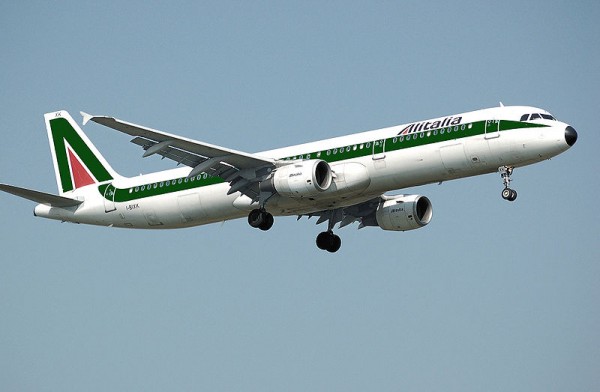
Francis Declares Plane Interviews New Authoritative Form Of Magisterial Teaching

Pope Francis gave a press conference on his flight back to Rome Thursday, declaring that all interviews given aboard a plane would henceforth be declared infallible.
“I , the Supreme Pontiff, intend to affirm that all statements made aboard this or any plane I am on will, from this day forward, be considered doctrine, which is to be held definitively for all the people of the Church,” Francis said after delivering a lengthy speech about how “absolutely epic” the street tacos were in Mexico. “Since being on a plane brings us close to 45,000 feet closer to heaven, all that I say will be put forth infallibly by the ordinary and universal magisterium.”
Francis went on to say that, “when, henceforth, I make a pronouncement from the Seat of St. Peter, which will from now on be over in seat A3, every believer will be required to give firm and definitive assent to the truths I proclaim, including the kinda weird things, based on faith in the Holy Spirit’s assistance to the Church’s Magisterium in the sky.”
“If anyone shall say that any dogmas proposed by me at such heights must be given a meaning different from that which I meant, let him not only be anathema, but also let him be made to open the emergency door and to jump. Thereafter, in a show of God’s mercy, we shall toss a parachute out, and let he that was made anathema try to chase it in the air like Special Agent Johnny Utah in Point Break when he jumps out of the plane without a parachute and has to chase down Bodhi so he can use his parachute.”

Posted in Lighter fare |
7 Comments

Pope Francis’ latest airplane presser remarks, post Mexico. Fr. Z’s take.

Another trip, another presser, another post.

A priest friend wrote to me:

I’m writing a new prayer for all of us … a “Nine Hour Pope Plane Ride Novena.”

I will write now what I have written before.

Again, when I am elected Pope, We shall take the name of Pius X-II (“Pius Decimus Secondus” – or maybe “Clement Ganganelli”), We shall not give interviews or press conferences.  We shall forbid the Lord Cardinals from speaking to the press without permission.  We shall disappear into the Apostolic Palace for lengths of time so long that the press will begin to speculate that We may have died.  Our encyclicals will be limited to five pages in Latin.  And Our first act as Supreme Pontiff will be to suppress the Jesuits.

Now … gulp… to this presser. And these remarks aren’t intended to reveal everything I think about it.

First, I read the transcript. I posted the link above.

Next, and this is important, I remind everyone that the Roman Pontiff doesn’t teach doctrine on faith and morals through off-hand comments to journalists ON AN AIRPLANE RIDE!  So, relax about the contraception comment.  It was meaningless.  Moreover, I am pretty sure that that anecdote about Paul VI giving permission to African nuns to use contraceptives is an urban legend.  We had a discussion about that in the COL Forum, which I ran for a long time.  One of the former staffers is now working to dig up the files on that.  More later, I hope.

As far as weighing into the issue of the American Presidential campaign and Donald Trump, after having celebrated Mass virtually on top one of the most politicized lines in the world, the US/Mexican border, I found his assertion that, as Pope, he doesn’t get into politics (“[I]l Papa è per tutti, e non può mettersi nella politica concreta, interna di un Paese: questo non è il ruolo del Papa.) fairly amusing.  Moreover, his quip about building walls not being Christian is odd, considering that right outside the door of Santa Marta, where His Holiness lives, is a Big Damn Wall™ that encircles the Vatican City State and that after Francis’ election the Holy See had to buy an entire street from the City of Rome that runs alongside that BDW near to Santa Marta in order to create a secure No Man’s Land.

In any event, I don’t believe for an instant that the Holy Father understands anything about the positions of the any of the candidates in this presidential election cycle in any comprehensive way.  He seems to have been reacting only to what the journalist included in his question about Trump.  So his answer… meh.   Unfortunately we are now going to have to hear incessant commentary on it.

And he really doesn’t know the 2003 CDF document on “Considerations Regarding Proposals To Give Legal Status To Unions Between Homosexual Persons”?  Okay.  Maybe he doesn’t.  Who cares?  WE know it!  And it is online right HERE.

That 2003 CDF document, especially addressed to politicians, says:

10. If it is true that all [ALL] Catholics are obliged to oppose the legal recognition of homosexual unions, Catholic politicians are obliged to do so in a particular way, [!] in keeping with their responsibility as politicians. Faced with legislative proposals in favour of homosexual unions, Catholic politicians are to take account of the following ethical indications.

When legislation in favour of the recognition of homosexual unions is proposed for the first time in a legislative assembly, the Catholic law-maker has a moral duty to express his opposition clearly and publicly and to vote against it. To vote in favour of a law so harmful to the common good is gravely immoral.

When legislation in favour of the recognition of homosexual unions is already in force, the Catholic politician must oppose it in the ways that are possible for him and make his opposition known; it is his duty to witness to the truth. If it is not possible to repeal such a law completely, the Catholic politician, recalling the indications contained in the Encyclical Letter Evangelium vitae, “could licitly support proposals aimed at limiting the harm done by such a law and at lessening its negative consequences at the level of general opinion and public morality”, on condition that his “absolute personal opposition” to such laws was clear and well known and that the danger of scandal was avoided. This does not mean that a more restrictive law in this area could be considered just or even acceptable; rather, it is a question of the legitimate and dutiful attempt to obtain at least the partial repeal of an unjust law when its total abrogation is not possible at the moment.

11. The Church teaches that respect for homosexual persons cannot lead in any way to approval of homosexual behaviour or to legal recognition of homosexual unions. The common good requires that laws recognize, promote and protect marriage as the basis of the family, the primary unit of society. Legal recognition of homosexual unions or placing them on the same level as marriage would mean not only the approval of deviant behaviour, with the consequence of making it a model in present-day society, but would also obscure basic values which belong to the common inheritance of humanity. The Church cannot fail to defend these values, for the good of men and women and for the good of society itself.

Finally:

The Sovereign Pontiff John Paul II, in the Audience of March 28, 2003, approved the present Considerations, adopted in the Ordinary Session of this Congregation, and ordered their publication.

Now that this document has come up again, people will look at it again.  That’s a good thing that came from this presser.   So, maybe Francis doesn’t recall immediately the content of the 2003 document, but he did affirm that Catholic politicians have to vote according to their conscience, and that their consciences have to be properly formed.  ”

[U]n parlamentare cattolico deve votare secondo la propria coscienza ben formata: questo, direi soltanto questo. Credo che sia sufficiente. E dico “ben formata”, perché non è la coscienza del “quello che mi pare.  …  A Catholic member of parliament must vote according to his own well-formed conscience.  That’s it. I would say only that.  I think that’s enough. And I say ‘well-formed’, because it isn’t the conscience of ‘whatever I like'”.

Right.  Well-formed according to the mind the Church.  And the mind of the Church on homosexual unions and our obligation to resist any of that business is certainly and clearly spelled out in the 2003 CDF document.  NO! to homosexual unions.

Also, Francis did a pretty good job with the response about civilly remarried people receiving Communion.  He said, among all the verbiage, “No”.

And he couldn’t have been clearer about what he thinks about abortion.

In sum, the Pope went to Mexico and he emphasized a few things which he thought were important to communicate there.  Fine.  However, those things will now be buried in the news cycle because of his off-the-cuff quips.  The sliver of the MSM news cycle that includes the Pope will now obsess mostly about things that the Pope probably didn’t want to emphasize with his Mexico trip.

The moderation queue is ON.  I will cull comments severely.  Don’t even bother if you simply want to bash the Pope.

UPDATE:

I’ve deleted a lot of comments.  Some of them were not bad, but I knew they would just stoke a fire I don’t want burning.  The others… some of you lost my respect.

UPDATE:

In a comment (not passed) one person wrote:

“Yes, there will be fallout and damage from this, but it is superficial.”

You can determine whether or not this is “damage”, but this gave Mr. Trump the news cycle for a couple more days very close to the South Carolina primary.

Posted in Francis, Sin That Cries To Heaven |
33 Comments

Archbp. Sample quoting Benedict XVI: “If we don’t have the liturgy, what do we have?”

At CWR there is an interview with Archbp. Alex Sample of Portland. Among the things he addressed are sacred liturgy and sacred music.

[…] Some have said that the sacred liturgy is my personal hang up, that I have an obsession with it. I reject that view, because it’s not merely my opinion that the liturgy be given the highest priority, but that of the Church.

The Church teaches us that the liturgy is the “source and summit” of the Church’s life [in Sacrosanctum Concilium]. There is nothing more important that the Church does. All our apostolic works flow from it. It is the heart of who we are as the body of Christ.

I had the pleasure of attending a general audience with Pope Benedict. As a bishop, I had the opportunity to greet him personally afterward. In the few moments I had with him, I told him I had a great admiration for what he’d done to renew the sacred liturgy and thanked him for his leadership. He responded, “If we don’t have the liturgy, what do we have?” I took that message to heart.

I want to do what the Church wants us to do in regards to liturgy. It is not my take, or my style, but what the Church is asking of us. I want to be faithful to what the Vatican II Council intended.

The liturgy is not the personal possession of any priest or liturgical commission, but belongs to Holy Mother Church. We must celebrate it according to the mind and heart of the Church.

Sacred music forms an important part of that liturgy. I hope, in time and with patience, to address this topic with our clergy and lay leaders.

CWR: You recently celebrated Mass in the Extraordinary Form during a conference at the Brigittine Monastery in your archdiocese. What brought you to this conference and what interest do you have in the Old Mass?

Archbishop Sample: We have wonderful group of lay people in our archdiocese with an interest in Gregorian chant who put this conference together. They wanted to introduce Gregorian chant to the people in accordance with the mind of the Church. Vatican II, in fact, indicated that chant should enjoy “pride of place” in the liturgy [in Sacrosanctum Concilium].

The conference organizers wanted to experience Gregorian chant within the liturgy and asked me to celebrate the Mass there according to the Extraordinary Form. I had no hesitation to do so when I was asked.

I’m grateful to Pope Benedict for allowing the Extraordinary Form to flourish again in the Church. I have a great love and appreciation for the ancient liturgy. I wish every priest and seminarian would familiarize himself with the Extraordinary Form, which can help us to better understand the Ordinary Form.  [Do I hear an “Amen!”?]

If we do not revitalize our liturgical worship of God, nothing we do in the Church will bear lasting fruit.

Posted in Liturgy Science Theatre 3000, Our Catholic Identity | Tagged ,
23 Comments

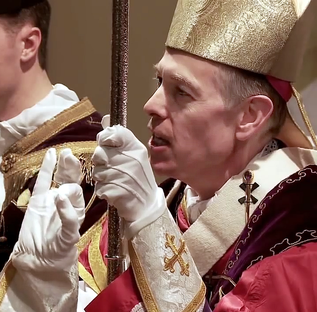
ASK FATHER: Canons, Monsignors, and the Institute of Christ the King

From a reader…

QUAERITUR:

I know that the priests of the Institute of Christ the King nowadays take the title “Canon” and that Monsignors Wach and Schmitz are, well, Monsignors.

Recently I have heard a few people independently doubt this, saying that they shouldn’t be called Canons and that the Monsignors aren’t real Monsignors. Neither explained to me why. As far as I have been able to research, they seem to have a right to these titles.

I would be very surprised if the ICRSP would allow a flaw like that, since they are so precise in everything they do. I’m not sure why these people thought like this.

Would you be able to shed any light on this?

Canons…

There are Canons Regular of St. John Cantius, the Canons Regular of the Holy Cross (associated with Opus Angelorum), Canons Regular of the New Jerusalem… to name a few of the more modern iterations of these ecclesiastical critters.  There are lots of others, older ones, as well.

A “canon” is a type of ecclesiastical person, a member of a chapter (such as a cathedral chapter or one of the basilicas in Rome) or body of clerics who live according to rule (regula) and who are presided over by one of their number.  Historically canons gave assistance to a bishop and they were especially involved in the liturgical life of the place, particularly in the singing of the hours of the Office.  Canons would dress like normal priests, although sometimes the Holy See granted the privilege of wearing other gear by a particular indult.  In such cases, canons were not to wear any of their special gear outside the diocese to which they were attached or the place where they were based.

In any event, a body of Canons must be set up officially either by the Holy See or by a diocesan bishop.

I have looked through the website of the Institute and they do not use the word “canon” to describe their members.  At least that I found.  If they use the term “Canon” among themselves, I suppose this is an internal decision they have made, but it seems that the bishops who gave them their canonical status (D. Mouila and later Archd. Florence) didn’t set them up as Canons Regular.  In 2008 they were recognized by the Holy See as a Society of Apostolic Life.  They seem to be members, clerical and lay, in an Institute which technically isn’t precisely a group of canons regular.  Also, I note that they call their lay members “clerical oblates”.  An oblate is generally a lay person who is formally attached to an order or institute who gives support and service according to necessity.  However, since Canon Law states that the clerical state begins with diaconate, and since the oblates of the Institute are not at least deacons, the term “clerical oblate” seems to overstate their situation a bit.  If they have made an internal decision to call their oblates “clerical” because they have received the traditional minor orders, then, hey!, Quis sum ego ut iudicem?

As far as the two men you mention, we must consult a recent copy of the official book of the Holy See, the Annuario Pontificio.   If a priest has been made a Monsignor, his name appears in the index along with an indication of his diocese, the kind of Monsignor he is, and the date that level was conferred.  Msgr. Michael Rudolf Schmitz is in the index.  He belongs to the Archdiocese of Cologne, Germany, and was made a Monsignor, a Chaplain of His Holiness, in 1998, I believe during his service in the Holy See’s diplomatic corps.  Giles Wach’s name does not appear in the index of the most recent Annuario to which I have access, which is the 2014.  It’s possible that, subsequently, his status changed, but I don’t have the most recent Annuario.  It should be mentioned, however, that Wach had once been Vicar General of an African diocese in Gabon, where the Institute still has ties.  It was the practice that vicars general were, for the time they held office, given the use of “Monsignor” even if they were not monsignors so named by the Holy See.  Thus, in the Annuario even today you will see under the listing for a diocese that “Mons.” is by the name of a vicar general even if he is a simple priest.  This is an old rule of churchy etiquette that doesn’t confer the lasting, official status.

In any event, what Institutes and Orders and Congregations and the like do within their own communities is hardly our business.  They have their own rules and manner of life to which they commit themselves.  They are known by their fruits.  The Institute seems to be doing good work where they are planted and the number of their locations seems to be growing.

Finally, since I am merely an outside observer of the Institute and don’t have much contact with them (not so much by my choice, mind you), if this doesn’t satisfy, you really should direct your questions to them.  I can only offer here what is public knowledge.

Posted in Mail from priests, The Drill | Tagged , , ,
17 Comments

ASK FATHER: Poured Precious Blood down sacrarium. Go to a Missionary of Mercy?

blood-of-jesusFrom a reader…

QUAERITUR:

I know an EMHC who once was instructed after Mass to pour, and did pour, the remaining (there was a lot) Precious Blood in the sacrarium.
This EMHC will be attending a pilgrimage this weekend at which a missionary of mercy (MoM) will be hearing confessions. At the time, this EMHC was distraught but did not know what she did was wrong. [There’s a disconnect here.  Why be distraught if she didn’t think it was wrong?] I understand this was confessed later, but should I encourage this person to visit the MoM?

You cannot pour the Precious Blood down a drain or sacrarium.  You cannot “throw away” a Host.   Someone who “throws away” the Eucharist, either by, for example, simply tossing a consecrated Host in the garbage, or putting it down the sacrarium, or pouring the Precious Blood down a sink or sacrarium, knowing that it is wrong to do, runs the risk of incurring a latae sententiae excommunication, the lifting of which is reserved to the Holy See alone.  The sin is forgiven in confession (since there are no more reserved sins).  The censure of excommunication, however, is under normal circumstances reserved to the Holy See. In the Year of Mercy, certain priest confessors (“Missionaries of Mercy”) have been given the faculty to lift this censure without recourse to the Holy See.

In the Latin Code of Canon Law we find:

can. 1367: Qui species consecratas abicit aut in sacrilegum finem abducit vel retinet in excommunicationem latae sententiae Sedi Apostolicae reservatam incurrit; clericus praeterea alia poena, non exclusa dimissione e statu clericali, puniri potest … A person who throws away the consecrated species or takes or retains them for a sacrilegious purpose incurs a latae sententiae excommunication reserved to the Apostolic See; moreover, a cleric can be punished with another penalty, not excluding dismissal from the clerical state..

The word abicit, abicere, means here “throw away”, and this was clarified by the Pontifical Council for the Interpretation of Legislative Texts, at their plenary session on 4 June 1999, as not … not… being restricted to “throw away” in a spirit of contempt, or intent to do dishonor.  It really does mean “throw away”, which is what happens when you put a consecrated Host or the Precious Blood down a sacrarium without first making sure that the substance of the same is first broken down (by dissolving).  Precious Blood, of course, should be consumed.

That said, in the case of any objectively sinful act which incurs an excommunication (e.g. throwing away the Eucharist), there are always the circumstances to be considered (e.g., the person’s will and knowledge, external compulsion, fear, etc.).

Redemptionis Sacramentum distinguished different levels of liturgical abuses.  The worst are in the category graviora delicata (graver crimes).  Among the graviora delicta is throwing away the Eucharist (cf. RS 172).   This grave crime is reserved to the Congregation for the Doctrine of the Faith.

From what you wrote I would say that, probably, No, she did not incur the penalty. She was following the direction of another person whom she deemed had authority.  You say she was “distraught”.  To incur such a penalty, one must commit a mortal sin in the act.  She did not have the obligation to know the truth about throwing away the Sacrament. The sacristan and the priests do!  She was acting, probably, in innocent ignorance.  The sacristan and priests, if they don’t know the law and theology of this matter, are in a state of culpable ignorance.  They are obliged to know this stuff.

I suspect that someone has incurred a censure, but not her.

Also, if there is risk of profanation of the Precious Blood – and it sounds as if there is at that parish – then Communion under both species should be stopped.

But, for a moment let’s assume that she did incur the censure, which is automatic excommunication.  Another result would be, if committed by a male, that man would be irregular to receive Holy Orders licitly.

She could go to Rome, to the offices of the Sacred Apostolic Penitentiary, which has competence in this and the authority to lift the censure.  Otherwise, she could explain the situation to a savvy priest confessor who knows how to write to the Sacred Apostolic Penitentiary.  He would write a letter to describe the situation – using total anonymity in her regard – and then receive back from them the faculty to lift the censure the next time she came back to him as a confessor.

If a cleric did this horrid thing, and you incurred the censure of excommunication, he would be suspended instantly by the very fact of doing it if, in doing it, he committed the mortal sin in full knowledge and will.  He could function as a cleric, for example say Mass and hear confessions if a priest, only if he had started the process of getting that censure lifted.

BUT… if other people saw you do it, saw you doing it all the time, and they knew she knew it was wrong because she was told or she had read it, etc., then it would be possible that someone could denounce her to the CDF.  A canonical process could started in her regard, under the new norms for graviora delicta.

Enough said.

Bottom line…. DO NOT pour the Precious Blood down a sacrarium or drain or anywhere else.  It ought to be consumed.

If she has contact with one of these Missionaries of Mercy, she could bring this up in confession, explaining the necessary circumstances (i.e., being told to do it, being distraught, etc.).  The confessor would them be able to make a judgment and, if necessary, lift any censure she might have incurred.

Posted in "How To..." - Practical Notes, ASK FATHER Question Box, Liturgy Science Theatre 3000 | Tagged , ,
18 Comments

It’s no joke. The Devil hates Latin.

I have attended a couple workshops on exorcism.  I have spoken with exorcists.   Again and again I have heard – and said – how the Devil hates Latin.  This is more than a witticism.

Over at NLM I found yet another confirmation that the Devil hates Latin.    There is a piece about a talk given by the priest who was the inspiration for the movie The Rite.  Read the whole thing, but this is the part that most interested me:

However, he did explain that the Rite of Exorcism is only said in Latin. One reason is practical – there is no approved translation in English as yet. He gave another reason why he was so strongly in favor of the use of Latin in the Rite of Exorcism: “The Devil hates Latin, it is the universal language of the Church.” I asked him about this afterwards, and he repeated it, saying that his personal experiences as an exorcist who has performed many, many exorcisms have convinced him of this. He told me he had heard from exorcists who did exorcisms in Italian, Spanish and Portuguese (the only approved vernaculars for this Rite) that Latin was the most effective language.

And there are a lot of people out there, liberals mostly, who hate Latin.

What does it mean for the identity of Catholics in the Latin Church when they almost never hear any Latin and have even been led to disdain it?

Let’s all recite together the Prayer to St. Michael the Archangel just to irritate the Enemy, and throw some Holy Water around while you’re at it:

Sancte Michael Archangele, defende nos in praelio.
Contra nequitiam et insidias diaboli esto praesidium.
Imperet illi Deus, supplices deprecamur.
Tuque princeps militiae caelestis,
Satanam aliosque spiritus malignos,
qui ad perditionem animarum pervagantur in mundo
divina virtute in infernum detrude.
Amen.

Posted in Liturgy Science Theatre 3000, Mail from priests | Tagged ,
71 Comments

ASK FATHER: Neglect of the Precepts of the Church and Mortal Sin. Wherein Fr. Z rants.

From a priest…

QUAERITUR:

I am trying to clarify whether or not the precepts of the church bind under mortal sin? According to the catechism of St. Pius X they do, however the current CCC gives no clear indication.

I have read it a dozen commentaries on the issue and some say they do, others say they don’t. This question is specifically in regards to “confessing our sins once per year.” Does a person need to confess even venial sin once a year under pain of mortal sin?

The Precepts involve grave matter. Neglecting them can be a matter of mortal sin, under the usual conditions (that is, you have to know that neglecting confession is wrong, etc.).  Of course the Precepts reflect the low bar for our conduct as Catholics, not a high bar.

The Precepts or Commandments, which are for the most part also reflected in the Church’s Canon Law, are strong guidelines which point a Catholic to a bare minimum of conduct of Catholic life.  They are not comprehensive.  They are the “At Least Do These Things” List.  They also concern outward, concrete actions and not interior thoughts or attitudes.  You either go to Mass for your Sunday obligation when possible or you don’t.  You receive the Eucharist once a year or you don’t.  Etc.

These days, however, there is a bit of confusion over the Precepts or Commandments of the Church.  Lists differ.

First, the Commandments or Precepts can change.  The Church determines what they are.  They are not doctrinal, though they are rooted in doctrine.  They concern discipline, our outward conduct.

The online article in the Catholic encyclopedia has a fascinating review of the history of the Commandments and show how their number changed according to time and place.  HERE  I can’t improve on the last part of that article.  Perpend:

The Church in her supreme authority has defined nothing regarding the form and number of the Commandments of the Church. The Council of Trent while recommending in a general way in its twenty-fifth session the observance of these precepts says nothing regarding them as a particular body of laws. Neither is any specific mention made of them in the “Catechismus ad parochos” published by order of the council and known as the “Catechism of the Council of Trent” or “Roman Catechism”. We have seen that St. Antoninus of Florence enumerates ten such commandments while Martin Aspilcueta mentions only five. This last number is that given by St. Peter Canisius. According to this author the precepts of the Church are: To observe the feast days appointed by the Church; to hear Mass reverently on these feast days; to observe the fasts on the days during the seasons appointed; to confess to one’s pastor annually; to receive Holy Communion at least once a year and that around the feast of Easter. Owing undoubtedly to the influence of Canisius, the catechisms generally used at present throughout Germany and Austria-Hungary have adopted the above enumeration. The fourth precept has, however, been amended so as to allow of confession being made to any duly authorized priest.

In Spanish America the number of church precepts is also five; this being the number as we have seen, set down by Aspilcueta in the sixteenth century. Here, however, the First and Second commandment in the table of Canisius are combined into one, and the precept to pay tithes appears. It is to be noted, also, that the precept of annual confession is more specific; it enjoins that this confession be made in Lent, or before, if there be danger of death. (Synod of Mexico, 1585, Lib. I, tit. i, in Hardouin, Conc., X, 1596.) French and Italian catechists reckon six precepts of the church, the enumeration given by Bellarmine. According to this writer the Commandments of the Church are: To hear Mass on Sundays and Holy Days; to fast during Lent, on prescribed vigils, and the ember-days; to abstain from meat on Fridays and Saturdays; to go to confession once a year; to receive Holy Communion at Easter; to pay tithes; and finally not to solemnize marriage during the prohibited times.

The French catechisms, following that of Bossuet, omit the last two precepts, but retain the same number as that given by Bellarmine. This they do by making two Commandments cover the obligations to observe Sunday and the Holy Days, and two also regarding the obligations of fast and abstinence. It will be readily observed that the omission by French writers of the Commandment to pay tithes was owing to local conditions. In a “Catechism of Christian Doctrine” approved by Cardinal Vaughan and the bishops of England, six Commandments of the Church are enumerated. These are:

  • to keep the Sundays and Holy Days of obligation holy, by hearing Mass and resting from servile work;
  • to keep the days of fasting and abstinence appointed by the Church;
  • to go to confession at least once a year;
  • to receive the Blessed Sacrament at least once a year and that at Easter or thereabouts;
  • to contribute to the support of our pastors;
  • not to marry within a certain degree of kindred nor to solemnize marriage at the forbidden times.

This list is the same as that which the Fathers of the Third Plenary Council of Baltimore (1886) prescribed for the United States.

Fascinating, no?

That said… the Catechism of the Catholic Church has this:

II. The Precepts of the Church

2041 The precepts of the Church are set in the context of a moral life bound to and nourished by liturgical life. [NB] The obligatory character of these positive laws decreed by the pastoral authorities is meant to guarantee to the faithful the indispensable minimum in the spirit of prayer and moral effort, in the growth in love of God and neighbor:  [If you knowingly and willingly break these precepts, you commit a mortal sin.]

2042 The first precept (“You shall attend Mass on Sundays and holy days of obligation.”) requires the faithful to participate in the Eucharistic celebration when the Christian community gathers together on the day commemorating the Resurrection of the Lord.

The second precept (“You shall confess your sins at least once a year.”) ensures preparation for the Eucharist by the reception of the sacrament of reconciliation, which continues Baptism’s work of conversion and forgiveness. [Cf. ? CIC, can. 989; CCEO, can. 719.]

The third precept (“You shall humbly receive your Creator in Holy Communion at least during the Easter season.”) guarantees as a minimum the reception of the Lord’s Body and Blood in connection with the Paschal feasts, the origin and center of the Christian liturgy.

2043 The fourth precept (“You shall keep holy the holy days of obligation.”) completes the Sunday observance by participation in the principal liturgical feasts which honor the mysteries of the Lord, the Virgin Mary, and the saints.

The fifth precept (“You shall observe the prescribed days of fasting and abstinence.”) ensures the times of ascesis and penance which prepare us for the liturgical feasts; they help us acquire mastery over our instincts and freedom of heart.

The faithful also have the duty of providing for the material needs of the Church, each according to his abilities.

Note that the Precept about marriage is not listed.  Issues concerning marriage are spelled out in Canon Law (Cf. can. 1091).

To your question, I say, and the Church seems to say, that if you don’t make a sacramental confession of mortal at least once a year, you are – objectively, at least – sinning either by omission (because you are being generally negligent about your soul) or – if you consciously refuse to go – you are sinning by commission (because you know and will the neglect for your soul).  Culpability for the sinful omission or commission might vary.

So, I say yes. More than likely if a Catholic doesn’t confess her sins at least once a year (which also means she probably can’t receive Communion once a year), she commits an additional sin.  She is neglecting her immortal soul and needlessly endangering her salvation.  She might also be committing a sin of scandal, by giving a bad example to her family and friends.

We all have an obligation to see to, to tend our immortal souls.

Some people are so far gone for one reason or another that they never think about their eternal fate.  Others are in a pattern of neglect that could eventually lead to total heedlessness.

Back in the day, I think that most Catholics, even lazy ones, knew that they ought to go to confession.  These days, after decades of horrid, negligent, bizarre or empty “catechism” and vapid, feckless, incompetent preaching in pulpits and teaching in classrooms… who knows?

The Precepts are a simple list of the bare minimum that are easy to communicate and remember.

“But Father! But Father!”, some of you victims of the feckless, and feckless perps are warbling, “Francis says you are a legalistic sour-puss!  You cling to laws?  We are an Easter people now!  You obviously hate…”.

This time I respond, “SHUT THE HELL UP!  Souls are risk!”

Obey Holy Church!  She is the greatest expert on humanity that ever was.  Laws, divine or ecclesiastical, are not given to spoil what otherwise might be a good time.  They are given, from love, to help us to avoid pitfalls on the way salvation.  They tell us, “Don’t hurt yourself!”

Dear readers… disregard the Precepts at your peril!  Hell is real and you can go there.

GO TO CONFESSION!
 

Posted in "But Father! But Father!", "How To..." - Practical Notes, ASK FATHER Question Box, GO TO CONFESSION, Our Catholic Identity, Wherein Fr. Z Rants | Tagged , ,
23 Comments