11 February 2013: Benedict XVI announced abdication

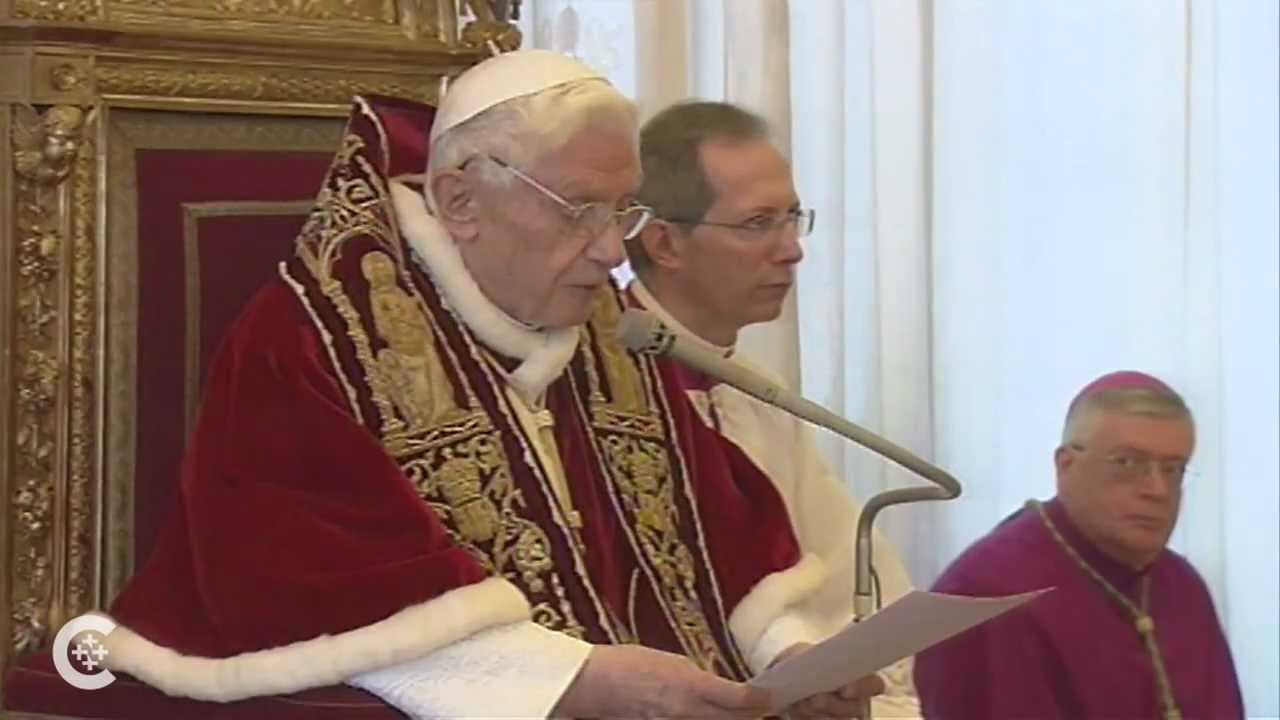
benedict xvi resignation abdicationOn this dark day in 2013, Pope Benedict XVI announced that he was to resign his office at Bishop of Rome.  He would step down on 28 February.

He announced to a hastily assembled consistory of Cardinals and others:

Dear Brothers,

I have convoked you to this Consistory, not only for the three canonizations, but also to communicate to you a decision of great importance for the life of the Church. After having repeatedly examined my conscience before God, I have come to the certainty that my strengths, due to an advanced age, are no longer suited to an adequate exercise of the Petrine ministry. I am well aware that this ministry, due to its essential spiritual nature, must be carried out not only with words and deeds, but no less with prayer and suffering. However, in today’s world, subject to so many rapid changes and shaken by questions of deep relevance for the life of faith, in order to govern the barque of Saint Peter and proclaim the Gospel, both strength of mind and body are necessary, strength which in the last few months, has deteriorated in me to the extent that I have had to recognize my incapacity to adequately fulfill the ministry entrusted to me. For this reason, and well aware of the seriousness of this act, with full freedom I declare that I renounce the ministry of Bishop of Rome, Successor of Saint Peter, entrusted to me by the Cardinals on 19 April 2005, in such a way, that as from 28 February 2013, at 20:00 hours, the See of Rome, the See of Saint Peter, will be vacant and a Conclave to elect the new Supreme Pontiff will have to be convoked by those whose competence it is.

Dear Brothers, I thank you most sincerely for all the love and work with which you have supported me in my ministry and I ask pardon for all my defects. And now, let us entrust the Holy Church to the care of Our Supreme Pastor, Our Lord Jesus Christ, and implore his holy Mother Mary, so that she may assist the Cardinal Fathers with her maternal solicitude, in electing a new Supreme Pontiff. With regard to myself, I wish to also devotedly serve the Holy Church of God in the future through a life dedicated to prayer.

From the Vatican, 10 February 2013

BENEDICTUS PP XVI
YouTube thumbnailYouTube icon

On this same day, 11 February, lightning struck St. Peter’s Basilica.

The photo from Agence France-Presse:

I’ll bet you remember where you were when you heard about this astonishing announcement.

I remember my reaction: “You gave up WHAT for Lent?”  Then I had Eggs Benedict for breakfast.

Seriously, I was pretty much floored.


Click HERE.

In the meantime, remember…

Posted in Benedict XVI | Tagged , ,
34 Comments

ASK FATHER: Young children receiving ashes on #AshWednesday

This comes up each year in my ASK FATHER email, so I will repost an oldie.

ashesFrom a reader:

I have a three year old girl. She loves the material aspects of Catholicism (holy cards, holy water, lighting candles, relics etc) and has a pretty good understanding of them for her age.

Can she receive ashes on Ash Wednesday? She obviously hasn’t any sin to repent of in the literal sense of the word, but we do encourage her to say sorry to Jesus every night for the littlw ways she might have been bold that day. Receiving ashes could be a useful part of the learning process for her.

Are there any official rules around the age when one can have ashes imposed on Ash Wednesday?

There aren’t any age rules for this.  As your child’s parent you get to make your own call about that.  If the priest is amenable, you can do this.

I would advise, however, that if the ashes are put on a bit thick on the forehead that you take care that she not get any in her eyes.

If she is old enough to say “sorry” to Jesus before bed, she is old enough to start learning with steps about penance and self-denial too, perhaps.  Of course, at that age she isn’t bound to fast or abstain, etc.

Perhaps parents can chime in with their comments about this, for they have been through these decisions.

Speaking for myself, I have some very early memories.  I wonder what the long-term effect of the reception of ashes might be deep down in her Catholic identity as she grows up amid the deepening challenges of this world.

Posted in "How To..." - Practical Notes, ASK FATHER Question Box, Liturgy Science Theatre 3000, Our Catholic Identity | Tagged ,
20 Comments

POLL: #AshWednesday Ashes and You

Some people are under the impression that Ash Wednesday is a Holy Day of Obligation.

It is not.

Lent is an important season in the yearly cycle of a Catholic Christian’s life.  The inclination toward a feeling of obligation is laudable. The desire to begin the spiritual war of Lent by marking it with ashes is good.

Nevertheless, people are not obliged to go to Mass on Ash Wednesday nor to receive ashes.

You are not a “bad Catholic” if you don’t go to Mass on Ash Wednesday.

As a matter of fact, were someone to go and receive ashes because they want to be seen, not in the sense of bearing witness, but in the sense of “See how pious I am”… well…

His dictis, let’s move to our poll question.

Give us your best answer and your comments.

On Ash Wednesday 2016...

View Results

Posted in Liturgy Science Theatre 3000, Our Catholic Identity, POLLS | Tagged , ,
53 Comments

ASK FATHER: Lent, #AshWednesday and the ol’ aligator on Friday question!

I have posted on this in the past, but repetita iuvant as we say in Latin.

ORIGINAL:

Someone sent me a copy of a letter written by the Archbishop of New Orleans to a member of his flock about eating alligator during Lent.  The answer is “yes”.  You may eat alligator during Lent.

This is old news to readers of this blog, of course.  Last year I posted this, which ought to have settled the whole thing:

QUAERITUR: Abstinentia de carne lacertina aut crocodrillina

Ex lectoris e-pistulis extractum:

Reverendo patro Ioanni Zuhlsdorf discipulus C. salutem et commemorationem in precibus suis. Gratias meas, sivis, ob opum tuam tibi agere volo. [Acceptae.] Mihi, catholico iuveni et discipulo in collegio liberalum artis et liberalum (aut impudicarum) mentum, scripturae tuae magnam auxilium fuerunt. Mox Ludovicianam meabo. Quaeritur: Sineturne corpus alligatoris feria VI in Quadregesima sine violando abstinentiam Quadragesimae edere?

Corrigendis ignotis

Ossificatus manualista impoenitens respondeo de paginis Compendii Theologiae Moralis (Sabetti-Barrett) n. 331, :

CLICK TO BUY

Nomine carnis veniunt omnia animalia in terra viventia ac respirantia, ut communiter admittunt theologi ex regula tradita a S. Thoma vel, ut S. Alphonsus innuit, n. 1011, animalia quae sanguinem habent calidum; vel illud quod consuetudo regionis ut carnem habet; vel, si nec consuetudo praesto sit, dubium solvi potest considerando mentem Ecclesiae in sanciendo delectu ciborum, ut comprimendae ac minuendae carnis concupiscentiae per salutarem abstinetiam consuleret; examinetur, an huiusmodi animal simile sit aut dissimile iis quorum esus interdictus est et an illius carnes humano corpori validius nutriendo et roborando idoneae dignoscantur; et si ita appareat, ista caro inter vetitas est ponenda. Benedict XIV., De syn. dioec., lib.11, c. 5, n. 12. Haec quatuor multum deservient omni dubitationi solvendae.

Ergo, crocodrilli et lacertae inter reptilia sunt et amphibia.

Edi ergo possunt feriis sextis et tempore Quadragesimae

Omnibus tamen diebus ab eis edimur!

So, there you have it.

You can eat alligator and crocodile on Fridays of Lent.

ADDENDUM:

Speaking of fasting and abstinence, during Lent I get all sorts of questions about what can be eaten and how much of the what. Old manuals of moral theology help me out with most of the things people throw at me.

By the way, the justification for the eating of alligator was that they are cold-blooded.  I think Benedict XIV was unaware of the existence of the endothermic (warm-blooded) Moonfish.  But I digress…

Yes, you may fry your fish and chips in liquefied beef fat. We can also eat gelatin from meat but not peptonized beef.  (I had to look that up.) I believe, according to local custom, in some parts of South America capybara is allowed.

NB: Muskrat can be eaten on Fridays in some parts of Michigan. I’m told it tastes of dirty dishrag and has the consistency of very old, thick asparagus.

Posted in "How To..." - Practical Notes, ASK FATHER Question Box | Tagged ,
14 Comments

Remember! #AshWednesday Fast and abstinence! What’s your plan?

What are you all having for your meals today?

I had a slice of toast this morning.  Later, probably a bowl of vegetable soup. For supper, after Mass… we’ll see.  Probably nothing.

According to the 1983 Code of Canon Law for the Latin Church, Latin Church Catholics are bound to observe fasting and abstinence on Ash Wednesday.

Here are some details. I am sure you know them already, but they are good to review.

FASTING: Catholics who are 18 year old and up, until their 59th birthday (when you begin your 60th year), are bound to fast (1 full meal and perhaps some food at a couple points during the day, call it 2 “snacks”, according to local custom or law – call it, two snacks that don’t add up to a full meal) on Ash Wednesday and Good Friday.  There is no scientific formula for this.  Figure it out.

ABSTINENCE: Catholics who are 14 years old and older are abound to abstain from meat on Ash Wednesday and on all Fridays of Lent.

In general, when you have a medical condition of some kind, or you are pregnant, etc., these requirements can be relaxed.

For Eastern Catholics there are differences concerning dates and practices. Perhaps our Eastern friends can fill us Latins in.

You should by now have a plan for your spiritual life and your physical/material mortifications and penitential practices during Lent.

You would do well to include some works of mercy, both spiritual and corporal.

I also recommend making a good confession close to the beginning of Lent.  Let me put that another way:

GO TO CONFESSION!

“But Father! But Father!”, some of you are saying anxiously, “What about my Mystic Monk Coffee?  I can drink my Mystic Monk Coffee, can’t I?  Can’t I  I know you hate Vatican II but… WHAT ABOUT MY COFFEE?!?”

You can, of course, with and as part of your full meal and two “snacks”.  No question there.

How about in between?  

The old axiom, for the Lenten fast, is “Liquidum non frangit ieiuniumliquid does not break the fast”, provided you are drinking for the sake of thirst, rather than for eating.  Common sense suggests that chocolate banana shakes or “smoothies”, etc., are not permissible, even though they are pretty much liquid in form.  They are not what you would drink because you are thirsty, as you might more commonly do with water, coffee, tea, wine in some cases, lemonade, even some of these sports drinks such as “Gatorade”, etc.  Again, common sense applies, so figure it out.

Drinks such as coffee and tea seem not break the Lenten fast even if they have a little milk added, or a bit of sugar, or fruit juice, which in the case of tea might be lemon.

Coffee would break the Eucharistic fast (one hour before Communion), since – pace fallentes  – coffee is no longer water, but it does not break the Lenten fast on Ash Wednesday.

You will be happy to know that chewing tobacco does not break the fast (unless you eat the quid, I guess), nor does using mouthwash (gargarisatio in one manual I checked) or brushing your teeth (pulverisatio).

If you want to drink your coffee and tea with true merit I suggest drinking it from one of my coffee mugs.  I’d like to offer an indulgence for doing so, but that’s above my pay grade.

Perhaps I should make a “Liquidum non frangit ieiunium” mug.

Posted in "How To..." - Practical Notes, Hard-Identity Catholicism |
25 Comments

Wyoming Catholic College has a cool new thing…

The next time you are passing through Lander, WY be sure to stop at Wyoming Catholic College‘s new downtown coffee shop.

Crux Coffee!

I sincerely hope that they offer also Mystic Monk Coffee, purchased through my link of course (HERE) and that they have some Fr. Z coffee mugs available (HERE).  I think this would be appropriate, no?  HERE

Here are some photos of they sent out.

Matt at Counter small Matt with Customers small Mugs on Counter small

There are two possibilities for this next photo.  Either this coffee is so strong it make you climb the wall, or they make it really hard to get.

Climbing small

Great school.  They have the Traditional Latin Mass, they learn Latin, they can have guns.

Wyoming!

Posted in Events, Just Too Cool, The Campus Telephone Pole | Tagged ,
12 Comments

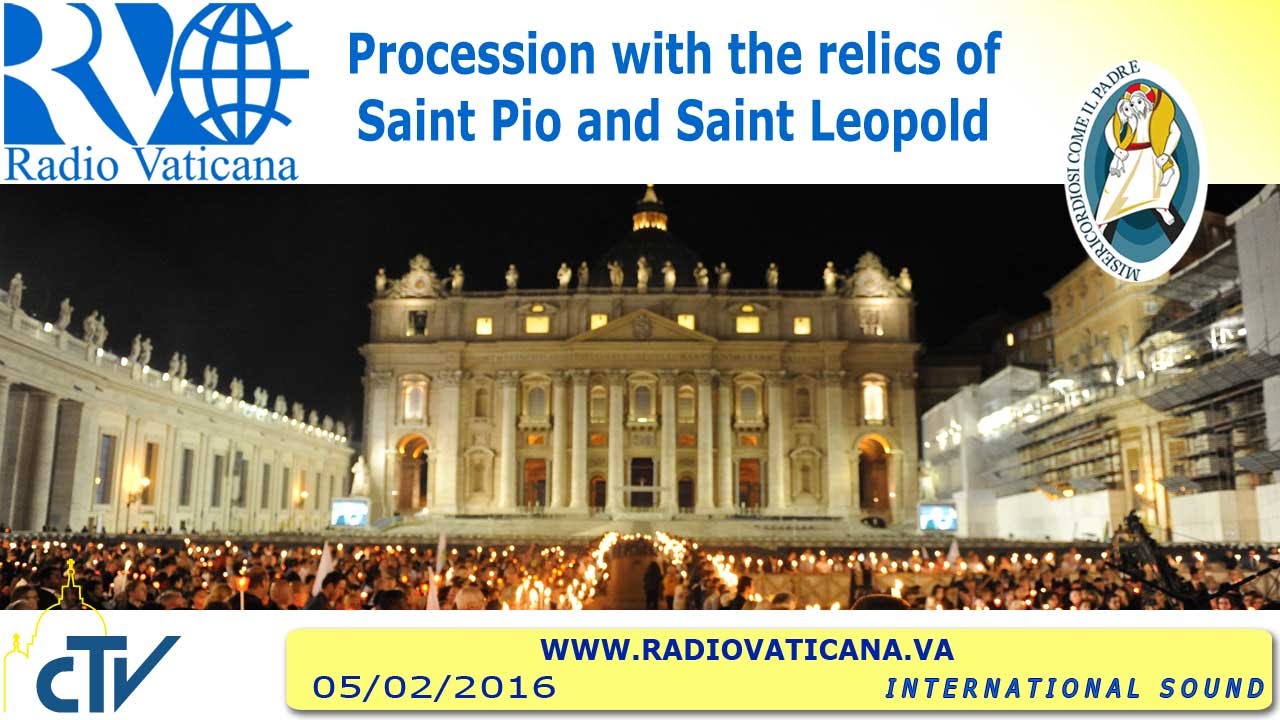
Procession in Rome with the bodies of Sts. Padre Pio and Leopold Mandi?

16_02_05_procession_02The other day Fishwrap‘s Mickens, channeling his inner Luther, scurrilously dissed Catholics for venerating the relics of saints. HERE Pope Francis had the bodily remains of two great Capuchin confessors, that is saints who were great receivers of confessions, Sts. Padre Pio and Leopold Mandić, brought to Rome so that pilgrims might be inspired by them. Mickens snarked:

“Do the men in the Vatican — including our dear Pope Francis — really think that dressing up dead bodies, even of the holiest of saints, is really going to help people “understand the ways in which God’s great love manifests itself in their daily lives”?

16_02_05_procession_01

Here is the video of the procession with the relics from CTV.  Try to ignore the syrupy music by Frisina.

YouTube thumbnailYouTube icon

Posted in Hard-Identity Catholicism, Saints: Stories & Symbols, Year of Mercy | Tagged
20 Comments

Super Bowl Doritos commercial annoyed big-business abortion NARAL!

Today I am going to buy a bag of Doritos… a small one.  Via one of its Super Bowl commercials Doritos annoyed big-business abortion NARAL.

One of the Doritos commercials featured an ultrasound moment.  Apparently Doritos are so good that Dad is eating them during the viewing of the ultrasound image.  Mom is unimpressed.  Unborn Junior, however, can sense the presence of the Doritos, as if through The Doritos Force and really wants one.  Mind you, the commercial has a crass outcome, as it were.  BUT… the point is… the moving thing in the ultrasound image was, clearly, A BABY.

The death-cult NARAL didn’t like that.  How dare that… thing… that invader by humanized?  Pretty soon women won’t want to have abortions and then what will they do?

CNS has the story.  (The video is embedded and it starts automatically.)

The Catholic League reports:

NARAL Livid Over Doritos Ad

February 8, 2016
Bill Donohue comments on the way the pro-abortion group, NARAL, responded to the Doritos ad that aired during the Super Bowl:

The Doritos ad that showed an ultrasound picture of the baby carried by the baby’s mother was condemned by NARAL for “humanizing the fetus.” It did just that. What else could it have done?

In 2013, Scottish professor Malcolm Nicolson co-authored a book, Imaging and Imagining the Fetus: The Development of Obstetric Ultrasound, published by Johns Hopkins University Press. He noted the “humanizing effect” of ultrasound and the enthusiastic reception it is receiving from pregnant women. In fact, he said, some women report not feeling pregnant until they’ve seen the pictures.

Anti-women feminists such as Allison Benedikt also acknowledge the effects of this technology. In a Salon article in 2012, she lashed out at pregnant women who were sharing pictures of their unborn babies on Facebook. She exclaimed that the more women share these pictures, “the harder it will be to deny that they are people.” She is exactly right: When photos of humans are shared, their humanity is confirmed.

Similarly, in 2007, author Melody Rose published a pro-abortion book wherein she decried the way “recent developments in imaging technique certainly have facilitated a reliance on powerful pictures that humanize the fetus in a way not possible two decades ago.” Imagine how human these humans will look two decades from now!

In 1994, the great English historian Paul Johnson, author of Modern Times, compared abortion to slavery. He noted that advances in medical technology have had a dramatic effect. “The fetus is being humanized,” he said, “just as the slave was humanized.” That’s what worries NARAL.

Contact NARAL’s president, Ilyse Hogue: IHogue@ProChoiceAmerica.org

Posted in Emanations from Penumbras |
23 Comments

Card. Onaiyekan on the proper disposition to receive Holy Communion

John Card OnaiyekanI have had my eye on John Card. Onaiyekan, archbishop of Abuja in Nigeria, for some time.

There was recently a Eucharistic Congress in the Philippines. Since Archbp. Piero Marini (former MC to JP2) is in charge of these conferences you might expect that there was some silliness. His talk about inculturation was a blast from the past. However, Card. Onaiyekan was pretty good, it seems. Here is an account from CBCPNEWS:

CEBU City (Jan. 29, 2016) – Where others prefer to tiptoe and use couched language, John Cardinal Onaiyekan, archbishop of Abuja in Nigeria, minced no words in talking about the proper disposition for the reception of the Holy Eucharist, which many Catholics seem to take for granted nowadays.

Delivering this morning’s catechesis, Onaiyekan said no one was really worthy to receive Holy Communion, but all people are under God’s “loving compassion.”

“That is why we have a penitential rite at the beginning of Mass. And when before communion we solemnly announce: ‘Oh Lord I am not worthy…,’ it is not a figure of speech, but a sincere admission of our spiritual inadequacy,” the 71-year-old cardinal said.

Nonetheless the Church has guidelines that set limits to the level of “unworthiness” compatible with a fruitful reception of Holy Communion, the metropolitan pointed out.

No to ‘Eucharistic hospitality’  [The Eucharist is not canapé at a liberal Left catholic brie and chardonnay reception.]

Allowing just anyone to receive communion during Mass will inflict “serious damage on the sanctity of the Holy Eucharist,” and harm both the individual and the wider Church.  [Sacrilege hurts everyone.]

“The traditional requirement of being ‘in a state of grace’ cannot be jettisoned without spiritual negative consequence at both personal and ecclesial levels.  [Bad Communions harm the Church.  So, good Communions help the Church.  Save The Liturgy, Save The World.]Therefore, those who freely offer or accept what is inappropriately called ‘Eucharistic hospitality’ to whoever cares to come to the communion rails seem to me to be inflicting serious damage on the sanctity of the Holy Eucharist,” said Cardinal Onaiyekan.

The Catechism of the Catholic Church teaches that those who have mortal sins cannot receive communion without first going to the Sacrament of Reconciliation. It defines mortal sin as “sin whose object is grave matter and which is also committed with full knowledge and deliberate consent.”

In Nigeria, he said, it is pastoral practice during public Masses to announce clearly before communion that “only Catholics that are properly prepared should come forward to receive communion.”

Sacrilege  [There it is.  The “S” word.  So few prelates and priests are willing to use the word these days.  They’ve gone all wobbly.]

“We do not believe that this is a place for any kind of false ‘political correctness.’ It seems that in many places today, there is a need to recover the sense of outrage about whatever may be tantamount to ‘sacrilege.’”  [Did he just say “outrage”?  Yes, I believe he did.]

Onaiyekan’s catechesis was on “The Eucharist: Dialogue with the Poor and the Suffering.”

“Here we might consider how much we do to make the Eucharist available to the poor living in slums or in remote villages. What about those who live in prisons and detention camps? Wherever possible, those who are suffering should be able to contemplate the face of Jesus in the Holy Eucharist,” he said. (CBCP News)

Fr. Z kudos to Card. Onaiyekan.

Posted in Fr. Z KUDOS, Hard-Identity Catholicism, Liturgy Science Theatre 3000, New Evangelization | Tagged , , , ,
18 Comments

“What a bore clergy find the ‘Hymn to Love’ in I Corinthians 13…”

From Fr. Hunwicke of Mutual Enrichment comes this brilliantly blistering entry. I am glad he’s on our side. And I am especially glad to have another defender of the pre-Lent Sundays. They were 86’d in the time of Paul VI. What a senseless tragedy.  My emphases:

QUINQUAGESIMA

What a bore clergy find the ‘Hymn to Love’ in I Corinthians 13 (the EF/BCP Epistle in Sunday’s Mass), as yet another engaged couple want Uncle Bob to read it at their wedding. Read, however, in the context of the blistering attack S Paul is making on the failings of the Corinthian Christians, its cutting irony, verging on sarcasm, is rather fun. Whenever S Paul says “Love is not X”, he is mightily suggesting that the Corinthians are X. But it isn’t irony Kevin and Sharon think they’re getting … I blame the late Thos Cranmer for the start of this vulgarisation. He abolished the fitting pre-Lent Collect for Quinquagesima and replaced it by a composition of his own, highlighting Charity. Since then, it has all been downhill.  [See what happens when you don’t adequately respect Quinquagesima?  Tinker tinker tinker… what good comes of that.]

If you look carefully at Quinquagesima’s BCP/EF Epistle and Gospel (Luke 18:31-43), you may notice that the link between them is the idea of being made able to See. Then, if you turn to the Homily by S Gregory which provides an extract for the third nocturn in the Old Breviary, you will discover that this is exactly what the saint leads us to expect. [NB: Many people use the word “liturgy” when they mean “Mass”.  But Mass is not “the liturgy”.  The Office is also “the liturgy”.  In the older, traditional form of the Roman Rite, there was far more cohesion between the two.  Read together, they present a far fuller view of the day.] (Migne, 76, columns 1081 and following; incidentally, as on the preceding two Sundays, the manuscripts tell us that this was preached to the people in the Stational Church – S Peter in Vaticano – on the Sunday we are examining. I will endeavour to amuse you by translating some of S Gregory’s little Latin ‘fillers’ by means of our popular modern ‘fillers’.)


[…]

Go over there to find the rest.  It’s worthy of your time.

Posted in Liturgy Science Theatre 3000, Mail from priests | Tagged , , ,
3 Comments