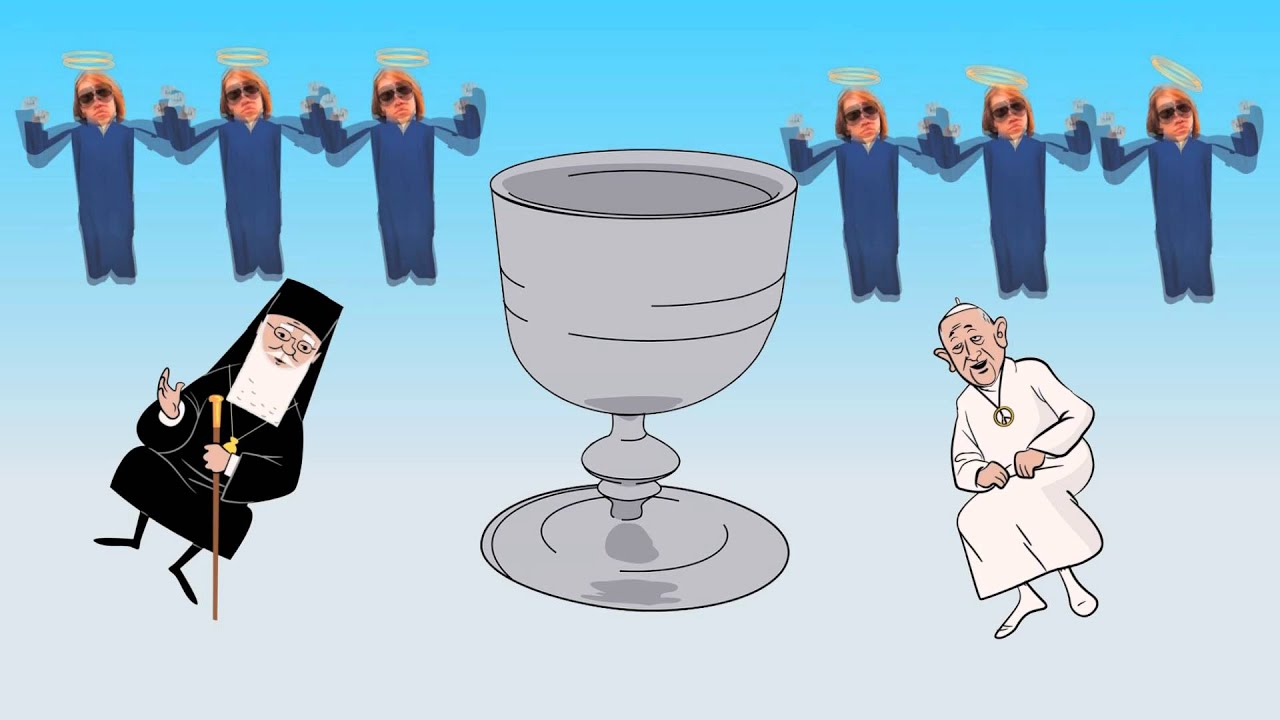
Lutheran Satire

Ever since Pope Francis met with some Lutherans and said pretty confusion things about reception of Holy Communion [HERE], I’ve been keeping half an eye out for a video from Lutheran Satire.

They have a couple already about Pope Francis. They are biting but, in all honesty, pretty funny.  They get some important points about the Church and the papacy right, even as they lampoon.

Years ago I was, for my sins, sent off to an ecumenical breakfast around Thanksgiving time. When I walked in a young man in black clerical clothing made a bee line for me. He was the pastor at the nearby Missouri Synod Lutheran church. Standing in my path, he asked me if I was the priest at the Catholic church nearby who told non-Catholics that they couldn’t come to Communion. “Yes”, I responded, “I am.” He thereupon stuck his hand out and said “Thank you! Many Catholic priests don’t know that not all Lutherans have inter-communion with each other much less with Catholics!” We wound up sitting together and having a cordial morning.

I think that ecumenical or inter-religious dialogue has to begin from a the foundation of true belief in your own doctrine!  And I think that we should still pay attention to Mortalium animos even if more recent magisterial documents have also been promulgated.

On that note, here is a Lutheran Satire video that I discovered today even though it is almost a year old.

YouTube thumbnailYouTube icon

Comment moderation is, of course, ON.

Posted in Francis, Lighter fare, Our Catholic Identity | Tagged ,
11 Comments

ASK FATHER: Can Orthodox obtain indulgences through the Catholic Church?

Carracci-PurgatoryFrom a reader…

QUAERITUR:

I am an Orthodox Christian. I believe that the Roman Catholic Church and the Eastern Orthodox Church are both Apostolic Churches, albeit, not in full communion. I converted to EO from Calvinism after being raised Pentecostal. I don’t believe that any “positive” and “non-polemical” teaching of the EOC contradicts or requires me to disbelieve in RCC doctrines such as the Immaculate Conception, Purgatory, or Indulgences. I am assuming that I am considered a catholic Christian with access to salvific sacraments from the Roman Catholic pov (re: Vatican II’s Decree on Ecumenism, Orientale Lumen).

My question is, can I gain plenary indulgences for souls in purgatory while being a member of the Eastern Orthodox Church? I try to pray the Rosary every day, and there is a chapel at the local cathedral a few blocks from work, so I could easily fulfill the conditions for a plenary indulgence three or four times per week.

The Catechism of the Catholic Church refers to the “Christian faithful” as the subjects of indulgences.

The Church is the dispenser of indulgences and so it would be logically assumed that those faithful united in full communion with the Church are those Christians who are able to obtain the indulgences which the Church so generously dispenses.

However, the Catechism, and Paul VI’s Indulgentiarum doctrina, only speak of the Christian faithful, not of Catholics. The Christian faithful must be properly disposed, free from any ecclesiastical penalties, and having received the sacraments of Penance and the Eucharist within the prescribed times for the indulgence.

Some might consider an Eastern Orthodox person to be in a state of schism, but, canonically, the culpability for schism is only incurred by those who, having once been united to the Church, have separated themselves from it. One who is born and raised outside the Church, though he be in de facto schism from the Church, is not imputable for the sin of schism (though he should be urgently encouraged to return to the fullness of the Church).

Therefore, it seems that it might be possible for an Orthodox Christian, who has never been Catholic, to obtain an indulgence.  It certainly does no harm to try!

Having said that, if you believe what the Catholic Church teaches regarding Purgatory, Indulgences, the Immaculate Conception (issues that are not necessarily at odds with official Orthodox teaching but which are certainly taught more clearly by the Catholic Church), why not advance the issue of true ecumenism and become Catholic?

Then, most certainly, there would be no doubt whatsoever about your ability to gain indulgences.

Posted in "How To..." - Practical Notes, Both Lungs | Tagged , ,
6 Comments

When Jesuits quote Jesus… and when they don’t

How the mighty have fallen.

La Civiltà Cattolica is a periodical edited by Jesuits which receives some vetting from the Secretariat of State and, thus, is considered by some to have a measure of “authority”.

However, true authority is based on the truth of premises and the quality of arguments… no matter who writes it or vets it.

I saw a tweet from Fr. Antonio Spadaro, SJ, who is close to Pope Francis and part of his writing team, and who seems to have a strong interest in the life and works of Pier Vittorio Tondelli (HERE).

15_11_19_tweet_01

“Hmmm…”, quoth I.  “Let’s have a look!”

In the Editorial under – Nell’ultima pubblicazione – n° 3971 del 12/12/2015 (the text is in Italian) I found the names of the other Jesuit publications.  Of course they are European, but I nevertheless found interesting the absence of Amerika.

Even more amusing was this.  Pay attention to their use of the authority of Lumen gentium for their… point:

La Costituzione dogmatica conciliare sulla ChiesaLumen gentium (LG) afferma autorevolmente: siccome «Cristo è stato mandato dal Padre “per annunciare ai poveri un lieto messaggio…, guarire quelli che hanno il cuore contrito” (Lc 4,18 Vlg), “a cercare e a salvare ciò che era perduto” (Lc 19,10), similmente la Chiesa abbraccia con amore quanti sono afflitti dall’umana debolezza, anzi riconosce nei poveri e nei sofferenti l’immagine del suo Fondatore povero e sofferente, cerca di sollevarne l’indigenza e in essi intende servire Cristo» (LG 8).

The Council’s Dogmatic Constitution on the Church Lumen gentium (LG) asserts authoritatively: given that “Christ was sent by the Father ‘to announce to the poor a joyful message…, to heal those who have a contrite heart’ (Luke 4:18 Vulgate), “to seek and to save that which was lost’ (Luke 19:10), similarly the Church embraces with love all those who are afflicted by human suffering, but rather recognizes in the poor and in the suffering the image of her poor and suffering Founder, seeks to alleviate destitution and in them means to serve Christ” (LG 8).

Sounds pretty pious, no?

Not if you read it carefully.

First, the writer utilizes Lumen gentium as an authoritative witness to the point he is trying to make.  However, Lumen gentium authoritatively affirms others things as well, such as the obligation we have to submit to properly defined and taught doctrine (not always a Jesuit strong point), and that those who resist membership in the Church, knowing her for what she is, cannot be saved.  Lumen gentium clearly upholds traditional doctrine about the Church’s hierarchical structure and insists on a qualitative difference between the priesthood of the ordained and of the laity.   There are more items, but that’s enough for now.

But, the Jesuit version of the Documents of Vatican II (i.e, the passages they accept) would be as thin as the Gnostic versions of the Bible.

Next, LG 8 says that Christ was sent by the Father “to bring good news to the poor, to heal the contrite of heart”.  What does “contrite” mean?   Note that Luke 4:18-19 are problematic in the Vulgate and in the Greek. Some scholarly Greek versions omit the part about “contrite heart” (ἰὰσασθαι τοὺς συντετριμμένους τὴν καρδίαν).  But no matter.  The writer is citing the Council document Lumen gentium which reads “Christus a Patre missus est “evangelizare pauperibus,… sanare contritos corde” (Lc 4,18)”.  We, therefore, have to go with the “contrite heart” statement.

Again, what does “contrite” mean?  Contrition of heart (from Latin contritio “a wearing down of that which is hard”) is sorrow of heart for and detestation of sin along with the resolution not to sin again (Council of Trent, session XIV, 4).  Contrition is necessary for forgiveness and, thus, for salvation.  It must be genuine.  It is more perfect when it comes from love for God, less perfect when it comes from fear of punishment (called “attrition”).  Christ came to heal those who are sorry for the sins they have committed and detest sin.  They have repented.  They are not just sad.  They are not just afraid.  They have turned a corner on sin.

Here’s the problem… This is the crew who are constantly chanting mercy mercy mercy without, seemingly, any strong exhortation to repentance and conversion and adherence to the Church’s teaching on faith and morals.  This crew utilizes a conciliar text which they shove in our face as authoritative (i.e., intended to end all discussion).  However, the very text they cite (and there are textual problems with it) affirms precisely what they are trying to avoid: that we have to stop sinning to be healed.

Furthermore, note that, all of a sudden, Christ’s words are really important!   They weren’t so important in the question of the clear and indisputable text about indissolubility of marriage.  But here, the Council and Christ’s words – which I think they misapply – are authoritative even though the Greek and Latin texts are a bit contested.

C’mon, guys.  You would think that Civiltà Cattolica could field a better team than this.


Posted in One Man & One Woman, Our Catholic Identity, Sin That Cries To Heaven, The Drill | Tagged , , ,
6 Comments

How about a Masters in RATZINGER STUDIES?

15_11_19_Augnum_02Here is an exciting opportunity for priests and lay people alike.

In Rome there is now a Masters program in RATZINGER STUDIES.  HERE  PDF of the brochure HERE.

The Fondazione Vaticana Joseph Ratzinger Benedetto XVI is sponsoring a Masters Program in Joseph Ratzinger: Studies and Spirituality.

This is a two semester program, beginning February 2016, consisting in a course of one afternoon per week for two semesters.   So, it’ll run from the second semester, starting in February 2016, and then pick up again with the next academic year in October through to January 2017.

And the program is in both Italian and ENGLISH.  That is.. the whole thing is offered… in ENGLISH.  You don’t need to take Italian courses because it is also offered IN ENGLISH.

This would be an amazing opportunity for, say, a priest who is to take a sabbatical year.

Rome in the spring, Ratzinger, summer off, Rome in the fall, Ratzinger … Masters!

15_11_19_Augnum_01The programs is coordinate by and held at my school, the Patristic Institute “Augustinianum, which is literally across the street from St. Peter’s Square.

This Masters program will trade off with their other Masters program in Augustinian Studies.  So, after the Ratzinger program ends in January 2017, the Augustine program (going on now at the Augustinianum) will start in February 2017.  They will alternate.


Super cool idea and opportunity.

Tempting?


Posted in Benedict XVI, Just Too Cool, The Campus Telephone Pole | Tagged ,
12 Comments

Card. Sarah on marriage, mercy and the incomprehension of doctrine by priests

Click

I saw at Sandro Magister’s Chiesa that Robert Card. Sarah (cheer here), Prefect of the Congregation for Divine Worship and author of God Or Nothing, [UK HERE] has some strong words for the Church (and churchmen) in the recent L’Homme Nouveau.

Magister has a preview.

Here is a preview of his preview. “Overrated Synod. Before All Else in the Church There Is a Crisis of Faith”.

Card. Sarah responds to critics.  My emphases.

Four objections, four responses, and one conclusion

by Robert Sarah

1. DOCTRINE, LET’S VOTE ON IT BY MAJORITY

[…]

2. COMMUNION FOR ALL, WITHOUT DISCRIMINATION

[…]

3. REMARRIED AND ACTIVE IN THE PARISH. WHY NO COMMUNION?

[…]

4. THE AFRICAN FAMILY IS NOT WHAT YOU TELL US IT IS

[…]

CONCLUSION. THE MAGISTERIUM OF THE CHURCH, THIS UNKNOWN TERRAIN

To conclude, I feel wounded in my heart as a bishop in witnessing such incomprehension of the Church’s definitive teaching on the part of my brother priests.

I cannot allow myself to imagine as the cause of such confusion anything but the insufficiency of the formation of my confreres. And insofar as I am responsible for the discipline of the sacraments in the whole Latin Church, I am bound in conscience to recall that Christ has reestablished the Creator’s original plan of a monogamous, indissoluble marriage ordered to the good of the spouses, as also to the generation and education of children. He has also elevated marriage between baptized persons to the rank of a sacrament, signifying God’s covenant with his people, just like the Eucharist.

In spite of this, there also exists a marriage that the Church calls “legitimate.” The sacred dimension of this “natural” dimension makes it an element awaiting the sacrament, on the condition that it respect heterosexuality and the parity of the two spouses when it comes to their specific rights and duties, and that the consent not exclude monogamy, indissolubility, permanence, and openness to life.

Conversely, the Church stigmatizes the deformations introduced into human love: homosexuality, polygamy, chauvinism, free love, divorce, contraception, etc. In any case, it never condemns persons. But it does not leave them in their sin. Like its Master, it has the courage and the charity to say to them: go and from now on sin no more.

The Church does not only welcome with mercy, respect, and delicacy. It firmly invites to conversion. As its follower, I promote mercy for sinners – which all of us are – but also firmness toward sins incompatible with the love for God that is professed with sacramental communion. What is this if not the imitation of the attitude of the Son of God who addresses the adulterous woman: “Neither do I condemn you. Go and from now on sin no more” (Jn 8:11)?

Read the whole thing there.

Posted in One Man & One Woman, Our Catholic Identity | Tagged
31 Comments

“It was impossible to say Mass in the barrack, of course.”

With God in RussiaOur religious liberties are not to be taken for granted.  I sometimes consider what I might do when they come for priests and bishops who continue faithfully to preach Catholic doctrine fully.

When my mind goes down this dark track, I inevitably recall what I read With God In Russia by Fr. Walter Ciszek, SJ, imprisoned during the Cold War years for being a Catholic priest. [UK link HERE.]

I finally looked up the passages I recalled from reading the book years ago.

It was impossible to say Mass in the barrack, of course. From time to time, however, Nestrov and I would take a walk into the forest, when we were free from work, and say Mass there. We used a big stump as our altar, and while one of us offered the Holy Sacrifice the other stood guard on the road. It was an experience I’ll never forget. In the heavy silence of the thick forest, you could hear the chipmunks running and the birds gathering overhead. Suddenly, you seemed very close to nature and to God. Everything seemed beautiful and somehow mysterious, all dangers for a time remote.

At other times, if we had an hour alone but couldn’t leave camp to say Mass, we would take turns reciting and memorizing the prayers of the Mass until we knew them all by heart. We were always aware that the Mass kit might be discovered, and we would lose our book and vestments, but we were determined that as long as we could get bread and wine we would try to say Mass.


And later…

After breakfast, I would say Mass by heart–that is, I would say all the prayers, for of course I couldn’t actually celebrate the Holy Sacrifice. I said the Angelus morning, noon, and night as the Kremlin clock chimed the hours. Before dinner, I would make my noon examen (examination of conscience); before going to bed at night I’d make the evening examen and points for the morning meditation, following St. Ignatius’ Spiritual Exercises. Every afternoon, I said three rosaries–one in Polish, one in Latin, and one in Russian–as a substitute for my breviary. After supper, I spent the evening reciting prayers and hymns from memory or even chanting them out loud: the Anima Christi, the Veni Creator, the Salve Regina, the Veni, Sancte Spiritus, especially the Dies Irae and the Miserere–all the things we had memorized in the novitiate as novices, the hymns we had sung during my years in the Society, the prayers I had learned as a boy back home. Sometimes I’d spend hours trying to remember a line that had slipped my memory, sounding it over and over again until I had it right. During these times of prayer, I would also make up my own prayers, talking to God directly, asking for His help, but above all accepting His will for me, trusting completely to His Providence to see me through whatever might lie ahead. (pp. 88-89)

Fathers, seminarians, do you memorize?   It could be good to memorize a Mass formula, such as the classic Votive Mass of the Blessed Virgin Mary along with the Ordinary of Mass.

Frankly, we all should have the necessary prayers of Holy Mass memorized, right?

Parents, perhaps you could motivate your children (and yourselves) to memorize prayers and hymns and catechism answers through some prizes and so forth.

Memorization fell out of favor.  But once you have something memorized, it’s yours in way that it otherwise is … not.

Posted in Semper Paratus, TEOTWAWKI, The Coming Storm, The future and our choices | Tagged , , , ,
27 Comments

US Embassy in Rome warns US citizens about “Potential for Terrorist Attacks”

Everyone, I call upon you to pray for the defeat or conversion of Islamists.

Friends in Rome.. please… keep your heads on a swivel.  Be alert.  Stay frosty.  Go to confession.

Italy has tightened up security in the wake of Paris and on the verge of the opening of the Year of Mercy.  HERE

This has been sent via email to American ex-pats in Italy.

UNITED STATES EMBASSY ROME, ITALY

Security Message for U.S. Citizens: Potential for Terrorist Attacks

November 18, 2015

U.S. Embassy Rome informs U.S. citizens that the following locations have been identified as potential targets in Rome and Milan for terrorist attacks:

  • St. Peter’s Basilica in Vatican City (Rome)
  • the Duomo and La Scala in Milan
  • General venues such as churches, synagogues, restaurants, theatres, and hotels in both cities are possible targets as well.

Terrorist groups may possibly utilize similar methods used in the recent Paris attacks.  The Italian authorities are aware of these threats.

U.S. citizens are advised to remain vigilant and aware of their surroundings.  We encourage U.S. citizens to monitor media and local information sources and factor updated information into personal travel plans and activities.

For further information:

o    U.S. Consulate General in Naples  can be reached at (+39) 081-583-8111; the fax number is (+39) 081-583-8275/081-761-1804

o    U.S. Consulate General in Milan is located at Via Principe Amedeo, 2/10 and is open from 8:30am to 12:00pm for emergency services.  If you are a U.S. citizen in need of urgent assistance, the emergency number for the U.S. Consulate General in Milan is (+39) 02-290-351.

o    U.S. Consulate General Florence is located at Lungarno A. Vespucci, 38 and is open from 9:00am to 12:30pm for emergency services.  After hours emergency number for U.S. citizens is +(39) 055-266-951

o    U.S. Embassy to the Holy See is located on Via Sallustiana, Rome and can be reach after hours at +(39) 06-46741

  • Call 1-888-407-4747 toll-free in the United States and Canada or 1-202-501-4444 from other countries from 8:00 a.m. to 8:00 p.m. Eastern Standard Time, Monday through Friday (except U.S. federal holidays).

  • Follow us on Twitterand Facebook.

Everyone, I call upon you to pray for the defeat or conversion of Islamists.

Friends in Rome.. please… keep your heads on a swivel.  Be alert.  Stay frosty.  Go to confession.

Posted in The Religion of Peace | Tagged ,
20 Comments

After Paris… How do you feel these days? Safe? Less safe?

I don’t know about you, but over the last year or so I have become increasingly disciplined regarding my situation awareness.  When I get out of my car, I look around to see where everyone is.  When I walk out the door, I look around to see where everyone is.  When I walk into a place, I look around.  I know where the doors and exits are.  I see where everyone is, who comes in after me.  If I see someone that looks or behaves oddly, I keep an eye on them.

Since the attacks in Paris, I have been thinking about posting a poll about how you feel these days, but I can’t quite get the questions down.  So…I’ll just ask:

How do you feel these days?  Safe?  Less safe?  Are you afraid to go to public venues?  Malls?  Movie theaters?  Soft targets?

I have to go to New York City for a charity event in December and so I was talking by phone with a friend there about taking in the new Star Wars movie on opening night.  Afterward, out of curiosity, I brought up a movie schedule website to see where in Manhattan it would be playing.   Then it hit me: opening night of Star Wars… in Manhattan… in a movie theater.  Soft tempting terror target?  You bet.  “Do I really want to do that?”, I thought.

At IJReview, Erick Erickson has some thought provoking comments.

After Paris, I Want to Take My Gun to Star Wars

I have never worried or fretted about things like this. Even after the Aurora, CO, shooting at the “Dark Knight Rises” showing, I never once worried about going to a theater and getting shot. I have taken the view of Stonewall Jackson that, believing in God, I am as safe on the battlefield as I am in my bed. Of course, Stonewall Jackson was killed on the battlefield.

After the events of Paris and in light of the unvetted Syrian refugees coming into this country, I am rather nervous about going to the opening day of “Star Wars.” If I were a terrorist and wanted to find a large, unsecured gathering of Americans without arms, I would show up with a bomb at the local cinema on opening day of “Star Wars.”

Most theaters have policies that prohibit their patrons from carrying guns in. Gun owners, law abiding folks that they are, then tend to leave their guns in their cars when they go to the movies. [In NYC people are denied their 2nd amendment rights.] A terrorist or nut job ignoring the law could do a lot of damage before anyone could respond. A terrorist with an undetected bomb strapped to himself could do even more damage.

There are no metal detectors at the theater.

I would like to find a theater in my area that allowed concealed carry permit holders to bring their guns to the movies. In Brazil, crime has gotten so bad, the government has now passed a wide ranging gun liberalization law. The citizens can now carry guns to defend themselves since the government has been unable to protect them. [That’s the case in a growing number of American cities.] At American theaters, the American citizens should be put in the same position as Brazilian citizens. We should be allowed to arm ourselves to protect ourselves.

I typically am never worried about these things. The stories tend to be remote. [These things always happen to someone else… until they happen to you.] They tend to not bother me. But in Paris, the terrorists went to a music concert and went to a soccer game. They went where unarmed masses were and where security was poor. The terrorists at the soccer game were stopped by security nonetheless. But that was not the case at the theater.

[…]

Read the rest there.

Whether you are a gun owner or not, a gun carrier or not, and even if you are an opponent of gun ownership, it seems to me that we all need to exercise real prudence these days and situational awareness.    If everyone were more alert when out and about (rather than keeping eyes glued to the damn phone screen with loud music in ear buds), bad guys would have a harder time making people into victims.

I say, make it really hard for bad guys to do their bad guy things.  Make it dangerous for them.  Make them want to be somewhere else.

Have you changed anything in your life because of the fear of terrorist attacks or rising crime?   Have you had a serious conversation about any of these things with a friend or a loved one?

And remember… GO TO CONFESSION!

Posted in GO TO CONFESSION, Semper Paratus, The Coming Storm, The future and our choices, The Religion of Peace | Tagged
85 Comments

ASK FATHER: The mantelletta and other clerical gear were “abolished” but under Summorum Pontificum can they be used? Wherein Fr. Z rants.

mantelletta and cappaFrom a reader…

QUAERITUR:

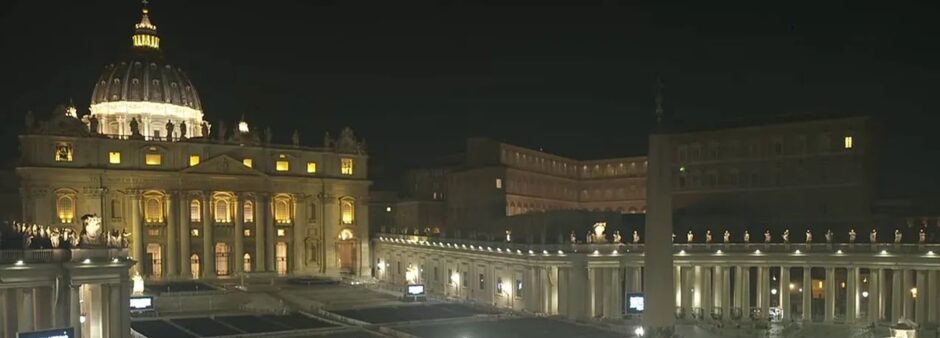
I am writing with a follow up question to your post yesterday (16 November) on the subject of the mantelletta. HERE In your response to the reader, you mentioned the (dolorous) decision, issued motu proprio, of the blessed pope, Paul VI, that white washed Catholic liturgy by flattening out the hierarchy and their attire.  Alas, think of what a papal procession may have looked like, in various times of the year!

In any case, my question is this, although the law of Pope Paul concerning mantellettas is in vigor, how is it now to be understood in light of Summorum Pontificum and, even more, of Universae Ecclesiae.  That is to say, since the liturgical laws in force in 1962 are to be followed by Bishops , would it not be the case that a Bishop outside of his own Diocese (and the other occasions on which it is to be worn) and Cardinals in Rome would be required to wear a mantelletta when engaged in anything connected to the more ancient form of the Mass?  Is it not also so, then, that every Bishop should have a mantelletta tailored so as to “be prepared for every good work”?

When you read the 1969 Instruction on the “Dress, Titles, and Coat of Arms of Cardinals, Bishops and Lesser Prelates,” approved by Paul VI, you often find the word “abolished”: the mantelletta is “abolished”, as is the sash with tassels, the red tabarro, the galero and the red plush hat, the colored hose and shoe buckles for lesser prelates, the red tuft on the biretta for prelates of honor, the mantellone for lesser prelates…. All “abolished.”

What does it mean to abolish or suppress an article of clothing?

What is being abolished is the necessity of wearing them. They are not forbidden. In the instruction, nowhere is it stated, “Cardinals may not wear…”.  It simply states that certain articles of clothing are “abolished” or sometimes “suppressed”.

“But Father! But Father!”, some of you are squealing like piglets. “The Pope clearly wanted to get rid of all this … this… frippery!  This is proof that you hate Vatican II!  And you hate the poor too!  And mercy!”

Some may find this pedantic, but we must ask:  What does the author of the Instruction really say about the motivation behind abolishing the obligation of wearing such things?

Having referred to “spiritual values”, the author of the document writes of the sensitivity of the modern mentality to avoid extremes, to bring decorum into harmony with simplicity, practicality, and a spirit of humility and poverty,

“which must always and preeminently shine forth in those who, by their investiture in ecclesiastical offices, have some special responsibility in the service of the People of God.”

The committee which was given the task of studying this issue prior to the promulgation of the this instruction was cautioned to “take account, at the same time and in just measure, tradition, modern needs, and deeper values implicit in certain forms of living, exterior and contingent though they be.”

Thus, the motive for the “abolishing” of certain articles of clothing had in mind the need to keep things simple, to demonstrate humility and obedience, and to attend to the needs and mindset of the modern mind.

However…

The modern mind of 2015 is not the same as the modern mind of 1969.

In this last half century, the world has moved beyond some of the assumptions of the 1960’s. While modern dress has arguably gotten more casual, great attention – even obsession – is paid to presentation, grooming, and appearance.  Watch TV commercials.

Furthermore, individuality is king! Those who shun those trends and overarching individuality and put on a regulated uniform now stick out.

I think that the counter-cultural “sign value” of clerical dress is even more important today than it was in 1969.  This goes for choir dress, too.

Summorum Pontificum does not seek to create a sort of “Colonial Williamsburg” liturgy.  It does not intend to recreate a moment in the past merely for historical curiosity. A central point of Benedict’s reform is to recapture and reintegrate the spirit of the ancient liturgy of the Church, our heritage, which is ever sacred and valid.  This is vital for an effective renewal of every sphere of the Church’s life and mission.  In all our endeavors we begin with and return to our liturgical worship of God.

Therefore, obedience to the liturgical dress – and that includes choir dress – required at the reference year Summorum Pontificum designated, will again today instill a proper sense of humility and order.

It’s not “What I want to wear”, but rather, “What do the books require that I wear?”, and subsequently “Will I subjugate myself own desire to the requirements of that spirit and decorum?”

The use of a mantelletta was a mark of humility for those greater prelates who wore it. Whereas the mozzetta demonstrated jurisdiction, the mantelletta showed a humbling of that jurisdiction before the greater jurisdiction of the local bishop or, in Rome, the Holy Father himself.

In this time radical individualism, clerical dress is a powerful counter-cultural sign.

Proper choir dress reveals a spirit of humility.  Submission to the ordering of seniority and hierarchy and jurisdiction is a spiritual value that clerics need to foster.  For example, the place of clerics in processions and in seating in choir followed certain rules.  They are followed loosely, but they are known.  Furthermore, this humble ordering is a value that seminarians and young priests should experience, for the sake of their own priestly identity which includes the service of the Church in humility.   (As an aside, study your average Novus Ordo entrance procession with a lot of clergy these days.  Not terribly edifying, is it.  But I digress.)

In sum, the obligation to wear these old things is no longer in force.  They may be worn, but it is not obligatory. (On a side note, the obligation that women once had to cover their heads in Church is no longer in force, but that doesn’t mean that they must not now wear hats or veils.  Maniples and birettas were once obligatory for Mass.  Now they are not.  They may be used, but they aren’t requirements. But I digress.)

In the context of liturgical celebrations with with Extraordinary Form, the older gear may be worn, but it is not obligatory.  The newer rules for choir dress may be followed as well, though it would probably be better to follow the older rules.

francis_benedict_election_MozzettaRemember, Fathers and seminarians, that a mantelletta or a certain kind of fascia or a buckle, or a mozzetta, in themselves, are not going to get us to heaven on their own.  For example, bishops and popes – even the Pope of the current parenthesis – don’t have to wear the mozzetta all the time.  There are, however, occasions in which such trappings and signs of office, solemn and traditional, have their proper place.  They send signals.  The non-use of these symbols also sends signals.  Frankly, I think it is wrong for the Pope to dress down in certain formal occasions, such as audiences with heads of state, or consistories, or the Urbi et Orbi blessings, etc.  I don’t see it as “humble” at all.  I see it more as that radical individuality that I mentioned, above. Other Popes did it, all his predecessors did, but he doesn’t? Sometimes we have to conform and put on all the gear as a sign of respect for office and for others.  But… enough of that.  He’s Pope and I’m not and this isn’t the pressing issue we face right now.  I’ll conform to my style of dress, suited to my station, in choro and on other occasions.

People who say that these things are not important, or are bad, or that they should be eliminated are just plain wrong.  That is a naive, shallow, approach to who we are. Liberals have a spittle-flecked nutty over these things. I say that Catholics are not “either/or” when it comes to the dynamic interplay of the humble and the lofty.  We are “both/and”, in proper measure, time and place.
Posted in "How To..." - Practical Notes, ASK FATHER Question Box, Hard-Identity Catholicism, Liturgy Science Theatre 3000, Mail from priests, Our Catholic Identity, Priests and Priesthood, Seminarians and Seminaries, Wherein Fr. Z Rants | Tagged , ,
10 Comments

Mercy requires Truth and the move away from sin. “Mercy is not moral peek-a-boo.”

Some folks are blabbing about mercy mercy mercy while shoving truth under the rug.  They suggest that mercy trumps truth, dogma, law conversion, etc.  Wrong. We have to call people on that.

There is a good article at Crisis Magazine today about Mercy and its lately neglected twin TRUTH.

St. John Paul II: No Mercy Without Truth

by John M. Grodelski

Mercy featured prominently in the polemics surrounding the recently concluded Synod on the Family. Mercy was frequently counterpoised to dogma as an appeal to dilute ecclesiastical practice and admit to Holy Communion those who were now “remarried.” Cardinal Kasper went so far as to publish a book between the 2014 and 2015 Synod sessions, Mercy: The Essence of the Gospel and the Key to Christian Life(New York: Paulist, 2014).

One might walk away from these events with the impression that, suddenly, the Church had discovered its vocation to mercy and was now busy making up for lost time when it was, presumably, unmerciful. Yet one should remember that St. John Paul II was the Pope who laid enormous stress upon Divine Mercy, emphasizing it as God’s premier attribute particularly relevant for contemporary man, and underscoring that focus by making the canonization of the “secretary of mercy,” Sr. Faustyna Kowalska, the first of the new millennium. If St. John Paul II’s first encyclical, Redemptor hominis, laid out the programmatic focus of his pontificate as one of Christian humanism, so we should not forget that his second encyclical, Dives in misericordia—issued 35 years ago this November 30—focused on the God who is “rich in mercy.” So much for the myth of the Church just awakening to her mission of mercy.

In the course of remembrance, however, we should go back even further, to a probably largely forgotten text from St. John Paul II’s prepapal writings, “Problem prawdy i milosierdzia” (The Problem of Truth and Mercy). That short text dates from 1957 and was one of twenty brief articles printed under the title “Elementarz etyczny” [The Ethics Primer] in Tygodnik Powszechny, the independent Catholic weekly then-published in Kraków. The articles in that series largely grapple with issues in modern philosophy having implications for faith and are distinguished by their succinct presentation of those questions in the light of faith.

[…]

Mercy, likewise, is not moral peek-a-boo. Mercy requires moving away from evil: “Where [mercy] enters in, evil effectively gives way. Where evil does not give way, mercy is not there—but we also add, where there is no mercy, evil does not yield. Mercy does not accept sin nor looks upon it as if peeking between one’s fingers, but only and exclusively helps in conversion from sin….  Divine mercy goes strictly in tandem with justice” (all translations mine).

[…]

I interrupt this sample to remind you of my call to Pope Francis to name John Paul Doctor of the Church with the title Doctor Misericordiae on Divine Mercy Sunday. HERE (Maybe some people who initially resisted me on this have finally started to figure out why I called for this?)

Skipping a bit to show how instructive this article is… this relates to the recent Catholic/Lutheran confusion provoked by comments made by the Holy Father. HERE and HERE

[…]

The scrupulous nominalist Martin Luther imported this voluntarism into Protestant theology through his doctrine of forensic justification: man is always sinful and never righteous, he is merely declared righteous by God, grace changing nothing. Man is moral dung. Grace is snow. The snow covers the dung, but does not change it: don’t go tip-toeing through the snowdrops barefoot…

[…]

Read the rest there.  It’s worth your time and attention.


Posted in The Drill | Tagged , , , ,
5 Comments