WDTPRS – 4th Ordinary Sunday: Billy loves bugs

bugsToday’s Collect prayer for the 4th Ordinary Sunday (it’s Septuagesima in the traditional calendar) was not in the post-Tridentine editions of the Missale Romanum but it does have its origin in the ancient Veronese Sacramentary.

Were you to hear this prayer intoned in Latin, or at least in an accurate translation, you would be thereby transported back 1500 years to our most Roman of Catholic roots.

Concede nobis, Domine Deus noster,
ut
[et (in Ver.)] te tota mente veneremur,
et omnes homines rationabili diligamus affectu
.

OBSOLETE ICEL (1973):
Lord our God,
help us to love you with all our hearts
and to love all men as you love them.

Is this what the Latin really says?

CURRENT ICEL (2011):
Grant us, Lord our God,
that we may honour you with all our mind,
and love everyone in truth of heart
.

SLAVISHLY LITERAL TRANSLATION:
Grant us, O Lord our God,
that we may venerate you with our whole mind,
and may love all men with rational good-will
.

“Affection” just doesn’t cut it for affectus and something more pointed than “love” is needed too.  I came up with “rational good-will”.  We mustn’t reduce all these complicated Latin words to “love”.  Why not?  Note in the prayer the contrast of the themes “reason” and “mood”, the rational with the affective dimension (concerning emotions) of man; in short, the head and the heart.   The fact is, a properly functioning person conducts his life according to both head and heart, feelings under the control of reason and the will.  The terrible wound to our human nature from original sin causes the difficulty we have in governing feelings and appetites by reason and will.

Today’s prayer aims at the totality of a human person: our wholeness is defined by our relationship with God.

We seek to know God so that we may the better love Him and His love drives us all the more to know Him.  Furthermore, possible theological and Scriptural underpinnings of this prayer are Deuteronomy 6 and Jesus’ two-fold command to love God and neighbor: “You shall love the Lord your God with all your heart, and with all your soul, and with all your mind. This is the great and first commandment.  And a second is like it, You shall love your neighbor as yourself. On these two commandments depend all the law and the prophets” (cf. Matthew 22:36-38; Mark 12:2-31; Luke 10:26-28).  In Deut 6:5-6 we have the great injunction called the Shema from the first Hebrew word, “Hear, O Israel: The LORD our God is one LORD; and you shall love the LORD your God with all your heart, and with all your soul, and with all your might….” Jesus teaches the meaning and expands the concrete application of this command in Deuteronomy 6.

There is no space here for the subtle relationships between the Latin words St. Jerome chose in his translations and the Greek or Hebrew originals of these verses.  Suffice it to say that in the Bible the language about mind, heart, and soul is terrifically complex. However, these words aim at the totality of the person precisely in that dimension which is characteristic of man as “image of God”.  Heart, mind and will distinguish us from brute animals.  We are made to act as God acts: to know, will and love.  Thus, “mind” and “heart” in man are closely related faculties and cannot be separated from each other.  Mind and heart are revealed in and expressed through our bodies and thus they point at the “real us”.

Love is at the heart of who we are and it the key to our prayer today.

We are commanded by God the Father and God Incarnate Jesus Christ to love both God and our fellow man and God the indwelling Holy Spirit makes this possible.

But the word and therefore concept of “love” is understood in many ways and today, especially, it is misunderstood.  “Love” frequently refers to people or stuff we like or enjoy using.  Bob can “love” his new SUV. Besty “loves” her new kitten.  We all certainly “love” baseball and spaghetti.  But “love” can refer to the emotions and affections people have when they are “in love” or, as I sometimes call it, “in luv”.

Luv is usually an ooey-gooey feeling, a romantic “love” sometimes growing out of lust.  This gooey romantic “love” now dominates Western culture, alas.   The result is that when “feelings” change or the object of “luv” is no longer enjoyable or usable, someone gets dumped, often for a newer, richer, or prettier model.

There some other flavors of “love” you can come up with, I’m sure.  But Christians, indeed every image of God in all times everywhere, are called to a higher love, the love in today’s prayer, which is charity: the grace-completed virtue enabling us to love God for His own sake and love all who are made in His image.  This is more than benevolence or tolerance or desire or enjoyment of use.

True love is not merely a response to an appetite, as when we might see a beautiful member of the opposite sex, a well-turned double-play, or a plate of spaghetti all’amatriciana.

True love, charity, isn’t the sloppy gazing of passion drunk sweethearts or the rubbish we see on TV and in movies (luv).  Charity is the grace filled adhesion of our will to an object (really a person) which has been grasped by our intellect to be good.

The love invoked in our prayer is an act of will based on reason. It is a choice – not a feeling.

Charity delights in and longs for the good of the other more than one’s own.  The theological virtue charity involves grace.  It enables sacrifices, any kind of sacrifice for the authentic good of another discerned with reason (not a false good and not “use” of the other).  We can choose even to love an enemy. This love resembles the sacrificial love of Christ on His Cross who offered Himself up for the good of His spouse, the Church.  St. Augustine, as a matter of fact, taught that “enemy love” is the perfection of the kind of love we can have in this earthly life.  Rationabilis affectus reflects what it is to be truly human, made in God’s image and likeness, with faculties of willing and knowing and, therefore, loving.

Knowledge and love are interconnected.

The more you get to know a person, the more reason you have to love him (remember… love seeks the other person’s good in charity even if a person is unlikable).  Reciprocally, the more you love someone or (in the generic sense of love) something, the more you want to know about him and spend time getting to know him.

For example, Billy is fascinated by bugs.  From this “love” for bugs Billy wants to know everything there is to know about them.  He works hard to learn and thus launches a brilliant career in entomology.  Given Our Creator’s priority in all things, how much more ought we seek to know and love God first and foremost of all and then, in proper order, know and love God’s images, our neighbors?  He is far more important that the bugs He created.  Even spouses must love God more than they love each other.  Only then can they love each other properly according to God’s plan.

We also have a relationship with the objects of both love and knowledge.  What sort of relationship?  With bugs or spaghetti it is one thing, but with God and neighbor it is entirely another.

In seeking to understand and love God more and more we come to understand things about God and ourselves as his images that, without love, we could never learn by simple study.  The relationship with God through love and knowledge changes us.  St. Bonaventure (+1274) the “Seraphic” doctor wrote about “ecstatic knowledge”. This kind of knowledge is not merely the product of abstract investigation or analytical study (like Billy with his bugs).  Rather, it comes first from learning and then contemplating. According to Bonaventure, by contemplation the knower becomes engaged with the object. Fascinated by it, he seeks to know it with a longing that draws him into the object.

Consider: we can study about God and our faith, but really the object of study is not just things to learn or formulas to memorize: the object of our study and faith is a divine Person in whose image and likeness we ourselves are made.  To be who we are by our nature we personally need the sort of knowledge of God that draws us into Him.  Knowledge of God (not just things learned about God) reaches into us, seizes us, transforms us.  To experience God’s love is to have certain knowledge of God, more certain than any knowledge which can be arrived at by means of mere rational examination.

Bring this all with you back to the last line of our prayer and the command to love our neighbor, all of them made in God’s image and all individually intriguing – fascinating, in a way that resembles the way we love God and ourselves.  This we are to do with our minds, hearts, and all our strength.


Posted in Liturgy Science Theatre 3000, WDTPRS | Tagged , , , ,
2 Comments

Fr @RayLBlake explains Peronism

My friend Fr. Ray Blake, intrepid PP of Brighton, has a strong post upon which you might reflect.

Peronism and Corruption

I had a lesson in Peronism from an Argentinian waiter recently, in Argentina he was a PPE graduate.

Peronism, he said, was the most corrupt form of politics, because you could be a Communist, or a Facist, or a Capitalist, the only thing that mattered was support for Peron, post Peron any other head of State. It is a remnant of 1920/30s Facism, where the will of the Fuhrer or Il Duce was all that mattered. Right or Wrong, Good or Bad, Custom or Tradition, Law or Morality or anything else pale into insignificance and have no validity compared to the Will of the Leader.

Therefore the ideal is to be as close as possible to the Leader, failing direct proximity the next best thing is to be close either to those who are close to the Leader or those know, or claim to know, the mind of the Leader. Under such a system moral automony is reduced to slavery because is no mral compass, such abstracts as Right and Wrong are of no importance. All that does matter is Dux Vult. If the leader is somewhat erratic that doesn’t really matter, it just means his followers have to be closer and listen even more intently and it could be that what was the Leader’s will last year or even this morning, might not be so now, or his will expressed to A might be the complete opposite of what was expressed to B.

To the Peronist the old elite, who based their authority on intellectual expertise or their understanding, or knowledge, even their fidelity to the law must be supplanted, nothing other than the leaders will matters. They represent an alternative authority, and therefore a possible alternative source of power, and certainly a source of evaluation and criticism. Peronism hates intellectuals, they are always totally arbitary and concerned with what is expedient, what adds to or deepens the leaders power.

[…]

Read the rest there.

Posted in The Drill | Tagged ,
9 Comments

My View For Awhile: Debate Edition

I’m on my way to NYC, for errands, fun, meetings and to attend a debate.

UPDATE:

Next leg… running a little behind, but I see that my bag is with me! These text notifications are helpful.

There is a new UBER Protocol in place at LGA now. Because of the nightmarish construction, all “rides”, black cars, etc., can’t pick us up at the arrival/baggage claim. We must take a shuttle bus to a lot somewhere else. Taxis, however, are still at baggage level. We shall see.

UPDATE

And see we have.

UPDATE

And the room gets blessed, first thing.

Posted in On the road, What Fr. Z is up to |
8 Comments

VIDEO: A remarkable vocation story.

A remarkable vocation story. Fr. James Mawdsley, FSSP.

YouTube thumbnailYouTube icon

For years I’ve written about how learning and celebrating the traditional form of Mass forms a priest. This priest touches on this transformative experience.

(He mentions that blogs played a role. I found an old email from him. This blog was one of them.)

Posted in Just Too Cool, Mail from priests, Priests and Priesthood | Tagged , ,
5 Comments

ASK FATHER: Priest tells people to stand around the altar during Eucharistic Prayer

From a reader…

As an avid reader of your blog please first be assured of my prayers.

I recently attended an Engaged Encounter weekend in the Archdiocese of Los Angeles and the priest who said Mass had the couples surround him at the altar during the entirety of the Eucharistic Prayer. [sigh]

In weakness my fiance and I did so during the first Mass but we remained kneeling in our pews during the second, I had hoped it was a one off thing.

I approached the priest about it, after we had received our certificate of completion, and he gave me some unfortunate explanations including: historical accuracy, and it not being ruled out in the GIRM.

I contacted the Archdiocese and received an unsatisfactory response. Namely a paragraph from the GIRM and Redemptionis Sacramentum which says nothing about the issue at hand. I would be happy to provide you with the full email if you wish.

I am looking for something to reply back with but all I can find is a dubium from the 1980’s that has a dubious web address, seemingly unofficial. Do you have anything I could respond with? I am frustrated and saddened.

GUEST PRIEST RESPONSE – Fr. Tim Ferguson:

In the 1990’s, I attended a lot of small, local theater productions. There can be a lot of fun in that – and good grist for conversations with friends afterwards, in assessing or deconstructing the experience. Most productions were fairly innocuous, and some were quite good.

What was a trend then, and I suspect is still done in some places, is a huge effort made to include the audience in the play. Actors broke the fourth wall, came out and interacted with members of the audience. On some rare occasions, this was effective, and in limited doses, it could be fun. Mostly, it was cloyingly inappropriate, overdone, and often disruptive of the theater experience. I did not need Hamlet tossing me the skull of Yorick to be drawn into the play, nor we need to have Orgon discover his box of incriminating letters under my chair and hand them to my friend with the side-whisper to keep them hidden from Tartuffe at all cost.

Now, the Holy Sacrifice of the Mass is not mere theater, and the congregation is not a mere audience to this sublime moment. Still, mutatis mutandis, many of the efforts of modern liturgists to make the Mass meaningful and draw the faithful into the experience are just as cloyingly inappropriate and ineffective.

The General Institution of the Roman Missal does not explicitly ban the faithful from gathering in the sanctuary during the Canon.

Nor does it forbid the faithful from being fitted with wires and hovering above the altar, or laying on the floor underneath the table-altar, or standing amongst the statuary in the reredos. The rubric do not cover every absurdity.

A presumption (perhaps a naïve one) is that the Church’s liturgy will be carried out by reasonable men.

The General Institution does say that the Eucharistic celebration “affects the individual members of the Church in a different way, according to their different orders, functions, and actual participation.”

And further, “All, therefore, whether ordained ministers or lay Christian faithful, in fulfilling their function or their duty, should carry out solely but totally that which pertains to them.” (Article 91, citing Sacrosanctum Concilium #28).

Let us, instead of trying to clericalize the laity and layify the clergy, be who we are – who God has called us to be.

The document you might be looking for was a response issued by the Congregation and published in the Congregation for Divine Worship’s official publication Notitiae, (that is, Notitiae 17 (1981) p. 61):

At the offertory of a community Mass, some (religious men and women, lay persons) bring down the bread and wine to be consecrated to the altar, and these gifts are accepted by the celebrating priest. All the participants together accompany the procession in which the gifts are brought forward, and they stand around the altar until communion.
Is this manner of acting in conformity with the letter and the spirit of the Roman Missal?

RESPONSE. Certainly the Eucharistic celebration is an act of the community, which is carried out by all the members of the liturgical assembly. Yet each person ought to have and keep his own place and the role proper to himself: « each minister or member of the faithful, performing his own role, should exercise solely and completely what pertains to him according the nature of the matter and the liturgical norms » (« Sacrosanctum Concilium », n. 28).

In carrying out the Eucharistic liturgy, only the celebrant who is presiding remains at the altar; the assembly of those participating hold their place in the church outside of the sanctuary, which is reserved for the celebrant or concelebrants and the ministers.

Reference HERE

It predates the current Missal and uses some imprecise wording (e.g. “the celebrant who is presiding…” but the point made is solid.

BONUS ANSWER: Fr. Z adds:

The priest who is doing this should be dissuaded, perhaps over a couple mugs of rich and aromatic Mystic Monk Coffee If he will not be dissuaded, then he should be compelled.  Either his superior if he is a religious and/or the local diocesan bishop, whose task it is make sure that the Church’s liturgical directives are followed, should be informed.

In 1997 several offices of the Roman Curia cooperated in an authoritative document called Ecclesia de mysterio, called in English “Instruction On Certain Questions Regarding The Collaboration Of The Non-Ordained Faithful In The Sacred Ministry Of Priest. This instruction clarified the distinct roles of laypeople and of priests. In that document, we find what Fr. Ferguson mentioned.  Let’s spin it out:

In liturgical celebrations each one, minister or layperson, who has an office to perform, should do all of, but only, those parts which pertain to that office by the nature of the rite and the principles of liturgy.” (SC art. 29). During the liturgy of the eucharist, only the presiding celebrant remains at the altar. The assembly of the faithful take their place in the Church outside the “presbyterium,” which is reserved for the celebrant or concelebrants and altar ministers. [Notitiae 17 (1981) 61]

Bottom line: the lay faithful (except those in liturgical serving roles) are not permitted to be inside the sanctuary, that is, “standing around the altar” during Holy Mass.

Moreover, the Ceremonial of Bishops 50 states, (NB: Just about every parish everywhere with lay readers at Mass!):

“A minister who is not wearing a vestment, a cassock or surplice, or other lawfully approved garb may not enter the sanctuary during a celebration.”

Think about that every time someone gets up from the pews and troops up into the sanctuary to read.

Posted in "How To..." - Practical Notes, ASK FATHER Question Box, HONORED GUESTS, Liberals, Liturgy Science Theatre 3000, Self-absorbed Promethean Neopelagians | Tagged ,
10 Comments

ASK FATHER: Can a bishop forbid kneeling for Communion?

Good enough for them.
Good enough for us.

From a reader…

QUAERITUR:

I have a few sincere questions and I believe answers to them may help other readers, too.

For years I have heard it said that the “universal norm” for receiving Holy Communion is kneeling and on the tongue. Therefore, even though the US Bishops obtained a rescript for communion standing and in the hand, no Catholic may be refused communion in the traditional manner.

I have three questions:

1. Where can we find the documentary evidence that the universal norm is kneeling, in case someone challenges this?

2. How do we respond to the claim that the US Bishops’ norm, because it is a “local adaptation,” trumps the universal norm?

3. If an individual, due to the universal norm, is permitted to receive kneeling, in spite of the US Bishops’ norm, could an entire community decide to kneel in preference to standing — either because the pastor decided it, or because it was a shared sentiment?

4. Could there ever be legitimate grounds for a bishop to forbid kneeling in any community?

Ad 1:

When one wants to know the “universal norm” for something, particularly a liturgical action, one should check the “universal language” – Latin.

In the Latin Institutio Generalis Missalis Romani, we read:

“160. … Fideles communicant genuflexi vel stantes, prout Conferentia Episcoporum statuerit. Cum autem stantes communicant, commendatur ut debitam reverentiam, ab iisdem normis statuendam, ante susceptionem Sacramenti faciant.”

Now let’s look at the English equivalent:

160…. The norm for reception of Holy Communion in the dioceses of the United States is standing. Communicants should not be denied Holy Communion because they kneel. Rather, such instances should be addressed pastorally, by providing the faithful with proper catechesis on the reasons for this norm.

When receiving Holy Communion, the communicant bows his or her head before the Sacrament as a gesture of reverence and receives the Body of the Lord from the minister. The consecrated host may be received either on the tongue or in the hand, at the discretion of each communicant. When Holy Communion is received under both kinds, the sign of reverence is also made before receiving the Precious Blood.

UPDATE:

The amended text of 160 now reads: “The norm established for the Dioceses of the United States of America is that Holy Communion is to be received standing, unless an individual member of the faithful wishes to receive Communion while kneeling (Congregation for Divine Worship and the Discipline of the Sacraments, Instruction, Redemptionis Sacramentum, March 25, 2004, no. 91).”

Thanks to the commentator, below.

Not exactly a translation, is it? This English version is the adaption of norm 160 for the Church in these United States. The US bishops didn’t receive a rescript to permit standing: they used the right given to them by the Institution itself to establish a norm.

Hence, the universal norm specifies that Holy Communion should be received “genuflexi vel stantes, prout Conferentia Episcoporum statuerit” – “kneeling OR standing, as the Bishops’ Conference will have determined.

In these USA, the bishops have determined that the norm is standing, but they further demand that no one be denied if he or she chooses to kneel.

Oddly… seriously oddly… the Institutio Generalis in Latin doesn’t seem to be available on the Vatican.va website.  Hmmm…

Ad 2:

There is a general canonical principle that particular law does trump universal law. See, for example, can. 20, which states in part, “A universal law however, does not derogate from a particular or from a special law, unless the law expressly provides otherwise.”

However, since the particular law makes provision for those who choose to kneel, this seems to be something of a moot point.

Ad 3:

A parish community in these United States could choose to kneel, as a community.  That choice of the majority of the community, with the pastor, etc., however, would not thereby prevent some people from opting to stand, as is their right according to the particular law. Moreover, were they as a community to maintain the practice of kneeling for thirty years, a case could be made that they have established a custom which is contrary to the law in accord with can. 26, provided that, during those 30 years, they do not receive any official contrary instruction from a proper authority, such as the local diocesan bishop or the Holy See.

Ad 4:

A bishop could, I suppose, instruct – beg- cajole – harangue – bully – admonish – plead with a community not to kneel, but he could not rescind Article 160 of the General Instruction, even with the American adaptations, which permits individuals – or many individuals together – to kneel with impunity.

So, over in the Diocese of Libville, the parishioners of Holy Martyrs of Islamic Terrorism Church, qua parishioners, could be instructed by their bishop, Most Rev. Fatty McButterpants, with all manner of high-falutin’, legal sounding phrases, always and only to stand for the reception of Holy Communion, but as individuals they could collectively make the decision to kneel.

I suspect that The Flexible-Knee Challenged parishioners would eventually hie their way over to the Engendering Togetherness Community of Welcome where Fr. “Just call me Bruce” Hugalot tries to drag the kneelers back to their feet before putting the white thing in their hand as a sign that everyone is, indeed, Welcome™.

Finally, the 2004 (hence, subsequent to the 2002 GIRM) Instruction Redemptionis Sacramentum states:

[91.] In distributing Holy Communion it is to be remembered that “sacred ministers may not deny the sacraments to those who seek them in a reasonable manner, are rightly disposed, and are not prohibited by law from receiving them”. Hence any baptized Catholic who is not prevented by law must be admitted to Holy Communion. Therefore, it is not licit to deny Holy Communion to any of Christ’s faithful solely on the grounds, for example, that the person wishes to receive the Eucharist kneeling or standing.

That applies to celebration of Holy Mass according to the Novus Ordo, the 2002 Missale Romanum.

For Masses with the 1962 Missale Romanum, one should kneel if one is able.  If one can’t, no problem.  Tradition is flexible.

I trust that that helps.

Posted in "How To..." - Practical Notes, ASK FATHER Question Box, Canon Law, Liturgy Science Theatre 3000 | Tagged , , ,
18 Comments

WRONG: Maltese, Germans, Argentinians and now Braga. “Patently and gravely wrong.” Ed Peters explains the situation.

My old pastor and mentor, Msgr. Schuler, used to say: When you’re right, you can’t be wrong.

The flip side is: When you’re wrong, you can’t be right.

There are a lot of people out there who are just plain wrong about certain aspects of Amoris laetitia and the consequences of the objective lack of clarity.

There are a growing number of people out there who are coming to the conclusion that, yes, there are objectively unclear aspects of Amoris.  They are just plain right.

Canonist Ed Peters examines the plans of the Archdiocese of Braga.

Sometimes one side is simply right and the other side is simply wrong

That’s the situation here.

It doesn’t matter what reasons might be offered by the storied Archdiocese of Braga for its plan to authorize the administering of holy Communion to basic divorced-and-remarried Catholics. If that is, as reported in the Catholic Herald, their plan, they are wrong. Patently and gravely wrong. Just like the Maltese. Just like the Germans. And just like a few others if only in terms of the wiggle room they allow themselves in these cases, as do, say, the Argentinians.

Of course, one more post here won’t convince the Lusitanians of this point, so I shan’t bother to make all the arguments that I (among many others) have already offered on this matter. We are right about this point and they are wrong about this point and that’s that. [Do I hear an “Amen!”?]

I suppose, though, I could reiterate for others what “the point” is in its tedious but crucial substantial specifics[Libs should put down their kale and cayenne vegan purge wraps and cans of $5 flavored water and read closely, even aloud from here on. It’ll help.]

Per Canon 915 (papally issued law, resting on divine law foundations, and, till the current crisis, uncontested by pastoral and canonical tradition in this regard), ministers of holy Communion may not offer that Sacrament (similar problems arise in regard to offering absolution in Confession, but one crisis at a time) to Catholics (who are generally the only ones eligible for holy Communion in the first place, per c. 844) who, having entered a marriage that enjoys the presumption of validity (c. 1060), thencivilly divorce (or are divorced, in other words, regardless of whose ‘fault’ the divorce is), and, failing to obtain (because they never applied for or were refused) an ecclesiastical declaration of nullity (or a variant on the uncommon dissolutions of marriage as discussed chiefly here and here), purport to enter a new marriage (civilly or by some other mechanism, even one that looks religious, but which, as long as the first spouse is alive, of course, isn’t a “marriage”, but we call it that for convenience, and yes this applies also to single Catholics who purport to enter marriages with divorced persons as described above), but decline to live as brother-and-sister (as befits all people who are not married and which is necessary for them even to approach for holy Communion in accord with Canon 916)and, even if they do live continently (may God bless them), are nevertheless known (always if ‘actually’, and usually even if ‘legally’) to be divorced and remarried outside the Church and so(notwithstanding their arguable eligibility for the Sacrament in conscience) give objective scandal to the faith community (even if no one is surprised by divorce and remarriage these days, and they thereby occasion, moreover, the giving of scandal by ecclesiastical ministers who are thus tempted to disregard their certain obligations under Canon 915).

I think that’s everything.

Broken down Barney-style so that even a monthly writer for the Fishwrap can understand it.

Fr. Z kudos to Dr. Peters.

Posted in "How To..." - Practical Notes, Canon Law, Fr. Z KUDOS, One Man & One Woman, The Drill | Tagged , , , ,
10 Comments

Card. Eijk: Pope Francis should create clarity about ‘Amoris laetitia’

UPDATE:

I note that Mark de Vries has a better translation than the one someone has provided so far:  HERE

(In Dutch, the word for ‘thus’, and an informal word for ‘sister’

consisting of its first syllable, are homonyms…)

____

Here’s some news…

The statement came in the course of an interview. HERE

The core… not my translation:

The question of the so-called remarried divorces is currently splitting the Catholic hierarchy. Bishops are fiercely discussing. Open letters are written and orthodox Catholics even think that the Pope makes heresies possible because he does not take a stand. It is hard against hard. Eijk does have a suspicion of how this comes about: “There is a document written by the Pope,” Amoris Laetitia “, on the basis of both family synods. This has caused doubt to be sown. Can remarried divorced now to communion or not? What you see a little is that one bishop conference arranges the sister and the other so. But yes, what is true in place A can not suddenly be false instead of B. At a given moment you would like clarity. ”

You want that too?
“Yes, I would really appreciate that. People are confused and that is not good. ”

What exactly do you require from Pope Francis?
“I would say: just create clarity. Regarding this point. Take away that doubt. In the form of a document, for example. ”

The cardinal is clear about what should be in there. “Of course here we have the words of Christ himself: that the marriage is one and unbreakable. We hold on to that in the archdiocese. If a marriage has been declared void by an ecclesiastical court, it has been officially confirmed that you have never been married. Only then will you be free to marry and receive confession and communion. “

Posted in The Drill | Tagged ,
8 Comments

Bp. Schneider of Kazakhstan on Archbp. Lefebvre of the SSPX

The best English language vaticanista today is Edward Pentin.  He has an interview with Bp. Athanasius Schneider today at the National Catholic Register (that’s the good one that begins with “National”).  HERE

The whole thing is worth reading. However, I want to emphasize one part which caught my eye for two reasons.

First, it is Patristic.  Bp. Schneider is a student of the Fathers of the Church, as am I.  We need to return to the Fathers.  It is amazing how many things they treated in their day which apply to our own.

Next, because it concerns a figure I’ve long been interested in, the late Archbp. Marcel Lefebvre.  He was a great churchman and missionary in Africa who went on to found the SSPX.  Since I once worked for the PCED I remain interested – and hopeful – for a wonderful result.

Here is Schneider on Lefebvre:

PENTIN:

What are your views on the Society of St. Pius X? Do you have sympathy for their position? 

SCHNEIDER:

Pope Benedict XVI and Pope Francis on various occasions spoke with understanding towards the SSPX. It was particularly at his time, as Cardinal of Buenos Aires, that Pope Francis helped the SSPX in some administrative issues. Pope Benedict XVI once said about Archbishop Marcel Lefebvre: “He was a great bishop of the Catholic Church.” Pope Francis considers the SSPX as Catholic, and has expressed this publicly several times. Therefore, he seeks a pastoral solution, and he made the generous pastoral provisions of granting to the priests of the SSPX the ordinary faculty to hear confessions and conditional faculties to celebrate canonically marriage. The more the doctrinal, moral and liturgical confusion grows in the life of the Church, the more one will understand the prophetic mission of Archbishop Marcel Lefebvre in an extraordinary dark time of a generalized crisis of the Church.

Maybe one day History will apply the following words of Saint Augustine to him:

“Often, too, divine providence permits even good men to be driven from the congregation of Christ by the turbulent seditions of carnal men. When for the sake of the peace of the Church they patiently endure that insult or injury, and attempt no novelties in the way of heresy or schism, they will teach men how God is to be served with a true disposition and with great and sincere charity. The intention of such men is to return when the tumult has subsided. But if that is not permitted because the storm continues or because a fiercer one might be stirred up by their return, they hold fast to their purpose to look to the good even of those responsible for the tumults and commotions that drove them out. They form no separate conventicles of their own, but defend to the death and assist by their testimony the faith which they know is preached in the Catholic Church” (De vera religione 6, 11).

Thus, St. Augustine.

It is interesting to note that Bp. Schneider’s baptismal name is “Athanasius”.

Posted in Our Catholic Identity, Patristiblogging, SSPX | Tagged , , ,
42 Comments

Pilgrimages and Local Gin

This spirit-filled offering comes from the UK’s best Catholic weekly, the Catholic Herald:
Meet Walsingham’s Catholic gin-makers

England’s great pilgrimage site now has a gin distillery inspired by the Faith

Every year 250,000 people make the journey to Walsingham, a remote village in Norfolk which since the 11th century has been one of Europe’s great pilgrimage sites. They may not know it, but on the way they pass a new business venture partly inspired by the faith: Archangel Gin, a Norfolk-based drink made with locally grown juniper, and distilled, bottled and labelled in the area.

The name is no accident. “The road that passes by the back wall of the distillery has been part of the pilgrimage route to Walsingham for hundreds of years,” says co-founder Peter Allingham. “I imagine that there have been tens of thousands of guardian angels walking that route beside their charges. I’m very keen on guardian angels. We put them to so much trouble but they never desert us.”

Allingham has many strings to his bow. He is an IT specialist, amateur Egyptologist and farmer. He’s in his early 50s, as is co-founder Jude De Souza, a London-based statistician and former BBC audience researcher. Two years back they joined forces and built their own distillery on Peter’s family farm.

“Our family has two farms in Norfolk with lots of lovely old buildings which were rather underused,” Allingham says, “so I thought ‘Gin-making sounds fun – let’s do it!’ Sometimes you just have to go for it.”

The design of the angel on the label is “inspired by the highly stylised angels from the Watts Cemetery Chapel at Compton in Surrey,” Allingham explains. “I’ve had those images in my head since I first saw them about 30 years ago.” The seal on the bottle-cap foil reads Angeli ab oriente: “The distillery is in the heart of the diocese of East Anglia and I like to think of our products as Angels from the East,” he says.

The gin draws on local history, too. “We wanted to make something that wasn’t a standard London Dry. There was a heavy Dutch influence in our part of Norfolk in the 16th to 19th centuries. You see that in the many Dutch-style houses in local ports. So making something that paid a little homage to traditional Dutch genever was very much in mind.”

[…]

I have always wanted to go to Walsingham.  Now, more than ever.  I love the entrepreneurial spirit.

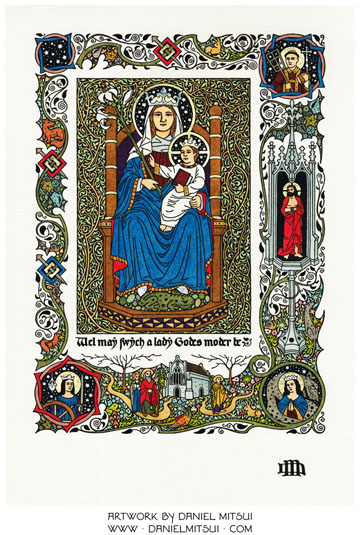
Speaking of Our Lady, Daniel Mitsui has a wonderful rendering:

Posted in ¡Hagan lío!, Just Too Cool, Lighter fare | Tagged ,
10 Comments