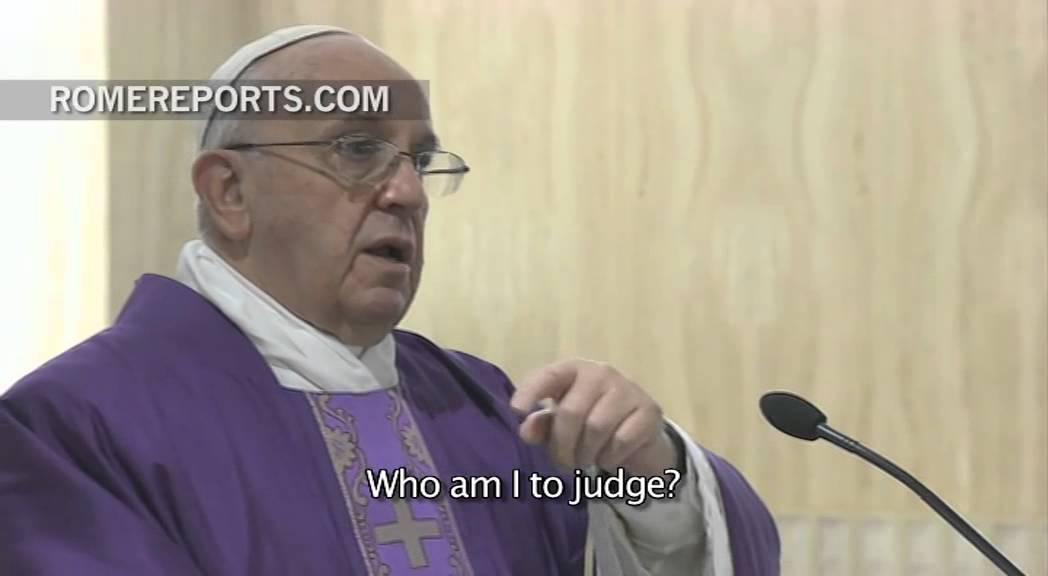
The Pope used again, on 17 March, the phrase “Who am I to judge?” in an informal, off-the-cuff context: his daily fervorino at his private Mass during which he says nothing that forms a part of his Ordinary Magisterium.
At News.va we find an account of the fervorino. Alas, we never get the whole thing. The Holy See newsies cut it up and make a hash of it, so our ability to consider context is somewhat hobbled.
Remember that the first time he used this unfortunate turn of phrase in front of journalists in an off-the-cuff way during an informal chat, all hell broke loose. Hell was loosened, and is still being loosened, as a predictable result because most newsies and 99.9% of the low-information type out there have no notion of what the Pope was talking about. I explain the situation more HERE. Francis wasn’t talking about all homosexuals everywhere, which is want the newsies and the 99% want you to think. The under-informed from politicians to students have claimed the phrase to mean: “Homosexuality is okay!”
That is not what the Pope was saying.
Remember: He referred to our making judgments about people who sin. That is to say, people commit sin X, and it is a sin. We, however, must be careful about how we view them, talk about them, etc. They may have sinned, but they may be trying now to live in a holy way. We should be ready to be merciful.
Let’s jump to the recent fervorino. My emphases and comments.
In his homily at Holy Mass on Monday, 17 March, Pope Francis preached on mercy. Commenting on the day’s readings from the Prophet Daniel (9:4-10) and the Gospel of Luke (6:36-38), the Pope explained that “Jesus’ invitation to mercy is intended to draw us into a deeper imitation of God our Father: be merciful, as your Father is merciful”. However, he added that “it is not easy to understand this willingness to show mercy, because we are accustomed to presenting the bill to others: you’ve done this, now you have to do this”. In short, he said, “we judge, and we fail … to leave space for understanding and mercy”. [NB: Mercy is what we give to people who have done something wrong.]
In order to be merciful, “two attitudes are needed”. The first is “self-knowledge”. The Pope noted that in today’s first reading, Daniel recounts the humble prayer of the people before the God and their acknowledgement that they are sinners: “We have sinned and done wrong, but to thee belongs righteousness, and to us shame”. Reflecting on the passage, the Pope said: “In the presence of a repentant people, God’s justice is transformed into mercy and forgiveness”. [Again: mercy is what the sinner asks. We are sinners. We ask God’s mercy. We are asked to show mercy to sinners.]
This challenges us, he continued, by inviting us “to make room for this same inner attitude”. Therefore, “to become merciful, we must first acknowledge that we have done many things wrong: we are sinners!. We need to know how to say: Lord, I am ashamed of what I have done in life”. [All people should be ashamed of sins. Homosexuals are people. Homosexuals should be ashamed of sins. Homosexual acts are sins. Homosexuals should be ashamed of homosexual acts. We should all be merciful toward the sinner, just as we desire mercy from God and others.]
The Pope continued: “even though none of us has ever killed anyone,” nonetheless “we still have committed many daily sins”. [We are all sinners.] Therefore, “acknowledging that we have sinned against the Lord, and being ashamed in his presence is a grace: the grace of knowing that one is a sinner!”. It is easy, he said, and yet “so very difficult” to say: “I am a sinner and I ashamed of it before you and I ask for your forgiveness”. [This should be the attitude of those who commit sins.]
“Our Father Adam gave us an example of what one should not do,” the Pope added. For he blamed the woman for having eaten the fruit and he justified himself, saying: “I have not sinned; it is she who made me go down this road!”. Eve then does the same thing, blaming the serpent. Yet one should acknowledge one’s sin and one’s need to for God’s forgiveness, the Pope said, and not look for excuses and “load the blame onto others”. Perhaps “someone helped me” to sin, “and opened the road: but I did it!”. [Take responsibility for your sins.]
“If we act in this way,” he explained, “how many good things will follow: we will truly be men!”. [!] Furthermore, “with this attitude of repentance we will be more capable of being merciful, because we will feel God’s mercy for us”. In the Our Father, in fact, we do not only pray: “forgive us our trespasses”. We also pray “forgive us as we forgive those who trespass against us”. [Nothing in here so far about turning a blind eye to sin. Nothing in here so far about saying that something sinful is really okay.]
The second attitude we need is “an openness to expanding our hearts”. The Pope noted that it is precisely “shame and repentance that expands a small, selfish heart, since they give space to God to forgive us”. [Not only shame about sins but also repentance.] What does it mean to open and expand one’s heart? First, it means acknowledging ourselves to be sinners and not looking to what others have done. And from here, the Pope said, the basic question becomes: “Who am I to judge this? Who am I to gossip about this? Who I am, who have done the same things, or worse?”. [The Holy Father is not suggesting that we turn a blind eye to sin. He is saying that we should be careful how we treat people who are sinners. He also is not saying that all people commit all sins. He is not saying that all sins are equal in gravity. He made a distinction at the top, for example. We understand ourselves as sinners and, therefore, we treat other sinners with mercy. It is NOT mercy to say that a sin is not sinful.]
“The Lord says it in the Gospel: “Judge not, and you will not be judged; condemn not and you will not be condemned; forgive and you will be forgiven. Give and it will be given to you; good measure, pressed down, shaken together, running over, will be put into your lap”. This is the “generosity of heart” that the Lord presents through “the image of those going to collect grain who enlarged their aprons in order to received more”. In fact, Pope Francis said, “you can receive far more if you have a big heart!”. And he added: “a big heart doesn’t get entangled in other peoples lives, it doesn’t condemn but forgives and forgets” as “God has forgiven and forgotten my sins”. [I suggest to you that the Pope is not saying that sins should have no consequences. “You did X, but, that’s okay. All is forgiven. Sure you can be a kindergarten teacher.” Obviously the Pope is not saying this about, for example, priests who abuse children. We can forgive, indeed, must forgive priests who do these horrible things. But mercy and forgiveness doesn’t require us to be completely stupid. We don’t forgive the child abuser and then readmit him to ministry in, for example, a parish with a grade school. That is not what Francis means by “forgive and forget”. When God forgives our sins in the Sacrament of Penance, our sins are forgiven, but we still have to make reparation for our forgiven sins.]
He then noted that in order to be merciful we need to call upon the Lord’s help, since “it is a grace”. And we also need to “recognize our sins and be ashamed of them” and forgive and forget the offences of others. [They remain, however, “offenses”.] “Men and women who are merciful have big, big hearts: they always excuse others and think more of their own sins. Were someone to say to them: ‘but do you see what so and so did?’, the respond in mercy saying: ‘but I have enough to be concerned over with all I have done’”. [Again, Pope Francis is not saying that the obviously guilty mass murder is simply to be set free with the cheerful phrase, “Hey! I’m a sinner too. Kill a bunch of people? forgotten. Most of us – think about it – most of need to foster a habit of forgiveness. He is not asking us to become idiots.]
Pope Francis concluded: “If all of us, all peoples, all families, all quarters had this attitude, how much peace there would be in the world, how much peace there would be in our hearts, for mercy brings us peace! [Sure… if all of us were that way. All. But there will be some who are unrepentant sinners that create havoc in society.] Let us always remember: who am I to judge? To be ashamed of oneself and to open and expand one’s heart, may the Lord give us this grace!”. [Again… “Who am I to judge?” is not permission for people to do anything they want. It is not approbation of sinful behavior. The Pope is applying an attitude of mercy to SIN.]
So, here we go again.
And remember: None of this was part of the Holy Father’s Ordinary Magisterium. This was an informal, off-the-cuff fervorino at his private Mass.
Podcast: Play in new window | Download
Subscribe:
 I had this from a reader. He said he was not advocating these things. However, liberals will advocate them.