
You might recall that some time ago I posted a preview of a booklet projected by Angelus Press.
It is now out:
Handbook for Laundering Liturgical Linens.
This is a very useful booklet!
Anyone with a parish or chapel who would like to get people involved in the care of altar linens would be wise to purchase copies of this nicely printed pamphlet for distribution.
As I wrote in my preview: I am highly in favor of anything that will help other people learn how properly to iron purificators, corporals, amices… all that stuff.
That said, I was a little puzzled why on the cover of the pamphlet they seem to have chosen to place the corporal upside down on the altar beneath the chalice.
Here is shot that gives you a sense also of the paper used for the cover, which I think is the clay-treated paper often found in magazines. It picks up your finger prints, but.. so what.

Notice the way the corporal is laid out, with the folds up. The point of a corporal is, in part, to retain particles of the Host within it, when folded up like an envelop. So.. I would have put it the other way.
But this can be easily corrected in a future printing, I imagine.
Here is the page with the instructions for the corporal.
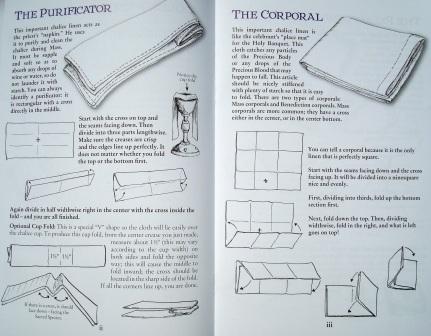
I see in the back, in a "Guidelines and Tips" section, they may have taken a tip from me both from the blog entry and a phone conversation. They included a line or two about priests first washing the linens and putting the water down the sacrarium before sending them off to be worked on. Also, they picked up on the washing bags for amices. There was some good discussing on laundering tips at that preview entry I posted.
Now if I could get someone to do the linens for the Sabine Farm!
So, the pamphlet is short, but packed: 12pp. Softcover, illustrated. $2.95































Isn’t the picture of the corporal on the front of the booklet upside-down? [Pretty observant! o{]:¬) ]
Oh please don’t tell us you wash your own linens? I don’t think your readers could handle anymore shocking news! Many years ago,I washed the
priest’s mother’s kitchen towels. He’s a Pastor now. Dreadful job
Gee,Fr.Z…nobody seems interested in the fascinating topic of proper linen care! Perhaps a spoiled lot…Nothing like the joy of seeing those linens brightened up and the stains miraculously gone! :) Come on wdtprs readers, somebody help Fr.Z out!
I think this booklet will be a good resource, because honestly, they don’t teach priests about things like this in seminary (at least not at the seminary I went to, which was a pretty good one), and so most priests are clueless, and just trust that their sacristans will do things right, whatever “right” is. I have the impression that there are many sacristans who don’t really know what they are doing.
Anyone know of usual/good dimensions for making both corporals and purificators?
My friends at Angelus gave me a booklet a few weeks ago when it first came it. All in all good.
On the Corporal: Ironically enough, if you follow the instructions inside the booklet about folding the corporal for laundering, it would end up facing the correct direction. Apparently the photographer didn’t read the text before taking the photos.
I’ll have to remember to give him a hard time when I see him.
Cheers and here’s wishing you bright white linens, Father.
Does it tell you how to get that glazed starched effect that Italian nuns used to get on a corporal?
Synchronicity, coincidence or the hand of the Holy Spirit! – This very week I have joined the ranks of Parish Ladies who care for Liturgical Linens. What an honour and privilege. I can remember a lot from my very early training, but this booklet will be invaluable. I hope it includes advice on repairs and storage.
Greg – some of us are indeed VERY interested in linen care. It is a VERY interesting subject.
Fr Blake – many years ago when I was at a convent school run by French nuns, we were taught to achieve that \”glazed starch effect\” by adding a solution of very fine sugar to the starch. The same mixture was used by many of the girls in place of hair spray – cheap and very effective. But I would guess that that is one of the things that priests most definitely would not know.
Actually, whilst we are on the subject, may I ask the advice and opinion of any priests reading these comments please?
The best way to preserve the freshness (and moth-free status) of liturgical linens is to store them with a natural herbal scent such as lavender or verbena or lemon salts. Is there any preference about the use of such scents? Good, bad, pleasant, irritating, likely to bring on hay fever? Is this practice even allowed? Or is it one of those things which annoy priests for years but they are always too charitable to mention?
Christabel, I can’t speak for Fr. but I’m pretty sure that
many priests don’t want to smell like lavender. Lemon &
verbena are unisex scents that probably wouldn’t be too
annoying to a man.
My best guess on the cover is that the items were arranged by a photographer (who didn’t read the book and for all we know isn’t even Catholic) who probably felt that folds-up looked better than folds-down. All they care about is getting the best looking shot, stuff like that. The problem actually is that no one in-the-know about such matters caught it before the book went to print (or before the cover went to print, if it is a dust jacket).
So true, christabel! Having worked in an Irish laundry, I know how fascinating it is, especially when the holy sisters would come in. Cleaning linens and the dirty laundry in the Church, both interesting. As always, JESUS is best at this kind of work…His speciality!
Fr. Blake – for the nice glazed starch look…
you have to use the real starch, cook it, soak your linens
in it, hang them up to dry and then iron them..
I learned this in the seminary when I was a student
in the seminary in Polan. I was on vacation and asked the
Sister’s to show me how to wash and iron the altar linens.
They said that this was the first time a seminarian aske
to help and learn how to take care of the altar linens.
Also, if you use red wine and there are red stains on
linens, soak them in soda water….yes, the soda water
for a drink…it takes the stains out. Bleach will just
break down the material…
Good Luck!
Fr. Darrell
Love the snap that a nice piece of linen has when it has the glazed starch look. Where does one get solid powdered starch these days? It’s unavailable at every store I go to localy. If you can even find someone over the age of 50 who actualy knows what it is they usualy tell you they havent sold it in years. The kids who stock the isles in the stores look at you like you have an extra hole in your head when you ask.
Also Christabel mentioned “very fine sugar”. Is this the same as what we call confectioners sugar, or 10x sugar here in the States? What are the proportions for use?
This is not a criticism of what is a laudable project. Still, I do not like the method given for folding the corporal. As Fr. Z. notes about the cover photo, it should and does fold in. But the problem with folding the bottom and top first is that this hides in side the little cross that is sometimes on the bottom center square. Some corporals have the cross in the center, so this does not matter, but when it is in the bottom center square (because that is where the host lies, at least in the Dominican rite), that cross is invisible using this folding system. In fact, it is the most hidden square of the nine on the corporal! That is the one folded in first.
The result is that priests usually open the wrong way (since they cannot see the cross) and have to awkwardly rotate the corporal to get it in the right position.
I would urge the publishers in the future to instruct the washers to fold sides in first then top, then bottom, leaving the cross (underside of course) clearly visible on the top of the folded corporal.
I cannot describe how annoying and distracting it is to find that the unfolded corporal is upside down or sideways. I suspect other priests will second this. Sorry but this is one of my pet peeves.
You can make homemade starch as follows:
Boil 4 cups of water and then add 1/2 cup of flour.
Stir until flour has desolved. Add your altar linens
to the mixture, take out hang up to dry and then get
your iron nice and hot…
Good Luck!
For the sugar option, follow Fr Roman’s recipe but add 1 tablespoon of white caster sugar (i.e finely granulated)which has previously been thoroughly dissolved in a large cup of warm water. This can also be used with traditional pre-prepared starch.
If you use the sugar option, I STRONGLY recommend that you practice first until you get it right. It takes time but the results can be really lovely. Also linens starched with sugar must be kept in a very dry cupboard or draw away from insects (because they just love both sugar and starch).
Incidentally, those of you in the UK may be interested in this most excellent company who provide old-fashioned starch powder : http://www.traditional-starch.co.uk/
I think the corporal folding instructions make sense.
The square where the host rested should be folded in first,
so as to be the most interior and most protected,
to reduce the possibility that unnoticed particles
would end up outside the corporal.
Any other folding order will permit the undesired result.
Dear Father Darrell Roman, how I can connect to you personaly.
Or this is allways impossible, give me answer to mtn@usa.com please.
A few observations:
One must be very careful if starching the corporal to ensure that the starch cannot be scraped off when the Priest collects any stray particles of the Sacred Host by ‘scraping’ the corporal with the paten.
Eft’s comment is spot on. The whole purpose of having a defined method of folding the corporal is to ensure that any particles are securely contained within the ‘package’.
To Fr Thompson – If those laundering the corporals were all taught the correct methd of of folding it there would be no problem as the Priest would always place it on the Altar in such a fashion that the ‘topmost’ fold was on the left hand side. One would then unfold to the left, to the right, to the top and finally to the bottom. If the embroidered cross is in the overall centre rather than at the bottom centre then your proposed method of folding will still not place it in a visible position when the corporal is about to be unfolded.