
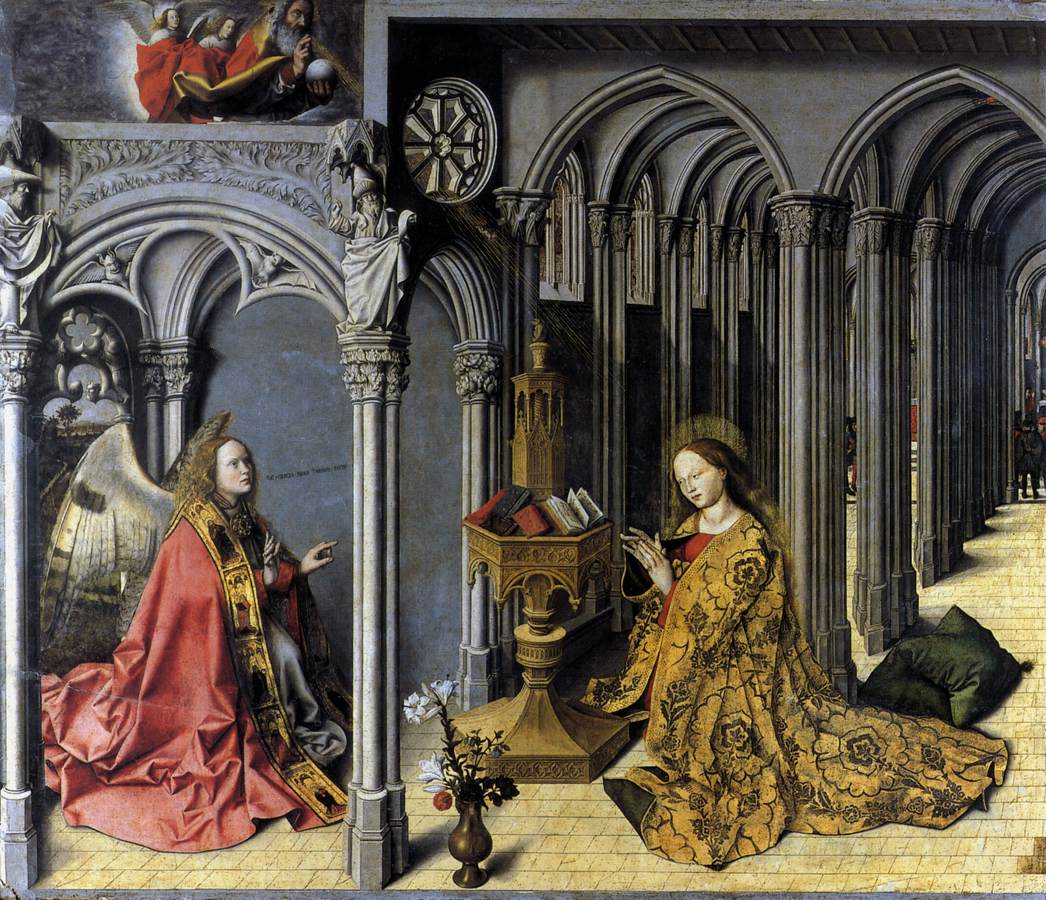
 Today, Ember Wednesday of Advent, those who have the use of the older, traditional Roman Missal, offer worship to God with the so-called Missa aurea, the "Golden Mass".
There is a strong Marian overtone to today’s Mass formulary. The Roman Station for today is St. Mary Major. the Gospel is the Annunciation. The illuminated missals and sacramentary of centuries past presented the Gospel or at least its initial capital letters in gold, when our nickname Missa aurea. And the Gospel pericope begins Missus est angelus Gabriel…. It was once celebrated with a solemnity nearly approaching a feast day. Thus, Missa aurea also refers to little dramas in medieval times in which the Annunciation was acted out. It is thus not just "golden Mass" but "the golden sending", which of course refers to the moment in which Our Lord becomes incarnate in the womb of the Virgin and His work for our salvation begins a new phase. Missa aurea comes to be used in the terminology of art history also for paintings of the Annunciation, which often contain dramatic elements associated with the tableaux struck in the dramatic presentations of the mystery. Doves would be lowered and an old man would be placed in a loft wearing an alb and cope. Angels would come vested in dalmatics. The Arena or Scrovegni Chapel in the 13th c. Giotto’s frescoes echo this tradition as do many paintings of the Annunciation.
The Advent Ember Days were timed to follow St. Lucy’s feast (13 Dec.). St. Lucy was an important saint for our forebears. Her name, derived from the world for "light", is tied to our awareness in the northern climes of the deepening darkness of our December days and that those days will soon be getting longer again. Listen for the urgency within the threefold "command" we are issuing to the Lord (festina… ne tardaveris… impende).
COLLECT:
Festina quaesumus, Domine, ne tardaveris,
et auxilium nobis supernae virtutis impende;
ut adventus tui consolationibus subleventur,
qui in tua pietate confidunt.
This Collect, an ancient prayer found in such manuscripts as the 8th c. Liber sacramentorum Gellonensis, survived the snipping and pasting experts of Fr. Bugnini’s Consilium in a somewhat truncated form, to be prayed on 24 December in the Novus Ordo: Festina, quaesumus, ne tardaveris, Domine Iesu, ut adventus tui consolationibus subleventur, qui in tua pietate confidunt.
That form tardaveris is a perfect subjunctive of tardo, "to tarry, loiter, linger, delay", paired here with ne to form a kind of imperative. That ne tardaveris is found in the Latin version of the Psalms.
Impendo is "to expend, devote, employ, apply". Pietas, when it refers to man has to do with "duty", but when applied to God, it becomes "mercy… pity". Remember that adventus here is a genitive with tui. Sublevo means, basically, "to lift up from beneath, to raise up, hold up, support", but it comes to mean, "to sustain, support, assist, encourage, console any one in misfortune". The perfect way to describe this vale of tears in which we journey.
LITERAL VERSION:
Hurry, we beseech You, O Lord, tarry not,
and expend upon us the help of heavenly power;
that those who rely upon Your mercy
may be sustained by the consolations of Your Coming.
You can feel in this prayer the growing Christian sense of urgency and longing. Advent seems to pick up speed and become more anxious for resolution as we plunge headlong into physical darkness and cold, the reminders of our inevitable appointment with death.
This oration looks simultaneously back to the Nativity of the Eternal Word made man, but also forward to the Second Coming, which gives us consolation. Christians in the state of grace can feel great consolation at the thought of the Coming of the Lord, in history and in the time to come. We need not be afraid when we are in the state of grace. Therefore, the Christian always eagerly says "Come, Lord Jesus. Maranatha. Come."
This prayers rings with consolation.
May the Lord’s coming and promise of return console any of you who are burdened with sorrow. Many people feel at times inconsolable.
This time of year can be a annual trial of despair and sadness for so many who are alone and suffering.
In gratitude for the Lord’s promises, console others.
Think of this as a "golden rule".































I just went through all of my Roman and Roman-Seraphic missals looking for a golden capital, but in vain. It’s true that many people have a hard time at this time of year; stress is high and old griefs are renewed. But I preach to myself–and others–that those are the sorts of hearts in which the Lord wills to be born.
“In gratitude for the Lord’s promises, console others.”
How beautiful this is.
“It is in the giving of ourselves that we receive, in pardoning that we are pardoned, and in dying that we’re born to eternal life.”
I’ve heard that Prayer of St. Francis my whole life, but only very recently has the balance of these themes hit home. Very good expression of Fr. Z’s admonition. Serve.
Thank you, Father!
Can anyone tell me who the painting is by? It is stunning.
Thank you.
That is a famous Annunciation altar piece in Aix-en-Provence.
Can someone tell me specifically ‘what’ is sent (meant) when saying “Ite missa est”?
WE are.
The painting looks like it’s by the van Eyck brothers-very Flemish!
At the risk of rabbit-holing . . .
Rellis, the “Peace Prayer” is much loved but has nothing to do with St. Francis. It was written, probably by a French military chaplain shortly before the First World War and first appeared in the Franch magazine “La Clochette” in 1912. Oddly enough the first time it was ever connected with St. Francis was on Francis (later cardinal) Spellman’s ordination card.