
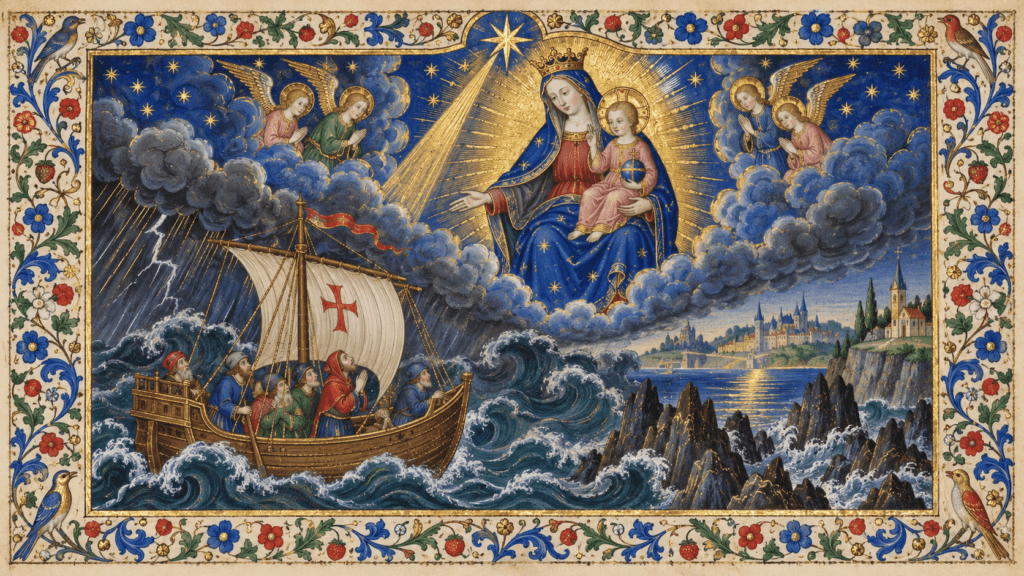
Let’s have a look at the hymn from the Common of Feasts of the Blessed Virgin, Ave Maris Stella.
This hymn has been attributed to Fortunatus and, because of his deepply Marian devotion, St. Bernard. However it is in a 9th c. manuscript. This hymn came into the Roman Breviary without tinkering, one of the few.
Eusebius tried to interpret the name of Mary, Miryam, as coming for the Hebrew for “drop of the sea”. Jerome went with this, and wrote Latin STILLA Maris. But a copyist transcribed it wrong and got STELLA maris. Eventually Isidore in his Etymologies spread this. By the 8th c. we were signing hymns to Mary “Star of the Sea” and waxing eloquent about this poetic image. Bernard of Clairvaux preached (Homilia II super “Missus est,” 17):
“If the winds of temptation arise; if you are driven upon the rocks of tribulation look to the star, call on Mary. If you are tossed upon the waves of pride, of ambition, of envy, of rivalry, look to the star, call on Mary. Should anger, or avarice, or fleshly desire violently assail the frail vessel of your soul, look at the star, call upon Mary. If you have fallen victim to some heinous crime, if you are overwhelmed by the reproaches of an evil conscience, if you fear being engulfed in the whirlpool of doubt or an abyss of sorrows, think of Mary, call upon Mary.”
The lines in the 7 short stanzas are in trochaic dimeter brachycatalectic, a six-syllable line composed of three falling, stressed–unstressed beats. We are using word stress not length of syllables at this point. We can break down the meter. A trochee is a metrical foot consisting of a stressed syllable followed by an unstressed syllable: DUM-da. Dimeter means the line contains two metrical units or metra. In trochaic verse, each complete metron normally contains two trochees. A full trochaic dimeter would therefore have four trochaic feet, or eight syllables: DUM-da | DUM-da || DUM-da | DUM-da. However, this is brachycatalectic or “shortened at the end.” The final metron is reduced, leaving three trochees, hence six syllables: DUM-da | DUM-da | DUM-da.
The opening of Ave Maris Stella illustrates the pattern:
Áve | máris | stélla
Déi | Máter | álma
átque | sémper | Vírgo
félix | cáeli | pórta
Each line has six syllables arranged, broadly speaking, as three falling rhythmic feet. Thus:
Á-ve | má-ris | stél-la
stressed–unstressed | stressed–unstressed | stressed–unstressed
There is a rocking quality to it, much as Mary might rock her spiritual children, and we might be rocked with her on the high sea of life.
| LATIN | ENGLISH | COMMENTS |
| Ave maris stella, Dei Mater alma, Atque semper Virgo, Felix cæli porta. | Hail, star of the sea, loving Mother of God, and ever Virgin, happy gate of heaven. | Four titles! A porta is a door, but this recalls portus, harbor. Mary steers us to the “port/portal” because she is the “port/portal” by which the Savior came. |
| Sumens illud Ave Gabriélis ore, Funda nos in pace, Mutans Hevæ nomen. | Taking that Hail from Gabriel’s mouth, cast us in peace, changing Eve’s name. | There is a play on the words “Ave” and “Eva”. Mary is the second more successful Eve. |
| Solve vincla reis, Profer lumen cæcis, Mala nostra pelle, Bona cuncta posce. | Break the bonds of sinners, bring light to the blind, drive away our ills ask for all good things. | Petitions. |
| Monstra te esse matrem, Sumat per te preces, Qui pro nobis natus, Tulit esse tuus. | Show yourself a mother, let He who, born for us, who chose to be your Son receive prayers through you. | Petitions are answered by her divine motherhood, as Mother of God, like the Davidic Queen by the throne of her Son. |
| Virgo singuláris, Inter omnes mitis, Nos culpis solútos Mites fac et castos. | Virgin unequaled, meekest among all, make us freed from guilt, meek and chaste. | Purity is ultimately necessary for access to the Beatific Vision. |
| Vitam præsta puram, Iter para tutum, Ut vidéntes Iesum, Semper collætémur. | Grant us a pure life, prepare a safe journey, that, seeing Jesus, We may always rejoice. | |
| Sit laus Deo Patri, Summo Christo decus, Spirítui Sancto, Tribus honor unus. Amen. | Praise to God the Father, glory to Christ the Highest, and to the Holy Spirit, one honor to all Three. Amen. |



 Chris Garton-Zavesky on Your Sunday Sermon Notes – 15th Sunday after Pentecost (N.O.: 23rd Ordinary): “Every little thing we do to save souls matters. The widow of Naim was weeping over her son, and God…”




























