In response to Phyllis Zagano on the matter of female deacons

fishwrapOur old pal Phyllis Zagano has a fresh column at the Fishwrap (aka National Schismatic Reporter).  How’s this for a captatio benevolentiae?

Pope Francis named just one woman from the Western Hemisphere to his commission on women deacons.

That would be me.

No, really.  That’s how she begins.

Ain’t she sumpin’?  

Phyllis of the West!

Along the way she casts aspersions on Joseph Card. Ratzinger, insinuating, that as Prefect of the CDF, he buried evidence of an early commission’s study of the question of female deacons (aka deaconettes). She then attacks my sacred person, accusing me criticizing the Pope and the commission (which I haven’t done) and, I am not making this up, “fomenting insurrection, if not schism” (which is at least absurd and maybe defamatory, as even my lawyer knows).

The thick-dripping irony will be lost on no one: this comes from a writer for the Fishwrap, which does little else but foment insurrection, dissent and even schism!

Let’s set her petty ad hominem attacks aside (and I do mean petty and I do mean ad hominem).  The hubris with which she begins carries into the rest of her piece.

She wrote (my emphases and comments):

By 2002, a new International Theological Commission committee, [a “Commission committee”!] headed by a former graduate student of Ratzinger, completed a study document concluding that “the ministry of discernment, which the Lord left his Church” should decide the question of women deacons.

Later on she adds:

Now, in 2016, the ministry of discernment about women in the diaconate has been handed over to twelve scholars under the presidency of another scholar, a Jesuit professor of dogmatic theology who is also the doctrinal congregation’s secretary. And so the commission will meet, discern, and one hopes, decide on a recommendation.

Outside the commission meetings, the larger ministry of discernment is already moving along.

She what she did there?  “Handed over to twelve”!  Under a Jesuit!  It’s like … like …the College of Apostles around the Lord again.  Glorioski!

More seriously, you, alert, will have observed how she muddles “ministry of discernment”.

First, she claims that the “ministry of discernment” is to be exercised by this commission.  Wrong.  Then, she speaks of a “larger ministry of discernment”.   This will not surprise you, since it comes from a writer for the National Schismatic Reporter (aka Fishwrap).  Fishwrap’s writers consistently split the Church into “official” and “spirit filled”, that is, the mean old patriarchal hierarchy v. the mass of the enlightened who, via a sort of gnosticism, discern for themselves whatever the Sam Hill they want.  The gnostic mass is placed, by Fishwrap, above the magisterium of the Pope and the bishops in union with him.

In the ITC document, on the other hand, “ministry of discernment”, is another way of talking about the power of the keys and about the magisterium.

When Phyllis of the West introduces the “larger ministry of discernment”, that’s where she attacks my sacred person as one of the “usual suspects”.  But then she goes on to say:

[I]t is important for the church — the whole church — to think and pray about women deacons.

First, quod gratis asseritur, gratis negatur.  I don’t see how it is important that the “whole church to pray about women deacons”.

The new commission about women deacons was not formed to apply the power of the keys or replace the magisterium.  That is not a “mandate”, in the proper sense.  That’s a task.  That is not a “ministry”, in the proper sense.  That’s a project.

At the conclusion of the 2002 ITC document, whence the quote about discernment was pulled, we read.

With regard to the ordination of women to the diaconate, it should be noted that two important indications emerge from what has been said up to this point:

1. The deaconesses mentioned in the tradition of the ancient Church – as evidenced by the rite of institution and the functions they exercised – were not purely and simply equivalent to the deacons;

2. [NB] The unity of the sacrament of Holy Orders, in the clear distinction between the ministries of the bishop and the priests on the one hand and the diaconal ministry on the other, is strongly underlined by ecclesial tradition, especially in the teaching of the Magisterium.

In the light of these elements which have been set out in the present historico-theological research document, it pertains to the ministry of discernment which the Lord established in his Church to pronounce authoritatively on this question.

That’s what the ITC wrote in 2002.  And to these two points, please see Sr. Sara Butler in First Things today. Sister is a serious scholar and she has written on the topic of deaconesses before.  She should have been appointed to this study group.

Finally, back to Zagano for one more item.  We began with her captatio benevolentiae.  It is only fitting to end with her peroratio.

I cannot tell you how things will be resolved, or when. I can only say that it appears Pope Francis will make a decision. I genuinely believe his decision, whatever it is, will be the right one.

I suspect that she is going to have to eat those words one day.   Which day that is, only time will tell.  Don’t hold your breath.  As a clearly irritated Pope Francis responded during the presser on the way back from Armenia:

There is a president in Argentina who advised presidents of other countries: “When you want something not to be resolved, make a commission.”


Posted in Deaconettes, Liberals, The Drill | Tagged , , , ,
26 Comments

New books by St. Robert Bellarmine, Doctor of the Church, now in English

Lately I received notice of, and a concrete copy of, newly released English translations of works by the great Doctor of the Church St. Robert Bellarmine (+1621).

St. Robert was a Jesuit (a good one), a Cardinal, theology and profession and rector at the Roman College, archbishop of Capua, He was a major figure in the implementation of the Council of Trent and in the Counter-Reformation. He also took a major role in the matters of Giordano Bruno and Galileo Galilei.  He was a splendid teacher in difficult times who refuted errors much like those we see cropping up in the Church today.

He was a prolific writer, but a great deal of his work has not yet been translated into English. Lately, there have been good efforts to do just that. One of those efforts has left me a bit in awe.

First, behold Controversies of the Christian Faith translated by the erst-while of Homiletic and Pastoral Review Fr. Kenneth Baker, SJ.  US HERE – UK [didn’t find it yet]

It’s hardcover only, I believe.  But… look at the size of this thing!

The pages, from fairly subtle paper, are jammed with text.

“But Father! But Father!”, you terrified liberals are quaking, “Ho… ho… how long is this book?!?  How many pages of so-called ‘sound teaching’ are there?  If you are happy about this book, it must be rigid and ossified and … and… AGAINST VATICAN II!  JUST LIKE YOU!”

To which I respond: Tremble, heretics, women’s ordination fans, and Fishwrap schismatics.

Seriously, I am in awe of the discipline it took to translate this opus magnum.

It begins with a Forward and a brief life of the saint.  Fr. Baker says that he did it in a year.  Holy cow.

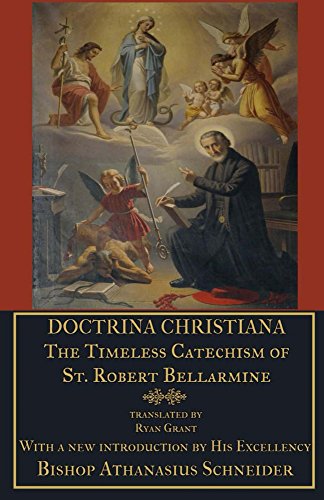
Next, available also on Kindle (don’t have a Kindle yet? US HERE – UK HERE), Doctrina Christiana: The Timeless Catechism of St. Robert Bellarmine translated by Ryan Grant with an introduction by the great Bp. Athanasius Schneider. US HERE – UK HERE

A while back I posted an entry with suggestions for different catechisms.  I think this should be on the list.  This takes the form of a dialogue, rather than simply prose explications of bullet points.

In the forward we read:

In our time of an enormous and general confusion in matters of Catholic faith we do need urgently a crystal-clear, absolute reliable and at the same time simple catechetical text. Such a text represents the famous catechism of St. Robert Bellarmine, which notwithstanding being written 400 years ago, remains nevertheless up to date. This catechism had until the 20th century about 400 editions and has been translated into 60 languages. It was a favorite catechetical tool for the missionaries in the past centuries.

The countries of the so-called Western civilization became today almost neopagan societies and there are even people who named themselves Catholics but are living like pagans. It is therefore obvious that we are living in a missionary. Both inside and outside the church.

The translator adds these interesting notes, which make reference to the first work by Bellarmine with which I started this entry, above:

St. Robert Bellarmine composed two catechisms under the title of Doctrina Christiana(Christian Doctrine), one called his “Small Catechism” which he had written for children and simple souls. This second one, written as a dialogue, called his “Long Catechism,” was intended for teachers and for the well instructed to deepen their understanding of the truths of the faith. The Shorter Catechism was translated in 1614, but the Long, at least to our knowledge, had never been rendered into English until now.

The translation was made from the Latin edition published in Prague in 1732. It seemed to be the most accurate, and it was compiled and edited into a text version book by Anton Repko, whom I especially thank as many of the copies available in electronic form have defects, missing pages etc. Still, as sometimes the Latin edition used complicated phrases from 16th century vernacular Latin that simply would not render into English well, it was necessary to consult Bellarmine’s original Italian to simplify.

This Catechism was written at the express command of Pope Clement VIII, and approved by him in 1598. It quickly became more popular than the Saint’s Controversies, which he is principally known for today. It was also specifically approved by Pope Benedict XIV, and its importance was so great that Pius XI, in his bull of canonization for the Saint, declared of this Catechism:

“Nor may we pass over in silence his sacred sermons and also his catechetical works, especially that catechism, which the use of the ages as well as the judgment of a great many bishops and doctors of the church has approved. Indeed, in that same catechism, composed at the command of Clement eight, the illustrious holy theologian expounded for the use of the Christian people and especially of children, the Catholic truth in a plain style, so brilliantly, exactly and orderly that for nearly three centuries in many regions of Europe and the world, it most fruitfully provided the fodder of Christian doctrine to the faithful.”

In his introduction, the great Bp. Schneider penned, and we cannot but agree:

The corruption of morals and depravity of life is already so great, and ever increasingly greater, not only among uncivilized peoples but even in those very nations that are called Christian. The Apostle Paul, writing to the Ephesians, repeatedly admonished them in these words: “But immorality and every uncleanness or covetousness, let it not even be named among you, as become saints; or obscenity or foolish talk” (Eph. 5:34). He also places the foundation of holiness and sound morals upon a knowledge of divine things—which holds in check evil desires: “See to it therefore, brethren, that you walk with care: not as unwise but as wise. . . Therefore, do not become foolish, but understand what the will of the Lord is” (Eph. 5:15-16).” (Encyclical Acerbo nimis from April 15, 1905).

A good and solid knowledge of the Catholic faith has as its aim a virtuous life through which alone with the help of God’s grace one can achieve eternal salvation. Saint Pius X teaches therefore: “Christian teaching not only bestows on the intellect the light by which attains truth, but from it our will draws that ardor by which we are raised up to God and joined with Him in the practice of virtue” (Encyclical Acerbo nimis from April 15, 1905).

The true knowledge of the Catholic faith fills the human mind with a light and this light, in spite of being sometimes obfuscated by a bad will, is usually the effective means of salvation.

The content of our Catholic Faith is not just words and formulae to be memorized.  The true, interior content of the Faith is a Person, the divine Person of the Eternal Word made Flesh, Christ Jesus.  We can have a relationship with a Person.  Coming to know the Faith leads to knowledge of Christ and, in turn, hope and love.  Furthermore, as the bishop pointed out, even if one loses love, that is charity, and loses hope, faith remains long after.  That faith can help to bring you back to hope and to charity.

I am delighted that these good resources are being made available.  Perhaps some of their clearly counter-reformation spirit can be spread through their acquisition and use.

Posted in "How To..." - Practical Notes, New Evangelization, REVIEWS, The Campus Telephone Pole | Tagged
8 Comments

FATHERS! Research about preaching – ACTION ITEM

action-item-buttonI am not eager to do many posts like this, but here is an exception.  This interests me because of the state of preaching in these USA.
I received an email from a reader…

+ Hello, Father!

My name is Jenni Sigler and I’m a doctoral candidate in communication at Purdue University. I’m also a daily Mass-going Catholic, so for my dissertation, I’m interviewing priests about their preaching work. In particular, I’m interested in how busy priests balance all they have to do with “waiting on the Holy Spirit” in preaching. There’s very little empirical research on Catholic preaching at present, and my own past research has indicated this particular question is an important one. So the goal of the study is to add to what we know about how priests do preaching work, and hopefully find out some things that could help make that work easier, faster, and better.

If you’re a diocesan priest working in a parish in the United States, I’d love for you to participate in this study. Interviews will last about an hour and can be scheduled whenever they’re convenient for you and conducted via Skype. To get an accurate picture of what I’m studying, it’s important that I talk to priests from many different dioceses and seminary backgrounds, so please don’t hesitate to get in touch even if you’re in Alaska. And international priests: If you’re working in the United States, I’d like to hear from you, too!

If you’re interested in participating, or want to find out more before committing, feel free to contact me at jsigler@purdue.edu or (765) 441-2136 (texting okay). Or contact my advisor Patrice Buzzanell (technically, the lead researcher on this project, since I’m still a graduate student) at buzzanel@purdue.edu.

Thanks, and God bless you, Father!

The combox is closed.


Posted in New Evangelization, Priests and Priesthood, The Campus Telephone Pole | Tagged , , ,
Comments Off on FATHERS! Research about preaching – ACTION ITEM

D. Peoria: 24 Aug – Requiem for 1st Bishop

Here is some great news via Badger Catholic:

Peoria IL Cathedral to celebrate beautiful new renovation with TLM August 24th

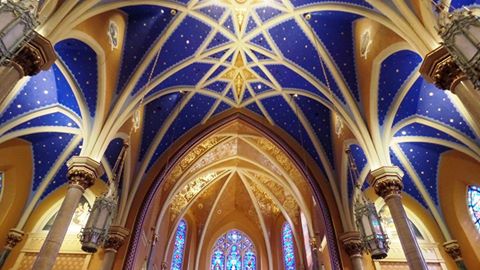
The beautiful restoration work is nearly complete at St Mary’s Cathedral in Peoria, IL (photos on their Facebook). To celebrate the completion of this work and in honor of the 100th anniversary of the death of the first bishop of the Diocese of Peoria, two special Masses are schedule:

1) On Wednesday, August 24 at 7:15pm a Solemn Requiem qMass will be offered in the Extraordinary Form of the Roman Rite at the Cathedral in commemoration of the 100th Anniversary of the Death of Archbishop Spalding

2) On Thursday, August 25 at 1pm a Solemn Mass of Founder’s Day will be celebrated by Bishop Daniel Jenky in the Cathedral.

Details can be found HERE

Beautiful.

I can’t tell from this whether or not this is a Pontifical Requiem, to be celebrated by Bishop Jenky.  I hope so.

Posted in Liturgy Science Theatre 3000, SUMMORUM PONTIFICUM | Tagged
4 Comments

A major step forward in relations with the SSPX? I hope so.

One of the most significant points of conflict between the SSPX and the Holy See has been the issue of the document of Vatican II Nostra aetate, the Declaration on the Relation of the Church with Non-Christian Religions.

Over the years, I’ve said that this document, as well as the document on religious liberty Dignitatis humanae, shouldn’t have to be an obstacle.  Of course, ecumenism and religious liberty are intimately intertwined.

The issue of religious liberty and ecumenism is difficult and susceptible of many Catholic approaches and views.  It should be acceptable to disagree about various aspects of religious liberty.  I am reminded of the case of Fr. Leonard Feeney, SJ, who took a hard-line position about the truth of the Catholic doctrine, “extra Ecclesiam nulla salus … outside the Church there is no salvation”.  After significant conflict with ecclesial authority, he was censured with an excommunication. Later, he was reconciled and he did not have to abure his hard-line position.

The situations of the SSPX and Fr. Feeney are not strictly parallel, but the example of the later serves to illustrate that Catholics, rather well-informed theologians, can have differing positions about difficult points of doctrine, so long as they do not dissent in a scandalous way from dogma.

There should be some flexibility when an issue is really hard, as the issue of religious liberty is.   Do people have a natural right to pursue error, or is this only a civil right?  Are there really paths to salvation outside the Church?  Does what the Second Vatican Council resolve these questions definitively?

We now see at LifeSite that an ice layer has broken in the jam at the Holy See regarding Nostra aetate.

One particular Council document with which the SSPX takes issue is Nostra Aetate (“In Our Time”), a declaration on the Church’s relationship with other religions. Some interpret it as inconsistent with or at the very least muddying the Catholic Church’s teaching that it alone is the one true religion.

Pozzo said Nostra Aetate is not dogmatic and therefore no Catholic is bound to accept it as such.

Nostra Aetate does not have any dogmatic authority, and thus one cannot demand from anyone to recognize this declaration as being dogmatic,” Pozzo said. “This declaration can only be understood in the light of tradition and of the continuous Magisterium. For example, there exists today, unfortunately, the view — contrary to the Catholic Faith — that there is a salvific path independent of Christ and His Church. That has also been officially confirmed last of all by the Congregation for the Faith itself in its declaration, Dominus Iesus. Therefore, any interpretation of Nostra Aetate which goes into this [erroneous] direction is fully unfounded and has to be rejected.”

Also, Fr. John Hunwicke cites Archbp. Pozzo, the Secretary of the Pontifical Commission “Ecclesia Dei” (my old office) which handles relations with the SSPX.   Fr. Hunwicke also relates what the LifeSite piece contained, but includes Archbp. Pozzo’s preamble about something that happened during the Second Vatican Council, specifically about Nostra aetate (my emphases):

“The Secretary for the Unity of Christians said on 18 November 1964 in the Council Hall about Nostra aetate ‘As to the character of the declaration, [PAY ATTENTION] the Secretariate does not want to write a dogmatic declaration on non-Christian religions, but, rather, practical and pastoral norms’. [We are free to disagree with “pastoral norms”.] Nostra aetate does not have any dogmatic authority and thus one cannot demand from anyone to recognise this declaration as dogmatic. This declaration can only be understood in the light of tradition and of the continuous Magisterium. For example, there exists today, unfortunately, the view – contrary to the Catholic Faith – that there is a salvific path independent of Christ and His Church. That [he apparently means “The unfortunate existence today of such an unCatholic view”] has also been officially confirmed last of all by the Congregation for the Doctrine of the Faith itself in its declaration Dominus Iesus. Therefore any interpretation of Nostra aetate which goes into this direction is fully unfounded and has to be rejected”.

It is not disobedience to desire clarifications about really hard questions that result from documents that are fraught with controversial points and that are not dogmatic.

I hope this signals a major step forward in relations with the SSPX.

The moderation queue is ON.

Posted in Religious Liberty, SSPX, The Drill | Tagged , , ,
27 Comments

Olympics Day 4-5: Fired Up

Last night, having avoided all Olympic news during the day, I summoned from the genie cave of my DVR the videos of the events.   I watched, of course, Michael Phelps and Katie Ledecky win gold medals.  He was pretty fired up after the 200m butterfly.

16_08_10_Rio_16

I also watched the gymnastics gals from these USA crush the opposition.

Today I’ve enjoyed a little Rugby, which I’m still working on grasping.  There are a few fine points of turn overs that I don’t quite get.

I also saw the nail biting defeat of the US men’s team by Italy in Volleyball.

16_08_10_Rio_15

There was more women’s sabre today.  The field is getting culled.

16_08_10_Rio_12

16_08_10_Rio_13

The really interesting winner today was Fehaid Al-Deehani of the Independent Olympic Athletes team “refugees” who marched in under the Olympic flag.  6th time in the Olympics for him.  He is an officer in the Kuwaiti military.  Kuwait was suspended from the Olympics for some reason.  He refused to carry the Olympic flag, because he is an officer.  He picked up shooting from his sister, who was a world-level competitor.  My experience is that women are often better shots than men, depending on the type of shooting.  They can keep very still and they often don’t have the same sort of ego in it.

16_08_10_Rio_10

He bested Italy’s Marco Innocenti in the double trap final to win the first gold medal for the IOC team.   The double trap shooting is incredibly fast.  I’ve done some trap and it’s tough enough with one, but two so quickly is amazing.

16_08_10_Rio_11


Posted in SESSIUNCULA | Tagged
7 Comments

Your Good News

Do you have good news to share with the readership?

Let us know.

For my part, I addressed seminarians of the diocese this morning.  They spend a week plus each summer together and with the bishop.  In the past, as this summer, you readers have supplied them with books and birettas.  Thanks!

The vocation direction was asked me to talk about priesthood and Eucharist.  I spoke about the priest as pardoned sinner and as simultaneously priest, who offers sacrifice, and victim who is sacrificed.

Then, for lunch, we had food from Chick-fil-a!

It was a good morning.

Posted in SESSIUNCULA |
17 Comments

LESBIANS! UNITE AGAINST OPPRESSION!

This entry has a convoluted origin, but here goes…

I saw a story at Stream about a lesbian couple who are suing New Jersey, which is oppressing them.  Get this…

Erin and Marianne Krupa, a lesbian couple struggling to get pregnant due to infertility, [first of all… a “couple” getting pregnant is goofy, but a couple of women?] are suing the commissioner of the New Jersey Department of Banking and Insurance, reportsThe New York Times. The couple’s lawsuit alleges the healthcare mandate is discriminating against their sexual orientation.  [They want to have the fertility treatments paid for by someone else.]

Erin, the one who is going to carry the child, was determined to be infertile after a doctor diagnosed her with benign cysts on her uterus and Stage 3 endometriosis. The couple’s healthcare provider, Horizon Blue Cross Shield, said that it would not provide coverage for Erin’s fertility treatments. They referred to a state insurance mandate that said that most women under 35 have to prove they are infertile by having unprotected sex for two years.  [The State of NJ is oppressing them!]

The couple, along with two other women, are suing the commissioner because they say the mandate is discriminating against them.

In the lawsuit, the plaintiffs claim that because the Supreme Court ruled in Obergefell v. Hodges[abomination] that the 14th Amendment guaranteed same-sex couples the right to marry, [wait for it…] it also protects their right to reproduce.  [They have a RIGHT!]

[…]

In the lawsuit, the plaintiffs ask for damages associated with having to pay for their own fertility treatments

Obergefell v. Hodges, ladies and gentlemen… and other or … both.  The gift that keeps on giving.

I saw that Rod Dreher also wrote about this sob-provoking, state oppression of poor infertile lesbians.  HERE

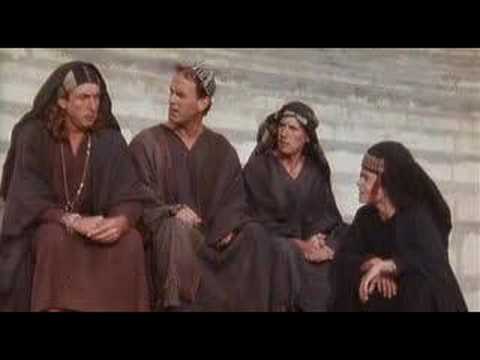
Then someone in my email inbox reminded me of this, from the really funny (but sometimes blasphemous) Monty Python movie Life of Brian. Stan wants to be a women!  Transcript below if you have a hard time getting it all.

YouTube thumbnailYouTube icon

JUDITH: I do feel, Reg, that any Anti-Imperialist group like ours must reflect such a divergence of interests within its power-base.
REG: Agreed. Francis?
FRANCIS: Yeah. I think Judith’s point of view is very valid, Reg, provided the Movement never forgets that it is the inalienable right of every man–
STAN: Or woman.
FRANCIS: Or woman… to rid himself–
STAN: Or herself.
FRANCIS: Or herself.
REG: Agreed.
FRANCIS: Thank you, brother.
STAN: Or sister.
FRANCIS: Or sister. Where was I?
REG: I think you’d finished.
FRANCIS: Oh. Right.
REG: Furthermore, it is the birthright of every man–
STAN: Or woman.
REG: Why don’t you shut up about women, Stan. You’re putting us off.
STAN: Women have a perfect right to play a part in our movement, Reg.
FRANCIS: Why are you always on about women, Stan?
STAN: I want to be one.
REG: What?
STAN: I want to be a woman. From now on, I want you all to call me ‘Loretta’.
REG: What?!
LORETTA: It’s my right as a man.
JUDITH: Well, why do you want to be Loretta, Stan?
LORETTA: I want to have babies.
REG: You want to have babies?!
LORETTA: It’s every man’s right to have babies if he wants them.
REG: But… you can’t have babies.
LORETTA: Don’t you oppress me.
REG: I’m not oppressing you, Stan. You haven’t got a womb! Where’s the foetus going to gestate?! You going to keep it in a box?!
LORETTA: crying
JUDITH: Here! I– I’ve got an idea. Suppose you agree that he can’t actually have babies, not having a womb, which is nobody’s fault, not even the Romans’, but that he can have the right to have babies.
FRANCIS: Good idea, Judith. We shall fight the oppressors for your right to have babies, brother. Sister. Sorry.
REG: What’s the point?
FRANCIS: What?
REG: What’s the point of fighting for his right to have babies when he can’t have babies?!
FRANCIS: It is symbolic of our struggle against oppression.
REG: Symbolic of his struggle against reality.

Posted in Pò sì jiù, Sin That Cries To Heaven, The Coming Storm, The future and our choices, Throwing a Nutty, You must be joking! | Tagged ,
33 Comments

Why Fr. Z harasses you to GO TO CONFESSION!

You are going along… doodee doodee dooo… and you glimpse something in the corner of y-

BAM!

Watch to the end.  It is short.

YouTube thumbnailYouTube icon

These people had a close call.  It could have gone otherwise.

Friends, examine your consciences daily and go to confession regularly.

We are going to get God’s justice whether we want it or not.  But, while we are still alive, His mercy is for the asking.

You do not know at what moment you may be called by the Lord, the Just Judge, the King of Fearful Majesty, to account for your life.

Posted in GO TO CONFESSION, Linking Back | Tagged ,
11 Comments

Desecrated church reconcilied in Missouri

There are sacred places, things and persons.  Mistreatment of a sacred place, thing or person is the sin of sacrilege.

By blessings and consecrations, places, things and persons are taken from the secular, temporal, profane realm and given to the sacred.

Sometimes sacred places, such as churches or cemeteries, are mistreated to the point of being desecrated.   These churches must then be put back into sacred order before they can be used again.  As we read in the Code of Canon Law for the Latin Church:

Can. 1211 Sacred places are violated by gravely injurious actions done in them with scandal to the faithful, actions which, in the judgment of the local ordinary, are so grave and contrary to the holiness of the place that it is not permitted to carry on worship in them until the damage is repaired by a penitential rite according to the norm of the liturgical books.

In the older, traditional way of doing things, a church or cemetery could be “reconciled” after profanation by a bishop or a priest with (at least) presumed permission.  You can see the traditional rite HERE.  I especially like this prayer:

Almighty and merciful God, who conferred on your priests above all others this great grace, that whatever they do worthily and exactly in your name, is regarded as being done by you; we pray that in your kindness you may be present wherever we are present and may bless + whatever we bless. And at our lowly coming, through the merits of your saints, may demons flee and the angel of peace be at hand; through Christ our Lord.



I just read a story of the “reconciliation” of a desecrated church in Missouri.  HERE  The Bishop of Jefferson City, Most Rev. John R. Gaydos, carried out the rite.

“Christ restored completely what Satan had taken from us,” Fr. Peckman, pastor of St. Clement Parish, said. “It was as if the sun was breaking over the horizon to let us know that the Light of Christ conquers the darkest sorrow the devil can inflict.”

The Devil hates sacred places, things and persons.  His agents will attack them constantly.

Posted in "How To..." - Practical Notes, Liturgy Science Theatre 3000 | Tagged , ,
9 Comments