ASK FATHER: Is it a sin to laugh or joke when in need of confession?

penance_confession_stepsFrom a reader…

QUAERITUR:

Is it grave matter to laugh or joke when in need of Confession? (That is, when one has committed mortal sin and intends to go to Confession at the next opportunity.)

Aristotle points out that man is the only animal that laughs.  Critters might look like they are “laughing”, but they aren’t.  So, it’s human to laugh.

Mark Twain points out that man is the only animal that blushes… or needs to.  Hence, because we are sinners, it’s human to blush.

It doesn’t help us to mope around all long-face before confession, though we should indeed pray that we feel remorse and shame and guilt for sins, true compunction, so that we might even blush, at least when alone or when making amends to others.

Latin compunctio is a compound of cum + punctum from pungo, “to pierce, prick”. It means “the sting of remorse”.

Non-stop levity isn’t perhaps your best option in the state of sin.  Neither is relentless melancholy.

So, before making your good confession be penitentially joyful, or joyfully penitent. Be, at the same time, cheerfully remorseful, or remorsefully cheerful.

If, while in the state of that separation from God which we call mortal sin, we truly meditate on our state, we will get to confession as quickly as possible. Right away we should make the very best act of contrition which we can summon. Then we should hie ourselves hence.

Simultaneously, we can be of good cheer because we know that God loves us, that He is already giving us graces to make our good confession, and that, shortly, we shall be shriven.

There is nothing happy about sins, but confession and reconciliation are everything to be happy about.


From the Mass for begging for compunction of heart in the 1962 Missale Romanum:

Omnipotens et mitissime Deus, qui sitienti populo fontem viventis aquae de petra produxisti: educ de cordis nostri duritia lacrimas compunctionis; ut peccata nostra plangere valeamus, remissionemque eorum, te miserante, mereamur accipere. Per Dominum.

Almighty and most gentle God, who, when Thy people were parched, from out the rock drew forth living water, draw now forth tears of remorse from out the stone-hardness of our hearts, so that we may bewail our sins and, as you show mercy, merit to receive their forgiveness. Through our Lord Jesus Christ, your Son, who lives and reigns with Thee in the unity of the Holy Spirit, ever one God, world without end. Amen.

Finally…

GO TO CONFESSION!

Posted in "How To..." - Practical Notes, ASK FATHER Question Box, GO TO CONFESSION, Liturgy Science Theatre 3000 | Tagged , , , ,
5 Comments

Why are certain people afraid of “ad orientem” worship?

holy-sacrifice-of-the-mass-freeing-souls-from-purgatoryAd orientem worship in the Latin Rite is important just just because, practically, it helps to keep priests and bishops under control (i.e., Mass isn’t about them), it helps to create the necessary conditions for the apophatic experiences which facilitate an encounter with Mystery.  This encounter prepares us for the Four Last Things, death, judgment, heaven and hell.  We all face towards the symbolic liturgical East, because Christians perennially believed that Christ will return from the East, like the glory of the rising sun.   The “eastward” arrangement, priest and people together, for the Eucharistic, sacrificial portion of Holy Mass, has eschatological force.  Rather than being locked into a closed circle among ourselves, we are more manifestly opened to the Lord who is to come.  Not only are we oriented toward the Lord who will come, but ad orientem worship also orients us back through the ranks and ranks of our forebears who worshiped in the same way for the same reasons.  As we hope to connect with the Lord is His splendor, we hope to rejoin our predecessors in their joy.

First Things has made another contribution to the discussion of ad orientem worship, set in motion by the personal appeal made to priests by His Eminence Robert Card. Sarah – The Sarah Appeal™.

Let’s jump in toward the end…

WHO’S AFRAID OF AD ORIENTEM?

[…]

The real issue, I believe, is not restorationism (which, ironically, was one of the mistaken reasons for the introduction of versus populum in the mid-twentieth century) or clericalism (this layman finds his Christian dignity and equality affirmed by ad orientem worship, which makes visible the solidarity of clergy and congregation, as well as the self-effacement of ordained ministers before the Lord). The real issue is much deeper: the Church’s identity in time and eternity. That identity touches on history, Vatican II and its reception, ecclesiology, and eschatology.

[…]

Finally, ad orientem worship raises the issue of the Church’s relationship to its past, present, and future, to its identity across time. Despite Vatican II’s conviction that believers’ commitments as citizens of both the heavenly and earthly cities ought to be mutually reinforcing (e.g., Gaudium et spes, No. 43), we have witnessed a diminishment of the Church’s eschatological awareness. A minor, but telling, example is the title of Chapter VII of Lumen gentium. The Flannery translation, the most commonly used, renders that title as “The Pilgrim Church.” The Vatican website’s translation renders it, more faithfully, as “The Eschatological Nature of the Pilgrim Church and Its Union with the Church in Heaven.” The rejection or marginalization of ad orientem worship feeds this “presentism” and the concomitant eschatological deficit. I am convinced that a significant reason for opposition to ad orientem worship is the sense that it pulls believers away from each other and the “real world,” that it is “churchy” and self-referential. There are, however, few more visible means than ad orientem worship for connecting the Church to its past and future, bodily orienting it in solidarity to its Lord, and thereby contributing to a renewal of the Church’s mission in the world.

Turn towards the Lord.

16_07_19_magnet_01_sm

Posted in Liturgy Science Theatre 3000 | Tagged , ,
25 Comments

Implementing ‘ad orientem’ worship with charity, prudence and courage

ad orientem direction drawingMy friend Msgr. Charles Pope has a piece at the National Catholic Register about celebrating Holy Mass ad orientem. Msgr. Pope is determined to teach his flock about ad orientem worship.  He thinks that Card. Sarah should, in his role as Prefect, issue some guidelines which will help to avoid potential conflicts between priests amenable to the Sarah Appeal™ and bishops who are not.

Let’s see his peroration, with my emphases and comments:

Why We Should All “Face East” During the Eucharistic Prayer

[…]

But let me reiterate the concerns that Cardinal Sarah needs to address to the world’s bishops on this matter. Otherwise the wishes and attempts of priests may prove dead on arrival. While it is true that a priest can use this option on his own, Bishops who are displeased with such a notion can apply a good deal of pressure on priests who seek to fulfill the request. It is not merely that some bishops might be “nasty” about it. Rather, most priests do not seek to do things (and optional things at that) that are displeasing to their bishop or might create dissentions among the faithful. Consensus among priests and bishops to respect the option of eastward orientation and the wish of Cardinal Sarah is going to be important for success in bring forth a wider use of it. Even if a particular priest or bishop does not prefer such an option, an official communiqué from the Cardinal (not just a talk at a liturgical conference) can go a long way to defuse conflicts. A letter “on Vatican stationery” can assist mutual respect in this matter.

Priest too who support the option to face east might also assist the faithful by implementing the option at certain Masses, but not all. We who support the Eastward stance of the Eucharistic prayer have insisted all along that this is an option. And thus we might demonstrate a pastoral solicitude for those who prefer the Eucharistic prayer facing the people even after our teaching. If this thing becomes a liturgy war it will be a countersign and is doomed to failure and overreaction. [It will be a war, I’m afraid, but there are things that we can do to make it short and to avoid lots of damage.  We must move carefully and prudently.  We must avoid what was inflicted on people decades ago in the name of the Council: sudden changes with little or no explanation.  Pope Benedict’s suggested arrangement of versus populum altars would be helpful as a transition.]

To reiterate, an official communiqué from Cardinal Sarah to the world’s bishops is important to preserve charity among bishops and priests. Pastoral prudence is also very important for those of us who would like to more widely use the Eastward option. This will be a hard change for some. And while I feel very strongly that the eastward orientation of the Eucharistic prayer is best, I do not seek to do to others what was done to us all in the late 1960s as changes railroaded through our churches at the hands of enthusiastic clergy but bewildered parishioners. [As I said.]

In a different post at Chant Cafe, Fr. Christopher Smith offers a few practical suggestions on how to introduce ad orientem worship in a parish.

How to Introduce Ad Orientem to Your Parish

[…]

Then, the months leading up to Advent can be a powerful time for catechesis.  Father Jay Scott Newman of St Mary’s, Greenville, has an excellent set of bulletin columns by which he introduced the idea, along with a series of sermons, to his parish.  Excerpting and integrating these into bulletin columns and pastoral letters to the faithful can introduce the idea to the faithful.  [I wrote about Fr. Newman’s initiative, for example, HERE.]

In my own parish, we put into the pews a resource, which explains to visitors and parishioners why what they may see, hear and experience at our parish may be markedly different than their experience in other American parishes.  That resource is given to all new families when they register and is excerpted in the bulletin on a regular basis.  We also invite people at Christmas and Easter to take home the booklets to learn more.

It is a great time to do a book study on Michael Lang’s seminal work  Turning Towards The Lord [UK HERE]Send a personal invitation to your highest donors, heads of ministries, school faculty and staff, parish employees and members of the finance and pastoral councils.

These months of catechesis leading up to Advent may be geared towards the implementation of ad orientem worship, but can also be used to address some of the lack of catechesis and liturgical confusion all around.  In my own parish we did a book study on Ronald Knox’s Mass in Slow Motion [UK HERE] as well as a sermonseries to which I go back from time to time.

[…]

It is clear that catechesis is the key.

It should be clear, sustained, calm and with a date in mind.

Fathers, bene ambula et redambula.

Posted in "How To..." - Practical Notes, Liturgy Science Theatre 3000, Mail from priests, Our Catholic Identity | Tagged , , ,
39 Comments

PODCAzT 149: Interview with Fr. Richard Heilman – Part 2

In this PODCAzT we hear the the second, shorter, of two parts of an interview I did with Fr. Richard Heilman, pastor of St. Mary’s Church in Pine Bluff, WI a few minutes to the west of Madison.  I’ve written about Fr. Heilman may times.  I help out at that parish on weekends.  I’ve seen some great things going on there.  It occurred to me that what Fr. Heilman is doing there could provide some encouragement, especially in the wake of Card. Sarah’s appeal to priests to start saying Mass ad orientem.

In the first part, Father spoke about an unusual situation he faced at the beginning of his pastorate, about moving his parish to ad orientem worship for all Masses and the influence learning the Traditional Latin Mass has had on him.  He also talks about working with groups of men.

In this part Father talks about confessions and confessionals (face to face or behind the screen), his Combat Rosaries and the Swiss Guard (I wrote on that HERE), and about his Scapular Crucifix.

Fr. Heilman’s blog is HERE.

In this PODCAzT we switch musical gears.  You might hear along the way something in honor of Pope Francis, whose favorite music is tango.

UK HERE

148 16-07-09 Interview with Fr. Richard Heilman – Part 1

Posted in Mail from priests, PODCAzT, Priests and Priesthood | Tagged , , ,
4 Comments

Aspirants to Religious Life, Priesthood, DEBT, and You – ACTION ITEM!

action-item-buttonI occasionally get email from people who want to enter convents, monasteries, seminaries, but they are held up on account of debt, mostly from education loans.  They usually have some crowd-funding page by which they are trying to raise money to pay off their debt and get on with the testing of their vocation.

Please use this entry to post about this aspirants to the priesthood or religious life.

Then… HELP THEM OUT!

Even small amounts given by a large number of people can add up quickly.

The sort of person who would write to me asking for help for himself or herself, or on behalf of another, are more than likely the sort of people we really need entering convents and seminaries.

And also please consider subscribing to making a monthly donation to give me a hand and to keep this blog going.  If you are regularly checking this blog and you have benefited from it, please pitch in.

Posted in ACTION ITEM! | Tagged
26 Comments

A US bishop “expects”, but doesn’t command, that Mass be said “facing the people”

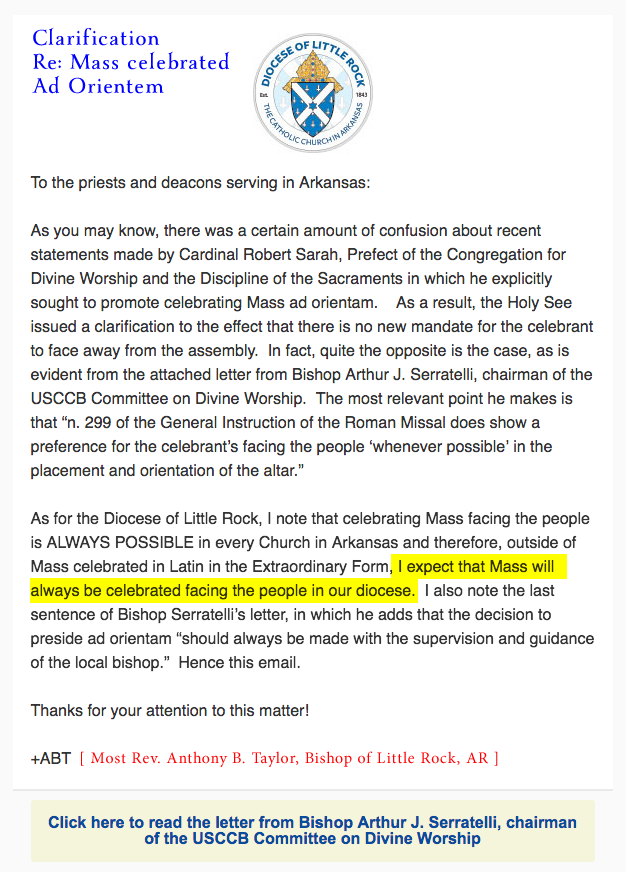
If email were rain, I’d be soaked.  I was sent an image of a letter sent by Bp. Anthony Taylor of Little Rock, Arkansas, to priests.  In this letter, the Bishop says that he “expects” that Mass always be celebrated “facing the people”.

CCWatershed has a good summary of this sad new development and an image of the letter with the relevant text highlighted.

Here’s the problem.

Bp. Taylor cites a letter of 12 July 2016 from the head the USCCB’s liturgy committee, Bp. Serratelli, in the wake of Card. Sarah’s personal plea to priests to say Mass ad orientem. Once again, however, Serratelli cited the English MISTRANSLATION of GIRM 299, incorrectly asserting that 299 says that it is preferable that Mass be celebrated “facing the people”.  That is NOT what 299 says.

Based on this error, Bp. Taylor then states that he “expects” that the Ordinary Form will be “facing the people”.

He “expects” that.  He can’t mandate or command that.  Why?

On 10 April 2000, the Congregation for Divine Worship issued an official response about this matter:

This dicastery wishes to state that Holy Mass may be celebrated versus populum or versus apsidem. Both positions are in accord with liturgical law; both are to be considered correct.
There is no preference expressed in the liturgical legislation for either position. As both positions enjoy the favor of law, the legislation may not be invoked to say that one position or the other accords more closely with the mind of the Church.

In a nutshell, bishops can’t overrule universal laws, including rubrics.

That last part is an overstatement, by the way: the rubrics of the Mass in Latin in the Missale Romanum clearly indicate that at times the priest turns away from the altar to face the people and then turns back to the altar.  Nevertheless, the Congregation is clear.  And Bp. Serratelli’s letter goes on to acknowledge this fact (not quoted here).

I would only add that it seems that in 2012 Bp. Taylor repressed a TLM community by placing myriad conditions for the celebration of the older form of Mass.  In 2011 the document Universae Ecclesiae from the Pontifical Commission “Ecclesia Dei”, would clarify.  Too late.  More on that HERE.  To be fair, right now in N. Little Rock, the FSSP have a toe hold at a parish, St. Patrick’s. It is not their own church, but they have some use of it for early daily Mass. Also, confessions are heard for 30 minutes before each Mass.  What a great service to that parish from these good FSSP priests.

Back at CCWatershed, there is a note at the end which I cordially and sincerely endorse, to wit (my emphases):

Some have already ascribed bad intentions to Bishop Taylor, but I disagree. I suspect he sent his letter without knowing the CDW had specifically said the diocesan bishop cannot outlaw “ad orientem.” I believe that once Bishop Taylor becomes aware of that statement, he will issue a retraction. Furthermore, I strongly suspect Bishop Serratelli will retract his letter when the correct translation of paragraph 299 is brought to his attention.

To help everyone involved, let’s review 299. Again.

Altare exstruatur a pariete seiunctum, ut facile circumiri et in eo celebratio versus populum peragi possit, quod expedit ubicumque possibile sit.

… And now for the correct translation…

The altar should be built separated from the wall, which [namely, the separation of the altar from the wall] is useful wherever it is possible, so that it can be walked around and (so that) celebration towards the people can be carried out at it. 

For those who make the rookie mistake of plodding along in Latin word for word, as if that’s how Latin works, let’s rearrange 299 to make it easier:

Altare exstruatur a pariete seiunctum, quod expedit ubicumque possibile sit, ut facile circumiri et in eo celebratio versus populum peragi possit.

Let’s make it more visual yet.  To what does that quod refer?

16_07_17_299_arrow

The relative pronoun quod refers back to the whole first part.    The ut clause in the middle (which creates a messy, but still readable sentence if you don’t fall into the rookie trap of reading Latin word for word in order) adds some additional information about how far away from the wall the altar should be built. It is a vast stretch to imagine that that quod refers to the infinitives in the ut clause (circumiri… peragi).  It is also a vast stretch to force quod to be a conjunction (therefore without gender or number).  No, the quod, in its role as a relative pronoun, refers most naturally and logically to the main clause.

BTW, Fr. Reginald Foster, the long-time Latinist to Popes, agrees with me.

Fr. John Hunwicke, now of the Ordinariate of Our Lady of Walsingham in England, taught Classical Languages for decades. HE wrote in a Guest Editorial in 2001 in Sacred Music:

Paragraph 299 says:

The High Altar [not, be it observed, every altar] should be constructed away from the wall, so that the option is open [possit] of walking easily around it and using it for Mass facing the people. This [i.e., having the altar free-standing so that the options are open] is desirable wherever possible.

GIRM continues – see paragraph 277 – to accept that there will be churches where keeping the options open in this way is not “possible.” And notice that according to the Oxford Latin Dictionary, ubicumque means only wherever. [not “everywhere”]
You rightly point out that the new GIRM repeats the instruction that, at certain points, the priest (or deacon) must be “turned to the people” (versus ad populum), clearly implying that he may lawfully be turned away from them at other times. You could have mentioned that these are not merely careless repetitions from earlier versions of the GIRM; I have noticed three places (Paragraphs 154, 181, 195) where the phrase is now added to
the text of the Editio typica prima, and these paragraphs occur in the description of a normal Sunday community Mass, celebrated perhaps with a deacon.
Incidentally, [NB] I suspect that a redaction critic, asked why the quod … clause has been added, might surmise that the addition was intended to emphasize the need for flexibility in the placing of the altar (it’s a good idea [expedit] to have a free-standing altar where this doesn’t cause too much trouble), rather than to discourage ad orientem.

Which is surely why this paragraph is mistranslated so often!

Elsewhere, Fr. Richard Cipolla, whom is no Latin slouch himself – an understatement – wrote:

That famous “quod” that introduces the relative clause cannot possibly refer to the celebration of Mass versus populum.  The English translation has been faulty from the beginning, or rather, from when that clause was added.  In addition the Congregation for Divine Worship in September 2000 rejected the interpretation that 299 made a free -standing altar obligatory and therefore versum populum obligatory.

It is clear from the Latin of the GIRM and the rubrics in the Ordo Missae that ad orientem worship is NOT to be, indeed cannot be, excluded.  It’s RIGHT THERE in the book.

It is clear that, according to the Latin of the GIRM and the rubrics in the Ordo Missae that versus populum is also NOT to be, indeed cannot be, excluded.  Again, check the book.

Bishops cannot forbid ad orientem worship.  They can torture priests who say Mass ad orientem in a thousand ways.  But that would be abuse of power.

The linguistic situation is pretty clear.  The history of ad orientem worship is not to be denied.  The legal/juridical/rubrical dimension is not really that complicated (if you are honest about it and have the correct information).

That said, what we have to do now is go deeper into the theology of the two manners of “orienting” Mass.

If we say that, theologically Holy Mass is to be “towards the Lord”, which of those positions (ad orientem versus or versus ad populum) will more fully manifest and also more fully facilitate an experience of Mass as being truly offered “towards the Lord“?

Friends, Card. Sarah’s personal invitation, the Sarah Appeal™, to priests was a turning point. His ad orientem appeal is a catalyst to set in motion significant change.  Each priest who takes up Card. Sarah’s catalytic call will in turn become a catalyst wherever he serves.  The way a priest says Mass produces knock-on effects in congregations.  Hence, those who support the Cardinal Sarah’s proposal are going to be persecuted.  Pray for your priests and bishops.  Pray that their minds and hearts be opened and that their actions reflect a loving balance of prudence and courage.

And, please, tell the TRUTH about 299.

Qui habet aures audiendi audiat!

Posted in Liturgy Science Theatre 3000, Mail from priests, The Coming Storm, The Drill | Tagged , ,
38 Comments

Your Sunday Sermon Notes

Was there a good point or two from the sermon you heard for your Sunday Mass of Obligation?

For my part, I spoke about the Roman ‘genius’ (mindset, worldview, identity rolled into one) and threefold component in the absolution form after the Confiteor in the prayers at the foot of the altar and before Communion.

Posted in SESSIUNCULA |
16 Comments

The Church in Germany is crashing and burning

Via EWTN.  This is nothing but grim:

German bishops release new figures: fewer churchgoers, parishes, and priests

Figures released Friday by the German bishops’ conference draw a bleak picture of the ongoing decline of Catholicism in Germany.

However, the head of the conference, Cardinal Reinhard Marx of Munich and Freising, described the Church July 15 as a continuing “strong force, whose message is heard and accepted”. [Meanwhile… Archdiocese of Munich has 6 billion in assets, Paderborn 4 billion Cologne 3.4 billion – HERE and HERE In 2013 the German Church took in from the “Church Tax”.  HERE  In effect, the German could pretty much buy the Vatican.]

With more than 23.7 million members in Germany, Catholicism is the largest single religious group in country, comprising 29 percent of the population. Yet people are leaving the Church in droves: in 2015, a total of 181,925 people departed.

By comparison, 2,685 people became Catholic, and 6,474 reverted to Catholicism.  [181,925 v. 9159]

Whilst the German bishops’ conference emphasized that baptisms and marriages showed a slight increase as compared to the year before, the actual long-term figures describe a steep downward trend.

When compared to the official statistics of twenty years ago, the number of baptisms has declined by more than a third, from almost 260,000 babies baptized in 1995 to just over 167,000 in 2015. The situation is even worse for marriages. Twenty-one years ago, 86,456 couples tied the knot in Church. Last year, the number was down by almost half: In a nation of 80 million people, only 44,298 couples were married in the Church last year.

Further official numbers confirm this precipitous decline: average church attendance is down from 18.6 percent in 1995 to 10.4 percent in 2015.

The number of people departing the Church has increased within the same timeframe, having peaked in recent years at more than 200,000 annually.

No numbers are provided by the German episcopate about how many Catholics went to confession last year. However, a recent academic study of the priesthood in Germany showed that even amongst the clergy, more than half – 54 percent – go to confession only “once a year or less”. [That’s damning.] Amongst pastoral assistants, a staggering 91 percent responded that they receive the Sacrament of Reconciliation once a year or less. [!]

Despite these alarming numbers, the head of the bishops’ conference issued an upbeat appraisal of the situation: “The statistics show that the Church in Germany continues to be a strong force, whose message is heard and accepted. There obviously not only is an interest in, but also an active desire for the sacraments of the Church, as the slight increase of baptisms and marriages proves”, Cardinal Marx said in a statement issued by the German bishops’ conference.

Acknowledging the high numbers of people leaving the Church, the head of the German bishops’ conference said: “We need a ‘sophisticated pastoral practice‘ that does justice to the diverse lifeworlds of people and convincingly passes on the hope of the Faith. The conclusion of last year’s synod of bishops and the Apostolic Exhortation Amoris Laetitia by Pope Francis are important signposts.” [What they need is a return to the basics: say Mass correctly and preach rudimentary catechism, revive devotions and put clerical clothing on, schedule confessions and get into the box.  How is this hard?]

“Pope Francis gives us courage”, the Archbishop of Munich and Freising continued, “when he tells us that the way of the future Church is the way of a ‘synodal church’. That means: All faithful are called upon, laypeople and priests! Together we will continue to give convincingly witness to our Faith and the Gospel.” [“walking together”!]

In fact, Pope Francis issued a scathing analysis of the decline of the Catholic faith in Germany since the 1960s on the occasion of the German bishops’ ad limina visit in 2015, calling on the bishops to re-introduce people to the Eucharist and Confession during the Year of Mercy, to take on the new evangelization, to strengthen the role of priests, and to protect unborn life.

Pope Francis is unimpressed with Germany, too.

I think I have a bead now on why the German bishops are so concerned about the numbers.

And yet… I am struck by an irony.

Read this

Apart from the legal difficulties of de-registering from the Church, defectors also face significant religious consequences. In 2012, the German Catholic Bishops’ Conference decreed that those who opt out of the church tax are not eligible to receive any of the sacraments, to serve as a godparent or communion sponsor, or to hold any office in the Church. Those de-registrants who did not show significant remorse about their decision can also be denied a religious burial.

The Teutonic world is leaping about with its hair on fire defending the right of just about anyone to receive just about any sacrament you can imagine!

And yet… if you don’t pay your Church Tax… you are shut out in the cold and the dark where there is wailing and gnashing of teeth.

Posted in Liberals, Our Catholic Identity, The Coming Storm, The Drill, The future and our choices | Tagged
90 Comments

ASK FATHER: Last prayer at the point of death

strigils smFrom a reader…

QUAERITUR:

Forgive the morbid nature of my query, but with the nature of the world today (and the mindset of an undertaker) a question has been on my mind. If one were to know death was imminent, what would be the very best prayer to recite with one’s final breath? Thank you for the daily edification you provide!

That is a good question.

I think that whatever prayer was uttered with sincerity and hope would be treated well.

However, for my part, I – a poor sinner – would beg for God’s mercy.  Especially, invoke the Holy Name.

plenary indulgence is granted to those at the hour of death who devoutly invoke the holy Name of Jesus.

My Jesus, mercy!

Save me, O Lord!

Lord Jesus, receive my spirit.

Holy Mary, pray for me.

Saint Joseph, pray for me.

Jesus, Mary, and Joseph, help me.

Jesus, Mary, and Joseph, assist me in my last agony.

That said, I think many of us die the way we live.  Just as soldiers and athletes drill and drill and drill so that actions and reactions are nearly automatic in times of extreme stress, we all have to have habits of prayer which will kick in even in that solemn moment, when we may be in pain, afraid, in duress.

The soldier’s lot and the athlete’s striving are images of the Christian life.  We strive for the crown of glory at the of the struggle, Greek agon, the final “agony” we must all face.  Praying often short intense prayers during the day, every day, in little nooks and corners of our day or in the midst of even boring or of strenuous activities will help us to pray in the same way in the moments before we take our last breath, our hearts stop, our souls separate from our bodies, and we go to God, Christ the Just Judge, King of Fearful Majesty.

last rites extreme unction anointing viaticum 02Oro supplex et acclinis,
cor contritum quasi cinis:
gere curam mei finis.

I meekly and humbly pray,
[my] heart is as crushed as the ashes:
perform the healing of mine end.

Lacrimosa dies illa,
Qua resurget ex favilla,
Judicandus homo reus.
Huic ergo parce, Deus:

Tearful will be that day,
on which from the ash arises
the guilty man who is to be judged.
Spare him therefore, God.

Pie Jesu Domine,
Dona eis requiem. Amen.

Merciful Lord Jesus,
grant them rest. Amen.

Dona mihi requiem!

If we develop these habits of prayer, it could be that, when the time comes, we won’t be so afraid and passing into the next life will bring longing and relief.

Dear readers… GO TO CONFESSION.

My Jesus, have mercy on me, a sinner.

Posted in "How To..." - Practical Notes, ASK FATHER Question Box, Four Last Things, GO TO CONFESSION, Hard-Identity Catholicism | Tagged ,
27 Comments

Fr. Z’s Kitchen: Odd Brit Sandwich, Priest Killer Pasta, Beautiful Youth Missal

So there I am, minding my own business, watching an episode of Endeavour (UK HERE prequel to Inspector Morse UK HERE), and there’s Thursday eating a “cheese and pickle” sandwich.

“?!?”, quoth I. “That can’t mean what it seems to mean. Brits don’t ever mean what they mean when they use common words. Hence, pickle must be something like Indian pickle, like a chutney.” I was, of course, correct. A quick online search revealed that not only does “cheese and pickle” involve something other than pickled cukes or other, it generally involves Branston’s Pickle (UK… well, it’s probably on every corner).

Another online search revealed that a nearby grocer had it in stock.

“!!!”, quoth I.  “I must try this.”

Additional research suggested a hearty bread (check), sharp cheddar (check), a bit of butter (check – this is Wisconsin)

As far as the mechanics are concerned, I think you know the rest of the sandwich process.  I would only add that, when you make a sandwich and need to spread something on the bread, always go to the edges.  Yes, it makes a difference.

“But Father!  But Father!” some of you are saying, what is that … glimpse of ‘CATH’ in the background.  Does that stand for “Cathars”?!?  We all know you HATE VATICAN II and therefore you must hate Cathars too!  They were so mistreated and misunderstood by mean people like you.  Who are we too judge?  We should celebrate the Cathar centenary!”

You can read the UK’s best Catholic weekly online for a relatively small cost.  You get far more than is in the online edition.  I think it is a a good idea to keep current with what is going on the Anglophone Church.  I guess that also means England.  But I digress.

But wait, there’s more.

As you read on, perhaps listen to the theme from the show Endeavour, which reprises the haunting theme of Inspector Morse.   Since the next bit involves “priest killing pasta”, this might be just the tune to use.  Note the clever use of Morse Code.  — — .-. … .

YouTube thumbnailYouTube icon

I am starting to experiment with menus for another Supper For The Promotion of Clericalism.

The next time, I think I might make strozzapreti alla puttanesca (some of you will get that, and some won’t).

Begin with anchovies.

The mise en place, or I suppose, “predisposizione” includes a couple kinds of pitted olives, minced garlic, rinsed anchovy fillets, the pasta (strozzapreti), capers, San Marzano tomatoes (thank you, readers!).

A splash of olio nuovo in the pan and start mashing the fishies.  The next time I do this, I’ll dice them up first.

I might try with paste the next time.

Add garlic.  I never let garlic get too brown.  It becomes bitter.  Give it some color, but never really dark.

In go the capers.

In go the olives.

WHAT ARE THOSE?

I added cayenne, because I didn’t have any peperoncini.

In goes the mostly cooked pasta.  Salt the water sparingly if at all, since the anchovies and capers have salt content.

Give it some time, to finish in the sauce with the addition of a splash of the hot starchy water from the pasta pot.  It’s a chemistry thing.

At this point you could add a bit of parsley, but I forgot.

With some ground pepper.

This was outstanding.  Will other clerics think so?  Good question.

The recipe goes quickly enough that I could make a second version substituting tuna or… not, in a third version.

So, I’m exploring options.   My deep gratitude to the reader who sent the strozzapreti from my wish list.  Come to think of it, it might have been from a liberal, if you get my drift.  Nomen omen, right?

Back to the cheese and pickle sandwich.   Would I do this again?

Yes.  I am wondering how best to pair it.  Tea?  Beer?  Either?  Both?

Finally, some food for the soul, specifically the souls of young people who are being introduced to the traditional Mass.  Or even if they know it already!

A reader from across the Pond (who sent the spiffing tea pot which I now use often – thanks), wrote the following:

I visited the Benedictine abbey of St Michael in Farnborough. The monks here are from St Peters Solesmes branch of the family.

They have a good printing press and bee hives. But I found this lovely missal printed in the good old US of A. I bought it for my nephews who serve the UA [TLM] regularly. The boys will love it. Perhaps your readers should be alerted to it.

It starts by saying.

This is the Mass. This is not a “religious service” or a scripture class. This is Heaven on earth: it is where our God comes to us.

As you can see its fabulously laid out. With an index at the back and so easy to appreciate the Mass for anyone trying to understand the Tridentine rite.

Yes, indeed, sir, I know this book well.  I have written of it in the past. I know the author. I advertise St. Augustine Academy Press on my left side bar!  It is indeed a beautiful book.  I warmly recommend it.


Here are some snaps which my correspondent sent.  TREASURE AND TRADITION!

IMG_4398

IMG_4399

IMG_4400

IMG_4401

IMG_4402


Posted in "How To..." - Practical Notes, Fr. Z's Kitchen, Liturgy Science Theatre 3000 | Tagged , ,
24 Comments