ASK FATHER: “Dear Fr. Z, why do bad things happen?”

From a reader… no… readers… no… many readers, all the time!

In summary…

“Fr Z, why does X [X = bad thing] continue to happen in my [FILL IN BLANK]?”

Many questions come in with the formula or some variation

“Dear Fr. Z, our priest (or bishop, or deacon, or whomever) did [FiLL IN BLANK]. Why?”

Evil is a mystery.

The old Catholic Encyclopedia, helpfully reprinted on the New Advent website, says that evil “is what ought not to exist. Nevertheless, there is no department of human life in which its presence is not felt; and the discrepancy between what is and what ought to be has always called for explanation in the account which mankind has sought to give itself and its surroundings.”

When we ask the “why” of morally evil acts of another, we necessarily also ask why we ourselves sin.

If we ponder the evil in our own lives, we might be able to understand better the evil in the lives of others.

Quid autem vides festucam in oculo fratris tui et trabem in oculo tuo non vides? Aut quomodo dicis fratri tuo sine eiciam festucam de oculo tuo et ecce trabis est in oculo tuo? Hypocrita! Eice primum trabem de oculo tuo et tunc videbis eicere festucam de oculo fratris tui.

We chose evil because (wrongly) we think it to be a good. Mind you, we can, because of appetites, vices, the temptations of the Enemy, etc., deceive ourselves about goods. Still, we choose what – at the moment – we think will bring us happiness or pleasure. Later, we realize that whatever pleasure there was in the evil, is in evil, it is inevitably transitory and false.

Evil (the absence of good, truth and beauty), by definition, cannot satisfy someone made in God’s image.

We choose evil because we have been deceived.

We choose evil because we are weak.

And, remember: Sin makes you stupid.

We choose evil because we are selfish and prefer our transitory pleasure over the beatitude of heaven.

How do we combat evil in society… in the Church?

How do we combat evil in ourselves?

Pray.

Fast.

Strive to let reason guide passions rather than the other way around.

Avoid near occasions of sin.

The best course to defeat evil in the world must be the same.

Pray.

Fast.

Discipline ourselves so that our intellects can guide our emotions and appetites.

Avoid near occasions of sin.

The solution to corruption and evil in the world is the same as it has always been:

Strive to be holy.

Desire heaven.

Raise your children to be saints.

Walk uprightly.

Be courageous.

Be willing to suffer.

Stick close to the sacraments and the sure teaching of the Church, which can be verified in her perennial teachings.

At this moment I have in my head the verse from Micah 6, which I recently saw in beautiful lettering in the reading room of the Library of Congress. As a convert, I still have some biblical verses in my head from the King James Bible and this is the verse I am thinking of:

He hath shewed thee, O man, what is good; and what doth the LORD require of thee, but to do justly, and to love mercy, and to walk humbly with thy God?

And lest anyone get his panties in a twist (you know who you are), here is the Douay of Micah 6:6-8:

What shall I offer to the Lord that is worthy? wherewith shall I kneel before the high God? shall I offer holocausts unto him, and calves of a year old? May the Lord be appeased with thousands of rams, or with many thousands of fat he goats? shall I give my firstborn for my wickedness, the fruit of my body for the sin of my soul? I will shew thee, O man, what is good, and what the Lord requireth of thee: Verily to do judgment, and to love mercy, and to walk solicitous with thy God.

Posted in "How To..." - Practical Notes, ASK FATHER Question Box | Tagged ,
3 Comments

Your Sunday Sermon Notes

Let us know about a good point made in the sermon you heard during your Mass of obligation.

Posted in SESSIUNCULA |
17 Comments

New procedures to remove negligent Bishops… what could go wrong?

The Pope has issued an Apostolic Letter (heavy) Motu Proprio to establish procedures to remove bishops who don’t act adequately in regard to priests who hurt children or vulnerable people.

Good.  On the face of it, that’s great.

I’ve been irritated ever since the US bishops decided to exempt themselves from the so-called Dallas Charter.   Instead of “clerics”, they chose “priests and deacons”, thus leaving themselves outside.

However, as I have listened to my friends react to this news in email and and texts, I am confirmed in my first reaction.

Bishops will now have an even greater motive to hammer innocent priests into the ground in order to cover their episcopal backsides.

Will this mark another “open season” on priests?

Think about it:

Freeda Burnbradia doesn’t like what Father preaches, or that he doesn’t have altar girls.  In her oddball feminist fog she imagines that, during a rehearsal for a Mass, Father is not quite properly dealing with all the altar boys.  Hence, she writes to the local Bishop of Libville, Most Rev. Fatty McButterpants, with the notion that Father might not be dealing with children in a way that she (therefore everyone) approves.   The Bishop of Libville then grinds Father into grit in the gutter on the force of a suggestion. He wants to cover his increasingly wide ass in light of the new legislation.

Father is, of course, entirely innocent.  But this moment gives everyone cover to get a troublesome priest out of the way.

It’s all about bishops and never about priests.

Except for Summorum Pontificum.  That was about priests.  It was a document of astonishing importance.


Posted in SESSIUNCULA | Tagged ,
44 Comments

Attacks on Catholic church in France and Belgium

I was just in Toledo… not Ohio. While I was in the glorious cathedral, and I heard that it had been the site of a mosque after the Visigothic church was torn down, it occurred to me that there are whole lot of people who would gladly destroy the present building and all of its treasures and any trace of why the cathedral exists in the first place

Via CNA:

Vandals Attack Churches in France and Belgium

ARIS — In recent weeks, Catholics in France and Belgium — countries still recovering from brutal ISIS attacks — have been hit with numerous acts of violence and aggression, including fires set in churches, an assault on a priest, the desecration of a tabernacle and the hacking of more than 100 Catholic websites.
In the French periodical La Provence, local priest Father Benoît Delabre reported that two weeks ago, the altar at the Church of St. Madeleine-de-l’Île was set on fire in Martigues, about 800 kilometers south of Paris.
“The altar … is marble, which prevented the fire from spreading. I can’t imagine what would have happened with a wooden altar. The consequences for our church would have been tragic.”
He also said that, on May 15, another unknown person desecrated the tabernacle that contained the consecrated Hosts in the church at Jonquières in the same region. Additionally, Father Delabre himself was attacked last Sunday, by a man he caught at the church door who appeared to be “trying to steal something.”
“We know just how serious these attacks are on signs and persons because of their faith. … The Catholic faith, its symbols and those that profess it deserve to be respected just like every kind of religious expression that does not disturb the public order,” he said.
Gaby Charroux, the mayor of Martigues, said in a statement that “thefts of every kind in churches in France are more and more frequent” and promised the police will curb the attacks.
The publication La Croix reported that, in April, more than 100 websites of churches and congregations were hacked by suspected Tunisian cyber-jihadists who call themselves the Fallaga Team.
In Belgium, on the afternoon of May 24, two fires considerably damaged the church in Mont-Sainte-Geneviève, which dates from the 16th century. The first one began in the sacristy. The firefighters had barely left the scene, after managing to control that fire, when another much bigger fire in the church roof was reported.
The police from Hainut, 37 miles southeast of Brussels, are looking for the culprits.

I can think of two groups who would want to desecrate or destroy Catholic Churches.  And the “Olympian Middle”, along with the Fishwrap types, are aiding them.

Get ready!

Posted in Hard-Identity Catholicism, Semper Paratus, Si vis pacem para bellum!, Sin That Cries To Heaven, The Coming Storm, The future and our choices, The Last Acceptable Prejudice, The Olympian Middle, The Religion of Peace | Tagged
12 Comments

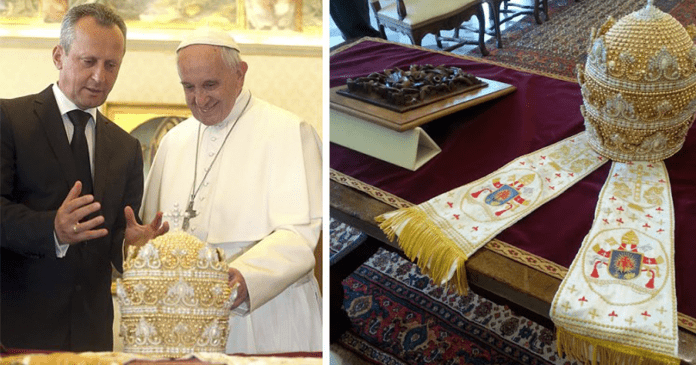
Sometimes a photo is worth 5000 thousands words.

You might have heard of this, but, since I have been traveling and using the interwebs less than usual in the last couple weeks, it was news to me.

A member of the Macedonian parliament brought a gift to Pope Francis from the Orthodox convent of St. George of Rajcica: a papal tiara, the triple crown symbol of the Bishop of Rome’s authority over just about everything. Women, nuns, lovingly made it by hand, embroidering it and setting it with pearls from a lake near their convent.

Such a beautiful gift! I am sure the Holy Father beamed with delight. After all, Benedict XVI did when he was presented with a small version of a tiara, even though Pope Francis is the first Pope who – as the press acknowledges – ever smiled.

Sometimes a photo is worth 5000 thousands words.* And, these days, they remain easily accessible.

His Holiness didn’t too happy with the tiara, which was lovingly made by women.

Remember when the Pope was in South America and he received the “crucifix” in the style of a global symbol of the violation of human rights?

Okay… a photo out of context doesn’t tell the whole story.

*Adjusted for Holy See Word Inflation.

UPDATE:

Yes, as it turns out there are other photos of the Pope with the tiara.

It must be difficult to be a dignitary who receives gifts all the time.  For my part, I have had  on many occasions to put on a smile and nod and make pleasing sounds when receiving some things.  But what someone like the Pope of Rome must do constantly is different by orders of magnitude.

Meanwhile, I think the choice by Orthodox of a tiara as a gift to the Pope of Rome was pretty interesting.

Posted in Lighter fare | Tagged ,
37 Comments

A moral theologian tackles difficulties in #AmorisLaetitia

In Catholic World Report there is some analysis of Amoris laetitia.

The writer first contrasts himself with others who think that the Exhortation is not magisterial in nature.

That doesn’t mean that he doesn’t find problems.  For example:

[…]

2. Doctrine and fidelity to Christ

Suggestions in AL that doctrine is a question of adherence to arid rules, lacking in motivation, devoid of mercy, and that pastors wish to cast stones at people in real difficulties are generic; [Right.  I keep asking myself, “Who are these people?  Where are these people whom Pope Francis keeps beating up in his talks and docs?”] they are unjust to those genuinely concerned to remain faithful to Christ on the indissolubility of marriage. Benedict XVI, humble and compassionate, saw no way of changing discipline here without compromising fidelity to Jesus. From Pius XI to Benedict, doctrine on marriage was also positively and pastorally motivated; these Popes were not guilty of heartless, Pharisaic legalism.

3. The formation of conscience

Magisterial texts in AL are distorted when quoted selectively or ignored almost completely. Repeatedly presenting conscience as the sanctuary where man finds himself alone with God (Gaudium et spes, 16) suggests it is only a private matter between the individual and God, while references to invincible ignorance and to other factors reducing responsibility risk implying that people rarely sin or are rarely culpable. Grave misinterpretations of conciliar doctrine on conscience, corrected in Veritatis splendor, are basically ignored in AL. Conciliar and papal teaching that no one can act in good conscience who disregards magisterial teaching or who treats it as mere opinion (Dignitatis humanae, 14; John Paul II, Allocution, Nov., 1988) is not mentioned.

[…]

4. Casuistry or discernment?

Ignatian discernment is no substitute for proper formation of conscience. [!] AL rejects legalism and casuistry. St. Thomas’ statement that, applied concretely, moral law binds in the majority, but not in a minority, of cases is mis-represented. [We knew that, as time went on, scholars would start writing about how the document’s writers (mis)used Aquinas.]

[…]

AL, though, could well give the impression of something even worse, of privatising conscience, of encouraging or permitting persons to refer to priests ignorant of or dissenting from magisterial teaching. The risk of situation ethics, of laxism, of moral relativism and of widespread contradictory pastoral practice, despite the Pope not wishing anything like this, seems to be considerable.

These are a few snips.  Read the whole thing over there yourselves.

Remember…

Whatever AL says now can be corrected in the final, official version in the Acta Apostolicae Sedis.

Would that be difficult to communicate?  Sure!   But everyone is listening to the Pope these days.  Were he to talk about the dialogue and insights gained from reactions around the world and then issue a new version, an official version with LATIN and translations, much of the damage could be undone while bringing the entire world’s focus to what the Church really says about matrimony and those who are struggling in their relationships or who need to get their acts together.

Posted in Francis, One Man & One Woman, Our Catholic Identity, The Drill, The future and our choices | Tagged ,
26 Comments

Happy news from Bradford

Within me two people are constantly vying for control.  First, there is the pessimist.  He says, “Things can’t possible get any worse!”.  Then, there is the optimist.  He responds, “Oh, yes they can!”

Seriously, we do have good news.

From the UK’s best Catholic weekly, The Catholic Herald comes this great news.

Bradford parish to become regular centre for Extraordinary Form Mass

A new centre for the celebration of Mass in the Extraordinary Form will open later this year in the north of England. Bishop Marcus Stock of Leeds has announced that St Joseph’s Church in Bradford is to become a centre for the Traditional Latin Mass in the Diocese.  [I love this news!  That said, this doesn’t mean that other parishes cannot have the older, traditional form, too.  My inner optimist and inner pessimist are at it again.  Say there is a bishop, like ol’ Bp. Fatty McButterpants over in the Diocese of Libville who doe not like the traditional form, at all.  He might choose, like Richard in the play, to be all smiles.  Then he might set up a place – The Sourpuss Nostalgia Faith Community of Yesteryear – that was second to none in the diocese and support it and make sure that it was so great that the older Mass would never spread outside that place.   Trads are complacent, after all.  Once they get what they want, they tend not to squawk anymore.  Right?   On the other hand, when people experience how wonderful things there… they might want them elsewhere!  WHAT TO DO?]

Bishop Stock said: “I am making St Joseph’s Church in Bradford a principal church for the celebration of the Extraordinary Form Rite of Mass within the Diocese of Leeds. This is a pastoral response to the request from a number of the faithful for a central church that is easily accessible with a celebration at a time on a Sunday that will facilitate a larger congregation of the faithful to attend.”

Neil Walker, regional representative for the Latin Mass Society, and Fr Timothy Wiley, the diocesan coordinator for the Extraordinary Form, first approached Bishop Stock after his appointment in 2014. They raised with the bishop the diocesan need for a regular Extraordinary Form Mass on a Sunday in a centrally located church.

“The bishop met us with great courtesy and warmth and made it clear he was particularly keen that those who wish to attend the Extraordinary Form of Mass should not have to do so in the middle of a Sunday afternoon which he sees as family time,” said Neil Walker.

‘”After looking at many possibilities, the Bishop agreed to allow us to become part of St Joseph’s Parish in Bradford, which we have used several times in the past and where we have been made most welcome by the parish priests. The parish also has another centrally located church, that of St. Patrick’s at the other side of the city, which is currently undergoing intensive restoration and renovation. “ [Ah hah!]

Bishop Stock has also agreed to continue to support the traditional rite by attending several diocesan annual Masses in the Extraordinary Form and to encourage conferences and retreats for priests interested in celebrating the Extrordinary Form.

[…]

Again, I am happy for this news and you should be too.   I’m slightly cynical at the moment, but I am in Spain as I write.  And… I am not sure why that would make my cynical, because I’m having a great time, but it’s a way to end this post.

Fr. Z kudos to the Bishop and people of Leeds.  They hagan-ed the lío!  They were the maquis!  They got something done!

Posted in ¡Hagan lío!, "How To..." - Practical Notes, Be The Maquis, Hard-Identity Catholicism, Liturgy Science Theatre 3000, SUMMORUM PONTIFICUM | Tagged , , , ,
11 Comments

The Insidious Footnote Saga continues: Fn. 329

I’ve been traveling and – frankly – backing off from the blog in order to have an actual vacation (NB: vacation, not rest).

However, one of my Roman correspondents has again done yeoman’s work on a SUPER IMPORTANT point about Amoris laetitia, Pope Francis’ Post-Synodal Exhortation which continues to produce theological and disciplinary hairballs.

I have written before about a deeply disturbing misuse of Gaudium et spes in a footnote, 329.   BUT … ad perpetuam rei memoriam….

Remember everyone: I suggest that the Powers That Be correct AL in the version to appear in the Acta Apostolicae Sedis.  Unless, of course, they intend these problems because they wanted them in the first place.

So here is some analysis:

Michael Pakaluk of Ave Maria University has published a piece at First Things, attacking another footnote in the infamous Chapter 8. You’ll remember the ink that has been spilt, notably by Cardinal Mueller, rolling back the erroneous interpretation of Footnote 351 offered by, among others Fr. Antonio Spadaro, SJ, and Cardinal Christoph Schoenborn, both of whom maintain that the footnote opens a path toward admission of CDR’s [civilly divorced and remarries] to Holy Communion without their living “as brother and sister”.

Pakaluk finds another serious error in Footnote 329, which I copy for you below in the translation that Pakaluk employs:

“In [second marriages], many people, knowing and accepting the possibility of living “as brothers and sisters” which the Church offers them, point out that if certain expressions of intimacy [i.e. sexual intercourse] are lacking, “it often happens that faithfulness is endangered and the good of the children suffers” (cf. SECOND VATICAN ECUMENICAL COUNCIL, Pastoral Constitution on the Church in the Modern World Gaudium et Spes, 51).”

The argument implied in this footnote, is that for the good of their “marriage”, the partners in a civil marriage following a civil divorce ought to be permitted to enjoy sexual intercourse despite the fact that is is prohibited by current Church teaching as expressed in Familiaris Consortio, 84, and in the Catechism of the Catholic Church, among other Magisterial documents. In support of this view, the footnote references a Vatican II document (cue celestial music!). For the sake of comparison, I copy below the pertinent section of the Second Vatican Council document Gaudium et Spes, 51, (= GS 51) that is referenced in the footnote: 

“51. This council realizes that certain modern conditions often keep couples from arranging their married lives harmoniously, and that they find themselves in circumstances where at least temporarily the size of their families should not be increased. As a result, the faithful exercise of love and the full intimacy of their lives is hard to maintain. But where the intimacy of married life is broken off, its faithfulness can sometimes be imperiled and its quality of fruitfulness ruined, for then the upbringing of the children and the courage to accept new ones are both endangered.”
Pakaluk shows that AL intentionally twists the meaning of GS 51, out of context. AL footnote 329 is talking about sexual intimacy in second “marriages” — i.e., civil marriages follwing civil divorce which are invalid; GS 51 is talking about sexual intimacy in valid, sacramental marriages. Hence, GS 51 cannot be used as an authority in order to trump the prohibition of sexual intercourse between CDR’s mandated by St. John Paul II at Familiaris Consortio, 84.

What is most insidious about Footnote 329 is the callous way it tries to use the “good of the children” and “faithfulness between partners” in order to cover up the adultery (there, I said it!) that the footnote seeks to justify. Anyone can understand exactly what GS 51 is talking about, and what it is not talking about.

Anyone, that is, who tries to read the document with rhe Church. The peoblem is that it seems to contradict the Church’s teaching in some serious matters.

No one is serves by silence about this.

The only way to work through it is to work through it.

If you choose to try to commnent, think before posting. Think and weigh before posting.

Posted in SESSIUNCULA |
35 Comments

June, Piety and You

Sacred Heart card GermanJune is traditionally dedicated to foster devotion and piety for the Sacred Heart of Jesus.

Speaking of piety, consider what you might do regarding your own pious, devotional practices. Hint: don’t be afraid to be pious! We lose nothing by being devout. We gain ineffable benefits.

Do not be afraid to bend yourself down before God. Address the angels and saints as your intercessors and patrons.

Be simply pious.

Man was made to be pious.

This is the essence of Religion: to give due reverence to God.

Without piety we are empty shells.

The sin of our First Parents was the opposite of piety: act like self-sufficient self-gods.  We can drift into sinful defiance of God by neglect of piety and devotion.

Consider the benefits of devotion, and then consider the downside of being, not impious, in the sense of being wicked, but slothful, haphazard, lukewarm. How did our Lord describe the fate of the tepid?  It wasn’t good.

People might hesitate to be pious because they then have to give up things that are incompatible with piety. Benedict XVI said in the sermon for his inaugural Mass in 2005:

“Are we not perhaps all afraid in some way? If we let Christ enter fully into our lives, if we open ourselves totally to him, are we not afraid that He might take something away from us? Are we not perhaps afraid to give up something significant, something unique, something that makes life so beautiful? Do we not then risk ending up diminished and deprived of our freedom? And once again the Pope said: No! If we let Christ into our lives, we lose nothing, nothing, absolutely nothing of what makes life free, beautiful and great.”

To develop a habit, and being pious and devout is a habit, start small.

Firstly, examine your conscience daily, in the evening, looking not just for sins you committed, but also how you sinned by omission.  That is how we ferret out negligence in regard to the virtue of Religion.

Next, during the day, say brief, silent prayers. No one needs to know that you prayed.  Pick one.  How about, “Jesus, meek and humble of heart: Make my heart like unto Thine.”  That little prayer has it all.  It drips with piety like Jesus’ wounded Heart.  It’s wonderful.

Next, research opportunities for public devotions and attend.  Never mind that they are unfamiliar.  Just go.

And…

GO TO CONFESSION!

Posted in "How To..." - Practical Notes, Our Catholic Identity | Tagged ,
9 Comments

ASK FATHER: VEIL WARS!

From a reader…

Our Latin Mass Community has no canonical status in the diocese. The FSSP has permission to be here, and we share (not rent as some communities do) the parish with the “Vatican II Congregation” (that’s how the pastor of the parish refers to themselves in relation to us). We have repeatedly asked the bishop for our own parish, but the answer is always no.

The past couple of years have become frustratingly painful. Our priest is forbidden from hearing confessions in the confessional on Sundays any time before noon (and yes, it’s strictly enforced). He’s not permitted to make holy water according to the Roman Ritual for parishioners, we are absolutely forbidden from giving the FSSP donations on church property and now the pastor of the parish has taken away our Tabernacle Veils (yes, they are ours, they belong to one of our vestment sets. They were using them instead of their old ugly polyester Tabernacle veils).

Below is a copy of the letter our priest sent the pastor asking for an explanation for why he wants our priest and altar boys to remove the Tabernacle veil after Mass (all of whom feel “very very uncomfortable doing so), which went in answered followed by our pastor’s note to our priest about taking away our Tabernacle veil.

I feel like this is the last straw for me. I have tried to be patient, giving the pastor the benefit of the doubt, but I feel like some sort of concrete action is necessary. To me, removing the Tabernacle veil is the equivalent to saying Jesus is not in the Tabernacle. This pains me. What would you suggest?

Okay, I read the attached correspondence, including the pastor’s … response.

First, let me say that the pastor of the parish is the pastor of the parish.  Right?  No matter how thick or weird or whatever a pastor might be, his is the juridical (if not moral or intellectual) authority.

Bottom line: He has power and you don’t.   Liberals always work this way: they dominate and oppress.

What to do … what to doooo… what to doooooo….?

Watch preschool children play together.   This, along with watching a four-way stop intersection, provides insight into our human nature.

Our nature has been wounded because of original sin. Even among the baptized, the effects of original sin remain. We have strong tendencies toward selfishness.

Watch young children color with crayons.  We will see fights break out, tantrums thrown because Becky uses the sky blue crayon that Jeremy was just using. It doesn’t matter that Jeremy doesn’t need the sky blue crayon anymore.  The fact that he was using it makes it his, and no one else has the right to it.

Mary, meanwhile, hides the brick red crayon. She doesn’t plan on using it, but she just doesn’t like the color and doesn’t want anyone to use it.

Meanwhile, Ryan peeled the label off of Derek’s burnt umber crayon, thinking it will help Derek color better. Derek, however, doesn’t want the label peeled off, and begins crying.

Katie, who has no direct interest in the fight between Derek and Ryan, nonetheless steps in to take Derek’s side.

Mayhem ensues.

Mom comes in and takes all the crayons away.

Most of us grow up, and learn how to get along.

We come to realize (usually some time before adolescence sets in) that we have to learn to play well together. This requires sharing.  This requires a degree of tolerance of the likes and dislikes of others.

Some people never quite grow up to learn these lessons.

Some, apparently, even go on to become pastors of “Vatican II Congregations.”

Sadly, unless the bishop steps in to give him a Time Out In The Corner™, I suspect he’ll keep playing silly, childish games.

Perhaps the best thing to do, considering the circumstances, is to take the veils down after Mass, and to put back the ugly polyester ones.  Then have the priest take the good veils (and vestments and anything else purchased exclusively by the EF community for their own use) with him to prevent further game playing.

Oh yes…

… pray that the pastor grow up.

And if you are ever in doubt about the fact of Original Sin, just sit and watch a four-way stop intersection for a while… or children.

Posted in "How To..." - Practical Notes, ASK FATHER Question Box, Liturgy Science Theatre 3000 | Tagged
40 Comments