SCANDAL ROCKS SPORT!

A major scandal now rocks a sport which is dear to the hearts of all readers of this blog, I am sure.

Strange brooms have been introduced into Curling!  They make the rocks shift more in their icy slide than normal brooms.

Behold, BROOMGATE!

From Vocativ:

Broomgate Scandal Rocks Curling
Welcome to the first ever controversy over high-tech brooms in sport

The broom, you might think, has little room for improvement. Take a handle and some bristles, fasten together, and enjoy a perfectly competent cleaning device.

Necessity may be the mother of invention, but sometimes fame and fortune become the adoptive parents. As the sport of curling has professionalized since its reintroduction to the Olympics in 1998—that’s the competition where stones are slid along the ice with two players furiously sweeping the preceding terrain—the investment in broom R&D has gone up, too. (Independent of Proctor & Gamble’s Swiffer, mind you.)

Therein arose a problem: Broomgate, as it’s predictably being called. Until last November, the World Curling Federation hadn’t really regulated the type of brooms curlers could use. This is, after all, a sport that still mines the quarry of an uninhabited Scottish island for all its micro-granite stones.

In this vacuum of regulation arose something called “directional fabric,” which permits more extreme course-changing down the lane. One company in this market, Hardline Curling, touts its icePad’s patent-pending technology that brushes only the small ice pebbles atop the lane. The president of Balance Plus, an industry leader, responded in an open letter urging an unnamed company (cough cough, Hardline, cough cough) to “Do The Right Thing and stop using directional fabric.”

Any novice who’s stumbled onto a televised match has probably wondered how much control the sweepers really have in generating enough friction to change the stone’s trajectory. Well, as former world champion Glenn Howard told SportsNet in Canada last fall, “It’s a type of fabric that allows you to virtually steer the rock. I use the phrase ‘joystick’. I can now joystick right, left, forward, back.

“Up until 18 months ago, it was 80 percent shooter, 20 percent sweeping and now in the last year and a half, it’s become 20 percent shooting and 80 percent sweeping. It’s just not acceptable.

[…]

Oh, the humanity! What pathos will sweep through the nation?

We will keep our eyes on this immense news.

Posted in Just Too Cool, Lighter fare | Tagged
7 Comments

My View For Awhile: “… tired but happy” Edition

Time to head home.


I’ll say one thing about these early flight: things move faster.

The taxi driver nearly broke a new BCN track record.  I noted that he crossed himself as we zoomed pasted the cemetery.

In the lounge I started to pull down from the interwebs my office for the whole day when I noticed a guy standing by a pillar with a napkin on his head, intent on his phone. “Jewish”, I guessed.


He read and bobbed a little. “Yep”, quoth I.   I felt some solidarity.


I don’t have to have a head covering and I can start on breakfast.

And so the trek home beginneth.


I must get some reading down on these flights.

UPDATE

My fellow praying traveler – who looks like he could bust 2x4s with his hand – is in the row across from me with his shawl and kippah and phylactery bound on.  He is going at it pretty intensely with his portion.  I think had better say some more office to hold up the starboard side.

UPDATE

I’m waiting at gate in AMS.  Since the last time I flew through here they changed the security set up.  It’s pretty efficient.

Speaking of efficient, the orderly Dutch at Schipol announce via a neutral and yet ominous slowly paced male voice,”Passenger Fatty McButerpants traveling to Libville, you are delaying the flight.  Please proceed to Gate E436 or your luggage will be removed.” You sense they really mean something like, “And your head will be shaved and you will be frog marched in front of hundreds of responsible people who know where to go and when, you inefficient dope.”  Having both Prussian blood and having moderated a blog and a forum, I appreciate this at a deeply satisfying level.  Only my many years in Rome have tempered this somewhat.

UPDATE


Settled in for another long leg.  At least I have a fairly quick process Stateside with the fast entry and security.  It the last leg that I don’t enjoy, but it’s mercifully short.

UPDATE

Some good news as they close the door.


It’s good to see that your bag is on the plane with you (hopefully with everything you packed still in it.)

They tell us our flight time is only 7:30.  Quick.  And we are leaving early, to boot.

UPDATE:

I’m back in these USA.

Customs went smoothly, my bag was one of the first off the plane, and I did security in a flash.  HINT when flying to DTW from abroad if you have TSA PRECHECK: There is no PreCheck downstairs.  BUT… you can go upstairs to the regular security area.  If there is a big line stacked up because more than one jumbo arrived and Fred and Wilma – not so familiar with travel – multiplied by 500 are keeping that line nice and slow, just go upstairs.

UPDATE


Posted in On the road, What Fr. Z is up to |
10 Comments

Your Good News

Do you have some great news to pass along to the readership?

As I note in the comments (especially some in the queue under other entries), there is a lot of negative out there.

We are facing serious problems in confusing times.  That doesn’t mean we have to be constantly focused only on bad news.  Right?

For my part, I am concluding a great trip after my 25th in Rome.  

Posted in SESSIUNCULA |
38 Comments

DAY….? BARCELONA

I have been in Barcelona for a few days.

Today I saw this.

IMG_2097

Of this building, Benedict XVI said, on the day he consecrated it (HERE):

In this place, Gaudí desired to unify that inspiration which came to him from the three books which nourished him as a man, as a believer and as an architect: the book of nature, the book of sacred Scripture and the book of the liturgy. In this way he brought together the reality of the world and the history of salvation, as recounted in the Bible and made present in the liturgy. He made stones, trees and human life part of the church so that all creation might come together in praise of God, but at the same time he brought the sacred images outside so as to place before people the mystery of God revealed in the birth, passion, death and resurrection of Jesus Christ. In this way, he brilliantly helped to build our human consciousness, anchored in the world yet open to God, enlightened and sanctified by Christ. In this he accomplished one of the most important tasks of our times: overcoming the division between human consciousness and Christian consciousness, between living in this temporal world and being open to eternal life, between the beauty of things and God as beauty. Antoni Gaudí did this not with words but with stones, lines, planes, and points. Indeed, beauty is one of mankind’s greatest needs; it is the root from which the branches of our peace and the fruits of our hope come forth. Beauty also reveals God because, like him, a work of beauty is pure gratuity; it calls us to freedom and draws us away from selfishness.

We have dedicated this sacred space to God, who revealed and gave himself to us in Christ so as to be definitively God among men. The revealed Word, the humanity of Christ and his Church are the three supreme expressions of his self-manifestation and self-giving to mankind. As says Saint Paul in the second reading: “Let each man take care how he builds. For no other foundation can anyone lay than that which is laid, which is Jesus Christ” (1 Cor 3:10-11). The Lord Jesus is the stone which supports the weight of the world, which maintains the cohesion of the Church and brings together in ultimate unity all the achievements of mankind. In him, we have God’s word and presence and from him the Church receives her life, her teaching and her mission. The Church of herself is nothing; she is called to be the sign and instrument of Christ, in pure docility to his authority and in total service to his mandate. The one Christ is the foundation of the one Church. He is the rock on which our faith is built.

IMG_2169

Time to head home.

Posted in SESSIUNCULA | Tagged ,
20 Comments

Perhaps this is the hour for ‘true prophets’? More on Amoris!

My heart rate increased a bit when I read the following…

I am aware that “Amoris Laetitia”, as an apostolic exhortation, does not come under any rubric of infallibility. Still it is a document of the papal ordinary magisterium, and thus it makes the idea of critiquing it, especially doctrinally, mighty difficult. It seems to me unprecedented situation. I wish there were a great saint, like St Paul, or St Athanasius or St Bernard or St Catherine of Siena who could have the courage and the spiritual credentials, i.e. prophecy of the truest kind, to speak the truth to the successor of Peter and recall him to a better frame of mind. At this hour, hierarchical authority in the Church seems to have entered a strange paralysis. Perhaps this is the hour for prophets – but true prophets. Where are the saints, of “nooi” (intellects) long purified by contact with the living God in prayer and ascesis, gifted with the anointed word, capable of such a task? Where are these people?

This is the second paragraph after the opening statement of intent of a talk given by Australian scholar Anna M. Silvas, a Romanian Greek Catholic who teaches at the University of New England and at the Australian Catholic University and who is an expert on the Cappadocia Fathers as well as monasticism, and female asceticism in early Christianity and in the Middle Ages. She also teaches at the Pontifical John Paul II Institute on Marriage and Family in Melbourne.

So, she’s got chops.

In her talk on the Post-Synodal Apostolic Exhortation Amoris laetitia, apparently “delivered before a packed crowd with bishops and priests and then published on the website of the Parish of Blessed John Henry Newman in Caulfield North, near Melbourne” she proposed to:

[O]utline some of the more pressing concerns I have with “Amoris Laetitia”. These reflections are organised into three sections. Part one will outline general concerns; part two will focus on the now infamous chapter eight; and part three will suggest some of the implications of “Amoris Laetitia” for priests and catholicism.

Let’s skip down a bit…

Reading chapter eight

And all that was before I came to reading chapter eight. I have wondered if the extraordinary prolixity of the first seven chapters was meant to wear us down before we came to this crucial chapter, and catch us off-guard. [I had that same exchange with one of my friends.  Ehem… IT DIDN’T WORK!] To me, the entire tenor of chapter eight is problematic, not just n. 304 and footnote 351. As soon as I finished it, I thought to myself: Clear as a bell: Pope Francis wanted some form of the Kasper proposal from the beginning. Here it is. Kasper has won. It all explains Pope Francis’ terse comments at the end of the 2015 Synod, when he censured narrow-minded “pharisees” – evidently those who had frustrated a better outcome according to his agenda. “Pharisees”? The sloppiness of his language! They were the modernists, in a way, of Judaism, the masters of ten thousand nuances – and most pertinently, those who tenaciously upheld the practice of divorce and remarriage. The real analogues of the pharisees in this whole affair are Kasper and his allies.

[…]

If that doesn’t get you reading, I don’t know what will.

Maybe this will…

Graven upon tablets of stone by the finger of the living God (Ex 31:18, 32:1 5), the ten “words” proclaimed to mankind for all ages: “You shall not commit adultery” (Ex 20:14), and: “You shall not covet your neighbour’s wife” (Ex 20:17).

Our Lord himself declared: “Whoever divorces his wife and marries another, commits adultery against her (Mk 10:11).

And the apostle Paul repeated the language: “She will be called an adulteress if she lives with another man while her husband is alive” ( Rom 7:3 ).

Like a deafening absence, the term “adultery” is entirely absent from the lexicon of “Amoris Laetitia”. Instead we have something called “‘irregular’ unions”, or “irregular situations”, with the “irregular” in double quotation marks as if to distance the author even from this usage.

“If you love me”, says our Lord, keep my commandments (Jn 14:15), and the Gospel and Letters of John repeats this admonition of our Lord in various ways. It means, not that our conduct is justified by our subjective feelings, but rather, our subjective disposition is verified in our conduct, i.e., in the obediential act. Alas, as we look into AL, we find that “commandments” too are entirely absent from its lexicon, as is also obedience. Instead we have something called “ideals”, appearing repeatedly throughout the document.

Ah yes… read the whole thing HERE.

“Where are these people?”, she asked at the top.

They are out there, friends, and they are rousing themselves and finding their paths to each other.

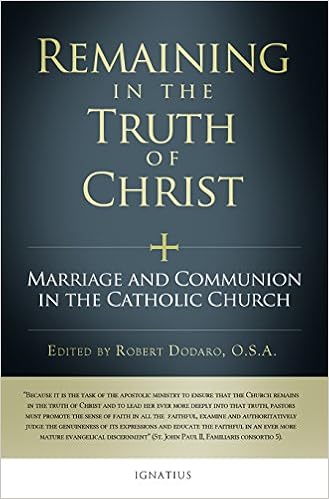
I think that the famous Five Cardinals Book™ – Remaining in the Truth of Christ – will eventually be seen as an important marker in this fork in the road for the Church.  US HERE – UK HERE ITALY HERE

If I am reading the stars and tea leaves and windy skies and entrails properly, I think we will see some great figures rising up.

“True” prophets.

They won’t come from the Fishwrap, or the Bitter Pill, or Amerika types.  They won’t come from the “Olympian Middle” either (and you know whom I intend).

NB: Don’t miss her peroration.

PS: The moderation queue is ON. Don’t post comments that haven’t been thought through and filtered. Remember that YOUR comments – in the eyes of some – reflect also on me. Some venting I can allow, but spewing and thoughtless lashing out I will not. This isn’t the Fishwrap.

Posted in Hard-Identity Catholicism, Our Catholic Identity, The Coming Storm, The Drill, The future and our choices | Tagged , ,
39 Comments

ASK FATHER: Baptized Catholic but never practiced: do marriage laws apply?

From a reader…

QUAERITUR:

I have two younger brothers who are close in age and who were both baptized Catholic as babies. Very early in their life, when they were around 1 and 3 years old respectively, our mom left the church and has since attended a Methodist church. Since canon law requires permission for the validity of a marriage for those baptized as Catholics, would my brother’s marriage be valid since he never had any conscious time being raised a Catholic? I know two baptized Protestants who have never been Catholic validly and sacramentally marry, but former and current Catholics who are baptized do not validly marry outside the church or without her permission.

The Church operates under the ancient dictum:

Semel Catholicus, semper Catholicus.

Once a Catholic, always a Catholic.

Or, if we want to be technical: Semel baptizatus, semper baptizatus.   You can’t change the fact that a) you were baptized and b) that baptism happened in the Catholic Church.  (Mine happened in the Lutheran Church, a fact I would change if I could, but I can’t, anymore than those baptized in the Catholic Church can change that fact.)  We will leave aside attempts to “defect” from the Church by a formal act rather than by negligence or laziness, which doesn’t figure into this entry.  Besides, the Church’s law about that was changed in 2009.  HERE

Being a Catholic is not like joining a club.  In a club, if you fail to pay your annual dues, or you stop attending, or even make a fuss and shred your registration card you can be kicked out. Or you can voluntarily leave.

Not so with the Church.

Once you’ve been baptized Catholic, your only choices are to be a practicing Catholic, or a lapsed Catholic.

Even excommunication, despite what some think, doesn’t kick you out of the Catholic Church. Instead, it’s more like you’re put into the penalty box until you come to your senses, reform your life, ask forgiveness, and come back.

You don’t get re-baptized, you just get absolved. You get your penalty lifted, and you’re back in the pew with the rest of us, praying, and struggling, and trying to get to heaven.

To turn the sock inside out, think of it this way: The bonds of the baptized Catholic and the Catholic Church run in both directions.  The Catholic might stray but the bond is there anyway.  The Church wants you, dear Catholic, to be in the Church and she won’t let go of you if you are simply running about doing silly things and not practicing your Faith.

And so, all Catholics are bound by the laws of the Church, even if they’re not aware of them.

That means marriage laws too.

Catholics who marry outside of the Church, and who don’t obtain a dispensation to do so, aren’t really married.  This includes those who were baptized as Catholics while infants but who never practiced their faith after that.

Dura lex, sed lex.

Posted in "How To..." - Practical Notes, ASK FATHER Question Box, Canon Law, Hard-Identity Catholicism, One Man & One Woman, Our Catholic Identity | Tagged , ,
19 Comments

Damian Thompson asks: “Is the Pope Catholic?”

At Heat Street, Damian Thompson asks: “Is the Pope Catholic?”

That site is a mess to read, so let’s see some of it here.  My emphases and comments:

Is the Pope Catholic? Here’s Why Many of Pope Francis Flock Aren’t Sure

Pope Francis, we learned this week, will take part in a service next year to celebrate a great moment in Christian history.

The Reformation.

Yes, you read that right. ‘Pope celebrates Reformation’ sounds like an Onion headline, but it’s actually going to happen – when Francis travels to Sweden next year to mark the 500th anniversary of Martin Luther’s first furious broadside against Rome.  [Here’s one Catholic who won’t be celebrating the Reformation.  I’ll be flipping to the back of my Missale Romanum for Votive Masses Pro fide propagatione, and ad tollendum schisma and  contra persecutores Ecclesiae….]

Liberal Catholics, liberal Protestants and the secular media will cheer when he does so. They will drown out the groans of traditional Catholics for whom this is yet another feelgood stunt by a pope who isn’t interested in theology. [That doesn’t sound like an unqualified “Huzzah!”, does it?]

And only the very sharp-eared will hear the rattle of decapitated skeletons – both Catholic and Protestant – turning in their graves.

The Reformation jamboree will pay lip service to the ‘tragedy’ of the 16th-century martyrs. But if those bones could speak, I suspect they’d say the real tragedy is the spectacle of Catholic, Lutheran and Anglican leaders glossing over the doctrines for which they died.

One thing is for sure. Benedict XVI, if he were still pope, wouldn’t be throwing himself into the Reformation festivities. Indeed, it’s hard to think of anything Francis has done that his retired predecessor really approves of.

‘Exactly!’ say Francis’s millions of admirers. ‘Benedict was a dinosaur who tried to turn the clock back. Francis is sweeping out the Vatican stables. He’s making Catholicism more compassionate. And did you see him with George Clooney?’

At which point I’m the one letting out a groan, together with lots of Catholics who, like me, were initially charmed by the Argentinian pontiff’s laid-back style.

Let’s get one thing straight. Pope Francis is not a ‘great reformer’, as one sycophantic biographer dubbed him. He’s pushed through just one overdue reform – simplifying the church’s marriage annulment procedures. [The annulment thing… oh boy, don’t get me started.  However, were Francis to accomplish only a financial reform of the Curia, that would be something noteworthy for a pontificate.]

His other ‘reforms’ never happened and aren’t going to.  [… not sure which he means here…]

That’s because Francis has a bad habit of hinting at big changes to Catholic teaching (especially on sexual morality) that he never gets round to proposing – either because he knows his bishops don’t support them or because he hasn’t made up his own mind how far he wants to go.

To add to the confusion, sometimes he gets over-excited during one of his mid-flight interviews and lets slip a remark that implies, accidentally, that he favours changes that he actually opposes.

For example: ‘Who am I to judge?[That phrase has caused a lot of confusion, hasn’t it?] The Pope was explaining that gay people who didn’t have sex or had repented shouldn’t be judged. But he was chatting away carelessly, so the journalists thought he was giving the green light to homosexual relationships.

The other thing they overlooked was the question Francis had been asked – about his friend Mgr Battista Ricca, a Vatican official who’d allegedly been trapped in a lift with a rent boy.

Ricca has been accused of many scandalous indiscretions. But he’s kept his job. Francis’s allies tend not to be ‘judged’ and, as a result, the Vatican stables are as dirty as ever. Shockingly, the Pope invited Cardinal Godfried Danneels, who had covered up family sex abuse by a Belgian bishop, to a Vatican Synod on the family last year.

That synod had the unenviable task of trying to clear up the biggest mess created by any pope for decades[whew] – over the ultra-sensitive issue of whether divorced and remarried Catholics can receive communion.

Francis wanted to relax the rules. But, typically, he didn’t set out any theological arguments and the synod voted against change.

His response? A long document, Amoris Laetitia, which dodged the question but mused incoherently about mortal sins not being mortal sins. Asked about a puzzling footnote, Francis said he couldn’t remember what was in it.

Was he serious? We don’t know, but last week it was revealed that some of the most controversial bits of Amoris Laetitia had been lifted from articles written a decade ago by a third-rate Argentinian theologian, Archbishop Victor Fernandez, [a little strange] who just happens to be an old friend of Francis.

“Is the Pope a Catholic?” asked orthodox Catholics, only half-jokingly. To which the answer is, of course, yes: the former Jorge Bergoglio is a man passionately devoted to Jesus and Mary who, in his own eccentric way, is trying to be loyal to the Church.

The problem is that, although his beliefs are (relatively) orthodox, he is behaving like a befuddled Anglican Primate who is too busy charming the media with quirky quotes to attend to the duties of his office.  [ouch]

Or, to put it another way, the Pope may be a Catholic – but it’s beginning to look as if the cardinals made a terrible mistake when they decided that this particular Catholic should be a pope.

Okay, that’s not exactly a ringing endorsement from Damian.

However, I will interject a couple thoughts.

First, Popes can surprise, as Paul VI did – clearly guided by the Holy Spirit – in the matter of Humanae vitae.

Also, this Pope might be Nixon, to the SSPX’s China, if you get my drift.  He could be the one to reconcile them.  Why?  Because he is interested in what the SSPX will bring to the wider Church by their integration?  No.  Because… who knows why?  But it would be a huge feather in his cap.  If he can celebrate with Lutherans, he can celebrated with the SSPX.

Have I turned on the comment moderation queue?  You bet I have!

Posted in Francis, The Coming Storm, The Drill | Tagged , ,
59 Comments

ASK FATHER: Hard choices about a priest and a parish

From a reader…

Father, my heart aches over this. Having heard you speak and read your blog over the years, I believe you can guide me with wisdom, charity, and moderation.

We have attended a TLM parish for over ten years. Many families have left our parish to go to other parishes where the TLM is now offered, and our parish is not growing, possibly shrinking. The reason or part of the reason why some of those TLM-loving people have left is the pastor’s behavior.

In the past, I was better able to let it slide off my back, or rationalize it, but I am less and less able since seeing good and faithful Catholics I care about hurt. But I also realize my feelings could be motivated by self love, because my own life is harder and I long for some support and encouragement. (I know that sounds warm and fuzzy. Sorry.)

At times, I have felt so beaten down that the thought has gone through my head that maybe I shouldn’t be Catholic anymore. Not rational, I know. But it’s hard when we are doing our best to live our Faith fully and authentically with all of life’s challenges but are given the message from the pulpit that we are slacking in one way or another.

The proverbial stuff hit the fan after Mass last Sunday when my husband said he was never going back. Since the, St. Peter’s words are constantly in my heart, “To whom would I go? You have the words of everlasting life.”

To complicate matters, there’s the question of using the 62 Missal and the earlier one for Holy Week and Pentacost. There are murmurings about that. Is this a serious issue that I should be concerned about? Is it disobedience? Obedience to the Church is essential to me, even when things seem wacky out there.

At this point I wouldn’t worry much about the use of the pre-1955 Holy Week rites.  The older books are used in some places.  This is an issue that, over time, will get sorted out.   We have a lot of rebuilding to do before we get worked up about that.

Meanwhile, I’ll address myself to other points.

For many years now, in certain places, faithful, orthodox Catholics have suffered. Much of it has been at the hands of the very pastors who should guide, comfort, and bless them, thus leading them closer to God.  A couple things have resulted.

On one hand, these faithful,orthodox Catholics have idealized a past (or fantasized about a future) wherein pastors were perfect, the faith was lived in a full and vibrant manner, and everything combined to create villages or neighborhoods full of saints.  On the other hand, some inflate conflict where there are just minor disagreements.  They are happy only when they are unhappy and they bring about the drama and circumstances whereby their expectations are self-fulfilled.

Both paths can undermine real spiritual growth.

It is good to strive for perfection. We can and must look to the past for a guide.  We have to do so soberly. Pastors of souls, since the time of the apostles, are – gulp – human.  They have faults and failings and sins that work against their own march toward heaven.  They can be scandalous to the faithful they lead. Pray for your fallible pastors, especially the ones with whom you disagree.

Even the most liberal, angry, bitter, immature priest is loved by Jesus Christ, who desires his salvation.

Satan wants us to lose hope, give up, to stop striving for holiness, to get involved in petty disputes, to allow the sins of others to drag us down, to lose our faith, and, by so doing, to fall directly into his clutches.

Don’t let him win.

Pray harder.

Be stubborn about your faith.

Invoke the Blessed Virgin, your Guardian Angel, St. Michael, all the saints, and push through.

Be faithful.

Examine your conscience and …

GO TO CONFESSION!

Posted in ¡Hagan lío!, ASK FATHER Question Box, GO TO CONFESSION |
27 Comments

ASK FATHER: Can a nun give a homily?

From a reader…

QUAERITUR:

I have a serious question. Should a nun w or wo a habit (I got wo habit of course) be allowed to give a homily by the priest who just got done reading the Gospel. I was under the impression that was not on. More importantly should I have stood up and yelled at sister liberal suit pants. Am I over reacting? Am I mistaken? Is my internal compass less than Catholic at this moment? I am not a liturgy expert but this bothered me to the core. It did not help when she began to plead for the poor immigrants. You know the type. I am not going to sink the ship of a person perfectly willing and able to do the job herself. Thank you for your answers. you service is invaluable. Even to those of us who have never had the privilege of the Latin mass.

Of course a lay person (married, single, or vowed religious) cannot preach a homily at Mass. That is reserved to those in Holy Orders: bishops, priests, and deacons (if they have the faculty to preach).

For years, liturgists found “wiggle room” in the rubrics, and went to great lengths to make artificial distinctions between a priest delivering a homily and a lay person offering a “reflection.” Sometimes, the priest would stand at the pulpit and say some quick, vacuous statement, which would then be followed by a de facto homily. At other times, a lay person would be invited to “reflect” but not use the pulpit to do so.

Liberals are great at playing childish games if they don’t get their way.

Any uncertainty about the matter was wholly clarified in 2004 with the publication – at the behest of St. John Paul II – of the CDW’s Instruction Redemptionis Sacramentum which has three concise paragraphs about the matter:

64 The homily, which is given in the course of Holy Mass and is a  part of the Liturgy itself, should ordinarily be given by the priest celebrant himself. He may entrust it to a concelebrating priest or occasionally, according to circumstances, to a deacon, but never to a layperson.  [Not really ambiguous, is it.]

65 It should be borne in mind that any previous norm that may have admitted non-ordained faithful to give the homily during the eucharistic celebration is to be considered abrogated by the norm of canon 767, 1. This practice is reprobated, so that it cannot be permitted to attain the force of custom. [So, the short answer is “No.”  The long answer is, “Noooooooooooo.”]

66 The prohibition of admission of laypersons to preach within the Mass applies also to seminarians, students of theological disciplines, and those who have assumed the function of those known as ‘pastoral assistants;’ nor is there to be any exception for any other kind of layperson, or group, or community, or association. [Yep, it’s “nope”.]

Article 74 explains that, occasionally (not as a regular practice) a layperson may give an “instruction or testimony” after the prayer after Communion, and these may not replace the homily, nor be of such a nature that it could be confused with a homily. A good example of what this article refers to would be a brief invitation to a parish event, the introduction of a seminarian who will be staying in the parish for the summer,  or the announcement by a group of religious women who will be conducting home visitations within the parish over the next few weeks.

All that said, proper decorum and the sacredness of the Holy Mass in general precludes standing up in the moment and yelling imprecations at Sr. Libby Pantsuit, RSM.

Just because she’s wrong and she gravely mars the holiness of moment by this abuse doesn’t mean that we should sink to her level.

Alternatives could be …

  • standing up (ideally, with others) and walking out to the vestibule to pray a decade or so of the rosary while this nonsense goes on;
  • a few stern but reasonable words to Father after Mass;
  • a politely worded letter to the bishop if it would do any good;
  • redirecting some of one’s financial support of the parish to another worthy cause for as long as this sort of abuse goes on.
Posted in "How To..." - Practical Notes, ASK FATHER Question Box, Liturgy Science Theatre 3000 | Tagged , , ,
2 Comments

Turn towards the Lord!

The esteemed scholar and liturgist Klaus Gamber said that the single most damaging thing that happened in the wake of the Council was the shifting around of orientation at the altar.   In The Spirit of the LiturgyJoseph Ratzinger picked up on Gamber’s work and wrote his own exceptional explanation of the significance of ad orientem worship.  He advocated a return to ad orientem worship, but in a way that was peaceful, not like a abrupt way that changes had been imposed on the people of God – changes never called for by the Council Fathers – virtual overnight and without explanations.  As a transitional phase, Ratzinger suggested what has come to be known as the “Benedictine Arrangement” of  candles and crucifix on the altar.  My friend Fr. Lang has a helpful book about Turning Towards the Lord.  Over the last few year a growing number of priests (sometimes with the help of, sometimes with the interference of bishops) have been taking their parishes to ad orientem worship.  I know one parish where this was implemented, along with the installation of an altar rail.  Now, there, virtually everyone kneels to receive Communion on the tongue, parish registrations are up, and the average age of the congregation is plummeting.

Our re-orientation of our liturgical worship of God is of central importance for the revitalization of our Catholic identity.

The revitalization of our Catholic identity – and therefore our ability to influence the world around us – is only possible through a renewal of our liturgical worship.  No great undertaking we enter into as a Church (macro or micro) will succeed without it being rooted in proper sacred liturgy, whence comes what we need to initiate and sustain all our good efforts which are pleasing to God.

Recently His Eminence Robert Card. Sarah drew attention to ad orientem worship in aninterview with French Catholic magazine Famille Chrétienne.

Picking up on that interview, and the fact in Providence, RI there is a parish where Mass is said ad orientem, the diocesan newspaper of the same Providence has an article that features comments of my friend Fr. Jay Finelli.  HERE

A snip:

“We’re worshipping with the people in a common orientation,” he said. “We’re going toward the Lord.”

Initial reactions to the changes at Holy Ghost were mixed, but Father Finelli said parishioners have come to enjoy the practice. More importantly, he said, returning to their liturgical roots has benefitted the parish spiritually.

“In the beginning a few people had difficulties,” he said. “But now it seems to have led to a — how can I express this — a deep spirituality. There’s more of a reverence, there’s more of a prayerfulness on behalf of the whole congregation.”

Father Finelli said the practice is also beneficial for priests, who are reminded of their role in the liturgy by facing God as the people do.

“It shows us that we, the priests, aren’t the focus,” he said. “We’re not important. We’re just a vessel of the Lord being used by him for the people.”

Though he said he thinks the celebration of the liturgy ad orientem could be practiced in any parish, Father Finelli advised priests considering it to thoroughly teach the meaning behind the practice before instituting any changes. He believes that much of the discomfort with changes following the Second Vatican Council as well as discomfort with the return of pre-Vatican II practices in recent years stem from a lack of education.

“After the Second Vatican Council, there was no discussion and it caused a lot of anger, pain and hurt,” he said. “But if we teach the people as we should — why are we doing this, why is this important — of course some might not like it in the beginning, but eventually I think it really sinks in.”

Fathers! Get on this!

Posted in "How To..." - Practical Notes, Hard-Identity Catholicism, Liturgy Science Theatre 3000, Mail from priests | Tagged , ,
14 Comments