QUAERITUR: Is it a sin for children to “play Mass”?

From a readerette:

A few years ago, my brother-in-law related a story that his family had invited their (then) pastor to dinner one night. When the pastor arrived at the home, he saw my brother-in-law, then a child, playing priest, and pretending to celebrate the Mass. The pastor admonished him not to do this anymore because it is a sin.

Nowadays, some Catholic stores sell kits for children to play priest. They are complete with pretend chalice, paten, etc. I have never purchased one of these. However, my son speaks of wanting to be a priest someday. He uses a piece of furniture as his altar and scavenges household items to use at his altar. He pretends to celebrate the Mass all decked out in his Franciscan dress-up costume, draped with blankets and a scarf for his vestments. Yes, lately, he sometimes pretend to be Pope Francis!

He is 12. Is it a sin for him to do this? Should I discourage him from doing this?

Thank you for your blog and for all you do for us through your internet ministry.

Short answer: NO! It is not a sin. Don’t discourage this.

It is not a sin for children to “play Mass”.  As a matter of fact, I think it’s great… for boys.

The only problem I can think of is if, as they got older, they would be less than respectful of what they were imitating.

I’ll bet some parents can jump in.

I have written about this question before, by the way. HERE and HERE and HERE.

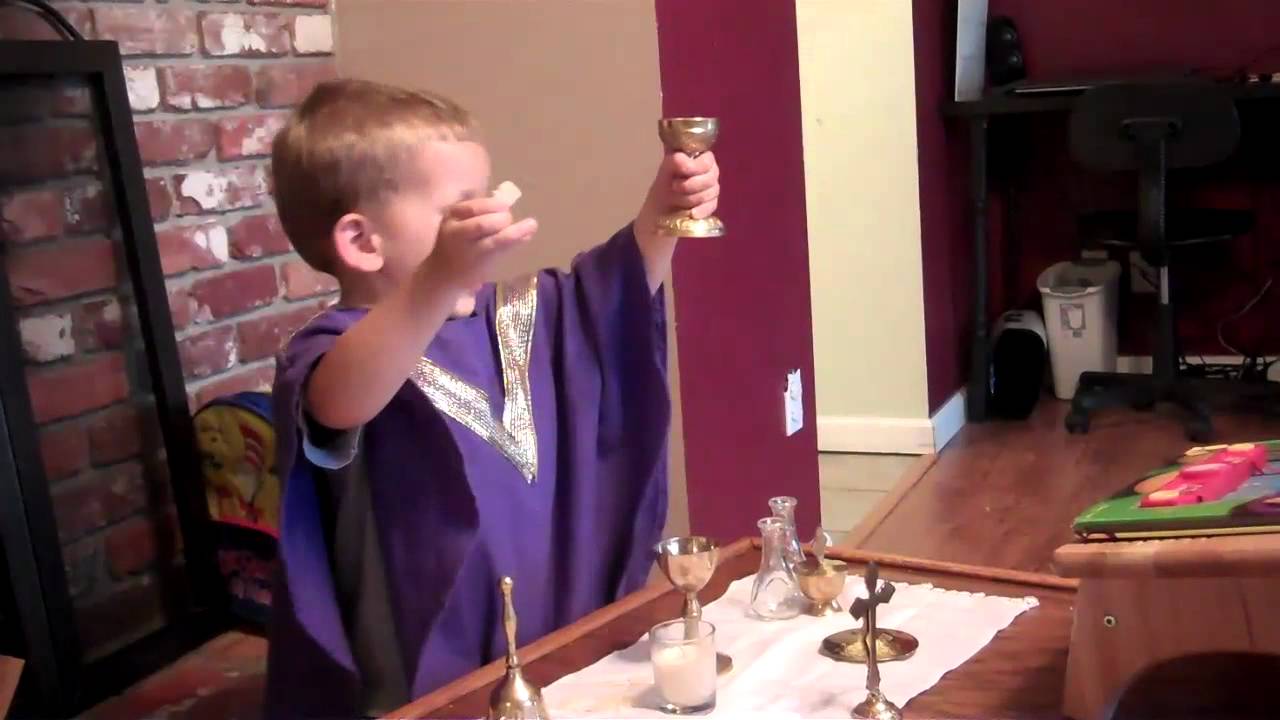
As a matter of fact, I received and posted a marvelous video of a tike playing Mass.

YouTube thumbnailYouTube icon

UPDATE:

From another readerette:

I want to remain anonymous on your blog but I have a response to your above thread:

When my sons were small, one of them played priest using a piano bench as an altar, a nut dish as a chalice and a small silver tray as a paten, potato chips as hosts and coca cola as wine. Their brothers and sister “received” on the tongue. After experiencing certain liberal priests he changed his orientation towards the priesthood but regained it when meeting holy priests as an adult. He is now an [traditional group] priest and so are 2 of his brothers.

Intelligenti pauca!

Posted in "How To..." - Practical Notes, ASK FATHER Question Box, Lighter fare, Liturgy Science Theatre 3000, Our Catholic Identity | Tagged ,
68 Comments

Learn more about Pope Francis and about Saint Francis

Do you want to know a little more about Pope Francis?  Publishers are getting up to speed. We know so much about Pope Benedict before his election.  In comparison, we don’t really know much about this new fellow.

(Readers in UK and Canada… I have an search box for you at the bottom of the blog… cut and paste titles or authors.)

There are new books for pre-order (buy a Kindle HERE).

Pope Francis by Matthew Bunson

Available for pre-order On Heaven and Earth: Pope Francis on Faith, Family, and the Church in the Twenty-First Century by Jorge Mario Bergoglio

Francis: Pope of a New World by Andrea Tornielli

I looked at an advance copy of this book and it is… okay.

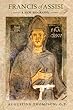
A great new biography of St. Francis of Assisi by Fr. Augustine Thompson, OP, who posts here now and then. Learn about the saint after whom Pope Francis purposely chose his name.

Posted in "How To..." - Practical Notes, Francis, Saints: Stories & Symbols | Tagged ,
4 Comments

Pope Francis’ General Audience focused on women. Feminists aren’t going to be happy.

The text of Pope Francis’ general audience:

Feminists and proponents of women’s ordination aren’t gonna be happy.

My emphases and comments:

Dear Brothers and Sisters,
Today we turn to the Catechism of the Year of Faith. [Well!  He mentioned it again.] In the Creed we repeat this phrase: “He rose again on the third day, in accordance with the Scriptures”. This is the very event [a historical event] that we are celebrating: the Resurrection of Jesus, the center of the Christian message that has resounded since the beginning and has been handed down so that it may reach us today. Saint Paul writes to the Christians of Corinth: “For I handed on to you …what I also received: that Christ died for our sins in accordance with the scriptures; that he was buried; that he was raised on the third day in accordance with the scriptures; that he appeared to Cephas, then to the Twelve”(1 Cor 15:3-5). This brief confession of faith announces the Paschal Mystery, with the first appearances of the Risen Christ to Peter and the Twelve: the Death and Resurrection of Jesus is the heart of our hope. Without this faith in the Death and Resurrection of Jesus our hope would be weak, but it wouldn’t even be hope, the Death and Resurrection of Jesus is the heart of our hope. The Apostle says: “If Christ has not been raised, your faith is vain; you are still in your sins” (v. 17).
Unfortunately, there have often been attempts to obscure faith in the Resurrection of Jesus, and doubts have crept in even among believers themselves. A watered down faith, as we would say, not a strong faith. This is because of superficiality, sometimes because of indifference, occupied by a thousand things considered more important than the faith, or because of a purely horizontal vision of life. But it is the Resurrection that gives us the greatest hope, because it opens our lives and the life of the world to the eternal future of God, to full happiness, to the certainty that evil, sin, death can be defeated. And this leads us to live everyday realities with more confidence, to face them with courage and commitment. The Resurrection of Christ shines a new light on these daily realities. The Resurrection of Christ is our strength!
But how was the truth of faith in Christ’s Resurrection transmitted? There are two kinds of witness in the New Testament: some are in the form of the profession of the faith, namely, synthetic formulas that indicate the center of the faith. Instead, others are in the form of an account of the event of the Resurrection and the facts connected to it. The form of the profession of faith, for example, is what we have just heard, or that of the Letter to the Romans where Paul writes: ” for, if you confess with your mouth that Jesus is Lord and believe in your heart that God raised him from the dead, you will be saved “(10.9). From the earliest days of the Church, faith in the Mystery of Death and Resurrection of Jesus is steadfast and clear.
Today, however, I would like to dwell the second, on testimony in the form of the accounts that we find in the Gospels. First, we note that the first witnesses to this event were the women. At dawn, they go to the tomb to anoint the body of Jesus, and find the first sign: the empty tomb (Mk 16:1). This is followed by an encounter with a Messenger of God who proclaims: Jesus of Nazareth, the Crucified One, he is not here, he is risen (cf. vv. 5-6). The women are driven by love and know how to accept this proclamation with faith: they believe, and immediately transmit it, they do not keep it for themselves. They cannot contain the joy of knowing that Jesus is alive, the hope that fills their heart. This should also be the same in our lives. Let us feel the joy of being Christian! We believe in the Risen One who has conquered evil and death! Let us also have the courage to “go out” to bring this joy and light to all the places of our lives! The Resurrection of Christ is our greatest certainty, it is our most precious treasure! How can we not share this treasure, this beautiful certainty with others! It’s not just for us it’s to be transmitted, shared with others this is our testimony!

[OKAY!  Here we go!  This is a good day for our team, friends.]

Another element. In the professions of faith of the New Testament, only men are remembered as witnesses of the Resurrection, the Apostles, but not the women. This is because, according to the Jewish Law of the time, women and children were not considered reliable, credible witnesses. [See what he is doing?  See?!?] In the Gospels, however, [!]women have a primary, fundamental role. [There it is!  The GOSPEL account is NOT culturally-conditioned, locked into a woman-repressing mentality.  The Gospel, the Christian message, breaks with that.] Here we can see an argument in favor of the historicity of the Resurrection: if it were a invented, in the context of that time it would not have been linked to the testimony of women. Instead, the evangelists simply narrate what happened: the women were the first witnesses. [Actually, the angels were the first… but let that pass.] This tells us that God does not choose according to human criteria: the first witnesses of the birth of Jesus are the shepherds,[again, the first were really angels… but let that pass…]  simple and humble people, the first witnesses of the Resurrection are women. This is beautiful, [this is fantastic!! Now wait for it…] and this is the mission of women, of mothers and women, [MOTHERS!] to give witness to their children and grandchildren that Christ is Risen! Mothers go forward with this witness! [MOTHERS!] What matters to God is our heart, if we are open to Him, if we are like trusting children. But this also leads us to reflect on how in the Church and in the journey of faith, women have had and still have a special role in opening doors to the Lord, in following him and communicating his face, because the eyes of faith always need the simple and profound look of love. [By being MOTHERS.  He isn’t talking about Church ministry.  Far from suggesting anything about leadership positions in ecclesiastical structures, Francis is talking about having babies and being strong Catholics.] The Apostles and disciples find it harder to believe in the Risen Christ, not the women however! Peter runs to the tomb, but stops before the empty tomb; Thomas has to touch the wounds of the body of Jesus with his hands. In our journey of faith it is important to know and feel that God loves us, do not be afraid to love: faith is professed with the mouth and heart, with the word and love.
After the apparitions to women, there were others: Jesus becomes present in a new way: He is the Crucified One, but his body is glorious; He did not return to an earthly life, but a new condition. At first they did not recognize him, and only through his words and deeds were their eyes opened: the encounter with the Risen Lord transforms, it gives new strength to faith, an unshakable foundation. The Risen Christ also reveals Himself to us with many signs: Sacred Scripture, the Eucharist, the other Sacraments, charity, these gestures of love bring a ray of the Risen One.  [Mothers Marching in the Plaza de Mayo morphed into Mothers Marching for the Resurrection of Jesus.]
Let us be enlightened by the Resurrection of Christ, let us be transformed by His power, so that through us the signs of death give way to signs of life in the world! I see that there are many young people in the Square! Young boys and girls, to you I say bring forth this certainty to the world: the Lord is Alive and walks beside us on our life’s journey! Bring forth this hope, be anchored in this hope, the hope that comes from heaven! Be anchored and bring forth the hope! You witnesses of Christ bring forth hope to this world that is aged by wars and sin! Go forward young people!

MOTHERS!  GO FORTH!  MARCH FOR LIFE!  MARCH FOR FAITH!

Posted in Francis, Just Too Cool, One Man & One Woman, Our Catholic Identity | Tagged , ,
88 Comments

ARCHBISHOP Sample is in Portland

Archbishop Viganò just read the letter of Pope Benedict XVI from last January to Archbishop Alexander Sample, now being installed in Portland.

There is a live stream.

Here is a great screen capture.

A mitre (a little odd), a cardinal’s biretta, a priest’s black biretta, a simple white mitre and an … eye-patch (which has no liturgical function that I know of… though I do know some who turn blind-eyes toward liturgical abuses… okay… I’m not saying that the bishop in the … oh darn… I’ll just stop….).  I don’t know who the bishop is with the eye-patch, bless him. [I knew the participants in the combox would supply the information: he is Bishop David Choby of Nashville.  I trust that whatever may be the trouble, it is temporary and brief.]

The first part of the ceremony was pretty chatty and the announcers on the stream talk way too much.  I am hoping that as this goes along we will get a sample of Sample’s style.  You may remember that now-Archbp. Sample gave an amazing sermon in Detroit, which I posted HERE.

I look forward to Archbp. Sample’s remarks.  He is now the shepherd of a city that is not known for its conservative Christian values.  (GREAT Chinese food, however.  I now have another reason to visit again!)

UPDATE:

Archbp. Sample’s sermon was the real deal.  After he got some of the necessary warm-up boxes checked, he gave a strong homily.  Hopefully we can get the audio or video of that part posted here soon.

I especially enjoyed the moment in which Sample cited the Latin phrase, Nemo dat quod non habet, which in macaronic Latin is “Nemo dat quod non got”.  This was great because the late Msgr Schuler in St. Paul at St. Agnes parish, where Archbp. Sample lived as a university student, used to quote that all the time.  I can’t help but think that the Latin phrase was a tip of the mitre in monsignor’s direction.

Posted in Brick by Brick, Just Too Cool | Tagged ,
62 Comments

What’s this you say? Popes are *not* above the law? Analysis at Commonweal.

Seen at the site of Commonweal.  This is great!

You watch… now that a liberal publication has put out something like this, pretty soon other liberals will be okay with talking about exactly what we have been discussing.  The difference will be that when they start in on it, they will claim that they are being thoughtful and reasonable, whereas when we talk about these things here, they claim that we are obsessed with lace or that we hate women or that we are fixated on rubrics… blah blah blah.

That said, here is Komonchak at Commonweal who strikes pretty close to the center.

Pontifex legibus solutus?
April 1, 2013, 3:11 pm
Posted by Joseph A. Komonchak

Conservatives and traditionalists need not be the only ones to raise questions about some of Pope Francis’ liturgical innovations, whether it was his including women and Muslims among those whose feet he washed or in the reduction of the readings for the Easter Vigil. [NB…] But shouldn’t we all be concerned when they are justified by the idea that, after all, the pope is the supreme law-giver and so is not bound by Church law. [Okay… am I reading a Commonweal entry?  Is this still 1 April?] There is an old Latin legal term for this: princeps legibus solutus, which Black’s legal dictionary translates as: “Released from the laws; not bound by the laws. An expression applied in the Roman civil law to the emperor.” As the example given shows, it is a very dangerous principle to allow into ecclesiology.  [I am rubbing my eyes.  What is he really up to?]

At Vatican II, when no. 22 of Lumen gentium was being discussed, Pope Paul VI proposed introducing into a sentence about the pope’s relationship to the college of bishops that in deciding whether to call the bishops to a collegial act a pope was “bound to the Lord alone” [uni Domino devinctus] The Doctrinal Commission refused this addition for two reasons: (1) its intent was already assured by statements about the pope’s freedom and independence, meaning by this that “there is no higher human authority which the Roman Pontiff has to observe”; and (2) because “the formula is over-simplified. For the Roman Pontiff is also bound to observe revelation itself, the basic structure of the Church, the sacraments, the definitions of previous Councils, etc.; [yep] all such things can’t be counted. Formulas of this sort, using ‘only,’ have to be treated with the greatest circumspection; otherwise countless difficulties arise.”

The Commission was pointing to elements that bind the pope in the exercise of his role. A pope is not legibus solutus. [Here’s the rub, I think…] Would we[“we” being…] not like to propose some conditions on what Pius XII’s claim that “the pope alone has the right to permit or establish any liturgical practice, to introduce or approve new rites, or to make any changes in them he considers necessary”? [Liberals would like to hem Popes in, you bet!] Can we be content with the view [watch…] that the Pope is not bound by Church law when he does something we like, but ought to be bound by Church law when he does something we don’t like?

So if one wishes to applaud some of the new Pope’s departures from Church law, before one gets too enthusiastic, it might be well to recall that it was also a pope who not so long ago tempted people [who?] to flee to the mountains when he obtruded the Divine Mercy devotion into Eastertide (see Mk 13:14).

Interesting!  Sounds familiar, no?  Pretty good, too.  Some reason applied to the issue.

That said…

It is the ultimate dream of liberals to restrict papal authority, just as they hope to see restrictions on bishops and the reduction of priests and priesthood to “ministry”.

BTW, liberals decry the liberal/conservative dichotomy when they are on the receiving end, but they use it too.

Posted in "How To..." - Practical Notes, Francis, Liturgy Science Theatre 3000, Our Catholic Identity, The Drill | Tagged , , , , , , ,
32 Comments

“absolutely licit”…. MY FOOT!

Spotted on the Facebook page of Ed Peters, canonist.

Every time I turn around, someone is citing Fr. Lombardi’s comment that the pope’s washing of women’s feet on Holy Thursday is “absolutely licit” because it’s not a sacrament. Now, whatever one might finally conclude about the liceity of the pope’s action, it simply CANNOT be defended on the grounds that Lombardi uses.

Consider: the homily is not a sacrament (obviously); the homily is optional at weekday Masses (c. 767 § 3); the homily is reserved to clerics (c. 767 § 1). Okay? So, if a priest decides, as a gesture of charity and to model Christ’s inclusivity, to allow a woman (well, any lay person) to preach the homily at a weekday Mass, is his action suddenly licit? And don’t tell us this does not really happen.

Where did the “absolutely licit” thing come from? People have sent email asking about this.  Here’s the deal.

There was a briefing of journalists in Rome by the papal spokesman Fr. Federico Lombardi, SJ, about the Holy Week ceremonies.  The issue of the washing of the feet of women came up, of course.

Lombardi’s remarks include the phrase (in translation)…

I would not make a big theory of this. I say: it is a pastoral reading of this event which I believe to be absolutely licit (legitimate?) and also present in the Church….

Okay… it is unclear what is “absolutely licit” in Lombardi’s remarks.  More below. But I think he is talking about Pope Francis choice to flout the rubrics of Holy Mass which all bishops and priests are obliged to follow.

On the site of Vatican Radio, there is a summary of the briefing including extensive quotes from Fr. Lombardi’s remarks.  Have a look at the original… because we don’t want to get this wrong or misrepresent him (emphasis mine):

“la regola classica della tradizione liturgica è di uomini, pensando ai dodici apostoli e quindi al fatto che la lavanda dei piedi la fa Gesù, nel Cenacolo, ai suoi dodici apostoli, che notoriamente erano uomini. Allora in questo senso la tradizione vuole che siano dodici uomini… La pratica pastorale nella Chiesa dei pastori che hanno l’“odore delle pecore” – come sappiamo – è che si tiene anche molto in conto la situazione concreta, diciamo la comunità per cui e in cui si celebra e il significato che questo gesto, che non è un sacramento della Chiesa, ma è un rito significativo, inserito anche nella Liturgia, ma che non è codificato da leggi fondamentali della Chiesa, si possa vivere a seconda del significato pastorale che assume. Tanto è vero, mi pare, che abbiamo visto anche per il passato delle foto del cardinale Bergoglio, arcivescovo di Buenos Aires, che fa la lavanda dei piedi con anche delle donne. Quindi non è una cosa inventata ieri in particolare. Credo che molti di noi, che hanno una certa esperienza pastorale in diverse situazioni o di gruppi giovanili o altro, hanno usato questa interpretazione molte volte nel corso della loro vita pastorale. Quindi qui si tratta di una comunità, dove era ieri il Papa, una comunità piccola, non era la Cattedrale di San Giovanni con tutta la diocesi di Roma: era una comunità piccola, costituita in una parte importante da giovani e anche da giovani ragazze, in cui il gesto della lavanda dei piedi aveva un ruolo molto importante nell’evento e nel suo significato di presentare e far sperimentare lo spirito di servizio e di amore del Signore a questa comunità, che è una comunità che capisce le cose anche molto essenziale e semplici, perché non erano studiosi di Liturgia. In questo senso è stato – mi sembra – del tutto normale che nel gruppo delle 12 persone che ricevevano la lavanda ci fossero anche due ragazze, perché è una componente importante – quella delle ragazze – della comunità che vive la sua esperienza nell’Istituto di Casal del Marmo. Siccome poi il criterio con cui erano stati scelti questi dodici era proprio di rappresentare anche le diverse etnie e le diverse componenti presenti nella comunità di Casal del Marmo, in questa comunità le ragazze sono una parte importante e quindi sarebbe stato strano che non fossero comprese in questo gruppo. Io non vorrei farne una grande teoria. Dico: è una lettura pastorale di questo evento che credo che sia assolutamente lecita e anche presente nella Chiesa e credo che fosse anche quella dell’esperienza dell’arcivescovo di Buenos Aires”.

The Italian is strange, even tortured.  This lead me to ask a Roman friend to help me out with the translation just so that I wasn’t posting something unfair.  Keep in mind that Fr. Lombardi is speaking off the cuff, not from a prepared statement.  He is probably getting mixed signals from different offices of the Curia.  He probably has his own views which he is more or less struggling to hide even while revealing them…. so… here is the translation with a couple additions for clarity (and my emphases):

“the classic norm of the liturgical tradition is of men, thinking of the twelve Apostles and thus of the fact that it is Jesus who does the washing of the feet, in the Cenacle, to his twelve Apostles, who were men, obviously. Then in this sense tradition wants it to be twelve men… The pastoral practice in the Church of the shepherds who have “the odour of the sheep” – as we know – is that the concrete situation is taken very much into account, shall we say the community for which and in which one celebrates and the meaning that such gesture  – which is not a Sacrament of the Church,  but a meaningful rite inserted also in the Liturgy, yet one not codified by fundamental laws of the Church – can be lived in keeping with the pastoral meaning that it takes (in a given context). This is so true, it seems to me, that we have seen also in the past photographs of Cardinal Bergoglio, (then) Archbishop of Buenos Aires, doing the washing of the feet including women. Therefore it was not something that was invented yesterday in particular. I believe that many of us who have a certain pastoral experience in a variety of situations either of youth groups or else have used this interpretation many times over the course of their pastoral life. Therefore we are speaking of a community, where the Pope was yesterday, a small community, it was not the Cathedral of St. John with the whole diocese of Rome: it was a small community,  for an important part made of youth and also young girls, where the gesture of the washing of the feet had a very important role in the event and in its meaning of showing the spirit of service and love of the Lord and to let this community experience it, a community that understands things that are very essential (singular declension in the original Italian: a typo?) and simple (plural in the original), since they were not experts of Liturgy. In this sense it seems to me  that it was completely normal that there would be also two girls in the group of 12 people who received the washing of the feet, because that of girls is an important component of the community that lives it experience in the Institute of Casal del Marmo. Moreover, since the criterion with which these twelve (people) were chosen was precisely that of being representative also of the diverse ethnicities and components present in the community of Casal del Marmo, in this community girls are an important part and therefore it would have been strange not to include them in this group.  I would not make a big theory of this. I say: it is a pastoral reading of this event which I believe to be absolutely licit (legitimate?) and also present in the Church and I believe it was also that of the experience of the (then) Archbishop of Buenos Aires”.

?!?

“classic norm” and “tradition” v. “pastoral practice” and “concrete situation”?

“yet one not codified by fundamental laws of the Church”?  It IS codifed!  In the rubric of the Missale Romanum in force now.  It was explained in the Congregation for Divine Worship’s document Paschale solemnitatis 51. The Congregation has answered questions about the practice.

At the end of this, I repeat…

We can flout the rubrics anytime we want for the sake of a sentimental motive … MY FOOT.

Just because the Pope did something in some ceremony which, apparently because it was small and in a jail, mattered a lot to the inmates but I guess didn’t really change anything for the rest us – except for the fact that the Pope did it and it was ballyhooed by the powers that be all over the world, that doesn’t mean that any bishop or priest can take upon himself to change the clear and important rubrics of Mass…. any rubrics.

NB: To the liberals reading this who have already spread the falsehood that people like me,  or Peters, because we write about this, are obsessed with the washing of women’s feet or are mired in the minutiae of liturgical rules, I respond: There is a bigger issue which you, apparently, can’t figure out because you are almost always wrong about almost everything.   Have a nice day!  o{]:¬)

Posted in Francis, Liberals, Liturgy Science Theatre 3000 | Tagged , ,
53 Comments

One look at Pope Francis’s first Holy Week. Fr. Z responds with brief manifesto.

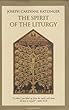
Many people don’t know that Pope Francis planned to write his thesis on Romano Guardini, the distinguished theologian and liturgist who had a profound influence on Joseph Ratzinger.  Ratzinger even named one of his most important books with the same title as that of one of Guardini’s, namely, The Spirit of the Liturgy.  (We need to read and apply what Ratzinger wrote now more than ever, by the way.) [Magister corrected his own entry which now reads: “It was precisely on Guardini that the Jesuit Bergoglio was planning to write the thesis for his doctorate in theology, during an academic sojourn in Germany in 1986 at the philosophical-theological faculty of Sankt Georgen in Frankfurt: a plan that was later abandoned.”]

click to buy

Pope Benedict, the day he stepped-down, quoted Guardini twice in his final speech as Pope.

A reader left a short note on my voice mail (see the side bar for more on that) about a piece by Sandro Magister concerning the first Holy Week of Pope Francis. I knew about the piece, but I liked the fact that he took the time to use the VM option.

Let’s have a look at Magister’s piece with my emphases and comments.  At the end, I respond.

First Holy Week for Francis

Powerful gestures. Simplified rituals. A week that has revealed the style of the new pope. But has also raised some questions that have gone unanswered

by Sandro Magister

[After review… I’ll cut the whole first part as not being especially relevant…]

ROME, April 1, 2013 – The first Holy Week of Pope Francis has revealed his style even more. In celebration, in preaching, in presence.

[… eventually he get’s to Pope Francis’ Chrism Mass…]

The “people” liturgically loaded onto the shoulders of the priest who celebrates, the “peripheries” of the cities and the hearts touched by the messianic oil, the pastors who must take “the odor of the sheep” are images that remain successfully imprinted.

“L’Osservatore Romano” of March 30 revealed that the text of this homily for the Chrism Mass, “with the exception of some additions,” was the same one that Bergoglio had “prepared before he was elected pope and had delivered to his collaborators before leaving for the conclave,” so much so that it was also read at the Chrism Mass celebrated in the cathedral of Buenos Aires.  [I had missed that, being busy with Triduum stuff.  I find that reassuring.]

*

[And now the point…] As for the “ars celebrandi,” in the liturgies of Holy Week at St. Peter’s there was noted a more elevated respect for the symbolism and the splendor of the rituals than that seen at work in the Mass for the beginning of the pontificate.  [I sincerely don’t mean for this to sound snarky, but it wouldn’t be too hard to have elevated the style in comparison to the first few days.]

Here as well, however, with abbreviations that were not always understandable. In particular, it was not clear why at the Easter Vigil, after the singing of the Exultet, the biblical readings were cut to the bone and the first was literally mutilated, with the account of the six days of creation limited to the creation of man alone.  [That was strange, indeed.]

That brevity which in some contexts can find justification and is in effect provided for by the missal [ahhhh…. Novus Ordo options…] made no obvious sense in an Easter Vigil presided over by the pope and attended – in person or via transmission – by a highly motivated faithful people, who were deprived of the fullness of that narration of the “historia salutis” which the liturgy illuminates, on this culminating night of the year, with the lighting of the Easter candle.

In one of his memorable passages, Romano Guardini described the celebration of the Easter liturgy in the basilica of Monreale, Sicily, packed with poor and mostly illiterate farmers, who nonetheless were enchanted by the splendor of the rite: “The sacred ceremony lasted for more than four hours, and yet there was always a lively participation.[Obviously meant as interior participation, a close and attentive following of all the gestures and words.]

It was precisely on Guardini that the Jesuit Bergoglio wrote the thesis for his doctorate in theology, in Frankfurt in 1986.

Magister is saying that, on the one hand, there have been improvements since the beginning of the pontificate. On the other hand, there is a serious defect and that Pope Francis ought to know better because he read Guardini.

Of course it is possible that Francis has forgotten what he read about Guardini… I don’t remember everything I wrote over the last couple decades and I am not 76… or that he read Guardini and came to different conclusions than Ratzinger did!  I haven’t read what Francis wrote – decades ago – about Guardini or what he concentrated on.  I don’t remember every point I made in my own thesis on Augustine.  If Bergoglio had planned to write a thesis on Guardini, that means that he had read a lot of Guardini along the way.

Moreover, as I have been saying all along, Pope Francis needs some time to learn how to be Pope.  We also have to learn to have him be our Pope.

He has done things that I think are both strange and ill-considered.  On the other hand, he minces no words about the warfare we are in with the Devil, to whom he refers clearly and boldly.  He spoke about the need for priests to hear confessions, though that was in private.  I’ll bet he speaks about it publicly too, before long.  In his homilies has has entirely eschewed a modern biblical exegetical style in favor of a more Patristic, allegorical style… even as Ratzinger famously used.  His use the image of the garb of the Old Testament priesthood and the chasuble priests put on for Mass was like something Pope Benedict would have offered us, and he wrote it before he was elected: it was his own work and not that of some flunky in the Secretariate of State.  There are a lot of things Francis is showing which traditional Catholics can sincerely applaud (if they can get over themselves long enough to see them).

Even though Francis has painted himself into a corner through his abrupt dramatic changes, he is more than likely going to adjust to the exigencies of his office, which include decorum at a different level and an awareness that he is more than the bishop of a diocese somewhere.

Time, friends.  Patience.  And pray for him.  He must be wondering if he is going to wake up from some sort of long, strange dream.

Here is my point.

We must not pit Francis against Benedict right now. We find the continuity between them.

Read Francis through Benedict.


Posted in "How To..." - Practical Notes, Benedict XVI, Francis, Liturgy Science Theatre 3000, Our Catholic Identity, Reading Francis Through Benedict, The Drill, The future and our choices | Tagged , , , , ,
52 Comments

New College to open in Bp. Finn’s diocese

Very cool brick by brick news from the Diocese of Kansas City-St. Joseph, where Most Rev. Robert Finn is, by the grace of God, bishop.

Go now to the side bar of this blog and look for the feed of the Cardinal Newman Society.  There you will find a story to click about a ….

Small College Could Open in KC-St. Joseph Diocese

The Kansas City Star reports that the Diocese of Kansas City-St. Joseph is considering allowing a nonprofit group from Texas to open a small college in their diocesan headquarters.

According to diocesan officials, The Walsingham Society of Christian Culture and Western Civilization wants to establish a Christ College in Kansas City. The group is considering leasing space from the diocese.

The College would offer a Catholic, seminar-based, Great Books course of study. The intention is to begin a pilot program, with a full academic program beginning in the fall of 2014.

“We are encouraged by the reception from many in the local Catholic community, and we appreciate the welcome and blessing from the Diocese of Kansas City-St. Joseph,” said Brinton Smith, president of The Walsingham Society. “We intend to be faithful in our teaching to the doctrine of the Church, but Christ College is otherwise an independent institution.”

[…]

Go read there and dig into the links.

Another Catholic response to the mind-repressing, gonad-stimulating, soul-annihilating main-stream education “opportunities” which are, so to speak, “out there”.

This is very cool.


Posted in Brick by Brick, Our Catholic Identity, The future and our choices | Tagged
8 Comments

Noodle preparation fun!

I am a fan of the films of Zhang Yimou.   Tonight I saw A Woman, A Gun, And A Noodle Shop (三槍拍案驚奇 Sānqiāng Pāi’àn Jīngqí). This is a surreal Chinese re-imagining of Blood Simple. Strange but intriguing.  Like some of Yimou’s other work, it seems like farce but then it turns out to be not so farcical.  He pokes a lot of fun at his own films, too, and it is beautiful to look at.

There was a moment, however, I thought I would share: the preparation of noodle soup.  

YouTube thumbnailYouTube icon

Alas, they cut it off before the hot oil was poured over the noodles and chilies.

Just for fun … or should I say mien.

A few of my favorite Zhang Yimou films are

The Road Home (我的父親母親 wǒde fùqin mǔqin)

The Story of Qiu Ju (秋菊打官司 Qiū Jú dǎ guān sī)

To Live ( 活著 Huózhe)

There are also, Not One Less, the spectacular Hero, Raise The Red Lantern, Red Sorghum, etc.

Posted in Just Too Cool, What Fr. Z is up to | Tagged ,
23 Comments

New Z-Swag items: Pope Francis!

In my online store there are some new items of Z-swag for Pope Francis.

Among them are mugs and other drinkware.

20130401-131209.jpg

And car magnets….

20130401-130038.jpg

Posted in Francis, The Campus Telephone Pole | Tagged , ,
30 Comments