Roadrunning

[wp_youtube]sFu4301-IJk[/wp_youtube]

USA HERE (mp3 HERE) and UK HERE (mp3 HERE)

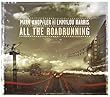
All The Roadrunning
Mark Knopfler

A million miles our vagabond wheels
Clocked up beneath the clouds
They’re counting down to show time
When we do it for real with the crowds
Air miles are owing but they don’t come for free
And they don’t give you any for pain
But if it’s all for nothing
All the road running’s been in vain

The rim shots come down like cannon-fire
And thunder off the wall
There’s a man in every corner
And each one is giving his all
But this is my piper, this is my drum
So you never will hear me complain
And if it’s all for nothing
All the road running has been in vain

All the road running

Well if you’re inclined to go up on the wall
It can only be fast and high
And those who don’t like the danger soon
Find something different to try
And when there is only a ring in your ears
And an echo down memory lane
Then if it’s all for nothing
All the road running’s been in vain

All the road running

The show’s packing up, I sit and watch
The carnival leaving town
And there’s no pretending that I’m not a fool
For riding around and around

Like the pictures you keep of your old wall of death
You showed me one time on the plane
But if it’s all for nothing
All the road running has been in vain

I’ve a million miles of vagabond sky
Clocked up above the clouds
And I’m still your man for the roaming
For as long as there’s roaming allowed
There’ll be a rider and there’ll be a wall
As long as the dream remains
And if it’s all for nothing
All the road running has been in vain

All the road running

Posted in On the road, What Fr. Z is up to | Tagged ,
5 Comments

QUAERITUR: Can I attend an “Anglican Use” parish?

From a reader:

My city has a an Anglican Use parish, and my understanding is their Mass is just like the TLM except, not in Latin. I can deal with that.

Is it permissible for regular Latin Rite Catholics to attend these Masses, or are they only for Anglicans who were received into the Church?

I believe that there is no law that prevents you from attending Holy Mass at an Anglican Use parish. They are in communion with the Holy Father and have a rapport with the local bishop. They are celebrating valid sacraments according to the Church’s duly promulgated laws. They have worthy worship in a Catholic Rite in the tradition of that which is familiar to Anglicans.

It seems to me that you can go to these Masses without second guessing. You can also attend the Divine Liturgy of Ukrainian Catholics or Maronites, etc.

In the meantime, perhaps some of you readers can talk about the differences between the TLM and the Anglican Use.  I believe, for example, that there is in the high liturgical Anglican tradition a virtual translation of the older Roman Missal.  I don’t think that has much traction in the Anglican Ordinariates, however.  They are sticking, if I am not mistaken, to an adaptation of the Book of Common Prayer.

I think it is wonderful that these good people are helping to raise the level of Holy Church’s worship. When the water rises, all boats rise.

Benedict XVI is the Pope of Christian Unity.

Posted in "How To..." - Practical Notes, ASK FATHER Question Box, Benedict XVI, Liturgy Science Theatre 3000, Our Catholic Identity, Pope of Christian Unity | Tagged , , ,
29 Comments

Women Religious as shareholders and proxy governance of corporations

Now this is interesting.

From the nice people at Acton Institute comes this fascinating piece of the puzzle that I hadn’t ever considered but, now that I know about it, it makes so much sense.

Nuns vs. Managers in the Proxy Wars

posted by JOE CARTER on

For many nuns in the U.S. April is a busy month. Not only do they have the liturgical season of Easter but they have the proxy season of corporate governance.  [“April is a cruel month…”]

The proxy season is the time when many companies hold their annual shareholder meetings. During these meeting any shareholders who own more than $2,000 in stock or 1% of the company can recommend the company take a specific course of action or institute a policy change for the betterment of the company. As the Manhattan Institute’s Center for Legal Policy reports, Catholic orders are among the most active of these shareholder activists.

As far as activism goes, shareholder activism is rather inert. To date shareholders have introduced only 1.43 proposals per company in the Fortune 200. The most active religious organization, the Sisters of Charity of St. Elizabeth, submitted a total of 21.

[…]

Since managers work for the shareholders, there doesn’t seem to be anything wrong with investors in a corporation trying to encourage specific policies or levels of disclosure. If the management of Starbucks can decide what social causes they choose to support, why shouldn’t the people who actually own the company have a similar say?

The Sisters of Mercy should have the right to pressure the managers (who work for them) to do what they want, which is “actively promote changes in corporate practices to achieve social and economic justice, a sustainable Earth and the common good.” In order to get their way they have to convince other shareholders to go along with them—and so far they haven’t been all that successful. (Not surprisingly, the Sisters aren’t interested so much in advancing a Catholic position as they are principles that could be accepted by any secular liberal. That is why “availability of arms” concerns them but a company’s support of abortion would not.)

The only concern I have which such activism—particularly by religious groups—is when they are less than forthright about their motives. If you want Lockheed-Martin to beat their F-16s into plowshares, …

As far as I can tell, though, the Sisters of Mercy are effectively walking that line. They may be “shareholder activists” but they aren’t too radical. For example, while they want Halliburton to “review its policies related to human rights” they are also happy to keep owning shares in the company. The conscience of these nuns may be liberal but when it comes to investing, they’re rather conservative.

I think it would be fascinating to see what corporate stocks are held by the community of Sr. Simone Campbell, SSS, or of Sr. Carol Keehan, DC.

Read the whole piece over there.

Posted in "How To..." - Practical Notes, Dogs and Fleas, Just Too Cool, Liberals, Our Catholic Identity, Women Religious | Tagged , , , , , , , ,
9 Comments

QUAERITUR: If no one is supposed to hurt Muslim feelings, why does the Obama campaign brag about killing OBL?

I was just out running errands and while surfing around on the radio, I heard some of Rush’s show, which I don’t usually hear during the day.

A first time caller to any show, who sounded like an older woman, made an interesting point in regard to the Obama Administration’s apology in the context of the murder of the Ambassador to Libya.

If the Obama Administration is so concerned about not offending the sensibilities of Muslims in the Middle East, then why do the White House and Obama campaign perpetually crow about having killed Osama bin Laden?

Interesting question.

When the extremist murderers, and I suspect it was not a group of radical Copts, attacked US sovereign territory yesterday, one of their chants was that they were all of them OBLs now, that there were a million OBLs now.  They hoisted a black flag that looked a lot like Al Qaeda’s black flag.  Again, I don’t think this was a bunch of radicalized Christians doing this.  The attacks occurred on 11 September.  Coincidence?  Was this night of terror sparked by a film someone made in the USA or was this an prepared anniversary observance.

But the question remains, if we are never to do anything to hurt the sensibilities of anyone in that that region, then why are Pres. Obama and VP Biden constantly spiking the football?  “GM is alive and Osama is dead!”  Isn’t that constantly heard and seen on the campaign trail?

Don’t imagine for a second that the organizers of these mobs don’t get campaign coverage through CNN International and Al Jazera.  Don’t imagine for a moment that the “Obama killed OBL” end-zone dance at the Democrats’ convention wasn’t observed around the world


Posted in I'm just askin'..., The Drill | Tagged , , , , , , ,
87 Comments

FOLLOWUP: “Translation” of relics in Louisville. Grand!

The other day I wrote (HERE) about the great event of the translation of the relics of two saints to a new and grander location at the Cathedral of the Diocese of Louisville.   In that post, I talked about the term “translation”.

That Cathedral in Louisville is privileged to have the full skeletal remains of two early martyrs Sts Bonosa and Magnus.

The rector dropped me a line with a link to photos of the event.  HERE

Here is an evocative shot.  I note with great satisfaction the ad orientem worship of God for the occasion and the missal being used.

It is a good idea to review the lives of martyrs, the times in which they lived, and the circumstances of their deaths.

Reflect on their witness and then think about the times in which we live.

Posted in "How To..." - Practical Notes, Brick by Brick, Just Too Cool, Linking Back, Liturgy Science Theatre 3000, Our Catholic Identity, SUMMORUM PONTIFICUM | Tagged , ,
21 Comments

US Ambassador to Libya,staff, killed by a mob

From FNC:

Fox News confirms US Ambassador Christopher Stevens and three of his staff were killed last night in an attack on the American consulate in Benghazi, as anti-Islam film sparks attacks against US compounds in Libya and Egypt by armed Muslims outraged over anti-Islam film posted to YouTube.

Ambassador Stevens being dragged before his death.

Pray for the victims and their families.

Pray that world leaders will find a way to deal with violent religious extremism.

Pray that the Lord returns soon.

GO TO CONFESSION.

You don’t know the minute of the day when you will face your Lord in Judgment.

Sts. Nunilo and Alodia, pray for us!

Posted in GO TO CONFESSION, Religious Liberty, The future and our choices | Tagged , , , , ,
120 Comments

Benedict XVI: “There is no such thing as a superfluous or useless prayer.”

From VIS:

NO PRAYER IS EVER LOST
Vatican City, 12 September 2012 (VIS) – During his general audience, held this morning in the Paul VI Hall, Benedict XVI focused his catechesis on prayer in the second part of the Book of Revelation in which, he noted, attention moves from the interior life of the Church “to the entire world, because the Church advances through history and is a part thereof”.
In this second part of Revelation, the Christian assembly is called “to undertake a profound interpretation of the history in which it lives, learning to discern events with faith so that, through its actions, it may collaborate in the advancement of the kingdom of God. Such interpretation, discernment and action are closely associated with prayer“.
The assembly is invited to ascend unto heaven “in order to see reality with the eyes of God”. There, according to St. John’s narrative, we find three symbols with which to interpret history: the throne, the scroll and the Lamb. On the throne sits Almighty God “Who has not remained isolated in heaven but has approached man and entered into a covenant with him”. The scroll “contains God’s plan for history and mankind, but it is hermetically sealed with seven seals and no one can read it. … Yet there is a remedy to man’s confusion before the mystery of history. Someone is able to open the scroll and illuminate him”.
That someone appears in the third symbol: “Christ, the Lamb, Who was immolated in the sacrifice of the cross but stands in sign of His resurrection. The Lamb, Christ, Who died and rose again, will progressively open the seals so as to reveal the plan of God, the profound meaning of history”.
These symbols, the Pope explained, “remind us of the path we must follow to interpret the events of history and of our own lives. Raising our gaze to God’s heaven in an unbroken relationship with Christ, … in individual and community prayer, we learn to see things in a new way and to grasp their most authentic significance”. The Lord invites the Christian community “to a realistic examination of the present time in which they are living. The Lamb then opens the first four seals of the scroll and the Church sees the world of which she is part; a world containing … the evils accomplished by man, such as violence … and injustice, … to which must be added the evils man suffers such as death, hunger, and sickness”.
“In the face of these often dramatic issues the ecclesial community is invited never to lose hope, but to remain firm in the belief that the apparent omnipotence of the Evil One in fact comes up against true omnipotence, that of God”. St. John speaks of the white horse, which symbolises that “the power of God has entered man’s history, a power capable not only of counterbalancing evil, but also of overcoming it. … God became so close as to descend into the darkness of death and illuminate it with the splendour of divine life. He took the evil of the world upon Himself to purify it with the fire of His love”.
[Quaeritur…] The Holy Father went on: “How can we progress in this Christian interpretation of reality? The Book of Revelation tells us that prayer nourishes this vision of light and profound hope in each one of us and in our communities. … The Church lives in history, she is not closed in herself but courageously faces her journey amidst difficulties and sufferings, forcefully affirming that evil does not defeat good, that darkness does not shade God’s splendour. This is an important point for us too: as Christians we can never be pessimists. … Prayer, above all, educates us to see the signs of God, His presence and His action; or rather, it educates us to become lights of goodness, spreading hope and indicating that the victory is God’s”.
At the end of the vision an angel places grains of incense in a censer then throws it upon the earth. Those grains represent our prayers, the Pope said. “and we can be sure that there is no such thing as a superfluous or useless prayer. No prayer is lost. … God is not oblivious to our prayers. … When faced with evil we often have the sensation that we can do nothing, but our prayers are in fact the first and most effective response we can give, they strengthen our daily commitment to goodness. The power of God makes our weakness strong”.

Posted in Benedict XVI, Our Catholic Identity | Tagged , , , ,
10 Comments

QUAERITUR: “Essential Directives” for handling energetic toddlers during Holy Mass

From a readerette:

I used to be a student and instructor in theology, and I had wonderful, quiet, pious times at Holy Mass. Now I am a mother, of an energetic toddler, and Holy Mass has become an Occasion of Circus Activity. My little one loves Jesus, but she wants desperately to dance, yodel, wail and thrash about before Him. I want my little one to be present at Mass as much as possible, but I also want to be considerate of our priests and fellow worshippers.

Would you be so kind as to list your essential directives to mothers of young children at Mass?

I would love to be able to put together a “list of essential directives”!

Think it’ll be possible?

Put your heads together.  I am sure you will come up with good suggestions from a wealth of collective experience.

I will now back away from the third rail and let readers cooperate cordially to work up this list.

Posted in "How To..." - Practical Notes, ASK FATHER Question Box, Liturgy Science Theatre 3000, Our Catholic Identity | Tagged , , ,
73 Comments

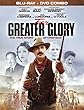
Movie “For Greater Glory” is now available on DVD and Blue-Ray

The movie about the Cristeros, For Greater Glory, is now available on DVD and Blue-Ray.

I haven’t seen it, but I hear it is good.

UK HERE.

Posted in The Campus Telephone Pole | Tagged , , ,
8 Comments

QUAERITUR: Did Jesus feed the Apostles on the tongue at the Last Supper?

From a reader:

Father, do you think Jesus fed His apostles on the tongue when he instituted the Eucharist?

I think it is very likely.

You may try to respond that He didn’t.  Gratis asseritur.

But, I’ll play along….

I respond saying, I hope He did give Himself to them, directly on the tongue, as they knelt, one by one.  And I hope it looked just like Tissot’s painting!  Or maybe like van Wassenhove’s version!

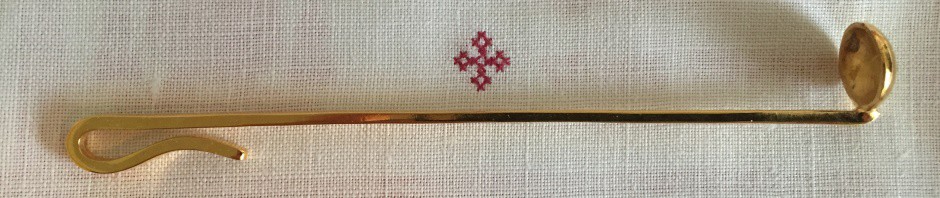
Better yet, I hope they even set up a communion rail, with cloths draped over it and used patens.   Yah, that’s right!  I hope the Last Supper looked just like a Traditional Latin Pontifical Mass of Ordination.  Yah!  I’ll bet they had bells too, and burses and maniples and, of course, birettas!  And when it was over, all the women got to do was scrape beeswax off the gold candlesticks.

“But Father! But Father!”, some of you will by now be barking, flecks of saliva sullying your monitor, “You hate Vatican II!  You think the Last Supper was a ‘Tridentine Mass’!  Did they ring bells?  Did they have ‘fiddle-backs’? PAH!  Vatican II was the beginning of a new era of us being church together!  EVERYBODY SING NOW!

♫ Not in the dark of buildings confining, not in some heaven, light years away – ♪
Here in this place the new light is shining, now is the kingdom, and now is the day.
Gather us in …. ♫”

SILENCE!

Okay, That’s enough.

We don’t know how the Last Supper unfolded.  However, it was common in ancient world all around the Mediterranean that people would recline to eat, and do so not so much facing each other as being angled out toward the open room, with the host of the meal in the chief place.

In any event, we are not biblical positivists.  We don’t have to, and should not, force Mass to be like a mid-1st century Jewish meal.  That would be an impossible task of inappropriate liturgical archaeology.  Holy Church’s understanding of what the Lord gave us in the Eucharist deepened over time brought us to a reverence that needed appropriate physical gestures of humility. Now that much of the reverence for the Eucharist has been undermined, over decades, people also don’t know why they should adopt positions of humility in the presence of the Eucharistic Lord. As the practice of standing and receiving in the hand spread, a vicious circle was created which further eroded reverence in congregations.

I hope people will on their own choose to receive Holy Communion only on the tongue.

We need more kneeling, more Holy Communions in the state of grace, received directly on the tongue, from the consecrated hands of priests.

So there.

Posted in "But Father! But Father!", "How To..." - Practical Notes, ASK FATHER Question Box, Lighter fare, Liturgy Science Theatre 3000 | Tagged , ,
29 Comments