A golden subject: Reclaiming silence in our churches. A Scotish bishop’s good insights.

The Bishop of Aberdeen, Scotland, has issued in interesting pastoral letter about the need to reclaim, indeed, “create” silence and, through silence, prayer.  The bishop, Most Rev. Hugh Gilbert, OSB, was once a monk and abbot of Pluscarden Abbey. He really gets silence.

He does not shy from the “third rail”: babies.

He makes a few great points along the way. Here are a few:

… There can be no real relationship with God, there can be no real meeting with God, without silence. Silence prepares for that meeting and silence follows it. … ‘Two people talking stop forty people praying.’ … ‘If deep silence has a hold on what is inside us, then into us too the all-powerful Word will slip quietly from the Father’s throne.’ …

Here, however, is a point that could use more thought:

Now often there is talking up to the very beginning of Mass, and it starts again immediately afterwards.

“Hmmm”, thought I (silently, of course) as I read this.

Not only does the noise/talking precede Mass and follow Mass but in many cases noise/talking continues through the whole of the Mass as well. Certainly talking does, in the Novus Ordo. It’s talk talk talk talk talk talk talk straight through. No?

I think the Bishop is right about this undoubtedly golden subject.

I suggest that, to help recover and create silence, we have far more celebrations of the Extraordinary Form.

I suggest that we diligently petition Rome to provide an Ordinary Form option for a silent Canon.

Even if the option might be for just a silent Roman Canon/1st Eucharistic Prayer, that would be helpful.  We have options here, there, and everywhere for so many things in the Ordinary Form.  Why not that also?

The rest is – as you know – silence.

Posted in "How To..." - Practical Notes, Liturgy Science Theatre 3000, New Evangelization, The Drill | Tagged , , ,
41 Comments

Aw…shucks!

One from a bushel of oysters!  This was a nice surprise.

The right tool makes all the difference.

Yum.

20111211-201113.jpg

Posted in "How To..." - Practical Notes, Fr. Z's Kitchen | Tagged
13 Comments

Phoenix: Mercy Sister excomm’d for abortion decision at Catholic hospital no longer excomm’d?

Did anyone notice this little story in the “briefs” at CNS?

Mercy nun at hospital that allowed abortion ‘no longer excommunicated

PHOENIX (CNS) — A Mercy sister who was automatically excommunicated because of her role on the ethics committee that allowed an abortion to be performed at a Catholic hospital in Phoenix in 2009 is back in good standing in the Catholic Church. In May 2010, officials at St. Joseph’s Hospital and Medical Center publicly acknowledged that an abortion had occurred at the hospital in late 2009. Officials said the woman was 11 weeks pregnant and suffered from pulmonary hypertension, a condition that the hospital said carried a near-certain risk of death for the mother if the pregnancy continued. It also was revealed at the time that Mercy Sister Margaret McBride had incurred automatic excommunication because of her role on the ethics committee that sanctioned the abortion. On Dec. 21, 2010, Phoenix Bishop Thomas J. Olmsted announced that the hospital could no longer identify itself as a Catholic hospital. [NB:] In a Dec. 8 statement, the hospital said Sister Margaret has since “met the requirements for reinstatement with the church and she is no longer excommunicated. She continues to be a member in good standing with the Sisters of Mercy and is a valued member of the St. Joseph’s executive team.” [Has there also been a statement from the Diocese of Phoenix?] The statement, emailed to Catholic News Service in response to a query about her status, provided no more details and the hospital had no further comment. [I hate to bring this up, but there is an old adage: “Gratis asseritur, gratis negatur.“] Sister Margaret is currently the medical center’s vice president for organizational outreach. Last year when Bishop Olmsted issued his decree revoking the 116-year-old hospital’s affiliation with the Catholic Church, he wrote that he could not verify that the hospital provided health care consistent with “authentic Catholic moral teaching.” “It became clear that, in their decision to abort, the equal dignity of mother and her baby were not both upheld,” he said. The baby “was directly killed,” which is a violation of the church’s ethical and religious directives.

I am always happy when erstwhile errant person returns to Communion in the One True Holy Catholic Church.  But this is a little fuzzy.  If there was a public statement made confirming that the excommunication was incurred, shouldn’t there be a public statement confirming that the censure was lifted?

UPDATE 1648 GMT:

Think about this.  In November she was given an award by Call To Action for what she did.

There is a video in which she effectively mocks the Church concerning the censure.  Is that the attitude of someone who is going to be reconciled?

Am I missing something?

UPDATE 1915 GMT:

Okay, I am ready to believe that Sr. McBride has been reconciled.  GREAT!  I am happy for that, as all Catholics ought to be.

What I am wondering about is this: If there was a public statement from the diocese giving a confirmation of the excommunication, in justice shouldn’t there be a public statement from the diocese stating that it was lifted?

UPDATE 2005 GMT:

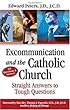
Don’t forget Dr. Peters’ excellent and affordable book on excommunications. HERE.

Posted in Emanations from Penumbras, Linking Back | Tagged , , , , , ,
18 Comments

Wymynprysts yn Mynnysota

In the Star Tribune, ultra-liberal newspaper of my native place, there is an article about wywmwmnyprysts.

It is too long and dull for you, so here are some bits. Let’s have a look with my emphases and comments.

Female priests push Catholic boundaries

ROSE FRENCH, Star Tribune

Dressed in a priestly white robe and green stole, Monique Venne lifted communion bread before an altar — defying centuries of Catholic Church law. [The writer stumbles in the first line: This is not just a matter of law. This is the Church’s teaching… the Church’s DOC-TRINE. Were it just a “law”, or as supporters of the impossible like to call it “policy” it could be changed.  The writer will call them “priests” or “Catholic priests” throughout.]

Despite promises of excommunication from the Vatican, she and six other women in Minnesota say they are legitimate, ordained Catholic priests, fit to celebrate the mass. They trace their status through a line of ordained women bishops back to anonymous male bishops [cowards] in Europe.  [Gratis asseritur, gratis negatur.]

“We love the church, but we see this great wrong,” said Venne, 54, who cofounded Compassion of Christ Church, a Minneapolis congregation that just celebrated its first anniversary. [WOW!  A founder of a CHURCH?  Along with about 15,000 others in the USA.] “Not allowing women to be at the altar is a denigration of their dignity. [False.] We want the church to be the best it can be. If one leaves, one cannot effect change. So we’re pushing boundaries.” [If one leaves…. ?  This from the one who founded a “church” apart from the Catholic Church.  Loopy.]

Minnesota has emerged as a hotbed [found directly under the seething cauldron] for the growing movement to ordain women as priests, with the highest per-capita number of female Catholic priests [No.  They are not “priests”.  They probably aren’t “catholic” at this point.  And they are “wymyn”, now, I think.  No?] in the nation, according to the organization Roman Catholic Womenpriests. Women [not-] priests are working in the Twin Cities, Red Wing, Winona, Clear Lake and soon St. Cloud. The group claims about 70 women priests in the United States and more than 100 worldwide.

Several Protestant denominations have allowed women to be ordained ministers for decades. But the Catholic Church views an all-male priesthood as unchangeable, “based on the example of Jesus, who, even though he had revered relationships with women who were his disciples, chose only men to be his apostles,” said Dennis McGrath, spokesman for the Archdiocese of St. Paul and Minneapolis.

Women who claim to have been ordained Catholic priests in fact have no relationship to the Catholic Church because their ordination is not valid,” he said.

Dozens of congregations

An increasing number of Catholics disagree with the church on this. In a poll last year by the New York Times and CBS, 59 percent of U.S. Catholics favored letting women become priests, with 33 percent opposed.

That’s encouraging news for Roman Catholic Womenpriests, founded nearly nine years ago in Europe. It began after seven women were ordained aboard a ship on the Danube River by three male bishops. The group claims their ordinations are valid because they conform within the bounds of “apostolic succession.” [How stupid can you get?  That stupid, as a matter of fact!  Being on a river has nothing to do with that.]

“I do believe we are connecting through the original church, which started with the apostles,” said Regina Nicolosi, 69, of Red Wing, who became bishop [ROFL!] for Womenpriests’ Midwest region in 2009.

[…]

The rest is just… frankly… sad.  The rest is just plain sad.

Do you suppose they all have their “ordination tambourines“?

Posted in Goat Rodeos, Lighter fare, Throwing a Nutty | Tagged ,
55 Comments

Changes to the C of E

From The Weekly Standard:

The End of Canterbury
Will the sun set on the Anglican communion?

BY JOSEPH BOTTUM

The archbishop of Canterbury is going to resign next year. At least that’s the story making the rounds of newspapers in London, and the interesting part is not that the 61-year-old Rowan Williams should be willing to give up another decade in the job. Or even, if the Telegraph is right, that the clergy and his fellow bishops are working to push him out.

No, the interesting news about the looming resignation is how little attention anyone appears to be paying to it. The Church of England just doesn’t seem to matter all that much, fading from the world’s stage only slightly more slowly than the British Empire that planted it across the globe.

Theological consequences will follow the dwindling of Anglican identity—the claim, ever since Queen Elizabeth I, that the Church of England represents the great middle way between Protestantism and Catholicism. Ecclesiological consequences, as well, will follow the end of Anglican unity: the disappearance of a coherent, worldwide denomination, led by the archbishop of Canterbury, for those who hold a certain moderate form of Christian belief.  [But a “form” which must inevitably follow the secular trends, slowly but inexorably, because it is tied to the state.]

Christianity will survive in other forms, of course, both theologically and denominationally. In the long run, the great tragedy of the fading of Canterbury and the looming breakup of the Anglican communion may be the geopolitical consequences—fraying the already weak ties between the global South and Western civilization.

[…]

There isn’t really much that is new in the piece, but for those who are not so familiar with the developments can glean some good information.

The real point of Bottum’s piece is, however, that nobody really cares.

Benedict XVI is the Pope of Christian Unity.

Posted in New Evangelization, Pope of Christian Unity | Tagged , ,
24 Comments

WDTPRS POLL: Did you see Rose vestments on “Gaudete” Sunday?

Here is a little poll for your 3rd Sunday of Advent.

Please choose an answer and add a comment in the combox.

For "Gaudete" Sunday the vestments I saw were

View Results

Posted in POLLS |
97 Comments

Stave by Stave: The great Fr. Perrone writes his first Mass!

Here is one for your “brick by brick” file.

My friend, the distinguished Church musician Fr. Eduard Perrone, pastor at Assumption Grotto in Detroit, has written a Mass, to be used during the Christmas season, in honor of the Blessed Virgin Mary.

The blog Te Deum has details and Fr. Perrone’s explanation to his choir about what is going on in the movements/parts of Mass.

The Mass will be used for the first time for Midnight Mass of Christmas, which begins – thanks be to God – at Midnight.  Click HERE for more details.

With this Mass, Fr. Perrone, as a true Church musician, has made a real contribution to the identity of “pastoral musicians”.  He has nudged the bar upward a couple notches.

If any of you are anywhere near Detroit when Masses will be offered with this new Mass by Fr. Perrone, I warmly encourage you to go and participate with the active participation that is listening.

Assumption Grotto is a treasure of the Archdiocese of Detroit and its deserves great attention and support.

Posted in "How To..." - Practical Notes, Just Too Cool, Liturgy Science Theatre 3000 | Tagged , , ,
17 Comments

QUAERITUR: What is a “stable group”? How big? How small?

From a reader:

Saw your most recent quaeriter [“quaeritur” is a verb, btw.] and noted the use of “stable group.” We are struggling with our diocese over the definition of that term, as they [“they”? Diocesan officials?] want to say a stable group is thirty Catholics [NO!] who will pledge themselves to attend the EF. Naturally, we had numbers approaching thirty when our TLM was pushed out of the parishes three years ago. Now we total about fifteen or so, and even though the same people have attended the TLM more or less faithfully (we even found ourselves in a chapel of a secular retirement home for about two years) for four years, the diocese still tells us we are not a stable group. By the way, we had a priest in the area willing to offer this Mass for us. But the bishop banished him to the hinterlands. Now he travels about 300 miles once a month to offer this Mass for our group. Just what IS a “stable group”?

Don’t forget that the Pontifical Commission “Ecclesia Dei” issued a clarificatory document Universae Ecclesiae, in which we read:

15. A coetus fidelium (“group of the faithful”) can be said to be stabiliter existens (“existing in a stable manner”), according to the sense of art. 5 § 1 of the Motu Proprio Summorum Pontificum, when it is constituted by some people of an individual parish who, even after the publication of the Motu Proprio, come together by reason of their veneration for the Liturgy in the Usus Antiquior, and who ask that it might be celebrated in the parish church or in an oratory or chapel; such a coetus (“group”) can also be composed of persons coming from different parishes or dioceses, who gather together in a specific parish church or in an oratory or chapel for this purpose.

The law on this says “some people”.  There is no minimum number identified by the Holy See.   Some have mentioned that a coetus in other contexts can be as few a three.  And the priest himself can be a part of the coetus.

It is wrong to try to impose a minimum number.

At the same time, it is common sense that – in most parishes – it is very hard to implement a major change to the parish schedule for very few people.  But if the priest is willing and able to add a Mass to the schedule and keep it covered through thick and thin without crashing and burning, great!  Support him?  If he wants to do it, he doesn’t need permission.

The BIG problem remains, however.  The parish priest, the pastor, implements Summorum Pontificum in the parish.  The diocesan bishop does not make the decisions about this in the way that he did under the old, now “extinct” provisions of Ecclesia Dei adflicta.

And don’t forget the Bux Protocol.

Posted in "How To..." - Practical Notes, ASK FATHER Question Box, Brick by Brick, Liturgy Science Theatre 3000, Our Catholic Identity, SUMMORUM PONTIFICUM, Universae Ecclesiae | Tagged , , , , ,
26 Comments

QUAERITUR: Resources for seminarians to learn TLM on their own. Wherein Fr. Z rants.

During an ordination, someone must stand up in front of the ordaining bishop and attest that seminarians are properly formed and educated and suitable for ordination.

However, seminarians of the Latin Church are not being trained in the whole of the Roman Rite. According to the Church’s law, the Roman Rite has two forms. How many seminaries are training men also in the Extraordinary Form with adequate training, real training… not just an occasional Mass they get to watch. Furthermore, the Code of Canon Law requires that all seminarians be very well-trained in Latin (can. 249). Is that happening?   Universae Ecclesiae reiterated this point. I also know of a document from the Congregation for Catholic Education which requires that there be a Patristic Theology component in the curriculum, not just the occasional reference in history or theology courses.

I think it is great, therefore, when – just as some of us did back in the day – seminarians are learning to row the boat all on their own.

From a seminarian:

I am wondering if you could recommend some sources for anyone
interested in learning how to celebrate the Traditional Latin Mass. I
am a year and a half away from ordination to the priesthood and would like to be able to offer both forms down the road. Thanks and God Bless.

I would contact the Fraternity of St. Peter. They have a very good instructional DVD.

Also, the Canons of St. John Cantius in Chicago have a great page, online tutorials.

I know that both groups host workshops. Also, in England there are occasional workshops for seminarians and priests.

Posted in "How To..." - Practical Notes, ASK FATHER Question Box, Mail from priests, New Evangelization, Our Catholic Identity, SUMMORUM PONTIFICUM, The future and our choices, Universae Ecclesiae, Wherein Fr. Z Rants | Tagged ,
11 Comments

QUAERITUR: How to get Gregorian chant and a TLM in the parish.

From a reader:

The New Missal has started in my parish and the music is atrocious. I had to go to the local public high school play to hear Gregorian Chant! No regard for GIRM #41. My Bishop refuses to allow the extraordinary form of the Latin Rite. Is there anything I can do to push the issue in my Diocese. Or am I doomed like Evelyn Waugh to “church going that is a bitter trial”.

GIRM 41 is based on Sacrosanctum Concilium 116:

All other things being equal, Gregorian chant holds pride of place because it is proper to the Roman Liturgy. Other types of sacred music, in particular polyphony, are in no way excluded, provided that they correspond to the spirit of the liturgical action and that they foster the participation of all the faithful.

Since faithful from different countries come together ever more frequently, it is fitting that they know how to sing together at least some parts of the Ordinary of the Mass in Latin, especially the Creed and the Lord’s Prayer, set to the simpler melodies.

First, keep in mind that since Summorum Pontificum went into effect in September 2007 pastors of parishes, not diocesan bishops, implement celebrations of the Extraordinary Form in their parishes. The diocesan bishop no longer makes these decisions. Were a pastor of a parish to start a regular TLM, and were the diocesan bishop to demand that the priest stop, that priest’s case would probably receive a very favorable hearing at the Pontifical Commission “Ecclesia Dei” in Rome.

What you should probably do is organize a group of people who will support the effort from soup to nuts in the parish. Take care of every detail so the priest doesn’t have to do it all himself. If the priest needs vestments, get him vestments. If you want chant, get a schola together and practice and provide the chant or hire some singers. If something in the sanctuary needs to be set up or moved or shifted around, then be there on the spot with enough hands on deck to get it done so that the priest never has to worry or wonder if it is going to be done in time. Get the whole thing ready to rock and roll and take the proposal to the parish priest. According to Summorum Pontificum a stable group making a request cannot be ignored. Make the request again and again and again. Present the whole thing as a “business plan” so the priest knows every detail. Keep at it. Press it forward slowly, cordially, persistently, kindly.

If you want it badly enough, you have to be involved in making it happen in concrete ways. You cannot simply sit back with nice aspirations and wish for it and then be sad when it doesn’t come to pass.

And perhaps you will have to be willing to suffer and even take it on the road.  But … if you don’t try, you’ll never know what might have been possible.

Posted in "How To..." - Practical Notes, ASK FATHER Question Box, Liturgy Science Theatre 3000, Our Catholic Identity, SUMMORUM PONTIFICUM, Universae Ecclesiae | Tagged , , , ,
15 Comments