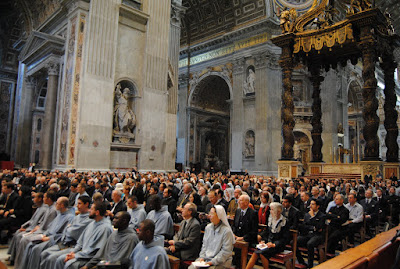
Pontifical Mass at the Altar of the Chair – roundup

Initial comments:

Card. Brandmueller wound up being celebrant for the Pontifical Mass at the Altar of the Chair in St. Peter’s Basilica.  Card. Canizares should have been the celebrant, but he had by accidentally scheduled a flight, apparently because he had been under the impression that this was going to be a Low Mass.  Things happen.  They had a couple Cardinals to spare, however.

Cards. Levada, Bartolucci were there, and one other Cardinal of Holy Roman Church.

The place was jammed, I hear.

I am sure there will be a torrent of photographic eye-candy.  The variety of choir dress should be interesting.

UPDATE:

The ever-present and diligent John Sonnen of Orbis Catholics has video and photos.

His video is on Youtube.

[wp_youtube]B7LNu6jCmes[/wp_youtube]

Sounds as if they used Palestrina’s Missa Papae Marcelli, nisi fallor.

A photo or two… but go to his site.

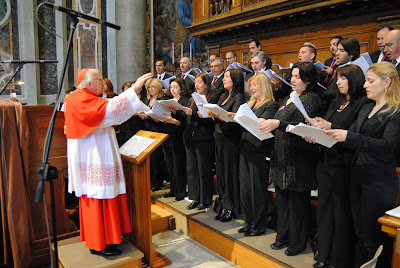
Here is something you don’t see very often… a Cardinal directing a choir.

A little more video:

[wp_youtube]iVrMOKYcTPQ[/wp_youtube]

UPDATE:

Photo album with lots of photos, here.

Posted in Brick by Brick |
27 Comments

Msgr. Bux tells it as he sees it. WDTPRS POLL for SEMINARIANS ONLY.

Over at Messa in Latino there are some posts about the talks being given at the conference going on in Rome for Summorum Pontificum. One of the talks was by Msgr. Nicola Bux, originator of the Bux Protocol.  Bux speak, as we say in Italian, “fuor dai denti”, bluntly.

Bux’s talk was about the older form of Ordination of priests in the pre-Conciliar Pontificale Romanum.

Messa in Latino didn’t give even a sketchy account of the talk.  We will get it eventually.  But they did relate a few bullet points.  Here they are.  The subscriber base of the Fishwrap are going to love #2:

  1. The liturgy requires purity of heart and profound humility.  No, therefore, to hamming it up and theatrics.
  2. Where there is abuse of the liturgy, there are certainly grave moral distortions.
  3. Only a bishop and a priest exercise the priesthood, not the deacon.  What is the priesthood?  Mediation between man and God, a role before which priests, if they took stock of it fully, would tremble.
  4. St. Paul wrote to Titus: pure doctrine, sound doctrine, secure doctrine. These are the criteria tp discern true doctrine from false.  And all this is recalled in the old rite of Ordination: how true, therefore, is the rule of Proper of Aquitane: lex orandi, lex credendi.

Yah…. liberals are going to luuuuv #2.

Keep in mind that the new Instruction says that bishops cannot use the old Pontificale Romanum to ordain men who are not members of those specialized institutes we all know about.   Although… although… I bet the Holy See would grant permission were a bishop to request it.

Think about it.

I don’t think many of today’s seminarians would choose the new rite over the old rite once they compare them side by side and think about them for a while.

I would be pleased to receive email from seminarians on this point.   Write to me and tell me.  Seminarians could also canvass their fellows at their seminaries.  Give me the results.  I’ll post them.

QUAERITUR.  Latin Church SEMINARIANS:

If you were given the choice, would you prefer to be ordained with the older, pre-Conciliar form or the newer book, the rite reformed by Paul VI and John Paul II, even in Latin?  Which?

I will preserve your anonymity of course.  Use the contact link on the top header menu and put SEMINARIAN WRITES ABOUT POLL as the subjectYou must tell me what seminary you are from.  I won’t give you up, don’t worry.  I don’t care which option you would choose: I just want an accurate picture.

OLDER RITE: 38
NEWER RITE: 6

UPDATE:

Some are asking to see the older form of ordination.  Sancta Missa has a pdf of an old Pontificale Romanum.


Posted in Lighter fare, Liturgy Science Theatre 3000, POLLS, SUMMORUM PONTIFICUM, The Campus Telephone Pole, Universae Ecclesiae | Tagged , ,
16 Comments

WDTIRS: Universae Ecclesiae 22: Drilling into the Latin and English (Dioceses without “qualified” priests)

I was sent a question about the Latin of Universae Ecclesiae 22.

Friends, the more I look compare the Latin and the Released English “translation”, the more apparent it is that the Latin is a better, stronger document than the English – as it stands.

Therefore, if you hear someone running down Universae Ecclesiae in some way, or trying to diminish its implications, you may want to look together at the Latin version in order to verify whether there criticism holds up.  Obvious, no?

Here is UE 22:

22 – In Dioecesibus ubi desint sacerdotes idonei, fas est Episcopis dioecesanis iuvamen a sacerdotibus Institutorum a Pontificia Commissione Ecclesia Dei erectorum exposcere, sive ut celebrent, sive ut ipsam artem celebrandi doceant.

RELEASED ENGLISH:
22. In Dioceses without qualified priests, Diocesan Bishops can request assistance from priests of the Institutes erected by the Pontifical Commission Ecclesia Dei, either to the celebrate the forma extraordinaria or to teach others how to celebrate it.

Exposco is more than simple “ask”.  It has at least the force of posco, which is “to ask for urgently; to beg, demand, request, desire”.  Exposco is “to ask earnestly, to beg, request, to entreat, implore”.

But, back to fas est.   Fas, as a word in Canon Law, isn’t as strong as nefas is in its negative sense.  If nefas really really bad. In Canon Law nefas is applied to things such as selling the Eucharist or relics or violating the Seal of confession.  Nefas is something like “intolerable” or “really-super-bad”.  On the other hand, fas is not “really good” or “praiseworthy”.  It fas isn’t as forceful as a positive as nefas is as a negative.  But, fas est is more than “can”… the bishop can ask help.  Of course, he can ask for help.  That’s obvious, isn’t it?

Would anyone have ever suggested that a bishop can’t ask for help from, say, the FSSP?  Absurd.

So, while fas est episcopis exposcere isn’t “it is a super-dandy thing for bishops to implore”, it is more than “bishops can ask”.

I contacted three canonists about this fas est.  Canonists #1 and #2 aid that it has the implication of something laudable, but without the same force as nefas is a negative. Canonist #3 saw it as merely a way to make the point an obvious point.  I am not using the majority-wins-thing here, particularly because of the esteem with which I hold Canonist #3.

I will go with “an obvious thing for diocesan bishops to do is …”

WDTPRS VERSION:
22. In Dioceses where qualified priests are lacking, an obvious thing for diocesan bishops to do is earnestly to ask assistance from priests of Institutes set up by the Pontifical Commission “Ecclesia Dei“,  either in order that they celebrate [Extraordinary Form’s rites] or that they teach the art of celebrating (artem celebrandi).

RELEASED ENGLISH (again):
22. In Dioceses without qualified priests, Diocesan Bishops can request assistance from priests of the Institutes erected by the Pontifical Commission Ecclesia Dei, either to the celebrate the forma extraordinaria or to teach others how to celebrate it.

That ars celebrandi is becoming a term of art, if you’ll pardon the pun.  Ars celebrandi was an important topic of discussion during the 2006 Synod on the Eucharist and then in Benedict XVI’s Post-Synodal Exhortation Sacramentum caritatis.

Let’s look at the section in Sacramentum caritatis.

Ars celebrandi

38. In the course of the Synod, there was frequent insistence on the need to avoid any antithesis between the ars celebrandi, the art of proper celebration, and the full, active and fruitful participation of all the faithful. The primary way to foster the participation of the People of God in the sacred rite is the proper celebration of the rite itself. The ars celebrandi is the best way to ensure their actuosa participatio. The ars celebrandi is the fruit of faithful adherence to the liturgical norms in all their richness; indeed, for two thousand years this way of celebrating has sustained the faith life of all believers, called to take part in the celebration as the People of God, a royal priesthood, a holy nation (cf. 1 Pet 2:4-5, 9) (115).

The Bishop, celebrant par excellence

[…]

Respect for the liturgical books and the richness of signs

[…]

[…]

Art at the service of the liturgy

[…]

Liturgical song

[…]

Moreover, during a Q&A session the Pope once responded to a question from a priest from the Diocese of Albano, Italy.  My emphases and comments.

Q: As priests, we are called to celebrate a “serious, simple and beautiful liturgy,” to use a beautiful formula contained in the document “Communicating the Gospel in a Changing World” by the Italian bishops. Holy Father, can you help us to understand how all this can be expressed in the “ars celebrandi?”

B16: … “(A)rs celebrandi” is not intended as an invitation to some sort of theater or show, but to an interiority that makes itself felt and becomes acceptable and evident to the people taking part. [How many times have I said that once a priest learns to say the older form  of Mass, that experience changes the way he says the newer form.  Also, a good experience of the newer form will impress also on the priest using the older form that there are people out there.  Congregations are over time deeply affected by the priest’s modus, hopefully ars celebrandi.  The greater the number of priests who learn to say the older form, the faster and the deeper liturgical renewal will be implemented in the Church, with the subsequent changes among God’s people and their corners of the world.] Only if they see that this is not an exterior or spectacular “ars” — we are not actors! — but the expression of the journey of our heart that attracts their hearts too, will the liturgy become beautiful, will it become the communion with the Lord of all who are present. Of course, external things must also be associated with this fundamental condition, expressed in St. Benedict’s words: “Mens concordet voci” — the heart is truly raised, uplifted to the Lord. We must learn to say the words properly. [Sounds like UE 20 -b, doesn’t it?]

Sometimes, when I was still a teacher in my country, young people had read the sacred Scriptures. And they read them as one reads the text of a poem one has not understood. Naturally, to learn to say words correctly one must first understand the text with its drama, with its immediacy. It is the same for the Preface and for the Eucharistic Prayer. [Of course the Canon is silent in the Extraordinary Form.  There are, however, many ways to “speak”.]

[…]Thus, the words must be pronounced properly. There must then be an adequate preparation. Altar servers must know what to do; lectors must be truly experienced speakers. Then the choir, the singing, should be rehearsed: And let the altar be properly decorated. All this, even if it is a matter of many practical things, is part of the “ars celebrandi.”

That ars celebrandi in UE suggests to me that there is something the Extraordinary Form can teach the Ordinary Form and vice versa.
Posted in "How To..." - Practical Notes, SUMMORUM PONTIFICUM, Universae Ecclesiae, WDTPRS | Tagged , , , , , ,
6 Comments

QUAERITUR: Would a request for meatier sermons offend a priest?

From a reader:

I was just wondering if you, as a priest, would find it offensive if you a received a letter from a parishioner encouraging you to spend more time catechizing from the pulpit?

We have a wonderful, holy, orthodox priest at our parish. He occasionally hosts little talks or educational sessions, and he is clearly well-educated and articulate.

But his homilies are a little…thin. They tend to be somewhat vague and kind of…blandly spiritual. I would like to encourage him to bring these insights to his homilies, so I have considered writing him a letter asking him to discuss “hot topics” like contraception, cohabitation, the sinfulness of missing Mass, the importance of confession, etc.

Would you be offended to receive such a letter? Is there a more appropriate route to talk, or should I just relax and thank God I have a good pastor?

Would I be offended?  No.  For my part, I wouldn’t be offended were the letter respectful.  But then I don’t think I have ever been asked for heavier sermons.  Lighter, yes.  I have also been set upon by deeply offensive, offending and offended people with red-raging eyes and ears-shooting-steam because I explained what the Church says.  I have actually been spat upon in a narthex after a Mass while still wearing my vestments, and not as an accident in the course of spittle-flecked grand-mall liberal pique.

The General Institution of the Roman Missal says:

65. The Homily is part of the Liturgy and is strongly recommended, for it is necessary for the nurturing of the Christian life. It should be an exposition of some aspect of the readings from Sacred Scripture or of another text from the Ordinary or from the Proper of the Mass of the day and should take into account both the mystery being celebrated and the particular needs of the listeners.

The needs of the listeners.

I am reminded of Augustine on the sometimes painful process of correction.  The doctor doesn’t stop cutting just because his patient is screaming for him to stop.

The homily/sermon can certainly, must certainly, be used also to catechize – a term which is pretty broad.  But I think we have to be careful as the Church’s preachers not to make Mass into a didactic exercise.  In a sense, all preaching involves repetition of the Church’s doctrines, and explanations of who we are and what we do as a result… and don’t do.  But the pulpit isn’t the lecture hall podium.

A preacher does well to make reference to the readings and the feast, but, from there he can really go just about anywhere.  The beautiful thing about the Faith is that it is so interconnected and the history of our Church goes back, well… to creation, if you think about it.  We have lots of material to work with.

That said, I think it is okay for you to tell the priest that you would like a bit more meat along with the mashed potatoes.

Would you as a father of growing children be offended by, “Please, father, may I have some more of those slightly bitter but nourishing Brussels sprouts?”

Okay, some fathers – priests – are very touchy.  But if you are diplomatic, I don’t imagine there should be a problem.

At least he will know you are listening.

Posted in "How To..." - Practical Notes, ASK FATHER Question Box |
23 Comments

MUST READ: Msgr. Pozzo’s comments on the Instruction “Universae Ecclesiae” in L’Osservatore Romano

The text of the Instruction Universae Ecclesiae appeared in the Saturday 14 May daily edition of L’Osservatore Romano.

In the Sunday edition of 15 May, there is a summary of a talk for the conference in Rome on Summorum Pontificum by Kurt. Card. Koch, President of the Pontifical Council for Christian Unity entitled “Dalla liturgia antica un ponte ecumenico… An ecumenical bridge from the old liturgy”.   I am sure that Sandro Magister will have the indefatigable Matthew Sherry translate the text into English. I just don’t have the will to translate it myself.   It is a fine piece and it sets up, in a way, what follows.

On the same page of L’Osservatore Romano is a piece by Msgr. Guido Pozzo, Secretary of the Pontifical Commission “Ecclesiae Dei” entitled “Il significato dell’istruzione «Universae Ecclesiae» … The meaning/significance of the Instruction ‘Universae Ecclesiae‘”.

I have taken the time to translate this piece by Msgr. Pozzo.  It merited the effort and I think you find it very useful in your consideration of the significance of Summorum Pontificum in this pontificate and for our own corners of the Church.

Some preliminary remarks.

1. During my initial comments on the Instruction Universae Ecclesiae I made the observation that the Instruction placed Summorum Pontificum within the Magisterium of Benedict XVI.  The Motu Proprio is not just juridical, but theological.  It is teaching as well as law.  Of course, it has to be teaching, doesn’t it?  It concerns liturgy, and, as I have said a zillion times here, liturgy is doctrine.  Faith, doctrine, liturgy, identity are all interlocked.  They are facets reflecting the bright core of the same jewel of our beautiful and true Catholic Thing. At the core of the jewel, and any doctrinal formulation or definition which can be taught and memorized and studied, or within in any prayer or oration of our liturgical worship there is a single content convered to us: Jesus Christ, speaking, teaching, revealing, healing, raising, forgiving, saving.

2. I was convinced before that Summorum Pontificum aimed at promoting the use of the Extraordinary Form, not merely providing it for those who asked for it.  Card. Castrillong, former President of the PCED, said this openly.  The will of the Pope in the Motu Proprio included that people who don’t know the older form actually come to be exposed to it.  The older, Extraordinary Form is a gift for all, not just those who know about it.  For all.  Every Catholic of the Latin Church – and also in the whole of the Catholic Church – has the Extraordinary Form as part of their heritage.  It belongs to all of us.  We must not be cheated out of our inheritance.  If someone were to die and leave you a precious thing in his will, and the executor of that will kept from you, that executor would be robbing you, defrauding you, cheating you our of the treasure the person who wrote the will desired you to have.  Bishops and priests: we have a responsibility now to mainstream the Extraordinary Form and those who don’t will be remiss in their responsibility.

3.   In the piece by Msgr. Pozzo, below, note that he at a certain point talks about people, in celebrating the Extraordinary Form are actually celebrating the FAITH “in the same way by which the Church substantially did for centuries.

4. This whole this is about the promoting of a hermeneutic, an interpretive lens and approach of continuity over and against a false and harmful approach, an approach of discontinuity and rupture.

5. As I repeat all the time in the context of anything ecumenical, Benedict XVI is the Pope of Christian Unity.  Benedict is holding up a new standard of ecumenical practice.   It’s working in the ad extra point of view, our relations with those outside formal union with the Church.  However, Benedict must also be the Pope of Christian Unity ad intra as well.  Summorum Pontificum concerns unity among Catholics of centuries past with us today and in the future, and now of those who see the Council of 1963-65 as a break with the past and those who don’t.

I have a great deal more to say about Msgr. Pozzo’s piece, but here it is in my fast translation from the Italian original without any emphases or comments so that bloggers and others can more easily lift it and use it.  NB: I may tweak it in the course of events.

The meaning of the Instruction “Univerae Ecclesiae”

The liturgical Constitution Sacrosanctum Concilium of the Second Vatican Council, affirms that “the Church, when the faith or the general common good is not in question, does not intend to impose, not even in the Liturgy, a rigid uniformity” (n. 37).  It has not escaped the notice of many people that today the faith is in question, for which reason it is necessary that the legitimate variety of ritual forms must recover the essential unity of Catholic worship. Pope Benedict XVI accurately called this to mind: “In our days, when in vast areas of the world the faith is in danger of dying out like a flame which no longer has fuel, the overriding priority is to make God present in this world and to show men and women the way to God. Not just any god, but the God who spoke on Sinai; to that God whose face we recognize in a love which presses “to the end” (cf. Jn 13:1) – in Jesus Christ, crucified and risen” (Letter of His Holiness Pope Benedict XVI to the Bishops of the Catholic Church Concerning the Remission of the Excommunication of the Four Bishops Consecrated by Archbishop Lefevre, 10 March 2009).

Blessed John Paul II in his own turn recalled that “Sacred Liturgy expresses and celebrates the one faith professed by all and, being the heritage of the whole Church, cannot be determined by local Churches in isolation from the universal Church” (Encyclical Ecclesia de Eucharistia, n. 51) and that “Liturgy is never anyone’s private property, be it of the celebrant or of the community in which the mysteries are celebrated” (ibid. n. 52).  In the Conciliar liturgical Constitution there is affirmed moreover: The sacred Council declares that holy Mother Church holds all lawfully acknowledged rites to be of equal right and dignity; that she wishes to preserve them in the future and to foster them in every way” (n. 4). Esteem for ritual forms is the presupposition of the work of revision from time to time becomes necessary.  Now, the two forms, Ordinary and Extraordinary, of the Roman liturgy are an example of reciprocal growth and enrichment.  Whoever thinks or acts to the contrary, undermines the unity of the Roman Rite which must be tenaciously protected, does not carry out an authentic pastoral activity or correct liturgical renewal, but rather deprives the faithful of their patrimony and their inheritance to which they have a right.

In continuity with the Magisterium of his predeceessors, Benedict XVI promulgated in 2007 the Motu Proprio Summorum Pontificum, with which he made more accessible the Universal Church the riches of the Roman liturgy, and now has given the mandate to the Pontifical Commission “Ecclesia Dei” to publish the Instruction “Universae Ecclesiae” in order correclty to favor its application.

In the introduction to the document there is affirmed: “With such a Motu Proprio the Supreme Pontif Benedict XVI has promulgated a universal law for the Church” (n. 2).  This means that one isn’t dealing with an indult, nor with a law for particular groups, but with a law for the whole Church, which, given the subject matter, is also a “special law” which “derogate from those legislative provisions, inhering in the Sacred Rites, issued from 1962 onward and incompatible with the rubrics of the liturgical books in force in 1962” (n. 28).  Let it be remembered here the golden patristic principle on which the Catholic communion depends: “every particular Church must be in harmony with the Universal Church, not only insofar as the doctrine of the faith and sacramental signs are concerned, but also concerning to uses universali received from the uninterrupted apostolic tradition, which must be observed not only in order to avoid errors, but also to transmit the totality of the faith, because the law of the prayer of the Church corrisponds to its law of the faith” (n. 3).  The celebrated principle lex orandi-lex credendi recalled in this paragraph, is at the foundation of a restoration of the Extraordinary Form: Catholic doctrine of the Mass in the Roman Rite has not been changed, because liturgy and doctrine are inseparable.  There can be in the one and the other form of the Roman Rite, accentuations, underscorings, clarifications which are more marked of some aspects in respect to others, but this does not undermine the substantial unity of the liturgy.

The liturgy was and is, in the discipline of the Church, a subject matter reserved to the Pope, while Ordinaries and Episcopal Conferences have some delegated responsibilities, specified by Canon Law.  Moreover, the Instruction reaffirms that there are now “two forms of the Roman Liturgy, defined respectively as Ordinary and Extraordinary: that is, two uses of the single Roman Rite (…) The one and the other form are expressions of the same lex orandi of the Church.  Because of its venerable and ancient use, the Extraordinary Form must be preserved with due honor” (n. 6).  The following paragraph quotes a key passage of the Letter of the Holy Father to the bishops which accompanied the Motu Proprio: “There is no contradiction between the two editions of the Roman Missal.  In the history of the liturgy there is growth and progress, but no rupture.  What earlier generations held as sacred, remains sacred and great for us too, and it cannot be all of a sudden entirely forbidden or even considered harmful”(n. 7).  The Instruction, in line with the Motu Proprio, does not regard only those who desire to continue to celebrate the faith in the same way by which the Church substantially did for centuries; the Pope wanted to help all Catholics to live the truth of the liturgy in order that, by knowing and participating in the old Roman form of celebration, they might grasp that the Constitution Sacrosanctum Concilium wanted to reform the liturgy in continuity with tradition.

Posted in "How To..." - Practical Notes, Just Too Cool, New Evangelization, Our Catholic Identity, Pope of Christian Unity, SUMMORUM PONTIFICUM, The Drill, The future and our choices, Universae Ecclesiae | Tagged , , , , , , , ,
17 Comments

The Feeder Feed: ancient Greek edition

I picked this up from the Laudator today, somewhat rearranged.

The Laudator is a great tree lover, by the way.

The text in question is Aristophanes, Birds 1058-1071.

ἤδη ᾽μοὶ τῷ παντόπτᾳ
καὶ παντάρχᾳ θνητοὶ πάντες
θύσουσ᾽ εὐκταίαις εὐχαῖς.
πᾶσαν μὲν γὰρ γᾶν ὀπτεύω,
σῴζω δ᾽ εὐθαλεῖς καρποὺς
κτείνων παμφύλων γένναν
θηρῶν, ἃ πάν τ᾽ ἐν γαίᾳ
ἐκ κάλυκος αὐξανόμενον γένυσι παμφάγοις
δένδρεσί τ᾽ ἐφημένα καρπὸν ἀποβόσκεται.
κτείνω δ᾽ οἳ κήπους εὐώδεις
φθείρουσιν λύμαις ἐχθίσταις·
ἑρπετά τε καὶ δάκετα < πάνθ᾽> ὅσαπερ
ἔστιν, ὑπ᾽ ἐμᾶς πτέρυγος
ἐν φοναῖς ὄλλυται.

Aristophanes, Birds 1058-1071 (sung by the birds, tr. Jeffrey Henderson):

To me, the omniscient
and omnipotent, shall all mortals
now sacrifice with pious prayers.
For I keep watch over all the earth,
and keep safe the blooming crops
by slaying the brood of all species
of critters, who with omnivorous jaws
devour all that in soil sprouts from the pod
and the fruit of the trees where they perch;
and I slay those who spoil fragrant gardens
with defilements most offensive;
and upon creepers and biters every one
from the force of my wing
comes murderous destruction.

The same, tr. Benjamin Bickley Rogers:

Unto me, the All-controlling,
All-surveying,
Now will men, at every altar,
Prayers be praying;
Me who watch the land, protecting
Fruit and flower,
Slay the myriad-swarming insects
Who the tender buds devour
In the earth and on the branches with a never-satiate malice,
Nipping off the blossom as it widens from the chalice.
And I slay the noisome creatures
Which consume
And pollute the garden’s freshly scented bloom;
And every little biter, and every creeping thing
Perish in destruction at the onset of my wing.

Rachel Carson, Silent Spring (1962), chapter 8 (And No Birds Sing):

The feeding habits of all these birds not only make them especially vulnerable to insect sprays but also make their loss a deplorable one for economic as well as less tangible reasons. The summer food of the white-breasted nuthatch and the brown creeper, for example, includes the eggs, larvae, and adults of a very large number of insects injurious to trees. About three quarters of the food of the chickadee is animal, including all stages of the life cycle of many insects. The chickadee’s method of feeding is described in Bent’s monumental Life Histories of North American birds: “As the flock moves along each bird examines minutely bark, twigs, and branches, searching for tiny bits of food (spiders’ eggs, cocoons, or other dormant insect life).”

Various scientific studies have established the critical role of birds in insect control in various situations. Thus, woodpeckers are the primary control of the Engelmann spruce beetle, reducing its populations from 45 to 98 percent and are important in the control of the codling moth in apple orchards. Chickadees and other winter-resident birds can protect orchards against the cankerworm.

Posted in Lighter fare, The Feeder Feed | Tagged
6 Comments

WDTIRS: Universae Ecclesiae 32: Drilling into the Latin and English (reciting the Breviary)

I had a question from a priest about Univerae Ecclesiae on the topic of recitation of the office, and a cleric’s obligation.  I also had conversations with three priests yesterday during which the topic of our daily office came up.



UE 32:

32 – Omnibus clericis conceditur facultas recitandi Breviarium Romanum anni 1962, de quo art. 9, § 3 Litterarum Apostolicarum Summorum Pontificum, et quidem integre et Latino sermone.

LITERAL TRANSLATION:
32. Conceded to all clerics is the faculty of reciting the Breviarium Romanum of the year 1962, dealt with in 9, § 3 of the Apostolic Letter Summorum Pontificum, and indeed (of reciting it) wholly and in Latin.

RELEASED TRANSLATION:
32. Art. 9 § 3 of the Motu Proprio Summorum Pontificum gives clerics the faculty to use the Breviarium Romanum in effect in 1962, which is to be prayed entirely and in the Latin language.

The more you look at the Latin alongside the English, the clearer it is that the document was not composed in Latin.

In any event, the LATIN is what we go by in the case of juridical documents.

For the sake of being complete, SP says: 9 § 3.  It is lawful for clerics in Holy Orders to use also the Breviarium Romanum promulgated in 1962 by Bl, John XXIII.

A first observation.  The Breviarium Romanum is not the Breviarium Monasticum in its various uses (Benedictine, Cistercian & Carthuisian).

My reading of the English suggests that the cleric who reads the Breviarium Romanum has to, must, read the whole of the day’s office and he must read it in Latin, not in an English translation.

My reading of the Latin suggests that the whole of the Breviarium can be read and the Breviary can be read in Latin.

So, in reading the English it seems that once the priest picks up the Roman Breviary for his in the morning, he has to use that book for the rest of the day, instead of switching to the Liturgy of the Hours for, say, Vespers and Compline.

In reading the Latin of UE 32 it seems as if the cleric can read the whole office from the Roman Breviary. That is, he has the faculty to read it wholly and in Latin, not the obligation to read it wholly and in Latin.

Moreover, the law is to be interpreted in such a way that it favors the people to whom favorable things are given. This is one of those cases. Interpret it UE 21 favorably.

Posted in "How To..." - Practical Notes, ASK FATHER Question Box, Mail from priests, SUMMORUM PONTIFICUM, Universae Ecclesiae | Tagged , , , ,
22 Comments

Fr. Finigan on Universae Ecclesiae

His Hermeneuticalness, P.P. of mighty Blackfen, the Dean of Bexley, Fr. Tim Finigan has a good roundup about Universae Ecclesiae, looking at different blogs which looked at the document.

Also, Fr. Finigan offers this sporting analogy analysis:

Fr Z has been searching for an alternative to the American Rounders [Crickey!  He is a traditionalist!] expression “no hitter.” I admit to having woefully failed to understand this expression. May I therefore offer some cricketing analogies for some of the paragraphs mentioned above?

The PCED were first to bat and their first innings was not too exciting although n.4 was a deliberate edge just outside third slip for four. In to bowl, PCED stamped its authority with n.7, an obvious but dangerous fast delivery on target for middle stump by the fresh bowler, while n.8a added a little seam and n.8b moved a worryingly towards leg stump. n.10.1 was a bouncer that made an orange-sized bruise, while n.13 was the work of a timely spin bowler who made the batsman’s heart beat nervously. In the second innings, nn. 20 and 21 were a series of perfectly executed square cuts to the boundary against a lacklustre medium-pace bowler and n.28 was the devastating punishment of a short ball hooked for six over the head of long leg. n.33 was a cheeky run taken while mid-off was fumbling and n.34 was one of those drives that made the umpire dance to avoid stopping the ball. PCED declared with every chance of bowling out the liberals easily.

There.  I have not the slightest clue what most of that means, but I’m sure that says it all.

Posted in Lighter fare, Linking Back, Mail from priests, SUMMORUM PONTIFICUM, Universae Ecclesiae | Tagged
12 Comments

WDTIRS: Universae Ecclesiae 21: Drilling into the Latin and English (training of priests and seminaries)

A question came in about what the Instruction Universae Ecclesiae really says, in paragraph 21.

Since we look at texts here, lets see UE 21.

21 – Ordinarii enixe rogantur ut clericis instituendis occasionem praebeant accommodatam artem celebrandi in forma extraordinaria acquirendi, quod potissimum pro Seminariis valet, in quibus providebitur ut sacrorum alumni convenienter instituantur, Latinum discendo sermonem  et, adiunctis id postulantibus, ipsam Ritus Romani formam extraordinariam.

LITERAL TRANSLATION:
21 – Ordinaries are strenuously (enixe) asked that they offer to clerics (clericis) to be trained up (instituendis) opportunity for acquiring adequate ars celebrandi… art of celebrating… in the Extraordinary Form, which point is has force above all (potissimum) for Seminaries, in which provision will be made that the students of holy things are to be suitably (convenienter) trained, by learning the Latin language, and,  as additional circumstances demand it (adiunctis id postulantibus), the Extraordinary Form of the Roman Rite itself.

RELEASED TRANSLATION:
21. Ordinaries are asked to offer their clergy the possibility of acquiring adequate preparation for celebrations in the forma extraordinaria. This applies also to Seminaries, where future priests should be given proper formation, including study of Latin  and, where pastoral needs suggest it, the opportunity to learn the forma extraordinaria of the Roman Rite.

Clerici includes deacons.  Deacons includes permanent deacons and transitional deacons.  Transitional deacons may be still in seminary.  Thus, Ordinaries are strenuously asked to make sure that their clergy, including deacons in seminary, are given the opportunity for training.  That would have to be – logically – either in the seminary itself or, obviously, elsewhere.  But deacons are to be trained, not just priests.

Note that the released translation ignores the Latin adverb enixe.

Also, the gerund form clericis instituendis suggest that this is something which must be done.  They are to be trained up.

Note that the released translation ignores the Latin adverb potissimum, “, chiefly, principally, especially, in preference to all others, above all, most of all”.  This applies “in preference to all others… especially” seminaries.

WDTPRS asks…

Was the old lame-duck ICEL team reassembled?

Did those who prepared the English version not think that adverbs are important?

Posted in "How To..." - Practical Notes, SUMMORUM PONTIFICUM, Universae Ecclesiae, WDTPRS | Tagged , , , ,
22 Comments

WDTPRS KUDOS to the Bishops of England and Wales: meatless Fridays re-established

If perhaps the Conference of England and Wales won’t be enthusiastic about Universae Ecclesiae I read this with pleasure from the site of Peter Jennings:

Fish on Friday re-established by the Catholic Bishops’ Conference of England and Wales

By Peter Jennings · May 13, 2011

The Catholic Bishops’ Conference of England and Wales have re-established the Friday Penance of abstaining from meat on a Friday[Do I hear an “Amen!”?  Catholics are bound to do penance on Fridays, but conferences play a role in establishing what that penitential practice is to be.]

The law will come into force on Friday 16 September 2011, the First Anniversary of the State Visit by Pope Benedict XVI to the United Kingdom in 2010[Is it therefore reasonable to connect this move with Pope Benedict’s wishes?  Perpend.]

Following their Spring Meeting at Hinsley Hall, Leeds, Monday 9 to Thursday 12 May 2011, the Catholic media office issued the following statement (13 May 2011) under the heading Catholic Witness – Friday Penance:

By the practice of penance every Catholic identifies with Christ in his death on the cross. We do so in prayer, through uniting the sufferings and sacrifices in our lives with those of Christ’s passion; in fasting, by dying to self in order to be close to Christ; in alms-giving, by demonstrating our solidarity with the sufferings of Christ in those in need. All three forms of penance form a vital part of Christian living. When this is visible in the public arena, then it is also an important act of witness.

Every Friday is set aside by the Church as a special day of penance, for it is the day of the death of our Lord. The law of the Church requires Catholics to abstain from meat on Fridays, or some other form of food, or to observe some other form of penance laid down by the Bishops’ Conference.

The Bishops wish to re-establish the practice of Friday penance in the lives of the faithful as a clear and distinctive mark of their own Catholic identity. [Do I hear an “Amen!”?] They recognise that the best habits are those which are acquired as part of a common resolve and common witness. It is important that all the faithful be united in a common celebration of Friday penance[May we all soon be well-known in all society for our Friday penance, as of old.]

Respectful of this, and in accordance with the mind of the whole Church, the Bishops’ Conference wishes to remind all Catholics in England and Wales of the obligation of Friday Penance[Huzzah!]

The Bishops have decided to re-establish the practice that this should be fulfilled by abstaining from meat.

Those who cannot or choose not to eat meat as part of their normal diet should abstain from some other food of which they regularly partake. [Or… perhaps go hungry.]

This is to come into effect from Friday 16 September 2011 when we will mark the anniversary of the visit of Pope Benedict XVI to the United Kingdom.

Many may wish to go beyond this simple act of common witness and mark each Friday with a time of prayer and further self-sacrifice.  In all these ways we unite our sacrifices to the sacrifice of Christ, who gave up his very life for our salvation.

WDTPRS KUDOS to the Bishops of England and Wales in their resolution.

This is a small thing, perhaps, but then also not so small.  You might say that there are many other things which need the attention of the bishops there, and their strong, bold, resolve.  But all journeys begin with first steps and, even well along the way, small steps still carry you forward when the ground itself is treacherous.

Posted in "How To..." - Practical Notes, Brick by Brick, Clerical Sexual Abuse, New Evangelization, Our Catholic Identity, The future and our choices | Tagged , , , , , ,
55 Comments