Archbp. Nichols (Westminster) on Universae Ecclesiae and seminarians

I have been watching Twitter about Universae Ecclesiae.   Anna Arco, the persistent feature writer of the UK’s best Catholic Weekly (full disclosure – they print my stuff each week), quotes the reaction of His Excellency Most Rev. Vincent Nichols, Archbishop of Westminster said concerning training of seminarians.

A verbatim quote:

Personally I don’t think it needs to be added to an already crowded seminary programme… because it’s a skill that can be learned later in a priest’s life.

“Hmmmm….” quoth I.  “Can’t be.”

Then I received this from a renowned figure of my acquaintance:

Archbishop Vincent Nichols addressed Universae ecclesiae in the press conference covering the biannual Bishops’ Conference meeting, drawing attention to paragraphs 13, 15 and 19 of the document: which respectively assert the bishop’s authority, define that enigmatic “stable group” and spell out that the Mass in the Extraordinary Form cannot be requested by people who are against validity or legitimacy of the ordinary form or who suggest the Pope is not the Church’s supreme pastor.

[Ad rem…] When asked whether seminaries in England and Wales would teach the Extraordinary form as is recommended by the Vatican document, Archbishop Nichols answered that this depended on the phrase “where pastoral need suggests it” [Exactly as I predicted.] and said the requirement was “provisional” not “absolute”. He added that the document was the product of a “process of consultation conducted by the Congregation for the Doctrine of the Faith in which every bishop around the world was asked, how this was going, and was asked to assess to the needs”.  The diocese of Westminster, he continued, asked if any priests were willing to learn—and there were “plenty”—and therefore the needs were met. [What is not addressed in this answer is whether or not Latin Church priests ought to know the liturgical rites of their Church.]

He said: “Personally I don’t think it needs to be added to an already crowded seminary programme because it’s a skill that can be learned later in a priest’s life.”  [Later?]

I don’t post this in order to criticize the Archbishop of Westminster, but rather to underscore something that my experience as confirmed again and again.

I would bet that a great many of the young seminarians in England and Wales want to learn and are going to learn the older forms one way or another.   Just a guess.

Posted in SUMMORUM PONTIFICUM, Universae Ecclesiae | Tagged , , ,
Comments Off on Archbp. Nichols (Westminster) on Universae Ecclesiae and seminarians

Reason #42564 for Universae Ecclesiae

Benedict XVI is a kind man of generous spirit. His desire to bring healing to a Church divided in every sphere if its life, and to lend to all, both on the liberal and the traditional side, a better lens through which to interpret the Council, is surely at the heart of his provisions in Summorum Pontificum and his approval of Universae Ecclesiae.

There are, however, those motives which arise from less than happy circumstances.

Here is a story from CNA I post with emphases but without comments.

One priest’s story

Rome, Italy, May 13, 2011 / 12:50 pm (CNA/EWTN News).- Father Stephen Dunn had a very personal reason for wanting to learn the Tridentine Mass.

“My father, who attends the Tridentine Mass every Sunday, has stipulated in his will that he is to be buried to the Tridentine Mass and no other Mass. So as his only son who’s a priest I hated to think I couldn’t bury my father through incompetence and lack of knowledge of the traditional Mass of the Church.”

So when Pope Benedict XVI called for a more generous provision of the Tridentine Mass in his 2007 document “Summorum Pontificum” Fr. Dunn thought the time had finally come to learn the traditional liturgy. Hence the priest from Glasgow, Scotland, quickly signed up for a course in Oxford, England, organized by the Latin Mass Society.

Crucially “Summorum Pontificum” lifted the requirement upon priests to receive episcopal approval before saying the old Mass. However, Fr. Dunn explained, soon all the priests in Glasgow received a four page advisory document drafted by the chancellor of the archdiocese, Monsignor Peter Smith.

Fr. Dunn said the advisory note seemed to interpret the Pope’s instructions in a way that effectively turned many of them on their head. In fact, the renowned blogger Fr. John Zuhlsdorf described the advisory document’s interpretation of “Summorum Pontificum” as the “coldest, most hostile I have read so far.”

“There were three Glasgow priests signed up to the course in Oxford. After that note came round, two dropped out. They felt really intimidated. My own response, though, was to stick it out and attend.

“Archbishop Vincent Nichols of Westminster said the first Mass. When I told him I was from the Archdiocese of Glasgow he said, ‘My goodness, you’re a brave boy’.”

That’s why Fr. Dunn welcomes today’s official clarification from the Vatican as to how “Summorum Pontificum” should be authentically interpreted and applied. So much so that he’s traveled to Rome for its publication and to attend the first traditional liturgy celebrated at the high altar of St Peters Basilica since 1969.

The Mass will take place this weekend.

“It’s really great. The fact that Rome is being so clear and precise about what the document really means. There now has to be obedience on all sides. It gives me great cause for hope and I pray by the grace of the Holy Spirit and through the intercession of Our Lady that Pope Benedict and his advisors are firm in applying this to bishops around the world and don’t accept any wavering.”

There are now only two parishes in Glasgow offering the Tridentine Mass but Fr. Dunn says that five other priests are now learning how to say the traditional liturgy.

Meanwhile, the Mass at St. Peter’s Basilica will be offered this Sunday morning by Cardinal Antonio Canizares Llovera, the prefect of the Congregation for Divine Worship.

Summorum Pontificum is Benedict XVI’s great gift to priests, part and parcel of his “Marshall Plan”, then perhaps Universae Ecclesiae is some wrapping and a bow.

Posted in Brick by Brick, SUMMORUM PONTIFICUM, The future and our choices, Universae Ecclesiae | Tagged , , ,
12 Comments

QUAERUNTUR: More questions about Universae Ecclesiae

From a reader:

I have a couple of questions [Looks like more than a couple.]
!. In regards to Breviarium Romanum. “Summorum Pontificum gives clerics the faculty to use the Breviarum Romanum in effedt in 1962, which is to be prayed entirely and in the Latin language.”
What if used by the faithful, in replacement of the LOTH. Can the Breviarum Romanum be prayed in vernacular. What if the faithful gather together without a priest, can it be prayed in vernacular, if no one understands or can speak Latin good enough.  [Those who are not bound to say the office may do as they please.]
2. In regards to 19. The faithful who ask for the celebration of the forma extraordinaria must not in any way support or belong to groups which show themselves to be against the validity or legitimacy of the Holy Mass or the Sacraments celebrated in the forma ordinaria or against the R
Roman Pontiff etcc”.
Will this also apply to the faithful of the forma ordinaria. They as well must not in any way support or belong to groups which show themselves to be against the validity or legitimacy of the Holy Mass or the Sacraments celebrated in the forma extraordinaria. [Neither Summorum Pontificum nor Universae Ecclesiae concern themselves with the faithful during celebrations of the Ordinary Form.]
3. In regards to 34. The use of the liturgical books proper to the Religious Orders which were in effect in 1962 is permitted.
Will this allow say a Franciscan OFM. To privately or publicly to use the liturgical books of their Order in 1962, or will they need permission from their superiors. [I think this will depend on the particular law of the orders in question.]
4. Will this document apply to the Ambrosian Rite. And what if the Ordianriates wish to use the Sarum Rite?. Will this document apply to these circumstances. Or will another document have to address these issues. [No. No.  Yes.]

I believe that the Sarum Rite was not one of the Rites grandfathered in.  The music associated with the Sarum thing was, however.  Use as much as possible.

Another reader writes:

I noticed Universæ Ecclesiæ mentions the Sacrament of Confirmation (§29), but what about Matrimony? Suppose one wants to get married outside his home parish at a church that permits Ordinary Form weddings for non-parishioners. Could the pastor of that church legitimately forbid a wedding in the Extraordinary Form (EF) from occurring in his church? My wife and I faced this problem when we were looking for a church in which to marry because our EF parish did not have its own church yet. This is an exceptional and probably rare situation, so I doubt Universæ Ecclesiæ can help at all in this case, but I thought I’d ask to be sure. Thanks

When you get into the subject of marriages, the playing field shifts a bit.  No one has a right to be married in church X.  You have to deal with the pastor, rector, etc.  This is not just a matter of which book is used for the rites.  However, people can certainly be married with the older rite, provided that there is a priest willing and able and everything is done within what is reasonable at the church.

Just because Universae Ecclesiae is out, that doesn’t mean people don’t have to exercise charm and diplomacy and have all their ducks in a row when dealing with priests.

Posted in ASK FATHER Question Box, SUMMORUM PONTIFICUM, Universae Ecclesiae | Tagged , , , , ,
Comments Off on QUAERUNTUR: More questions about Universae Ecclesiae

Arial view

Big ship.

This is USS JFK docking in Malta.

To get an idea of the size of this aircraft carrier, compare the nearby buildings.

Click for larger image.

Posted in Just Too Cool | Tagged ,
24 Comments

The Feeder Feed: “Am I blue?”

Everyday seems to bring a surprise and a newcomer.

Behold: Passerina cyanea.

Indigo Bunting

Indy is wary.  But he really likes millet.  A few days ago I filled a long empty canister feeder with millet hoping to catch the first arrivals and keep them in the area.  My fingers are crossed.  I hope he brought the gals along.

I haven’t gotten a good shot of the Ruby-throated Hummingbirds which have returned in force.  The Battle of Britain had nothing on the dogfights these critters have.  Also, the Orioles are hanging on to the window frame near the hummer feeder.

Were the Z-Cam working, you would have a pretty good view of some great colors.

Posted in The Feeder Feed | Tagged ,
8 Comments

Superman comes to his senses

It is a momentous day.  It is the Feast our Our Lady of Fatima, the day of the release of Universae Ecclesiae, the day of the last broadcast of Smallville.

Yes, friends, the young Clark Kent finally becomes Superman.

I was pretty irritated last week when I learned that Superman had, horribile dictu, renounced his American citizenship.  What about “Truth, Justice and the American Way!”?

NO! SUPERMAN!  Say it ain’t so!

I was pretty irritated.

But today I learn that Superman has reaffirmed his love of the United States, while gazing at the flag.

I am not sure who “Livewire” is… probably a bad guy… probably using the his cover as a writer for the Fishwrap to twist people to the dark side and, in their confusion, dismiss abortion as an issue Catholics have to consider when voting.  Not sure.

Though that little bit about “people everywhere”… a little ominous.  And it looks like Superman is advocating illegal immigration. He was an illegal alien I guess.   Yes, this comic image has changed my view of illegal aliens.  Orphans from Krypton can have amnesty if they fight for Truth, Justice and the American Way.  The rest still have to apply for a visa.

I put out the Vatican flag today in honor of Universae Ecclesiae but as soon as I finish here I will put out my American flag too.  I don’t have a Superman flag.  Maybe I can the Superman “S” up as my computer wall paper for the rest of the day.

Then I will open my Veuve Cliquot.

Posted in Lighter fare, Look! Up in the sky! | Tagged , ,
14 Comments

QUAERUNTUR: Universae Ecclesiae and “Novus Ordo” practices

I had a note from a reader with a list questions.  It is a brief list, without any rambling, so I won’t ramble either.

First, UE 28 is the (soon-to-be infamous) paragraph with the derogation of liturgical practices that came into use after 1962 which conflict with the rubrics of the books in use in 1962.  That means that, if there is a conflict, the 1962 rubrics and practices are to be followed, not the more modern practices.

So,.. to the questions.

1. May communion be distributed under both species?  [I don’t think so.  This was permitted after 1962.]
2. May extraordinary ministers of holy communion be used? [No.]
3. May one receive communion standing, or must one kneel? How about communion in the hand? [Standing, yes, if you cannot kneel. In the hand, no.  That was a modern indult.  However, the may be the issue of force of custom.  I suspect this will be clarified. This gets into the messy question of “rights”.  I don’t think people have the “right” to receive in the hand now, but there is a privilege that must be respected, for the Ordinary Form.  Extraordinary?  I don’t think so.]
4. May lay persons (esp. lay women) proclaim the scriptures? [No.  But there may be, I think, a commentator, but outside the sanctuary.  The “straw subdeacon” singing the Epistle is at issue here also. So, there was a situation in which a layperson proclaimed Scripture in 1962.]
5. May girls also assist at the altar? (I note that the Vatican spokesperson simply sidestepped that question by saying that this document does not address the issue). [No.  That came by law after 1983 and is in conflict with the 1962 books.  The 1962 rubrics is undoubtedly male.  The utriusque sexus” came much later.]
6. Since “permanent” deacons did not exist in 1962, do they have any role in the EF? [Permanent deacons are deacons.  Of course they have a role: deacon.]
7. Which eucharistic fast ought to be observed? [I don’t believe there is a rubric for the faithful in the 1962 books.  There is for priests celebrating more than once a day.  The fast is covered in the Code of Canon Law.]
8. Is concelebration allowed? [Only at ordinations to the priesthood, as described in the rubrics.  Otherwise, NO!]
9. What liturgical items must be used? [?!? Those described in the books.  But, can you not use certain vestments?  If the altar is not consecrated, must you have a Greek corporal?  Rubrics say you kiss the relics.  So… we’ll see.]
10. For the triduum, must the Good Friday intercessions (especially the intercession for the Jewish people) be used? [Of course they must be.  They are in the book.  Say the Black – Do The Red.]

I would add that par. 28 also would imply that priests may not opt out of using prescribed vestments.  It would also have implications for what music can be used or substituted.

Posted in "How To..." - Practical Notes, ASK FATHER Question Box, SUMMORUM PONTIFICUM, Universae Ecclesiae |
30 Comments

REMINDER: Liturgical manuals for the Extraordinary Form

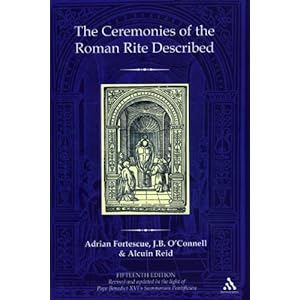
The Ceremonies of the Roman Rite DescribedSince Universae Ecclesiae is going to reshape somewhat the playing field, and since there will now be additional motivation to ask questions about how to do things the Extraordinary way, it occured to me to remind you about some helpful resources.

First, there is Alcuin Reid’s reworking of Adrian Fortescue, J.B. O’Connell, The Ceremonies of the Roman Rite Described. This takes into consideration the provisions of Summorum Pontificum.  I suspect it will now need a revision, but it is useful.  I wrote about it here.

There is also the reprint of the original 1962 edition of Fortescue, J.B. O’Connell

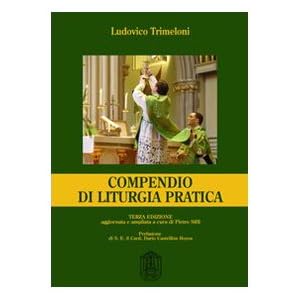
TrimeloniThere is, in Italian, the reworking of Compendio di Liturgia Pratica by Ludivico Trimeloni.  I wrote about it here.

This volume is more comprehensive than Fortesque O’Connell.  It is organized with the sort of analytical precision that was possible, perhaps, only in the mind of pre-Conciliar Roman clerics.  You just don’t see this degree of articulation any more.   There are six pages on how to bow.

There is a preface by H.E. Dario Card. Castrillon Hoyos.  It is dedicated to the Holy Father.  Benedict XVI’s Sacramentum caritatis is quoted at the beginning.

Also, there is a little known but valuable book by by Jeffrey Collins, which is published privately, I think.  It is a solid easy to use volume.  It focuses mainly on what most parishes can muster.  Collins is presently reworking it with an index thanks be to God.  He is working also on a volume for fancier ceremonies.  More about it when I have updated information.

Posted in "How To..." - Practical Notes, ASK FATHER Question Box, Brick by Brick, SUMMORUM PONTIFICUM, Universae Ecclesiae | Tagged , , , ,
6 Comments

VIS: Holy See Press Office statement about Universae Ecclesiae

From VIS with my emphases and comments.

NOTICE ON NEW INSTRUCTION UNIVERSAE ECCLESIA [Spelled incorrectly.  Ecclesiae.]

VATICAN CITY, 13 MAY 2011 (VIS) – Following is the notice, in full, summarizing the new Instruction Universae Ecclesia [again] regarding the application of the Motu Proprio “Summorum Pontificum” issued by Fr. Federico Lombardi, director of the Holy See Press Office.

“Instruction on the application of the Motu Proprio Summorum Pontificum (of 7 July 2007, entered into effect 14 September 2007) was approved by Pope Benedict XVI last 8 April and carries the date of 30 April in liturgical remembrance of Pope St. Pius V.

The Instruction, called Universae Ecclesiae [At last.] on the basis of the first words of the text in Latin, comes from the Pontifical Commission Ecclesia Dei, to which the Pope also entrusted the task of monitoring the observance and application of the Motu Proprio. It therefore bears the signatures of its president, Cardinal William Levada, and secretary, Msgr. Guido Pozzo.

The document was sent to all the Bishops in the past weeks. Remember that “Instructions clarify the prescripts of laws, elaborating on and determining the methods to be observed in fulfilling them” (CIC, can. 34). As is said in n.12, the Instruction was issued “with the desire to guarantee the proper interpretation and the correct application of the Motu Proprio ‘Summorum Pontificum’“.

It is natural that, in its application, the Instruction follow the law contained in the Motu Proprio. The fact that this occurs now, three years later, is easily explained by recalling that in the Pope’s Letter accompanying the Motu Proprio, he explicitly said to the Bishops: “I invite you to send to the Holy See an account of your experiences, three years after this Motu Proprio has taken effect. If truly serious difficulties come to light, ways to remedy them can be sought.” The letter accompanying the Instruction thus bears with it the fruit of a three year trial of the application of the law, which was foreseen from the beginning.

The document is presented in plain wording and is easily read. [Though there are a couple points which require some knowledge of canonical terms.] Its Introduction (nos. 1-8) briefly recalls the history of the Roman Missal up to the last edition of John XXIII in 1962 and the new Missal approved by Paul VI in 1970 following the liturgical reform of Vatican Council II. It repeats the fundamental principle that there are “two forms of the Roman Liturgy, defined respectively as extraordinaria and ordinaria: they are two usages of the one Roman Rite, one alongside the other. Both are the expression of the same lex orandi of the Church. On account of its venerable and ancient use, the forma extraordinaria is to be maintained with appropriate honor” (n. 6).

The purpose of the Motu Proprio, expressed in the following three points, bears repeating: a) to offer to all the faithful the Roman Liturgy in its most ancient usage, considered as a precious treasure to be preserved; b) to effectively guarantee and ensure, for all who ask for it, the use of the forma extraordinaria; and c) to promote reconciliation at the heart of the Church (cf. n. 8).

A brief section of the document (nos. 9-11) recalls the tasks and powers of the Commission Ecclesia Dei, to which the Pope “has conferred ordinary vicarious power” on the subject. Among others, [Nota bene:] this has two very important consequences. First of all, this Commission can [1] decide on  recourses legitimately sent to it against eventual measures taken by bishops or other Ordinaries that seem to be in conflict with the dispositions of the Motu Proprio (while retaining the possibility of further challenging the decisions of the Commission itself before the Supreme Tribunal of the Apostolic Signatura). Moreover, it falls to the Commission, with the approval of the Congregation for Divine Worship, [2] to take care of eventual editions of liturgical texts for the forma extraordinaria of the Roman Rite (for example, it is to be hoped that, following the document, new saints and new prefaces will be added).

The properly normative part of the document (nos. 12-35) contains 23 brief points on different topics.

The competence of diocesan bishops to implement the Motu Proprio is reasserted, with the reminder that in cases of controversy regarding the celebration in the forma extraordinaria, the Commission Ecclesia Dei will adjudicate.

It clarifies the concept of coetus fidelium stabiliter existens (“where there exists a stable group of faithful”), whose desire to attend the celebration in the forma extraordinaria is to be willingly accepted by pastors. While leaving an evaluation of the number of persons necessary to constitute such a group to the prudent assessment of the pastors, it specifies that it not be necessarily constituted by persons belonging to a single parish, but can be composed of persons coming from different parishes or even different dioceses. Always keeping in mind respect for the widest pastoral needs, [that wording does not appear in the Instruction] the Instruction proposes a spirit of “generous welcome” toward the groups of faithful who request the forma extraordinaria and the priests who occasionally ask to celebrate that form with some faithful.

Also very important is the clarification (n. 19) according to which the faithful who request the celebration of the forma extraordinaria “must not in any way support or belong to groups which show themselves to be against the validity or legitimacy of the Holy Mass or the Sacraments celebrated in the forma ordinaria” or against the Pope’s authority as Supreme Pastor of the Universal Church. Such would, in fact, be in obvious contradiction of the purpose of the Motu’s “reconciliation”. [Reminder: the third of three purposes indicated.]

Important indications regarding the “qualified priest” to celebrate the forma extraordinaria are also given. Naturally, he should not have impediments from a canonical aspect. He should know Latin sufficiently well and know the rite to be celebrated. Bishops should, therefore, make adequate formation possible in the seminaries to such ends and the possibility is noted, if other qualified priests are unavailable, of the assistance of priests from the Institutes established by the Commission Ecclesia Dei (which normally use the forma extraordinaria).

The Instruction repeats that every priest, whether diocesan or religious, has the right to celebrate the Mass sine popolo (without a congregation) in the forma extraordinaria if they so desire. Therefore, if it is a celebration with the participation of only one minister, the individual religious do not need the permission of their superiors.

Always in reference to the forma extraordinaria, there follow norms regarding the liturgical rubrics and use of liturgical books (such as the Ritual, the Pontifical, and the Ceremonial of Bishops), the possibility of using the vernacular for the readings (proclaimed either after the Latin language readings or even in alternative to them in “Low Masses”), the possibility for clerics to use the pre-reform Breviary, and the possibility of celebrating the Sacred Triduum of Holy Week for groups of faithful who request the ancient rite. As regards holy ordination, the use of ancient liturgical books is only permitted in the Institutes that are under the Commission Ecclesia Dei.

[And new we depart from news and move into opinion, interpretation…]

On finishing the letter, one is left with the impression of a well-balanced text that intends to promote – as intended by the Pope – a serene usage of the pre-reform liturgy by priests and faithful who feel its sincere desire for their spiritual well-being: [Note: “promote”.] even more, a text that intends to guarantee the legitimacy and efficacy of such usage in keeping with what is reasonably possible. At the same time, the text is animated with trust in the bishops’ pastoral wisdom and insists very strongly on a spirit of ecclesial communion that should be present in all – faithful, priests, and bishops – so that the purpose of reconciliation, so evident in the Holy Father’s decision, not be hindered or frustrated but fostered and attained”.

CNS has this:

Jesuit Father Federico Lombardi, Vatican spokesman, said the language of that provision made it clear that “there should be no polemical or critical intent on the part of those people making the request.”


Posted in "How To..." - Practical Notes, SUMMORUM PONTIFICUM, The Drill, Universae Ecclesiae | Tagged , ,
12 Comments

Universae Ecclesiae, chapel veils, and you

Posts about women wearing head coverings in church never get any attention… NOT.   Nice double negative, no?

I am reminded of the story of the guy during a conference on philology and philosophy who, having delivered a dopey and mind-numbing talk filled with errors, eventually quipped that, while in English a double-negative pointed to an affirmation, a double-positive did not point to a negation. At which point a thoroughly fed-up fellow panelists, griped “Yah, yah.”

I digress.

The new instruction Universae Ecclesiae has this important paragraph.

28 – Praeterea, cum sane de lege speciali agitur, quoad materiam propriam, Litterae Apostolicae Summorum Pontificum derogant omnibus legibus liturgicis, sacrorum rituum propriis, exinde ab anno 1962 promulgatis, et cum rubricis librorum liturgicorum anni 1962 non congruentibus.  … Furthermore, by virtue of its character of special law, within its own area, the Motu Proprio Summorum Pontificum derogates from those provisions of law, connected with the sacred Rites, promulgated from 1962 onwards and incompatible with the rubrics of the liturgical books in effect in 1962.

Derogate means that things are partially replaced, set aside.  So, insofar as the use of the 1962 books is concerned, if there is something that came into law after 1962, and that thing or practice conflicts with what is in the 1962 books, then those post-1962 things don’t apply to the use of the 1962 books.

Communion in the hand is after 1962, as are Extraordinary Ministers of Communion, altar girls….

As I read this, and I checked this with canonists, since the employment of females substituting for Instituted Acolytes came with an interpretation of the 1983 Code, you cannot have altar girls for the Extraordinary Form which was, in 1962, carried out by all male ministers and servers.  This would probably apply to other issues, such as the substitution of music, the use of proper vestments and choir dress, who gives which blessings, etc.

However, I don’t believe that this applies to the use of head-coverings in church by women.  Under the previous Code of Canon Law of 1917, women were obliged to cover their heads with a hat or veil during Mass.  The newer Code of 1983 does not have that obligation.

But, as best I can make it out, this obligation for women in the congregation to wear a head-covering was not in any liturgical book in 1962.  I haven’t checked, but there probably was one for the consecration of an abbess or for vows of religious sisters.  The rite of consecration of virgins was introduced in 1970, though I am vaguely aware that it had barely survived even before for Benedictine nuns.  But that is neither here nor there.  As far as I know there was no mentioned of women in the congregation wearing head coverings in the liturgical books.  And the Instruction UE deals with liturgical books.

So, while UE 28 makes it clear that females are not to serve at the altar when the older books are used, it does not touch on the issue of head-coverings for women in the congregation.

That said, Card. Burke has argued along the lines of the spirit of the provisions of Summorum Pontificum.  Surely he is right.  While there is no strict obligation according to the law, the whole ethos of the older use of the Roman Rite creates a soft obligation, a strong presumption that those who attend will of their own free will do their best to conform themselves to what the older use is offering.  That would include a willingness on the part of women to use a head-covering in church.


Posted in "How To..." - Practical Notes, 1983 CIC can. 915, SUMMORUM PONTIFICUM, Universae Ecclesiae |
58 Comments