Minnesota: Bp. Sirba testifies for defense of marriage amendment

The Catholic Spirit, Archdiocesan newspaper of my native place, has a piece about the testimony in defense of marriage given to the House Civil Law Committee of the Minnesota Legislature by His Excellency Most. Rev. Paul Sirba, Bishop of Duluth.  For this statement he spoke for all the bishops of Minnesota.
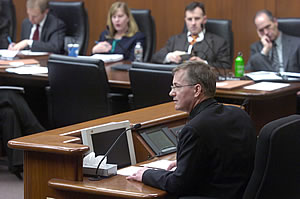
From my personal experience, Bp. Sirba was one of the best priests I have ever known. I have known him for 30 years.

Duluth bishop testifies in favor of marriage amendment bill
May 3, 2011

Bishop Paul Sirba of Duluth testified May 2 before the House Civil Law Committee in support of a bill (HF 1613) that would put a constitutional amendment on the ballot in 2012 to define marriage as a union between one man and one woman. [Make it so!]

“Based on God’s Word given in divine revelation, we believe that marriage creates a sacred bond between spouses,” said Bishop Sirba, speaking for the Catholic bishops of Minnesota. “We hold this to be true not only for ourselves, but for all humanity.” [And marriage can be defended also from the point of view of reason, without the reference to divine revelation.]

The church’s convictions about marriage “find ample support in principles which can be discovered by human reason and which have been reflected throughout human history,” he said.

The House bill, introduced by Rep. Steve Gottwalt (R-St. Cloud), was approved by the Civil Law Committee by a 10-7 vote. A companion bill in the Senate (SF 1308), authored by Sen. Warren Limmer (R-Maple Grove), was passed April 29 in the Senate Judiciary Committee, where Bishop John Quinn of Winona testified in support of the measure.

If both houses pass the measure, a question would be placed on the ballot in November 2012 asking voters: “Shall the Minnesota Constitution be amended to provide that only a union of one man and one woman shall be valid or recognized as a marriage in Minnesota?”

Bishop Sirba was the third of seven people to testify on behalf of the House bill. Hundreds of people were directed to a lower-level room to watch the proceedings via live broadcast, as only ticketed participants were allowed into the packed hearing room.

Testimony in support of the bill was also given by representatives from four other faith groups, University of St. Thomas School of Law professor Teresa Collett and Jennifer Roback Morse, founder and president of the Ruth Institute, [Participates at Acton Institute’s summer university.  Great speaker.] a project of the National Organization for Marriage. Amendment opponents also testified.

Bishop Sirba said “the committed relationship between one man and one woman calls forth the best of the spouses, not only for their own sake, but also for the well-being of their children and for the advancement of the common good.”

In defending the institution of marriage, he emphasized that “persons with same-sex attractions are our sisters and brothers, and should not be deprived of their authentic human rights, including the most fundamental rights of all — the right to life and the right to love.” [It is impossible for them to claim a right to marriage, which can only be between one man and one women.]

The Catholic Church opposes discrimination against any person based on a same-sex attraction, he said. “At the same time,” he added, “meeting authentic human needs does not require changing society’s definition of marriage.”

Bishop Sirba said the bishops believe the amendment is needed because several legislative proposals in the past few years have sought to “transform marriage from an institution focused on the needs of children into a totally new legal entity centered on the happiness of adults.”  [Can we conclude from this that passage of legislation allowing same-sex couples to “marry” and then in some way adopt children, is a form of child abuse?]

To view the Minnesota Catholic Conference’s “Marriage Amendment Resource Page,” visit HERE.

WDTPRS kudos to Bp. Sirba.

Posted in "How To..." - Practical Notes, Fr. Z KUDOS, One Man & One Woman, Our Catholic Identity | Tagged , , ,
18 Comments

Of crackit gaberlunzies

I was enjoying some jocular O’Brian references, for I was listening to part of a book as I worked over some tech updates.  I must share a passage.  We are close to the beginning of Treason’s Harbor (book 9 of the series) enter in media res.  Stephen Maturin, you must know, is the Napoleon detesting ship’s surgeon of Irish/Catalan extraction, a Papist and intelligence agent for the Royal Navy, and not just a surgeon but an actual doctor and naturalist and member of the Royal Academy.

He is also one of literature’s great masters of invective:

But Dr Maturin had been baulked of his John Dory. This was Friday; he had been promised a John Dory and he had looked forward to it; but on Tuesday, Wednesday and Thursday the gregale had blown with such force that no fishing-boats had put out, and since Searle, unused to Catholic officers (rare birds in the Navy, where every lieutenant, on receiving his first commission, was required to renounce the Pope), had not even laid in any salt stock-fish, Maturin was obliged to dine on vegetables cooked in the English manner, waterlogged, tasteless, depressing. He was not ordinarily a greedy man, nor very ill-natured, but this disappointment had come on top of a series of vexations and some very grave anxieties, and on the second day of his giving up tobacco.
‘You might say that Duns Scotus stands in much the same relationship to Aquinas as Kant to Leibnitz,’ said Graham, carrying on their earlier conversation.
‘Sure, I have often heard the remark in Ballinasloe,’ said Maturin. ‘But I have no patience with Emmanuel Kant. Ever since I found him take such notice of that thief Rousseau, I have had no patience with him at all -for a philosopher to countenance that false ranting dog of a Swiss raparee shows either a criminal levity or a no less criminal gullibility. Gushing, carefully-calculated tears, false confidences, untrue confessions, enthusiasm -romantic vistas.’ His hand moved of itself to his cigar-case and came away disappointed. ‘How I hate enthusiasm and romantic vistas,” he said.
‘Davy Hume was of your opinion,’ said Graham. ‘I mean with regard to Monsieur Rousseau. He found him to be little more than a crackit gaberlunzie.’
‘But at least Rousseau did not make a noise,’ said Maturin, looking angrily at his friends in the farther bower. ‘Jean-Jacques Rousseau may have been an apostate, a cold-hearted prevaricating fornicator, but he did not behave like a Bashan bull when he was merry. Will you look how they call out to those young women now, for shame?’
The young women, who nightly capered on the stage or lent their voices to the chorus, and who often accompanied the younger officers on their boating picnics to Gozo or Camino or their expeditions to what meagre groves the island had to offer, did not seem outraged: they called back and laughed and waved, and one of them, coming up the steps, poised herself for a moment on the arm of Captain Pellew’s chair, drank off his glass of wine, and told them they must all come to the opera on Saturday; she was to sing the part of the fifth gardener. At this Captain Aubrey made some amazingly witty remark: it was lost to Maturin, but the roar of laughter that followed must certainly have been heard in St Angelo.
‘Jesus, Mary and Joseph,’ said Maturin. ‘In Ireland I have known many a numerous gathering rejoice at little more than a genteel murmur; and it is to be supposed that the same applies to Scotland.’
Graham could suppose no such thing, but he was benevolently inclined towards Maturin and he said no more than ‘Heuch: ablins.’

Okay.  From now on I shall use “crackit gaberlunzie” far more often than I, heuch, ablins, have hitherto.

If you want to listen to the unabridged audio books, seek out the recordings on Blackstone by Simon Vance.  He hits his stride in the second book and to the end he gets better and better.

Posted in Crackit Gaberlunzie, Lighter fare, O'Brian Tags | Tagged ,
6 Comments

QUAERITUR: The smoke of Satan

From a reader:

I have a question regarding this document in reference to Pope Benedict XVI’s Motu Proprio Summorum Pontificum.

In Conferentiarum Episcopalium, which was issued by the sacred Congregation of Divine Worship on October 28th, 1974, the use of the
1962 edition of the Roman Missal was “offically” abrogated — is almost all cases.

My question is this: What are your thoughts on this document? Is this part of the “smoke of satan” what Pope John XXIII spoke about at the beginning of V2? I have read rumors about how there were some problems with implimentation after V2 that Pope Paul VI tryed to correct and do away with. Is this one of them?

First, conferences of bishops don’t have the authority to abrogate a liturgical book or use of the whole Church.  Also, in the final analysis they are not competent to state whether or not something is abrogated.  Furthermore, Pope Benedict XVI specifically stated that it had not been abrogated.  That is what we go with.

Also, it was Paul VI, not John XXIII, who said that the smoke of Satan had entered the Church.  Paul said this on 29 June 1972 in a sermon for the 9th anniversary of his Coronation he said that, “through some crack the smoke of Satan has entered the temple of God”.

Pope Paul could have been referring to any number of factors.   Point in any direction and you will find one.  It has ever been so in the Church, since the Church is made up of sinners who betray the Lord in their sins.

“We believe in something that is preternatural that has come into the world precisely to disturb, to suffocate the fruits of the Ecumenical Council, and to impede the Church from breaking into the hymn of joy at having renewed in fullness its awareness of itself.  Precisely for this reason, we should wish to be able, in this moment more than ever, to exercise the function God assigned to Peter, to strengthen the Faith of the brothers.  We should wish to communicate to you this charism of certitude that the Lord gives to him who represents him though unworthily on this earth.”

Posted in ASK FATHER Question Box, SUMMORUM PONTIFICUM | Tagged , , , , , , ,
23 Comments

5 May – Rome – Solemn TLM at St. Mary Major for St. Pius V

For anyone hanging about in Rome on 5 May:

On 5 May at 15,30 at the Alta of the Salus Populi Romani in St. Mary Major there will be a Solemn Mass in the Extraordinary Form to celebrate the Feast of St. Pius V, whose tomb is in the basilica.  The celebrant will be Msgr. Guido Pozzo, Secretary of the Pontifical Commission “Ecclesia Dei” and the music will be provided by the Franciscans of the Immaculate.

Posted in The Campus Telephone Pole | Tagged , ,
8 Comments

Not “your” body? Not your “choice”!

I found this on Fallible Blogma.

I want to add a note.

One of the things we were reminded of during the pontificate of Bl. John Paul II was that we are our bodies. His “theology of the body” served to remind us that we are both soul and body, together.  The body component we have as human beings is not something external or foreign to who we are as images of God.

What flows from this is that we are not free simply to treat even our own bodies as if they were possessions, something we own, like a car we ride in, a meat machine that hauls our souls around.

If we are not really our bodies, if our bodies are things we can treat any way it pleaseth us to treat them, abuse or drug or harm or kill or use for illicit pleasures, because – after all – its mine and I can use it as I want, then… someone else can abuse your body or drug it or harm it or kill it or use it for illicit pleasures because – after all – its just a object to be used.

We are not free to use our bodies as objects.  Our bodies pertain to persons made in God’s image.  Just as you are not free to use as an object another person (the free subject of their own actions) you are not permitted to harm yourself.  In harming yourself you are harming an image of God, which – indeed who – should be treated with dignity.

Posted in Clerical Sexual Abuse, Emanations from Penumbras, One Man & One Woman, Our Catholic Identity, The Drill, The future and our choices | Tagged , , ,
26 Comments

REVIEW: Roman Catholic Sunday Missal Booklet (Angelus 2002)

Sometime back I was asked about booklets or resources for th e Extraordinary Form of the Roman Rite for those who are, perhaps, first timers.

The nice people at Angelus Press sent me an example of the Extraordinary Form Mass booklet for use by people in the congregation who may not have their own hand missal.

The booklet has a thin cardboard-like cover with a little texture.

This 2007 booklet is based on The Ideal Missal revised by Sylvester P. Jurgens, SM, of 1962, which had an imprimatur.  Commentary was adapted from sources from 1908 and 1960.  This particular booklet is a 2008 3rd printing.

It of course has the name of St. Joseph in the Canon.

It is useful also in the UK.

There are indications, within boxes, for Solemn Masses.

There are spiritual comments in the margins.

A sample of artwork.

In the back there is an area to indicate the place where the booklet was obtained.  Note: it says “Chapel contact information”, and not “Church contact information”.  Perhaps this could be corrected in a future reprint.  It would make it slightly more useful.

In the back of the booklet there are the “Leonine Prayers” once ordered by Leo XIII for after Low Masses, prayers for after Mass, Exposition and Benediction.  There are no “catechetical appendices” as in the “red” booklet, which spurred the “Ask Father” question I mentioned at the top.

Posted in "How To..." - Practical Notes, Brick by Brick, REVIEWS | Tagged ,
17 Comments

QUAERITUR: Eucharistic Adoration for the first time: use an iPhone?

monstranceFrom a reader:

My confessor strongly recommended I spend time in adoration. I’ve been hesitant because I’ve never done it before, but I decided to do it tonight after Mass. I just have one problem…

What exactly am I supposed to do during that time? I assume some sort of prayers, but I don’t know too many. Is it Improper to use my iPhone to assist me?

I am glad you will be giving this a try.  Good for you.

I will also ask other readers to jump in on this issue of use of the iPhone to help the experience of Eucharistic Adoration.  But I will also ask them to attend to my preliminary comments.

There are different ways to spend your time before the Blessed Sacrament.

Those who are not used to extended periods of silent or still prayer may want to use pre-set, traditional prayers and spiritual reading to help them get into it and then see where it takes them.

Those who are more accustomed or inclined to contemplation or meditation will perhaps not need to start in that way.

About using the iPhone or other electronic thing.  As favorable as I am toward using new tech, gadgets could still be a distraction in themselves.  Yes, people can use them to help them move out of the world, as it were, or provide texts or lists of people to pray for, etc.  Also, they might be a distraction to others who may get the idea that you are “playing with a gizmo” or “not paying attention to Jesus” simply because you have one in your hand.

I would try your first experiences with adoration without such an aid, at least at first.  Use a book, or take a note pad.   Take a Rosary.

Perhaps people who are experienced with this could chime in with their tips and observations.

UPDATE:  Fuller disclosure:

When I received an advance copy of the Holy Father’s new book, in PDF, I put it on my iPad and read it in the chapel.  Seemed right.

Posted in "How To..." - Practical Notes, ASK FATHER Question Box | Tagged ,
44 Comments

QUAERITUR: veils and burses

burse, chalice veilBefore the enthusiasts of the chapel veil question get all revved up, this is about chalice veils and burses, which are designed to hold the corporal when during Mass it is not in use upon the altar.



From a reader:

Do you know where suitably appropriate burses and veils can be bought
for a good price? I want to buy some for our parish as a thank you to
our priest before I go to University.

A nice gesture.

I know that many chasubles these days are sold without veils and burses – horribile dictu.  I hope that trend is changing.   In the Ordinary Form, use of the chalice veil is not absolutely required, but it is strongly recommended, or it was in the older GIRM.  Newer, 2000 GIRM?  I didn’t find it.  I believe there is also profound symbolism in the moment of the unveiling of the chalice.  Also, in the Ordinary Form white can be used as a chalice veil on all occasions.

Also, the burse has a practical use, especially for those who believe in the Real Presence.   The corporal is traditionally folded in such a way that, when closed up again at the end of Mass, any particles of the Host that may have been missed by the priest will stay within the folds and not simply be scattered.  The burse holds the folded corporal so that it won’t unfold.

I suppose that any Catholic religious goods store, online or in non-virtual reality, would be able to help you find chalice veils and burses.  Also, veils would not be especially hard to make.

Anyone else?

UPDATE 22:57 GMT:

A commentator added this useful citation, below:

New GIRM 2000: Sorry it is late in the evening, and I cannot be bothered to look up a translation, so am using the altar Missal which is near my desk.  You will be glad to know the veil is indeed mentioned.

Caput IV : De Diversis formis Missa celebranda, part entitled Praeparanda :
Section 118, last paragraph: “Calix laudabiliter cooperiatur vela, quod potest esse aut coloris diei aut coloris alba.” So there you have it. (trans “it is good to cover the chalice with a pall, [No. Vela is “veil”, not pall.] which may match the  vestments, or white)

The earlier para of the same section also expects the chalice pall if you have one: “c) in abaco: calix, corporale, purificatorium et, pro opportunitate, palla.”  No mention is made of the Burse, so very oddly.

Posted in "How To..." - Practical Notes, ASK FATHER Question Box | Tagged ,
24 Comments

QUAERITUR: permanent deacons taking role away from priests

From a reader:

I’ve noticed recently that permanent deacons seem to be taking over the roles of priests during Mass with anything and everything they are permitted to do, even what should normally be done by priests when one is available (ie, giving the homily, Holy Thursday foot washing, reading the parts of Jesus on Good Friday, giving the blessing at the end of Mass, etc).

This has me concerned because it’s beginning to appear as though the deacon is the main celebrant at Mass, and the priest is “just there to do the consecration.”

Furthermore, because every permanent deacon I’ve ever known is married, I find myself (epically failing at) defending the celibate priesthood to people who think deacons are the equivalent to priests. I’ve actually been told quite recently by a family member the parish deacon “is better than the priest because he is married, has children, and keeps the congregation entertained during the homily with his guitar.” (YouTube example of one of his songs during the homily from his prior parish.)

This makes me fear that priests are going to get further pushed off to the side during Mass, while the deacon takes over until the consecration. Seeing how many people don’t know why they come to Mass, I worry Mass is going to further disintegrate into something worse, and priests are going to be even less respected.

What role are permanent deacons supposed to have within the Church, and how do we get the priest back as the main celebrant?

The roles of deacons during Mass are in many respects described in the GIRM for the Ordinary Form of the Roman Rite.  They in every way described in the older, Extraordinary Form.

I think I will let well-informed readers chime in on this, including any permanent deacons out there who care to comment and clarify.

Posted in "How To..." - Practical Notes, ASK FATHER Question Box, Liturgy Science Theatre 3000 | Tagged
46 Comments

Hans Kung on the Beatification: making irony redundant

The NCFishwrap’s editor is advertising a hit piece in The Irish Times: Hans Kung’s reaction to the Beatification of Bl. John Paul II

A sample with my emphases:

[…]

In an interview last weekend with German daily the Frankfurter Rundschau , Küng says John Paul II does not merit being presented to the faithful as an example. He says: “John Paul II is universally praised as someone who fought for peace and human rights. But his preaching to the outside world was in total contrast with the way he ran the church from inside, with an authoritarian pontificate which suppressed the rights of both women and theologians.[Better than Ambien.]

In particular, Küng argues that John Paul’s harsh treatment of Latin American liberation theologians such as Gutierrez and Boff represented the “exact opposite” of decent Christian behaviour. [Actually, they were treated with extreme patience.  And this is, of course, a shot at Pope Benedict, who was Prefect of the CDF.] Küng also sees it as totally “logical” that Pope Benedict would be keen to promote the cause of his predecessor but adds: “Wojtyla and Ratzinger are the people most responsible for the chronic sickness of today’s Catholic Church. Behind the sumptuous pomposity of the great Roman liturgy, there looms a total emptiness in many Catholic communities.”  [And that is because of John Paul II and Benedict XVI.  Not John XXIII or Paul VI.  No.]

One of the most regularly touted criticisms of this beatification has been its fast-track time scale, given that it comes just six years after the death of John Paul II. Supporters of the late pope point to the fact that, to some extent, this is a beatification that has come about by popular acclamation, given the cries of “Santo subito” (Make him a saint immediately) that rang out in St Peter’s Square on the day of his funeral.  [See the irony?]

Küng dismisses this justification, [Wait for it…] arguing that the campaign was manipulated: [ROFL!] “I remember those so-called “spontaneous” posters in St Peter’s Square – all neatly and carefully printed. The whole thing was just a con act by conservative and reactionary Catholic groups, especially those ones that are very strong in Spain, Italy and Poland.” [I supposed union activists and professional protesters were bussed in.]

[…]

Isn’t it ironic that when there is – at long last! – a positive response from the Church to a movement “from below”, from the people, Hans Kung and other of his world view find a way to run it down?

Posted in Throwing a Nutty | Tagged , , ,
30 Comments