 From a seminarian:
It is becoming increasingly popular to use those fake candles with replaceable oil. Even the side-altars in St. Peter’s use these, and as we know, there are many priests who daily celebrate private Masses in the EF at those altars. I was under the impression the real candles with a certain percentage of real beeswax were specified.
This isn’t just about being fussy. It is good to pay attention to candles.
Candles are interesting things. They do more than simply shed light or, in this age of electricity, create an ambiance. They, like we do, breathe in air. They move. They eat. They die. We use them as a sacrificial offering, for once they are used, they are gone for good. They stand in our place when we have intentions to pray for. We light them to avert storms. They remind us that, in this dark fallen world, the light of Christ will be victorious.
It seems to me that Summorum Pontificum did not automatically revive all the pre-Conciliar legislation and decrees for the rubrics and things used for Mass and other rites. That said, there is an interior logic to the way things were done before. It seems like a good idea to follow those ways as closely as possible when we are dealing with the Extraordinary Form.
At the same time, not ever place where the Extraordinary Form is used is exclusively for the Extraordinary Form. That being the case, there must be for the time being some flexibility about what we do. There are bound to be some accommodations to the way things are set up for the Ordinary Form.
For example, if there is one altar cloth being used on a parish altar that is also used for the older form of Mass, given the fact that there are often time restrictions and less than adequate labor available, it doesn’t seem reasonable to require a re-clothing of the altar every time. The logical solution would be to have the altar permanently clothed for the older form. That sounds to me like a healthy and reasonable approach. First, our forebears figured out the best and most practical way to do things. The number of cloths have a purpose: if there is a spill of the Precious Blood, three cloths will effectively contain the spill whereas one probably will not.
Similarly, it could be too hard to switch all the candles before celebrations of a TLM. So, we forge ahead hoping that, perhaps, the choice will be made to adjust the present use according to our tradition. That said, if it is not possible to have better candles, I suppose we just have to sigh and move forward, keeping our hod and trowel close at hand.
Here is something that was posted by a commenter here some time ago on the question of candles.
This is more about candles than you may want to know!
Fr. John Bolen, “The Wax Candle in the Liturgy,” The Ecclesiastical Review, May 1942, 376-383 makes some distinctions.
The 1904 decree stated that the Paschal Candle, the candles used in the blessing of baptismal water, and the two candles needed for the celebration of Mass, must be made of wax, at least “in maxima parte”; all other candles used on the altar must contain a “greater or notable part of wax.” Bolan reports that “In maxima parte” was interpreted as low as 65%, “greater part” meant 51%, and “notable part” was interpreted as low as 25%.
More recently, a guidelines – I don’t think a law – from the U.S. bishops in the USCCB’s Built of Living Stones (2000), n. 93:
Candles for liturgical use should be made of a material that provides “a living flame without being smoky or noxious.” To safeguard “authenticity and the full symbolism of light,” electric lights as a substitute for candles are not permitted. [The footnote is the Notitiae text quoted elsewhere.]
Also at n. 94:
“Above all, the paschal candle should be a genuine candle, the pre-eminent symbol of the light of Christ.
About the sanctuary lamp before the Blessed Sacrament look in “Holy Communion and Worship of the Eucharist Outside Mass” (1973) in the General Introduction, n. 11:
As an indication of Christ’s presence and as a mark of reverence, a special lamp should burn continuously before a tabernacle in which the Eucharist is reserved. According to traditional usage, the lamp should, if at all possible, be an oil lamp or a lamp with a wax candle. [The footnote refers to Congregation of Rites, Instruction Eucharisticum mysterium, n. 57.]
That said, in 1974 the Congregation for Divine Worship and the Discipline of the Sacraments answer a question about candles in Notitiae (10:80 (1974), no. 4):
“Query: Must the lighted candles that are to be placed in candlesticks for the celebration of Mass consist in part of beeswax, olive oil, or other vegetable oil?
Reply: The GIRM prescribes candles for Mass ‘as a sign of reverence and festiveness’ (nos. 79, 269). But it makes no further determination regarding the material of their composition, except in the case of the sanctuary lamp, the fuel for which must be oil or wax (see Holy Communion and Worship of the Eucharist Outside Mass, Introduction no. 11). The faculty that the conferences of bishops possess to choose suitable materials for sacred furnishings applies therefore to the candles for Mass. The faculty is limited only by the condition that in the estimation of the people the materials are valued and worthy and that they are appropriate for sacred use. Candles intended for liturgical use should be made of material that can provide a living flame without being smoky or noxious and that does not stain the altar cloths or coverings. Electric bulbs are banned in the interest of safeguarding authenticity and the full symbolism of light.”
In the GIRM (2002) at n. 316:
In accordance with traditional custom, near the tabernacle a special lamp, fueled by oil or wax, should be kept alight to indicate and honor the presence of Christ.
So, there is quite a bit of flexibility about the material of the candles, but the vector of the Church’s thought is pretty clear. Candles should be of a material that is for the most part natural. A high percentage real bee’s wax is preferred, always remember that 100% bees wax candles can get a little droopy in hot weather. They should produce a good flame without guttering. Tallow or animal fat is too smokey and smells bad. Vegetable oil, especially olive oil is permitted.
Finally, as a personal note, nothing makes a church smell “Catholic” more than the lingering scent of incense, some wood polish, and bee’s wax candles burning. That combination alone is just about enough to get you thinking about converting or going to confession or saying the Rosary … you know… doing something Catholic.
Maybe some readers have more.
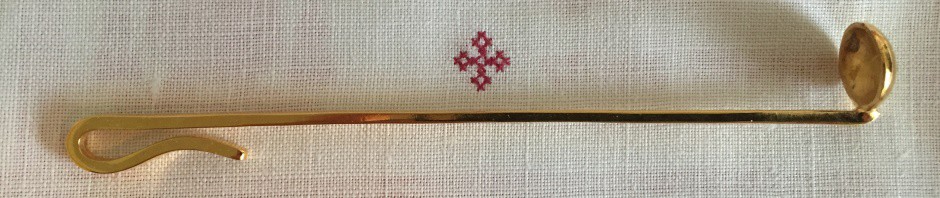
 From a reader:





























