Cable guy: Do it yourself!

I have a very long ethernet cable that had broken connectors.

It was time to make a change.

I have had a cable crimper and tool for a long time and some connectors.

Hack off the bad connector.

In examining the cable carefully I realized that this was a cross-over not a straight-through cable. I wanted a cross-over cable.  No power-over-ethernet stuff to worry about.  What this meant, however, is that once I did one end of the cable, I had absolutely to do the other end as well to be sure.   The straight and the cross-over have a different order of the little wires.

Untwist the twisted pairs.   Which… now that I think of it… is a good slogan for the present day culture wars.

Got them into the right order and them trimmed them down to the right length.

Stuck them into the crimper and, well, crimped ’em.

Yes, indeed, I need to do the other end too.  Sip some Mystic Monk Coffee (it’s swell!) and repeat the process.

I don’t have an ethernet cable tester, but I carefully double-checked the order of the wires.   It works just fine.

I have spool of cat-5, some connectors, a crimper.   Ready to go.

Need cables?  Do it yourself.

Posted in "How To..." - Practical Notes | Tagged
19 Comments

A study in contrasts

From one side….

And from the evil side….

Posted in Emanations from Penumbras, The future and our choices | Tagged , ,
17 Comments

WDTPRS Ember Wednesday “Missa Aurea” Collect: solace for the lonely

Today, Ember Wednesday of Advent, those who have the use of the older, traditional Roman Missal, offer worship to God with the so-called Missa aurea, the “Golden Mass”.

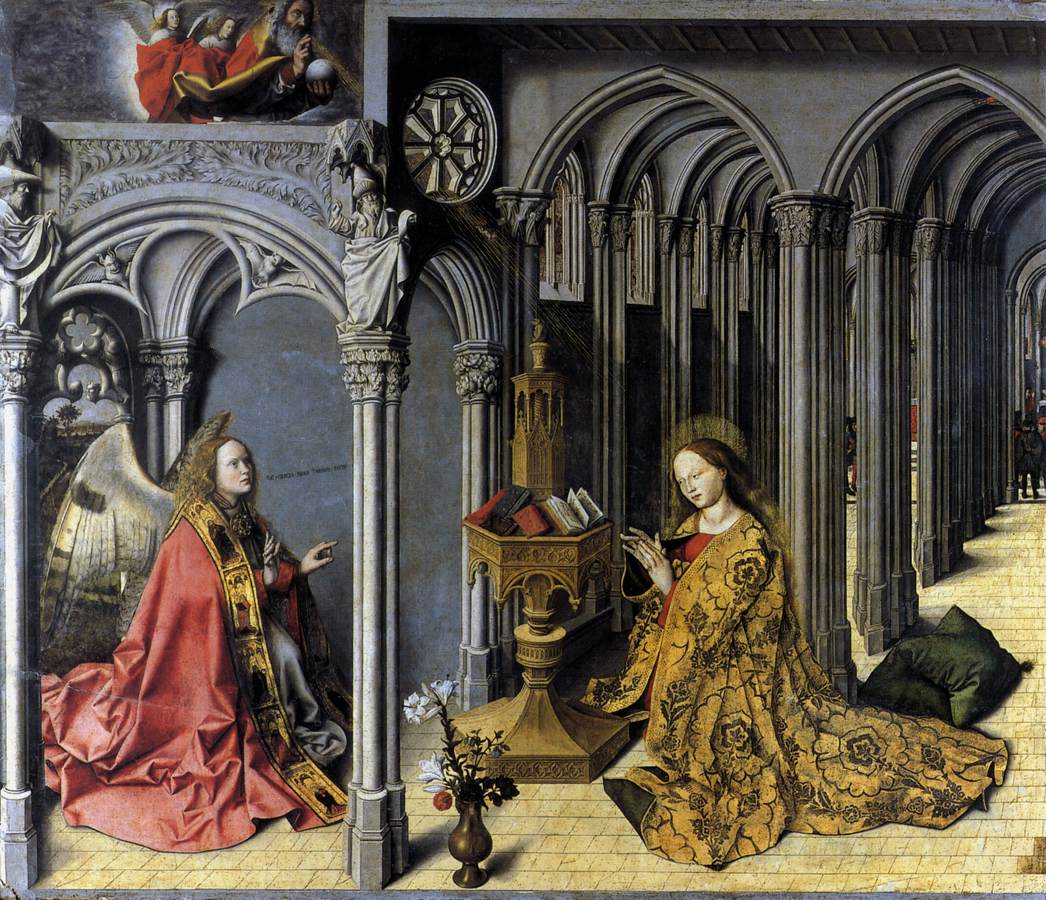
There is a strong Marian overtone to today’s Mass formulary.  The Roman Station for today is St. Mary Major.  the Gospel is the Annunciation.

The illuminated missals and sacramentary of centuries past presented the Gospel or at least its initial capital letters in gold, whence our nickname Missa aurea.

And the Gospel pericope begins Missus est angelus Gabriel….  It was once celebrated with a solemnity nearly approaching a feast day.

Missa aurea also refers to little dramas in medieval times in which the Annunciation was acted out.  It is thus not just “golden Mass” but “the golden sending“, which of course refers to the moment in which Our Lord becomes incarnate in the womb of the Virgin and His work for our salvation begins a new phase.  Missa aurea comes to be used in the terminology of art history also for paintings of the Annunciation, which often contain dramatic elements associated with the tableaux struck in the dramatic presentations of the mystery.  Doves would be lowered and an old man would be placed in a loft wearing an alb and cope.  Angels would come vested in dalmatics.  The Arena or Scrovegni Chapel in the 13th c.  Giotto’s frescoes echo this tradition as do many paintings of the Annunciation.

The Advent Ember Days were timed to follow St. Lucy’s feast (13 Dec.).  St. Lucy was an important saint for our forebears.  Her name, derived from the world for “light”, is tied to our awareness in the northern climes of the deepening darkness of our December days and that those days will soon be getting longer again.  Listen for the urgency within the threefold “command” we are issuing to the Lord (festina… ne tardaveris… impende).

COLLECT:

Festina quaesumus, Domine, ne tardaveris,
et auxilium nobis supernae virtutis impende;
ut adventus tui consolationibus subleventur,
qui in tua pietate confidunt.

This Collect, an ancient prayer found in such manuscripts as the 8th c. Liber sacramentorum Gellonensis, survived the snipping and pasting experts of Fr. Bugnini’s Consilium in a somewhat truncated form, to be prayed on 24 December in the Novus Ordo: Festina, quaesumus, ne tardaveris, Domine Iesu, ut adventus tui consolationibus subleventur, qui in tua pietate confidunt.

That form tardaveris is a perfect subjunctive of tardo, “to tarry, loiter, linger, delay”, paired here with ne to form a kind of imperative.  That ne tardaveris is found in the Latin version of the Psalms.

Impendo is “to expend, devote, employ, apply”.  Pietas, when it refers to man has to do with “duty”, but when applied to God, it becomes “mercy… pity”.  Remember that adventus here is a genitive with tui.   Sublevo means, basically, “to lift up from beneath, to raise up, hold up, support”, but it comes to mean, “to sustain, support, assist, encourage, console any one in misfortune”.  The perfect way to describe this vale of tears in which we journey.

LITERAL VERSION:
Hurry, we beseech You, O Lord, tarry not,
and expend upon us the help of heavenly power;
that those who rely upon Your mercy
may be sustained by the consolations of Your Coming.

You can feel in this prayer the growing Christian sense of urgency and longing.  Advent seems to pick up speed and become more anxious for resolution as we plunge headlong into physical darkness and cold, the reminders of our inevitable appointment with death.

This oration looks simultaneously back to the Nativity of the Eternal Word made man, but also forward to the Second Coming, which gives us consolation.  Christians in the state of grace can feel great consolation at the thought of the Coming of the Lord, in history and in the time to come.  We need not be afraid when we are in the state of grace.  Therefore, the Christian always eagerly says “Come, Lord Jesus.  Maranatha.   Come.”

This prayers rings with consolation.

May the Lord’s coming and promise of return console any of you who are burdened with sorrow. Many people feel at times inconsolable.

This time of year can be a annual trial of despair and sadness for so many who are alone and suffering.

In gratitude for the Lord’s promises, console others.

Think of this as a “golden rule”.

Posted in ADVENT, WDTPRS | Tagged , ,
7 Comments

REVIEW: 2011 Ordo from Angelus Press

The nice people at Angelus Press sent me a 2011 Ordo… the Ordo Divini Officii Persolvendi Missaeque Sacrificii Peragendi Pro Anno Domini 2011.

Ordo

This Ordo is in accordance with the rubrics established by John XXIII in Rubricarum instructum of 25Jul 1960.

This is the usual paper-bound affair which will be sturdy enough to last the whole year even with a bit of flattening to get it to lie open.

It starts with the calendar year at January 2011 instead of the liturgical year at Advent in December.  Odd.  It makes the book less useful.   I think they should reconsider that.

US feasts are included in this Ordo.

There is an amusing bit in the front of the book, by way of a preface.   It has something of that combative spirit we expect from the SSPX!

Contrary to the assertions of some persons, there is nothing substantially different between earlier versions of the Missal/Breviary and the 1962 editions.  Nothing contrary to the traditional Roman Catholic Faith is either contained or insinuated in the 1962 Missal and Breviary.  No reputable theologian or liturgical expert of any standing has made any such assertion in this regard.  With supplements and the [Ordo for Holy Week], the older editions of those liturgical books can easily continue to suffice for saying Mass and the Divine Office.

A conversation starter to be sure.   Then, at the end of the preface…

Many older priests, having fewer duties and obligations, continued to say the additional orations and used the oler Breviary as before.  In those days, nobody was upset or critical that they did.  Who would complain if they did so today?

Who indeed?

I appreciate having this Ordo.  I haven’t had one of their ordos in the past, so it will be interesting to see how it differs from others I have seen.

Some helpful information is included.  For example, the texts for the blessing of throats on St. Blaise Day.

I chuckled a bit at the note on p. ix under the excerpts from 1960 rubrics, where I read:

82. According to conditions and customs varying from one church to another and from one place to another – of this matter the local ordinary is the judge….

I wonder how often the SSPX priests are calling the local chancery for a ruling on processions are to be conducted on 24 April.  I’d like to hear that conversation.

Also, during January there is the Octave of Christian Unity.  They include some intentions for each day, such as “The submission of Anglicans to the Authority of the Vicar of Christ.”.   Timely, but a little ironic.

In the back there are Appendices with the feasts for Dioceses of Canada and for Great Britain.

“But Father! But Father!” I can hear some of you saying even as you are reading to the end of this rather specialized entry. “Why aren’t you using an FSSP Ordo?  Should you be supporting Angelus Press?”

Angelus Press prints good things and they send them to me.  The FSSP hasn’t sent me an Ordo.  If they had, I would be reviewing it.  I have used the FSSP Ordo in the past.

Posted in "But Father! But Father!", REVIEWS | Tagged ,
30 Comments

Simple pleasures

Sometimes it’s the small things.

  • Filling up a large black garbage bag with clutter
  • Cleaning up your computer’s “desktop”
  • Not screwing up the chicken
  • The return of the chickadees after the blizzard
  • Getting your office finished at more or less the right hours of the day
  • Good coffee
  • The snap of a mousetrap
  • Getting a call from someone you haven’t heard from in a while
  • Locating that quote
  • Having sunshine for a change
Posted in Lighter fare |
31 Comments

Just some photos

I just liked the way this turned out.

Last night I stuffed and roasted a chicken which was on a super sale.  I almost never stuff chickens.  Usually when I make a chicken I just use rosemary and lemon.  Sadly, I didn’t have my memory stick in my camera, duh, during the preparation.  But here is the final product.

I was so pleased, I had some coffee.

And my little jasmine tree, which came inside for the winter, is flowering.

Now I have to fix my digital thermometer, which died.  I think it just needs a new battery.

Posted in Fr. Z's Kitchen |
13 Comments

WDTPRS: Wednesday of the 3rd Week of Advent

Here is the Collect for Wednesday of the 3rd Week of Advent.

COLLECT:
Praesta, quaesumus, omnipotens Deus,
ut Filii tui ventura sollemnitas
et praesentis nobis vitae remedia largiatur,
et praemia aeterna concedat.

This prayer was in Rotulus 6 published with the Veronese Sacramentary.  It was in the Gelasian Sacramentary.

It is interesting that this is more or less the Collect that is in the 1962MR, though changed.  I add some emphasis.

Praesta, quaesumus, omnipotens Deus: ut redemptionis nostrae ventura solemnitas, et praesentis nobis vitae subsidia conferat, et aeternae beatitudinis praemia largiatur.

Here is what it looked like in the Gelasian:

Praesta, quaesumus, omnipotens deus, ut filii tui uentura solem[p]nitas et praesentis nobis uitae remedia conferat et praemia aeterna concedat.

There is a parallelism between remedia and praemia. Subsidia and remedia closely related.

LITERAL VERSION:
Almighty God, grant, we beseech You,
that the upcoming solemn feast of Your Son,
both may lavish upon us remedies for this present life,
and also concede to us eternal rewards.

CORRECTED ICEL VERSION:
Grant, we pray, almighty God,
that the coming solemnity of your Son
may bestow healing upon us in this present life
and bring us the rewards of life eternal
.

LAME-DUCK ICEL:
Father,
may the coming celebration of the birth of your Son
bring us your saving help
and prepare us for eternal life
.

You decide.

What comes to my mind is the prayer that the priest says silently as he purifies the sacred vessels in both the older and the new form of Holy Mass: “Quod ore sumpsimus Domine, pura mente capiamus: et de munere temporali fiat nobis remedium sempiternum. … Into a pure heart, O Lord, may we receive the heavenly food which has passed our lips; bestowed upon us in time, may it be the healing of our souls for eternity.”

The Collect is already directed to the moment of Communion.

Posted in WDTPRS | Tagged
Comments Off on WDTPRS: Wednesday of the 3rd Week of Advent

A report on my urgent appeal to help with a crisis pregnancy

Sunday I took up the cause posted by my friend Fr. Finigan about swiftly gathering money and necessary things for a young woman in a “crisis pregnancy”.  My post was here.  I got on board because I know Fr. Finigan so well and I trust his judgment about what to support.

I have to say, WDTPRSers made me proud.

I pass this along from the person who was coordinating the effort to help the young woman.  Edited and with my emphases:

Here is a little bit of info – you might want to share an update with the bloggers.

I must tell you that this young woman has been one of the most challenging situations I have ever dealt with! It is the most complicated, messy and difficult family situation.

The young girl was initially told by her family very directly that she had to have an abortion or she could not come home. Her mother rang up and booked the abortion for her.

Since then it has been an emotionally exhausting, continuous soap opera of months of trying to make things work for this girl. She has had a very tough time and through it despite the fact that everyone around her was against her she has shown tremendous courage and determination that she wanted to keep her baby.

But because her entire family was shunned she has been completely alone, financially the situation was impossible and no-one was on hand to come round and donate a spare pram or anything.

So on saturday she rang me and told me the baby was due in 5 days and she had absolutely nothing for when the baby arrived.

Due to the generosity of your bloggers and a few other benefactors who donated prams, cots etc we were able to kit her out with absolutely everything she needs for when the baby arrives (she is due tomorrow!) [OORAH!]

We had a thoroughly exhausting day- It took us all day and quite a few car trips to unload and reload to get everything in and I was worried that the young girl was going to go into labour in the middle of the baby shop because she was carrying two jumbo packs of nappies! At the end of the day her mother (grandmother of the baby) popped round – she has only just really accepted the idea that she has a grandchild but what was amazing was she was just so moved she just couldn’t stop hugging me. She kept saying “your heaven sent” (and this woman was a muslim!) It was an incredibly moving experience for them because everyone else has completely rejected them and they just couldn’t believe that people were this generous. [OORAH!] The young expectant mother walked me to the front door at the end and she turned to me and she said “you’ve made it possible for me to have my baby. Everyone told me it was impossible. But you’ve made it possible- it’s all thanks to you that I can keep my baby” Well I hugged her and quickly turned round as I began to cry.

This young lady has faced what seemed like an impossible situation on every level – Homeless, alone, rejected by everyone she loved, violence, financially unable to even support herself and no practical way forward. But the bloggers made it possible – because once you pave out a practical way forward ….once you put all the jigsaw pieces together and show them a lot of love….then it becomes not just possible but more than that….it’s actually quite incredible.

I must finish by telling you that I was losing a little bit of hope with this girl last week because I was just exhausted of all the family antics and I had to have some little words with Our Lady of Guadeloupe and entrust it to her. Well she responded on her kinda feast day which wasn’t a feast day because it was a sunday by absolutely blowing me away with some incredible people who were willing to reach into their pockets and do something very incredible.

Can’t tell you how moved I am with the generosity of your bloggers.

Your bloggers have made this baby’s first christmas an incredible one.

There it is, friends.

Posted in Brick by Brick, Fr. Z KUDOS, Just Too Cool, Linking Back, Our Catholic Identity | Tagged , ,
27 Comments

Brick by Brick in Sugar Land, TX

For your “Brick by Brick” file comes this from a reader:

St Theresa’s in Sugar Land had it’s annual youth winter retreat, but with a few notable changes.  Adoration included 30 minutes of silence (rare for youth gatherings.). Mass was celebrated Ad Orientem by the pastor, Fr. Stephan B. Reynolds.  During communion kneelers were set out.  The Homily included catechesis and the history of these practices and their recent dissipation.  The young people were extremely receptive, they noted that they were better able to sense the sacredness of the Mass and it’s mystery.

A mixture of chants and Jesus I love you music were used.  Definitely a beautiful step in the right direction.  We must build from the bottom up.  The youth are hungry for the faith and it’s reason.  God bless the priests who are willing to teach and lead by example!

WDTPRS KUDOS to Fr. Reynolds.

Meanwhile…

[CUE MUSIC]

coffeeWhen you are wondering what it is going to take to restore a sense of the sacred and reestablish continuity in our liturgical worship, why not cogitate over a piping hot WDTPRS mug filled to the brim with Mystic Monk Coffee?

With each bean you grind or each sip you take of that Jingle Bell Java goodness, or that Cowboy Blend or even one of those froo froo flavored coffees I never buy… but you should if you like that sort of thing…  you advance, I am not making this up, you advance the cause of liturgical excellence.  How, you might ask, do you do that?  Well, I’ll tell you!

It’s like this…. By helping the traditional Carmelites in Wyoming, who are traditional in their liturgical life, you support a community whose prayers support and sustain the whole Church.  They also set a good example for other religious communities and those who aspire to the religious life of the evangelical counsels.  You also, by getting their coffee through my link, help to keep the undersigned online and feisty.

You need coffee anyway, so buy it from them.  And it makes good gifts as well.

Mystic Monk Coffee!

It’s liturgically swell!

Posted in Brick by Brick | Tagged
21 Comments

What does “refrigerium” mean in the Roman Canon’s Memento of the dead?

refrigeriumI just put together an article for The Wanderer, my usual weekly column which was the origin of this blog.

In the course of the column I offered this.  It is something I have written on before, since I have written on the Roman Canon before.   Still… it may be of interest to new readers.

___

The ancient Roman orator, philosopher, and statesman M. Tullius Cicero (+ 43 BC), and other authors as well, use the verb refrigero for “to cool off, make cool” and “to relieve, refresh”.  It also has a moral overtone, in the sense of “cooling passions”.  Think of “taking a cold shower”.  In ecclesiastical use refrigerium means “a cooling; a mitigation, consolation”.  We find a use of refrigerium also in the magnificent Pentecost sequence Veni, Sancte Spiritus.

So, just what is our refrigerium in the Canon?  Our context is a moment in which we explicitly pray for the repose of souls of the dead.

Refrigerium concerns refreshment and coolness, the resting of passions, associated with happiness with the Lord at His heavenly banquet.  Think of the parable Jesus recounted about the rich man, in tradition called Dives (“dee-vays”) and the beggar Lazarus (Luke 16:19-31).  Lazarus dies and goes to “Abraham’s bosom” to be refreshed. When Dives dies, he goes to rather hotter place. Dives longs for a single cooling drop of water from Lazarus’s fingertip.

In the ancient Church a custom developed from the pagan practice of banquets at the tombs of loved ones, ancestors.  The banquet was called a refrigerium.   It was a kind of “family reunion”.  The Christian refrigerium continued this, even as it also prefigured the banquet prepared for us by God in heaven.  The Roman catacombs of St. Callistus and St. Sebastian have spaces intended for these refrigeria meals.  At Tipasa (modern Tefassad, Algeria) tables for these banquets are still visible near the churches of martyrs.  Refrigeria were tolerated because of the deep cultural roots and the sensibilities of the faithful.  Sometimes, however, they turned riotous.  St. Augustine of Hippo (+430) restricted and refocused them on the increasingly important cults of martyrs and on how the Eucharist can impact state of the dead.  Refrigeria would eventually be entirely suppressed in North Africa.  Earlier, by St. Ambrose’s time (+397), they had already been suppressed at Milan in Northern Italy.

refrigeriumAugustine recounts an episode about his mother, St. Monnica, when she was with him in Milan.  Monnica carried on with her North African custom of refrigeria (called laetitia in Confessions 6.2.2) which raised many Milanese eyebrows, including those of bishop Ambrose.  Augustine says that Ambrose instructed Monnica not to do this in Milan, it was not their local custom.  Ambrose said that when he was in Rome, he followed the Roman laws concerning fasting, which were different from those of Milan: “When I am here I do not fast on Saturday, but when I am at Rome I do; whatever Church you may come to, conform to its custom”  (cf. Augustine ep 36.14.32 and ep 54.2.3).

This is where we get the phrase, “When in Rome, do as the Romans do.”

In sum, the Roman Canon’s petition for a place of refreshment, refrigerium, bears witness to the belief of an interchange of help between the living and the departed.

Posted in WDTPRS | Tagged ,
21 Comments























