WDTPRS 3rd Sunday of Advent (1962MR) – Collect: illumination of our darkness

COLLECT (1962MR):
Aurem tuam, quaesumus, Domine, precibus nostris accommoda:
et mentis nostrae tenebras, gratia tuae visitationis illustra.

The multi-volume Corpus orationum says this prayer was, with variations, in numerous ancient manuscripts.  The mickle Lewis & Short Dictionary says accommodo means “to fit or adapt one thing to another, to lay, put, or hang on”.  In English “accommodations” are a place suited to our living needs.  An “accommodating” person adjusts his world to suit our exigencies.  In relation to property accommodo means: “to lend it to one for use”. In Classical Latin it is found, as in today’s prayer, with “ears”.  Think of Marc Antony crying out in Shakespeare’s Julius Caesar (III,ii) , “Friends, Romans, countrymen, lend me your ears”.  Mens means “the conscience” as well as “a plan, purpose, design, intention”.  Mens points to our heart, mind and soul.

LITERAL VERSION:
O Lord, lend your ear to our prayers, we beseech you, and by the grace of your visitation, illuminate the shadows of our mind.

God is infinite.  Yet it is possible for us to call on a loving God to condescend and adapt to our needs.  Our prayers are bound with God’s eternal self-knowledge, plan and providence.  In the case of God “hearing” us, He knows what we want better than we know it ourselves.  Consider also that the eternal Word, uttered from before time, is in our prayers and good words and deeds, echoing back to the Father.

If we are images of God, especially in our mens, God should be able to hear and recognize Himself in us.  Our neighbor should look at us and hear us and see God reflected.

A second image in the prayer is from the contrast of illumination and darkness.  Christ, the light to our darkness, moral and intellectual, is coming.  With grace He adapts our minds and hearts to receive what is necessary for salvation.  He adapts to us, in His incarnation.  He adapts us to Him by grace.

Rejoice!
Posted in ADVENT, WDTPRS | Tagged
5 Comments

IRELAND July 2011 Conference: FOTA IV

I received a press release:

“St. Colman’s Society for Catholic Liturgy is pleased to announce that the Fourth Fota International Liturgy Conference (Fota IV) will take place in Cork, Ireland, 9th ,10th  and 11th July 2011.

The Conference will explore the topic: Benedict XVI and the Roman Missal.  Drawing on a panel of expert speakers from the U.S.A., Germany, Italy, Great Britain, and Ireland, it will examine the approach of Benedict XVI/Joseph Ratzinger to understanding and appreciating  the Roman Missal as one of the central texts of Catholic Worship.

The Conference will be opened by His Eminence Raymond Leo Cardinal Burke who will also give the key note address.

In preparation for the publication of the English translation of the third edition of the Missale Romanum, the Fota IV Conference will host a special one day seminar in Cork, Ireland, on 29 July 2011 to present the new English translation of the Roman Missal.

The seminar will be chaired by His Eminence George Cardinal Pell, Archbishop of Sydney, President of the Vox Clara Committee”.

Registrations for both sessions of the Conference will shortly be opened to the public.

Posted in The Campus Telephone Pole |
Comments Off on IRELAND July 2011 Conference: FOTA IV

Saturday in the 2nd Week of Advent

Here is the Collect for Saturday of the 2nd Week of Advent.

This prayer has its roots in Rotulus 19 published with the Veronese Sacramentary.  It is also in Gelasian Sacramentary.  It was not in any edition of the Missale Romanum before the Council.

COLLECT:
Oriatur, quaesumus, omnipotens Deus, in cordibus nostris,
splendor gloriae tuae,
ut, omni noctis obscuritate sublata,
filios nos esse lucis Unigeniti tui manifestet adventus.

Unless you get that sublata right in the ablative absolute construction, you may go insance working this out.  There are two verbs which cough up the form sublata.  We turn to the mighty The Lewis & Short Latin Dictionary for insight.  First, there is suffero  (subf- ), sustu­li, sublatum, sufferre (“to carry under, to put or lay under”; “to hold up, bear, support, sustain”).  Then there is tollo, sustuli, sublatum (“to lift or take up, to raise, always with the idea of motion upwards or of removal from a former situation”).  You can see the verbs are related, but the impact they have is entirely different.

LITERAL VERSION:

May the splendor of Your glory arise in our hearts,
Almighty God, we beseech You,
so that once all darkness of night is lifted,
the Coming of Your Only-Begotten may reveal us to be children of the light.

ANOTHER WAY TO DO IT:
Let the splendor of your glory dawn in our hearts,
we pray, almighty God,
that, all shades of the night once scattered,
we may be shown to be children of light
by the advent of your Only-begotten Son.

This time of year we of the Northern hemisphere have the constant reminder of the passing of this world written in to the very rhythm of our day.  Not only do the long nights remind us of this world’s brevity, but they evoke in us a deep longing for the light.

Reflection on our sins must also be a unquieting journey into the darkness we inflict on ourselves and others.

The undying Light is there, however.

Ultimately we need not be afraid.

We have much to do, however, to be children of the light and not the darkness so that God can bring to completion in us what He began in our cooperation.

Posted in ADVENT, WDTPRS | Tagged
1 Comment

Card. Burke on Catholic Universities

From CNA with my emphases and comments.

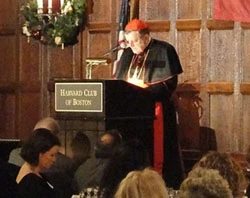
Boston, Mass., Dec 11, 2010 / 07:39 am (CNA).- The authentically Catholic university helps students resist “secularist dictatorship” by keeping Jesus Christ at the center of its mission and by exposing the moral bankruptcy of contemporary culture, Cardinal Raymond Burke said Dec. 4. [What schools do that today?]

The cardinal’s comments came in an address at St. Thomas More College’s annual President’s Council Dinner, held Dec. 4 at the Harvard Club of Boston.

In a lengthy discussion of the nature of Catholic higher education, he said that a Catholic university faithful to its identity will help students give an account of their faith and help them resist “the secularist dictatorship which would exclude all religious discourse from the professions and from public life in general.”  [I wonder if His Eminence spoke about Ex corde Ecclesiae at all…]

He also declared Jesus Christ, the “fullness” of God’s revelation, as “the first and chief teacher at every institution of Catholic higher education.”

“A Catholic college or university at which Jesus Christ alive in His Church is not taught, encountered in the Sacred Liturgy and its extension through prayer and devotion, and followed in a life of virtue is not worthy of the name,” he told attendees.

Jesus’ presence is not something “extraneous” to the pursuit of truth because he alone inspires and guides professors and students to remain faithful in their pursuits and not “fall prey to the temptations which Satan cleverly offers to corrupt us.”  [No doubt liberal critics will pick on Card. Burke’s superstitious medieval notions about the some guy with red tights and mustache.]

Cardinal Burke lamented the fall of many American Catholic colleges and universities that have become “Catholic in name only.” [A phrase which may be gaining more currency these days, as people wake up.]

Citing Pope John Paul II’s ad limina address to the U.S. bishops of New York, he said that the service of Catholic universities “depends on the strength of their Catholic identity.” The Catholic university was born from “the heart of the Church[i.e. ex corde Ecclesiae] and has been “critical” to meeting the challenges of the time.

The Catholic university is needed more than ever in a society “marked by a virulent secularism which threatens the integrity of every aspect of human endeavor and service,” he said.

“How tragic that the very secularism which the Catholic university should be helping its students to battle and overcome has entered into several Catholic universities, leading to the grievous compromise of their high mission,” he commented.

The American-born cardinal said that rather than exemplifying secularism, the Catholic university’s manner of study and research should “manifest the bankruptcy of the abuse of human life and human sexuality … and the bankruptcy of the violation of the inviolable dignity of human life, of the integrity of marriage, and of the right order of our relationship to one another and to the world.” [This puts their mission in somewhat negative terms.  Some would perhaps prefer that schools should manifest the positive things a lived-Christian faith can bring about.  However, Catholic schools must engage prevailing culture as well.  In doing so the deficiencies of secularism will be made manifest.]

This bankruptcy is “the trademark of our culture, a culture of violence and death,” he charged. Quoting Pope Benedict XVI, he said the mission of the Catholic university is “to develop a society truly worthy of the human person’s dignity.”

Cardinal Burke also described the kind of relationship that should exist between the local bishop and a Catholic university. The “noble mission” of the university, he said, can only be accomplished within the Church, and the local bishop should be able to depend upon the Catholic university as a partner in meeting the challenges of evangelization, in teaching the faith, and in celebrating the liturgy.

He criticized as “totally anomalous” the situation in which the Catholic university views the bishop as “a suspect or outright unwelcome partner in the mission of Catholic higher education.”

On the issues of creating curricula and hiring professors, Cardinal Burke advised “special care,” noting the poor religious formation of many young Catholics.

Given the religious illiteracy which marks our time and in fidelity to the seriousness with which university studies should be undertaken, there is really no place for engaging in speculative theology and certainly no time to waste on superficial and tendentious theological writings of the time,” the cardinal contended.  [Basics first.]

He questioned why students should be engaged in discussions about the ordination of women as priests when they already have little knowledge of the “consistent teaching” of the Holy Scriptures and Catholic Tradition on the priesthood.

He closed his remarks by praying that St. Thomas More College will form its graduates to cultivate “the divine wisdom and truth” and always to place truth and love first.

“My reflection is offered to assist us all in seeking always first the truth and love by which we serve others and our world well by serving God first,” he said.

In an e-mail to CNA, St. Thomas More College president William Fahey characterized Cardinal Burke’s speech as “a kind of authoritative gloss on Ex Corde Ecclesiae,” John Paul II’s encyclical on Catholic higher education.

In his own remarks at the President’s Council Dinner, Fahey characterized the New Hampshire college as “small by design” like the U.S. Marine Corps. He stressed the college’s Catholic identity and its commitment to the New England region, asking for help and prayers to support a growing student body.

Posted in Brick by Brick, New Evangelization, Our Catholic Identity, The future and our choices | Tagged , ,
19 Comments

A Vortex Video about the need for true reform

Here is a video from Michael Voris.

What do you think?  On target?  Deluded?

Posted in The future and our choices | Tagged
112 Comments

A note from a priest and a request for your prayers

I had to share this with the readership:

Thank you so much for “What does the prayer really sound like.” [HERE is the PRAYERCAzT for the 3rd Sunday of Advent.] I have been a priest for ten years now and I am trying to polish my Latin skills and learn the traditional Mass on my own. The audio on your website has been a great help. In seminary we took two years of classical Latin and thus I am very apprehensive about my pronunciation and so on. This was also years ago and now my Latin skills are terrible. I am very grateful for your willingness to help us priests who wish to learn the traditional rite. [My pleasure.  Many will be grateful to you in years to come.]

In addition, I confidentially ask for your prayers for us younger priests who are not supported in our willingness to serve the church using the older rite. My bishop has made it very clear that it is not welcome in this diocese, and most (actually all) of our priests have no interest in the older rite. To be very honest, I personally am so tired of Novus Ordo land and pray that God will guide me to serve the church and the liturgy as He best sees fit. However, it is a cross to carry as one easily feels isolated in this situation. One of my best priest friends celebrates TLM and I have seen the joy it has brought to his priesthood. If it is God’s will hopefully some day, and soon, I can get to that point. Whatever the consequences may be I will have to deal with. As for now, I do pray often the Breviarium Romanum and it has been a wonderful experience. God willing soon I can go out of my comfort zone and celebrate the Latin Mass even if privately. Thanks again for your wonderful presence on this website and know of my prayerful support in your ministry!

Hang in there, brother.  The time will come when your view will be normal.  It’ll take a while.  Be patient.  Think of how far we have come in just the last five years.

Dear readers, please remember in your prayer priests who are literally isolated or made to feel isolated because of their legitimate aspirations in favor of traditional liturgical worship.

St. Michael the Archangel,
defend us in battle.
Be our defense against the wickedness and snares of the Devil.
May God rebuke him, we humbly pray,
and do thou,
O Prince of the heavenly hosts,
by the power of God,
thrust into hell Satan,
and all the evil spirits,
who prowl about the world
seeking the ruin of souls. Amen.

Posted in Brick by Brick, Mail from priests | Tagged
37 Comments

WDTPRS 3rd Sunday of Advent – Collect (200MR):

We are coming to the 3rd Sunday of Advent, also nicknamed Gaudete…. the plural imperative of gaudeo, “Rejoice!”.  This Sunday there is a relaxation of the penitential aspect of Advent.  Yes, Advent is a penitential time, though not so much as Lent.

Remember: Real priests wear rosacea.

In the first week of Advent we begged God for the grace of the proper approach and will for our preparation.  In the second week, we ask God for help and protection in facing the obstacles the world raises against us.  This Sunday we have a glimpse of the joy that is coming in our rose colored (rosacea) vestments, some use of the organ, flowers.  Christmas is near at hand.

COLLECT – (2002MR)
Deus, qui conspicis populum tuum nativitatis dominicae
festivitatem fideliter exspectare,
praesta, quaesumus,
ut valeamus ad tantae salutis gaudia pervenire,
et ea votis sollemnibus alacri laetitia celebrare
.

The infinitives in our Collect (expectare… pervenire… celebrare) give it a grand sound and alo sum up what we are doing in Advent.  L&S informs us that conspicio means, “to look at attentively, to get sight of, to descry, perceive, observe.” Alacer is, “lively, brisk, quick, eager, active; glad, happy, cheerful” and it is put in an unlikely combination with laetitia, “joy, especially unrestrained joyfulness”.  At the same time we also have votis sollemnibus. Votum signifies first of all, “a solemn promise made to some deity” (we have all made baptismal vows!) and also “wish, desire, longing, prayer”.  There is a powerful sentiment of longing in this prayer, God’s as well as ours.  Don’t fall into the trap of thinking that expecto is from ex- + pecto (pecto, “to comb”). You won’t find exspecto “look forward to”, in your L&S, but the etymological dictionary of Latin by Ernout and Meillet says it is from ex– + *specio, spexi, spectum or ex- +  spicio.  Therefore, it is a cousin of conspicio:  God “watches” over us and we “look” back at… er um… forward to Him.  This word play is clever.

LITERAL TRANSLATION:
O God, who attentively do watch Your people
look forward faithfully to the feast of the Lord’s birth,
grant, we entreat,
that we may be able to attain the to joys of so great a salvation
and celebrate them with eager jubilation in solemn festive rites.

LAME-DUCK ICEL (1973 translation of the 1970MR):
Lord God,
may we, your people,
who look forward to the birthday of Christ
experience the joy of salvation
and celebrate that feast with love and thanksgiving.

You decide.

With the last two week’s of “rushing” in our prayers and doing good works, we have now the added image of eager and unrestrained joy, an almost childlike dash towards a long-desired thing.

Have earthly fathers watched this scene all of a Christmas morning?

Even so should we be in our eager joy to perform good works under the gaze of a Father who watches us, a Father with a plan.

The lame duck ICEL version captures little of the impact of the Latin prayer, that is, God the Father is patiently watching his people as we go about the Advent business of doing penance and just works in joyful anticipation Christ’s coming.

A CORRECTED ICEL TRANSLATION (A):
O God, who see how your people
faithfully await the feast of the Lord’s Nativity,
enable us, we pray,
to attain the joys of so great a salvation,
and to celebrate them always
solemn worship and glad rejoicing
.

THE OTHER CORRECTED VERSION (B):
O God, who look upon your people
as they faithfully await the feast day  of the Lord’s birth,
strengthen us, we pray,
to reach the joys of so great a salvation,
and to celebrate them always
with solemn worship and glad rejoicing
.

Which of these last two is the better effort?  A or B?

Discuss.

Posted in ADVENT, WDTPRS | Tagged ,
13 Comments

PODCAzT 112: Winter poems – corrected

Well… I went and did it again.  I made a PODCAzT.

And then I screwed up and posted the wrong audio file.   I have now corrected that.  Sorry.

I’m not going to say what’s in it other than that there are some poems.  You’ll know a most of the authors, think, but perhaps not the poems I chose.

They have to do with winter, … I’ll say that much.  Most do, anyway.

There is a very famous line in one of them, pertinent to today.

I just felt like reading some poetry. So I did.

113 10-12-12 More winter poems


Posted in PODCAzT, Poetry | Tagged ,
11 Comments

Stunningly dopey editorial

From the Catholic League comes a note about an example of extreme religious illiteracy… or is it just plain stupidity?

My emphases and comments.

MENORAH IS A RELIGIOUS SYMBOL

The Sun-Sentinel, a south Florida newspaper, has an editorial today criticizing the Catholic League for its claim that Christians are being discriminated against in Boca Raton: the City allows a menorah in public buildings, but not manger scenes. The editorial says, “local governments have been fairly consistent that nativity scenes are religious symbols that violate the separation of church and state when on public property, but [get this…] that secular symbols like menorahs and Christmas trees do not.”  [I think Christmas trees are religious symbols actually.  One could debate that.  But is there any question about a menorah? Really?  Do the editors of that newspaper not know what a menorah is?]

Catholic League president Bill Donohue responds:

This is the most remarkably ignorant editorial I have ever read on this subject. If what the Sun-Sentinel said were true, then there would be no nativity scenes on public property anywhere in the United States. In fact, they appear in State Capitols, Governors’ Mansions, outside municipal buildings, and in public parks. They even allow nativity scenes in Boca Raton’s Sanborn Square Park! On December 16, the Catholic League will display a life-size nativity scene on public property—it’s called Central Park—just as we have since the mid-1990s; Jews displayed the world’s largest menorah there over Hanukkah.

If the Sun-Sentinel were correct, then all of these crèches are illegal. I have a wager for them: tell those who share your ignorance to sue the Catholic League once we put our manger scene up in Central Park. And remind them to sue the New York City Parks Department as well—they granted us the permit.

Someone at the Sun-Sentinel needs to tell an Orthodox rabbi that a menorah is a secular symbol. They also need to educate the public: they should explain why a symbol that represents a miracle is considered secular in nature. And then they need to inform all federal judges that the Second Circuit erred when it said, in its 2006 ruling, Skoros v. City of New York, that “The Supreme Court and our sister circuits agree that the menorah is a religious symbol.” (My italic.)

Contact the paper’s editorial page editor, Antonio Fins:afins@sun-sentinel.com

Here is the Sun-Sentinel editorial.

Wow. Just wow.

Posted in Throwing a Nutty | Tagged
Comments Off on Stunningly dopey editorial

Iran: Christian convert to be executed

Pray, please, for our brother Christian Youcef, sentenced to be executed in Iran for converting to Christianity from the religion of peace.

Iran to execute Christian pastor for renouncing Islam
December 10, 2010

Youcef Nadarkhani, a 32-year-old Protestant pastor who became a Christian at the age of 19, has been sentenced to death for renouncing Islam. Nadarkhani maintains that he did not practice any faith before his conversion to Christianity.

The “draconian language in the verdict makes it very clear that the Iranian authorities mean business,” said Leonard Leo, chairman of the US Commission on International Religious Freedom. “He could be executed at any time. And for what? For being a Christian.”

“We call upon the Obama administration and the international community to use every means available, to raise this issue and demand the unconditional release of Mr. Nadarkhani.”

Nadarkhani’s attorney has appealed the verdict to the nation’s supreme court.

Sts. Nunilo and Alodia, pray for us, pray for Youcef.

Posted in Modern Martyrs | Tagged ,
15 Comments
























