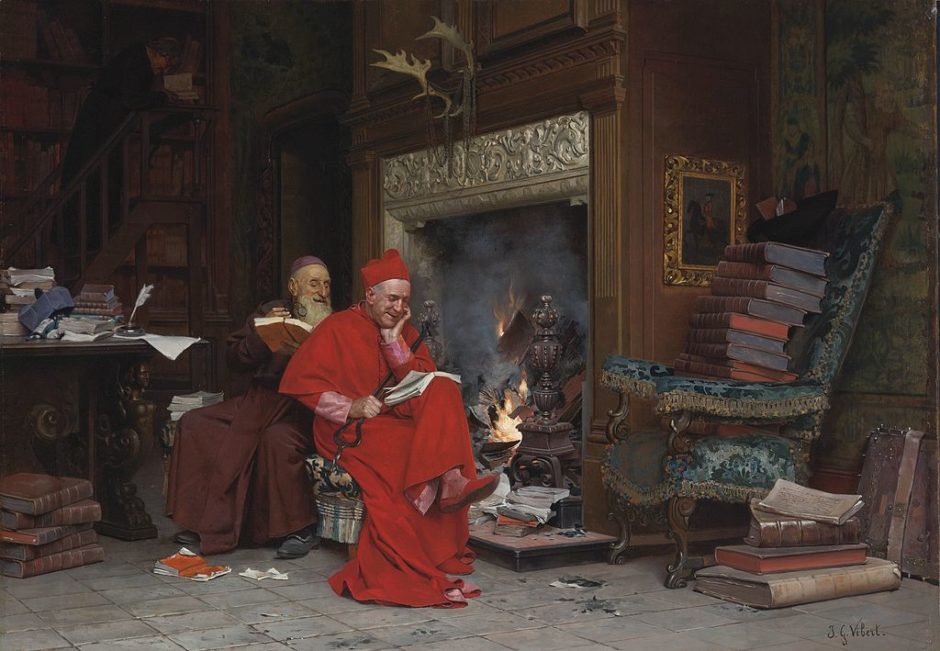
A Jesuit theologian opines about the 60’s and Pope Benedict

An alert reader caught this and passed it along.  I am, as you can guess, unlikely to read The Huffington Post, on my own.

The last response amused me.

My emphases and comments.

How The ’60s Transformed The Catholic Church Forever: An Interview With Rev. Mark Massa

By Daniel Burke

Religion News Service

(RNS) For generations, thousands of Catholics — from archbishops to people in the pews — saw the Catholic Church as eternal, timeless, and unmoved by the tides of history. [Well… from the onset that isn’t true.  Of course the Church moved in the tides of history.  And the Church shaped the tides of history as well.  I think we have to reject this premise, at least as stated.]

But the Second Vatican Council in the 1960s unleashed a sea of changes — none more significant than the recognition that Catholicism has, and continues to be, shaped by historical events, [See above.] argues the Rev. Mark Massa in a new book.

Massa’s intellectual history, “The American Catholic Revolution: How the ’60s Changed the Church Forever,” describes how celebrating the Mass in English, butting heads with the pope on birth control, and priests protesting the Vietnam War opened new possibilities — and controversies — in the church.

Massa, [SJ] dean of Boston College‘s School of Theology and Ministry, spoke about his book; some answers have been edited for length and clarity.

Q: Why should American Catholics care what happened in the 1960s?

A: Starting with Vatican II, Catholics became aware that the church, its worship, and its beliefs change — that the church develops over history. The current battles between the left and the right are really between those who want to press a historical awareness of change and those who want to view the church as timeless. [See above.]

Q: Why did the “Catholic Revolution,” as you call it, begin in 1964?

A: The new Mass (which was introduced in America that year) made real, or concrete, the changes that Vatican II made in ways that theology, or other declarations from the council could not. [On the face of it, this doesn’t take into account the poor implementation, and the spirit of discontinuity at work at the time.]

Q: Why is change — not sex [That’s right, reporter, go for the groin.] — the church’s dirty little secret?

A: A great majority of Catholics (once) thought of the church as outside of time altogether [There it is again.  I wonder if this is true.  I suspect it isn’t.] — that what they did on Sunday is what Jesus did at the Last Supper, and early Christians did in the catacombs. Vatican II attacked this notion of the church as providing a timeless set of answers to life’s questions about meaning. [Really?]

Q: And that became a personal crisis for Catholics in the 1960s?

A: Catholics, like all believers, want security. [I think, if they have a strong identity, they want salvation and a path amid the vicissitudes of this world.  That doesn’t mean that Catholics are blinkered about history.] The world seems, and can be, a very scary place; and they want their religion to provide them with some form of certainty, security, and peace of mind. But faith is a stance in history; [?] it doesn’t preserve us from messiness, or from change, including to religious institutions.

Q: How much was the “Catholic Revolution” affected by the cultural tumult of the’60s?

A: There was always an international dimension that made the Catholic ’60s different from the general culture, because of this long devotion to Rome and the primacy of the pope. My sense is that most of the important stuff wasn’t a reaction to events and ideas outside the church but to things happening inside the church itself. [Hmmm… ]

Q: Pope Benedict XVI has been among those arguing that Vatican II was not a disruption in the church’s usual course of business, right?

A: I think, basically, Benedict is a classicist and he thinks that human essence and things like that stay the same. [Doesn’t that sound rather like the stance of a classic Modernist?  Modernists see man as evolving past the limitations of the past, regardless of how they may provide models and inspiration.  Ultimately, the past must be rejected.]

Q: So, is he trying to put the “change” genie back in the bottle, or does he deny there is any genie to bottle up?

A: I think he knows the genie exists. He’s very smart, a world-class theologian — he knows the stakes. I think he see that the changes made by Vatican II led to fewer priests and fewer (members of religious orders) and so something went really wrong. [So, Benedict’s project is based on, what, practical or utilitarian grounds, rather than on what is … I don’t know… right or wrong?]

Q: As a Jesuit, are you worried about publicly disagreeing with the pope?

A: No. [Said the member of the Society of Jesus.] I’m a historian. I’m only laying out the past. The argument stands or falls according to whether it makes the most sense of the most data from the past. I’m not making moral judgments.

[Here it comes…] Q: How does Benedict’s recent reform of the Mass in English and support for the Latin Mass fit into your theory?

A: It’s partly personal preference. He’s Austrian, [Noooo…..] and likes looking back to the past. [This is an old liberal canard.  They sneer and mutter “nostalgia”.] He likes the smells and bells. I do, too. I suspect there’s more to it than that, but I don’t know. [Indeed.]

In a way I am comforted by the fact that Fr. Massa, SJ, doesn’t seem to know much about liturgy, or about the Holy Father’s liturgical writing.  There is an old adage that a man can’t be simultaneously a good liturgist an a good Jesuit.

Most people can, however, correctly place the Holy Father’s birthplace in GERMANY, in Bavaria.

Austria… Germany… what-e verrrrrr.  Close enough for HuffPo readers.

Fr. Massa’s little Anschluss did bring a chuckle.

UPDATE: A commentator remind me of this, so here it is again.

[Modernist]nBtDIVfhh8k[/Modernist]
Posted in Liturgy Science Theatre 3000, The Drill | Tagged , , , , ,
35 Comments

Mass, priesthood and sacrifice must never be separated

A while ago I sent in my weekly column for The Wanderer.  This week I wrote about the Hanc igitur in the Roman Canon.

Here is an excerpt:

[…]

Return for a moment to that phrase “servitutis nostrae”.  Servitus was sometimes in ancient times used as a form of address.  We mustn’t stretch this too much, but tune your ear to how our ancient forebears would have heard words such as servitus.   In the writings of the Fathers of the Church servus is used for the priest or bishop.  St. Pope Leo I, “the Great” (+461) refers to himself in this way (ep. 108, 2).  Servitus or “Servitude” was much as Sanctitas or “Holiness” is for the Pope today, or Excellentia or “Excellency” is for a bishop. I don’t hear of many bishops today welcoming the title “Your Servitude”.  St. Augustine (+430) used servus servorum (ep. 217).  One of the venerable titles of the Bishop of Rome is, from the time of the aforementioned St. Gregory I, “Servus Servorum Dei… Servant of the servants of God”.  The altar is the supreme place of priestly service.  An altar is about sacrifice.  Priesthood is about sacrifice.  Priesthood and sacrifice must never be separated in our minds.

We must never lose sight of Mass as propitiation, or of the priest as offering sacrifice to God.  This deep current in Holy Mass must inform every word and gesture, ornament and sign.

For example, when the priest is standing at the altar in the place of Christ, Head of the Church (in persona Christi capitis), he isn’t always talking to you in the congregation– or at least he shouldn’t be.  If Father’s style during Mass, his ars celebrandi as Benedict XVI calls it (cf. Sacramentum caritatis) reflects talk show host chumminess or open mic night at the Ha Ha Club rather than the priest renewing our deliverance from eternal damnation, perhaps it would be good gently and respectfully to help him get reoriented.

Tell him your aspirations for our sacred liturgical worship.  Treat Father like a priest, not a pal.  Support clerical dress, especially the use of the cassock – at least in church.  Provide materially for liturgical decorum through the purchase of worthy vestments and vessels.  Do not praise liturgical abuse.  Pray, fast and give alms for the intentions of your priests.  Pray for and encourage vocations to the priesthood.

Liturgy is language.  Signs, words have meaning.  The spaces and silences among and between the them brim with mystery. Sacramental realities are no less real just because they cannot be easily sensed through the bodily senses.

Posted in Our Catholic Identity, WDTPRS, Wherein Fr. Z Rants |
7 Comments

Benedict XVI asks prayers for Catholic-Orthodox talks

From CNA:
 

.- The Pope called the faithful to a greater commitment to Christian unity during Wednesday's audience. The "peace and harmony" of Christians, he said, shows the world an "authentic" witness to the Gospel message.

At the end of Wednesday morning's audience in St. Peter's Square, Pope Benedict drew attention to the concurrent plenary meeting of the Joint International Commission for Theological Dialogue between the Catholic Church and the Orthodox Church.

The meeting is taking place in Vienna, Austria this week, with participants examining "the role of the Bishop of Rome in the communion of the Universal Church," particularly in the first millennium of Christianity.

Of this, the Holy Father said, "obedience to the will of the Lord Jesus and consideration for the great challenges facing Christianity today, oblige us to commit ourselves seriously to the cause of re-establishing full communion among the Churches.

"I exhort everyone to intense prayer for the work of the commission and for the ongoing development and consolidation of peace and harmony among the baptized, that we may show the world an increasingly authentic evangelical witness."

Benedict XVI is the Pope of Christian Unity.

Posted in Pope of Christian Unity |
17 Comments

US Military Archbp: Homosexual advocacy group is not Catholic

From CNAwith my emphases and [comments]:

Homosexual advocacy group not legitimately Catholic, military archbishop says

Archbishop Broglio

Archbishop Broglio

Washington D.C., Sep 22, 2010 / 05:54 am (CNA).- After receiving a letter from the group Catholics for Equality urging a change to the “Don’t Ask, Don’t Tell” policy, the Archbishop for Military Services responded, saying that the archdiocese’s position is “clear.” The prelate added that the group “cannot be legitimately recognized as Catholic.

Catholics for Equality had requested a meeting with Archbishop for the Military Services Timothy Broglio, claiming he offered misleading and false arguments in his June 1 statement against allowing open homosexuals to serve in the U.S. military.

Last week leaders of the group joined a lobbying effort sponsored by Servicemembers United. They lobbied Congress and asked key senators and Catholic leaders to support changing “Don’t Ask, Don’t Tell.”

Catholics for Equality Board Member Patsy Trujillo, a former New Mexico state legislator, said the group was confident that senators would vote to change present policy.

“Further, we trust our Catholic Senators will vote in their conscience and the will of the pro-equality Catholics in their state, and not the misinformed dictates of Rome,” she said in a Catholics for Equality press release. [Do you see anything wrong in that statement? Look at the terms: “Catholic… consciences… misinformed dictates of Rome”.]

On Tuesday the U.S. Senate blocked the bill that would allow changes to the “Don’t Ask, Don’t Tell” policy. While 60 votes were required to start debate, the final vote was 56 to 43.

In a Sept. 20 statement responding to a CNA inquiry, Archbishop Broglio said the Archdiocese for the Military Services has a “clear” position on a change in the present policy concerning the service of persons who “openly manifest a homosexual orientation.”

While his latest statement did not reiterate the archdiocese’s position, in a June 1 statement Archbishop Broglio opposed the policy change. Saying moral beliefs should not be sacrificed for “merely political considerations,” he explained that Catholic chaplains can never “condone” homosexual behavior.

At the time he also voiced concern that a change in policy might negatively affect the role of the chaplain in the pulpit, the classroom, the barracks and the office.

CNA’s inquiry to the archbishop recounted CNA’s previous report on Catholics for Equality.

The organization was founded by groups such as New Ways Ministry and Dignity USA with cooperation from the homosexual advocacy group Human Rights Committee (HRC). It aims to “support, educate, and mobilize equality-supporting Catholics to advance LGBT equality at federal, state, and local levels.” [But it completely subverts terms such as “conscience” and denies the Church her right to shape consciences of Catholics.]

It also charges the Catholic hierarchy with favoring discrimination and having an “anti-equality voice” that does not represent Catholics. [Archbp. Broglio is right: this is not a Catholic group.]

In his Monday statement, Archbishop Broglio explained that according to canon law a group may call itself Catholic if it has been approved by a bishop or recognized by the Holy See in some manner.

“It is doubtful that the group in question has such approval. Therefore, it cannot be legitimately recognized as Catholic,” he commented.

The archbishop also challenged any indication that the Catholic hierarchy does not represent Catholics.

“By definition that is impossible. The Body of Christ, as is clearly taught, is the Church united in communion: the hierarchy with the faithful joined with the Successor of St. Peter and untied to Christ our Head.

Translating the language of political systems to the Church simply demonstrates a lack of understanding of what the Church is,” Archbishop Broglio commented.

He also insisted that Church teaching is based in love and truth.

It is not the desire of the Archdiocese for Military Services to offend anyone, but there is an obligation to teach the truth in love, even when that truth is displeasing to some or politically incorrect to others. The Holy Father made that quite clear in Caritas in Veritate.”

Phil Attey, the present acting executive director of Catholics for Equality, is a former employee of HRC. Last year Attey created a website to “aggregate reports on every gay priest” in the Archdiocese of Washington to help them “stand up to the church hierarchy” on homosexual issues. [Nasty.]

The Catholics for Equality website asks readers to report “anti-equality activity” in Catholic parishes, dioceses or community activities.

It appears that this group, or group of groups, is simply using Catholic identity as camouflage.

Posted in Our Catholic Identity, The Drill, The future and our choices |
29 Comments

CHILE: Card. Errazuriz against the “ideological colonialism of abortion”

From CNA:

Cardinal affirms Chile’s rejection of abortion

Santiago, Chile, Sep 21, 2010 / 05:52 pm (CNA).- During the celebrations commemorating Chile’s bicentennial, Cardinal Francisco Javier Errazuriz of Santiago called on the faithful to continuing building their country on the foundation of the Gospel, which has been the basis for rejecting the new cultural and ideological colonialism of abortion. [Note the use of “colonialism”.]

The Chilean bishops, he said, are committed to doing everything in their power to ensure the country continues to value the “treasure it received from its inception, the Gospel of Jesus Christ.”

He then made reference to the Christian values that have been part of the fabric of the nation from the very moment Spaniards first arrived in Chile, and noted the contributions made by the native peoples and immigrants throughout the centuries.

“In 1520 the first Mass was celebrated at the Straits of Magellan. Soon after missionaries ventured into lands known and unknown with only the courage of Christ in their hearts. The baptisms they administered were precisely what sowed a new relationship, which they passionately defended against many powerful conquistadores,” the cardinal said.

He also thanked God that Chile has opposed the new cultural and ideological colonialism by defending the life of the unborn.

St. James, pray for us!

Posted in Emanations from Penumbras, New Evangelization, Our Catholic Identity | Tagged , ,
2 Comments

So a Pope and an Anglican Archbishop walk into an Abbey…

Benedict XVI in Westminster Abbey The other day when Benedict XVI was at Westminster Abbey, together with Anglican Archbp. Williams for an Anglican service, I just about sprayed my Mystic Monk Coffee on the screen when I heard that the Holy Father chose to wear a stole that belonged to … Leo XIII.

I was going to post about it then but time took it away from me. Today, a priest reader reminded me.

Leo XIII was the Pope who declared that Anglican ordinations, orders, priesthood, were invalid.

So,… the Pope of Rome goes into Westminster Abbey, a church dedicated to the Prince of the Apostles, and – while wearing Leo XIII’s stole – reminds them that he is the Successor of Peter.

And they applauded!

The title of this entry is a bit lighthearted, but the issues at hand are very serious.

Benedict XVI teaches through signs. Signs point to deeper issues. Vestments are signs.

In the person of Pope Benedict, Peter’s Successor came to Westminster. In Benedict, in a symbolic sense, Leo XIII came to Westminster as well.

This was not a a way of wiping anyone’s eye. This was medicine for a chronic pain.

Benedict engaged the Church of England on an entirely new level. He symbolically and effectively let them know that, from the point of view of the Roman Catholic Church, the still open strife of the last four centuries was over. At the same time, he affirmed that, while there is no going back, there may not be a way to go forward on certain issues if the Church of England continues in the direction it is headed.

He gave a great deal while still not budging an inch.

Benedict XVI is the Pope of Christian Unity.

Posted in Pope of Christian Unity, The Drill | Tagged , , ,
32 Comments

Of Blogs and Magic

In the work going on behind the scenes to make the blog.. well… work, I have had an enlightening experience.

Never in life did I imagine I would see this combination of letters in an actual sentence:

"I’m using a git clone for the svn repo." 

I speak about 6 languages, but that isn’t one of them.

This tech thing …

I think it was Arthur C. Clarke who said that technology which is sufficiently advanced is indistinguishable from magic.

And so I picture someone working on the server while chanting:

git clone for the svn repo

git clone for the svn repo

git clone for the svn repo

Posted in Lighter fare | Tagged
19 Comments

Litany for the conversion of internet thugs.

A work in progress.

I am willing to take some intelligent suggestions and additions.

Litany for the conversion of internet thugs.
(private use only, and when truly irritated, and when the alternative is foul language)

Lord, have mercy.
Christ, have mercy.
Lord, have mercy.
Christ, graciously hear us.
God, the Father of Heaven, have mercy on us.
God, the Son, Redeemer of the World, have mercy on us.
God, the Holy Ghost, have mercy on us.
Holy Trinity, one God, have mercy on us.

Lest internet thugs be eternally tormented by all the fiends of hell, convert them, O Lord.
Lest they pass eternity in utter despair, convert them, O Lord.
Lest they come to be damned for the harm they cause, convert them, O Lord.
Lest they roast forever in the deepest cinders of hell, convert them, O Lord.
Lest they suffer the unceasing pain of loss, convert them, O Lord.

Lest devils endlessly increase their physical agony, convert them, O Lord.
Lest devils twist their bowels and boil their blood in hell, convert them, O Lord.
Lest devils use them as their toys and tools, convert them, O Lord.
Lest devils gnaw on their skulls, convert them, O Lord.

Lest the innocent be harmed by their sins, convert them, O Lord.
Lest the innocent yield to them in weakness, convert them, O Lord.
Lest the innocent be drawn into their traps, convert them, O Lord.

From faceless Facebook admin drones, spare us O Lord.
From tweeting Twitter idiots, spare us O Lord.
From from heart-hardened spammers, spare us O Lord.
From rss feed problems, spare us O Lord.
From server memory resource difficulties, spare us O Lord.

From viruses, trojan horses, and all manner of snares, Lord save us.
From wasting our time, Lord save us.
From our own stupidity, Lord save us.

St. Isidore, defend us.
St. Francis de Sales, defend us.
St. Gabriel, defend us.
St. Michael, defend us.
Guardian angels, defend us.
All the angels and saints….. GRRRRR.

Lamb of God, who takest away the sins of the world, spare us, O Lord.
Lamb of God, who takest away the sins of the world, graciously hear us, O Lord,
Lamb of God who takest away the sins of the world, have mercy on us.

V. Christ, Jesus who died for our sins.
R. Return, and return swiftly.

Let us pray.
Almighty and eternal God,
who according to an ineffable plan
called us into existence to do your will
amid the vicissitudes and contagion of this world
grant, we beseech you,
through your mercy and grace
both to protect the innocent who use the tools of this digital age
and to convert from their evil ways all those who abuse them.
Through Christ our Lord.   Amen.

Posted in Lighter fare, New Evangelization, Wherein Fr. Z Rants | Tagged ,
16 Comments

Hyde Park Litany… of the… Sacred Heart

Hyde ParkWhen the Holy Father was at Hyde Park in London, there was a species of The Litany of the Sacred Heart.

It was curtailed and there were interpolated intercessions, very contemporary, very much suggesting the ramifications of the clerical sexual abuse crisis as well as – though perhaps less so – anti-Catholic sentiment.

I wrote at the time:

"Don’t know about that…"

I am ambivalent.  I think it is proper to make litanies current and relevant.  That is why most of them developed: a pressing need or catastrophe loomed and people needed help.

Also, the Holy Father can add to or take from litanies as it pleaseth him.  John Paul II officially added to the Litany of Loreto.

But what happened at Hyde Park struck me as odd.  

First, there was the fact of various readers for the intercessions.  It didn’t seem liturgical.  It seemed terribly self-conscious.  It seemed – as so much does in contemporary liturgy – to be an effort to get as many people of different ethnic backgrounds or states of life involved as possible.

I picked this up from the blog Countercultural Father.

Liturgical infantilism v. liturgical wisdom

Others have commented on the re-writing of the Litany of the Sacred Heart. I noticed something else.

The Litany was split up with different readers reading a few invocations each.

That struck me as indicative of one of the problems with liturgy in this country, which I call liturgical infantilism, and was in stark contrast to the Holy Father’s approach.

When the Holy Father is engaged in a liturgical action, it is all about Christ: hence his insistence on a crucifix on the altar. He switches modes, very deliberately, from his interactions with the faithful, before and after Mass, when the focus is on relating to them, to focus on the serious business of adoration, contrition, thanksgiving, supplication… The person of the celebrant almost disappears; he becomes transparent, so we see Christ through him. It is not all about the front-man.

But liturgists in the UK don’t seem to understand this, and the Litany was a glaring example of the problem. By splitting the Litany up – presumably so as to ‘include’ more people, and possibly with the intention of making something long ‘less boring’ they distract from the focus on the Sacred Heart and draw attention to the reader: who is it now? who is it next? How well was that read? Why did they choose him? and so on

But what the Holy Father did brilliantly was to demonstrate by example that worthy and reverent liturgy is hugely attractive and intensely prayerful. Let us hope and pray that our bishops noticed: I look forward to their copying his example, not least in the manner of the distribution of Holy Communion…


WDTPRS Kudos.

Posted in "How To..." - Practical Notes, Fr. Z KUDOS, Liturgy Science Theatre 3000 | Tagged , ,
15 Comments

QUAERITUR: Can I buy a relic?

From a reader:

I wanted to know if it is permissible to buy relics. I know that Canon Law says that it is absolutely wrong to sell them. But what about buying them? Also, how do I go about confirming the authenticity of the relic. I feel that the documentation can be easily forged.


It is not permissible to sell relics, which is a terrible sin and sacrilege.  It is similarly sinful to traffic in relics by buying them for anything other than the motive of saving them from profanation.  It is permissible to buy a relic to "rescue" it from mistreatment or other unworthy purposes.

When a person seeks to obtain a relic, from an approved source such as the Vicariate of Rome of the HQ of a religious order or institute or, perhaps, a postulator of a cause, there can often be an expense involved.  The expense is not for the relic, but for the purchase of the reliquary, the preparation of the relic, a document, etc.

Again, buying and selling relics, trafficking in relics, is thoroughly wicked and deserves our deepest pity-filled contempt.

It is laudable, however, to "rescue" relics from mistreatment.

As far as documentation is concerned, it can be difficult today to obtain documents even from approved sources for relics.  This is especially the case with relics of saint from the distant past.  However, reliquaries when opened usually reveal a waxen seal, embossed by the entity that handled the relics.  It could be possible to hunt down the source of the relic, which can help to authenticate that it was prepared under the aegis of Church authority.

Some might argue that by "rescuing" a relic, you create a market for them, inspiring the unethical to do sacrilegious things for profit.

If you are in doubt, bring your concern to your local bishop and ask for advice.   If that does not produce swift results, you can write to the Congregation for Causes of Saints for advice, sending a copy of your correspondence.

Posted in "How To..." - Practical Notes, ASK FATHER Question Box, Saints: Stories & Symbols | Tagged
7 Comments
























